
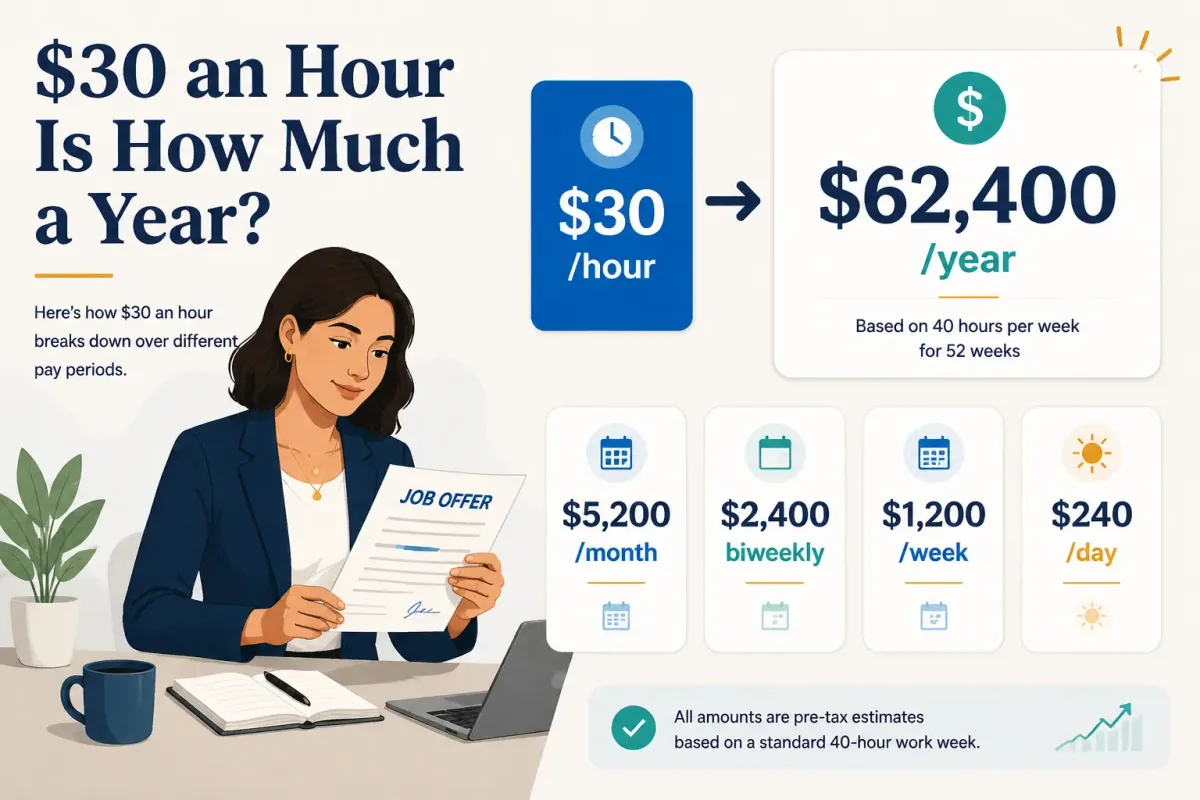
If you make $30 an hour and work 40 hours a week for 52 weeks, your gross annual salary is $62,400 before taxes. This assumes 2,080 paid work hours per year. The real number can change with overtime, unpaid time off, taxes, benefits, job classification, and location. So the fast answer to "30 dollars an hour is how much a year" is $62,400 gross. The useful answer also checks what you actually keep and spend.
$30 an hour by year, month, week, and day
For the search question "30 an hour is how much a year," the standard answer is based on full-time paid hours: 40 hours/week and 52 weeks/year.
| Pay period | Gross pay at $30/hour |
|---|---|
| Yearly, 40 hrs/week, 52 weeks | $62,400 |
| Monthly average | $5,200 |
| Semi-monthly, 24 paychecks | $2,600 |
| Biweekly, 26 paychecks | $2,400 |
| Weekly | $1,200 |
| Daily, 8-hour shift | $240 |
Monthly vs biweekly paycheck trap
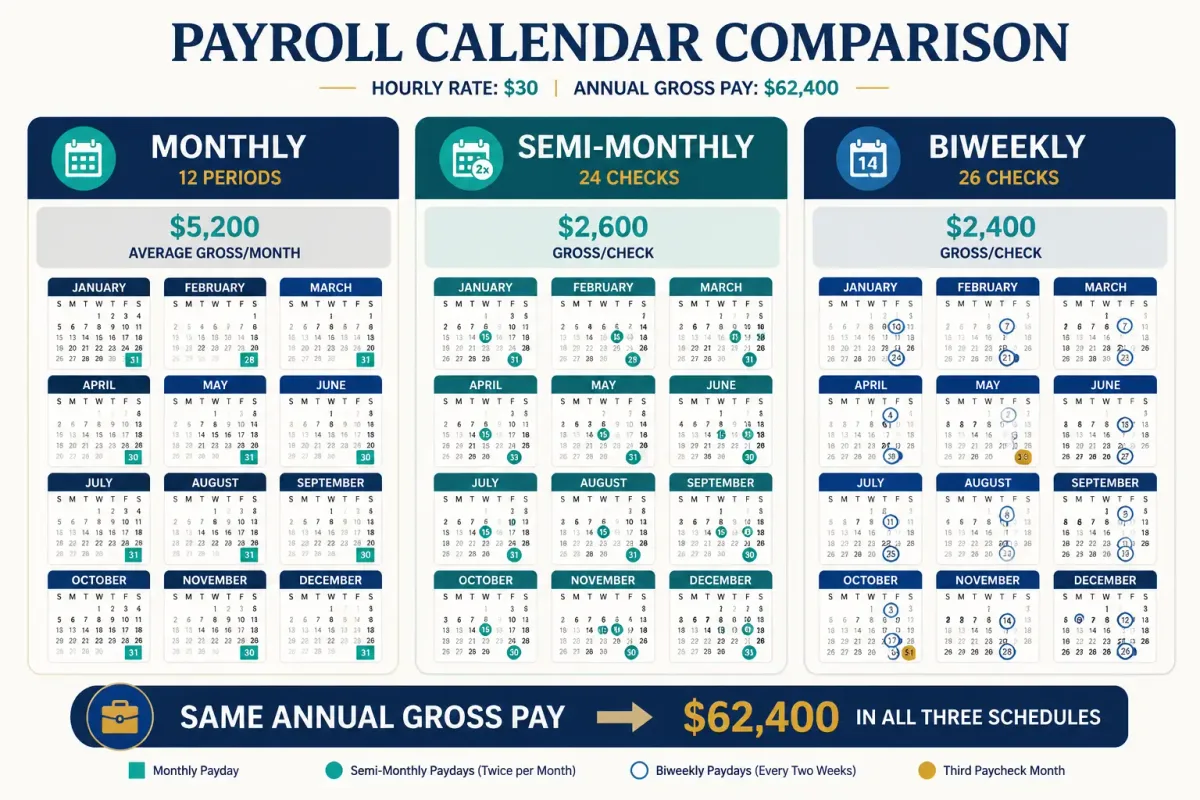
A few paycheck details matter. $30 an hour monthly is usually quoted as a yearly average divided by 12, not necessarily the exact amount of every paycheck. $30 an hour biweekly is usually $2,400 before deductions because biweekly payroll has 26 checks per year. Semi-monthly payroll has 24 checks per year, so each gross check is usually $2,600.
The table is gross pay only. It does not include federal income tax, Social Security, Medicare, state tax, health insurance premiums, retirement contributions, garnishments, or other deductions.
If you are paid biweekly, two months of the year may include a third paycheck. That does not mean your annual pay is higher; it means the same annual gross pay is spread across 26 checks instead of 24. This matters for budgeting. Rent, utilities, insurance, and loan payments are usually monthly, while biweekly paychecks arrive every two weeks. A good approach is to budget from two regular checks per month and use any third-check month for savings, debt payoff, car repairs, or annual bills.
How the annual salary formula works
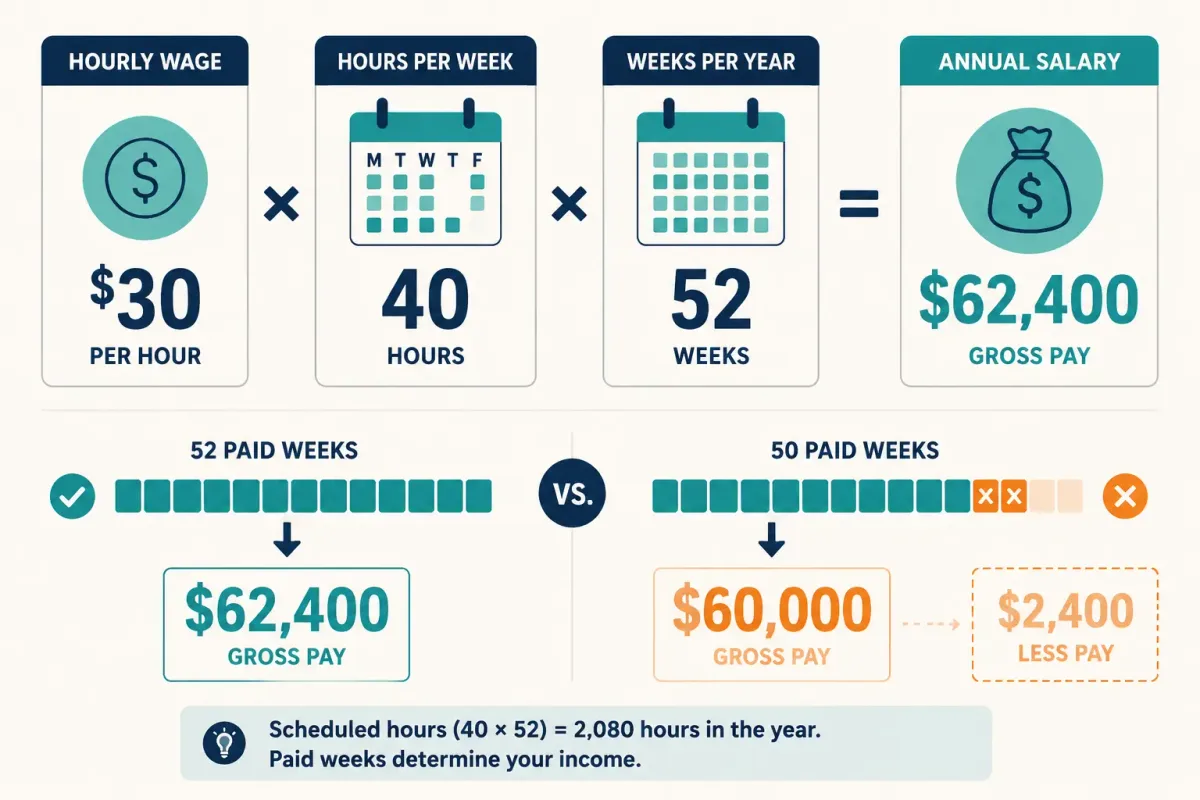
The basic hourly-to-salary formula is:
Hourly wage x hours per week x weeks per year = annual gross pay
$30 x 40 hours/week x 52 weeks/year = $62,400/year
Another way to see it is:
40 hours/week x 52 weeks/year = 2,080 hours/year
2,080 hours/year x $30/hour = $62,400/year
That is why $30/hour full-time salary is normally listed as $62,400. Employers, payroll teams, and salary calculators often use 2,080 annual hours as the clean full-time baseline.
Paid-hours reality check
Scheduled hours and paid hours are not always the same thing. A person scheduled for 40 hours may not be paid for 40 hours if lunch breaks are unpaid, shifts are canceled, the work is seasonal, or time off is unpaid. Paid vacation can protect the annual number; unpaid vacation lowers it.
For example, if you work 40 hours a week but take two unpaid weeks off, your annual gross pay becomes:
$30 x 40 hours/week x 50 paid weeks = $60,000/yearSo the clean $62,400 answer is accurate only when all 52 weeks are paid.
Different work schedule scenarios
Not everyone earning $30 an hour works exactly 40 paid hours every week. The table below shows how the annual number changes before taxes.
| Hours per week | Gross annual pay at $30/hour |
|---|---|
| 20 | $31,200 |
| 25 | $39,000 |
| 30 | $46,800 |
| 35 | $54,600 |
| 37.5 | $58,500 |
| 40 | $62,400 |
A 37.5-hour week is common in some office, government, education, and nonprofit roles because unpaid lunch is not counted as paid time. At $30/hour, that schedule is $58,500 per year before taxes, not $62,400.
Overtime example at $30 an hour
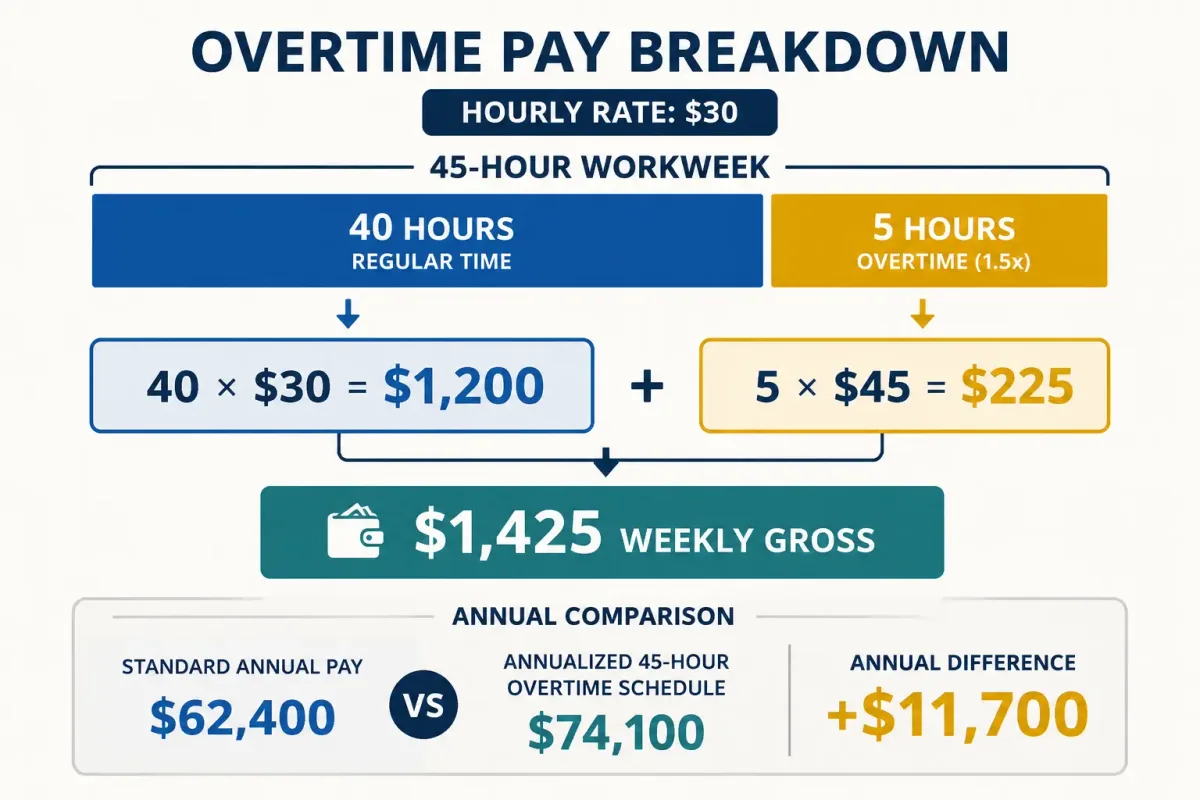
Under U.S. Department of Labor guidance, covered nonexempt employees generally must receive overtime pay after 40 hours in a workweek at not less than one and one-half times the regular rate. At $30/hour, time-and-a-half is:
$30 x 1.5 = $45/hour overtime rateIf you work 45 hours in a week and the 5 extra hours qualify for overtime:
- 40 regular hours x $30 = $1,200
- 5 overtime hours x $45 = $225
- Weekly gross pay = $1,425
- Annualized for 52 weeks = $74,100
That is $11,700 more than the standard $62,400 full-time figure. However, overtime eligibility depends on your classification, state rules, employer policy, and the way your regular rate is calculated. Do not assume every extra hour is paid at $45 unless your job is covered and nonexempt.
After-tax take-home pay
Your gross salary is $62,400, but $30 an hour after taxes is lower. The main deductions are federal income tax, FICA payroll taxes, state and local tax where applicable, and any benefit deductions you choose or are required to pay.
What usually comes out of a W-2 paycheck
For a W-2 employee, the common paycheck reductions are:
- Federal income tax based on taxable income, filing status, credits, and withholding settings.
- Social Security tax and Medicare tax, often called FICA.
- State and local income taxes if your location has them.
- Pre-tax benefits, such as health insurance, HSA/FSA contributions, and some retirement contributions.
- Post-tax deductions, such as certain insurance add-ons or wage garnishments.
The IRS lists the employee Social Security rate at 6.2% and the employee Medicare rate at 1.45%, for a combined employee FICA rate of 7.65% on wages below the Social Security wage base. For $62,400 of W-2 wages, that equals about $4,774 in FICA before any other deductions.
A careful 2026 federal tax example
For tax year 2026, the IRS announced a $16,100 standard deduction for single filers and a 22% single-filer bracket beginning over $50,400 of taxable income. A simple single-filer example starting with $62,400 of gross W-2 wages would look like this before credits and other adjustments:
$62,400 gross wages - $16,100 standard deduction = $46,300 taxable incomeThat $46,300 taxable-income figure is below the 2026 single-filer 22% bracket threshold. In that simplified case, the worker generally reaches the 12% marginal bracket, not the 22% bracket. The exact result can change if the person has other income, itemized deductions, credits, pre-tax retirement contributions, HSA contributions, or different filing status.
For 2026, the IRS set the single-filer 10% bracket to cover taxable income up to $12,400, with the 12% rate applying above that up to $50,400. Run $46,300 through both brackets:
10% x $12,400 = $1,240
12% x ($46,300 - $12,400) = $4,068
Estimated federal income tax = $5,308
Subtract that federal tax and the $4,774 of FICA from $62,400 gross, and a single filer in a no-income-tax state keeps roughly $52,300 per year, or about $4,360 per month, before benefit deductions. Add state income tax and most workers land somewhere between $48,700 and $52,300 in annual take-home pay. Treat these as planning numbers, not payroll promises: credits, pre-tax benefits, and local taxes move the result in both directions.
How taxes differ by situation
| Scenario | Gross annual pay | Main deductions | Take-home direction |
|---|---|---|---|
| Single W-2 employee in no-income-tax state | $62,400 | Federal income tax, FICA, benefits | Higher net pay than similar worker in a high-tax state |
| Single W-2 employee in high-tax state | $62,400 | Federal income tax, FICA, state tax, benefits | Lower net pay, especially with high rent or premiums |
| Married filing jointly | $62,400 | Depends on spouse income, credits, deductions, dependents | Varies widely by household |
| 1099 contractor | $62,400 | Self-employment tax, federal tax, state tax, business expenses | Often lower unless the rate is increased |
Gross pay trap
The biggest mistake is treating $62,400 as spendable cash. I see this constantly in coaching sessions: a candidate compares two offers by gross salary alone, picks the bigger number, and only discovers months later that the "smaller" offer would have left more in their checking account. Two workers can both earn $30/hour and still have very different lifestyles. One may have employer-paid health insurance, no state income tax, a short commute, and stable hours. Another may pay high premiums, state and local taxes, parking, tolls, and unpaid time off. Their gross pay is the same, but their usable income is not.
Most W-2 workers at this income level keep roughly 70% to 85% of gross after taxes and deductions. That is a planning range, not your number. For a real decision, check your pay stub, state tax rules, benefit costs, and withholding settings.
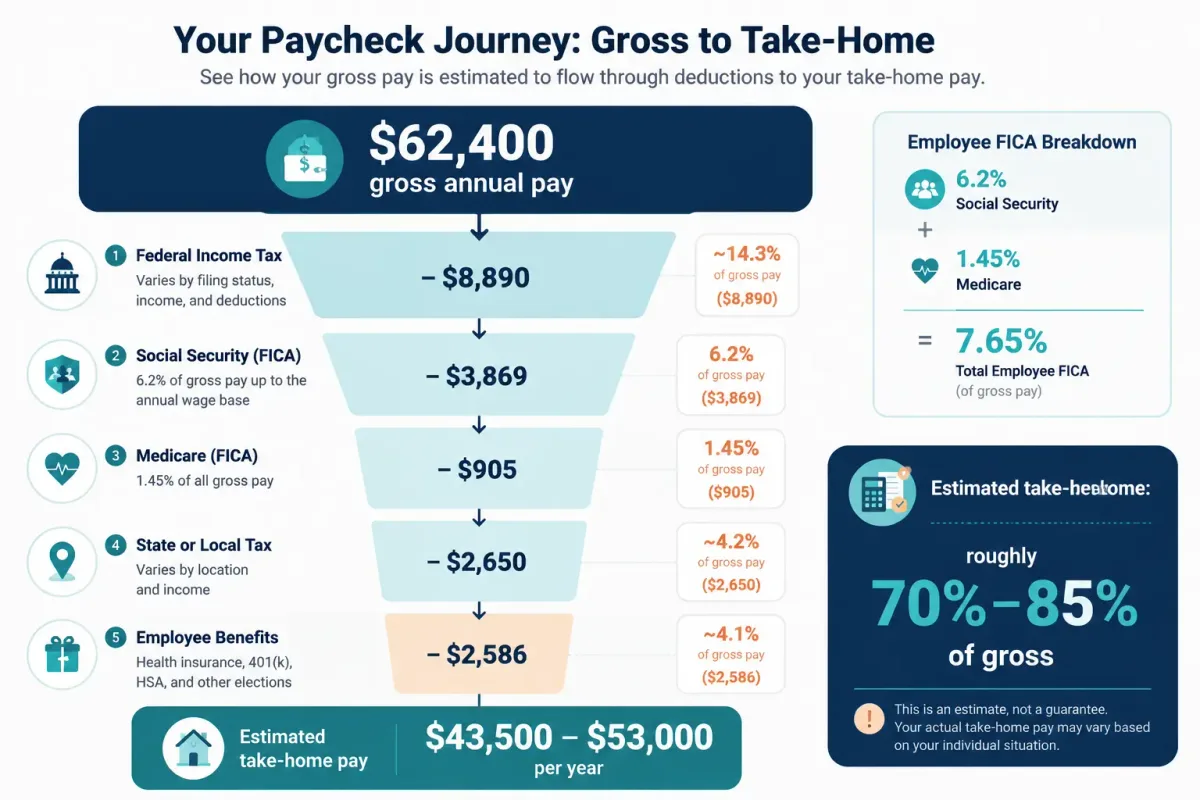
A practical way to estimate your personal range is to start with gross pay, subtract known payroll deductions from an actual offer packet, and then test the result against your monthly fixed costs. If the employer can tell you the employee share of health premiums, dental or vision premiums, retirement match, paid holidays, and PTO policy, you can make a much better estimate than any generic calculator. The same hourly wage can be worth thousands more per year when the employer covers more of the benefits.
W-2 employee vs 1099 contractor
A $30/hour W-2 job and a $30/hour 1099 contract are not equal. The hourly rate may look identical, but the economic package can be very different.
| Factor | W-2 employee at $30/hour | 1099 contractor at $30/hour |
|---|---|---|
| Payroll taxes | Employer withholds employee FICA; employer pays its own share | Contractor generally pays self-employment tax |
| Benefits | May include health insurance, retirement match, disability, training | Usually self-funded |
| Paid time off | Often included if full time | Usually unpaid |
| Unemployment/workers' comp | Often covered by employer systems | Often not covered in the same way |
| Business expenses | Usually employer-paid | Often paid by contractor |
| Schedule risk | May have more predictable hours | Can be flexible, but income may be irregular |
| Best use case | Stable job with benefits and growth | Higher rate, strong pipeline, ability to price expenses |
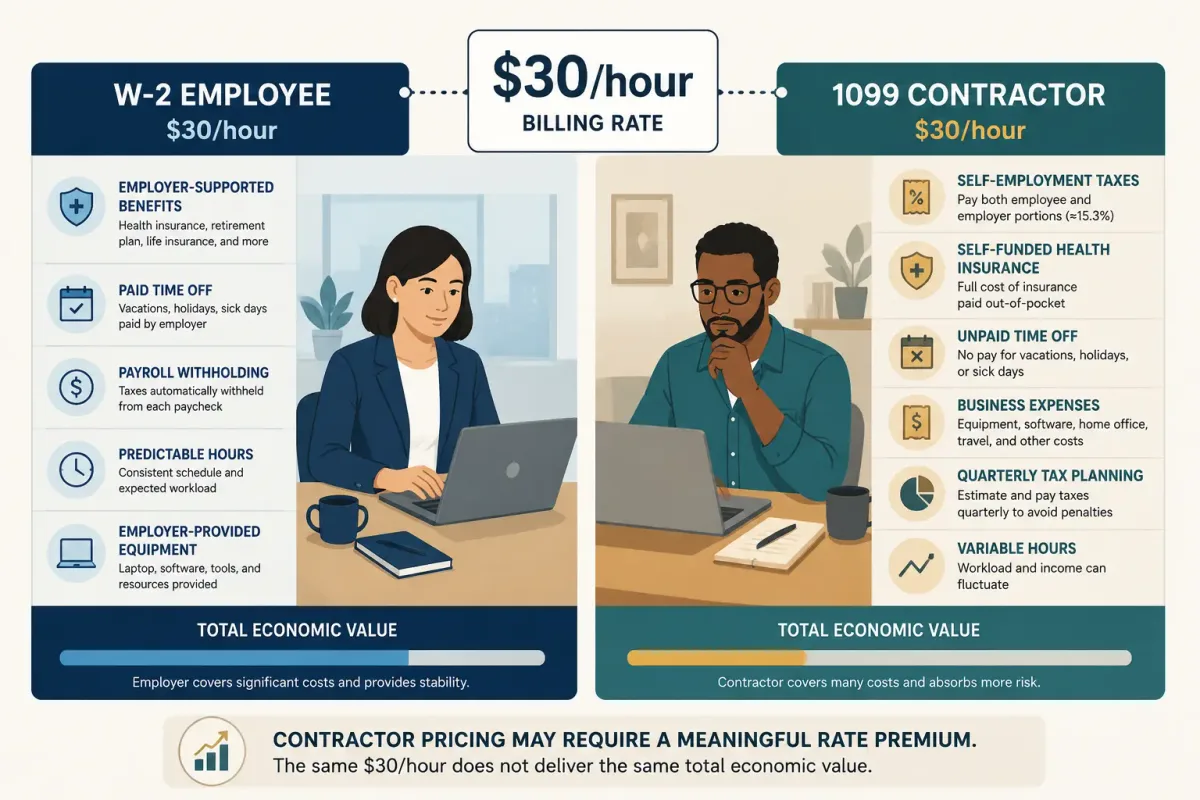
The IRS states that the self-employment tax rate is 15.3%, made up of Social Security and Medicare portions. Self-employed people may also deduct the employer-equivalent portion of self-employment tax for income-tax purposes, but that does not make a $30 contractor rate automatically equal to a $30 employee rate.
W-2 vs 1099 break-even checklist
If you are considering $30 an hour as a 1099 contractor, price the missing pieces:
- How much will health insurance cost if no employer helps pay it?
- How many unpaid vacation, sick, holiday, or admin days will you have?
- Will you pay for equipment, software, mileage, licensing, insurance, or bookkeeping?
- Is the client guaranteeing enough hours to reach your target income?
- Are you saving enough for quarterly estimated taxes?
A simple rule: if a W-2 offer is $30/hour with good benefits, a contractor rate often needs to be materially higher to deliver the same net value.
Contractor pricing example
Suppose a contractor bills $30/hour for 2,080 hours and shows $62,400 of gross revenue. That sounds equal to the W-2 number, but the contractor may lose paid holidays, paid sick time, employer health contributions, unemployment protection, equipment reimbursement, training, and the employer share of payroll taxes. Even if the contractor can deduct some business expenses, those expenses still affect cash flow. If the client does not guarantee hours, the contractor also carries downtime risk. This is why many freelancers quote a higher hourly rate than the wage they would accept as an employee. In a decade of coaching, the contractors who regret their rate are almost always the ones who matched a W-2 number instead of pricing the missing benefits. The right premium depends on your expenses, tax position, and risk tolerance, but asking for 20% to 50% more is common in contractor pricing discussions.
Is $30 an hour a good salary?
Is 30 an hour good pay? In many parts of the United States, yes. The BLS Occupational Employment and Wage Statistics release for May 2025 puts the national median hourly wage at $24.51 across all occupations, so $30 an hour runs about 22% above the national median. That makes $62,400 a comfortably above-median wage on paper. But it is not automatically comfortable everywhere.
| Situation | How $30/hour usually feels |
|---|---|
| Single adult, low-cost area, modest rent | Often comfortable |
| Single adult, high-cost metro | Workable but rent-sensitive |
| Household with dependents | Depends heavily on child care, insurance, and second income |
| High debt or car payment | Can feel tight despite decent gross pay |
| Strong benefits and PTO | Much better real value |
| No benefits, no PTO, irregular hours | Much weaker real value |
A good way to judge the wage is to compare net income to fixed costs. If rent, transportation, insurance, minimum debt payments, and utilities are manageable, $30/hour can feel solid. If those fixed costs consume most of your monthly take-home pay, the same wage can feel stressful.
Fixed-cost pressure test
Before you accept or reject the wage, add up the bills that are hard to change quickly: rent, car payment, car insurance, minimum debt payments, utilities, phone, child care, required prescriptions, and commuting costs. Then compare that number to estimated monthly take-home pay. If fixed costs are below about half of take-home pay, $30/hour may give you room to save. If fixed costs are closer to 70% or more, even a decent wage can feel fragile because one repair, medical bill, or reduced-hours week can create a cash crunch. Living close to that edge is stressful, and the stress is telling you something real. Treat it as data about the offer, not a personal failure.
Can you live on $30 an hour?
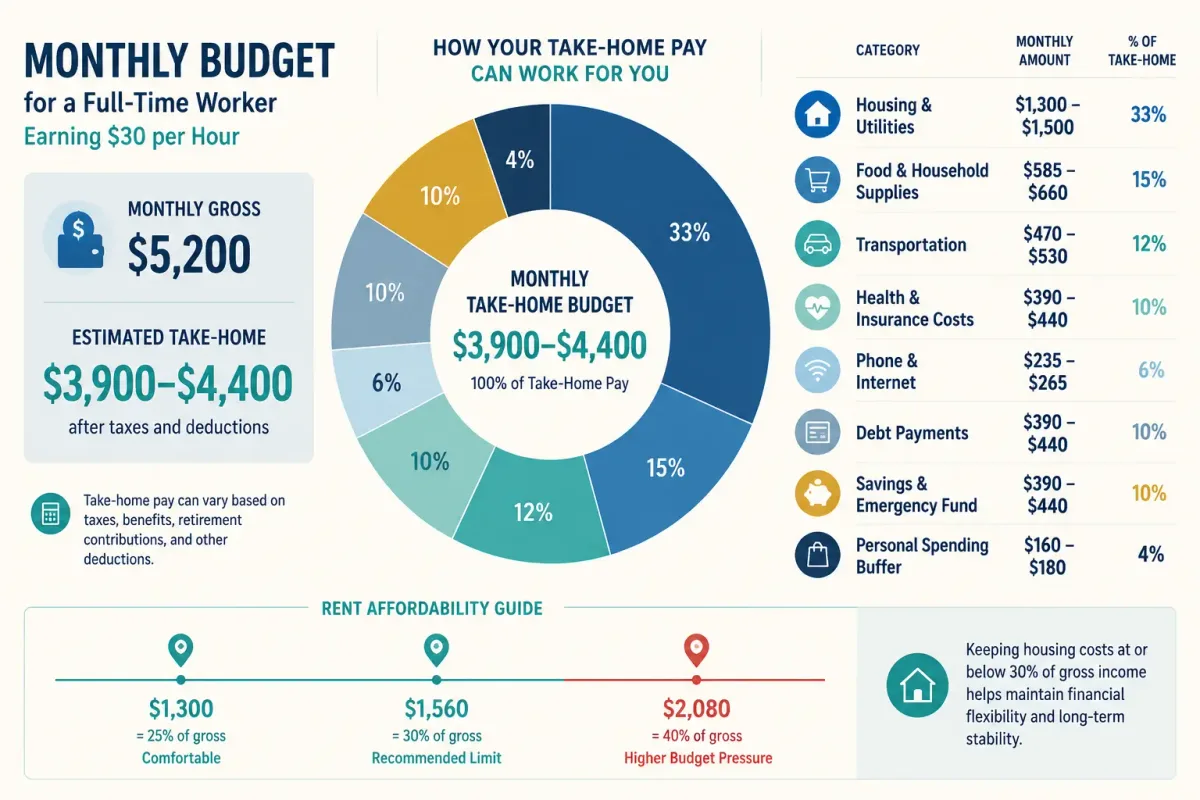
At full-time hours, $30/hour equals $5,200 per month gross. Take-home pay depends on taxes and deductions, so the budget below uses gross-income ratios for housing and a sample net-pay template for monthly planning.
Rent affordability table
| Rent as share of gross monthly income | Monthly rent at $5,200 gross | Budget pressure |
|---|---|---|
| 25% | $1,300 | More flexible |
| 30% | $1,560 | Common affordability target |
| 40% | $2,080 | Tight unless other costs are low |
The 30% guideline is not a law; it is a planning shortcut. In some expensive cities, rent may exceed 30% even for careful renters. In lower-cost areas, staying near 25% can leave more room for savings, emergencies, and debt payoff.
Sample monthly budget at $30/hour
This example assumes a hypothetical monthly take-home range around $3,900 to $4,400 after taxes and deductions. Your real net pay may be higher or lower.
| Category | Example monthly amount | Notes |
|---|---|---|
| Rent and basic utilities | $1,400-$1,700 | Strongly location-dependent |
| Food and household supplies | $450-$650 | Higher with dependents |
| Transportation | $300-$700 | Car payment, fuel, insurance, transit, parking |
| Health/insurance out-of-pocket | $100-$400 | Depends on employer benefits |
| Phone, internet, subscriptions | $120-$250 | Easy area to trim |
| Debt payments | $0-$600 | Student loans, credit cards, personal loans |
| Savings and emergency fund | $300-$700 | Aim to automate if possible |
| Personal, clothing, gifts, buffer | $250-$500 | Prevents the budget from breaking |
Two budget scenarios
Low fixed-cost scenario: Picture a modest apartment, employer health insurance, no large debt, and a reasonable commute. At $30/hour that combination leaves room for savings and some discretionary spending.
High fixed-cost scenario: What if you live alone in a high-rent metro, pay for parking or a car loan, carry high health premiums, and owe on credit cards? The bills still get covered. Not much else does, and one bad month shows up immediately.
Where $30 an hour goes furthest
Location can change the meaning of $62,400 more than almost anything else. The MIT Living Wage Calculator, which notes that its data was last updated on February 15, 2026, is a useful place to compare local costs by county, metro area, state, and household type.
A job paying $30/hour in one city may feel like $25/hour somewhere else after rent and transportation. The reverse can also happen: a $30/hour remote role can feel stronger if you live in a lower-cost area and keep benefits. Use this location value score to judge a $30/hour offer:
| Factor | Strong signal | Weak signal |
|---|---|---|
| After-tax income | No or low state/local tax; useful credits | High income tax and few offsets |
| Rent or mortgage | Housing near 25%-30% of gross pay | Housing near 40%+ of gross pay |
| Transportation and insurance | Short commute, public transit, low premiums | Long commute, tolls, parking, high premiums |
| Job stability and growth | Guaranteed hours, raises, training | Variable schedule, no advancement |
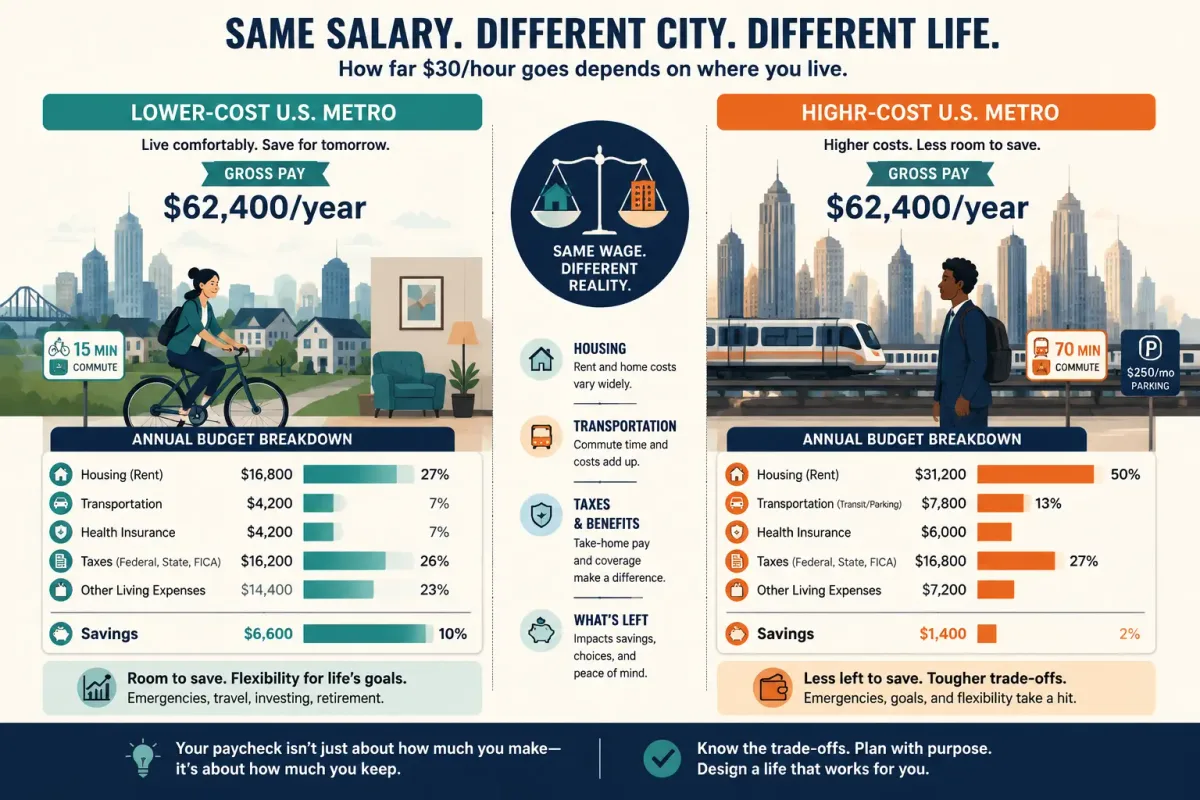
A $30/hour job can be attractive in many smaller metros, suburbs, and lower-cost regions. It can be much harder in places with very high rent, high insurance costs, or expensive transportation. If you are comparing two offers, do not just compare hourly rates. Compare the hourly rate after rent, commute, taxes, benefits, and likely raises.
Jobs that pay around $30 an hour
Jobs around $30/hour vary by state, licensing, experience, union status, shift differentials, and employer. Use broad job categories rather than assuming every posting in a field pays the same.
Common categories where some workers may earn around $30/hour include:
- Healthcare support and licensed roles, such as licensed practical nurses, specialized technicians, and experienced medical support staff.
- Skilled trades: HVAC technicians, electricians, plumbers, and maintenance roles, often with overtime or union differences.
- IT support and technical roles, including help desk analysts, support specialists, junior systems roles, and field technicians.
- Logistics and operations: dispatchers, warehouse leads, transportation coordinators, and operations coordinators.
- Administrative and finance roles like bookkeepers, payroll assistants, accounting assistants, and office managers.
- Remote and freelance specialist work in design, analytics, content operations, virtual assistance, and development support.
The Bureau of Labor Statistics is the best starting point for occupational wage research because it publishes wage data by role and geography. When comparing a job posting to BLS data, match the duties, not just the title. "Coordinator," "technician," "specialist," and "assistant" can mean very different responsibility levels across employers.
Also look for pay add-ons. Shift differentials, hazard pay, union scale, certification premiums, on-call pay, commissions, and overtime can push total compensation above the base hourly rate. On the other hand, unpaid training, split shifts, seasonal layoffs, or required personal equipment can reduce the real value. Before accepting an offer, compare the posting to current local wages, required credentials, schedule, benefits, overtime, and advancement path.
Compare $30/hour with other hourly rates
Small hourly differences matter because full-time annual hours multiply every dollar by 2,080. If you are weighing offers at nearby rates, we break down the same math for $25 an hour and $35 an hour.
| Hourly wage | Annual pay at 40 hrs/week |
|---|---|
| $20/hour | $41,600 |
| $25/hour | $52,000 |
| $30/hour | $62,400 |
| $35/hour | $72,800 |
| $40/hour | $83,200 |
Raise ladder
Every $1/hour raise is about $2,080/year before taxes at full-time hours. Every $5/hour raise is about $10,400/year before taxes.
That means negotiating from $30/hour to $32/hour is not just a $2 difference. At 2,080 paid hours, it is about $4,160 more per year before taxes. If overtime is common and paid correctly, the value of a raise can be even higher because the overtime rate also rises.
Should you accept a $30/hour job offer?
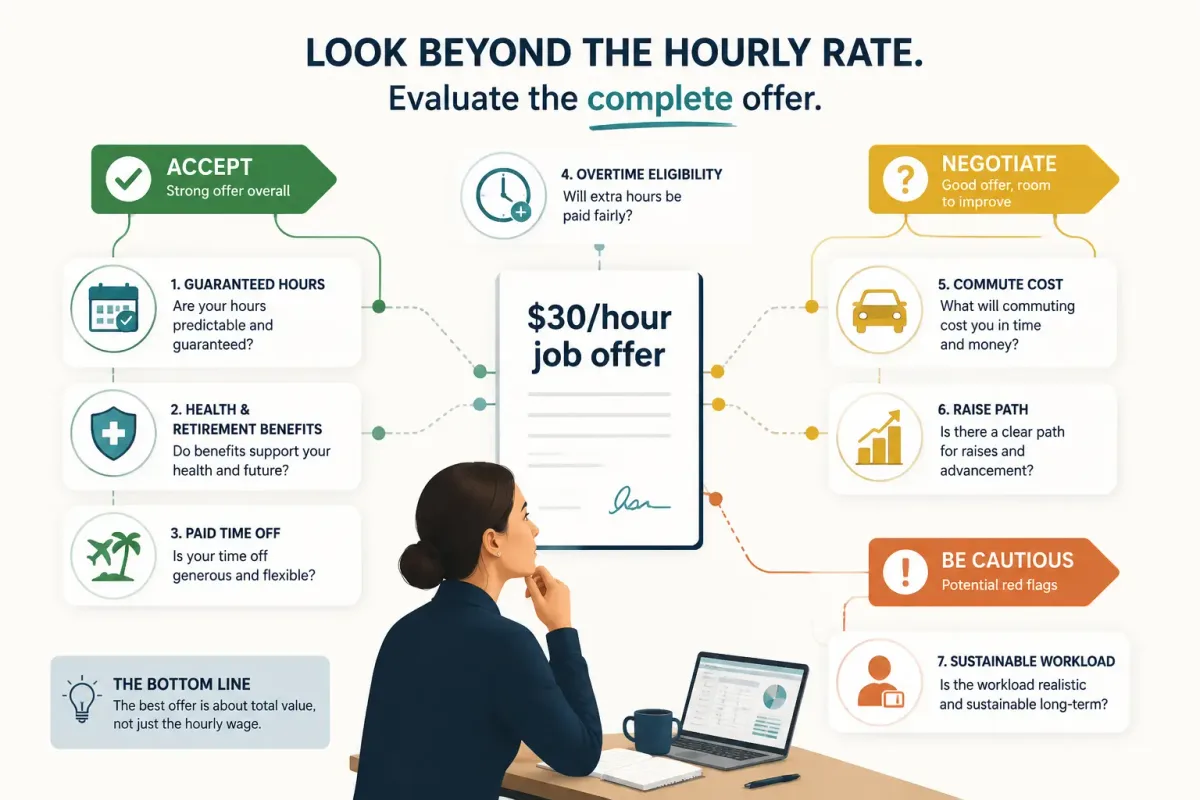
Use this job offer decision matrix before saying yes. The headline wage is only one part of the offer. When I walk candidates through an offer review, the wage line takes five minutes; the rest of the hour goes to the rows below, because that is where offers actually differ.
| Question | Why it matters |
|---|---|
| Are hours guaranteed? | Variable schedules can reduce annual pay |
| Is overtime available and paid? | Can materially increase income |
| Are benefits included? | Benefits can add thousands in value |
| Is PTO paid? | Unpaid time off lowers annual income |
| What is the commute cost? | Gas, parking, transit, and time reduce real value |
| Is there a raise path? | $30/hour is better with growth |
| Is the work sustainable? | Burnout can erase the benefit of higher pay |
When to accept
Accept when the hours are stable, the benefits are useful, the commute is manageable, the schedule fits your life, and the role gives you a path to higher pay. If most of those boxes check, $30/hour is a solid offer in much of the country.
When to negotiate
Negotiate when the job has no benefits, no PTO, irregular hours, mandatory overtime, expensive commuting, or responsibilities above the advertised pay level. You can ask for a higher rate, a signing bonus, guaranteed hours, remote days, certification reimbursement, better benefits, or a written review timeline. And if the total package still does not work after a real negotiation, walking away is a legitimate outcome; our guide on how to decline a job offer politely covers the wording.
If the employer will not move the hourly rate, negotiate the surrounding package. A small raise is valuable, but so are guaranteed hours, earlier benefit eligibility, paid certification, a tool allowance, a predictable schedule, or a written review date. For someone earning $30/hour, even one extra paid holiday is worth $240 before taxes.
Useful questions include:
- "Are 40 hours guaranteed each week?"
- "How is overtime calculated and approved?"
- "What are the employee health insurance premiums?"
- "Is PTO paid, and how many holidays are paid?"
- "What raise would be typical after 6 or 12 months of strong performance?"
When to be cautious
Be careful if the employer calls the job full time but cannot guarantee hours, labels you as a contractor while controlling your schedule like an employee, offers no benefits, or expects unpaid off-the-clock work. Also be cautious if your fixed costs are so high that a small drop in hours would break your budget.
Sources and methodology
This article uses the standard hourly-to-salary conversion of 2,080 paid hours per year. Tax and labor-law references should be checked again before future updates because thresholds can change.
- IRS: 2026 tax inflation adjustments
- IRS: Topic No. 751, Social Security and Medicare withholding rates
- IRS: Self-employment tax
- U.S. Department of Labor: Overtime pay
- MIT: Living Wage Calculator
- BLS: Occupational Employment and Wage Statistics
This is general educational content, not personal tax, legal, career, or financial advice. For decisions involving taxes, worker classification, benefits, or state-specific overtime rules, use current official guidance or a qualified professional.
Conclusion
$30 an hour is $62,400 a year before taxes if you work 40 hours/week for 52 weeks. That is about $5,200/month gross, $2,400 biweekly gross, and $1,200 weekly gross, with take-home pay for a single filer typically landing between $48,700 and $52,300 depending on state tax and benefits.
Whether $30 sounds high or low is the wrong question. Run your numbers: take-home pay, rent, transportation, health insurance, debt, dependents, benefits, PTO, overtime eligibility, and schedule stability. A $30/hour job with good benefits, paid time off, guaranteed hours, and a raise path can be a strong offer. The same rate with no benefits, no PTO, unpredictable hours, or a costly commute needs negotiation before it is worth signing.