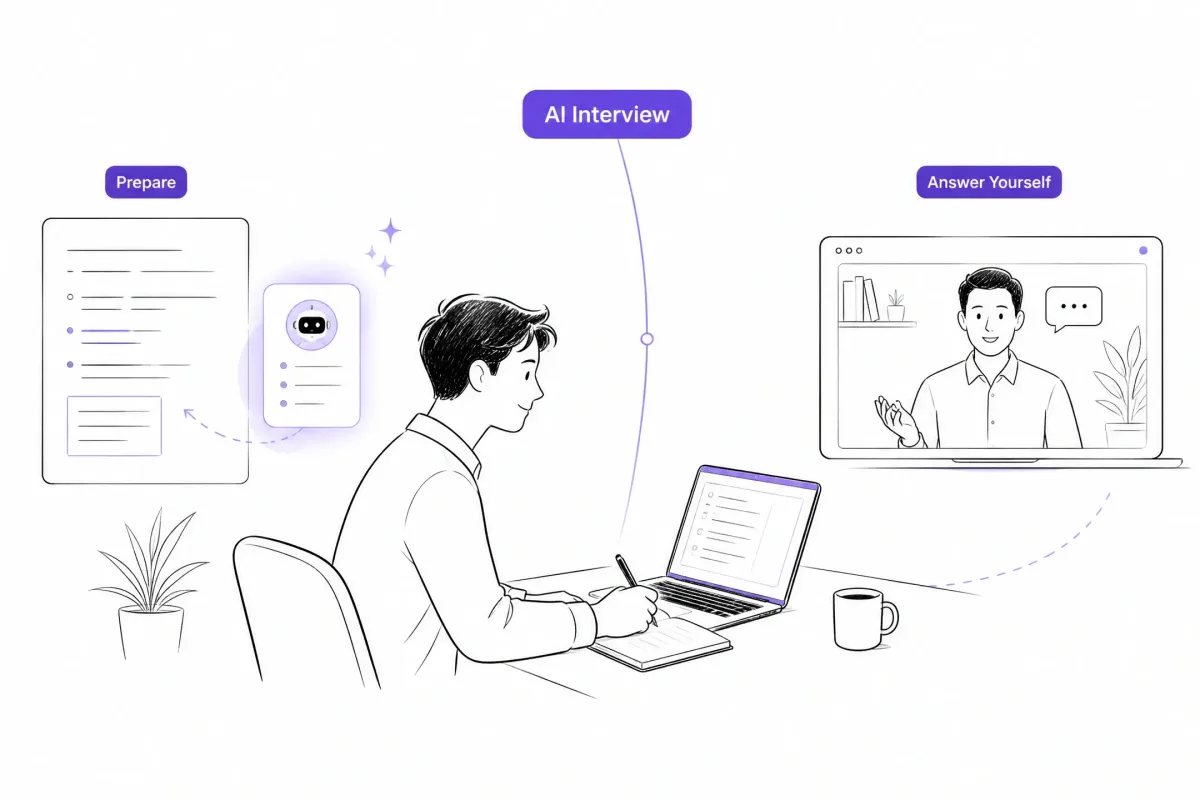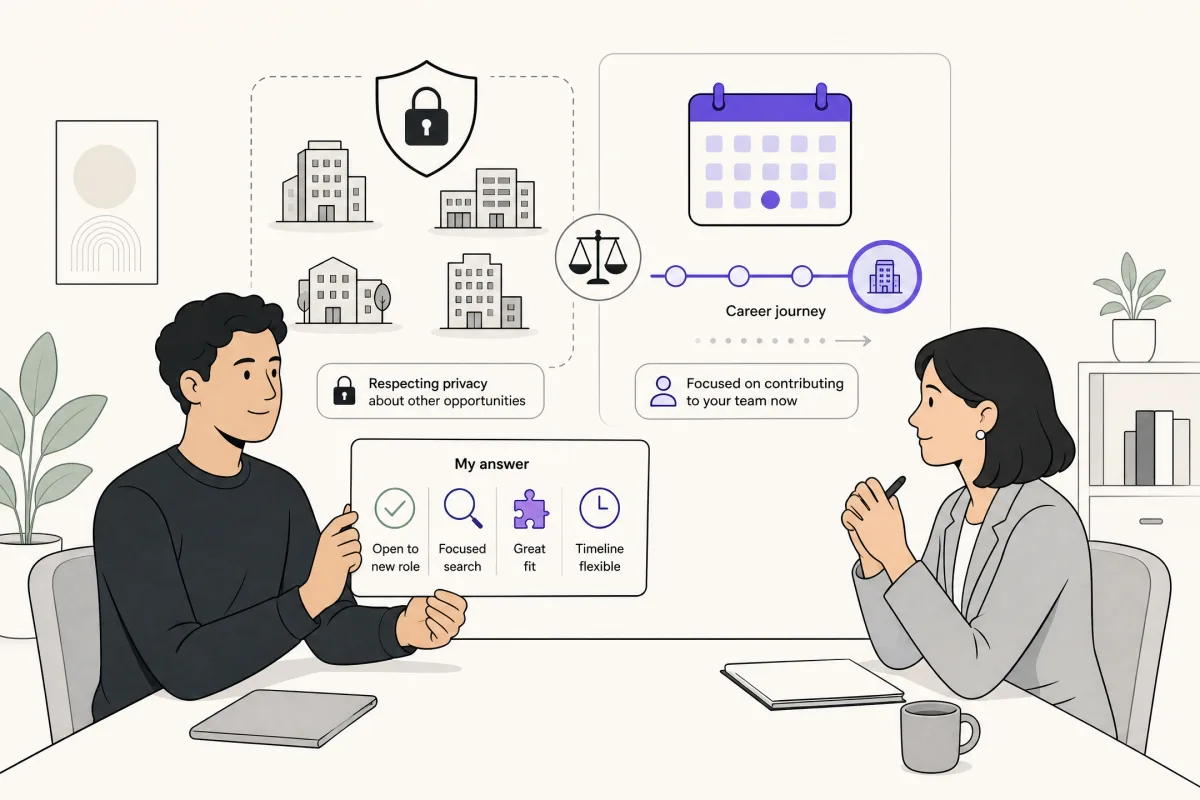


To prepare for a job interview, start by studying the company and the role so you can speak their language. Then decide what you want them to remember about you—your strongest qualifications, your most relevant results, and the problems you can solve. Next, build a small “evidence library”: prepare several STAR stories (Situation, Task, Action, Result) that prove you’ve done the kind of work the job requires. After that, practice common questions out loud until your answers sound natural, focused, and credible.
Finally, prepare smart questions for the interviewer and confirm the logistics (time zone, location or link, what to bring, and who you’re meeting). If you’re using AI tools, use them to generate realistic questions and run mock interviews—especially helpful when you don’t have a coach available. But your final answers should always reflect your real experience, your real thinking, and your real results.
Quick Interview Preparation Checklist (to Prepare for a Job Interview)
- Review the job description
- Research the company
- Identify three main selling points
- Prepare five STAR stories
- Practice common questions
- Prepare questions for the interviewer
- Complete at least one mock interview
- Confirm clothes, documents and logistics
- Test video interview equipment
- Prepare a follow-up email
What Are Interviewers Actually Evaluating?
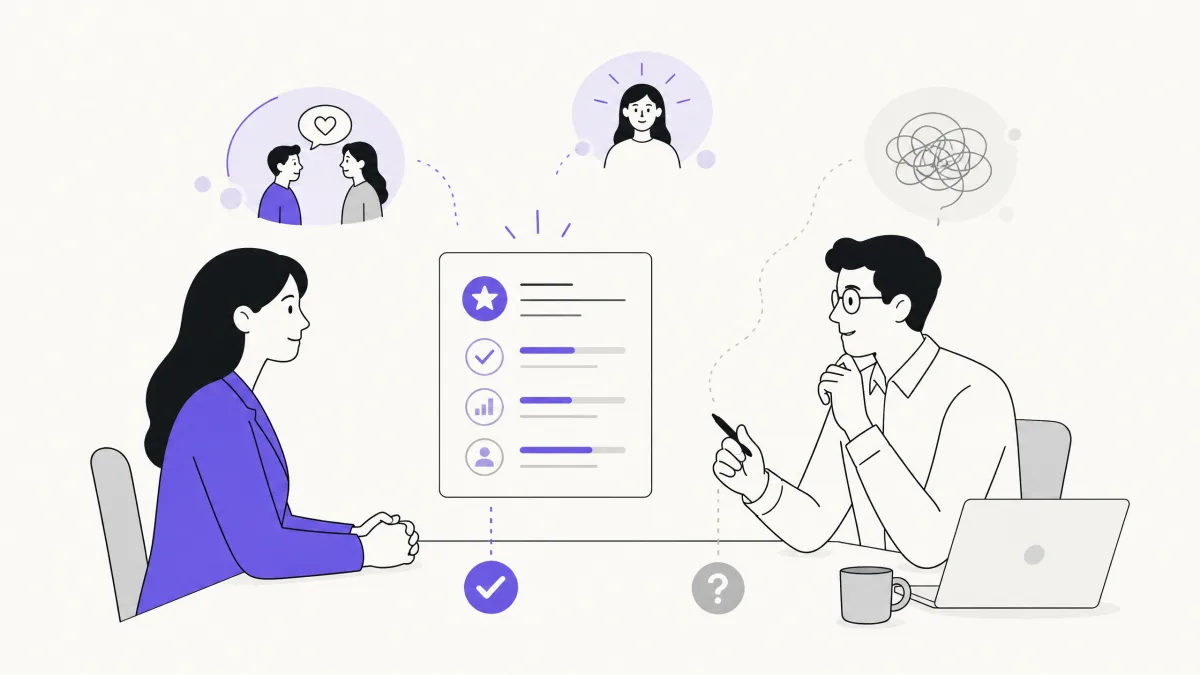
Most interview questions are just different ways to evaluate the same core things:
- Can you do the job? (skills, judgment, problem-solving)
- Do you understand the role? (priorities, tradeoffs, what “good” looks like)
- Do you actually want to join this company? (motivation that isn’t generic)
- Can you communicate clearly? (structure, conciseness, listening)
- Is your experience credible? (specifics, consistency, evidence)
- Will you fit the team and work environment? (collaboration style, values, pace)
Key Takeaway: Great interview prep isn’t memorizing “perfect answers.” It’s preparing credible evidence (examples, results, decisions) so you can prove your fit under pressure.
1. Analyze the Job Description
Identify the Most Important Requirements
Print the job description or paste it into a document. Then highlight and label:
- Must-have skills (tools, systems, methods)
- Years of experience (and what counts as relevant)
- Primary responsibilities (what you’ll do weekly)
- Repeated keywords (the language they use is a clue to what they value)
- Soft skills (collaboration, ownership, communication)
- Measurable business goals (growth, retention, quality, cost, speed)
If you can’t point to evidence for a requirement, assume you’ll be asked about it.
Create a Job Qualification Matrix
This one table makes your prep 10x easier because it turns a vague job description into talking points.

| Job requirement | My experience | Evidence or result | Interview story |
|---|---|---|---|
| Project management | Led a website launch | Finished two weeks early | STAR story 1 |
| Customer service | Managed escalations | Improved satisfaction | STAR story 2 |
Build 8–12 rows. Then you’ll know exactly what stories to prioritize.
Identify Possible Weaknesses or Gaps
If you’re missing a requirement, don’t try to “sound like you have it.” Interviewers can usually tell when you’re improvising.
Instead:
- Name the gap honestly (briefly).
- Show adjacent experience (transferable skill or similar scenario).
- Explain how you’re closing the gap (coursework, projects, mentorship, repetition).
- Offer a proof plan (what you’ll do in the first 30–60 days).
Example:
- “I haven’t used Tableau daily, but I’ve built dashboards in Looker and Power BI. I’m currently completing a Tableau course and I can walk you through a dashboard project I did last quarter. If I joined, I’d prioritize replicating your core reporting in my first month.”
2. Research the Company, Industry and Interviewers
What to Research About the Company
Focus on what helps you answer why them and why this role credibly:
- Products and services
- Customers
- Business model
- Competitors
- Company values
- Recent developments
- Current challenges
- Role of the relevant department
A practical baseline is the U.S. Department of Labor’s interview tips, which emphasize understanding the organization and the role before you walk in.
What to Research About the Interviewer
Keep it professional and relevant:
- Job title
- Department
- Professional background
- Possible relationship to the position
Use public information (like LinkedIn). And don’t act like you’re “investigating” them. The goal is to understand their perspective so you can communicate better, not to prove you can stalk someone.
Turn Research Into Interview Answers
Research only matters if you can use it naturally in answers like:
- Why do you want to work here?
- What interests you about this role?
- What do you know about our company?
A simple pattern:
- Specific observation (product, strategy, culture, recent change)
- Personal connection (what you enjoy, what you’re good at)
- Evidence (relevant result)
- What you want to contribute
Example (short):
- “I saw your team is expanding into mid-market. In my last role I helped redesign onboarding, which reduced drop-off by 18%. This role sits right at that growth moment, and I’m excited about improving conversion and retention through better customer workflows.”
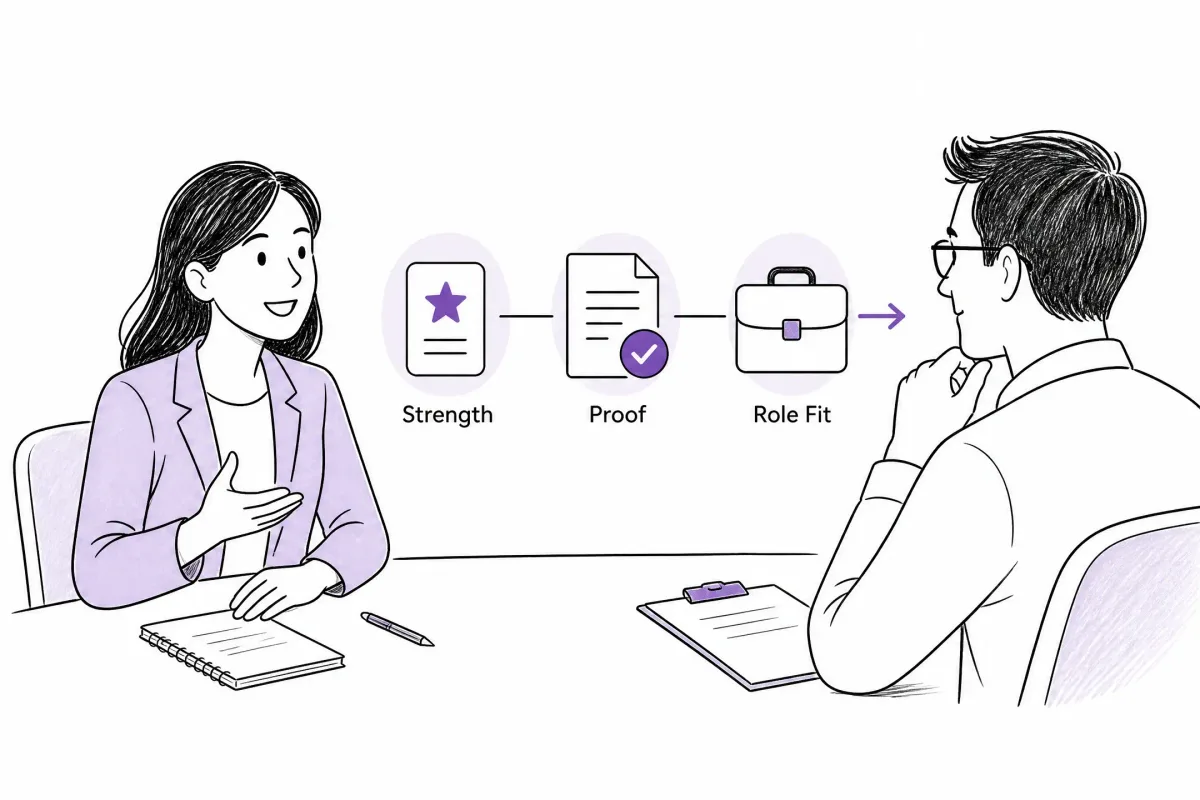
3. Define Your Three Main Selling Points
Write these three sentences and don’t overthink them:
- I am a strong fit because…
- One problem I can help the company solve is…
- The strongest evidence of my ability is…
If you can’t answer these, your interview answers will sound scattered.
Prepare a 30-Second Elevator Pitch
Use this structure:
Current role/background → relevant experience → strongest result → why this opportunity makes sense.
Example:
- “I’m a customer success specialist with three years in SaaS onboarding. I’ve led renewals and handled escalations, and I recently redesigned our QBR process, which improved retention in my book of business. I’m excited about this role because it’s focused on scaling onboarding, and that’s where I’ve had my biggest wins.”
Adapt the Pitch for Your First Interview
If you don’t have formal experience, you still have evidence. Use:
- School projects
- Volunteer work
- Internships
- Student organizations
- Personal projects
- Part-time work
- Transferable skills
Example:
- “I’m a recent graduate in information systems. In a capstone project, I led a team building a reporting dashboard and we delivered ahead of schedule. I’m applying for this analyst role because I like turning messy data into clear decisions, and I’m looking for a team where I can build that skill in a real business environment.”
4. Build a Bank of STAR Interview Stories
What Is the STAR Method?
The STAR method is a simple structure for behavioral questions: Situation → Task → Action → Result. MIT’s career office explains it clearly in “Using the STAR method for behavioral interviews”.

Prepare at Least Five Flexible Stories
Aim for stories you can reuse across many questions:
- A major accomplishment
- A difficult problem
- A conflict or disagreement
- A mistake or failure
- A leadership or initiative example
- A teamwork example
- Working under pressure
- Learning something quickly
You don’t need a separate story for every question. You need a small set of strong stories that flex.
How Long Should a STAR Answer Be?
As a rule of thumb:
- Situation: 1–2 sentences (just enough context)
- Task: what you owned and what “success” meant
- Action: the majority of your answer (what you did, step by step)
- Result: the outcome (numbers if possible) and what you learned
Northwestern’s career guidance notes that Action should be the longest part of a STAR answer in “Behavioral Interviewing & the STAR Approach”.
Weak Answer vs. Strong STAR Answer
Question: “Tell me about a time you handled a difficult stakeholder.”
Weak answer (what goes wrong):
- “I had a stakeholder who didn’t like our timeline. I explained what we were doing and tried to keep them updated. Eventually things worked out and they were happy.”
Why it’s weak:
- No details, no actions, no measurable outcome.
- The interviewer can’t tell what you actually did.
Strong STAR answer (credible and specific):
- Situation: “In my last role, we were rolling out a new website launch and the Sales lead was concerned it would hurt lead volume during a key campaign.”
- Task: “I owned the project timeline and had to ship on schedule without causing disruption to lead capture.”
- Action: “I set up a 20-minute alignment call, asked Sales to define the exact risk scenarios, and mapped them to our rollout plan. We agreed to a staged launch: I moved the highest-traffic landing pages to the first release, added a tracking checklist (forms, UTMs, analytics events), and created a same-day rollback plan. I also sent a one-page status update after each milestone so they didn’t have to chase me.”
- Result: “We launched on time, saw no drop in tracked leads during the campaign week, and Sales asked to reuse the same rollout process for the next product page refresh.”
What makes it strong:
- You can picture the situation.
- The actions are concrete and owned.
- The result is observable (and ideally quantified when you can).
5. Prepare for Common Interview Questions
Don’t memorize answers word-for-word. Prepare bullet-point structures and plug in the most relevant STAR story.
Five Common Questions (With Structure + Sample Answers)
Use these as models—then rewrite them in your own words so you don’t sound scripted.
Tell me about yourself
A strong structure (Present → Past → Proof → Future):
- Present: who you are now (role / focus)
- Past: 1–2 relevant experiences that led here
- Proof: one measurable result or concrete project
- Future: why this role is the next logical step
Sample answer:
“I’m a data analyst focused on product analytics and experimentation. Over the last three years I’ve worked on retention and onboarding funnels, partnering closely with product and engineering to turn messy event data into decisions. In my current role, I redesigned our activation dashboard and the team used it to identify a drop-off point that we fixed, improving week-one activation by 12%. I’m excited about this role because it sits at the intersection of analytics and product strategy, and I’d like to bring that same ‘find the bottleneck → test → measure’ approach to your growth team.”
Why do you want to work here?
A strong structure (Specific → Personal → Evidence → Contribution):
- Specific: a real observation about the company (product, strategy, culture, growth moment)
- Personal: what you genuinely like doing that connects to that observation
- Evidence: proof you’ve done similar work
- Contribution: what you want to help them achieve next
Sample answer:
“I noticed you’re investing in self-serve onboarding and shortening time-to-value. That’s a space I enjoy because the best improvements are a mix of customer empathy and clean measurement. In my last role, I partnered with CS and product to simplify the first-run experience and we reduced early churn by 9% over two quarters. I’m applying because this team is clearly prioritizing the same problems, and I’d love to help you increase activation through better instrumentation and tighter experiments.”
Why should we hire you?
A strong structure (Match → Evidence → Differentiator → Close):
- Match: 2–3 requirements from the job description
- Evidence: one result per requirement (numbers beat adjectives)
- Differentiator: what you do unusually well (decision-making, speed, stakeholder mgmt, clarity)
- Close: how you’d use it in the first 60–90 days
Sample answer:
“Based on the role description, you need someone who can (1) run experiments end-to-end, (2) translate insights into product decisions, and (3) communicate clearly with cross-functional partners. In my current role, I designed and analyzed A/B tests for onboarding, built the metric definitions with engineering, and presented weekly readouts to product leadership; one set of changes increased conversion from signup to first key action by 14%. What I think I bring is speed with structure—I move quickly, but I document assumptions and keep stakeholders aligned. In the first 90 days, I’d focus on learning your funnel, validating your core metrics, and shipping a small set of high-confidence experiments.”
What is your biggest weakness?
A strong structure (Real weakness → Impact → Fix → Evidence):
- choose a real weakness that is not core to the role
- show you understand the impact
- explain what you do to manage it
- give evidence it’s improving
Sample answer:
“Earlier in my career, I sometimes moved too fast into problem-solving and didn’t pause long enough to confirm the real constraint. That could lead to extra rework. To fix it, I started using a short ‘problem framing’ checklist: what decision we’re making, what success metric changes, what we’re not doing, and the smallest test that would teach us something. Over time it’s reduced back-and-forth because stakeholders see the assumptions upfront, and it’s improved how I prioritize when multiple teams have urgent requests.”
Why are you leaving your current job? / Why is there a gap in your resume?
A strong structure (Truth → Brief context → What you did → Why now):
- state the reason plainly (no oversharing)
- keep the context short and non-blaming
- show what you learned / built / did during the gap
- connect to why you’re ready now
Sample answer (leaving):
“I’m proud of what I accomplished, but the scope has plateaued and I’m looking for a role with more ownership over experimentation and analytics strategy. Over the last six months I’ve taken on additional projects to grow that skill set, including building a churn model and leading the readouts with product. I’m now looking for a team where analytics is a strategic partner, which is why this role is a great fit.”
Sample answer (gap):
“I took a planned break for family reasons. During that time, I kept my skills current by completing a statistics refresher and building two small portfolio projects. I’m fully available now, and I’m excited to return to a role where I can apply that work to real product decisions.”
Salary Expectation: How to Answer Without Boxing Yourself In
If you’re asked “What salary are you expecting?”, your goal is to be prepared without anchoring too low.
A practical 3-step approach:
- Research a realistic range for your level, location, and role scope (use multiple sources; don’t rely on a single number).
- Give a band, not a single number, and state what the band depends on (scope, leveling, total comp).
- Delay politely if you truly lack information (leveling, equity, on-call load, travel, etc.).
Sample answer (band):
“Based on the role scope and market data for this level, I’m targeting a total compensation range around $X to $Y. That said, I’m flexible depending on leveling and the overall package—bonus, equity, and benefits. If you can share the level and comp structure, I can be more precise.”
Sample answer (delay):
“I’m open, but I’d like to understand the leveling and the full compensation structure first so I don’t anchor us in the wrong direction. Could you share the budgeted range for this role?”
Questions About Your Background
- Tell me about yourself.
- Walk me through your resume.
- Why are you leaving your current job?
Questions About Your Motivation
- Why do you want this job?
- Why do you want to work here?
- Why should we hire you?
Behavioral Interview Questions
- Tell me about a challenge.
- Describe a conflict.
- Tell me about a mistake.
- Describe a time you showed leadership.
Difficult Interview Questions
- What is your biggest weakness?
- Why is there a gap in your resume?
- Why were you fired?
- What salary are you expecting?
When you answer tough questions, the meta-goal is the same: credibility. Be direct, don’t over-explain, and bring it back to what you learned and what you can do now.
Role-Specific Questions
Use the job description to predict what you’ll be tested on—and add one concrete drill for each type:
- Technical questions (tools, methods, edge cases): practice explaining one project end-to-end and answering “why this approach?”
- Case questions (your thinking and tradeoffs): do 2–3 timed cases and narrate assumptions + decision criteria.
- Management questions (prioritization, coaching, decision-making): prepare 2 stories on feedback/coaching and 1 story on a tough tradeoff.
- Sales questions (objection handling, pipeline judgment): rehearse a short discovery flow + 3 common objections with proof.
- Customer-service questions (de-escalation, clarity, empathy): script 2 de-escalation scenarios and practice calm, concise phrasing.
6. Prepare Questions to Ask the Interviewer
Strong candidates don’t just answer questions—they ask them.
Questions About the Role
- What would success look like in the first 90 days?
- What are the biggest challenges facing the person in this role?
- How will performance be measured?
Questions About the Team
- How does the team collaborate?
- What is the manager’s working style?
- Which departments work most closely with this position?
Questions About Company Direction
- What are the team’s priorities this year?
- How is the company responding to changes in the industry?
Questions to Avoid or Delay
These aren’t always “wrong,” but they can be premature as your first questions:
- Detailed vacation/time-off policies
- Promotion timelines in the first 6–12 months
- Remote exceptions (before you understand role expectations)
- Compensation negotiation details (save for the right stage unless the interviewer brings it up)
A better first interview goal is to understand expectations, success metrics, and team realities.
For a deeper list of role, team, and next-step prompts, review 15 smart questions to ask in an interview.
7. Practice Your Answers Without Memorizing Them
Why Silent Practice Is Not Enough
In your head, every answer sounds smooth. Out loud, you notice problems:
- answers run long
- phrases sound unnatural
- the point gets buried
- filler words increase
- results disappear
University career guidance commonly recommends rehearsal and practice, including scripts and speaking practice, such as Tufts’ interview preparation guidance and UC Davis’ Interviews and Offers Guide (PDF).
Use Bullet Points Instead of Scripts
For each common question, write only:
- Opening point
- Two supporting details
- Example
- Result
- Closing connection to the role
This keeps you structured without sounding memorized.
Record and Review Yourself
Do a 10-minute recording session and check:
- answer length
- speaking speed
- volume
- eye contact
- repeated words
- whether you actually answered the question
How Real Job Seekers Use AI to Prepare
A common “real-world” workflow shared by job seekers looks like this:
- Paste your resume + the job description → ask AI to predict likely questions.
- For each question, ask what the interviewer is really testing.
- Draft a STAR story bank and map each story to multiple questions.
- Practice out loud (voice mode), then request follow-up questions to pressure-test vagueness.
- Ask for a scorecard (clarity, structure, evidence, conciseness), then iterate.
Examples of this approach (high-engagement Reddit discussions):
8. Use AI to Prepare for the Interview
This is where you can get a real edge—if you use AI like a coach, not like a shortcut.
Let AI Compare Your Resume With the Job Description
Prompt:
Compare my resume with this job description. Identify the five most important requirements, evidence from my experience that supports each requirement, possible weaknesses and questions the interviewer may ask.
Before you paste anything into an AI tool, remove:
- address
- phone
- government ID or document numbers
- client confidential details
- non-public company data
⚠️ Warning: Your interview materials can contain sensitive personal and business information. Treat AI tools like a third party unless you know exactly how your data is handled.
Ask AI to Generate Role-Specific Questions
Prompt:
Act as a hiring manager recruiting for this position. Create 15 realistic interview questions, including five behavioral questions, five role-specific questions and five difficult follow-up questions.
Use AI to Improve STAR Stories
Prompt:
Help me organize this real experience into a concise STAR answer. Do not invent facts or results. Ask me questions if important details are missing.
Conduct an AI Mock Interview
A workflow that works (and feels realistic):
- Provide the job description.
- Provide a de-identified resume.
- Specify interview type (behavioral / technical / case / phone screen).
- Ask the AI to give one question at a time.
- Answer out loud.
- Ask for follow-ups when your answer is vague.
- After 10 questions, request a full evaluation.
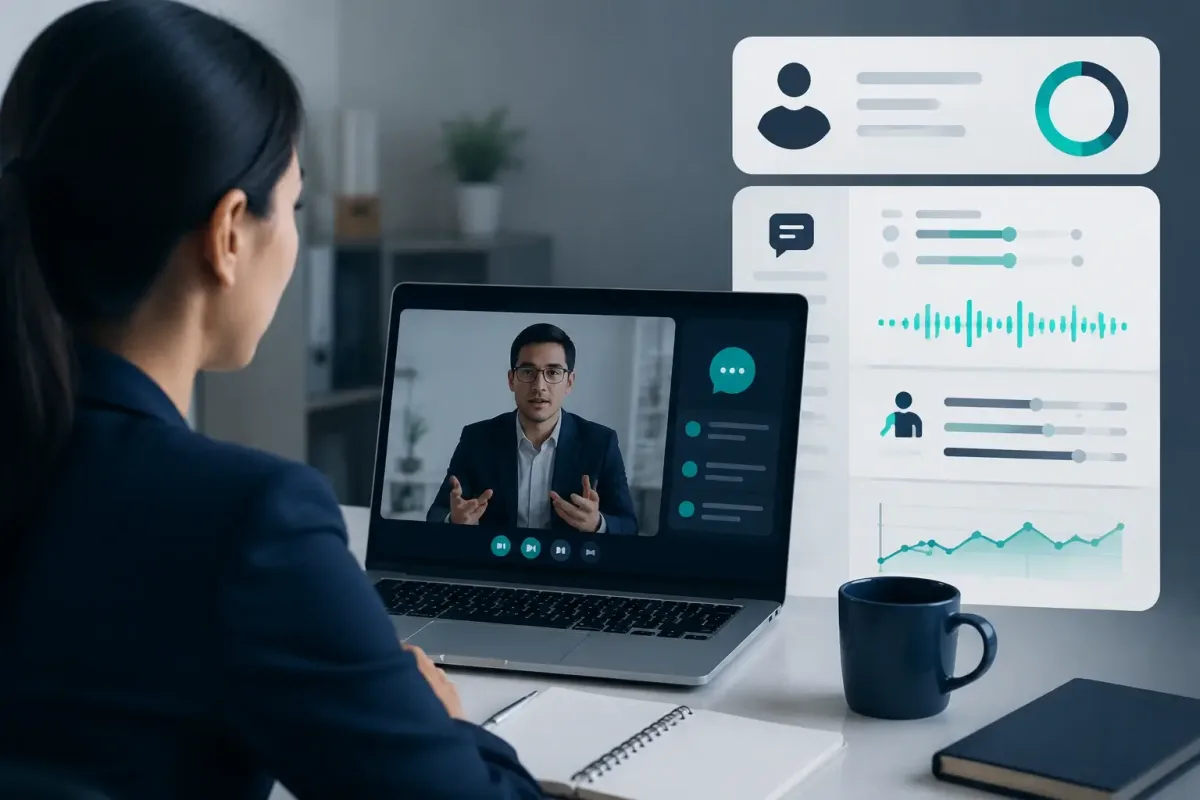
Prompt:
Conduct a realistic mock interview for this position. Ask one question at a time and wait for my spoken answer. Use follow-up questions when my answer is unclear. After ten questions, evaluate my relevance, structure, clarity, confidence and use of evidence.
What Feedback Should You Request?
Ask for scoring on:
- Relevance
- Clarity
- Answer structure
- Specific examples
- Measurable results
- Conciseness
- Confidence
- Filler words
- Missed follow-up opportunities
Recommended AI Mock Interview Tools (and How to Choose)
Different tools are useful for different types of practice. Use this comparison to pick faster.
| Tool | Best for | Main features | Limitations | Live or practice use |
|---|---|---|---|---|
| ChatGPT Voice | General practice with realistic back-and-forth; practicing concise speaking | Conversational mock interviews, follow-ups, quick rewrites of your answers, can role-play interviewer types | Quality depends on your prompt and context; may produce generic advice; you still need to verify facts | Practice (best). Live only if explicitly allowed and you can stay authentic |
| Yoodli | Speech delivery training (filler words, pace, clarity) | Automated speaking feedback, filler-word tracking, pacing, clarity coaching | Less role-specific; content relevance depends on what you feed it | Practice |
| Huru | Structured interview drills with scoring | Interview question banks, timed answers, feedback rubric and practice flows | Feedback can feel formulaic; may not match your exact role/company | Practice |
| Big Interview | Traditional interview training + structured curriculum | Role-based modules, question libraries, practice + coaching style guidance | Can feel less personalized unless you do the setup work | Practice |
If your biggest problem is content and structure, start with ChatGPT Voice. If your biggest problem is delivery (rambling, filler words, pacing), add Yoodli.
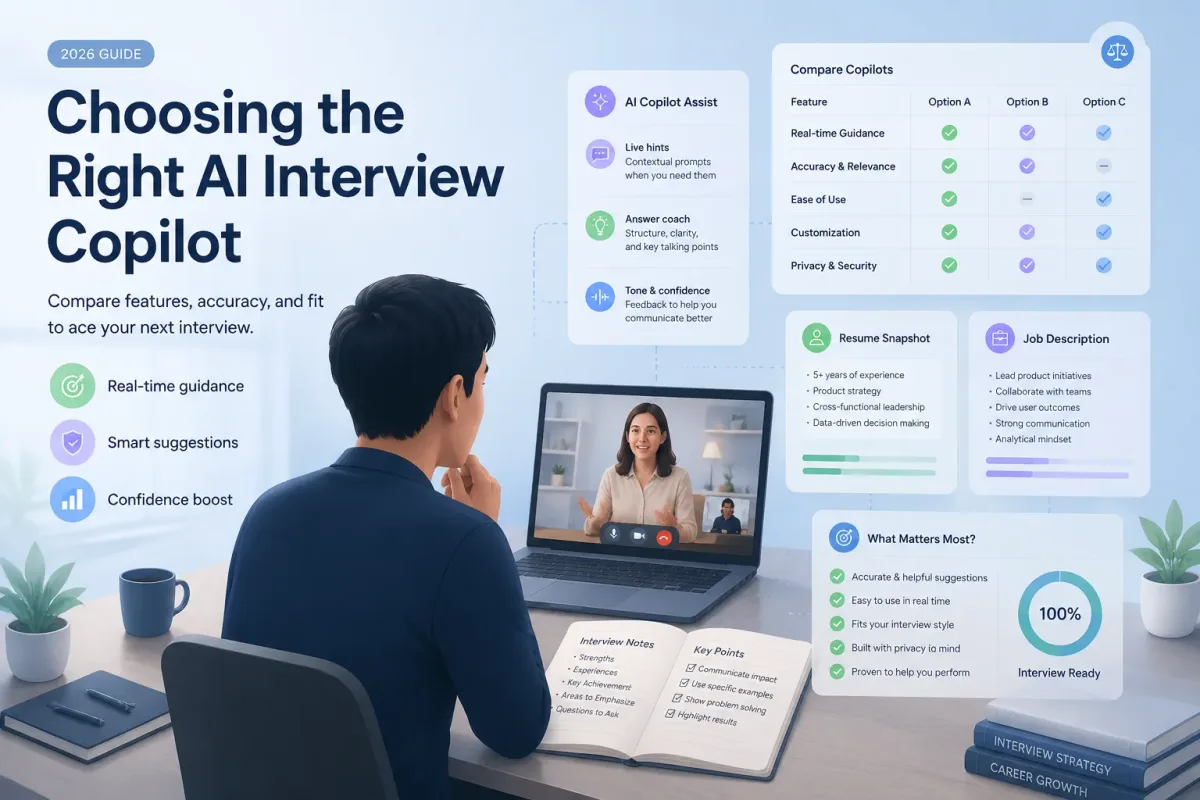
Before choosing live AI assistance, compare the strengths and limitations of AI interview copilot tools.
9. How to Manage Interview Anxiety
Interview prep isn’t only “content.” Anxiety changes how well you can access your own experience.
Recognize What Is Making You Nervous
Common causes:
- fear of not knowing the answer
- worry about being judged
- lack of interview experience
- not knowing enough about the company
- perfectionism
- unfamiliar video interview environment
Use Repeated Mock Interviews
A simple progression:
- write answers
- say them out loud
- record audio/video
- simulate with a friend
- simulate with AI
- do a full mock interview with follow-ups
Prepare a Recovery Plan
When your mind goes blank, you can say:
- “That’s a good question. Let me take a moment to think about the most relevant example.”
Or:
- “Could you clarify which part of the situation you would like me to focus on?”
Reduce Pressure on the Day
- confirm the route or the link
- bring water
- test equipment early
- do a short breathing exercise
- avoid cramming at the last minute
- treat the interview as a two-way conversation, not an exam
A 5-Minute Pre-Interview Routine (Quick Reset)
If you feel nervous right before the call, run this:
- 60 seconds breathing: inhale 4 seconds, hold 2, exhale 6.
- 60 seconds posture reset: stand up, drop shoulders, unclench jaw, relax hands.
- 90 seconds selling points: quietly repeat your 3 main selling points + one proof metric each.
- 30 seconds water + voice: sip water, do one slow “warm-up” sentence.
- 60 seconds environment: silence notifications, close extra tabs, confirm notes are minimal.
When Interview Anxiety Requires More Support
If anxiety is consistently impacting sleep, work, or daily life, consider professional support. AI tools can help you practice, but they shouldn’t be your only coping strategy.
10. Should You Use an AI Interview Copilot During a Live Interview?
This is a real question candidates are asking—and the answer depends on rules, risk, and ethics.
What an AI Interview Copilot Can Do
Some tools may offer:
- live transcription
- suggested talking points
- answer frameworks
- notes
- question detection
- post-interview summaries

Potential Benefits
- helps you track complex multi-part questions
- reduces the pressure of forgetting key points
- supports accessibility needs
- helps non-native speakers organize thoughts
Risks and Limitations
Be honest about tradeoffs:
- it may violate employer or platform rules
- it can push you into answers that aren’t truly yours
- AI can be wrong or tone-deaf in context
- follow-up questions can expose that you don’t understand the answer
- interviews may include sensitive personal or business information
- over-reliance can increase stress (now you’re managing the tool too)
Privacy + Policy Checklist Before Using Any AI Copilot
Before you use a tool during a live interview (even “just for notes”), do a fast check:
- Recording: Does it record audio/video by default? Can you turn recording off?
- Upload: Does it upload your interview audio/screen to the cloud, or run locally?
- Retention: How long is data stored? Can you delete it immediately?
- Access: Who can access transcripts/recordings (you, the vendor, reviewers)?
- Consent: Does the interviewer/company require consent for transcription/recording?
- Rules: Could this violate the employer’s policy or the interview platform’s terms?
- Sensitive info: Could confidential company details appear in the conversation?
If you can’t confidently answer these, treat it as not safe to use live and stick to pre-interview practice.
When It May Be Appropriate
- the employer explicitly allows it
- you’re using it as live captions/accessibility support
- you’re only taking notes, not generating answers
- it’s a mock interview, not a real one
- you can verify and express everything yourself
Where GreatOffer.ai Fits
Disclosure: GreatOffer.ai is our product. We include it here because it is designed specifically for candidates who want structured, real-time interview support, but it should only be used when the employer and interview rules allow it.
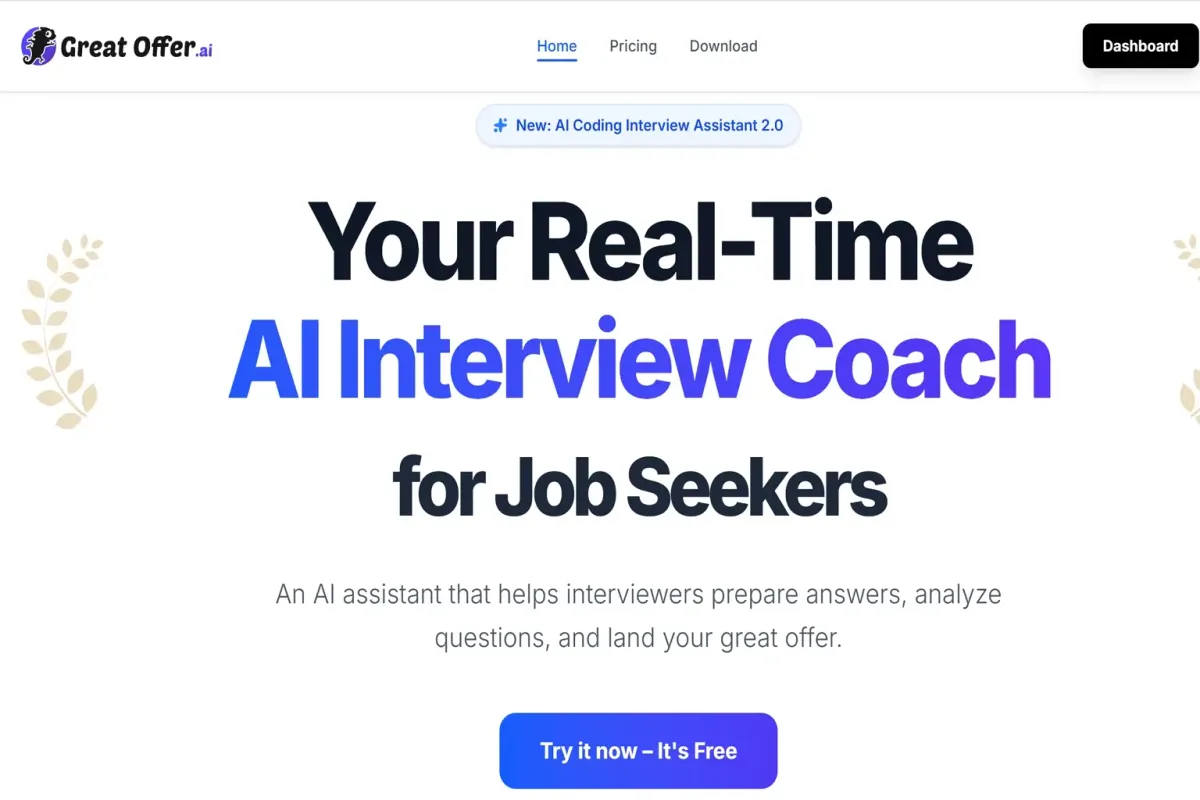
GreatOffer.ai provides real-time interview coaching support, including low-latency guidance and a Focus Mode designed to keep the coaching interface out of your shared screen. It can be used alongside common interview environments such as HireVue, Zoom, Google Meet, Microsoft Teams, and LeetCode.
GreatOffer.ai may be useful when you need help organizing multi-part questions, recalling prepared evidence, or keeping your answers structured under pressure. It should support preparation and communication—not replace your judgment, experience, or authentic answers.
Important: treat any real-time copilot as “allowed-only.” Use it only if the employer/interview explicitly allows it, and only in a way you can explain and stand behind. If it starts generating answers you can’t justify, it increases your risk under follow-up questions.
Want more structured support during your next interview? Explore GreatOffer.ai to see how its real-time coaching features work, then confirm that using an interview assistant is permitted before enabling it in a live interview.
Safer Alternatives
- do an AI mock interview beforehand
- use your own keyword notes
- prepare a STAR story sheet
- use allowed caption features
- use AI after the interview for a debrief
11. Prepare for Different Interview Formats

In-Person Interview
- Route
- Parking
- Building access
- Printed resumes
- Portfolio
- Arrival time
Video Interview
- Camera position (eye-level)
- Lighting
- Microphone
- Internet connection
- Background
- Notifications
- Backup contact method
- Interview link
- Headset (reduces echo) + do a 10-second test recording
- Know when you’ll screen share (and close sensitive tabs beforehand)
- Have a backup device ready (phone or second laptop) and a reconnect plan
- Update the app early (don’t install updates 5 minutes before)
One-Way or Asynchronous Video Interview
In one-way interviews, you record answers without a live interviewer (often timed). Prep is different:
- Understand the rules: time limit, number of retakes, and whether you can rewatch before submitting.
- Practice with a timer: rehearse 45–90 second answers that land a clear point fast.
- Camera rehearsal: record a full run-through to fix eye line, lighting, and filler words.
- Plan for retakes: if retakes are limited, don’t “burn” them early—do one calm practice first.
Phone Interview
- Quiet location
- Charged phone
- Resume and notes
- Strong verbal structure
- No reliance on visual cues
Panel Interview
- Record interviewer names
- Address the questioner first
- Include the rest of the panel
- Prepare for different priorities
Technical or Case Interview
- Practice explaining the thought process
- Clarify assumptions
- Test the solution
- Accept feedback
- Avoid jumping directly to an answer
12. What to Do the Day Before the Interview
Use this as a real checklist:
- Review the job description
- Review your three selling points
- Read your five STAR stories
- Confirm the time and location
- Test the interview link
- Prepare your clothes
- Print or save documents
- Prepare questions
- Set alarms
- Sleep instead of continuing to cram
13. What to Do on the Day of the Interview
Before the Interview
- Eat something appropriate
- Review keywords, not complete scripts
- Arrive or connect early
- Silence notifications
- Keep water nearby
- Complete a brief voice warm-up
During the Interview
- Listen to the complete question
- Pause before answering
- Ask for clarification
- Use specific examples
- Keep answers focused
- Admit when you do not know something
- Connect answers back to the role
If You Make a Mistake
You can correct yourself:
- “I’d like to clarify one part of my previous answer.”
14. Follow Up After the Interview
Take Notes Immediately
Write down:
- questions asked
- answers that went well
- answers that need improvement
- interviewer priorities
- important details about the role
Send a Thank-You Email
Include:
- appreciation for their time
- one specific detail you discussed
- renewed interest in the role
- a brief connection to your strengths
Use AI for Post-Interview Review
AI can help you:
- analyze questions
- improve answers
- generate a practice plan for the next round
- edit your thank-you email
But you should always verify details and personalize the final output.
Interview Preparation Plans Based on Time Available
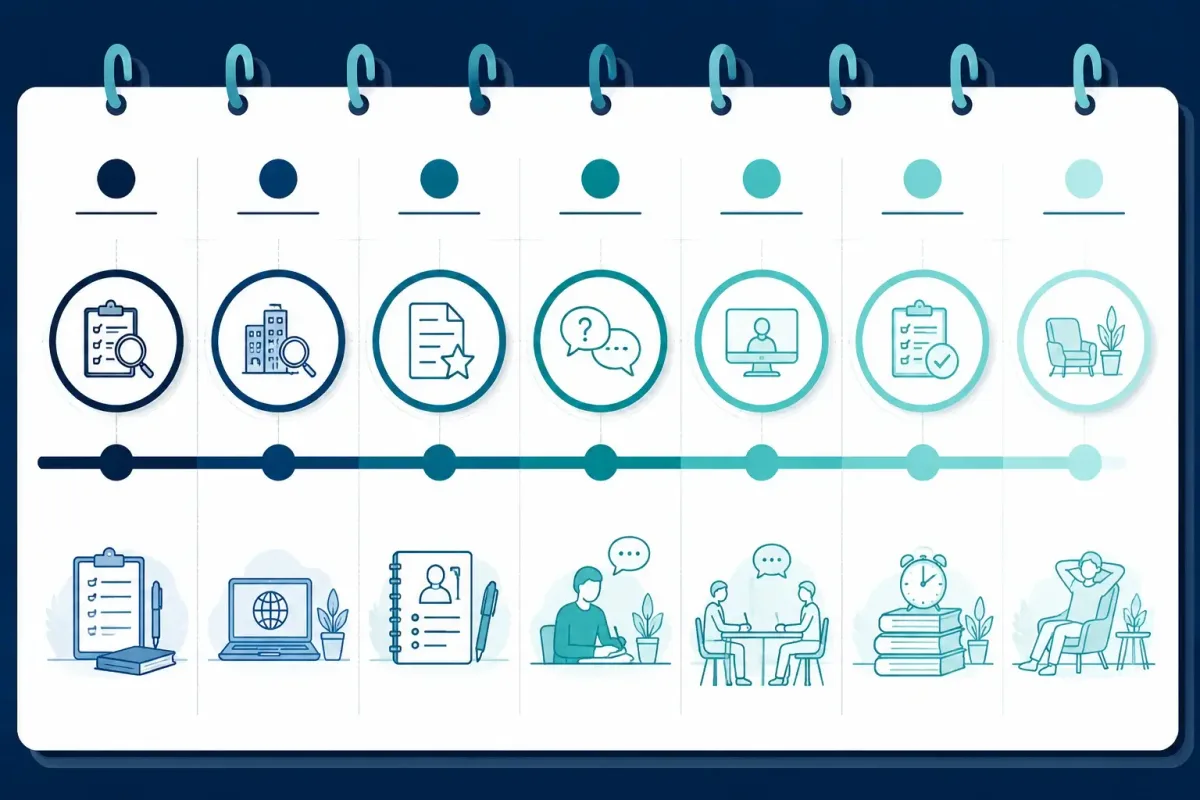
Seven-Day Interview Preparation Plan
- Day 1: Analyze the job description
- Day 2: Research the company
- Day 3: Build a STAR story bank
- Day 4: Practice common questions
- Day 5: Do an AI mock interview
- Day 6: Fix weak answers and prepare questions
- Day 7: Check logistics, light review, and rest
24-Hour Interview Preparation Plan
Prioritize:
- research the role and company
- confirm your three core strengths
- prepare three STAR stories
- practice five high-frequency questions
- prepare three questions
- check interview equipment or route
30-Minute Emergency Plan
- 5 minutes: read the job description
- 5 minutes: check the company website
- 5 minutes: prepare your introduction
- 10 minutes: prepare two STAR stories
- 3 minutes: prepare questions
- 2 minutes: check the link and equipment
Conclusion
Strong interview preparation is evidence-based: understand the role, research the company, identify the value you offer, and practice examples that prove it. A small set of flexible STAR stories and thoughtful questions will help you respond naturally instead of relying on memorized scripts.
Finish by rehearsing in a realistic format, reducing avoidable logistics, and planning your follow-up. The goal is not a perfect performance; it is to communicate your real experience clearly, confidently, and credibly.