 Mike Chen
 Sasha
Sasha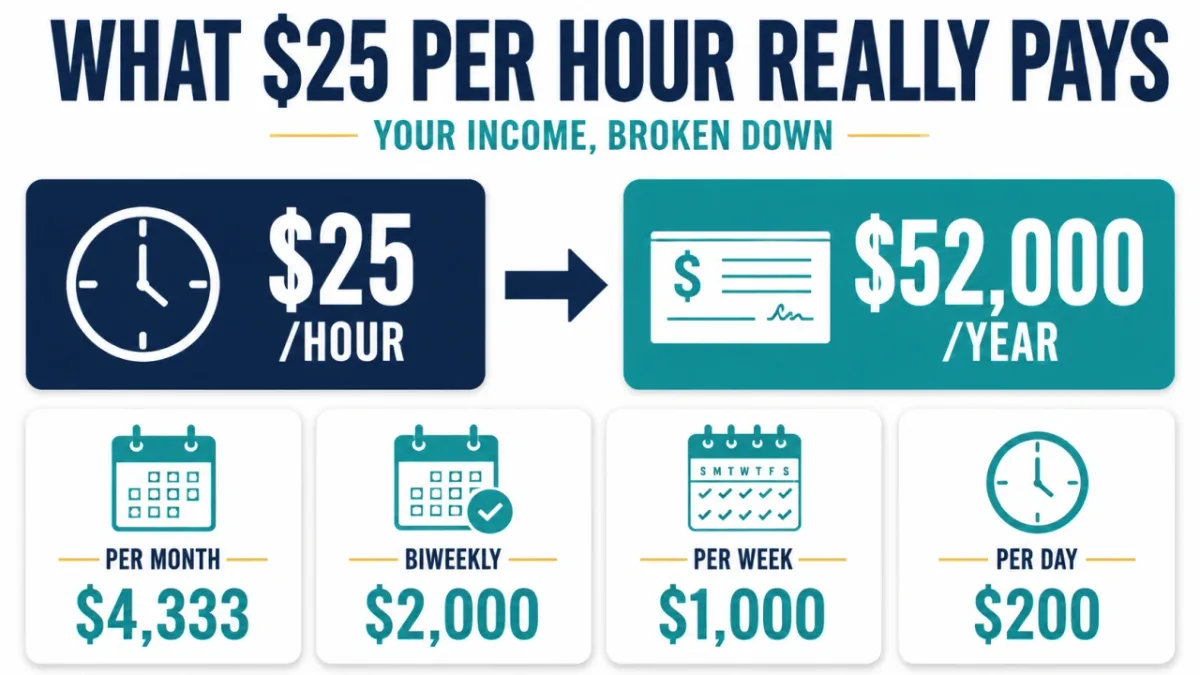
$25 an hour equals $52,000 a year before taxes if you are paid for 40 hours a week for 52 weeks. That works out to $1,000 per week, $2,000 for an 80-hour biweekly pay period, and an average of $4,333.33 per month.
The $52,000 figure is gross pay, not take-home pay. It also assumes 2,080 paid hours. Your actual income may be lower or higher depending on guaranteed hours, paid time off, unpaid leave, overtime, taxes, benefits, and whether the job is W-2 employment or 1099 contract work.
Quick pay breakdown at $25 an hour
The standard calculation is:
$25 × 40 paid hours × 52 paid weeks = $52,000 gross per year
| Pay period or schedule | Gross pay |
|---|---|
| 8-hour day | $200 |
| 40-hour week | $1,000 |
| 80-hour biweekly pay period | $2,000 |
| Semimonthly, 24 checks per year | $2,166.67 |
| Average month | $4,333.33 |
| 40 hours × 52 weeks | $52,000 per year |
| 35 hours × 52 weeks | $45,500 per year |
| 30 hours × 52 weeks | $39,000 per year |
| 20 hours × 52 weeks | $26,000 per year |
| 40 hours × 50 weeks | $50,000 per year |
| 40 hours × 48 weeks | $48,000 per year |
These amounts are before taxes and paycheck deductions.
How to convert $25 an hour to annual pay
Use this formula:
Annual gross pay = hourly rate × average paid hours per week × paid weeks per year
Many calculators use 2,080 hours because 40 hours a week multiplied by 52 weeks equals 2,080. At $25 an hour:
$25 × 2,080 = $52,000
That shortcut is accurate only when all 2,080 hours are paid. An hourly rate by itself does not guarantee a specific annual income.

Count paid hours, not scheduled hours
A schedule may show 40 hours, but annual pay can still fall below $52,000 if shifts are cut or time away is unpaid. Seasonal demand, delayed start times, early clock-outs, unpaid sick days, and unpaid vacation can all reduce paid hours.
For a more realistic estimate, review several recent schedules or pay stubs and calculate your average paid hours. Then multiply that average by the number of weeks you expect to be paid.
For example, averaging 35 paid hours for all 52 weeks produces:
$25 × 35 × 52 = $45,500 gross per year
The key question is not only “What is the hourly rate?” It is also “How many paid hours can I reasonably expect?”
Part-time work and unpaid time off
At $25 an hour, weekly hours have a large effect on annual pay.
| Average paid hours per week | Weekly gross | Annual gross at 52 weeks |
|---|---|---|
| 20 | $500 | $26,000 |
| 30 | $750 | $39,000 |
| 35 | $875 | $45,500 |
| 40 | $1,000 | $52,000 |
Unpaid weeks matter too. If you work 40 paid hours a week but receive no pay during time off, 50 paid weeks produces $50,000 and 48 paid weeks produces $48,000.
Paid vacation, holidays, and sick leave can help preserve annual income because those hours remain paid. Unpaid leave lowers annual income even though the stated hourly rate does not change. When comparing jobs, ask how many hours are guaranteed and exactly which types of leave are paid.
Weekly, biweekly, semimonthly, and monthly pay
At 40 paid hours a week, gross weekly pay is $1,000. The amount per check depends on the payroll schedule.
Weekly: A 40-hour check is $1,000 gross. There are typically 52 weekly paychecks in a full year.
Biweekly: An 80-hour check is $2,000 gross. A biweekly schedule normally produces 26 checks a year. That often creates two calendar months with three paychecks, but it does not increase annual pay; it changes when the money arrives.
Semimonthly: With 24 equal pay periods, $52,000 divided by 24 is $2,166.67 gross per check. Hourly semimonthly checks may vary if the number of paid hours in each period differs.
Monthly average: $52,000 divided by 12 is $4,333.33. This is an annual average, not necessarily the amount of any particular deposit.
If you are paid biweekly, building a recurring monthly budget around two regular paychecks can make cash flow easier to manage. The two three-paycheck months can then support irregular expenses, savings, or debt payments rather than permanent monthly commitments.
How much is overtime at $25 an hour?
When time-and-a-half applies, the overtime rate is:
$25 × 1.5 = $37.50 per overtime hour
If an eligible worker receives 40 regular hours and five overtime hours every week, the calculation is:
- Regular pay: 40 × $25 = $1,000 per week.
- Overtime pay: 5 × $37.50 = $187.50 per week.
- Total weekly gross: $1,187.50.
- Total for 52 weeks: $61,750 gross.
This example assumes the five overtime hours continue every week. Overtime is not always available, so avoid relying on it for essential costs unless the schedule is dependable.
Under federal rules, covered, nonexempt employees generally must receive overtime pay for hours over 40 in a workweek. Exemptions and special rules apply, and state law may provide additional protection. Confirm your classification and applicable rules through the U.S. Department of Labor’s overtime resources or a qualified professional.
How much is $25 an hour after taxes?
There is no universal take-home amount for $25 an hour. Workers with the same $52,000 gross income can receive different net pay because withholding and deductions depend on personal circumstances and employer benefits.
Possible paycheck reductions include federal income tax withholding, Social Security and Medicare taxes, state or local income taxes, health insurance premiums, retirement contributions, HSA or FSA contributions, union dues, and other authorized deductions.
For W-2 employees, the IRS lists the employee Social Security withholding rate as 6.2% and the Medicare withholding rate as 1.45%, subject to the rules and limits described by the agency. See IRS Topic No. 751 for current details.
Federal income-tax brackets are marginal. A higher bracket does not apply that rate to every dollar you earn. Different portions of taxable income can be taxed at different rates, while deductions and credits affect the final result. The IRS publishes current thresholds on its federal income tax rates and brackets page.

How to estimate your take-home pay
Use a current paycheck calculator and enter your actual details rather than relying on a generic percentage. Start with your expected gross pay, then enter your state, filing status, pay frequency, and withholding information. Add known insurance and retirement deductions. Finally, adjust annual income for variable hours or unpaid leave.
Treat the result as an estimate. Compare it with your first complete paycheck and update your budget if the actual deductions differ.
A paycheck with overtime may show higher withholding because payroll calculations can project that pay level across the year. That does not automatically mean every overtime dollar is taxed at a separate, permanently higher rate.
Is $25 an hour a good wage?
At 40 paid hours a week, $25 an hour is $52,000 gross a year. Whether that is enough depends on where you live, who depends on the income, and what the job costs you.
It may be workable for one adult in some lower- or moderate-cost areas, especially with stable hours, manageable housing costs, and employer-supported health insurance. It may be tight in a high-cost area or for a household facing childcare, medical bills, high debt payments, or a long commute.
Evaluate these factors before deciding:
- Guaranteed paid hours and schedule stability
- Rent or mortgage and required utilities
- Household size and childcare
- Transportation, parking, and commute time
- Insurance premiums, deductibles, and out-of-pocket costs
- Minimum debt payments
- Paid time off and paid holidays
- Retirement contributions or employer match
- Emergency savings and other financial goals
The MIT Living Wage Calculator can help you compare local basic-needs estimates by county and family type. Its methodology includes location-specific estimates for housing, food, transportation, childcare, health care, other necessities, and taxes. It is a planning benchmark, not a guarantee that a wage will feel comfortable for every household.
Run a fixed-cost pressure test
Calculate:
Monthly fixed-cost pressure = required monthly fixed costs ÷ estimated monthly take-home pay
Include housing, minimum debt payments, transportation, required insurance, childcare, and basic utilities. The result is not a universal pass-or-fail threshold. It simply shows how much of your net income is committed before groceries, savings, and flexible spending.
Can you live on $25 an hour?
You can answer this more reliably with your own numbers than with a national sample budget. Start with estimated monthly take-home pay, then complete this worksheet.
| Budget category | Enter your monthly amount |
|---|---|
| Housing | $_____ |
| Required utilities, phone, and internet | $_____ |
| Groceries | $_____ |
| Transportation and parking | $_____ |
| Health insurance and medical costs | $_____ |
| Childcare | $_____ |
| Minimum debt payments | $_____ |
| Savings | $_____ |
| Flexible spending | $_____ |
| Irregular-expense buffer | $_____ |
Subtract the total from your estimated monthly take-home pay. A positive remainder provides room for irregular costs and changing prices. A negative result means you may need a higher rate, more guaranteed hours, lower expenses, or a different benefits package.

Calculate your personal break-even hourly rate
When comparing jobs, use:
Break-even hourly rate = (required annual gross income + annual work costs) ÷ expected paid hours
Work costs can include commuting, parking, uniforms, tools, licensing, equipment, childcare, and unpaid time. If you need $45,000 in annual gross income, expect $3,000 in annual work costs, and anticipate 1,900 paid hours, the calculation is:
($45,000 + $3,000) ÷ 1,900 = about $25.26 per hour
This is a planning example, not personalized financial advice. Its main lesson is that a slightly lower rate with paid leave and reliable hours may be worth more than a higher rate with unstable hours and substantial work expenses.
W-2 employee vs. 1099 contractor at $25 an hour

A $25-an-hour W-2 job and a $25-an-hour independent-contractor engagement do not necessarily provide equal value.
A W-2 position may include the employer’s share of payroll taxes, paid leave, health-plan contributions, retirement contributions, workers’ compensation coverage, unemployment insurance coverage, and regular payroll. The exact package varies by employer.
A contractor may need to cover self-employment taxes, health insurance, retirement savings, equipment, software, bookkeeping, unpaid time off, and non-billable administrative or business-development time. Contractor classification depends on the working relationship and applicable law, not merely the label in a contract.
Before accepting $25 an hour as a contractor, ask:
- How many hours are billable and how reliably are they available?
- Which expenses must I pay?
- How much time will be non-billable?
- What will insurance and retirement contributions cost?
- How will unpaid vacation and sick time affect annual income?
- When and how will invoices be paid?
The IRS Self-Employed Individuals Tax Center explains federal filing and estimated-payment basics. There is no single contractor markup that is right for everyone, so compare the full economics of both offers.
Jobs that may pay around $25 an hour
Pay varies by occupation, location, experience, credentials, industry, union coverage, and shift. A national median is not a promise that a specific role or employer will pay exactly $25 an hour.
The examples below use May 2024 national median wages from the U.S. Bureau of Labor Statistics Occupational Outlook Handbook. Hourly equivalents are annual medians divided by 2,080 and rounded to the nearest cent; they are comparison figures, not BLS-published hourly rates on these pages.
| Occupation | May 2024 median annual wage | Approx. hourly equivalent | Typical entry-level education shown by BLS | Official source |
|---|---|---|---|---|
| Heavy and tractor-trailer truck drivers | $57,440 | $27.62 | Postsecondary nondegree award | BLS OOH |
| Welders, cutters, solderers, and brazers | $51,000 | $24.52 | High school diploma or equivalent | BLS OOH |
| Bookkeeping, accounting, and auditing clerks | $49,210 | $23.66 | Some college, no degree | BLS OOH |
| General maintenance and repair workers | $48,620 | $23.38 | High school diploma or equivalent | BLS OOH |
| Construction laborers and helpers | $46,050 | $22.14 | Requirements vary; see the BLS occupation page | BLS OOH |
| Medical assistants | $44,200 | $21.25 | Postsecondary nondegree award | BLS OOH |
These are national medians across all workers in each occupation. Entry-level offers may be lower, while experienced workers, certain locations, overtime, certifications, or shift differentials may produce higher pay. Check local job postings and state or metro wage data before using the table to evaluate an offer.
How $25 an hour compares with nearby rates
At 2,080 paid hours a year, each additional $1 per hour adds $2,080 in annual gross pay.
| Hourly rate | Annual gross at 2,080 hours | Increase from $25 |
|---|---|---|
| $25 | $52,000 | — |
| $26 | $54,080 | $2,080 |
| $27 | $56,160 | $4,160 |
| $28 | $58,240 | $6,240 |
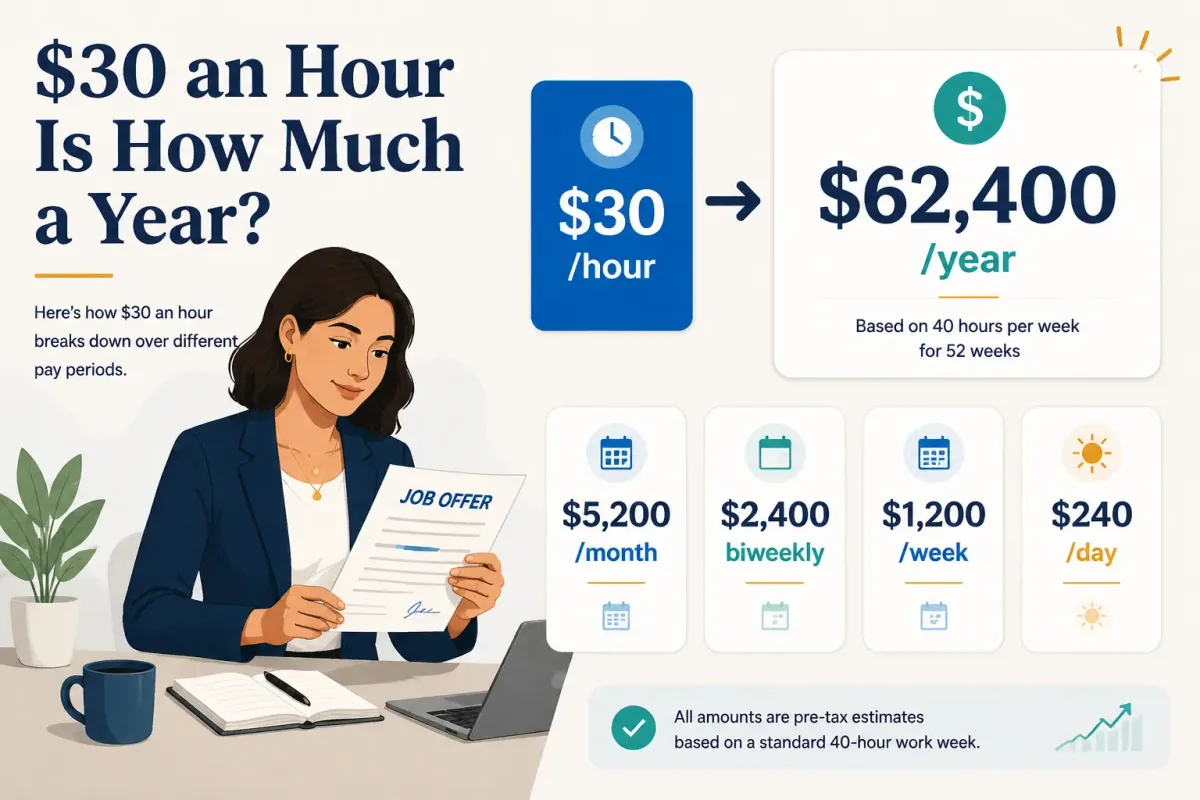
| $30 | $62,400 | $10,400 |
The shortcut applies only if all 2,080 hours are paid. If you expect fewer hours, multiply the rate increase by your own expected annual paid hours.
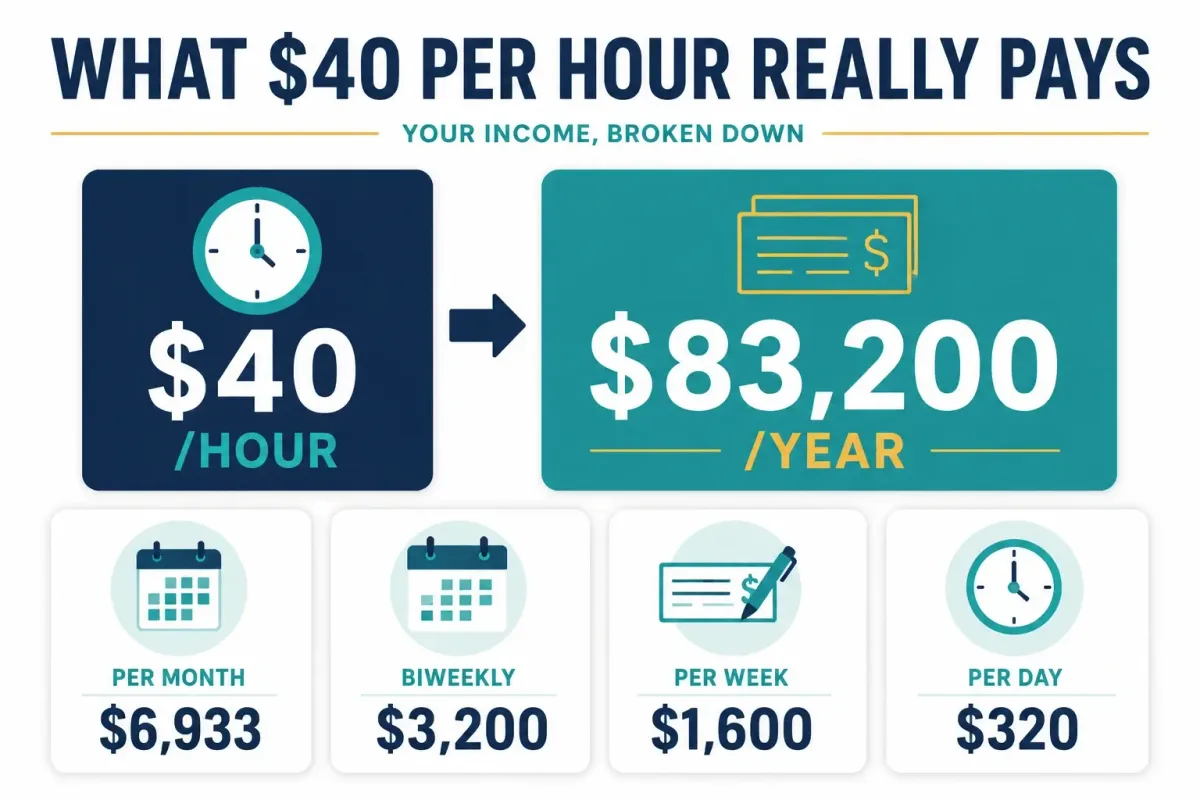
For additional benchmarks, compare what $30 an hour equals annually, the annual salary at $35 an hour, and how much $40 an hour pays per year.
Should you accept a job paying $25 an hour?
Judge the total offer, not only the headline rate. A strong $25-an-hour offer may include guaranteed hours, paid leave, affordable health coverage, a predictable schedule, a reasonable commute, and a clear path to higher pay. A weaker offer may combine unstable hours, high work expenses, limited benefits, or contractor status with no rate adjustment.

Use this scorecard before accepting or negotiating:
| Factor | Question to ask |
|---|---|
| Rate | Is $25 competitive for this role and location? |
| Hours | How many paid hours are guaranteed? |
| PTO | Are vacation, sick leave, and holidays paid? |
| Insurance | What are the premium, deductible, network, and employer contribution? |
| Retirement | Is there an employer contribution or match? |
| Overtime | Is it available, required, and properly paid? |
| Schedule | Is it predictable, and how far ahead is it posted? |
| Commute | What will it cost in time, fuel, fares, parking, or childcare? |
| Status | Is the role W-2 employment or 1099 contract work? |
| Growth | Are raises, training, or promotion opportunities defined? |
Reasons to negotiate can include reliable market evidence, specialized skills, measurable achievements, weak benefits, added work costs, or another offer. Caution signs include vague pay terms, unpaid work expectations, unpredictable hours, unexplained deductions, or a classification that does not match the actual working relationship.
If you decide to negotiate, prepare a short evidence-based request and practice saying it aloud. GreatOffer.ai is an optional way to rehearse an offer or raise conversation before speaking with an employer.
Bottom line
At 40 paid hours a week for 52 weeks, $25 an hour equals $52,000 per year before taxes. It also equals $1,000 per week, $2,000 for an 80-hour biweekly period, and an average of $4,333.33 per month.
The more important decision is what the job produces after variable hours, unpaid time, taxes, deductions, commuting costs, and benefits. Confirm guaranteed paid hours, estimate take-home pay with your own details, compare local living costs, and evaluate the full offer before accepting or negotiating.