 Sasha
Sasha Mike Chen
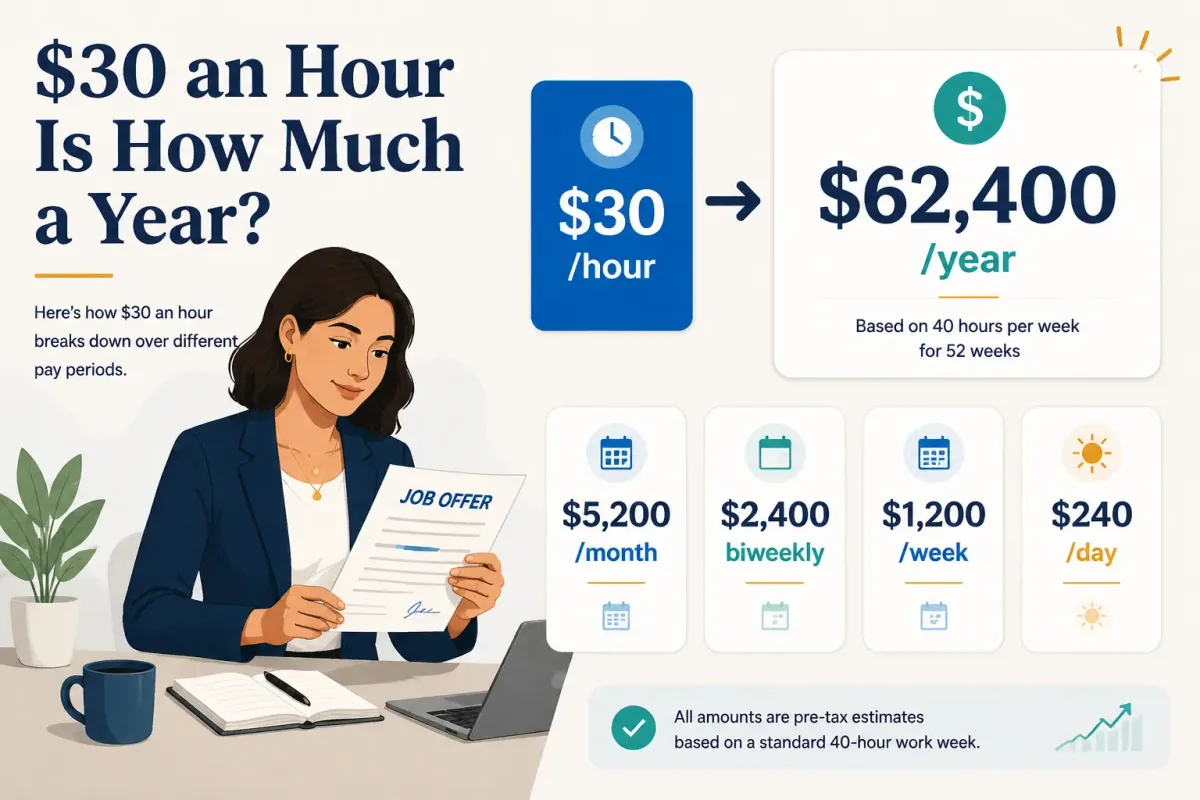
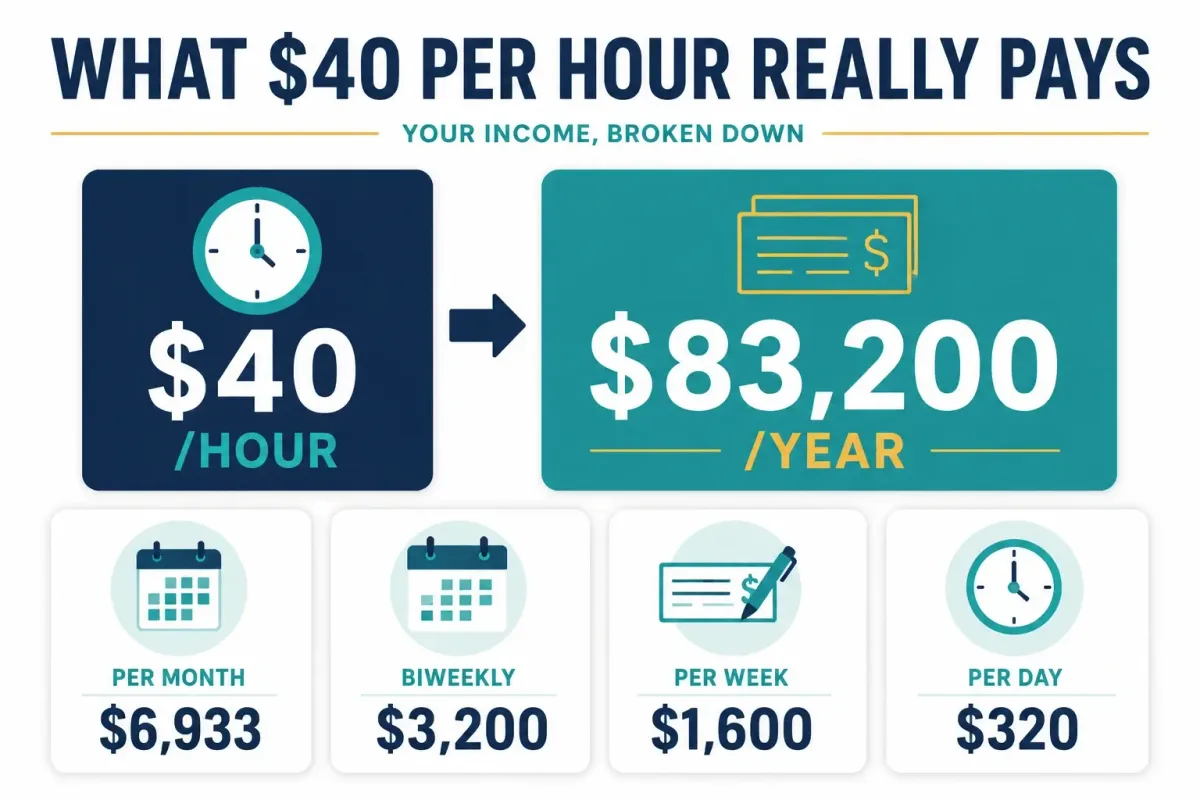
Formula: $40 × 40 hours/week × 52 weeks/year = $83,200/year in gross pay.
This is the standard full-time assumption. Your actual income can change if you work different weekly hours, take unpaid time off, or earn overtime pay.
Quick Salary Table
| Pay period | Gross income before taxes |
|---|---|
| Yearly | $83,200 |
| Average monthly | $6,933.33 |
| Semimonthly | $3,466.67 |
| Biweekly | $3,200 |
| Weekly | $1,600 |
| Daily, 8 hours | $320 |
How to Calculate $40 an Hour as an Annual Salary
The formula is simple:
hourly rate × weekly hours × weeks worked = annual gross pay
Most calculators use 2,080 working hours because it’s the standard “full-time” baseline:
- 40 hours/week × 52 weeks = 2,080 hours
- $40/hour × 2,080 hours = $83,200/year
Paid time off vs. unpaid time off
The “52 weeks” assumption is only accurate if you’re paid for your full year:
- A W-2 employee often has paid time off (PTO) and paid holidays, so gross pay can stay close to the full $83,200.
- A 1099 contractor (or an hourly role with unpaid gaps) may realistically work 48–50 paid weeks, not 52.
If you want to adjust quickly, change either weekly hours or weeks worked.
How Much Is $40 an Hour per Month?
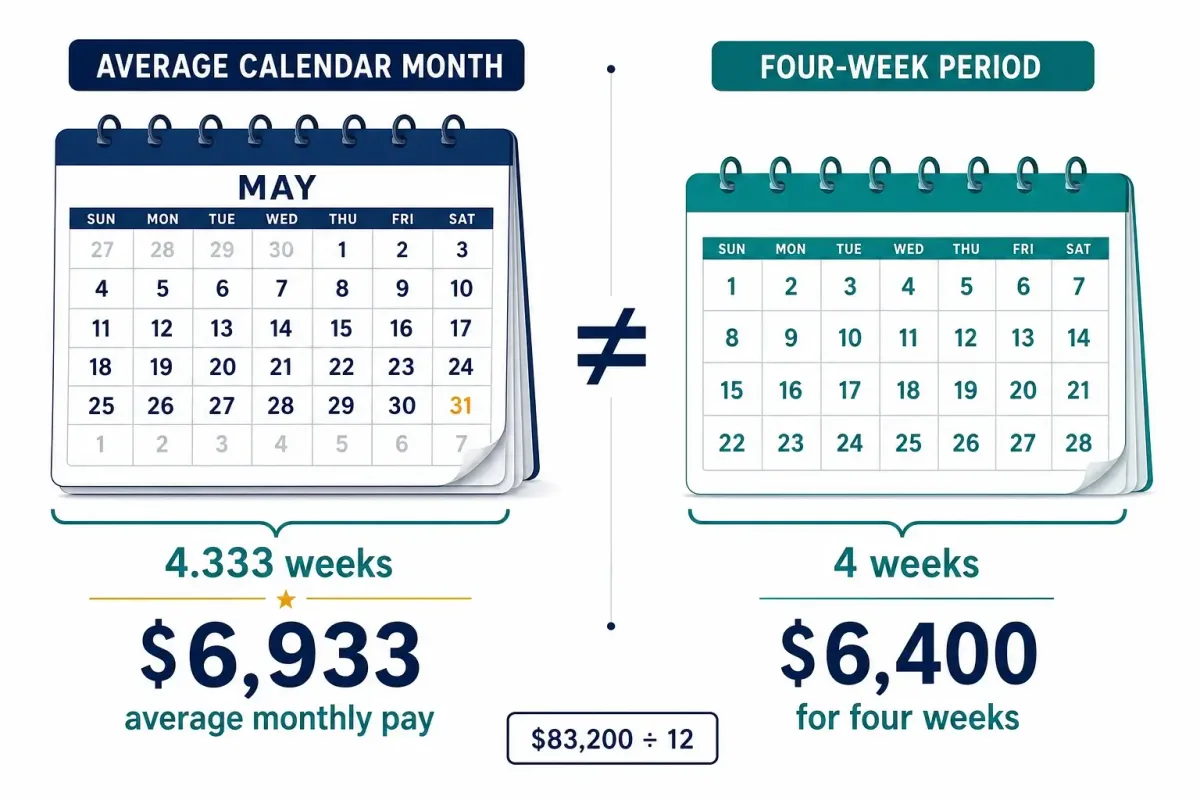
Average Monthly Pay — $6,933
Average month = annual ÷ 12:
$83,200 ÷ 12 = $6,933.33 gross per month.
For monthly budgeting, this is the more useful figure because it matches how most monthly bills work.
Four Weeks of Pay — $6,400
Four weeks of pay is:
$40 × 40 × 4 = $6,400
That’s real, but it’s not the same as an average calendar month. Most months are longer than 4 weeks. On average, a month is about 4.333 weeks (52 ÷ 12), which is why the average monthly number is higher.
Weekly, Biweekly and Semimonthly Pay
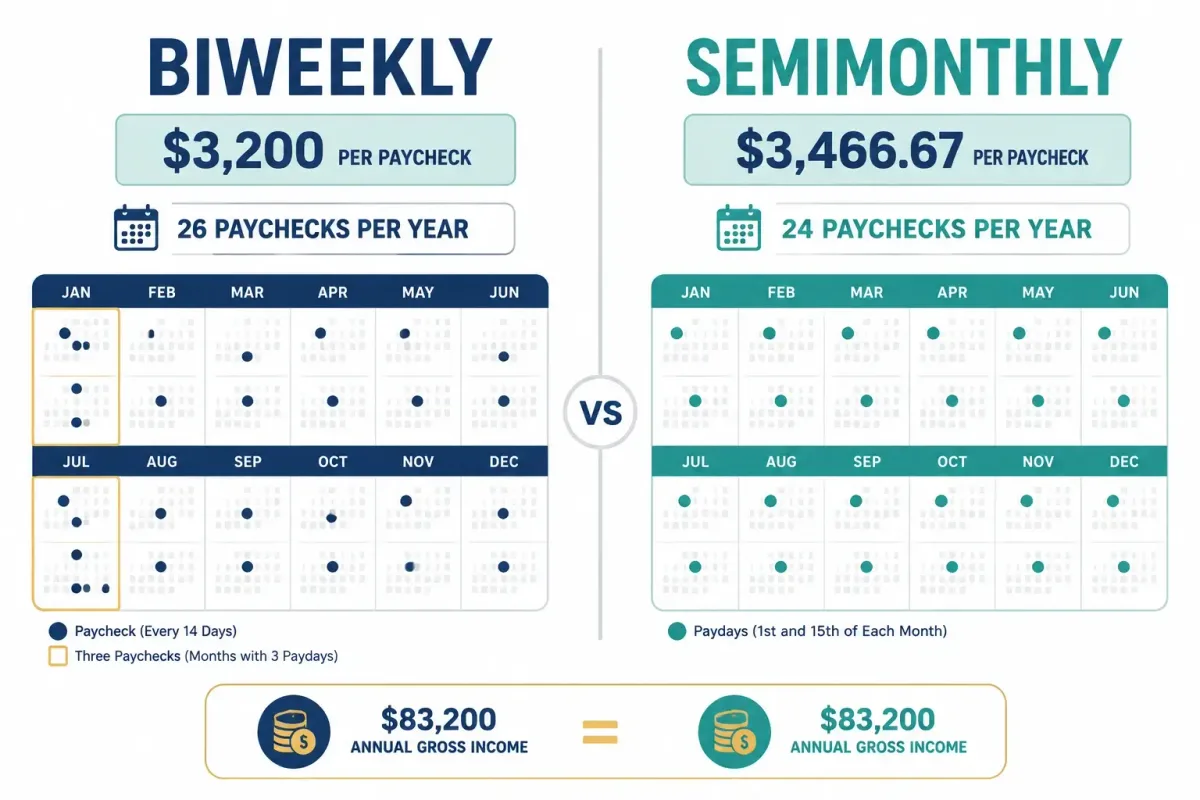
- $40 an hour weekly (40 hours/week) = $1,600 gross
- Biweekly = $3,200 gross per paycheck (typically 26 paychecks/year)
- Semimonthly = $3,466.67 gross per paycheck (exactly 24 paychecks/year)
Why biweekly isn’t “twice a month”
Biweekly pay means every two weeks. Since 52 weeks ÷ 2 = 26, you usually get 26 checks, not 24—so two months often have a “third paycheck.”
Semimonthly pay is exactly two checks each month. Same annual income, different cash-flow rhythm.
What If You Work Fewer Weeks or Different Hours?
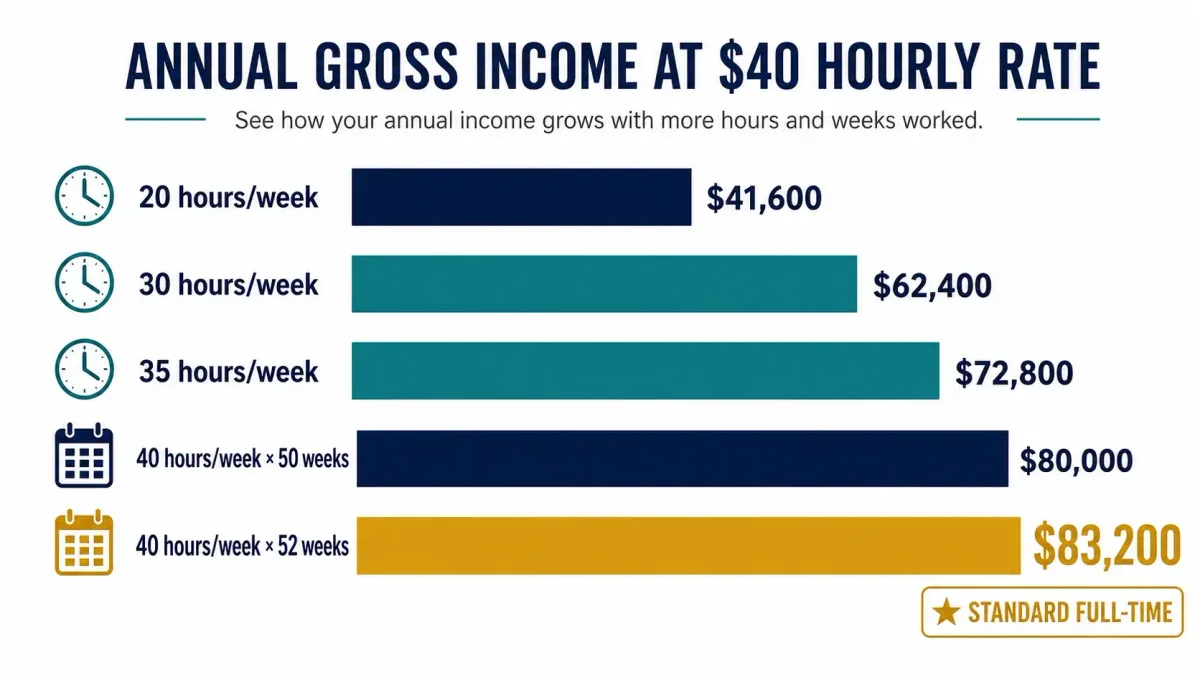
Here is how annual pay at $40 an hour changes with different weekly hours and paid working weeks:
| Work schedule | Gross per year |
|---|---|
| 40 hours/week × 50 weeks | $80,000 |
| 35 hours/week × 52 weeks | $72,800 |
| 30 hours/week × 52 weeks | $62,400 |
| 20 hours/week × 52 weeks | $41,600 |
If you’re considering $40 an hour part time, ask one question first: How many hours are actually guaranteed? A “$40/hour” offer that averages 25–30 hours/week is a very different financial picture than a stable 40.
How Much Is $40 an Hour With Overtime?
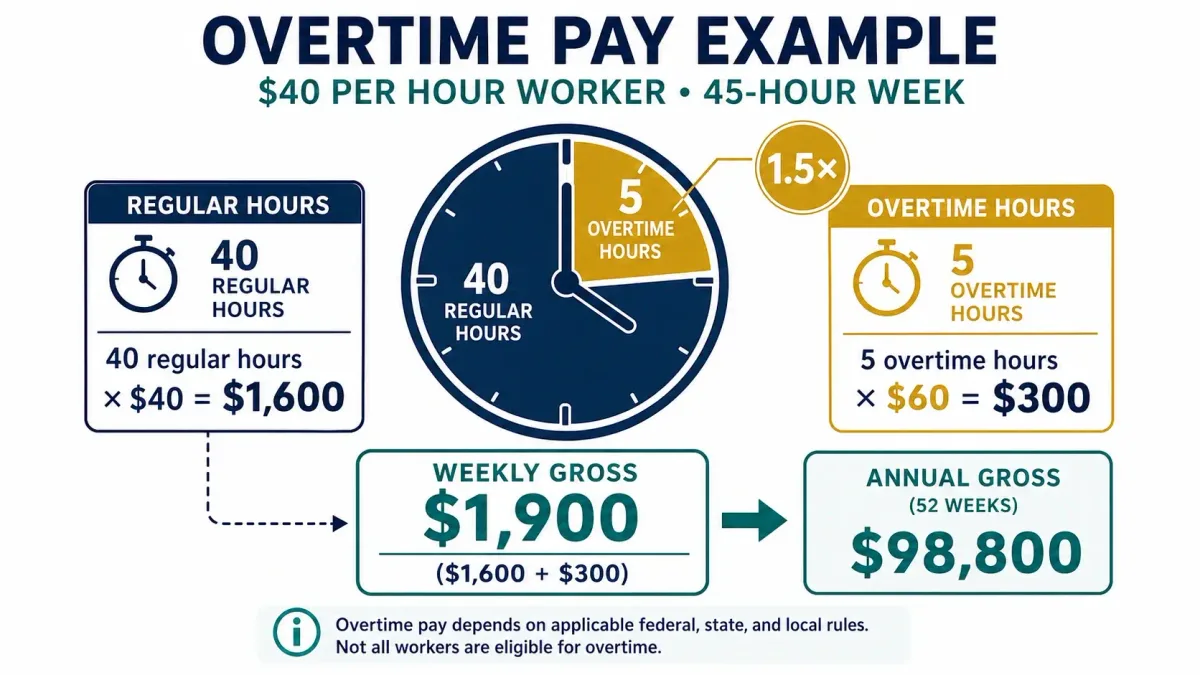
At $40 an hour, the federal time-and-a-half overtime rate is $60 per hour for covered, nonexempt employees. Your annual income depends on how many overtime hours you actually work.
For covered, nonexempt employees, the U.S. Department of Labor explains overtime is paid at not less than time and one-half the regular rate for hours worked over 40 in a workweek (see the DOL’s Overtime Pay guidance).
- Regular rate: $40/hour
- 1.5× overtime rate: $60/hour
Example: 45 hours/week
- 40 hours × $40 = $1,600
- 5 overtime hours × $60 = $300
- Weekly gross = $1,900
- Annual gross = $1,900 × 52 = $98,800/year
Pro Tip: If overtime is part of why you’re taking the job, confirm how often overtime is actually available—and whether you need approval before working it.
How Much Is $40 an Hour After Taxes?
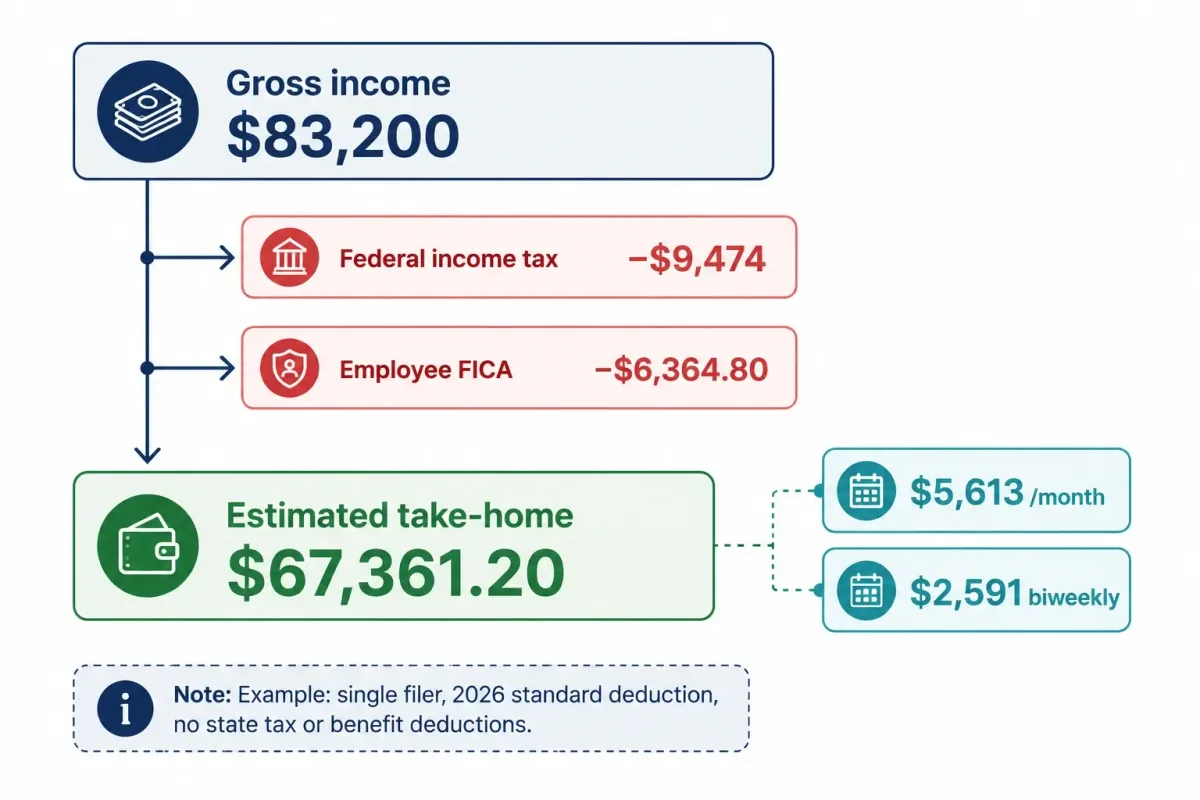
Under the example assumptions below, $40 an hour produces estimated take-home pay of about $67,361 per year, $5,613 per month, or $2,591 biweekly. Your actual take-home pay depends on your filing status, deductions, benefits, and state/local taxes.
Instead of using a vague “25% tax” shortcut, the following 2026 example shows the assumptions and calculation.
Taxes That May Be Deducted
Common paycheck deductions include:
- Federal income tax
- FICA (Social Security + Medicare)
- State and local income taxes (if applicable)
- Health insurance premiums
- Retirement contributions
A Transparent 2026 Example
Assumptions (example only):
- Single filer
- Standard deduction
- No state/local income tax
- No pre-tax retirement or health deductions
- W-2 employee earning $83,200 gross
1) Gross income
- Gross pay: $83,200
2) Taxable income (simplified)
The IRS lists a 2026 standard deduction of $16,100 for single filers in its 2026 inflation adjustments release.
- Taxable income ≈ $83,200 − $16,100 = $67,100
3) Estimated federal income tax (2026 brackets)
Applying 2026 single-filer brackets to $67,100 of taxable income yields an estimated federal income tax of about $9,474.
4) Estimated FICA (employee share)
The IRS summarizes employee FICA rates in Tax Topic 751: 6.2% Social Security + 1.45% Medicare = 7.65%.
- FICA ≈ $83,200 × 7.65% = $6,364.80
This income is below the Social Security wage base cap; the Social Security Administration lists the 2026 wage base as $184,500 on its Contribution and Benefit Base page.
5) Estimated take-home pay (no state tax, no benefits withheld)
- Take-home ≈ $83,200 − $9,474 − $6,364.80 = $67,361.20/year
| Example component | Annual amount |
|---|---|
| Gross income | $83,200.00 |
| Estimated federal income tax | −$9,474.00 |
| Estimated employee FICA | −$6,364.80 |
| Estimated take-home pay | $67,361.20 |
That is roughly $5,613 per month or $2,591 biweekly before state and local taxes or benefit deductions.
⚠️ Disclaimer: This is an educational estimate. Payroll withholding and final tax liability can differ (credits, other income, deductions, benefits, and your state).
Is $40 an Hour Good Pay?
A clean way to sanity-check “good pay” is to compare weekly earnings.
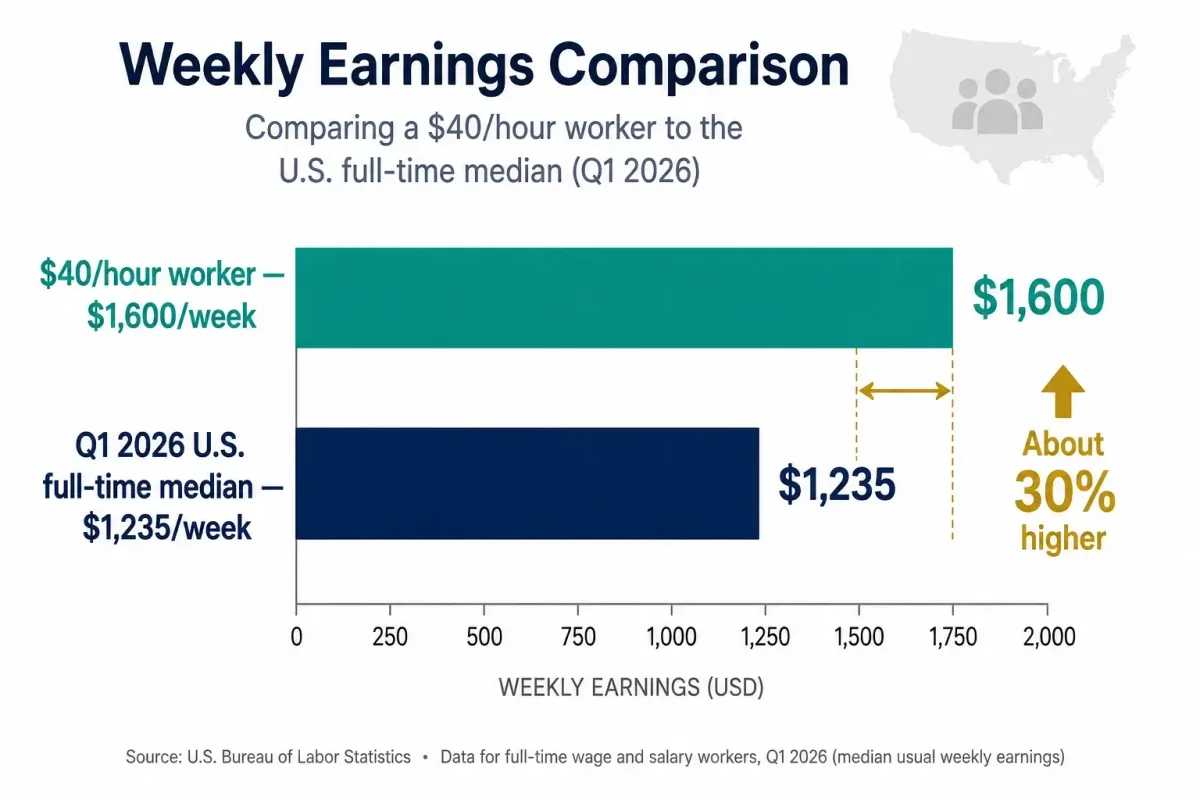
At $40/hour and 40 hours/week, you make $1,600/week gross.
For context, the U.S. Bureau of Labor Statistics reported that median weekly earnings for full-time wage and salary workers were $1,235 in Q1 2026, according to the BLS news release Usual Weekly Earnings—First Quarter 2026.
So $1,600/week is about 30% higher than the overall median.
Whether it feels good depends on:
- cost of living where you live
- household size
- debt and fixed expenses
- benefits (health insurance and retirement match can be worth thousands)
Is $40 an Hour Better as W-2 or 1099 Pay?
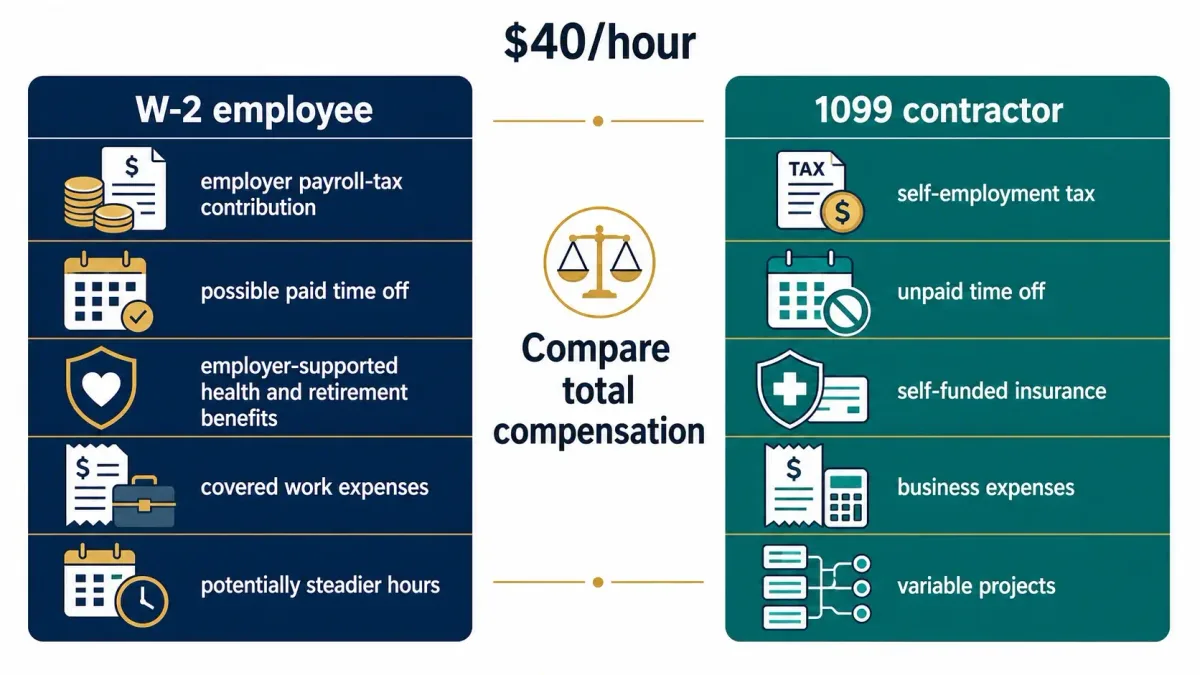
A $40/hour W-2 role is often worth more than a $40/hour 1099 contract once payroll taxes, unpaid time, insurance, and employer benefits are included. The better option still depends on the benefits offered, business expenses, schedule, and contractor deductions.
| Factor | W-2 employee | 1099 contractor |
|---|---|---|
| Payroll taxes | Employer pays the employer share; worker pays the employee share | Worker generally pays self-employment tax |
| Paid time off | May include paid holidays and PTO | Time off is usually unpaid |
| Health and retirement benefits | May be subsidized by the employer | Usually purchased or funded by the contractor |
| Work expenses | Often covered by the employer | May include equipment, insurance, licensing, and other business costs |
| Income stability | May include guaranteed hours | Hours and projects may vary |
The IRS explains that the self-employment tax rate generally consists of 12.4% Social Security tax and 2.9% Medicare tax, although the taxable amount and available deductions require a separate calculation.
A practical approach: compare offers using total compensation, not just the hourly rate.
How to Evaluate a Job Offer Paying $40 an Hour
When you see an offer like this, it’s easy to focus on the headline rate. But converting $40 an hour into a salary only tells you the gross number—your schedule, taxes, and benefits decide what you can actually spend.
Before you accept a $40/hour offer, check the details that change your real income:
- Guaranteed hours: Is it truly 40 hours/week?
- PTO and holidays: Are you paid when you’re off?
- Benefits cost: How much comes out of your paycheck for insurance?
- Overtime rules: Are you eligible, and how often is overtime available?
- Hidden costs: commute, tools, licensing, childcare.
If you’re negotiating and interviewing for roles in this pay range, it also helps to be sharp about questions and prep. Two resources:
- An interview preparation checklist
- Smart questions to ask in an interview (including compensation, schedule, and growth)
And if you want a private, on-device interview coach to stay calm and structured in the high-pressure moments, you can take a look at GreatOffer.ai (keep in mind employer/interview policies).
Sources and Methodology
- Standard annual salary uses 2,080 paid hours: 40 hours per week × 52 weeks.
- Monthly pay is calculated as annual gross income ÷ 12; four weeks of pay is shown separately to avoid mixing the two figures.
- The take-home example uses the IRS 2026 single-filer standard deduction and tax brackets, employee FICA rates, no state or local income tax, and no credits or benefit deductions.
- Overtime calculations use the federal time-and-a-half rule for covered, nonexempt employees; eligibility and state rules may differ.
- The national earnings comparison uses the BLS Q1 2026 median weekly earnings release.
- Figures are educational estimates and are rounded where noted. Last verified: July 20, 2026.