 Sasha
Sasha Mike Chen
If you’re preparing for an Amazon interview in 2026, don’t try to memorize 22 scripts.
Amazon is evaluating whether your past behavior predicts strong judgment under pressure—especially when the customer is unhappy, the data is incomplete, and the team doesn’t agree.
This guide is built for candidates in preparation mode: you’ll get a set of questions, what they’re really testing, STAR frameworks, follow-ups, and role-specific examples.
What to Expect in an Amazon Interview
Behavioral, Technical, and Role-Specific Questions
Most candidates hear “Amazon interview questions” and expect a simple list.
In reality, Amazon questions follow a few consistent patterns.
Behavioral questions tend to map to Leadership Principles. Amazon’s official guidance emphasizes behavioral interviewing through STAR and explicitly says it avoids brain teasers because they’re not indicative of real performance (see Amazon’s STAR interview tips).
Technical questions vary by role. Engineers might code and do system design. Data roles may discuss analysis approaches. Operations roles may dig into process improvement under safety/quality constraints.
Role-specific questions test how you prioritize, communicate, and make trade-offs in the job you’re interviewing for.
The Interview Loop
Many Amazon roles use a “loop” style interview: multiple interviewers, each probing different competencies.
A few realities:
- You might talk to several people in one day, or across multiple days.
- Interviewers often focus on different Leadership Principles.
- The number of rounds and the balance of technical vs behavioral vary by role, level, and team.
For Amazon’s official overview of how the process works end-to-end, read Your complete guide to the Amazon interview process.
What One Amazon Engineering Candidate Experienced
Official guidance tells you the structure.
Candidate experience tells you what it can feel like.
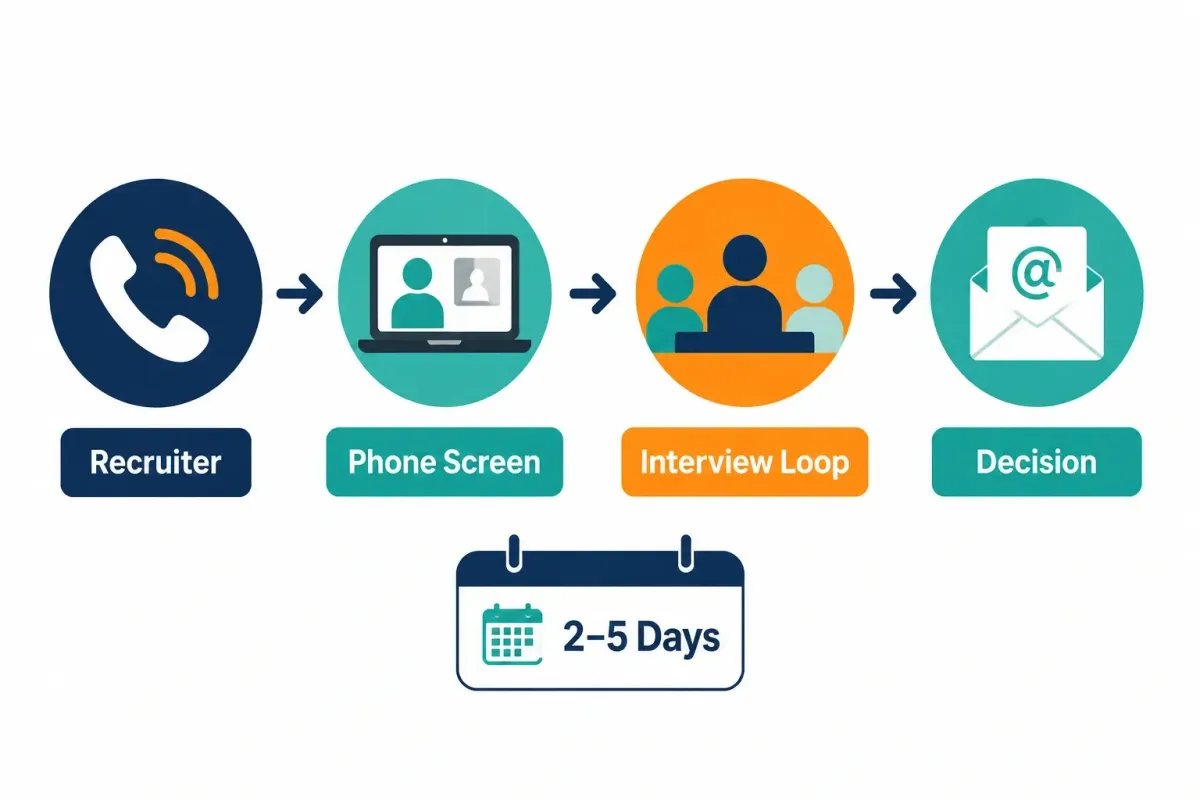
One successful Amazon engineering candidate described a process that included recruiter contact, a technical phone screen, a recruiter preparation call, and a four-to-six-interviewer loop.
They also believed the technical phone screen didn’t only probe isolated technical knowledge. It explored workflow, thinking process, project experience, and relevant software experience.
This is one person’s experience—not a universal Amazon process.
You can read the original Reddit post here: Amazon Interview 101: Comprehensive Guide for Engineering Roles.
Amazon’s 2 & 5 Promise
Candidates often want a simple timeline.
Amazon’s technical-role guidance says candidates should hear back within two to five business days after an interview concludes (Interview prep for technical roles).
Treat this as a general expected range rather than a guaranteed stage-by-stage schedule. Response times can still vary by role, team, interview format, and hiring volume.
Two Opening Amazon Interview Questions
These two opening questions are not tied to only one Leadership Principle, but they shape the interviewer’s first impression and often determine which parts of your background receive follow-up questions.
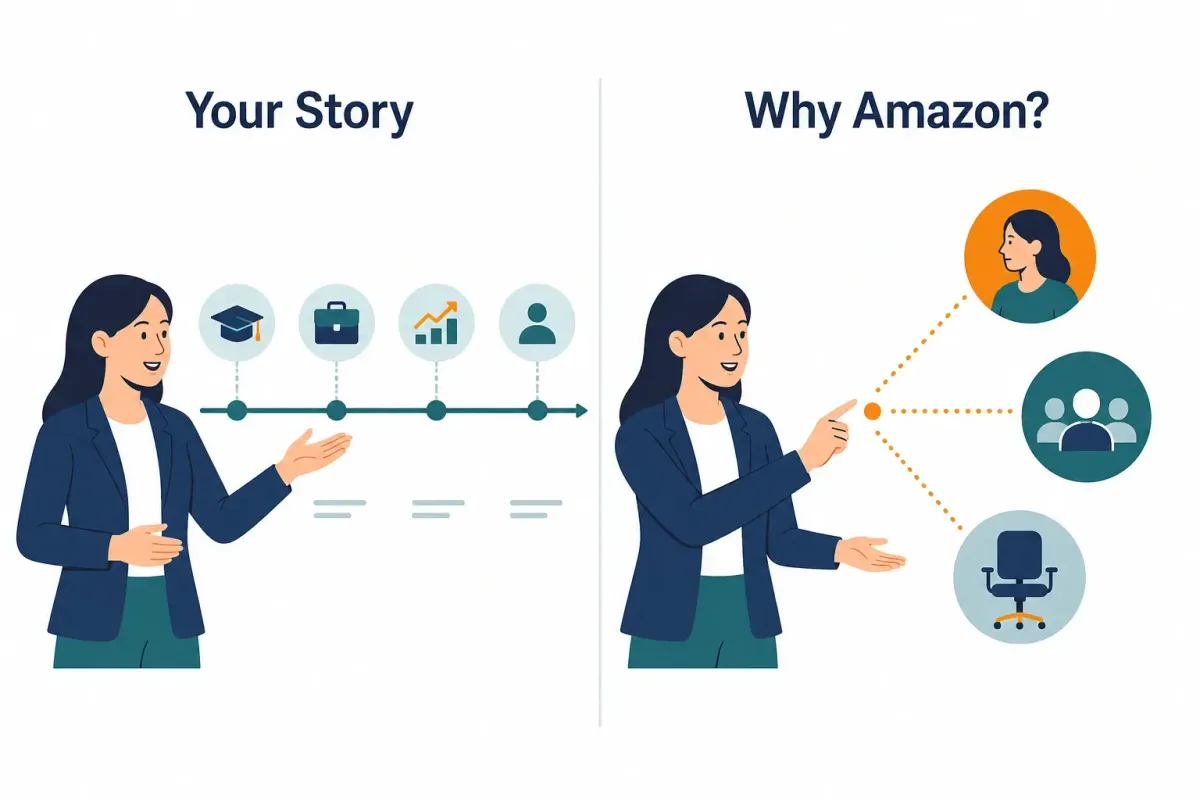
Tell Me About Yourself
A strong answer should connect your current work, relevant past experience, and reason for pursuing this Amazon role. Keep the response focused on evidence that matters for the job rather than repeating your entire resume.
A simple structure:
- Current: Your role, scope, and strongest relevant responsibility
- Relevant past: One or two experiences that prepared you for this position
- Why now: Why this role is the logical next step
Aim for about 60–90 seconds. Avoid unrelated personal history, a chronological resume summary, or generic claims without examples.
Why Do You Want to Work at Amazon?
Connect your answer to the role, the customer problem, and specific parts of Amazon’s working culture that genuinely match your experience. You can reference one or two Leadership Principles, but do not recite the full list.
A useful structure:
- What interests you about the team, product, customer, or operational problem
- How your skills and past results match the role
- Why Amazon is a better fit for your next step than a generic large company
Avoid focusing only on brand recognition, compensation, or benefits. The strongest answer shows that you understand the job and can explain the value you hope to create.
How to Answer Amazon Questions With STAR
If you’re practicing amazon STAR interview questions, focus less on finding the “right” story and more on executing a crisp STAR structure.
STAR isn’t a trick.
It’s a format that makes your evidence easy to evaluate.
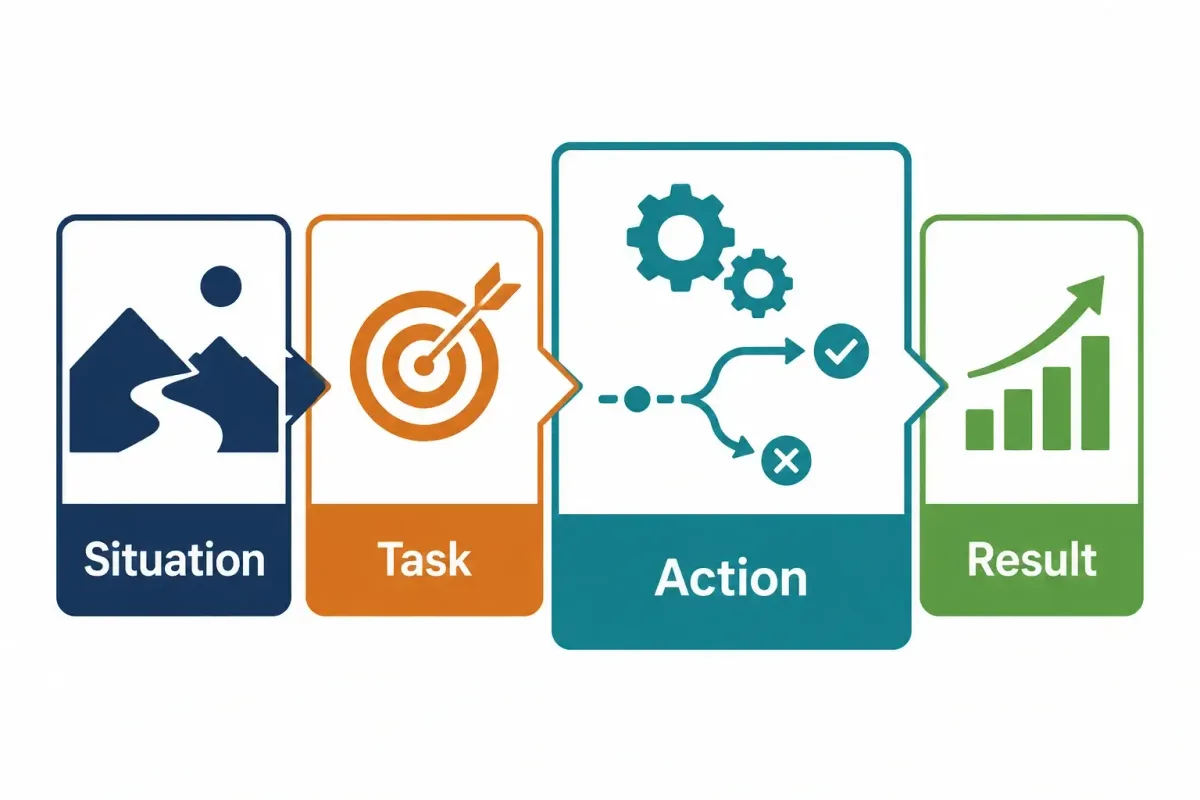
Situation
Keep background minimal.
- What was happening?
- What was at stake?
- What was the customer impact or business risk?
Aim for 1–3 sentences.
Task
Make ownership explicit.
Use “I” language.
If it was a team effort, define your scope:
- “I owned the rollout plan and risk review.”
- “I was responsible for incident debugging and stakeholder comms.”
Action
This is where strong candidates differentiate.
Don’t list steps.
Explain the thinking:
- what data you used
- what trade-offs you made
- how you prioritized
- how you unblocked others
- how you handled disagreement
Result
Quantify impact.
Even if you weren’t revenue-facing, you can usually measure something:
- time saved
- incident reduction
- latency/availability changes
- cycle time improvement
- customer satisfaction signals
If you failed or the outcome was mixed, say so—then show how you repaired impact and what you changed afterward.
Recommended Answer Length
As a practical starting point, aim for 2–3 minutes for your first-pass answer. This is not an Amazon-wide time limit; some questions will need a shorter or longer response.
Keep deeper detail ready for follow-ups:
- exact metrics
- alternatives you considered
- what you would do differently
Build an Amazon Interview Story Bank
The fastest way to stop “Amazon behavioral interview questions” from feeling random is to build a story bank.
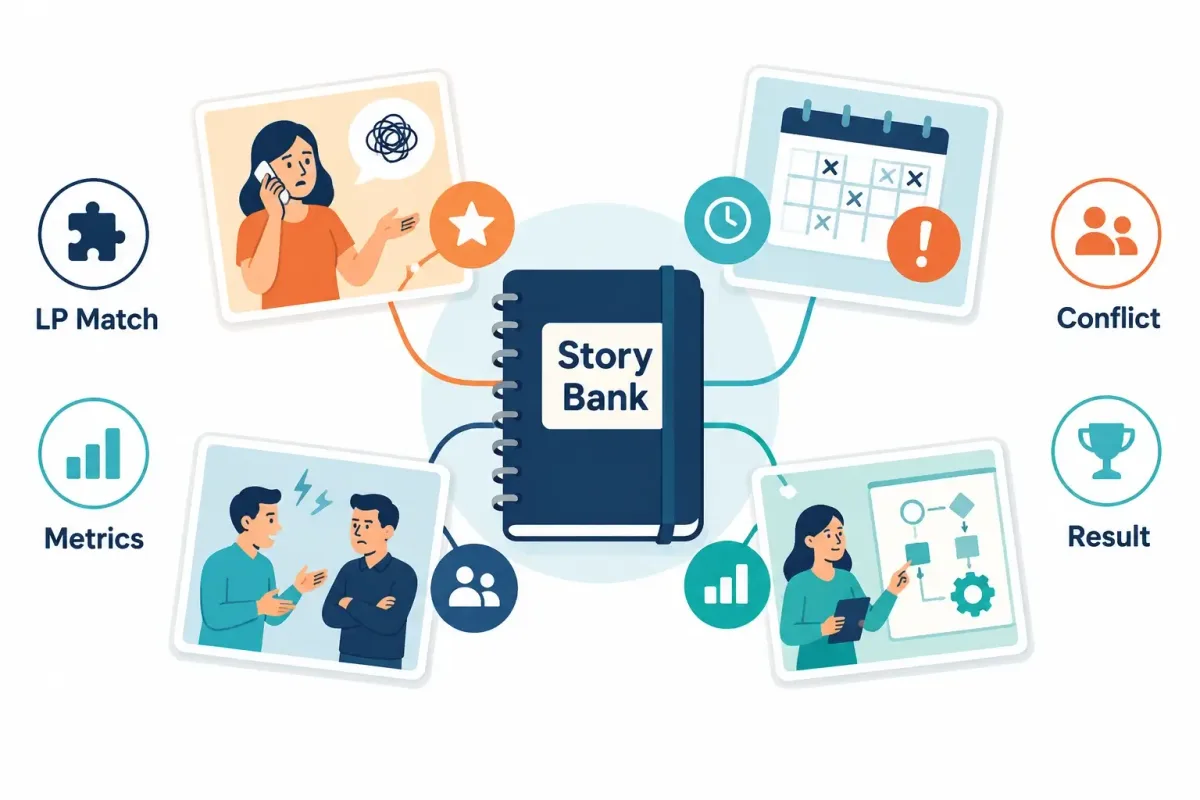
Start With Stories, Then Map Them to Leadership Principles
Pick real experiences where:
- stakes were meaningful
- you took clear action
- you can prove impact
Then map to Leadership Principles.
A useful line from the Reddit post is:
“Match LPs to stories, not the other way around.” — Amazon engineering candidate on Reddit
Trying to force-fit principles often leads to fake-sounding stories.
How Many Stories Should You Prepare?
Some candidates prepare 15–20 stories.
As a practical starting point, this guide recommends 8–10 high-quality stories. Senior candidates or people preparing for several related roles may choose to build more.
Each story should include:
- your personal actions (not just the team’s)
- 2–3 numbers or measurable signals
- a constraint, conflict, or trade-off
- a clear result
- a lesson learned
Create a One-Page Story Sheet
A one-page sheet forces you to get crisp.
| Story | Primary LP | Additional LPs | Metrics | Failure/Conflict | Follow-up ready |
|---|---|---|---|---|---|
| Customer escalation | Customer Obsession | Ownership, Earn Trust | Retention +18% | Yes | Yes |
| Missed deadline | Learn and Be Curious | Ownership, Deliver Results | Delivery time −25% | Yes | Yes |
8 Common Amazon Behavioral Interview Questions
Before we go deep, here’s a quick map of the 8 most common questions and the primary Leadership Principle they typically probe.
If you’re searching specifically for amazon leadership principles interview questions, this section is where those principles become concrete prompts you can practice.
| Question | Primary Leadership Principle |
|---|---|
| Went above and beyond for a customer | Customer Obsession |
| Took ownership of a problem | Ownership |
| Failed or made a mistake | Learn and Be Curious |
| Disagreed with a manager | Have Backbone; Disagree and Commit |
| Delivered under a tight deadline | Deliver Results |
| Made a decision with limited data | Bias for Action |
| Investigated a difficult problem | Dive Deep |
| Earned someone’s trust | Earn Trust |
Below, every question uses the same format.
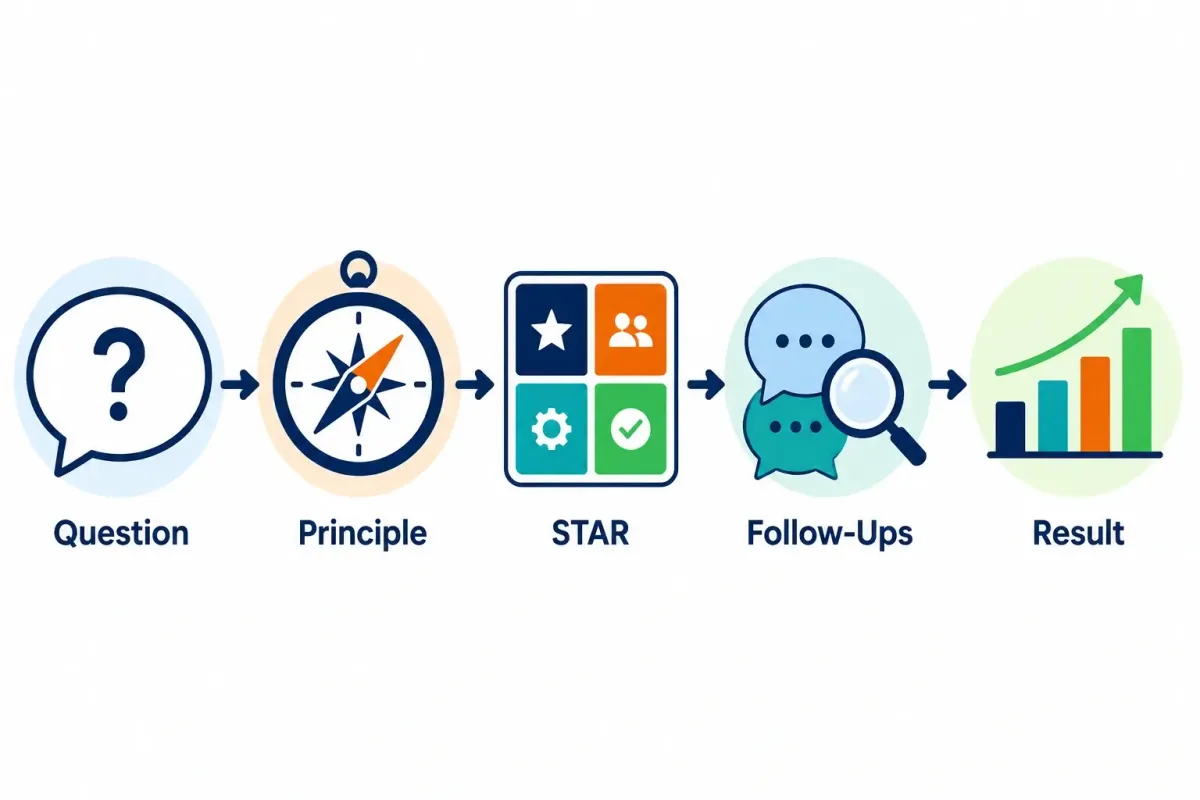
1. Tell Me About a Time You Went Above and Beyond for a Customer
Leadership Principle: Customer Obsession
What Amazon is testing
- Do you start with the real customer need?
- Can you balance short-term demands with long-term trust?
- Do you make smart trade-offs rather than just saying yes to everything?
STAR answer framework
- Situation: A customer was blocked, unhappy, or about to churn.
- Task: Solve the immediate issue and prevent repeats.
- Action: Explain how you discovered the true need and aligned stakeholders.
- Result: Quantify the customer outcome and the system fix you implemented.
Likely follow-up questions
- How did you discover the real customer need?
- How did you measure success?
- What did the customer say afterward?
Mistake to avoid
- Talking about effort (“I worked late”) instead of impact.
2. Tell Me About a Time You Took Ownership of a Problem
Leadership Principle: Ownership
What Amazon is testing
- Do you take responsibility beyond your job description?
- Can you drive closure across teams and ambiguity?
- Do you prevent recurrence rather than patching symptoms?
STAR answer framework
- Situation: A recurring issue existed with no clear owner.
- Task: You chose to own it because impact was real.
- Action: Define scope, align stakeholders, remove blockers.
- Result: Show measurable improvement and a durable prevention change.
Likely follow-up questions
- Why were you the right person to own this?
- What resistance did you face?
- How did you stop it from happening again?
Mistake to avoid
- Making it sound like chaotic heroics. Ownership is structured.
3. Tell Me About a Time You Failed or Made a Mistake
Leadership Principle: Learn and Be Curious
What Amazon is testing
- Do you take responsibility without excuses?
- Can you repair impact fast?
- Did you change behavior afterward?
STAR answer framework
- Situation: A decision or assumption caused impact.
- Task: Fix it and learn.
- Action: Diagnose root cause, communicate, implement prevention.
- Result: Quantify recovery; share the new habit/process you adopted.
Likely follow-up questions
- When did you realize you were wrong?
- Who was affected?
- What did you change to avoid repeating it?
Mistake to avoid
- Choosing a “fake failure” that’s obviously a humblebrag.
4. Tell Me About a Time You Disagreed With Your Manager
Leadership Principle: Have Backbone; Disagree and Commit
What Amazon is testing
- Can you challenge respectfully using data?
- Can you commit fully once a decision is made?
- Can you disagree without making it personal?
STAR answer framework
- Situation: You believed a plan had a real risk.
- Task: Raise it clearly and influence the decision.
- Action: Use data, propose alternatives, articulate risk; then commit after the call.
- Result: Explain what happened and what you learned about influencing.
Likely follow-up questions
- How did you communicate the disagreement?
- What was the final decision?
- Would you challenge them again?
Mistake to avoid
- Confusing “backbone” with being combative.
5. Tell Me About a Time You Delivered Results Under a Tight Deadline
Leadership Principle: Deliver Results
What Amazon is testing
- Can you prioritize the inputs that matter?
- Can you remove blockers fast?
- Do you balance speed and quality?
STAR answer framework
- Situation: A deadline had business/customer consequences.
- Task: Deliver outcome X by time Y with constraints Z.
- Action: Show what you de-scoped, how you managed risk, and how you kept stakeholders aligned.
- Result: Quantify delivery and downstream impact.
Likely follow-up questions
- What did you cut?
- How did you manage risk?
- What would it have cost to miss the deadline?
Mistake to avoid
- Only talking about being “busy.”
6. Tell Me About a Time You Made a Decision With Limited Data
Leadership Principle: Bias for Action
What Amazon is testing
- Can you make reversible decisions quickly?
- Can you assess risk without perfect information?
- Can you set a feedback loop to correct fast?
STAR answer framework
- Situation: You didn’t have full data but delaying had a cost.
- Task: Choose a path with imperfect inputs.
- Action: Explain your decision framework: signals, worst case, mitigation, rollback.
- Result: Show the outcome and what you monitored afterward.
Likely follow-up questions
- What data was missing?
- What was the worst-case outcome?
- When would waiting have been the right call?
Mistake to avoid
- Confusing speed with recklessness.
7. Tell Me About a Time You Had to Dive Deep Into a Problem
Leadership Principle: Dive Deep
What Amazon is testing
- Can you find root cause instead of chasing symptoms?
- Can you validate assumptions?
- Can you reconcile metrics vs anecdotes?
A helpful line from Amazon’s official Leadership Principles page is: leaders “audit frequently” and stay skeptical when “metrics and anecdote differ” (see Leadership Principles).
STAR answer framework
- Situation: Something looked wrong (metric spike, incident, quality drop).
- Task: Identify root cause and fix it.
- Action: Walk through hypotheses, tests, and how you ruled out false leads.
- Result: Quantify the fix and what monitoring you added.
Likely follow-up questions
- What was the first metric that looked off?
- How did you confirm the root cause?
- What did you learn that changed your approach later?
Mistake to avoid
- Overselling intuition. Dive Deep is about proof.
8. Tell Me About a Time You Had to Earn Someone’s Trust
Leadership Principle: Earn Trust
What Amazon is testing
- Can you communicate transparently under tension?
- Can you admit mistakes?
- Do you follow through consistently?
STAR answer framework
- Situation: Trust was low (new team, past failure, cross-team tension).
- Task: Build credibility and collaboration.
- Action: Listen, communicate expectations, deliver small wins, address root causes.
- Result: Describe measurable collaboration improvement and timeline.
Likely follow-up questions
- Why was trust missing?
- What did you do that changed the relationship?
- How long did it take?
Mistake to avoid
- Treating trust as a speech. It’s earned through behavior.
8 More Questions Covering the Remaining Leadership Principles
| Leadership Principle | Example question | What to include |
|---|---|---|
| Invent and Simplify | Tell me about a process you simplified. | Original process, simplification, time/cost saved |
| Are Right, A Lot | Tell me about a judgment call that proved correct. | Reasoning, dissenting views, validation |
| Hire and Develop the Best | Tell me about someone you helped develop. | Feedback, coaching, long-term growth |
| Insist on the Highest Standards | Tell me about a time you refused low-quality work. | Risk, standard, improvement outcome |
| Think Big | Tell me about an ambitious idea you proposed. | Opportunity, scope, execution plan |
| Frugality | Tell me about achieving results with limited resources. | Constraints, creative plan, cost awareness |
| Strive to Be Earth’s Best Employer | Tell me about improving your team environment. | Safety, fairness, growth, measurable change |
| Success and Scale Bring Broad Responsibility | Tell me about considering broader business impact. | Customers, employees, community, long-term risk |
Role-Specific Amazon Interview Questions
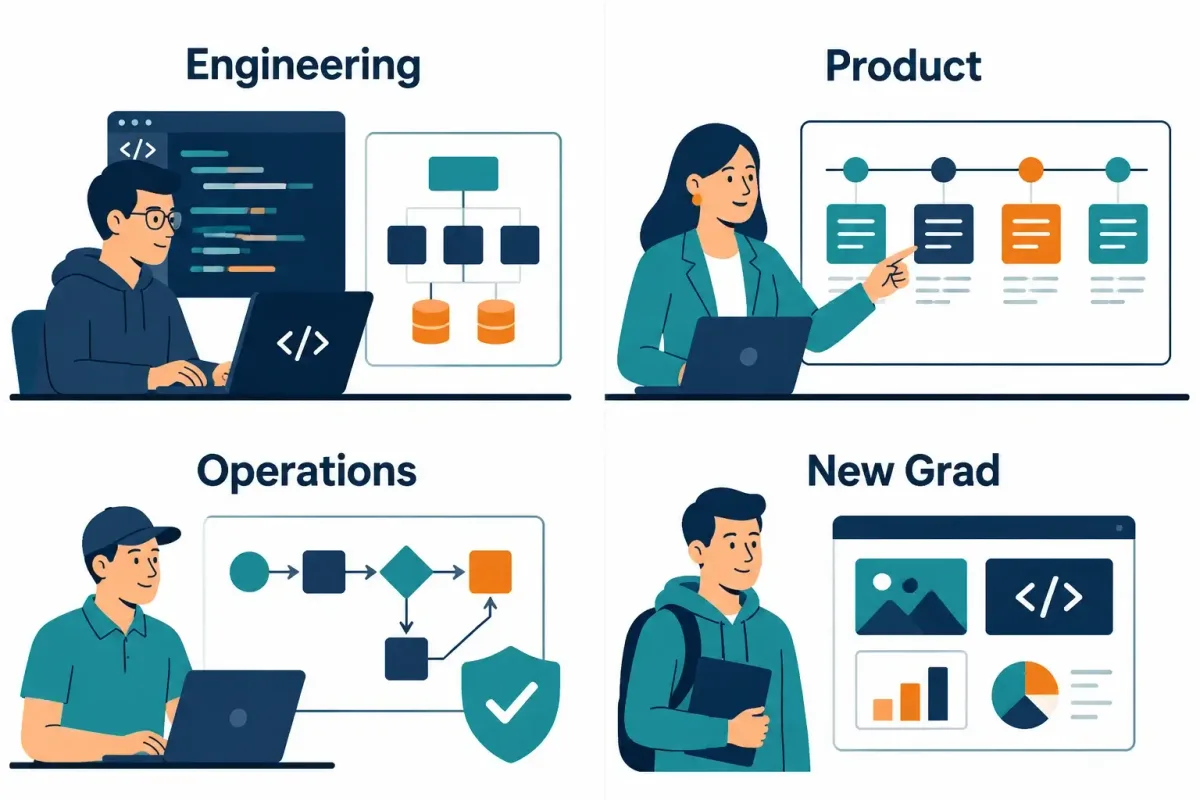
Technical Phone Screen: What to Prepare
The candidate said their technical phone screen explored workflows, thought processes, past experience, and relevant software—not only isolated technical knowledge.
Prepare for both “solve the problem” and “explain how you work.”
| Prepare to explain | What an interviewer may explore |
|---|---|
| Technical decisions | Why you selected one approach |
| Workflow | How you move from requirements to delivery |
| Trade-offs | Cost, performance, speed and reliability |
| Project ownership | Your exact contribution |
| Troubleshooting | How you investigated and fixed issues |
| Tools | Why and how you used relevant software |
Software Engineering
Question: How would you design a scalable order-tracking system?
Requirements
- Users and core actions (create order, update status, query status)
- Latency expectations and traffic shape
Data model
- Entities: Order, Shipment, TrackingEvent
- What must be strongly consistent vs eventually consistent
Reliability
- Idempotent updates, retries, deduplication
Scale
- Partitioning strategy and hot-key avoidance
Monitoring
- Error rate, latency, backlog/lag, success counters
Trade-offs
- Cost vs performance vs complexity
If you want a concrete example of how Amazon describes interview structure for a technical role, their SDE II interview prep page is a useful reference.
Product or Program Management
Question: How would you prioritize two conflicting customer requests?
Customer impact
- Who benefits, and how severe is the pain?
Business value
- Retention, revenue, strategic alignment
Data
- Usage signals, support volume, urgency
Opportunity cost
- What gets delayed and what risks shift
Stakeholder alignment
- How you communicate trade-offs and keep trust
Operations
Question: Tell me about a time you improved an inefficient process.
Baseline measurement
- “Before” metric and operating context
Root cause
- What actually caused the waste (handoffs, defects, unclear ownership)
Safety and quality
- What could not be compromised
Cost and delivery
- Time/cost saved, throughput increased
Sustainable improvement
- How you made it stick (standard work, audits, training)
Interns and New Graduates
Question: Tell me about a time you showed ownership without formal authority.
Use stories from:
- school projects
- internships
- volunteer work
- student organizations
- personal projects
The key is: you saw a real problem, took initiative, and delivered measurable impact.
Bar Raiser and Amazon Follow-Up Questions
What the Bar Raiser Is Evaluating
Assume your answers need to hold up under scrutiny.
What gets evaluated is less about polish and more about evidence:
- Leadership Principles alignment
- quality of examples (specificity, accountability, metrics)
- decision-making and trade-offs
- long-term hiring standards
Amazon describes Bar Raisers as objective interviewers from outside the hiring team who help maintain long-term hiring standards and reduce bias. They work with the hiring manager and interview panel rather than serving as a standalone “veto.” See Amazon’s official Bar Raiser interview guidance.
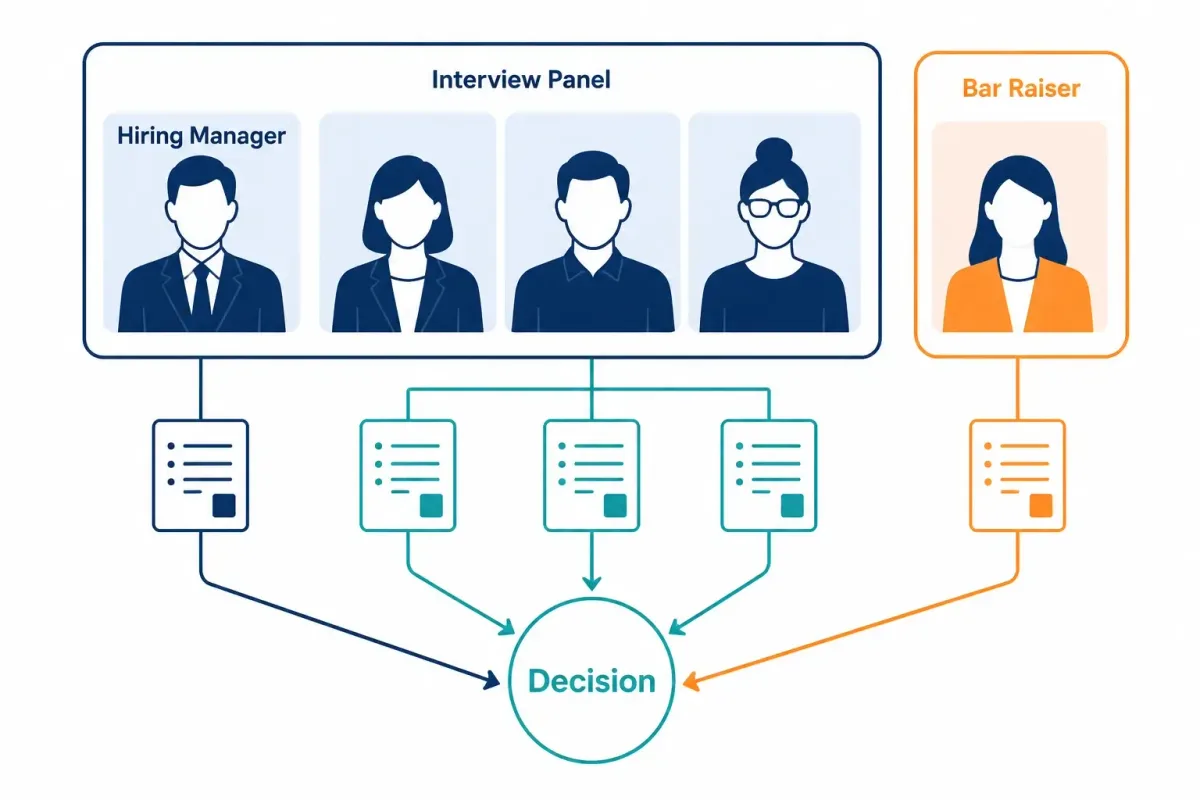
Common Follow-Up Questions
- What was your exact contribution?
- What data did you use?
- What alternatives did you consider?
- Who disagreed with you?
- What was the biggest risk?
- What would you do differently?
- How did you measure success?
- What happened after six months?
Use Numbers and Notes
Numbers make your story real.
Before your interviews, write down:
- 2–3 metrics per story
- one key trade-off
- one lesson learned
If you want a general structure for practice beyond Amazon, this job interview preparation checklist is a solid baseline.
Also: avoid using the same story in every round. But if you repeat one story once, it’s not automatically fatal—especially if you go deeper the second time.
Questions to Ask an Amazon Interviewer
Use questions to learn about the team, not to perform.
Here are 8 strong questions:
- What would success look like in the first six months?
- What is the biggest challenge facing the team?
- Which Leadership Principles matter most in this role?
- How does the team measure customer impact?
- What distinguishes top performers?
- How are disagreements handled?
- What ownership opportunities exist beyond the job description?
- What do you wish you had known before joining?
For more options (and better wording), see this list of smart questions to ask in an interview.
Common Amazon Interview Mistakes
- Memorizing generic sample answers
- Being unable to explain your personal contribution
- Not quantifying results
- Spending too long on background
- Not preparing a real failure story
- Reusing one story too many times
- Getting stuck on follow-ups
- Forcing Leadership Principles into stories unnaturally
A 2026-specific warning:
- Uploading private recruiting information or unnecessary personal data into AI tools
- Using AI to fabricate experiences, metrics, or technical ability
Use tools to practice structure and clarity—not to invent a life you didn’t live.
Seven-Day Amazon Interview Preparation Plan
| Day | Preparation task |
|---|---|
| Day 1 | Review the role and all 16 Leadership Principles |
| Day 2 | Select 8–10 stories |
| Day 3 | Map stories to principles |
| Day 4 | Add numbers, actions and lessons learned |
| Day 5 | Practice technical and behavioral follow-ups |
| Day 6 | Complete a mock interview |
| Day 7 | Review one-page notes and questions to ask |
If you want to compare practice tools and workflows, see our AI interview copilot comparison guide.
Sources and Candidate Experience Note
- Amazon official interview process guidance: Your complete guide to the Amazon interview process
- Amazon Leadership Principles: Leadership Principles
- Amazon official STAR guidance and “no brain teasers” stance: Prepare for Amazon’s STAR interview
- Amazon technical interview timeline guidance: Interview prep for technical roles
- Amazon Bar Raiser guidance: Interview tips from Amazon Bar Raisers
- Amazon SDE II role preparation: SDE II interview prep
- Candidate experience: Amazon Interview 101: Comprehensive Guide for Engineering Roles
The Reddit example reflects one successful engineering candidate’s experience. Amazon interview processes and timelines can vary, so candidates should use it as a preparation perspective rather than a guaranteed process.
Last reviewed: July 21, 2026.