 Mike Chen
 Sasha
Sasha
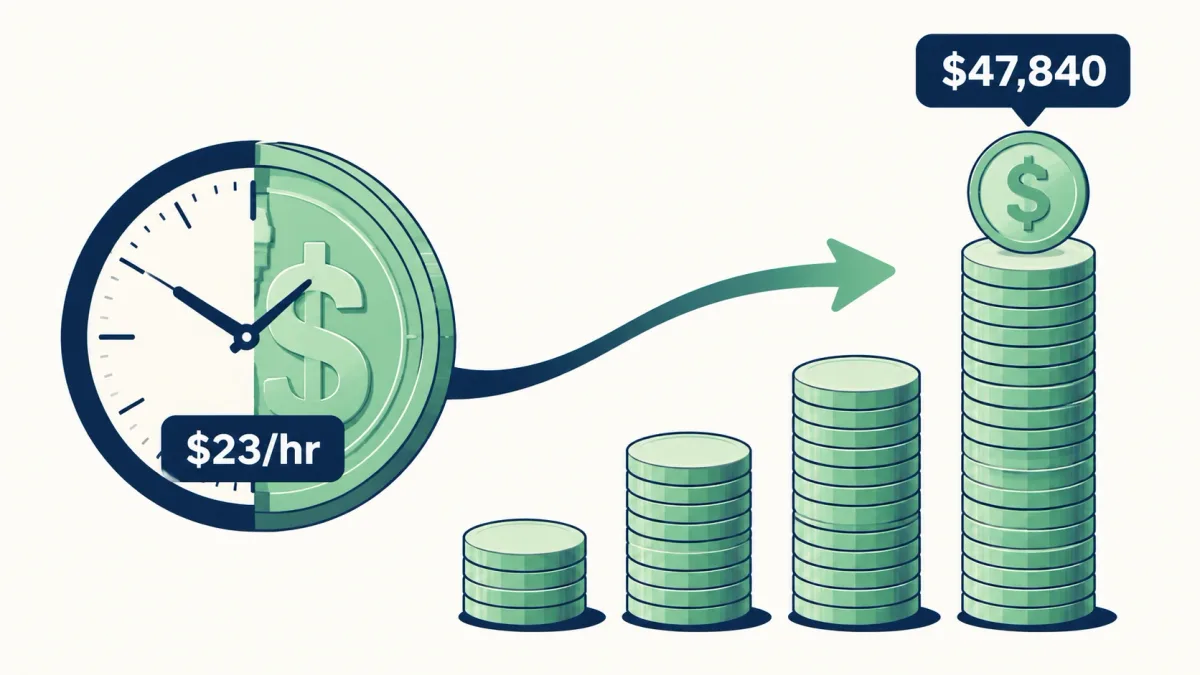
If you make $23 an hour and work 40 paid hours a week for 52 weeks, your gross annual pay is $47,840 before taxes.
$23 × 40 hours per week × 52 weeks = $47,840 per yearThat math assumes 2,080 paid hours a year. It's the right headline answer, but it's not automatically what your job will pay. Your actual annual income rides on guaranteed hours, paid time off, unpaid weeks, overtime eligibility, taxes, benefits, and whether the role is W-2 employment or independent contract work.
Quick Pay Breakdown at $23 an Hour
| Pay period | Gross pay | Calculation |
|---|---|---|
| Yearly | $47,840 | $23 × 40 × 52 |
| Monthly average | $3,986.67 | $47,840 ÷ 12 |
| Semi-monthly paycheck | $1,993.33 | $47,840 ÷ 24 |
| Biweekly paycheck | $1,840 | $47,840 ÷ 26 |
| Weekly | $920 | $23 × 40 |
| Daily, eight hours | $184 | $23 × 8 |
These are gross amounts. Taxes and other deductions haven't come out yet.
A monthly average is not a paycheck, either. Semi-monthly employees get 24 checks a year; biweekly employees get 26, which means a biweekly worker usually hits two calendar months with three paychecks. The annual gross stays $47,840 as long as total paid hours stay the same.
The Formula and the Assumption That Matters Most
You can convert any hourly offer with this formula:
Annual gross pay = hourly rate × paid hours per week × paid weeks per yearThe word doing all the work here is paid. Four numbers that sound alike produce different annual incomes:
- Scheduled hours: hours shown on the work schedule.
- Guaranteed hours: the minimum hours the employer commits to providing or paying.
- Hours worked: the time you actually work.
- Paid hours: worked hours plus any paid holidays, vacation, or sick time included in the job.
A listing can call a role full-time without guaranteeing 40 paid hours every week. Seasonal slowdowns, cancelled shifts, unpaid school breaks, shutdowns, and unpaid leave all cut your annual income while the hourly rate stays exactly the same.

Guaranteed-Income Matrix at $23 an Hour
| Paid hours per week | 52 paid weeks | 50 paid weeks | 48 paid weeks |
|---|---|---|---|
| 40 | $47,840 | $46,000 | $44,160 |
| 37.5 | $44,850 | $43,125 | $41,400 |
| 35 | $41,860 | $40,250 | $38,640 |
| 30 | $35,880 | $34,500 | $33,120 |
A $23 hourly rate is not automatically a $47,840 year. Before you commit that number to rent or any other fixed bill, get two answers: how many weekly hours are guaranteed, and whether vacation, holidays, sick days, and planned closures are paid.
Part-Time Pay at $23 an Hour
If you work part-time, run the same formula with your actual paid schedule. Assuming 52 paid weeks:
| Weekly hours | Weekly gross | Annual gross |
|---|---|---|
| 20 | $460 | $23,920 |
| 25 | $575 | $29,900 |
| 30 | $690 | $35,880 |
| 35 | $805 | $41,860 |
| 37.5 | $862.50 | $44,850 |
Hours are only one piece of a part-time offer. Also check:
- whether the schedule is consistent or changes each week;
- whether the role qualifies for health insurance, retirement benefits, PTO, or paid holidays;
- how many commute days it takes to get the available hours;
- whether breaks, training, travel, or setup time are paid.
Twenty-five predictable hours are easier to budget than a schedule sold as "up to 30 hours" that keeps landing below it.
Overtime Pay at $23 an Hour
If you're eligible for time-and-a-half overtime, the overtime rate on $23 is $34.50 an hour:
$23 × 1.5 = $34.50For example, a 45-hour week with five qualifying overtime hours would produce:
40 regular hours × $23 = $920
5 overtime hours × $34.50 = $172.50
Total weekly gross = $1,092.50
If that exact schedule ran for all 52 weeks, gross annual pay would be $56,810. That's a math scenario, not a prediction.
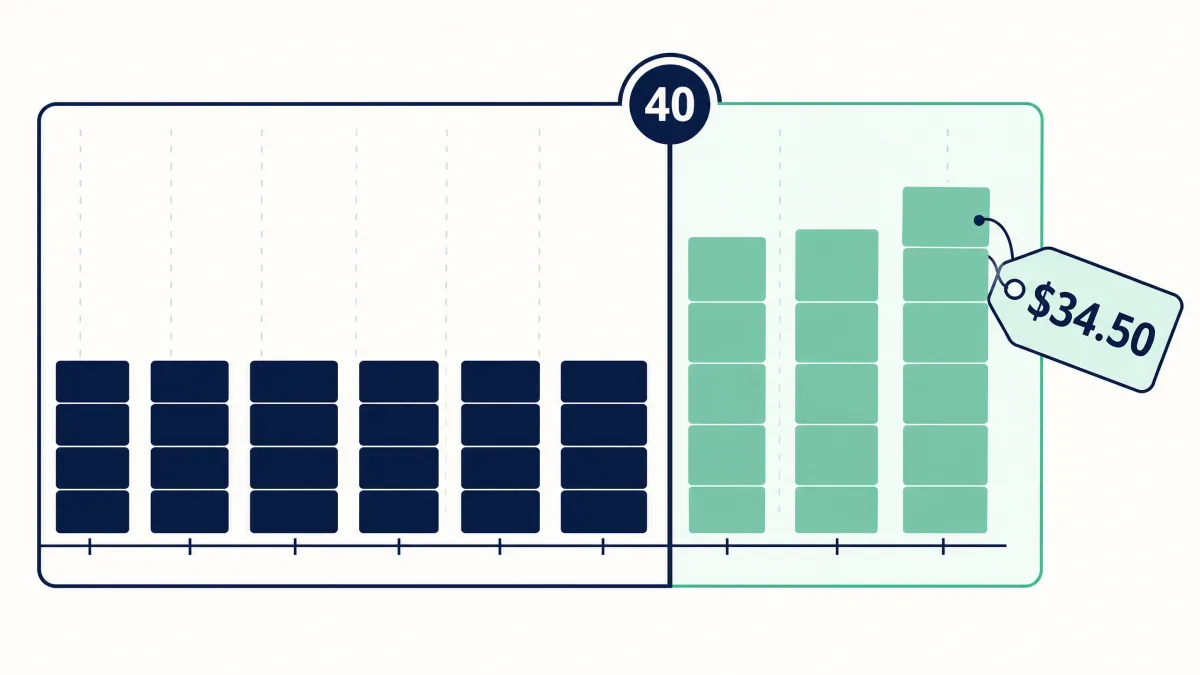
The U.S. Department of Labor explains that many covered, nonexempt employees must receive at least one and one-half times their regular rate for hours over 40 in a workweek. Exemptions and special rules apply, so confirm your classification instead of assuming every hour past 40 pays overtime. See the Department of Labor's FLSA reference guide.
Treat overtime as upside, not income, unless the employer puts a reliable schedule in writing. Building rent or debt payments around overtime that can disappear is a risk you don't need to take.
$23 an Hour After Taxes
There's no single correct take-home amount for everyone earning $23 an hour. The $47,840 figure is gross pay. Your net paycheck may include:
- federal income tax withholding;
- Social Security and Medicare withholding;
- state or local income tax where applicable;
- health, dental, or vision premiums;
- retirement, HSA, or FSA contributions;
- union dues, garnishments, or other deductions.
For most covered W-2 wages at this income level, the employee Social Security withholding rate is 6.2% and the Medicare withholding rate is 1.45%. The IRS lists the current rates in Topic No. 751. Income-tax withholding is separate and depends on your filing status, other income, and your Form W-4.

Why Two $23-an-Hour Workers Can Receive Different Paychecks
Two employees with the same gross wage can see different deposits because one:
- lives in a state or city with different income taxes;
- has a spouse, dependents, another job, or other household income;
- pays more for employer-sponsored health coverage;
- contributes more to a retirement plan or HSA;
- has different withholding elections;
- worked a different number of paid hours during the pay period.
That's why an unsourced "$23 an hour after taxes equals X" figure is misleading. It's built on someone else's assumptions, not yours.
Build a Take-Home Estimate From Verifiable Inputs
For a biweekly employee working 80 paid hours, start with $1,840 gross and subtract only amounts you can verify or estimate from an identified source:
- Social Security and Medicare withholding.
- Federal income-tax withholding from a current payroll or IRS estimator.
- State and local withholding, if applicable.
- The employee share of health and other benefit premiums.
- Retirement, HSA, FSA, union, or other deductions.
Once you have a real pay stub, use it. For a new job, ask for the benefits summary and payroll schedule, then run two versions: the expected schedule, and a lower-hours version if hours aren't guaranteed.
W-2 Employee vs. 1099 Contractor at $23 an Hour
A $23/hour W-2 offer and a $23/hour contractor offer are not equal compensation. Don't compare them as if they were.
| Factor | W-2 employee | Independent contractor |
|---|---|---|
| Tax handling | Employer generally withholds applicable payroll and income taxes | Worker generally handles estimated taxes and self-employment tax |
| Paid time | May include paid holidays, vacation, or sick leave | Commonly paid only for billable work |
| Benefits | May include employer-supported insurance or retirement benefits | Usually arranged and paid by the worker |
| Work costs | Employer may provide tools, software, insurance, or mileage reimbursement | Worker may absorb more operating expenses |
| Income pattern | Depends on the employer's schedule | Depends on billable demand and contract terms |
The IRS states that self-employed people generally file an annual return, may need to pay estimated taxes quarterly, and generally pay self-employment tax as well as income tax. It also notes that self-employment tax applies to net earnings, after eligible business expenses, not every dollar billed. See the IRS Self-Employed Individuals Tax Center.
Worker status comes down to the facts of the working relationship: behavioral control, financial control, and the type of relationship. A contract can't settle the question just by using the word "contractor." See the IRS guidance on independent contractors and employees.
When you compare offers, estimate billable hours, not available hours. Then subtract identifiable contractor expenses and account for unpaid admin work, gaps between projects, insurance, and time off. If classification or tax obligations are unclear, get qualified professional advice before you trust the headline rate.

Is $23 an Hour Good Pay?
It can be, in the right situation. The hourly rate alone can't answer the question.
Evaluate the offer on:
- realistic take-home pay based on your location and deductions;
- guaranteed hours and paid weeks;
- housing, debt, transportation, health, and child-care costs;
- employer-paid benefits and paid leave;
- commuting and other required work costs;
- the documented path to a raise or promotion.
A slightly lower rate with predictable hours, paid time off, affordable health coverage, and a short commute can be worth more than a higher rate with cancelled shifts and heavy out-of-pocket costs.
Skip the national comparison. The question that matters is: does this specific offer reliably cover my fixed costs and move me toward my next career target?
Can You Live on $23 an Hour?
Possibly. The answer depends on location, household size, debt, transportation, child care, health costs, and schedule stability.
Start with net pay, not the $3,986.67 monthly gross average:
- Estimate monthly take-home using stated tax and benefit assumptions.
- List required monthly costs: rent, utilities, food, transportation, insurance, health care, debt minimums, and child care.
- Add irregular but predictable expenses, such as car repairs, annual fees, clothing, and medical costs.
- Decide how much emergency margin you need.
- Re-run the budget at 37.5 hours a week or 50 paid weeks if the employer doesn't guarantee the full 2,080-hour year.
How to Evaluate $1,350 in Monthly Rent
Don't compare $1,350 with gross monthly pay. Compare it with your expected net income and every other fixed obligation.
Housing share of take-home = monthly housing cost ÷ monthly take-home payThen test the same rent against a lower-hours scenario. The result isn't a universal pass/fail rule; it shows how much room is left for transportation, food, insurance, debt, savings, and surprises.
If the lower-hours version can't cover required expenses, you need a lower housing cost, more guaranteed income, a bigger cash buffer, or a higher base rate before that lease is safe to sign.
From $47,840 to $50,000: The Exact Gap
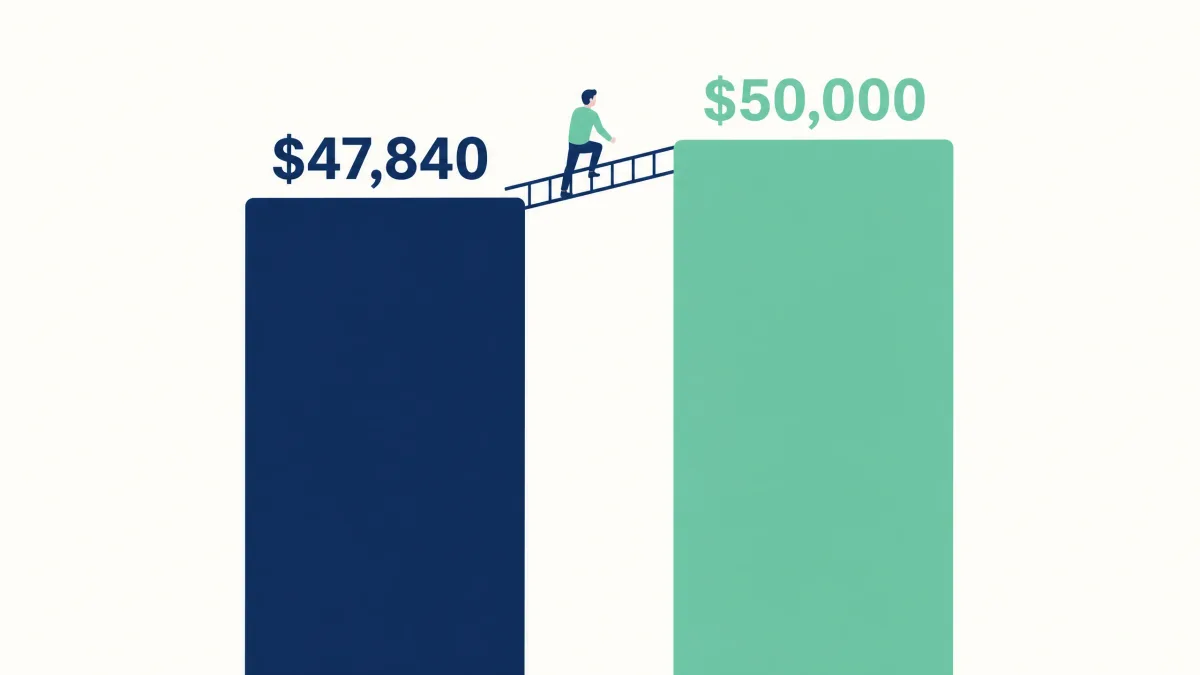
At the standard full-time schedule, $23 an hour is $2,160 below $50,000 a year:
$50,000 − $47,840 = $2,160A $50,000 salary converts to about $24.04 an hour at 2,080 paid hours:
$50,000 ÷ 2,080 = $24.038... per hourSo the base-rate difference is about $1.04 an hour.
If qualifying overtime were available at $34.50/hour, the gap equals about 62.6 overtime hours a year, roughly 1.2 hours a week. Don't read that as the safe route to the target. A base-rate increase applies to every regular paid hour; overtime moves with demand and classification.
Practical ways an offer can close the gap:
- negotiating the base rate from
$23to about$24.04or higher; - receiving a guaranteed bonus whose terms are documented;
- adding reliably scheduled, qualifying overtime;
- comparing verified employer-paid benefits when the goal is total compensation rather than cash salary alone.
Compare the Effective Value of a $23-an-Hour Offer
Use the same calculation for every offer:
Effective annual offer value = reliable cash pay
                             + verified employer-paid benefits
                             − required work costs
This is a comparison tool, not a tax or accounting definition.
Reliable Cash Pay
Use guaranteed hours and paid weeks, not the best possible schedule. Add a shift differential, bonus, or overtime only when the terms are documented and reliable enough for the decision you're making.
Verified Employer-Paid Benefits
Record only the benefits you can confirm in the plan or offer documents, including:
- employer health-premium contribution;
- paid holidays, vacation, and sick time;
- retirement match you expect to earn and satisfy vesting rules for;
- documented tuition, certification, or transportation support.
For example, 48 paid holiday hours plus 40 hours of PTO is 88 paid hours. At $23/hour, that paid time has a gross value of $2,024. Confirm the time is actually paid and available to a new employee before you count it.
Required Work Costs
Subtract expenses that differ between the offers:
- commuting, tolls, parking, or transit;
- required uniforms, tools, licenses, or equipment;
- child care caused by the schedule;
- unpaid travel or administrative time;
- contractor insurance, software, and business expenses.
Don't chase a "perfect" number. Use the same assumptions on both sides so hidden costs can't quietly fall off one half of the comparison.
$23-an-Hour Job Offer Scorecard
Before you accept, get answers to these five questions:
- How many weekly hours and paid weeks are guaranteed?
- Is the role W-2 employment or independent contract work, and who pays each work expense?
- Which benefits are employer-paid, when do they begin, and when do they vest?
- What will commuting, parking, child care, tools, and schedule changes cost?
- What is the documented path to approximately $24 to $25 an hour or $50,000?
Useful questions for the employer include:
- "What minimum weekly hours should I expect, and are they guaranteed?"
- "Can you share the benefits summary and the coverage start date?"
- "Is this position overtime-eligible, and how often is overtime available?"
- "Are there predictable periods when hours are reduced?"
- "When is the first pay review, and what results qualify an employee for a raise?"
None of these questions is confrontational. They pin down the assumptions your annual income actually depends on.
Compare $23 an Hour With Nearby Rates
| Hourly rate | Annual gross at 2,080 paid hours | Related guide |
|---|---|---|
| $23/hour | $47,840 | Current guide |
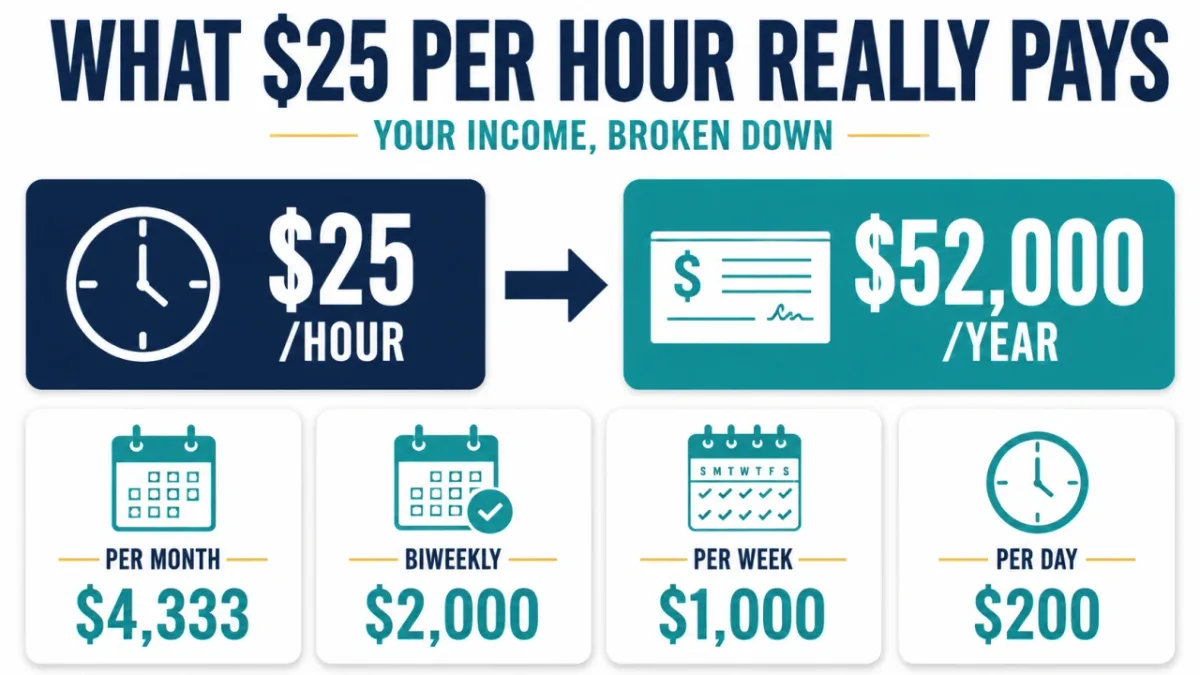
| $25/hour | $52,000 | $25 an hour annual pay |
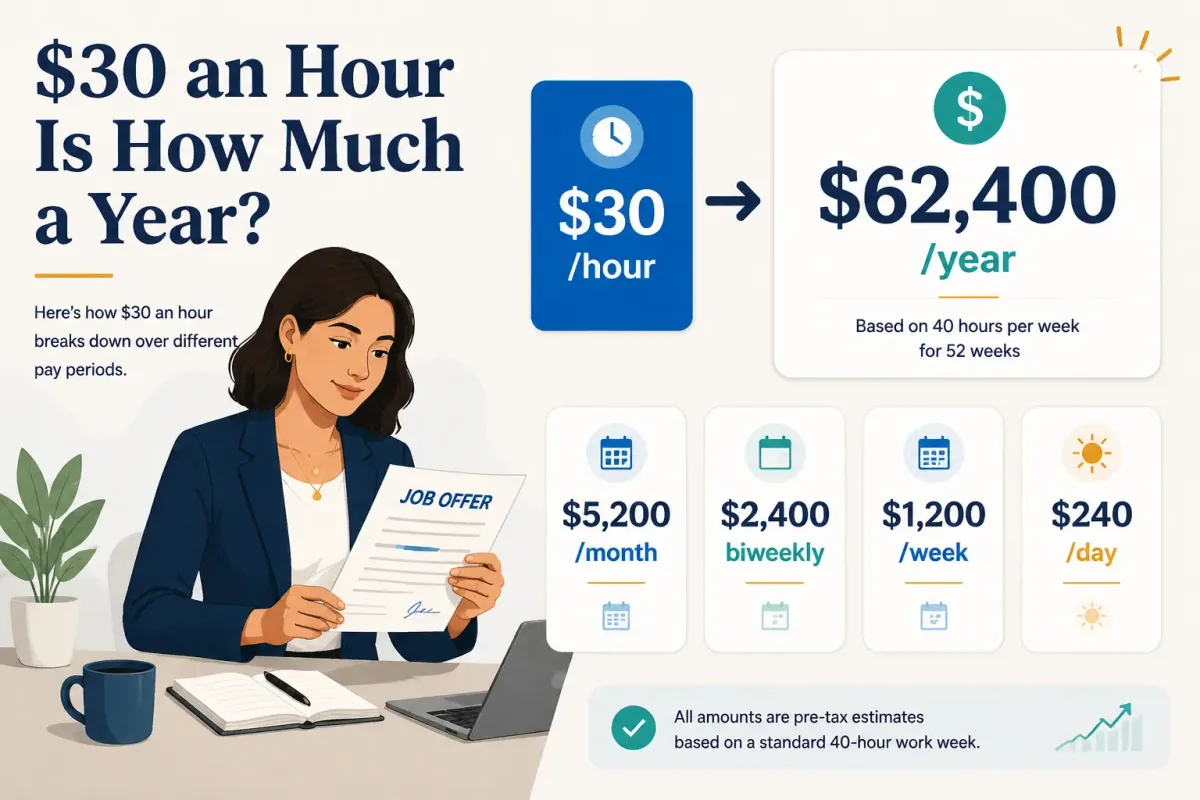
| $30/hour | $62,400 | $30 an hour annual pay |
| $35/hour | $72,800 | $35 an hour annual pay |
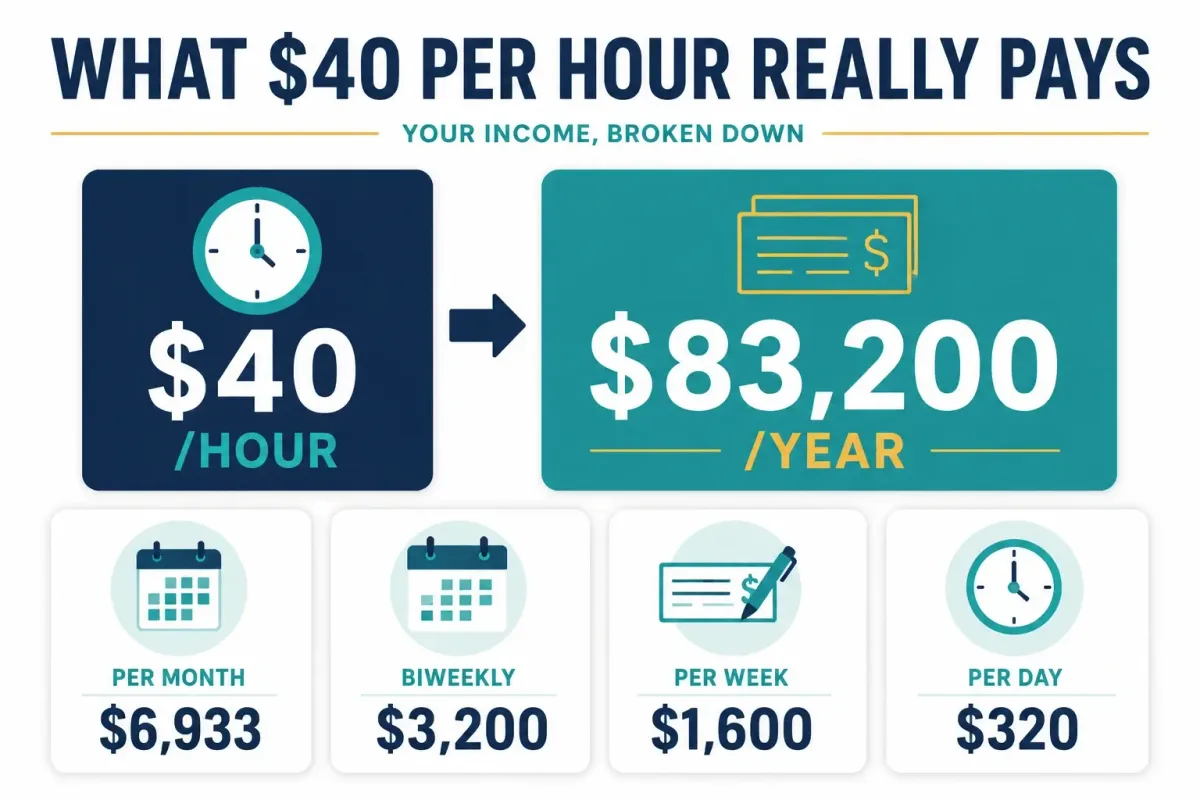
| $40/hour | $83,200 | $40 an hour annual pay |
At 2,080 paid hours, each $1/hour change is $2,080/year before taxes. The nearby $25/hour rate is $52,000, which clears the $50,000 threshold under the same assumptions.
Frequently Asked Questions
How much is $23 an hour a month?
At 40 paid hours a week for 52 weeks, $23 an hour averages $3,986.67 gross per month. That's an annual average, not necessarily one paycheck. Taxes, benefits, unpaid time, and variable hours all shrink what you can actually spend.
How much is $23 an hour biweekly?
At 80 paid hours per two-week pay period, the gross biweekly paycheck is $1,840. Semi-monthly pay is different: $47,840 ÷ 24 is about $1,993.33 gross per check.
How much is $23 an hour a week?
At 40 paid hours, $23 an hour is $920 gross per week. On a 37.5-hour schedule, weekly gross is $862.50.
How much is $23 an hour after taxes?
There's no universal take-home figure. Net pay depends on filing and withholding details, state and local taxes, paid hours, health premiums, retirement contributions, and other deductions. Start with the gross paycheck and subtract amounts backed by a current estimator, benefits summary, or actual pay stub.
Can you live on $23 an hour?
It depends on local costs, household size, debt, transportation, child care, health expenses, benefits, and whether the hours are stable. Build the budget from expected take-home pay, then rerun it with fewer hours or paid weeks if the employer doesn't guarantee a full schedule.
How much is $23 an hour part-time?
At 52 paid weeks, 30 hours a week is $35,880 gross per year, 25 hours is $29,900, and 20 hours is $23,920. Use the actual number of paid weeks if time off or closures are unpaid.
Is $23 an hour close to $50,000 a year?
Yes. It equals $47,840 at 2,080 paid hours, leaving a $2,160 gap. A base rate of about $24.04 an hour reaches $50,000 on the same schedule.
Sources and Methodology
All gross-pay conversions use the stated hourly rate, weekly paid hours, and paid weeks. The main $47,840 figure assumes 2,080 paid hours. Overtime examples assume time-and-a-half eligibility and are labeled as scenarios, not guaranteed earnings.
Tax and employment references:
- IRS Topic No. 751: Social Security and Medicare withholding rates
- IRS Self-Employed Individuals Tax Center
- IRS: Independent contractor or employee?
- U.S. Department of Labor: Handy Reference Guide to the FLSA
This article provides general educational information, not individualized tax, legal, or financial advice.
Conclusion
At $23 an hour, the standard full-time conversion is $47,840 a year before taxes. That number holds only when its assumptions hold: 40 paid hours a week, 52 paid weeks, 2,080 paid hours a year.
Before you accept an offer, verify the hours, paid time, worker classification, benefits, work costs, and raise path. If $50,000 is the target, the gap is $2,160 and the equivalent base rate is about $24.04/hour. That's a negotiation, not a moonshot.
Need to make the case for that rate in your next interview? Great Offer AI provides interview practice and on-screen coaching tools for job seekers.