 Mike Chen
 Sasha
Sasha
It can feel impossible to get hired when every posting asks for experience you don’t have. That frustration is real. But “no experience” can mean several things, and each gap needs a different fix.
This guide helps you diagnose the gap, find honest evidence, build one credible proof asset, and improve your job search over time.
“No experience” may mean no paid work, no relevant work, no recent work, or no clear proof of your skills. Your best strategy depends on the gap you have.
How to Get a Job With No Experience in 10 Steps
- Define the experience gap.
- Inventory the experience you already have.
- Choose one realistic target role.
- Separate must-have requirements from preferences.
- Build one credible proof of readiness.
- Tailor your resume and cover letter.
- Network for information and introductions.
- Apply to well-matched roles.
- Prepare evidence-based interview answers.
- Track results and fix the weakest stage.
Can You Get a Job With No Experience?
Yes. You can be hired without formal or directly relevant experience, especially for roles designed to train new employees.
Employers often treat prior experience as proof that a candidate can do the work with less risk. If you lack that history, give them honest proof from projects, school, volunteering, or related work.
You don’t need a perfect background. You do need basic proof of readiness:
- Task ability: You can complete at least some of the core tasks (or something close).
- Reliability: You show up, follow through, and communicate.
- Learning + role interest: You understand what the job is and you’ve taken steps toward it.
A quick contrast:
- “I’m a fast learner.”
- “I learned basic Excel pivot tables and used them to build a weekly budget report for a student club. I can explain how I cleaned the data and checked for errors.”
That second version gives a hiring manager something they can picture—and ask you about.
Define What “No Experience” Means for You
Before you rewrite your resume or apply to 100 jobs, diagnose what’s actually going on. The best next move depends on the gap.
Use the table below as a decision tool: choose the closest situation, confirm the evidence you already have, and take the recommended next step.
No Experience Diagnostic

| Situation | What the Reader May Already Have | Main Gap | Best Next Move |
|---|---|---|---|
| No formal work experience | School, projects, activities, responsibilities | Employer-based proof | Inventory evidence and target trainable roles |
| No paid experience | Volunteering, caregiving, community or project work | Paid-work signal | Label evidence accurately and seek a higher-credibility next step |
| No relevant experience | Experience in another role or industry | Direct role match | Map transferable skills and create a bridge project |
| No industry experience | Functional skills from another industry | Industry context | Learn the workflow, language and common tools; build contextual proof |
| No recent experience | Older experience or a gap | Recency and confidence | Refresh one skill, create current evidence and prepare a gap explanation |
| No U.S. work experience | International work, education or projects | Local context or verification | Preserve international experience; add U.S.-relevant context and references where available |
| No degree or required credential | Skills or informal learning | Mandatory qualification | Separate legally/operationally required credentials from preferences |
| Experience exists but is presented poorly | Relevant tasks and outcomes | Positioning | Rewrite materials around target-job evidence |
A quick self-check (so you don’t build the wrong “experience”)
Ask yourself:
- Is my gap about eligibility? (license, certification, background requirement, work authorization)
- Is my gap about proof? (I can do the task, but nothing on my materials shows it)
- Is my gap about targeting? (I’m applying to roles that are too senior or too far from my evidence)
- Is my gap about recency? (My best proof is old, and I don’t have anything current)
A career changer may have years of work history but no direct industry experience. That does not mean starting from zero. Translate what you’ve done, then add one bridge proof asset that fits the new role.
Identify the Experience You Already Have
Experience is not a job title. It’s evidence that you:
- completed tasks,
- used skills or tools,
- handled responsibility,
- produced an output,
- worked with other people,
- solved a problem,
- followed through.
Paid employment is one source of evidence. It’s not the only source.
Here are honest places to look for usable evidence:
- Class projects (especially capstones), labs, research, presentations
- Clubs, sports, and student leadership
- Volunteering and community work
- Caregiving or family responsibilities (when relevant)
- Family business support (inventory, scheduling, customer communication)
- Personal projects (a portfolio piece, a simple app, a newsletter, a budget system)
- Certifications and simulations (as learning evidence, not a replacement for task proof)
Experience Inventory Worksheet
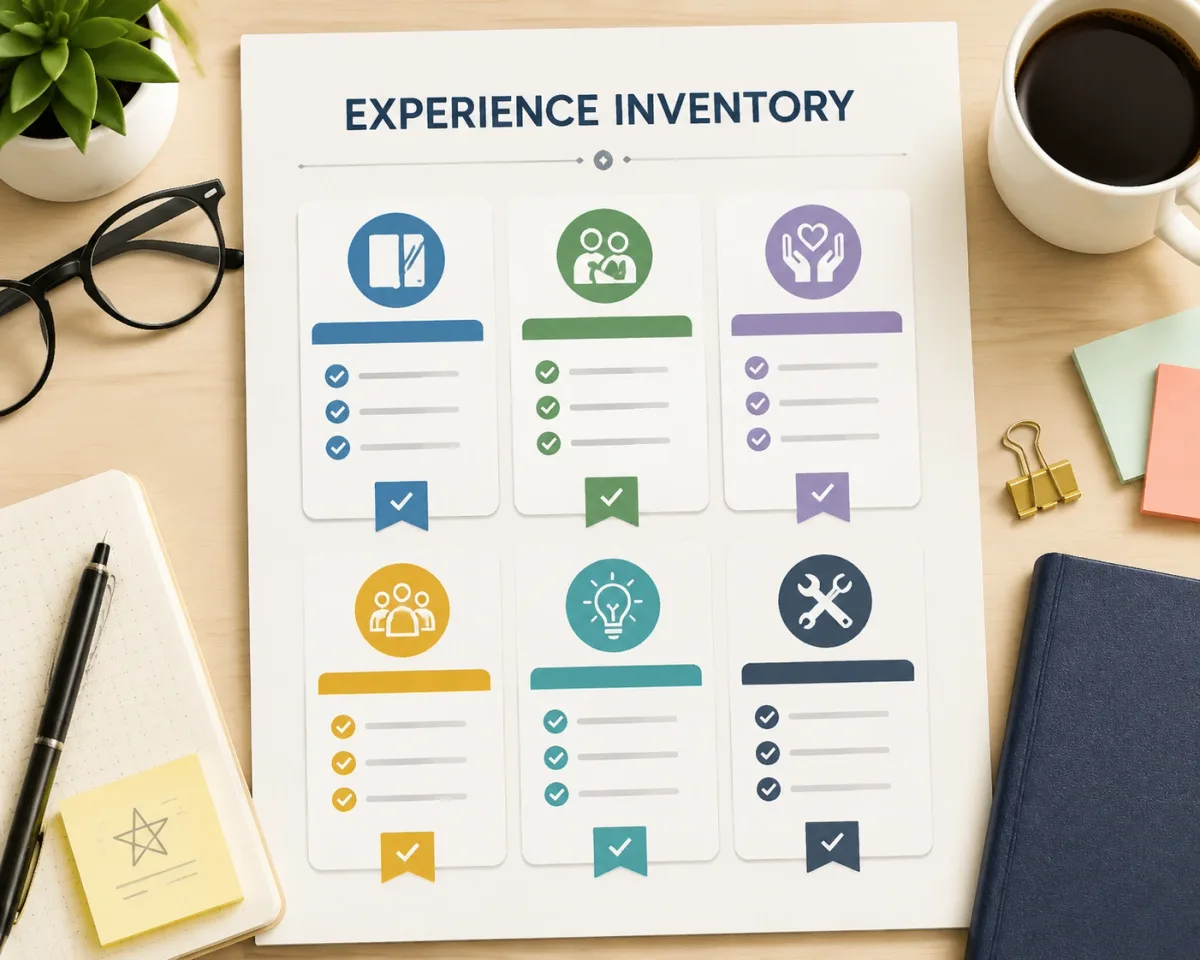
Fill this in with 5–10 items. You’re looking for evidence you can connect to a job requirement.
| Evidence Source | Task or Responsibility | Skill Demonstrated | Tool or Method | Output or Result | Target-Job Relevance |
|---|---|---|---|---|---|
| Example: Class project | Coordinated a four-person research presentation | Planning, research, communication | Shared calendar, spreadsheet, presentation software | Delivered the final presentation on time | Relevant to project coordination and client communication |
How to extract transferable skills (simple chain)
Use this method to turn “I did a thing” into evidence:
Requirement → prior task → skill → evidence
Example:
- Requirement (job posting): “Coordinate schedules and track tasks.”
- Prior task: You organized teammates’ deadlines for a group project.
- Skill: Planning + follow-through.
- Evidence: Shared calendar + weekly check-ins + final deliverable submitted on time.
If a bullet feels weak, add “by” and explain how you did the work. USC’s career center also recommends this method. See “You Have More Experience Than You Think” (2026).
Two examples (accurately labeled)
Example 1: School project (student experience, not employment)
You’re applying for an entry-level operations coordinator role.
- Evidence source: Capstone project (school)
- What you did: Coordinated tasks for a four-person team, created a timeline, consolidated research notes, built the final slide deck
- Tools: Google Drive, Google Sheets, Google Slides
- Output: Final presentation delivered on time; shared folder that kept work organized
- What this proves: Coordination, communication, basic tracking, follow-through
Example 2: Volunteer work (volunteering, not employment)
You volunteer at a community food pantry.
- Evidence source: Volunteer role (volunteering)
- What you did: Scheduled shifts, trained new volunteers on the intake checklist, handled visitor questions
- Tools: Signup tool or spreadsheet, checklists, simple scripts for intake
- Output: Consistent coverage and smoother handoffs
- What this proves: Reliability, customer service, process discipline
What not to put on your resume
Not everything you’ve ever done belongs on an application.
Include an experience item when it is:
- relevant to your target role,
- specific enough to explain,
- something you can defend in an interview.
Skip it when it’s vague (“helped with stuff”), unrelated, or impossible to talk about without exaggerating.
Choose a Realistic Target Role Before You Apply
If you apply to “anything,” you’ll usually get silence—because your materials can’t be specific.
Choose one role family before you:
- rewrite your resume,
- take a course,
- build a project,
- or start networking.
Step 1: Pick one role family (and one backup)
Examples of role families (not a job list): customer support, operations coordinator, sales development, junior analyst, administrative assistant, IT support.
Pick one primary and one backup. That’s enough.
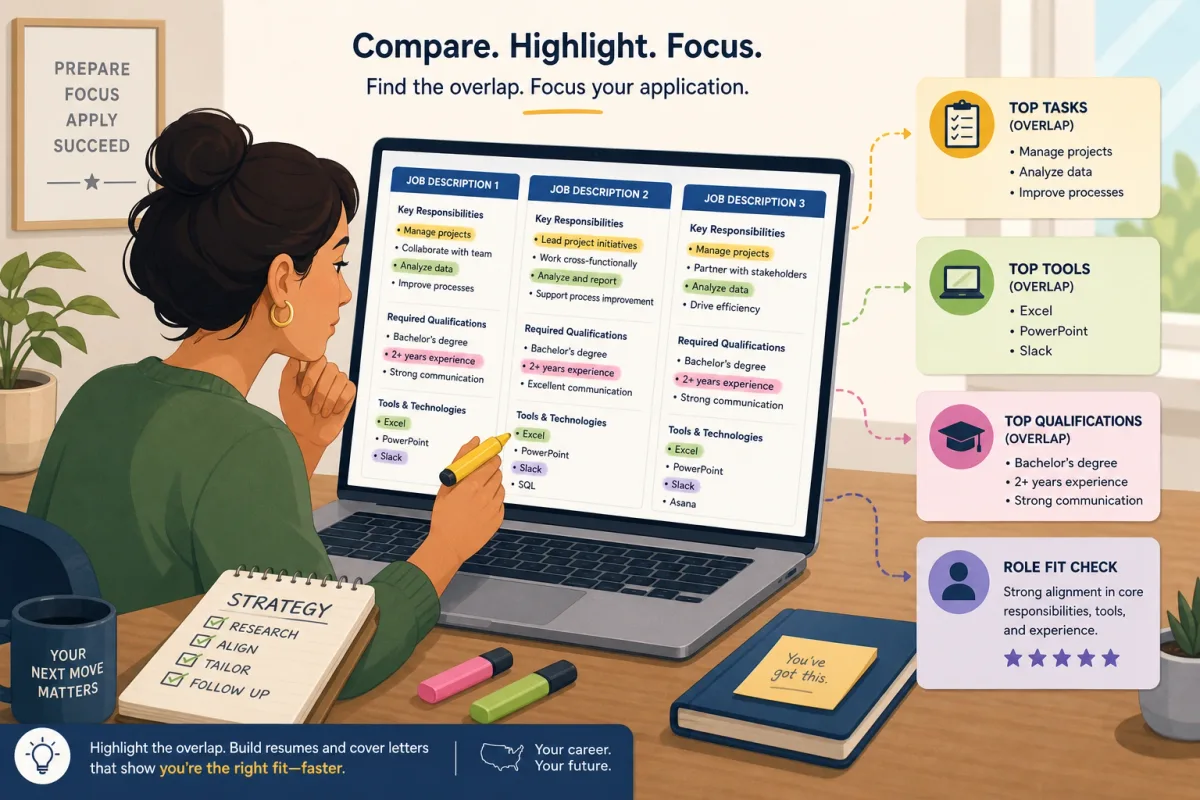
Step 2: Collect 10–15 current job descriptions
You’re not trying to represent the entire market. You’re trying to spot repeated patterns.
Highlight repeated:
- tasks (what you’ll do)
- tools (what you’ll use)
- qualifications (what’s required)
- language (how they describe success)
If you’re comparing careers, use the BLS Occupational Outlook Handbook (OOH). It summarizes duties, common education or training, pay, and job outlook.
Step 3: Sort requirements into four buckets
When you read a job posting, sort requirements:
- Must-have: You’re not eligible without it (license, required credential, core skill you can’t do, legal requirement).
- Preferred: Nice to have. Often a “wish list.”
- Trainable after hiring: The job expects you to learn it.
- Unclear: The posting doesn’t explain whether it’s essential.
A practical example:
- Entry-level marketing coordinator: missing “1–2 years” might be okay if you can show projects and can do the core tasks.
- Licensed clinical role: missing the required license is usually a real barrier.
A simple “must-have” test you can run in 2 minutes
If you’re unsure whether something is a must-have, ask:
- Could you legally do the job without it? (license, certification, work authorization)
- Is it part of the core job every day? (for example: a customer support role requires real communication skills)
- Does the posting say “required” or “must” and repeat it multiple times?
- Would the job become unsafe without it? (safety training, medical clearance)
If the answer is yes, treat the item as a likely must-have. Confirm it in the job posting or with the employer before deciding whether to apply.
Apply Now vs. Build First Matrix

| Situation | Recommended Action | Why |
|---|---|---|
| Core tasks match and missing items are preferred | Apply now | You have relevant evidence and you’re not missing a true barrier |
| Core tasks mostly match but evidence is weak | Apply selectively while building one proof asset | Application and proof-building can run in parallel |
| One trainable skill or tool appears repeatedly | Build a focused project or short learning proof, then apply | The gap is narrow and testable |
| A mandatory license, credential or central skill is missing | Build first or choose a nearer role | The gap directly affects eligibility or job performance |
| The role is several levels above current evidence | Choose a bridge role | A closer target can create higher-credibility experience |
Build Proof of Readiness Without Pretending It Is Employment
If your evidence is thin, your goal is not to collect random activities. Your goal is to prove one repeated requirement for your target role.
A strong proof asset:
- resembles a real task,
- has a clear deliverable,
- uses relevant tools,
- can be explained step by step,
- is labeled accurately.
Experience Substitution Ladder

| Level | Evidence Type | What It Can Prove | Limitation | Move Up When |
|---|---|---|---|---|
| 1 | Learning evidence | Basic knowledge and terminology | Does not prove task performance | You can explain concepts but have no output |
| 2 | Practice exercise | Ability to follow a defined process | May be highly guided | You can complete the exercise independently |
| 3 | Personal project | Initiative, tools and end-to-end execution | No external stakeholder | The project is relevant and can be reviewed |
| 4 | Simulated assignment | Ability to handle a realistic brief | Still self-created | You need a role-specific work sample |
| 5 | Volunteer project | Work for a real stakeholder | Scope and supervision vary | You can document responsibilities and outcomes |
| 6 | Freelance or contract task | Client communication and delivery | May be small or inconsistent | You can verify the work and relationship |
| 7 | Internship or apprenticeship | Structured workplace learning | Access and eligibility vary | The role provides supervised real-work evidence |
| 8 | Entry-level paid role | Ongoing performance in a workplace | May be a bridge rather than the final target | You’re ready to pursue the next level |
Proof-of-Readiness checklist
A proof asset should answer:
- What target-job task does this demonstrate?
- What tools or methods did you use?
- What constraints or decisions did you handle?
- What did you produce?
- How can a hiring manager review or verify it?
- What did you learn or improve?
- Is the work labeled accurately?
Employer risk map
| Employer Concern | Evidence That Can Reduce the Concern |
|---|---|
| Can this person perform the basic task? | Relevant project, work sample, assessment or prior adjacent task |
| Do they understand the role? | Specific application language, informed questions and role research |
| Are they reliable? | Completed commitments, references, consistent follow-through and clear timelines |
| Will they require constant supervision? | Independent project decisions, documented process and examples of solving problems |
| Can they learn? | A recent learning example followed by applied output |
| Can they communicate professionally? | Clear resume, focused message, organized interview answers and timely follow-up |
| Are they likely to stay? | Credible motivation tied to the role, not an exaggerated promise |
Choose the lowest-cost credible proof option
Choose a path that fits your time, income, health, and caregiving needs:
- If unpaid work is not realistic, focus on a personal project, paid bridge role, or apprenticeship.
- If your schedule is limited, build a proof asset in short, repeatable sessions.
- If you need income quickly, prioritize temporary, part-time, or entry-level work that also develops relevant evidence.
When it fits your target role, a registered apprenticeship can provide paid, structured training. Review Apprenticeship.gov’s career seeker guidance. Then search the Apprenticeship Job Finder.
Three practical proof templates
| Target Role Type | Deliverable | Example |
|---|---|---|
| Operations, admin, support | A short process document and checklist | A volunteer shift handoff or new-member onboarding guide |
| Service roles | A before-and-after improvement note | A clearer intake script, sign-up message, or organized spreadsheet |
| Analyst, marketing, tech | A focused mini project | A dashboard, short analysis, basic website, or campaign brief |
Label each asset accurately. A personal project is not client work, and volunteering is not paid employment.
Example: a proof asset you can finish in 7–10 days
Fictional example: you are targeting a junior data analyst role and repeatedly see “clean data and create a simple report.”
- Choose a narrow question and a public dataset.
- Clean the data and document each important change.
- Create one chart or table.
- Write a one-page summary covering the question, method, result, and next step.
This gives you a reviewable output and a process you can explain in an interview.
Tailor Your Resume and Cover Letter Around Evidence
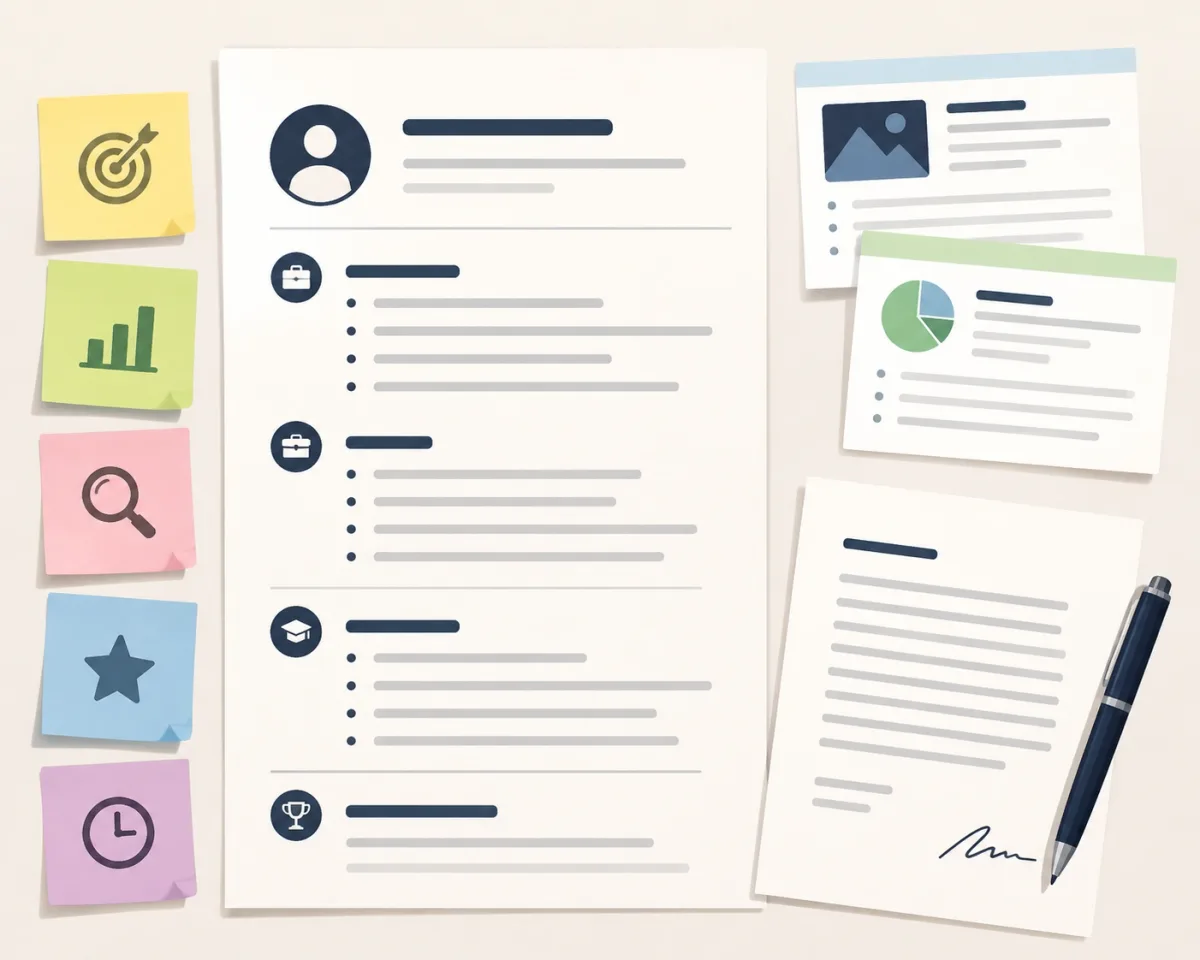
If you need a foundation first, review what a resume is. For this job search, treat your resume as a focused proof document—not a complete life story.
If you don’t have a strong work history, your top sections might be:
- Education
- Projects
- Skills
- Volunteering
- Additional experience (part-time, seasonal, family business support)
Keep sections accurately labeled. Do not rename projects as “work experience.”
What to put on a resume with no experience
A resume with no experience still needs to make one thing obvious: you can do the job’s core tasks or learn them fast.
Use:
- relevant coursework only when it directly maps to tasks
- 2–4 projects or proof items that match repeated requirements
- skills you can explain and demonstrate
Bullet writing: action + context + output
A good bullet helps the reader picture what you actually did.
Before: Helped with social media for a student organization.
After pattern: Planned and scheduled weekly posts for a student organization using [tool], coordinated content with [number or type of collaborators], and produced [accurate output or result].
If you do not have numbers, use truthful details. These may show cadence (“weekly”), completion (“delivered on time”), or scope (“coordinated a four-person team”). For a broader editing process, see how to make your resume stand out.
Cover letter: bridge the gap (don’t apologize)
A cover letter is not a confession. It’s a bridge:
- Name the target role and explain the specific reason it fits.
- Present one closely related project, responsibility or transferable achievement.
- Explain the relevant skill, tool or learning process the evidence demonstrates.
Adaptable example: “I’m applying for the Operations Coordinator role because I enjoy coordinating details and keeping work moving under deadlines. In my campus volunteer role, I managed shift schedules and wrote a simple intake guide. I also trained new volunteers so handoffs stayed consistent. That work strengthened my planning and communication skills, and I’m ready to use the same habits on your team.”
If you’re worried about an experience gap
You do not need to explain every gap on a resume. You do need to be ready to explain it in a calm, honest way if asked.
A simple rule: if you’ve been doing something meaningful (school, caregiving, training, recovering, relocating), you can say that—without oversharing.
Apply Strategically and Build Connections

Your goal here is balance: targeted applications + small, specific outreach + steady proof-building.
What “strategic” means (in plain terms)
- You apply to roles where your evidence matches the core tasks.
- You tailor your materials to those roles.
- You use people for information and feedback—not as vending machines for referrals.
Start with the network you already have
This is usually faster and more comfortable than messaging strangers:
- classmates, teachers, professors
- coaches
- community members
- former coworkers (even if it was a first job)
- alumni groups
- local workforce services
CareerOneStop lists free local job-search services, including American Job Centers. Services vary by location. They may include workshops, resume help, and other support.
Use small, specific requests
Here are two scripts you can copy and customize.
Networking Message: Alumni or Community Contact “Hi [Name], I’m exploring entry-level [role family] opportunities and noticed your experience in [specific area]. I’m working on [brief relevant project or preparation]. If you have 15 minutes, I’d value your perspective on the skills or work samples that matter most for someone entering the field. No worries if your schedule is full.”
Informational Interview Request “Hi [Name], I’m researching what day-to-day work in [role] actually involves before I apply. Your background in [specific context] stood out to me. Would you be open to a short conversation about the role’s core tasks, common entry points, and what new candidates often misunderstand? I’m not asking for a job or referral.”
Follow-Up Principle A follow-up should reference the prior interaction, thank the person, state one useful action taken, and ask at most one clear question. Avoid repeated daily messages or guilt-based language.
Track the process so you can improve it
You don’t need a fancy tracker. Track these fields:
- company and role
- where you applied (company site, job board, referral)
- date
- resume version (A/B)
- cover letter version (or none)
- contact name (if any)
- stage (applied → screened → interview → final → offer)
- next action
Tracking helps you stop guessing. It also helps you diagnose what to fix.
One more thing: don’t outsource “fit” to the job title
Two jobs with the same title can be completely different.
When you’re early-career, it’s usually better to apply to a role where:
- the job description names clear tasks,
- the employer is clearly real and verifiable,
- the requirements aren’t wildly disconnected from the duties.
That’s how you avoid wasting time on roles that will never consider you.
Prepare to Discuss Limited Experience in Interviews

When an interviewer points out your limited experience, don’t deny it and don’t overcompensate. Use a simple, honest structure.
Interview answer framework
- Acknowledge: Briefly confirm that direct experience is limited.
- Bridge: Name the closest relevant project, responsibility or prior work.
- Prove: Explain the task, action, tool and result.
- Prepare: State how the evidence and learning process apply to the role.
Sample (fictional example, clearly labeled)
“I’m early in my career, so I haven’t held this exact role yet. But I coordinated a campus event for a student group. I owned the timeline, tracked tasks for a small team, and shared changes so we stayed on schedule. I used a shared spreadsheet and weekly check-ins to keep the work organized. We delivered the event without last-minute problems. That experience shows the coordination and follow-through I can bring to this role.”
Prepare 6 evidence stories (so you’re not scrambling)
You don’t need 20 stories. You need a small set that covers common concerns:
- reliability (showing up, finishing)
- teamwork
- problem-solving
- communication
- learning something new
- handling feedback
If you’re not sure what to say in an interview with no experience, prepare three stories. Use one from school, one from volunteering, and one from a personal project. Practice them aloud until they sound natural.
For a complete process, see how to prepare for a job interview. For real-time practice, GreatOffer.ai can help you structure clear answers based on your own honest examples.
Diagnose Why Your Job Search Is Not Producing Results

If you’re not getting traction, sending more applications with the same approach usually just creates more silence.
Think of your search like a funnel: opportunities found → applications → screening calls → interviews → final interviews → offers
There’s no universal “good” conversion rate. What matters is your pattern and your biggest drop-off.
Job Search Funnel Diagnosis
| Observed Pattern | Possible Issue | Next Test |
|---|---|---|
| Very few realistic openings | Target is too narrow, senior or geographically constrained | Broaden role keywords or choose a bridge role |
| Many applications, no screening calls | Weak match, generic materials, missing proof or poor channel | Tighten role fit, revise top-third evidence and add one warm path |
| Screening calls, few interviews | Positioning, constraints or evidence is unclear | Practice a concise target-and-proof explanation |
| Interviews, no final rounds | Examples may be weak, generic or not role-relevant | Improve task stories and demonstrate role understanding |
| Final rounds, no offers | Competition, specific skill gap or interview evidence may be decisive | Request feedback when available and compare repeated patterns |
| Offers are unsuitable or suspicious | Target criteria or legitimacy checks are weak | Define minimum conditions and verify employer/job details |
Example of a controlled fix
Fictional example: you submitted 40 broad applications and got zero screens.
A controlled change might look like:
- narrow to one role family
- rewrite the top third of your resume to feature your most relevant evidence
- add one proof asset that matches a repeated requirement
- apply to the next batch of strong matches
Then compare results. Don’t change five things at once—you won’t know what helped.
Follow a 30-Day Plan to Build Minimum Viable Experience
“Minimum viable experience” is the smallest honest evidence package that makes your applications credible.
This is not a promise you’ll be hired in 30 days. It’s a plan to build proof and improve your process.
30-Day Action Plan
| Week | Primary Goal | Required Actions | Deliverable |
|---|---|---|---|
| Week 1 | Diagnose and target | Choose a role family; review job descriptions; complete the diagnostic and experience inventory | Target-role profile + requirement map |
| Week 2 | Build or strengthen proof | Select one missing requirement; create or improve a project, sample, credential application or volunteer deliverable | One reviewable proof asset |
| Week 3 | Prepare materials and connections | Tailor resume and cover-letter bridge; update portfolio; contact selected people; practice the target explanation | Application package + outreach list |
| Week 4 | Apply, practice and review | Submit strong-match applications; conduct informational conversations; practice interview stories; review funnel data | Tracked application batch + next adjustment |
Minimum viable experience checklist
Before expanding your search, try to have:
- a defined target role
- three repeated role requirements
- existing evidence for at least two requirements
- one recent proof asset for a weak or missing requirement
- a resume that leads with relevant evidence
- a concise explanation of the experience gap
- at least two evidence-based interview stories
- a tracking method for applications and outcomes
Avoid Common Mistakes and Entry-Level Job Scams
You don’t need perfect strategy. You do need to avoid choices that hurt your credibility or safety.
Credibility mistakes to avoid
- applying to every role with the same materials
- waiting to meet every preferred qualification before applying
- confusing endless learning with proof-building
- buying an expensive credential without confirming target jobs value it
- inventing employers, clients, titles, dates, metrics, references, or certificates
- labeling a personal project as paid client work
- using AI-generated claims you can’t explain or verify
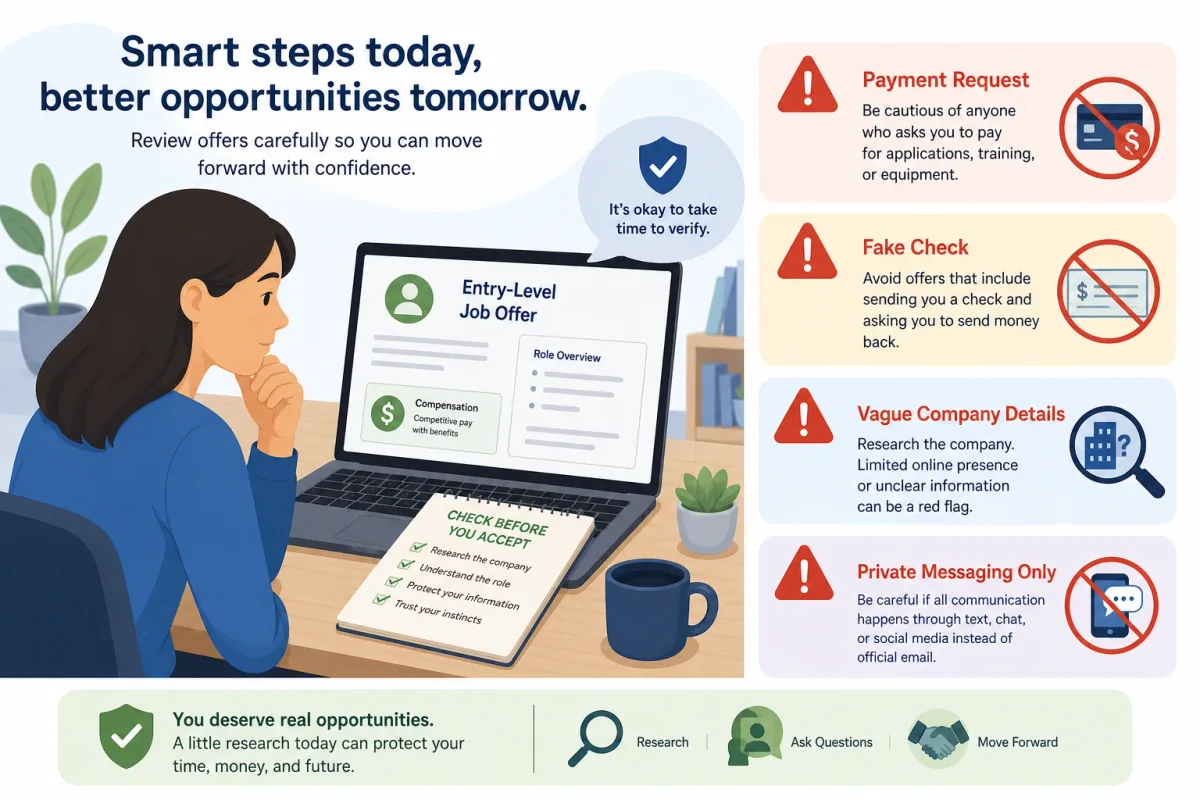
Scam warning signs (FTC-backed)
The Federal Trade Commission warns about job scams that ask for payment or unusual personal information. It also flags fake check schemes. Before you accept an offer, review the FTC’s guidance on job scams.
Watch for red flags like:
- you’re asked to pay to get hired
- you’re asked to deposit a check and send money back
- “recruiters” contact you from a personal email domain or only via private messaging
- you’re pressured to act immediately, with vague job details
Stop and verify independently if anything feels off. Use the company’s official website to find contact info rather than replying to the contact details in the suspicious message.
⚠️ Warning: A legitimate employer should not require you to pay to get a job. If money is involved, stop and verify the employer independently.
AI authenticity check (required)
Before submitting AI-assisted materials, confirm:
- every fact, date, skill, tool and result is true
- the wording sounds like you and can be explained aloud
- the application names the actual role and employer
- generic claims such as “results-driven” are replaced with evidence
- no project, volunteer activity or school assignment is mislabeled as employment
Conclusion
The practical answer to how to get a job with no experience is to make your readiness easier to see and trust.
Choose one realistic role family and identify one proof gap. Use the experience you already have before paying for training. When it makes sense, apply while you build proof. Track your results and improve the stage that falls behind.
Your next step: choose one target role, write one evidence-based interview story using acknowledge → bridge → prove → prepare, and practice saying it aloud.
GreatOffer.ai is a real-time interview coach that can help you organize and practice answers based on your actual experience.
Sources
Accessed July 20, 2026.