 Mike Chen
 Sasha
Sasha
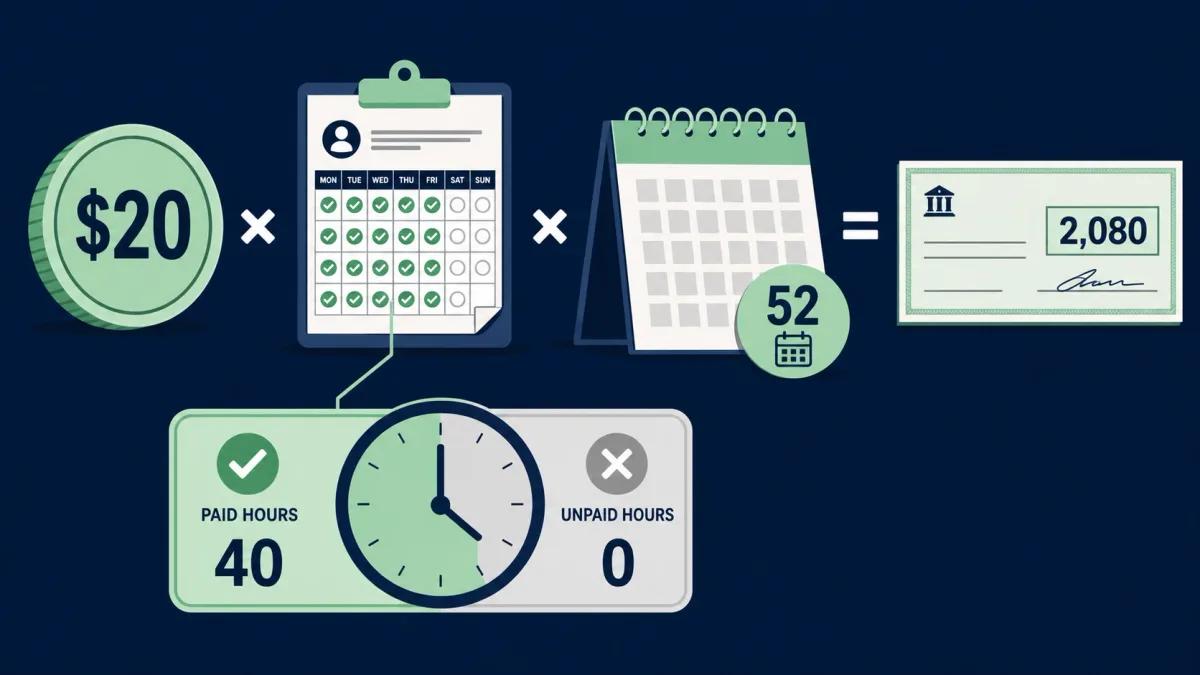
If you make $20 an hour and work 40 paid hours a week for 52 weeks, your gross annual pay is $41,600 before taxes.
$20 × 40 hours/week × 52 weeks/year = $41,600/yearThat calculation assumes 2,080 paid hours per year. Your actual number moves if your schedule changes, time off is unpaid, you earn overtime, or you work as a 1099 contractor instead of a W-2 employee.
Quick Pay Breakdown at $20 an Hour
| Pay period | Gross pay at $20/hour | Calculation |
|---|---|---|
| Yearly | $41,600 | $20 × 40 hours × 52 weeks |
| Monthly average | $3,466.67 | $41,600 ÷ 12 |
| Semi-monthly | $1,733.33 | $41,600 ÷ 24 paychecks |
| Biweekly | $1,600 | $20 × 80 hours |
| Weekly | $800 | $20 × 40 hours |
| Daily, eight hours | $160 | $20 × 8 hours |
The monthly figure is an average, not a paycheck. Paid biweekly, you get 26 checks a year: two in most months, three in two of them. Semi-monthly means 24 checks on fixed dates, each slightly larger.
How $20 an Hour Is $41,600 a Year
The standard full-time conversion uses 2,080 paid hours:
40 paid hours/week × 52 paid weeks/year = 2,080 paid hoursUse this formula for any schedule:
Hourly rate × paid hours per week × paid weeks per year = annual gross payThe word that matters is paid. A job can keep you on site for eight hours and pay you for 7.5 because the meal break is unpaid. A 40-hour schedule can also fall short of 2,080 hours when holidays, shutdowns or personal time are unpaid.
| Work pattern | Calculation | Annual gross |
|---|---|---|
| 40 hours/week for 52 paid weeks | $20 × 40 × 52 | $41,600 |
| 40 hours/week for 50 paid weeks | $20 × 40 × 50 | $40,000 |
| 40 hours/week for 48 paid weeks | $20 × 40 × 48 | $38,400 |
A $20 hourly rate does not automatically produce a $41,600 year. Confirm how many hours and weeks the employer will actually pay.
Before you rely on the annual figure, ask three questions:
- How many hours per shift are paid? Confirm whether meal breaks are paid or unpaid.
- How stable are weekly hours? Ask whether the employer cuts shifts during slow periods.
- How many weeks are paid? Check paid holidays, paid time off and seasonal shutdowns.
Already in the job? Use your timecard and pay stub, not the advertised schedule.
What $20 an Hour Pays at Different Schedules
$20 an hour can mean a part-time job, a 37.5-hour schedule or a 40-hour schedule. The rate stays the same. The annual pay doesn't.
| Paid schedule | Annual gross pay |
|---|---|
| 20 hours/week × 52 weeks | $20,800 |
| 30 hours/week × 52 weeks | $31,200 |
| 35 hours/week × 52 weeks | $36,400 |
| 37.5 hours/week × 52 weeks | $39,000 |
| 40 hours/week × 52 weeks | $41,600 |
Each additional paid hour per week adds $20 in weekly gross and about $1,040 a year across 52 weeks. That's why a 37.5-hour job pays $2,600 less per year than a 40-hour job at the same rate. Read the schedule in the offer, not just the rate.
Overtime at $20 an hour
If you're eligible for time-and-a-half overtime, the overtime rate is $30 an hour. Five overtime hours would produce this weekly gross pay:
40 regular hours × $20 = $800
5 overtime hours × $30 = $150
Weekly gross = $950
If that schedule ran all 52 weeks, annual gross pay would be $49,400. If the overtime showed up in only 20 weeks, it would add $3,000 to the base annual pay.
Don't build rent or debt payments around overtime unless the hours are dependable. Eligibility and calculation rules vary by classification, so review the U.S. Department of Labor's Overtime Pay guidance and confirm the employer's policy before you count on the extra $150 a week.

$20 an Hour After Taxes
There is no universal after-tax amount for $20 an hour, and anyone quoting you one national take-home number is guessing. The $41,600 figure is gross pay. Your deposit depends on federal withholding, payroll taxes, state and local taxes, filing status, dependents and deductions for benefits.
Common paycheck deductions include:
- federal income tax withholding based partly on your Form W-4 and pay frequency
- Social Security and Medicare taxes
- state or local income tax, depending on where you live
- health insurance, retirement and other benefit deductions
- post-tax deductions such as union dues or garnishments
The IRS explains employee withholding in Tax withholding for individuals.

Withholding is not the same as final tax
Withholding is what your employer sends to tax authorities from each check. Your final tax bill is settled when you file your return. A bigger deposit can simply mean lower withholding, not better pay, so compare gross wages and benefits when you weigh jobs against each other.
If you can get a sample pay stub from HR, review gross pay, federal withholding, Social Security and Medicare, state or local withholding and benefit deductions. After two normal paychecks arrive, use those deposits to build a better monthly estimate.
| Illustrative scenario | Gross annual pay | Deductions to consider | Expected direction |
|---|---|---|---|
| Single W-2 worker in a state without individual income tax | $41,600 | Federal withholding, payroll taxes, benefits | Relatively higher take-home, all else equal |
| Single W-2 worker in a state with individual income tax | $41,600 | Federal withholding, payroll taxes, state tax, benefits | Relatively lower take-home, all else equal |
| Married filing jointly | $41,600 | Household income, withholding, dependents and deductions | Varies materially |
| 1099 contractor | $41,600 | Self-employment tax, business expenses and estimated taxes | Not directly comparable with W-2 pay |
These scenarios show direction, not a promise of net income. For a usable estimate, enter your tax year, filing details, location, pay frequency and benefits into a current withholding tool or payroll calculator.
A 2026 federal take-home example
Here is one reproducible baseline for a single W-2 employee in 2026. It assumes $41,600 of wages, single filing status, no dependents, the $16,100 standard deduction, no other income or credits, no state or local income tax, and no insurance or retirement deductions.
| 2026 baseline item | Approximate amount |
|---|---|
| Gross annual wages | $41,600.00 |
| Federal taxable income after standard deduction | $25,500.00 |
| Estimated federal income tax | $2,812.00 |
| Employee Social Security tax, 6.2% | $2,579.20 |
| Employee Medicare tax, 1.45% | $603.20 |
| Estimated annual take-home before benefits | $35,605.60 |
| Monthly average | $2,967.13 |
| Biweekly average, 26 checks | $1,369.45 |
| Weekly average, 52 checks | $684.72 |
The federal income-tax estimate applies the IRS's 2026 single-filer brackets: 10% on the first $12,400 of taxable income and 12% on the remaining $13,100. Social Security and Medicare use the employee rates published by the IRS. This is an annual tax estimate, not a guaranteed paycheck withholding amount. Payroll timing, Form W-4 entries, tax credits, additional income and benefit deductions can change each deposit and the final tax bill.
Use the IRS Tax Withholding Estimator for your own inputs. The example intentionally uses a state without individual wage income tax; if you live elsewhere, you also need to account for state and local taxes.
Monthly cash flow on biweekly pay
At 80 paid hours per two-week period, biweekly gross pay is $1,600. A typical two-check month has $3,200 in gross pay, while a three-check month has $4,800. Neither number equals the $3,466.67 monthly average.
Build recurring bills around two-check months. Treat the third check as a buffer for irregular expenses, savings or debt. Committing money that arrives in only two months of the year is how budgets break.
W-2 vs. 1099 at $20 an Hour
$20 an hour as a W-2 employee and $20 an hour as a 1099 contractor are not the same compensation.
| Factor | W-2 at $20/hour | 1099 at $20/hour |
|---|---|---|
| Tax handling | Employer withholds payroll taxes | Worker manages estimated payments and tax planning |
| Benefits | May include insurance, paid leave, holidays or retirement match | Usually self-funded unless the contract provides otherwise |
| Work expenses | Employer may cover tools and business costs | Worker may pay for equipment, mileage, software, insurance and downtime |
| Income predictability | Often tied to a scheduled shift | Depends on the contract and billable hours |
A self-employed worker may owe self-employment tax and may need to make estimated payments. See the IRS pages on self-employment tax and estimated taxes.
Don't use a universal multiplier to turn W-2 pay into a contractor rate. Price your own unpaid admin time, insurance, tools, mileage, nonbillable hours and time off. If a contract doesn't guarantee billable hours, you're comparing a rate with a job, not two equivalent offers.

Is $20 an Hour Good Pay?
$20 an hour can work, but the rate alone can't tell you whether the job supports your household. Location, reliable paid hours, benefits, debt, transportation and household size all change the answer.
Stop looking for a national yes or no. Ask these instead:
- What is my conservative monthly take-home estimate?
- Are paid hours guaranteed?
- What will housing and commuting cost where I live?
- What will I pay for health insurance and other benefits?
- Does this job provide paid time off?
- Is there a credible path to a raise or promotion within 6 to 12 months?
Clearing minimum wage doesn't make a rate affordable. The test is whether dependable net income covers your actual fixed costs and leaves room for the irregular ones.
Can You Live on $20 an Hour?
You may be able to live on $20 an hour, but housing, household size, debt, transportation, benefits and schedule stability decide it. Start with take-home pay, not the $3,466.67 gross monthly average.
1. Estimate conservative monthly take-home pay
Use your pay frequency, location, filing details and benefit deductions. Until you have normal pay stubs, budget from the low end of a documented estimate, not from an attractive round number.
2. Test housing against take-home pay
Add rent, mandatory fees and average utilities. Compare that total with conservative monthly take-home pay. Then run the budget again after removing one shift or five paid hours.
At $20 an hour, five paid hours equal $100 in gross pay. If losing that makes rent impossible, the problem isn't the conversion formula. The job lacks enough stability or your budget lacks enough margin.
3. Add the full cost of transportation
Include the car payment, insurance, fuel, maintenance and parking, or your actual public-transit costs. A manageable rent can still fail when the commute eats the remaining income.
4. Add other non-negotiable expenses
Account for food, health costs, debt minimums and child care if you need it. Add irregular costs such as repairs, medical bills and replacement of essential items rather than pretending every month will behave.
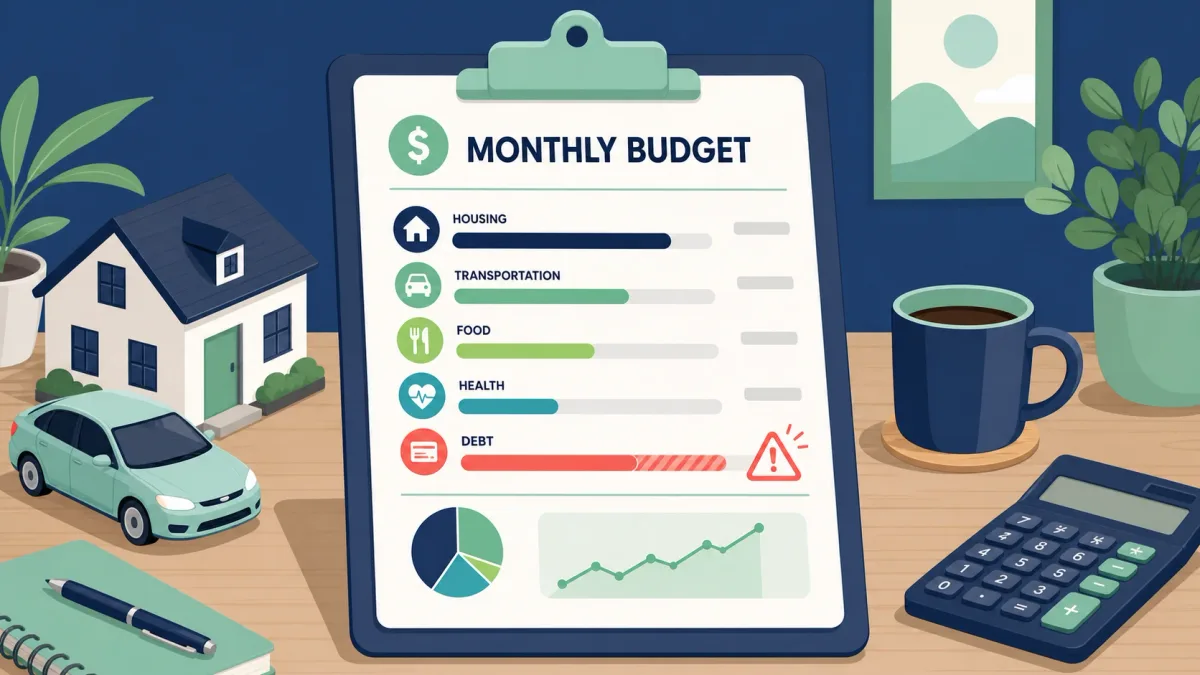
| Category | Monthly amount | What to include |
|---|---|---|
| Take-home pay | ____ | Conservative estimate based on current inputs |
| Housing | ____ | Rent, required fees and utilities |
| Transportation | ____ | Car or transit, insurance, fuel, parking, maintenance |
| Health costs | ____ | Premiums and expected out-of-pocket costs |
| Debt minimums | ____ | Required payments |
| Food | ____ | Groceries and planned dining |
| Child care | ____ | If applicable |
| Irregular-expense buffer | ____ | Repairs, medical bills and replacements |
| Remaining amount | ____ | Savings and flexible spending |
Shared housing, lower transportation costs, employer-paid health coverage or another household income can improve the result. High rent, car debt, child care and uninsured medical needs push it the other way.
$20 an Hour Offer Reality Check
Before you accept a $20-an-hour job, verify what the employer will pay and what the job will cost you.
- Are the hours guaranteed and paid? Ask about minimum weekly hours, seasonal slowdowns, unpaid breaks, paid holidays and paid time off.
- Is it W-2 or 1099 work? Confirm who handles payroll taxes, insurance, equipment, mileage and downtime.
- What does the benefits package add or remove? Check employee premiums, retirement match, paid leave, tuition support and scheduling rules.
- What does the job cost you to do? Price commuting, parking, uniforms, tools, child care, schedule strain and unpaid travel.
- What is the 6-to-12-month path? Ask about reviews, raises, training, promotion criteria and transferable experience.
A lower rate with stable hours and useful benefits can beat a higher rate with unreliable shifts and no paid time off.
Questions to ask HR
- "How many hours are typically paid each week, and are meal breaks paid or unpaid?"
- "Are there guaranteed minimum hours, or can shifts be cut during slow periods?"
- "Which holidays are paid, and how does paid time off accrue?"
- "Is this W-2 or 1099, and who pays for equipment, mileage and insurance?"
- "When is compensation reviewed, and what results lead to a raise?"

These aren't aggressive questions. They're the inputs you need to decide whether the offer works, and an employer who bristles at them is telling you something too.
Try the GreatOffer.ai interview copilot to rehearse the interview and practice asking about paid hours, benefits and advancement before you accept an offer.
Jobs That May Pay Around $20 an Hour
Pay varies by employer, location and experience. Fields where offers near this rate show up include customer support, warehouse and logistics, administrative support, entry-level skilled trades, health support, hospitality supervision and technical support.
Don't treat that list as a salary guarantee. Check current local openings and official occupational data before targeting a role.
The BLS Occupational Outlook Handbook reports these May 2024 national median wages:
| Occupation | National median pay | Typical entry-level education | What the figure means |
|---|---|---|---|
| Security guards | $38,370/year, about $18.45/hour | High school diploma or equivalent | Below $20/hour nationally, though local offers vary |
| Customer service representatives | $20.59/hour | High school diploma or equivalent | Close to the article's $20/hour benchmark |
| General office clerks | $20.97/hour | High school diploma or equivalent | Slightly above the benchmark nationally |
| Medical assistants | $44,200/year, or $21.25/hour | Postsecondary nondegree award | Above $20/hour and usually requires formal training |
These are national medians, not starting wages or promises about a specific opening. Half of workers in an occupation earn less than the median and half earn more. Location, experience, employer and shift can move an offer substantially.
Want a higher rate? Collect measurable results for your resume, learn one skill your target role screens for, practice specific interview answers and research local pay before you negotiate.
Compare $20 an Hour With Nearby Pay Rates
| Hourly rate | Annual gross at 40 hours/week × 52 weeks | Next comparison |
|---|---|---|
| $20/hour | $41,600 | Current page |
| $23/hour | $47,840 | $23 an hour is how much a year |
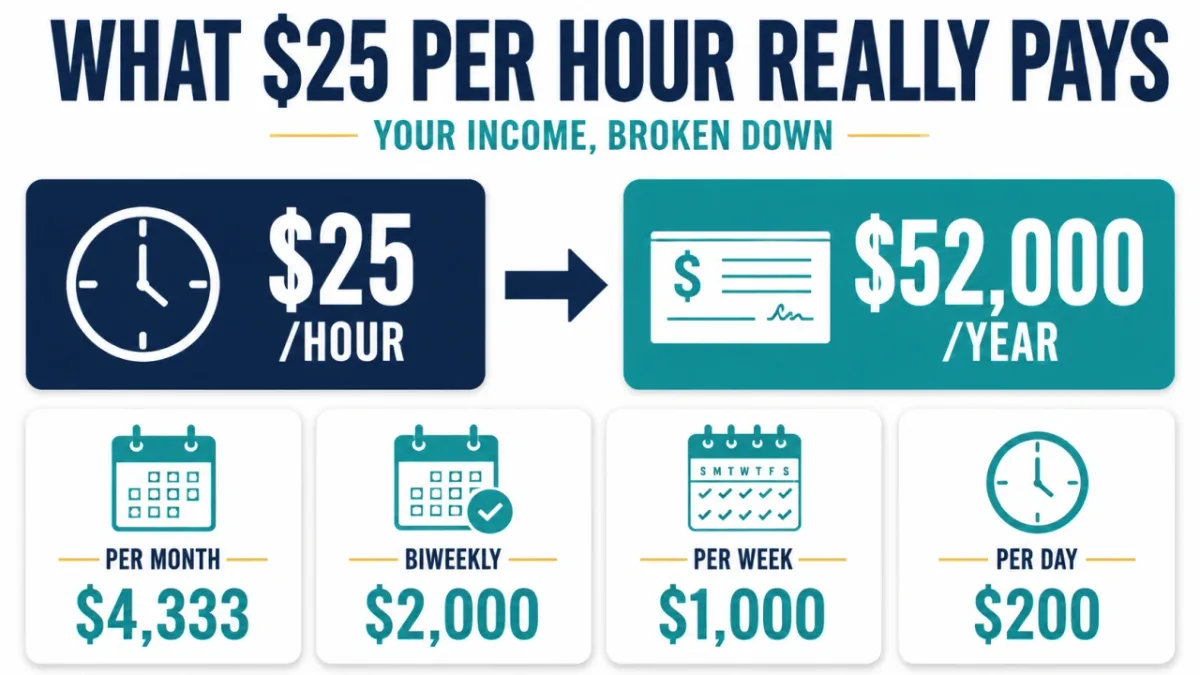
| $25/hour | $52,000 | $25 an hour is how much a year |
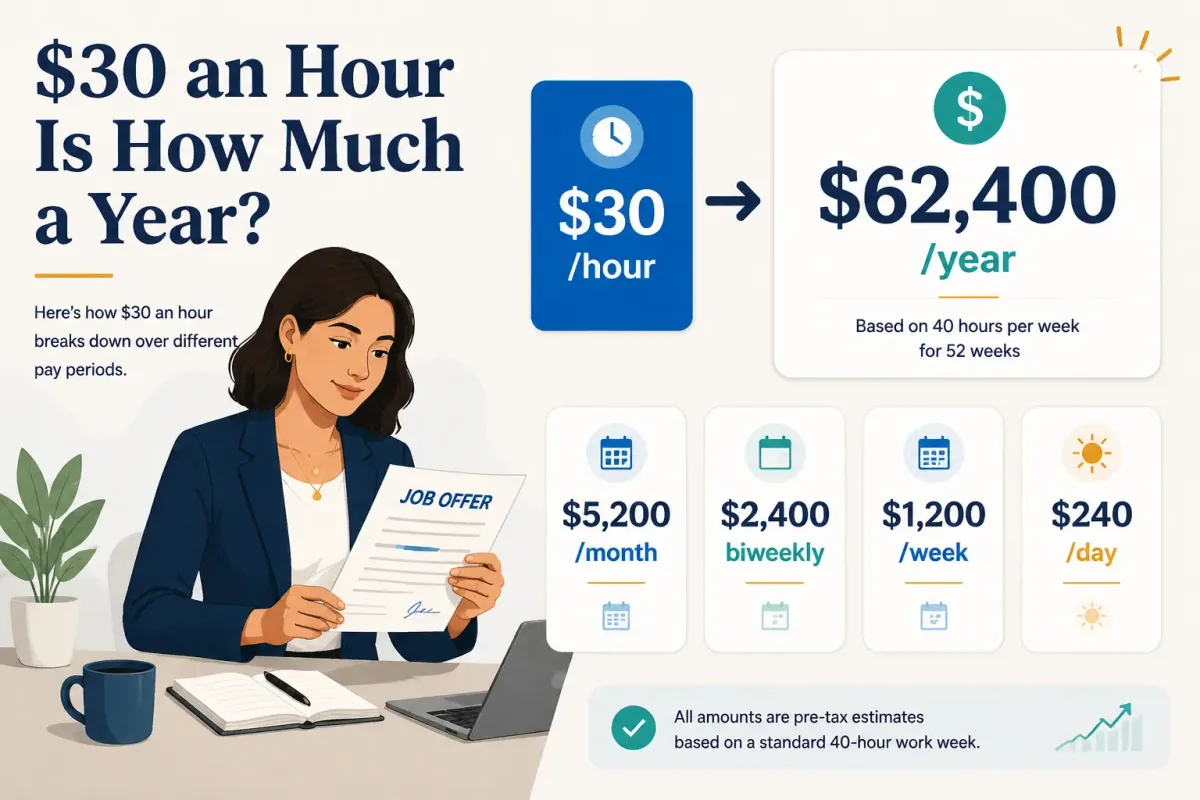
| $30/hour | $62,400 | $30 an hour is how much a year |
| $35/hour | $72,800 | $35 an hour is how much a year |
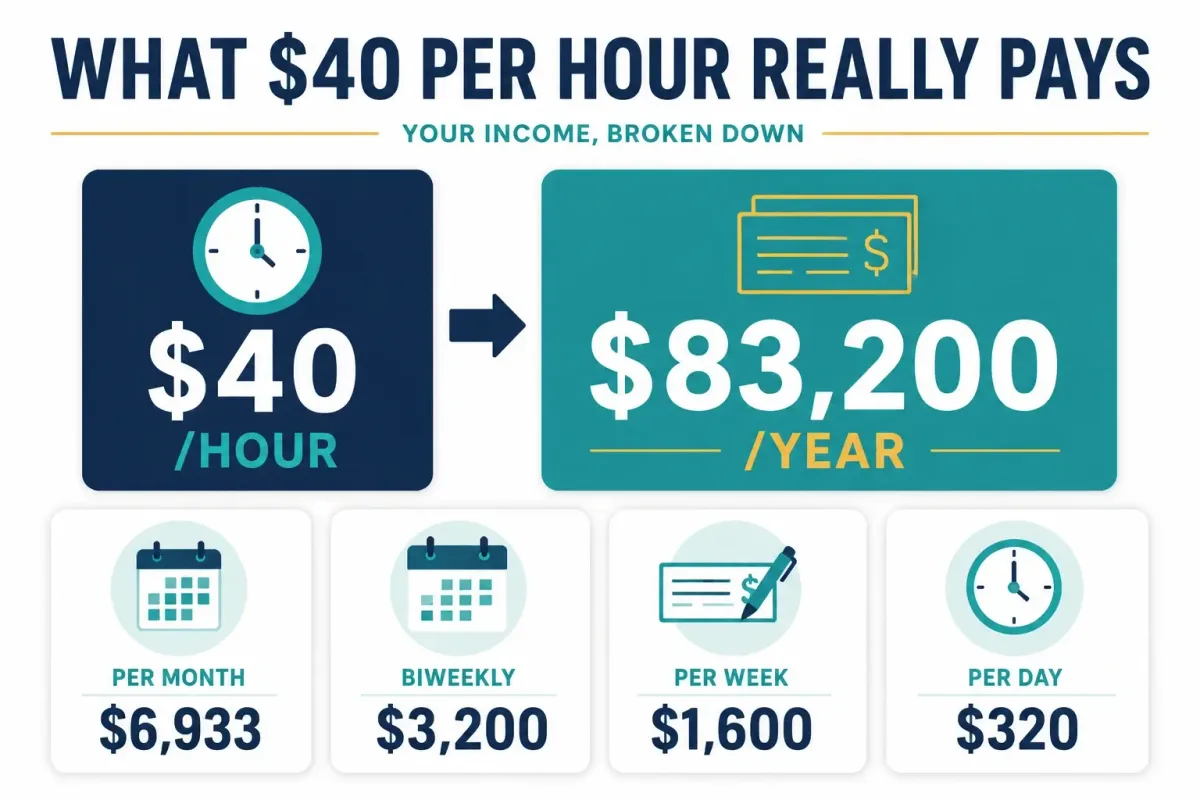
| $40/hour | $83,200 | $40 an hour is how much a year |
At the 2,080-hour assumption, every $1 increase in hourly pay adds about $2,080 in annual gross pay.
$20 an Hour Is How Much a Year? Frequently Asked Questions
How much is $20 an hour a year full-time?
$20 an hour is $41,600 a year before taxes at 40 paid hours a week for 52 paid weeks. Fewer paid hours or unpaid weeks reduce that total.
How much is $20 an hour a month?
$20 an hour averages $3,466.67 in gross monthly pay at 2,080 paid hours per year. That's an annual average, not necessarily the amount deposited in a particular month.
How much is $20 an hour biweekly?
$20 an hour is $1,600 gross every two weeks when the pay period includes 80 paid hours. Semi-monthly pay is different: $41,600 divided among 24 checks averages $1,733.33 per check.
How much is $20 an hour weekly?
$20 an hour is $800 gross for a 40-hour week. If your schedule changes, multiply $20 by the paid hours on your timecard.
How much is $20 an hour after taxes?
There is no responsible universal figure. Net pay depends on the tax year, filing status, location, dependents, withholding and benefit deductions. Use a current estimator with your own inputs, then update your budget after normal pay stubs arrive.
Is $20 an hour good pay?
It can be, especially when hours are stable and benefits reduce your household costs. Judge the offer on conservative take-home pay, local housing and transportation costs, debt, household needs and the path to higher pay.
Can you live on $20 an hour?
Possibly. Housing, transportation, debt, child care, benefits and reliable hours usually decide the outcome. Build the budget from take-home pay and test whether it still works after a reduced-hours week.
How much is $20 an hour part-time?
Multiply $20 by paid hours per week and paid weeks per year. At 30 hours a week for 52 paid weeks, gross annual pay is $31,200.
What is $20 an hour with overtime?
For a worker eligible for time-and-a-half, the overtime rate is $30 an hour. Five overtime hours plus 40 regular hours would produce $950 in weekly gross pay. Eligibility and calculation rules depend on classification and applicable law.
Is $20 an hour better as W-2 or 1099?
The headline rate is not enough to decide. Compare taxes, benefits, paid leave, work expenses, nonbillable time and guaranteed hours. At the same rate, a 1099 contract may leave you covering costs an employer would otherwise pay.
Sources and Methodology
All gross-pay figures use basic multiplication and the stated paid-hour assumptions. The main annual conversion uses 2,080 paid hours: 40 hours per week multiplied by 52 weeks.
Official background sources used for tax and overtime concepts:
- U.S. Department of Labor, Overtime Pay, accessed July 24, 2026
- IRS, Tax withholding for individuals, accessed July 24, 2026
- IRS, 2026 tax inflation adjustments, accessed July 24, 2026
- IRS, Social Security and Medicare withholding rates, accessed July 24, 2026
- IRS, Tax Withholding Estimator, accessed July 24, 2026
- IRS, Self-employment tax, accessed July 24, 2026
- IRS, Estimated taxes, accessed July 24, 2026
- BLS, Occupational Employment and Wage Statistics tables, accessed July 24, 2026
- BLS Occupational Outlook Handbook occupation pages cited in the jobs section, accessed July 24, 2026
This article provides general educational information, not individualized tax, legal or financial advice.
Conclusion
At the standard full-time assumption, $20 an hour is $41,600 a year before taxes at 2,080 paid hours. The number that should drive your offer decision is dependable take-home pay after actual paid hours, taxes, benefits and the cost of doing the job.
Before you accept, confirm paid breaks, guaranteed hours, time-off policy, worker classification and benefit costs. Then test the resulting take-home estimate against housing and transportation. If you are comparing a higher rate, see the $25, $30, $35 and $40 breakdowns.
Want to walk into the interview ready to ask about paid hours, benefits and advancement? Rehearse those questions with the GreatOffer.ai interview copilot before you compare offers.