 Mike Chen
 Sasha
Sasha
An employment gap is a period when you were not in a traditional paid role. It may reflect caregiving, health, a layoff, education, relocation, career change, job searching, or another personal or professional transition.
How to Get a Job With an Employment Gap in 8 Steps
- Identify the type and visibility of the gap.
- Decide whether and where it needs an explanation.
- Use a brief, neutral, truthful description.
- Tailor your resume around relevant evidence.
- Build recent proof of skills and readiness.
- Prepare a concise interview answer.
- Reconnect with your professional network.
- Track results and adjust the weakest stage.
If you have a gap, you’re not “starting from zero.” A hiring manager may still be making a decision with incomplete information. Your job is to reduce that uncertainty—without oversharing or inventing anything.
This guide follows a practical sequence. You will clarify the timeline, address work-related concerns, and show what you can do today.
Can You Get a Job With an Employment Gap?
Yes—an employment gap is not an automatic rejection rule.
But it can raise questions. A hiring team may want answers before investing time in interviews or making a hiring decision. Those questions are usually practical, not moral.
Here are the most common concerns employers try to resolve when they see a gap:
- Skill recency: Are your tools, knowledge, and day-to-day skills still current?
- Role familiarity: Do you still understand what the job requires right now?
- Availability: Are you ready for the schedule, travel, or workload this role expects?
- Reliability: Can you follow through consistently?
- References: Are your references recent enough to be useful?
- Motivation and direction: Do you have a clear reason for returning and a clear target?
There isn’t one universal “gap penalty” that applies to everyone. Field experiments (resume audit studies) have found different patterns depending on who was studied and what roles were targeted.
An NBER resume audit study by Kroft, Lange, and Notowidigdo (2012) found that callbacks fell as unemployment duration increased in its sampled jobs and cities. A later NBER study by Farber, Silverman, and von Wachter (2015) found no such link among experienced, college-educated women applying for administrative-support roles. Different applicants, jobs, and labor markets can produce different results, so neither finding is a universal hiring rule.
What matters for you: don’t argue with the existence of the gap. Reduce uncertainty with (1) a clear timeline, (2) a brief context category when it helps, and (3) current evidence you can show.
Diagnose the Employment Gap You Actually Have
Not all gaps create the same questions.
A two-year gap can look very different if you were recovering from a health issue, caring for a family member, relocating countries, or building a small business that later closed.
Before you write a single line on your resume, do this quick diagnostic:
- What kind of gap is this? (reason category)
- How visible is it? (timeline + date format)
- How recent is it? (last month vs. five years ago)
- What would a reasonable employer worry about? (the work-related question)
- What proof can you show today? (readiness evidence)
Employment Gap Diagnostic

| Gap Type | What May Already Be True | Main Employer Question | Privacy Level | Best Next Move |
|---|---|---|---|---|
| Caregiving or parental leave | Strong prior work history; limited recent paid work | Are you available and ready to return? | High | Use a neutral label if needed and add recent readiness proof |
| Health or recovery | Prior experience; private medical context | Is the current situation compatible with the role? | Very high | Share only the minimum relevant information and focus on present readiness |
| Layoff plus long job search | Recent role-related experience | Why has the search lasted, and are skills current? | Medium | State the layoff briefly and show targeted current activity only when true |
| Education or reskilling | New knowledge or credential | Can you apply the learning? | Low | Pair training with a project, work sample, or supervised task |
| Career change | Work history in another field | How does prior experience transfer? | Low | Map transferable results and build one bridge asset |
| Relocation or immigration | Prior experience from another place | Is local context or verification available? | Medium | Preserve prior experience and add current market context or references |
| Business closure or genuine freelance work | Actual clients, operations, or deliverables | How relevant and verifiable is the work? | Medium | Label it accurately; never invent consulting activity |
| Multiple or older gaps | Mixed experience over time | Is the pattern relevant to the current role? | Varies | Focus on recent fit and prepare a concise pattern-level answer |
Key Takeaway: Your goal is not to make your gap sound “acceptable.” Your goal is to make your timeline clear and your readiness believable.
Decide Whether—and Where—to Explain the Gap
Many people either overshare (putting private details everywhere) or undershare (leaving the timeline confusing).
A simple rule works better: explain only when it improves clarity or removes a reasonable work-related doubt.
Use these four checks:
- Visibility: Will the gap jump off the page?
- Recency: Is it recent enough that it affects your current readiness?
- Relevance: Does it affect the role (tools, schedule, requirements)?
- Usefulness: Will a short explanation help the reader understand your fit?
A short or older gap often needs no special resume entry.
A recent multi-year gap often benefits from a neutral label—because it prevents the reader from wondering if you’re hiding something.
And no matter what you put on the resume, you should still prepare an interview answer. If a recruiter asks, you don’t want to improvise.
Explain / Don’t Explain Channel Matrix
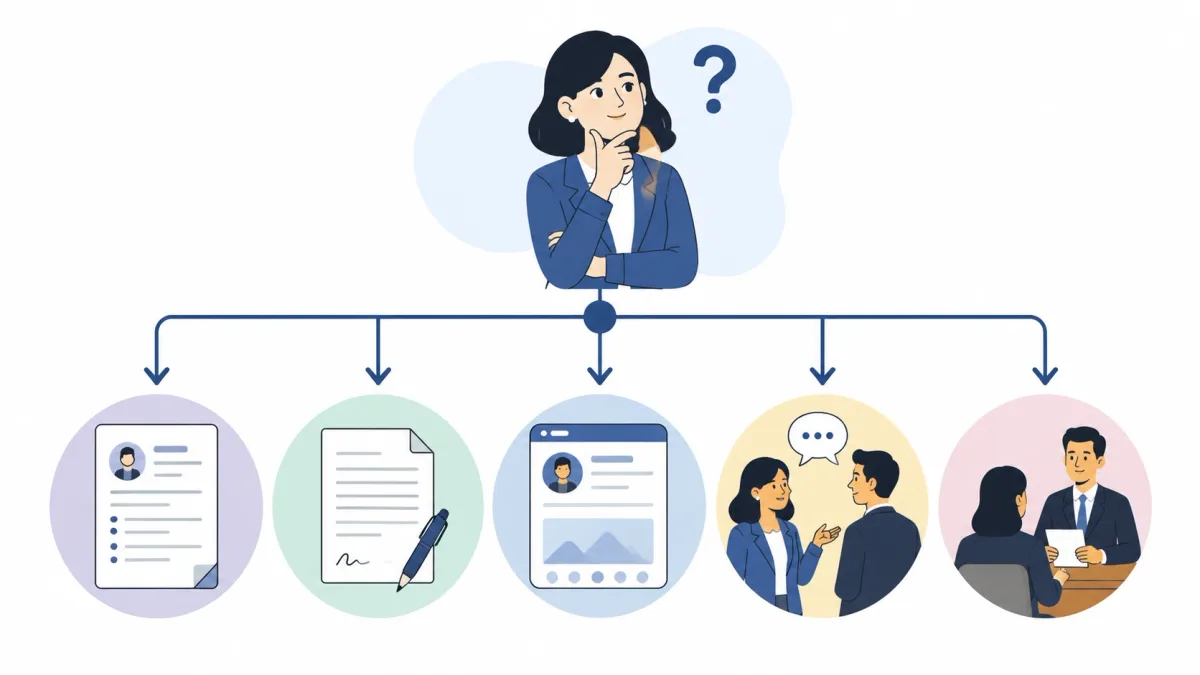
| Channel | Explain When | Usually Keep It Minimal When | Main Goal | Privacy Note |
|---|---|---|---|---|
| Resume | The gap is recent, long, and visually obvious; a neutral entry improves clarity | It is old, short in context, or outside the relevant history | Establish relevance and a clear timeline | Never include a diagnosis or family details |
| Cover letter | Context directly supports the return or career-change story | The letter can focus on stronger role evidence without raising the issue | Connect motivation and fit | One or two sentences are usually enough |
| A Career Break entry improves the public timeline and you are comfortable with it | Public disclosure adds no professional value | Create a coherent public profile | Use a broad neutral category | |
| Networking | A trusted contact needs context to give useful advice | The relationship is new or the detail is unnecessary | Rebuild relationships and clarify the target | Share only what supports the request |
| Interview | The interviewer asks or the timeline clearly requires context | Never lie, but do not volunteer unrelated private details | Resolve uncertainty and pivot to readiness | Prepare a short answer in advance |
How to Address an Employment Gap on Your Resume

Your resume must show that you can do the work and make the timeline easy to understand. These steps keep an employment gap on a resume truthful, clear, and secondary to your strengths.
Step 1: Select the relevant work history
You do not have to include every role you’ve ever had. In many cases, listing older, less relevant roles makes a gap look bigger than it is.
If you’re unsure how to think about what belongs on a resume, start with what a resume is—a focused evidence document, not a complete biography.
Step 2: Choose one consistent date format
- Month + year (common): clear and easy to verify.
- Year-only dates: can be reasonable if you use them consistently, but they must not create a false timeline.
The University of Arizona Career Center notes that year-only dates can reduce attention on short breaks. You should still be ready to discuss the timeline in an interview.
Step 3: Decide whether the gap needs a neutral entry
Add a gap entry when it:
- prevents confusion, and
- helps you control the story in one calm line.
Keep it brief and neutral. This is not the place to explain your whole life.
Step 4: Add real gap-period activities in the right sections
You can include:
- education and certifications (if real)
- volunteer work (if real)
- projects and portfolios (if real)
- self-employment or freelance work (only if you actually did it)
Path Forward’s returner guidance recommends a clear timeline and includes unpaid work only when it is real and substantial. It also warns against presenting family caregiving as paid experience.
Step 5: Tailor the summary and bullets to the target role
This is where you win back attention.
If you want your resume to compete even with a gap, focus on relevance: mirror the core tasks from the job description and show proof. If you need a refresher on what changes actually make a difference, see this guide on how to make your resume stand out.
Step 6: Run the truthful-labeling check
Before you send your resume, ask: can I explain and verify every label, date, and claim?
Resume Entry Directions (quick rules)
Caregiving or parental leave
- Use a neutral entry such as
Career Break — Family Carewhen it improves clarity. - Keep any description short.
- Do not list caregiving as paid employment.
Health or personal leave
- Use a broad phrase such as
Career Break — Personal Leaveif useful. - Do not include a diagnosis or treatment details.
Education or reskilling
- Put real credentials in the right section.
- Pair learning with applied output if possible.
Layoff and long job search
- Keep end dates accurate.
- Do not create a job entry for “job searching.”
Freelance, consulting, or business activity
- Include only genuine work with real deliverables/clients.
- Label self-employment accurately.
Resume Format Comparison
| Format | Potential Benefit | Main Risk | Recommended Use |
|---|---|---|---|
| Reverse chronological | Clear, familiar, easy to verify | Makes a recent gap visible | Default when prior roles remain relevant |
| Hybrid / combination | Highlights relevant skills while preserving dates | Can become repetitive | Strong option for career returners and changers |
| Fully functional | Emphasizes skill categories | Hides context and may concern recruiters | Use only with a clear reason and professional review |
Three resume-entry examples (accurate, neutral)
Example 1: Caregiving
-
Career Break — Family Care | 2022–2024
- Returned to full-time availability in 2024; completed [role-relevant course/certification] and built [one work sample] to refresh skills.
Example 2: Health / personal leave
-
Career Break — Personal Leave | 2023–2024
- Now ready for full-time work; completed [training/project] to update [relevant tool/skill].
Example 3: Professional development / reskilling
-
Professional Development (Data Analytics) | 2024
- Completed [credential]; built [portfolio project] analyzing [dataset/problem] and documented findings.
“Do not use” example: invented consulting
Don’t do this (if it’s not true):
-
Independent Consultant | 2023–2024
- “Advised clients across industries on strategy and operations.”
If you didn’t have actual clients, deliverables, or invoices, this puts you in a corner. Recruiters will ask follow-ups you can’t answer.
Use Different Strategies in a Cover Letter, LinkedIn, and Networking

The mistake is copying the same gap explanation everywhere.
Different channels have different jobs:
- your cover letter connects motivation to fit,
- LinkedIn creates a public timeline,
- networking rebuilds real-world trust.
Cover letter: use a short bridge (optional)
When to use it: your gap is recent and your return story directly supports your fit.
Goal: reduce doubt in two sentences, then move on.
Include: neutral category + readiness + one piece of current evidence.
Leave out: medical details, family details, long backstory.
Two-sentence cover-letter bridge (template):
After stepping away from full-time work for [neutral truthful category], I am now ready to return to [role family]. My previous experience in [relevant strength] and recent work on [real current evidence] align with the role’s need for [core task].
LinkedIn: choose your public comfort level
When to add a Career Break entry: it improves clarity and you’re comfortable with it being public.
Goal: a coherent timeline, not a detailed explanation.
Privacy tip: use broad labels (Family Care, Personal Leave, Career Transition) and keep details minimal.
Networking: ask for perspective, not a job
A good networking message makes it easy to say yes—or no.
If you feel awkward about a resume gap, networking is also where you can add context privately (to a trusted person) instead of making your whole story public.
Former-colleague reconnection message
When to use it: you have real shared context and you want perspective (not a favor).
Goal: rebuild connection and get current info.
Include: shared context, target role, one sentence on preparation, a small request, an easy decline.
Leave out: guilt, pressure, long personal story.
Message:
Hi [Name] — I’ve been thinking about our time at [Company/Team], especially the work we did on [specific project]. I’m preparing to return to [role family] and I’ve recently been sharpening [specific skill] by [one real action]. If you’re open to it, could I ask you a few questions about what [company/industry] looks for right now in [role]? Totally fine if now isn’t a good time.
Informational interview request
When to use it: the person’s background is directly relevant and you want advice.
Goal: learn how the field works now and what proof matters.
Include: why them, your target, 15 minutes, 2 topics, “advice not a job.”
Request:
Hi [Name] — I’m reaching out because your work in [field/company] is exactly the kind of path I’m exploring as I move toward [target role]. Would you be open to a quick 15-minute chat? I’d love to understand (1) which skills/tools matter most right now in [role], and (2) what “strong evidence” looks like on a resume or portfolio for someone returning to work. I’m asking for advice, not a job — and I’m happy to work around your schedule.
How to Explain an Employment Gap in an Interview
You do not need a perfect script.
You need a short, true answer that resolves the employer’s main question and then moves on.
Gap Story Builder

- Acknowledge: Confirm the timeline in one sentence.
- Context: Use a broad truthful category instead of private details.
- Evidence: Mention one relevant activity, result, or refreshed skill when true.
- Readiness: Explain why you are ready and available for this type of work now.
- Relevance: Connect your evidence to a core need in the target role.
Pro Tip: Practice your gap answer as a 30–60 second story and as a 15-second version. Different interviewers ask differently.
Interview answer boundaries (keep you out of trouble)
- Do not apologize more than once.
- Do not give a long chronological defense.
- Do not blame the market, recruiters, or your prior employer.
- Do not invent consulting, projects, clients, credentials, or references.
- Do not share a diagnosis or another person’s private information unless you independently choose to.
Four example answers (30–60 seconds each)
Example 1: Caregiving
“I stepped away from full-time work from 2022 to 2024 for family caregiving. I’m now in a stable situation where I’m ready for full-time work again. During that time, I kept my skills current by [one real action—course, project, volunteering], and before my break I [one relevant accomplishment]. This role is a fit because it needs [core task], and that’s exactly what I’ve done in [past role or recent proof].”
Example 2: Health or personal leave
“I have a gap from 2023 to 2024 because I took a personal leave. The important part is that I’m ready and able to do this work now, including the schedule you described. To get current again, I [one real action—training, project, volunteer work], and before the break I delivered [relevant result]. I’m excited about this role because it’s focused on [core task], and I can show you examples of how I approach that.”
Example 3: Layoff + long job search
“My last role ended in 2023 due to a layoff. I’ve been targeting [role family] roles since then, and I’ve used the time to stay sharp by [real activity—practice, project, temp work, volunteer work], plus I’ve been focusing on roles where my experience in [relevant area] is a strong match. I’m here because your role needs [core task], and I can point to [past result] and [recent proof] that show I can do it.”
Example 4: Education + career change
“I left my previous path in 2024 to transition into [new role family]. I completed [credential/course] and applied it by building [project/work sample] that involved [specific task]. In my prior roles, I consistently delivered [transferable result], and this role is a fit because it needs [core task], which shows up in both my past work and my recent project.”
If someone presses for private detail
You can redirect without sounding evasive:
“I prefer to keep the details private, but I can share what’s relevant for the role: I’m ready for the schedule, and here’s what I’ve done recently to get current.”
If the questions move into disability-related territory, the EEOC explains that employers generally cannot ask disability-related questions or require medical exams before a conditional job offer. Limited exceptions can apply, and laws and facts vary, so treat this as general information rather than legal advice.
Build Current Proof That You Are Ready to Return
If you take one thing from this article, take this:
An explanation is not proof. Proof beats reassurance.
You build proof by choosing a target role and creating a few pieces of evidence that make it easy to believe you can do the work now.
Step 1: Pick one target role family
Before you buy a course or build a project, pick one role family (e.g., customer success, operations coordinator, data analyst, front-end engineer). If you don’t choose, you’ll build random proof that doesn’t match the jobs you apply for.
Step 2: Pull three repeated tasks from real job descriptions
Review 10–15 postings and look for repeats:
- tools (Excel, SQL, Jira, Figma, React, etc.)
- tasks (stakeholder updates, analysis, writing PRDs, debugging, scheduling)
- outputs (reports, dashboards, tickets, presentations)
Step 3: Build the lowest-cost credible proof
Certificates can help, but they mostly prove you completed learning. A stronger signal is a reviewable output: something a hiring manager can look at.
Current Readiness Proof Stack

| Evidence Layer | Example | What It Helps Prove |
|---|---|---|
| Current knowledge | Recent role-specific course or industry research | You understand current language and expectations |
| Applied output | Work sample, project, simulation, analysis, plan, or portfolio item | You can perform a relevant task |
| External feedback | Instructor, former colleague, volunteer lead, mentor, or stakeholder | Someone else has recently observed your work |
| Current communication | Updated resume, focused outreach, interview practice | You can communicate professionally now |
| Reliable follow-through | Completed project, volunteer schedule, contract task, or returnship | You can deliver within real constraints |
Employer Concern Map
| Employer Concern | Weak Response | Better Evidence |
|---|---|---|
| Skills may be outdated | “I learn quickly” | Recent tool use plus a reviewable output |
| Role knowledge may be unclear | Generic enthusiasm | Target-role research and task-specific examples |
| Availability may be uncertain | Private history with no present statement | Clear, truthful readiness for the stated schedule |
| References may be old | No current professional contact | Reconnected former colleague or recent project stakeholder |
| Return may not last | Defensive promise | Realistic motivation tied to the role and current circumstances |
A simple proof example (to make this concrete)
If you’re returning to an operations role, a “proof asset” might be:
- a one-page process map,
- a simple scheduling plan,
- a spreadsheet + short write-up that explains how you track and solve a recurring problem.
This is not busywork. It is a way to make your readiness visible.
Use a Realistic Job-Search Strategy After a Long Gap
A long gap doesn’t automatically mean you must restart at the bottom.
But it does mean you should choose roles where your current evidence supports most core tasks.
If you’re returning to work after a career break, this is the fastest way to stop guessing and start rebuilding momentum.
Use this process:
- Choose one role family.
- Review 10–15 job descriptions.
- Map your evidence to the core tasks.
- Identify one evidence gap you can close quickly.
- Apply and build proof in parallel when the missing item is trainable.
- Track results so you don’t guess.
Return-to-Work Route Comparison

| Route | Best When | What It Can Prove | Main Tradeoff |
|---|---|---|---|
| Targeted direct application | Prior experience remains relevant and skills are current | Immediate role fit | Requires strong resume evidence |
| Personal project or work sample | A reviewable output can demonstrate a core task | Applied current skill | Limited external accountability |
| Volunteer project | A real organization needs relevant work | Stakeholder communication and delivery | Must be accurately labeled and manageable |
| Temporary or contract role | Recent paid-work evidence is useful | Current workplace performance | May offer less stability or benefits |
| Returnship | The program is designed for experienced returners | Structured recent experience | Availability varies by role and location |
| Education or credential | A specific knowledge gap is repeatedly required | Baseline knowledge | Does not replace task evidence |
Diagnose Why Your Job Search Is Not Producing Results
When you’re getting rejected, it’s easy to blame the gap.
Sometimes the gap is part of it. But often the bigger issue is where you’re dropping off: role targeting, resume relevance, screening calls, or interviews.
Track your funnel for a few weeks:
- roles found
- applications sent
- screening calls
- interviews
- final interviews
- offers
You don’t need a universal “good” conversion rate. You need to find your biggest drop-off and improve that stage first.
Job-Search Funnel Diagnosis
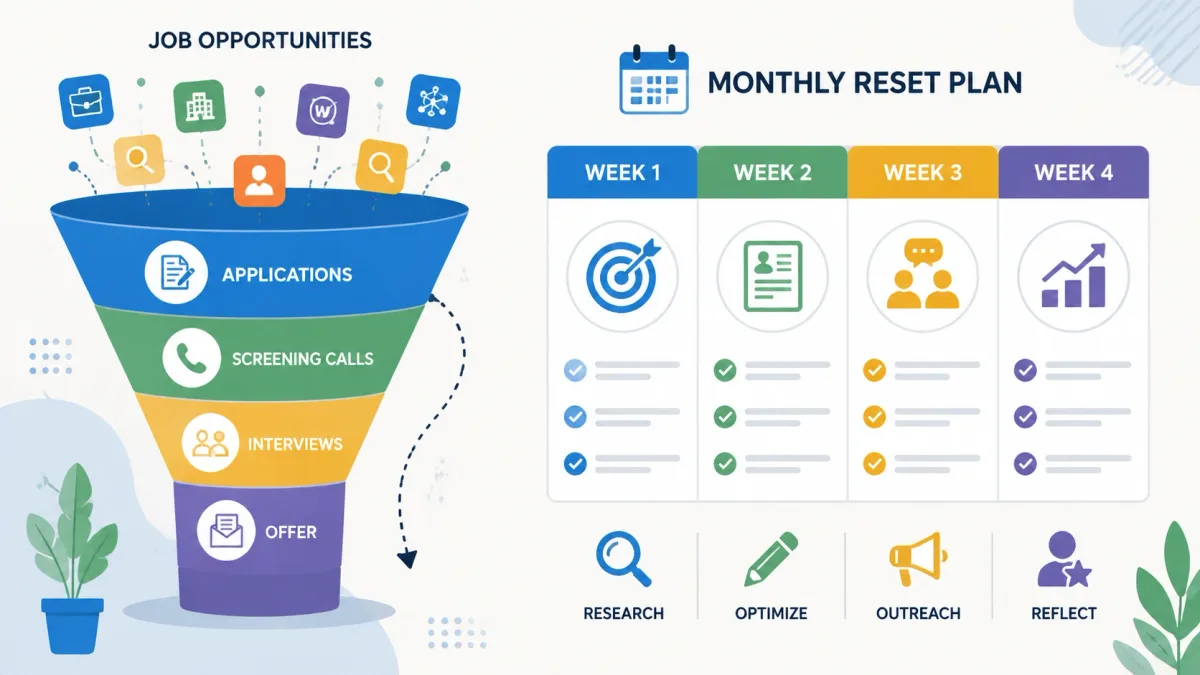
| Pattern | Possible Issue | First Controlled Change |
|---|---|---|
| Few suitable roles found | Target is too narrow, keywords are wrong, or requirements changed | Expand role-family terms and review current descriptions |
| Many applications, no screening calls | Resume relevance, current proof, or role level may be weak | Audit ten recent applications against repeated core tasks |
| Screening calls, few interviews | Gap explanation or role positioning may be unclear | Practice a concise bridge from the gap to current fit |
| Interviews, no offers | Evidence stories, role depth, or competition may be stronger elsewhere | Improve examples and request feedback when available |
Follow a 30-Day Readiness Reset
This is not a promise that you’ll get hired in 30 days.
It’s a way to build momentum and proof in a sequence that makes sense.
Adjust the pace for health, caregiving, finances, and available time.
30-Day Plan
| Week | Main Goal | Required Actions | Output |
|---|---|---|---|
| Week 1 | Define the target | Complete the diagnostic, choose one role family, review 10–15 descriptions | Target-role requirements list |
| Week 2 | Build current evidence | Refresh one skill, create one output, request feedback | Reviewable proof asset |
| Week 3 | Prepare communication | Update resume, draft gap answer, reconnect with contacts | Application kit and outreach list |
| Week 4 | Apply and review | Submit focused applications, practice interviews, track the funnel | First strategy review |
Protect Your Privacy, Credibility, and Personal Information
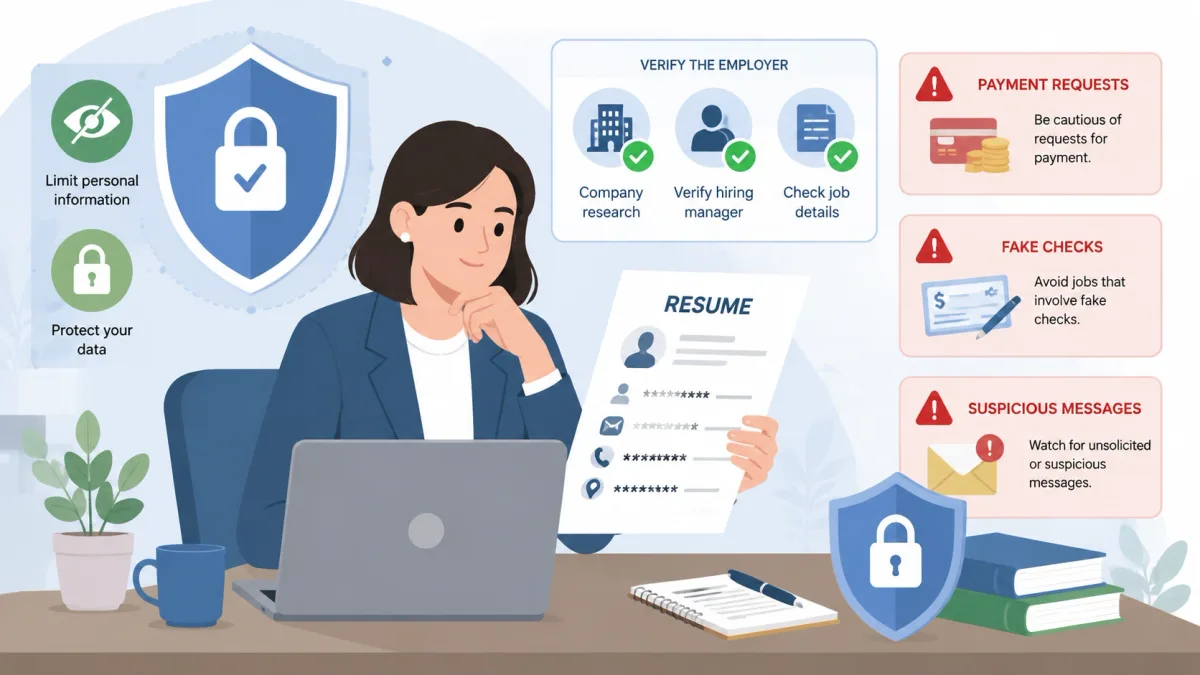
A gap can make you feel like you have to “explain yourself.”
You don’t.
You need to answer work-related questions and protect your credibility.
Disclosure minimum (privacy-first)
Use only the information needed to resolve a work-related question:
- Neutral category: caregiving, personal leave, health-related leave, education, relocation, layoff, or career transition.
- Current status: explain only what is necessary to show you are ready for the stated role or schedule.
- Current evidence: name one real skill, output, activity, or relationship that supports readiness.
- Role relevance: connect the answer to a core job need.
Do not require yourself to disclose a diagnosis, treatment details, a family member’s condition, relationship conflict, financial hardship, or private information unrelated to job performance.
For disability-related questions, the EEOC’s Pre-Employment Inquiries and Disability page explains general limits before a conditional offer.
For caregiving stereotypes and disparate-treatment concerns, see the EEOC’s Enforcement Guidance on Workers with Caregiving Responsibilities. The guidance does not create a universal protected category for caregivers, and individual facts and laws vary.
Truthful-labeling check
Before you publish an example or choose wording, confirm:
- the activity actually happened;
- the dates are accurate;
- paid work is not confused with volunteering or personal projects;
- freelance or consulting claims involve genuine work;
- credentials and references can be verified;
- the wording can be explained naturally in an interview.
Compact job-scam checklist (FTC-aligned)
If you’re returning to work, you may be targeted by scams that prey on urgency.
Watch for:
- anyone who asks you to pay to get a job (training, equipment, “placement fees”)
- a check they want you to deposit and then send money back (fake check scam)
- “interviews” conducted only by text or messaging apps
- pressure to act immediately, vague job duties, or unrealistic pay promises
- early requests for sensitive data (banking info, SSN) before you’ve verified the employer
The FTC’s Job Scams guide covers these red flags and ways to verify offers.
⚠️ Warning: If anything feels off, pause and verify. Honest employers should not require you to pay to get a job or deposit a check and send money back.
Practice Your Employment Gap Answer
If your gap makes you anxious about interviews, you don’t need a “perfect” story—you need a clear one you can say under pressure.
GreatOffer.ai can help you practice concise, privacy-aware answers and organize your real examples so you can communicate your experience clearly in live interviews.
For a broader preparation process, see how to prepare for a job interview.
Conclusion
An employment gap is context—not a full assessment of your ability.
So, can you get a job with an employment gap? Yes. Make the timeline clear, share only what helps, and build current evidence that makes your readiness easier to trust. Then track your search like a process, improve the stage where results fall off, and repeat.
Your next step: complete the diagnostic table above, choose one target role, draft a 30–60 second gap answer, and practice it out loud until it sounds like you.
Sources
Accessed July 21, 2026.
- Kroft, Lange, and Notowidigdo: Duration Dependence and Labor Market Conditions (NBER Working Paper 18387)
- Farber, Silverman, and von Wachter: Factors Determining Callbacks to Job Applications by the Unemployed (NBER Working Paper 21689)
- U.S. Equal Employment Opportunity Commission: Pre-Employment Inquiries and Disability
- U.S. Equal Employment Opportunity Commission: Enforcement Guidance on Workers with Caregiving Responsibilities
- Federal Trade Commission: Job Scams
- University of Arizona Career Center: How Do I Explain Employment Gaps on My Resume?
- Path Forward: Writing a Resume After Being Out of the Workforce for a Long Time