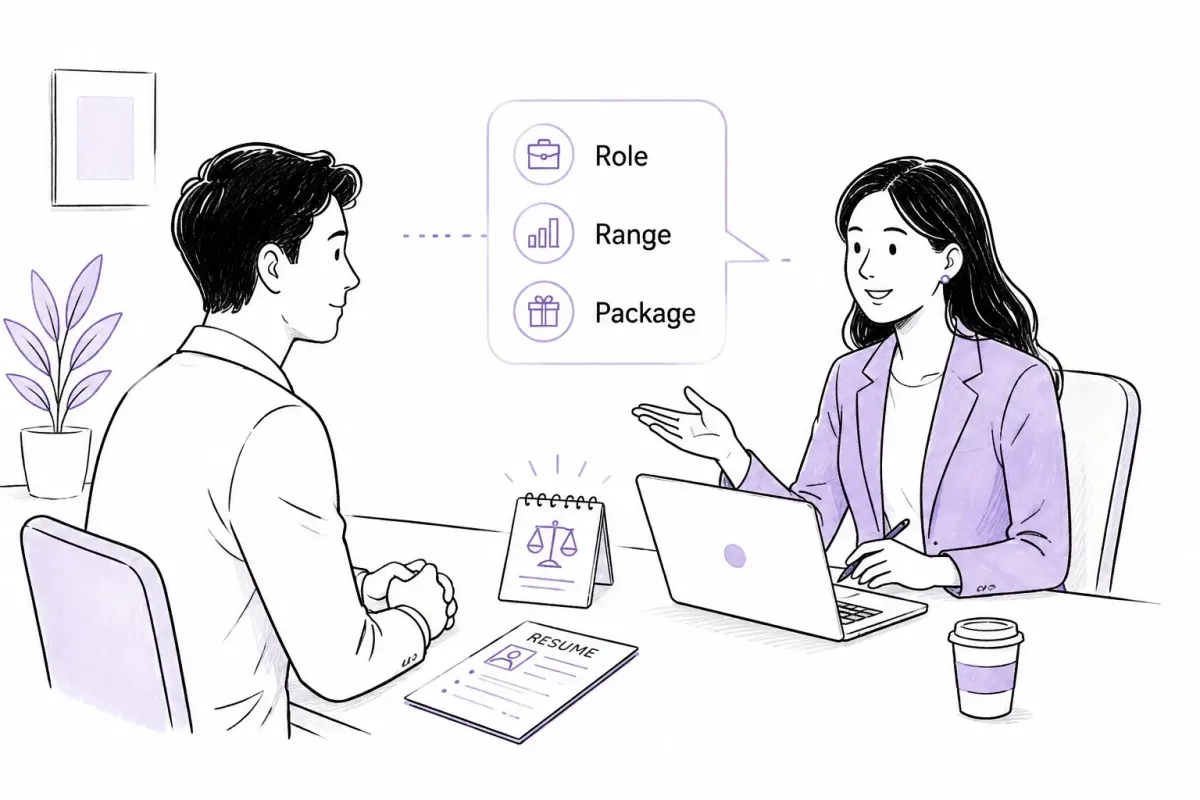

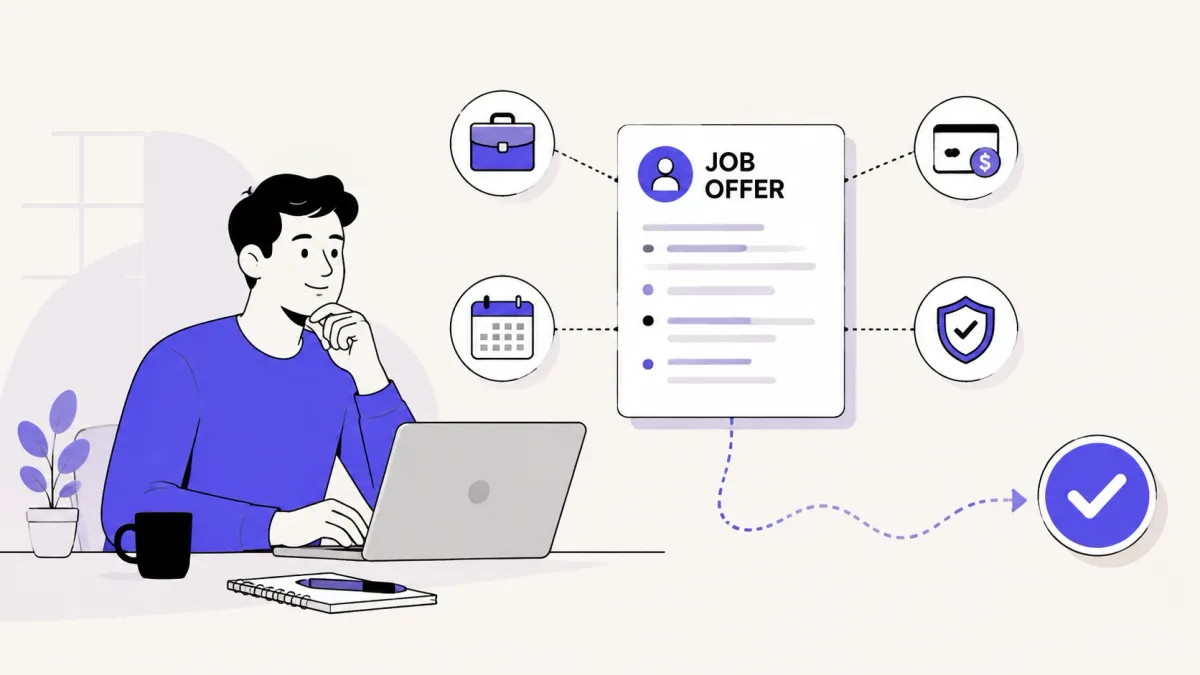
Saying yes is the easy part. Saying yes precisely is what protects you six months in, when someone asks why your bonus terms look different from what you remember.
Most of the trouble I see in offer conversations comes from one confusion: people treat six different moves as if they were the same move. Acknowledging an offer, asking a question, negotiating, agreeing on a call, accepting in writing, and clearing a background check are separate stages with separate risks. Blur them and you either commit before the terms are settled or resign before the job is actually secure.
This guide keeps them separate. You get the short email first, then a review checklist, a five-point gate to run before you commit, templates for the situations that actually differ, and a plan for the handoff after you accept.
Copy This First: The Short Acceptance Email
Reviewed the written offer, settled everything you needed to settle, and ready to commit? Send this.
Subject: Job Offer Acceptance - [Your Name] - [Job Title]

Dear [Hiring Manager or Recruiter Name],

Thank you for the offer to join [Company Name] as [Job Title]. I am pleased to formally accept.

I am confirming a start date of [Start Date] and the terms in the offer letter dated [Offer Letter Date].

What documents or pre-employment steps do you need from me before my first day?

Best regards,

[Your Name]
[Your Phone Number]
That is enough to create a clear record. If your offer went through a negotiation, or you accepted on a call, or the start date is still moving, skip to the templates further down and use the one that matches.
What to Do Before Accepting a Job Offer
Do not accept an offer you have not read. That sounds obvious, and it is still the most common mistake in this process, usually because the relief of getting the offer feels like the finish line.
Get the Offer in Writing
A verbal offer is real news and an incomplete document. If a recruiter or hiring manager calls, thank them, tell them you are interested, and ask for the written offer.
Two questions to ask on that call:
- When can I expect the written offer document?
- What is the deadline for my response?
Indeed's guide on how to accept a job offer puts it directly: get the details in writing, both to make the offer official and to understand what you are agreeing to on pay, start date, and benefits. A written offer is what lets you compare the terms against what you were told in interviews.
Review the Role and Work Arrangement
Check that the job in the document is the job you interviewed for:
- Title and scope: Does the official title match the level and responsibilities you discussed?
- Reporting line: Who is your manager, and where does the role sit in the team?
- Location and work arrangement: On-site, hybrid, or remote. If hybrid, are the required in-office days written down?
- Start date: Does it leave room for the notice you owe your current employer?
Review Total Compensation and Conditions
Base pay is one line on a longer list:
- Base pay: The exact figure and how often it is paid.
- Variable pay: Bonus, commission, signing bonus, or equity, including the payout schedule, the performance conditions, and any repayment clause if you leave early.
- Benefits and time off: When health coverage starts, how retirement matching vests, how paid time off accrues.
- Contingencies: Background check, drug screening, reference checks, work authorization.
- Employment provisions: At-will language, probation, non-compete, non-solicitation, intellectual property assignment.
Where a term is vague or differs from what you were told, ask before you accept. A clause you did not understand is not a clause you agreed to in good faith.
Fill In the Terms Confirmation Matrix
Copy this table and fill it in from your own offer. Blank cells are the point: an empty "final agreed term" is a question you have not asked yet.
| Term | Written source | Question to ask | Final agreed term | Unresolved? |
|---|---|---|---|---|
| Job title and scope | Offer letter | Does this match the role we discussed? | Yes / No | |
| Base salary | Offer letter | Is this annual or hourly, and how often is it paid? | Yes / No | |
| Bonus, commission, or equity | Plan document | What conditions, vesting, or repayment terms apply? | Yes / No | |
| Benefits and paid time off | Benefits summary | When does coverage start and how does time off accrue? | Yes / No | |
| Start date | Offer letter | Is the date flexible if I owe notice? | Yes / No | |
| Work arrangement | Offer letter or policy | Is the remote or hybrid schedule in writing? | Yes / No | |
| Contingencies | Offer letter | What has to clear before the role is final? | Yes / No |
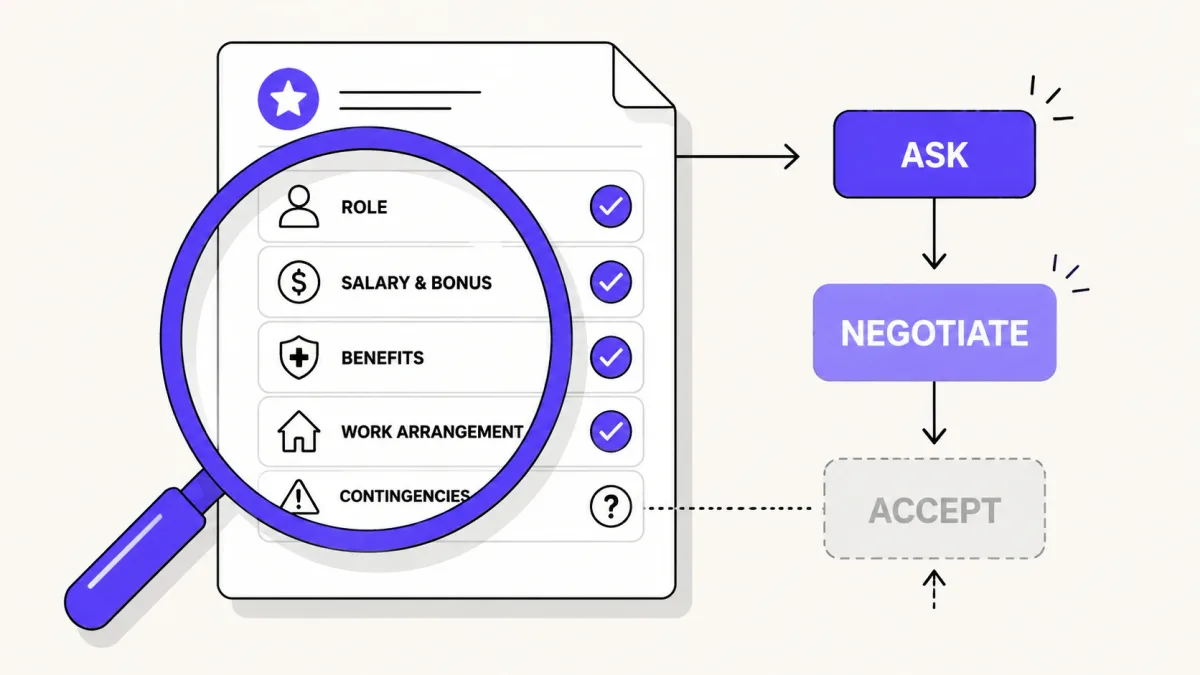
Decide Whether to Ask, Negotiate, or Accept
After the review you have three moves, and only one of them is acceptance.
- Ask when a term is unclear, missing, or contradicts what you were told. Bonus eligibility left out of the document is a question, not a negotiation.
- Negotiate when a term is clear and does not work for you. Make the request, and keep it out of any message where you also say you accept.
- Accept when every term that matters to you is clear, acceptable, and written down.
How to Accept a Job Offer in Six Steps
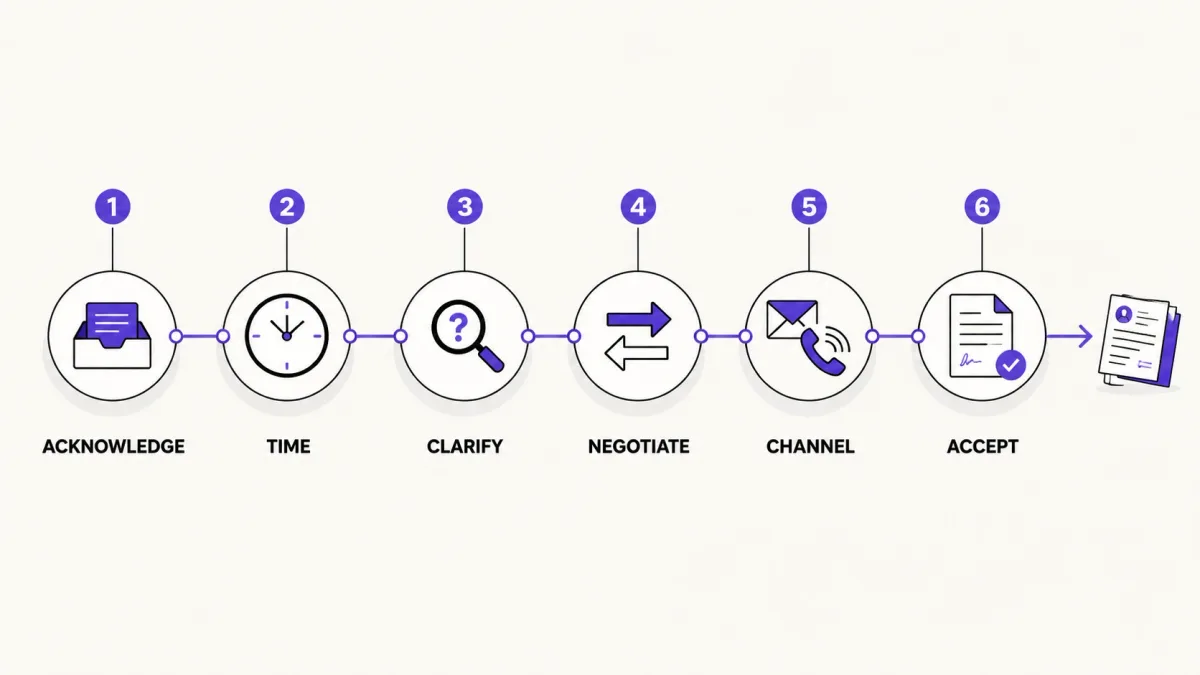
The order matters more than the wording. Each step closes something before the next one opens.
- Acknowledge the offer
- Ask for time if you need it
- Clarify open terms
- Negotiate
- Choose your channel
- Accept in writing and confirm next steps
1. Acknowledge the Offer Promptly
Reply promptly to confirm the offer arrived. It costs you nothing and it stops the recruiter wondering whether their email landed.
An acknowledgement is not an acceptance. It says you have the document and you are reading it.
Dear [Recruiter or Hiring Manager Name],

Thank you for sending the offer letter for the [Job Title] position. I am confirming receipt and reviewing the details. I will follow up by [Date] with any questions or my decision.

Best regards,

[Your Name]
2. Ask for Reasonable Consideration Time When Needed
Your offer letter usually states a deadline. If it does not, ask for one rather than assuming you have a week.
If you need longer than the stated deadline:
- Propose a specific date you can actually meet, not an open-ended delay.
- Give a brief, truthful reason. Reviewing benefits documentation and talking it over at home are both real reasons.
- Ask before the deadline passes, not after.
Dear [Hiring Manager Name],

Thank you again for the offer for the [Job Title] role. I am enthusiastic about the opportunity.

So that I can review the full benefits package and sort out logistics at home, could I give you my formal decision by [Proposed Date]?

I appreciate your flexibility.

Best regards,

[Your Name]
Do not invent a competing offer to buy time. Recruiters talk to each other, the bluff adds nothing a straight request would not get you, and you lose the one thing you actually need from this relationship later.
3. Clarify Open Terms
Found gaps between what you were told and what the document says? Put your questions in one message or one short call rather than sending them in a trickle over three days.
Lead with what could change your decision: base pay, bonus structure, work location, when medical coverage starts. Get the answers in writing before you accept.
4. Negotiate Before You Accept
Settle the negotiation first. Trying to move salary or remote days after you have written "I accept" puts you in a weak position and makes the employer wonder what else is unsettled.
When you negotiate:
- Make a focused request and tie it to the role and the market, not to what you need personally.
- Keep the counteroffer in its own message.
- Consider asking for a short conversation to discuss it rather than sending a counteroffer letter into silence. Indeed suggests the same, and something as simple as "I have reviewed the offer and would like to discuss a few details, when could we talk?" is enough.
- Once you agree on revised terms, ask for the updated offer letter before you send your acceptance.
The terms you accept should be the terms actually written down. That is the whole point of doing it in this order.
5. Choose the Communication Channel
- Email is the default. It is written, time-stamped, and lets you attach a signed document.
- A phone call fits when the hiring manager called you with the offer. Follow it with an email the same day.
- A portal or e-signature system is what many companies require. If you sign through DocuSign or an internal HR system, send the recruiter a short note saying you have submitted it, so a human knows.
6. State Acceptance Clearly and Confirm Next Steps
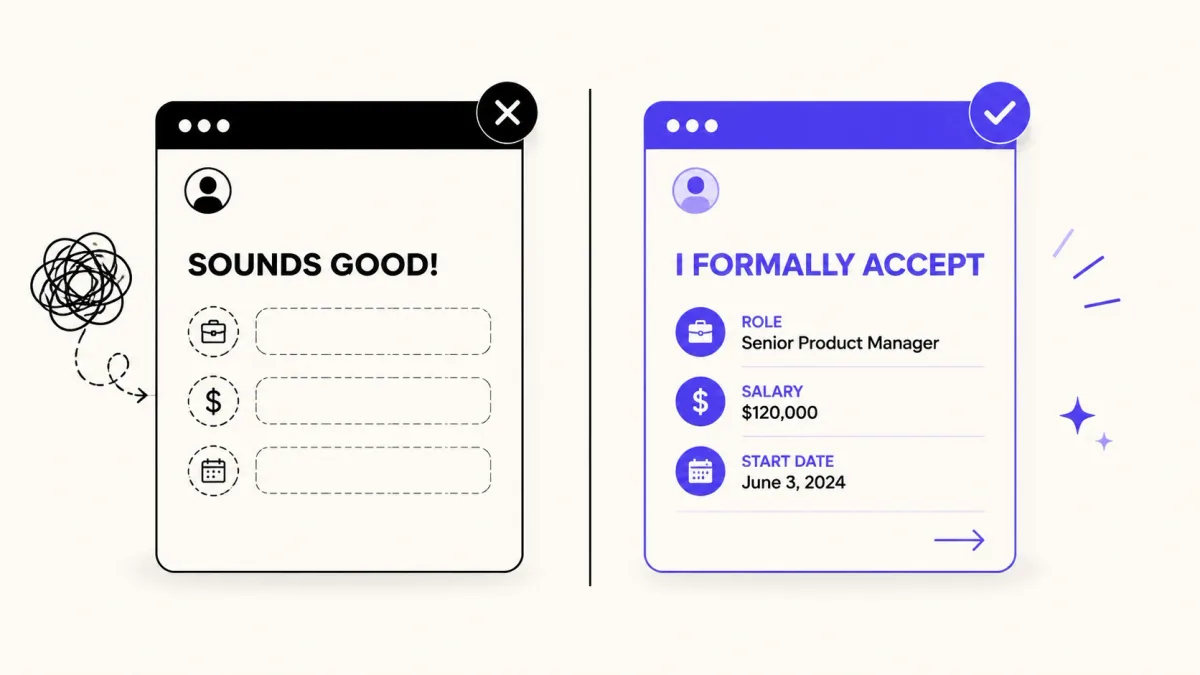
Leave no ambiguity. Write: I am pleased to formally accept your offer for the [Job Title] position at [Company Name].
In the same message, restate the title, base pay, and start date, then ask what onboarding paperwork and pre-employment steps come next.
Offer Acceptance Readiness Gate
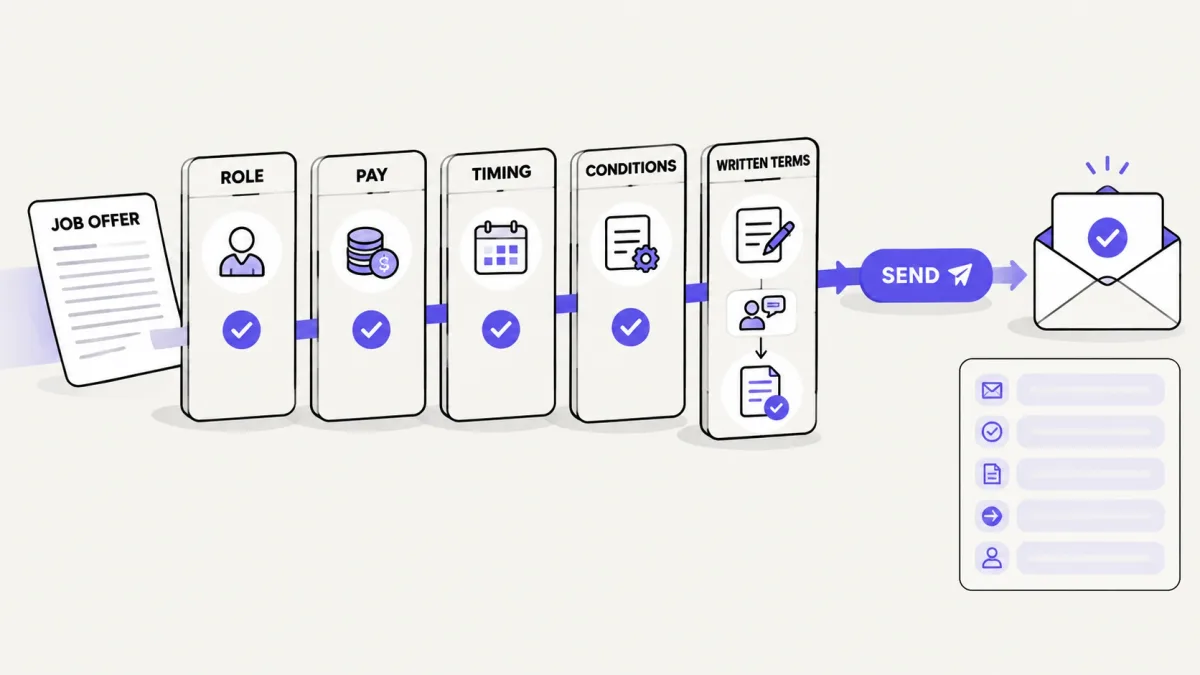
Before you send anything containing the words "I accept," run the offer through these five checks.
- Role. Title, manager, core responsibilities, and work arrangement are stated and acceptable.
- Compensation. Base pay, variable pay, equity, benefits, and time off are documented.
- Timing. The start date works against your notice period and any clearance that has to happen first.
- Contingencies. You know every condition attached to the offer and who confirms each one.
- Final written terms. The document in front of you reflects the negotiation, with nothing left as a verbal promise.
The decision rule: If an unresolved item could change your decision, resolve it before accepting. If it will not change your decision, accept and sort out the detail during onboarding. Parking-pass instructions are not worth delaying an acceptance over. A missing bonus clause is.
Of the five, the one people skip is almost always the fourth. The first three you run into naturally while reading the offer letter. Contingencies are the only item you still have to manage after you have written "I accept," and by that point it feels like the thing is done. The candidates who get burned are rarely the ones who did not read the terms. They are the ones who heard "I accepted" and understood it as "I am safe."
What to Include in a Job Offer Acceptance Email
Seven elements, and HR will process it without a follow-up question:
- Subject line with your name, the job title, and the words "Job Offer Acceptance."
- A greeting using the person's name.
- Thanks for the offer.
- An explicit acceptance sentence.
- Confirmation of the final terms: title, base pay, start date.
- A question about next steps: paperwork, screening, orientation.
- Your sign-off with phone number and email.
What not to do in an acceptance email
- Skip the vague phrasing.
Sounds good!andLooks fineare not acceptances. Someone has to interpret them.- Do not reopen negotiations. No salary request in the message where you write
I accept.- Do not paste the contract back. Title, base pay, and start date are enough.
- Do not confirm what is not final. Only restate terms that appear in the written offer or a written amendment.
Job Offer Acceptance Email Templates
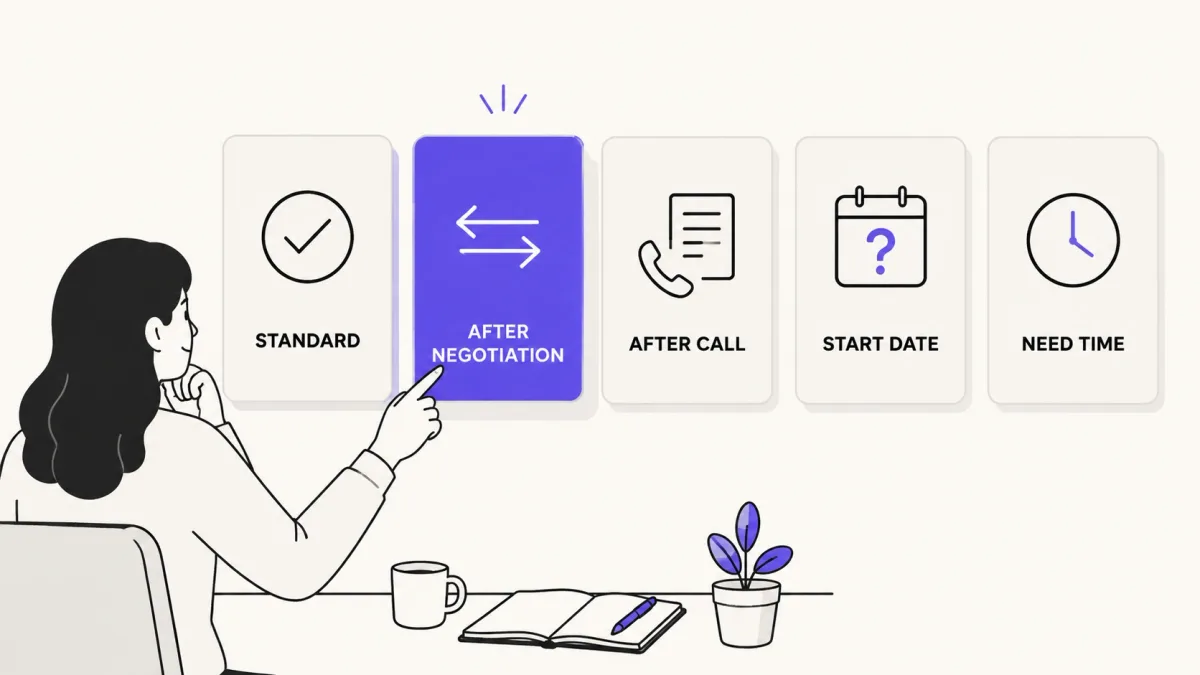
Five templates for situations that genuinely differ. Replace every bracketed placeholder with your own details, including [job title], [salary], [start date], and [company name].
Template 1: Standard Written Acceptance
For a clean offer you are accepting as written, where you want the full terms on record.
Subject: Job Offer Acceptance - [Your Name] - [Job Title]

Dear [Hiring Manager or Recruiter Name],

Thank you for the offer to join [Company Name] as [Job Title]. I am pleased to formally accept.

As set out in the offer letter, I am confirming:
- Position: [Job Title]
- Starting base salary: [Salary] per year
- Start date: [Start Date]
- Work arrangement: [Remote / Hybrid / On-Site]

Please let me know what onboarding paperwork you need before my start date, and whether any pre-employment checks are still outstanding.

Thank you again for the opportunity.

Sincerely,

[Your Name]
[Your Phone Number]
[Your Email Address]
[Your LinkedIn URL]
Template 2: Acceptance After Negotiation
Use this once the revised terms are confirmed in writing. Notice what is absent: any new request.
Subject: Job Offer Acceptance - [Your Name] - [Job Title]

Dear [Hiring Manager or Recruiter Name],

Thank you for the revised offer letter for the [Job Title] position at [Company Name], and for working through [negotiated term] with me.

I am pleased to formally accept the updated offer:
- Title: [Job Title]
- Base salary: [Revised Salary]
- Signing bonus: [Signing Bonus Amount, if applicable]
- Start date: [Start Date]

I have signed and attached the updated offer letter. Please let me know what onboarding documents or pre-employment checks remain.

Best regards,

[Your Name]
[Your Phone Number]
[Your Email Address]
Template 3: Written Follow-Up After Verbal Acceptance
Said yes on a call? Send this the same day. The call is the agreement; this is the record of it.
Subject: Written Confirmation of Acceptance - [Your Name] - [Job Title]

Dear [Hiring Manager or Recruiter Name],

Thank you for speaking with me today. As discussed, I am writing to confirm my acceptance of the offer for the [Job Title] position at [Company Name].

To summarize what we agreed:
- Job title: [Job Title]
- Base salary: [Salary]
- Start date: [Start Date]

Please send over any onboarding materials or background check forms I should complete before [Start Date]. If any of the above differs from your record, let me know and I will correct it.

Kind regards,

[Your Name]
[Your Phone Number]
[Your Email Address]
Template 4: Acceptance With a Start-Date Question
One caution before you use this. Accept only if the date is a logistics question you can live with either way. If the start date is a deal-breaker, that is a negotiation, and it belongs in a separate message before you accept anything.
Subject: Job Offer Acceptance - [Your Name] - [Job Title]

Dear [Hiring Manager or Recruiter Name],

Thank you for the offer for the [Job Title] position at [Company Name]. I am pleased to formally accept the role on the compensation and benefits set out in your offer letter.

On timing: my current employer requires [notice period] of notice, which puts my realistic start date at [Proposed Start Date] rather than [Original Start Date]. I am accepting the role either way and would like to confirm which date works for your onboarding schedule.

I can complete any pre-employment paperwork in the meantime.

Sincerely,

[Your Name]
[Your Phone Number]
[Your Email Address]
Template 5: Not Ready to Accept Yet
This is not an acceptance email. It confirms receipt and buys you review time without committing you to anything. "I am reviewing the offer" is not acceptance, and this message keeps it that way.
Subject: Job Offer Receipt Acknowledgement - [Your Name] - [Job Title]

Dear [Hiring Manager or Recruiter Name],

Thank you for the offer for the [Job Title] role at [Company Name]. I appreciate the confidence you have placed in me.

I received the offer documents today and am reviewing them. So that I can evaluate everything properly, I would appreciate having until [Requested Date] to give you my formal decision.

Please let me know if that timeline works on your end.

Best regards,

[Your Name]
[Your Phone Number]
[Your Email Address]
The Job Offer Acceptance State Map
Know which stage you are in. The stages are not interchangeable, and the riskiest mistakes come from acting as if you are further along than you are.
Offer received
  -> Acknowledged
  -> Questions pending
  -> Negotiating
  -> Verbally agreed
  -> Accepted in writing
  -> Contingencies pending
  -> Cleared to start
- Offer received. You have the offer, verbal or written, and have not responded. Keep interviewing elsewhere. Do not resign.
- Acknowledged. You confirmed receipt and set a decision date. Review the documents against the readiness gate.
- Questions pending. You have asked about benefits, duties, or location. Wait for written answers before deciding.
- Negotiating. Your counteroffer is with the employer. No acceptance until the revised terms come back in writing.
- Verbally agreed. You said yes on a call. Confirm it in writing the same day. Still not the moment to resign.
- Accepted in writing. You returned a signed offer or sent a written acceptance. You have committed. Start gathering verification documents.
- Contingencies pending. Your acceptance stands, and the offer still depends on background checks, references, screening, or work authorization. Weigh that before you hand in your notice.
- Cleared to start. The employer has confirmed the conditions are satisfied and issued first-day instructions.
When to resign is a judgment call, not a formula. It depends on what your written offer says, which conditions are still open, what your current contract requires, and how much risk you can absorb. Anyone who gives you one universal answer is not accounting for your situation.
What to Do After Accepting a Job Offer
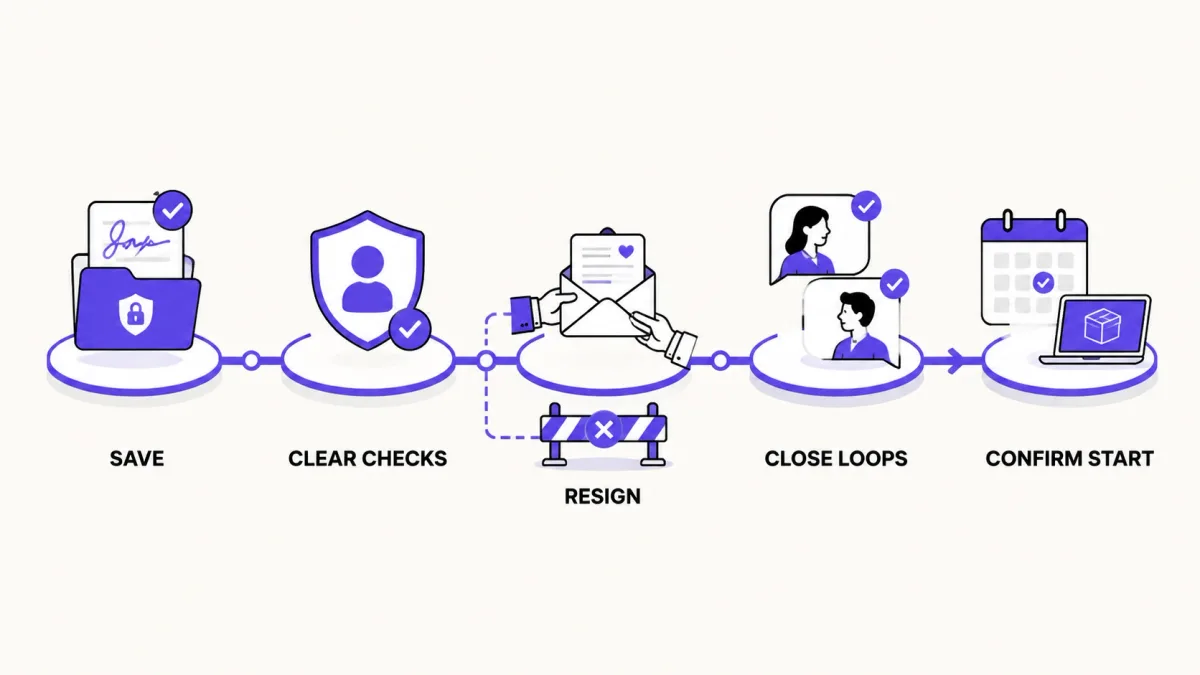
Acceptance starts the handoff. Four things to manage.
Save the Final Documents
Put all of it in one folder you control, not your work email:
- The signed offer letter or employment contract.
- Your acceptance email and the employer's reply.
- Benefits summaries, equity agreements, commission plans, time-off policies.
- Written confirmation of anything special: remote arrangements, bonus payout schedules, adjusted hours.
If a pay or policy question comes up two years from now, this folder is the only version of events that does not depend on someone's memory.
Track Contingencies
If your offer is conditional, treat each condition as an open item with an owner.
Complete the authorization forms promptly, and give your references a heads-up so a screening call does not catch them cold. Watch your email for messages from third-party screening vendors, which often land in spam.
Worth knowing what the rules give you here: under the Fair Credit Reporting Act, an employer running a background check through a reporting company has to tell you in writing, in a standalone document, and get your written permission first. If something in the report might cost you the job, they have to give you a copy and a summary of your rights before deciding. The FTC's guide to employer background checks and your rights lays out the whole sequence, including your right to dispute inaccurate information.
Then ask the recruiter for explicit written confirmation once everything has cleared. Not "I think we're all set." Confirmation.
Plan Your Resignation
Resignation timing is a risk decision. Three things to weigh:
- Contingency status. Waiting until checks have cleared is the lower-risk path. If your employer pressures you to resign before that, ask them to confirm the outstanding conditions in writing and decide with your eyes open.
- Notice obligations. Check your contract or handbook for what you actually owe. It varies by employer, seniority, and country, so use your document rather than a rule of thumb.
- Coverage gaps. Look at when your current health coverage ends and when the new one starts. A gap between them is fixable if you spot it early.
Keep the resignation conversation calm regardless of how you feel about the place. You will want these references.
Close Other Hiring Processes and Confirm Your Start
Once you have accepted and you are confident in the commitment, withdraw from the other pipelines. Contact the recruiters and hiring managers who are actively scheduling you, thank them, and tell them plainly that you have accepted another role. Keep it short and warm. Our guide on how to decline a job offer covers the wording if you want it.
Before your start date, confirm the practical details: arrival time and location or the orientation link, how your laptop and credentials arrive, and what identification you need to bring.
On that last point, one thing gets misreported constantly. For Form I-9 employment eligibility verification, you choose which documents to present from the USCIS lists. A passport on its own works as a List A document, or you combine one identity document such as a driver's license with one employment authorization document such as a Social Security card. USCIS is explicit that an employer cannot tell you which documents to bring, and anyone presenting a valid List A document should not be asked for anything else. Check the current Form I-9 acceptable documents list and pick what you have. Your W-4 for tax withholding is a separate form.
Signed everything and still have no start date? Send a short note to your recruiter asking them to confirm it, and copy the hiring manager if the recruiter has gone quiet. Silence at this stage is usually an administrative gap rather than bad news, and one email closes it.
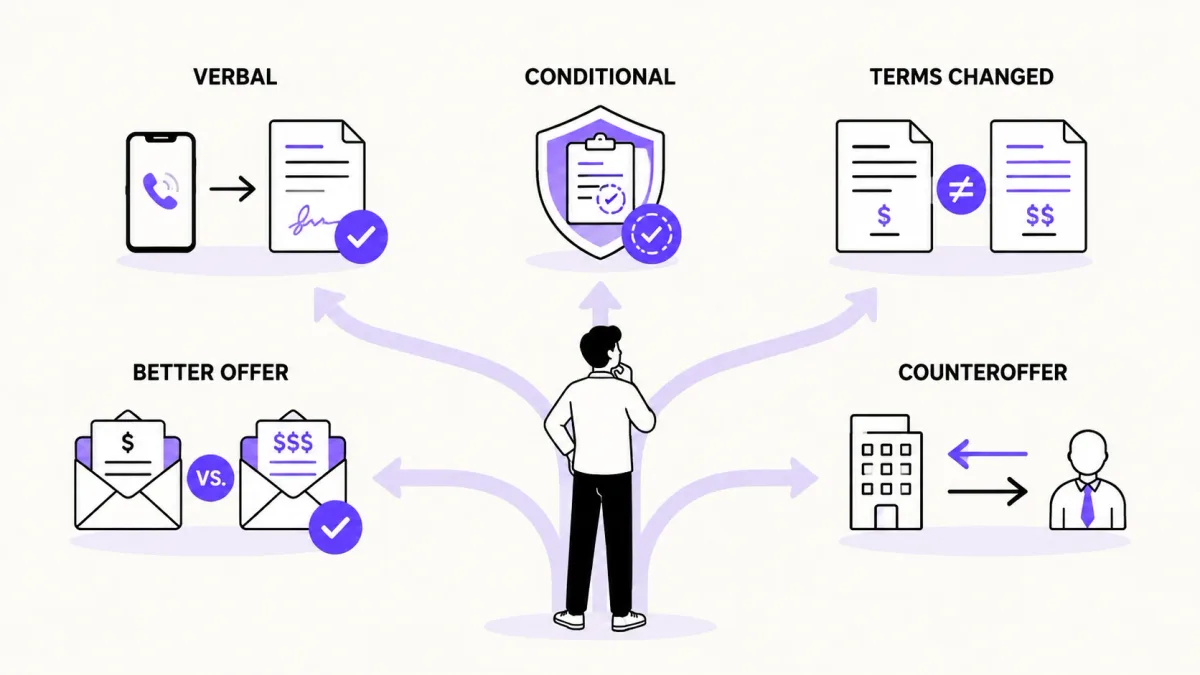
Special Situations When Accepting an Offer
| Situation | What not to do | Best next action |
|---|---|---|
| Verbal offer only | Resign, or accept without written terms | Thank them, ask for the written offer and the decision deadline |
| Written offer delayed | Send anxious repeat emails, or assume it fell through | Check in once, confirm interest, ask when the document will arrive |
| Deadline feels too short | Panic-accept, or invent a competing offer | Ask promptly for a specific extension with a practical reason |
| Waiting on another company | Mislead either employer | Ask the first for time, tell the second you have a live deadline |
| Conditional offer | Treat the background check as a formality and resign | Accept, submit forms promptly, resign after clearance is confirmed |
| Employer changes terms | Accept silently, or react angrily | Point out the discrepancy in writing, ask for a corrected offer letter |
| Better offer after acceptance | Ghost the first employer | Weigh your obligations, then communicate promptly and directly |
| Current employer counteroffers | Accept it for the money alone | Re-examine why you started looking in the first place |
Five of these deserve more than a table row.
You Only Have a Verbal Offer
A hiring manager calls with a number and asks if you are in. Be pleased, be warm, and do not give a binding yes on the call.
Try: This is great news, thank you. Once I have the written offer with the full compensation and benefits details, I will review it and come back to you quickly.
That is not hesitation and no reasonable employer reads it as such. It is you declining to agree to terms you have not seen.
The Offer Is Conditional
A conditional offer is a real offer that is not yet final. Identify every condition, find out who confirms each one, and keep the distinction between "I have accepted" and "I am cleared to start" firmly in mind.
This is the stage where people get hurt, because it is the stage where resigning feels safe and is not. Submit your documentation quickly and stay in contact with your HR contact until they confirm in writing that the conditions are met.
The Employer Changes the Terms
The written offer arrives with a lower salary, a missing signing bonus, or the remote days quietly gone. Do not accept quietly to avoid an awkward conversation, and do not fire off an angry email.
Point out the gap in writing, reference what was discussed, and ask them to correct the offer letter. Errors do happen at this stage. If they will not correct it, you have learned something useful about the employer while you still have the option to walk.
You Receive a Better Offer After Accepting
This one is genuinely uncomfortable, and the discomfort is not a reason to handle it badly.
Do not ghost the first employer. Call or email the hiring manager as soon as you have decided, explain the change honestly, and acknowledge the disruption you are causing. Where a signing bonus, relocation payment, or visa sponsorship is involved, get qualified advice on your obligations before you withdraw, because those can carry repayment terms. Our guide on how to decline a job offer has the language for the conversation.
Your Current Employer Makes a Counteroffer
Pause before you take it. A counteroffer can improve your pay without touching the reasons you started looking. Compare scope, manager, growth, and work arrangement against the new role, not just the two numbers.
Weak-to-Strong Acceptance Email Rewrites
Ambiguous acceptance
❌ Hi [Name], Sounds good! I'm super excited and can't wait to start. See you soon!
✅ Dear [Name], Thank you for sending the offer letter. I am pleased to formally accept the position of [Job Title] at [Company Name]. As set out in the offer, I confirm a starting salary of [Salary] and a start date of [Start Date]. What onboarding forms should I complete before my first day?
The weak version confirms nothing. No title, no pay, no date, and no record of what either side thinks was agreed.
Acceptance before the negotiation is finished
❌ Dear [Name], I accept the [Job Title] position, but can we bump the base to [Higher Salary] and do three remote days?
✅ Dear [Name], Thank you for the offer letter for the [Job Title] role. Before I confirm, I would like to discuss the base salary in light of [specific qualification or market context]. Could we find time this week? Once we have settled it, I will send my formal acceptance.
Writing I accept and asking for more money in the same breath gives away your position and keeps nothing. Separate the two and you still have a negotiation.
Verbal acceptance with no written record
❌ Saying yes on a five-minute call and sending nothing.
✅ Dear [Name], Thank you for the call today. I am writing to confirm my acceptance of the [Job Title] offer at [Company Name]. Per our conversation, I accept a base salary of [Salary] with a start date of [Start Date]. Please send the onboarding portal link when convenient.
Two people remember a phone call two different ways. Nobody is lying; memory just works like that.
Common Mistakes When Accepting a Job Offer
- Accepting before reading the written offer. Verbal enthusiasm is not a review.
- Missing a term that would have changed your mind. Usually a non-compete, a bonus clawback, or a benefits start date.
- Confusing acknowledgement with acceptance, in either direction.
- Negotiating after saying "I accept."
- Confirming terms that were never finalized, such as a promised mid-year review that never made it into the document.
- Resigning before contingencies clear.
Accept Clearly, Then Manage the Handoff
The safe order does not change: review the written document, resolve your questions and negotiations, accept clearly in writing with the key terms restated, then track the contingencies until someone confirms you are cleared to start. Everything that goes wrong in this process goes wrong because two of those stages got collapsed into one.
If you have interviews still running alongside this offer, our guide on how to prepare for a job interview covers the preparation.
And for the live rounds themselves, GreatOffer.ai runs a real-time AI Interview Copilot alongside Zoom, Google Meet, and Microsoft Teams, with answer prompts and coding support on your screen while you talk. It is interview support, not a substitute for reading your offer properly.