


Disclaimer: This guide provides general career-planning information. Immigration, tax, securities, employment and compensation rules depend on your circumstances. Verify high-stakes decisions with the relevant authorities, your employer and qualified advisers. Use GreatOffer.ai only where the interviewer’s and platform’s rules permit it.
Start Here Based on Your Situation
| Your situation | First priority | Avoid |
|---|---|---|
| Your employer has an India office | Explore internal mobility before applying externally | Assuming the title, level, equity or reporting line will remain unchanged |
| You have four to six months | Build a target-company list and start networking now | Waiting until your flight is booked |
| You have fewer than eight weeks | Narrow to one role lane and one or two cities | Broad applications across unrelated roles |
| You are a senior manager or principal-level specialist | Use referrals and specialist recruiters early | Treating senior hiring like a volume application exercise |
| You are moving with a family | Define the minimum acceptable role, city and start date | Triggering irreversible relocation costs on verbal assurances |
The rest of this guide takes you from route selection to offer evaluation.
What the India Tech Market Looks Like in 2026
India’s technology market is growing overall, but hiring is uneven. NASSCOM’s Strategic Review 2026 estimates that the sector reached about $315 billion in FY26 revenue and approximately 6 million employees after adding about 135,000 net jobs.
The composition of hiring matters more than the headline growth. Naukri JobSpeak for June 2026 reported that overall white-collar hiring rose 6% year over year while IT hiring remained moderated. Machine-learning roles grew 25%, and IT and information-security functions grew 18%.
The practical conclusion is not that every returning professional will find a role quickly. It is that candidates should target the parts of the market where their recent evidence is strongest—for example:
- Cloud, platform and site-reliability engineering
- Information security, identity and application security
- Data engineering and machine-learning infrastructure
- Product engineering and global capability centers
- Technical program leadership and distributed-team management
- Cost, reliability, compliance and modernization programs

A broad claim such as “I have global experience” is not enough. Employers need to see the specific problem you can solve, the level at which you can solve it and why your return is credible.
Seniority changes the search strategy
| Profile | Likely employer concern | Strongest evidence |
|---|---|---|
| Mid-career individual contributor | Whether the technical stack is current | Recent production work, debugging depth, coding and design decisions |
| Senior or staff-level engineer | Whether overseas scope maps to the employer’s level | System ownership, architecture boundaries, reliability, cost and influence |
| Engineering manager | Whether the candidate can remain close to execution | Team size, hiring, delivery, technical decisions and performance management |
| Director or executive | Whether an appropriately scoped role exists | Organization scale, business ownership, leadership references and India mandate |
Do not assume that an overseas title maps directly to an Indian title. Compare scope, decision rights and expected outcomes before comparing labels.
Two First-hand Experiences That Show the Real Friction
Public forum posts are not representative market data, but they reveal the questions returning candidates are struggling with.
In a July 2025 r/nri thread, an EU-based Indian professional described roughly ten years of experience, an engineering background, an MBA and applications through several India-focused platforms—yet reported that they had “never got back a single response.” Commenters suggested that overseas location, an unclear return commitment, compensation expectations and the lack of referrals could all create friction.
In a June 2026 r/nri thread, a UK-based application-security professional said they needed to return within six months and asked whether a two-month job-search window would be too aggressive. Their employer had no India operation, so an internal transfer was not available. Commenters advised starting earlier, using a reachable Indian contact number where genuine and stating an explicit return date on the resume and LinkedIn profile.
These are individual experiences, not proof that a platform, phone number or timeline will produce a particular result. The useful lesson is narrower: overseas candidates must reduce uncertainty about location, timing, level and commitment before a recruiter invests in a process.

Choose Your Re-entry Route Before You Apply
Your route affects speed, compensation continuity and relocation risk. Check the lowest-risk option first, then build alternatives.
1. Internal transfer
Start with internal mobility if your current employer has an India entity, engineering center or relevant business team. An internal move may preserve more organizational context than an external search, but nothing should be assumed.
Ask for written clarity on:
- India job title and internal level
- Reporting manager and team mandate
- Local payroll and benefits
- Treatment of unvested equity or long-term incentives
- Relocation support
- Probation, notice and start date
- Whether the move is permanent or time limited
An internal transfer is an option, not a universal answer. The second Reddit poster could not use this route because their employer had no India operation.
2. Direct hire into a global capability center or product company
This route suits candidates whose overseas experience maps to a clear India-based mandate. Your application should connect your background to the employer’s current problem: platform modernization, security, regulated systems, global product ownership, reliability, cost or distributed delivery.
Do not apply to every company using the same positioning. A global capability center may value enterprise scale and cross-border collaboration. A product company may care more about product ownership and technical depth. A growth-stage company may expect broader hands-on responsibility and faster decisions.
3. Referral-led external search
Referrals are most useful when the contact can explain why your experience matches the role—not merely forward your resume. Prioritize former colleagues, current India-based teammates, alumni, customers, vendors and professional-community contacts who know your work.
Give each contact a specific request:
- Confirm whether the role is genuinely active
- Explain the expected level and team scope
- Introduce you to the recruiter or hiring manager
- Review whether your resume communicates the right evidence
4. Specialist recruiter, contract or consulting bridge
Senior, niche or leadership candidates may benefit from recruiters who understand their domain and level. A fixed-term or consulting engagement can also create local context, but only if the scope, payment terms, intellectual-property obligations and cross-border compliance are clear.
Do not use a contract merely to avoid making a positioning decision. It should have a defined purpose: rebuilding a network, testing a sector, entering a new city or converting to a permanent mandate.
Route comparison
| Route | Main advantage | Main risk | Best fit |
|---|---|---|---|
| Internal transfer | Organizational continuity | Level or compensation may change | Employees with a relevant India entity |
| Direct GCC/product hire | Clear long-term India role | Multi-round process and local level mapping | Candidates with directly transferable scope |
| Referral-led search | Higher-context introduction | Depends on relationship quality | Most experienced returners |
| Specialist recruiter | Access to less visible mandates | Recruiter coverage varies | Senior or niche profiles |
| Contract/consulting bridge | Faster local market exposure | Income and compliance uncertainty | Candidates with a defined bridge strategy |

Build a Search Timeline Around Your Move
Treat the return as a project with decision gates. The following timeline is a planning framework, not an average hiring-time claim.
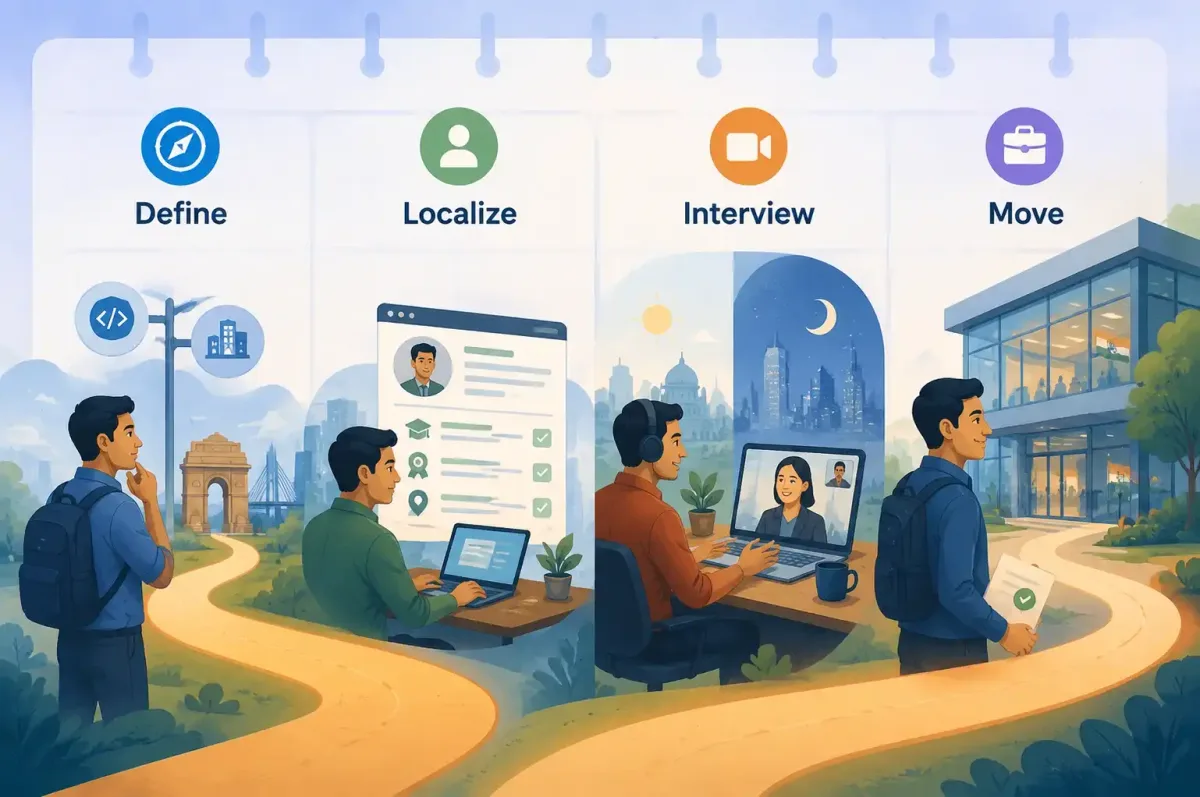
Around six months before the move: define the search
- Choose one primary role lane and no more than two adjacent options.
- Select one or two target cities based on actual employers, family needs and realistic commuting patterns.
- Define your earliest start date, preferred move date and whether a staggered family move is possible.
- Build a working list of target employers, grouped by strong fit, adjacent fit and bridge opportunities.
- Identify people who can validate the role market before you apply.
You are ready for the next phase when you can answer: “What role, at what level, in which city, from what date, and why me?”
Three to four months before the move: localize and activate
- Rewrite the resume for the primary role lane.
- Update LinkedIn with a truthful location and relocation statement.
- Prepare a reachable phone or WhatsApp contact route.
- Ask former colleagues for market conversations before asking for referrals.
- Contact recruiters who visibly work on relevant mandates.
- Start targeted applications and track the response by source.
A useful weekly cadence might include a small number of high-fit applications, several warm conversations and one or two recruiter discussions. Adjust the cadence based on response quality rather than chasing a fixed application count.
Final two months: interview, negotiate and de-risk
- Block reliable cross-time-zone interview windows.
- Prepare one consistent answer for return motivation, compensation and availability.
- Collect documents that an employer may request for background verification.
- Compare role scope before negotiating headline pay.
- Confirm written terms before making non-refundable relocation commitments.
If you have fewer than eight weeks
Use a fast-track plan:
- Choose one role lane and one preferred city.
- Contact people who can make direct introductions.
- Apply only where your recent work closely matches the job description.
- State a real return date and joining window.
- Prepare for interviews before the first recruiter call.
- Keep a temporary financial and housing buffer in case the search continues after arrival.
Translate Overseas Experience into India-market Value
Replace title comparison with scope comparison
A title is only a starting point. Describe your current level through evidence:
- Systems, products or business processes owned
- Number and seniority of direct reports
- Architecture and operational decisions you control
- Reliability, security, revenue, cost or risk outcomes
- Customers, regions and regulatory environments supported
- Hiring, mentoring and performance responsibilities
This lets an employer evaluate the work rather than guess from a foreign title.
Write a one-sentence value proposition
Use this structure:
I help [type of employer] solve [specific problem] using my experience in [relevant evidence], and I am relocating to [city] in [month/year].
Examples—with placeholders rather than invented results:
- “I help global engineering centers improve platform reliability using my experience owning [system scope] across [regions], and I am relocating to Bengaluru in [month/year].”
- “I help product companies scale engineering teams without losing delivery quality, based on my experience leading [team scope] and delivering [verified outcome], and I am relocating to Hyderabad in [month/year].”
- “I help regulated businesses strengthen application security using my experience in [security domain, certification or program], and I am returning to Pune in [month/year].”
Replace every bracket with evidence you can defend in an interview.

Close the India-readiness gap
A hiring team may wonder whether you understand local compensation, work patterns, customer needs or execution expectations. Address the concern through evidence, not assurances.
Useful proof includes:
- Recent work with India-based colleagues or customers
- Ownership across multiple time zones
- Cost-conscious engineering decisions
- Hands-on technical work completed recently
- Experience adapting global standards to local constraints
- A clear move date and realistic joining plan
If you have not worked with India-based teams, say so. Then explain which parts of your experience transfer and what you have done to update your market understanding.
Create an India-ready Resume and LinkedIn Profile
Make the return plan visible
A recruiter should not have to infer whether your move is hypothetical. Use a factual line such as:
Currently based in [country] | Relocating to [Indian city] in [month/year] | Available from [date] | [reachable phone/WhatsApp]
Do not claim an Indian address you do not have. Do not add a +91 number unless you can reliably answer it. The Reddit comments suggest that clearer local contact and return-date signals may reduce uncertainty, but they do not guarantee a response.

Rewrite responsibilities as evidence
Avoid copying fabricated metrics from resume examples. Use numbers only when they come from your real work.
Weak: Managed cloud infrastructure and backend services.
Stronger: Owned [number/type] of production services supporting [verified scale]; led [specific change] that improved [measured outcome].
Weak: Managed a global engineering team.
Stronger: Led [team size and functions] across [locations]; hired or mentored [verified number]; delivered [named product or program] against [business or operational result].
Weak: Worked on payment systems at a major technology company.
Stronger: Owned [specific payment component or responsibility]; improved [latency, reliability, fraud, cost or delivery metric] by [verified result].
For additional resume fundamentals, review GreatOffer.ai's guide to what a resume needs to communicate and its practical advice on making a resume stand out. These are internal learning resources, not evidence for the market claims in this article.
Match the job description without stuffing keywords
Review a set of current India job descriptions for your target role and build three columns:
| Required capability | Your evidence | Gap or refresh action |
|---|---|---|
| Example: Kubernetes operations | Owned [specific production responsibility] | Refresh troubleshooting examples |
| Example: engineering management | Led [team and decision scope] | Prepare performance-management story |
| Example: application security | Delivered [program/control/result] | Update knowledge of current regulations |
Use the employer’s terminology where it accurately describes your experience. Do not repeat terms you cannot support.
LinkedIn headline and About section
A useful headline answers four questions: role, specialization, proof and return destination.
Staff Software Engineer | Distributed Systems and Cloud Platforms | Returning to Bengaluru in [month/year]
A concise About section can follow this structure:
I am a [role] with [years] of experience in [specialization]. At [current/recent employer], I have owned [verified scope] and delivered [verified outcome]. I am relocating to [city] in [month/year] and exploring [specific role lane] positions where my experience in [two or three relevant strengths] can support [business or engineering outcome]. I am available for India-time-zone interviews and can join from [date].
Use the Right Channels—and Give Each One a Job
The first Reddit poster had used several well-known platforms without receiving a response. That does not prove the platforms fail. It shows that broad platform coverage is not the same as an effective cross-border search.
Use each channel for a specific purpose:
| Channel | Use it to |
|---|---|
| Current employer | Test internal mobility and India mandates |
| Former colleagues and alumni | Validate roles and request contextual introductions |
| Specialist recruiters | Access senior or niche mandates |
| Find hiring managers, recruiters and relevant team members | |
| India-focused job platforms | Monitor current demand and apply to close-fit roles |
| Company career pages | Confirm the role is active and use the official application route |
| Technical communities | Build genuine domain relationships before requesting help |
Platform focus and availability can change. Judge a channel by the quality of current roles and conversations in your lane.

Three outreach templates
Former colleague
Hi [Name]—I’m planning to relocate from [country] to [city] in [month/year] and am targeting [specific role lane]. I saw that [company/team] is working on [relevant problem]. My recent work includes [one verified achievement]. Would you be open to a short conversation about the team’s current priorities and whether this role appears aligned? No pressure on a referral; I would value your perspective first.
Specialist recruiter
Hi [Name]—I’m a [role/level] with experience in [specialization and verified scope]. I am relocating to [city] in [month/year] and can begin India-time-zone interviews immediately. I am focusing on [specific role lane] in [company types]. My resume is attached. Are you currently handling mandates where [two relevant strengths] are central to the role?
Hiring manager
Hi [Name]—I noticed your team is hiring for [role/problem]. In my current role, I have owned [relevant scope] and delivered [verified outcome]. I am relocating permanently to [city] in [month/year]. If the role is still active, I would welcome a brief conversation about the team’s priorities and whether my background is relevant.
Track the funnel, not only the application count
Record company, role, source, contact, application date, stage, next action and reason for rejection or withdrawal.
Then diagnose the bottleneck:
| Pattern | Likely issue to test | Next change |
|---|---|---|
| Applications but no screens | Positioning, level, location or resume clarity | Narrow the lane; strengthen return and evidence signals |
| Screens but no technical rounds | Compensation, motivation or role mismatch | Clarify expectations and return story |
| Technical rounds but no finals | Technical depth or communication | Practise verbal reasoning and targeted scenarios |
| Finals but no offer | Differentiation, references or relocation risk | Strengthen evidence and ask for direct feedback |
| Offers but none acceptable | Target list or decision criteria | Revisit level, city, company type and compensation mix |
Change one or two variables at a time so you can see what improves the funnel.
Compare Compensation, Level and City Together
Direct currency conversion is a poor decision tool. Compare what you receive, what is at risk and what the role does to your future market value.
Build a comparable compensation view
Use a conservative worksheet:
Comparable compensation = fixed pay + realistically attainable variable pay + conservative annualized equity value + employer benefits + one-time relocation or joining value
Check:
- Fixed versus variable pay
- How variable pay is calculated and historically paid
- Whether equity is liquid, vested and transferable
- Vesting, cliff and forfeiture terms
- Employer retirement contributions and insurance
- Joining or relocation clawbacks
- Probation and notice provisions
- Tax withholding and cross-border reporting questions
Do not treat an unlisted company’s option grant as equivalent to cash or publicly traded equity.

Negotiate the role before the number
Ask:
- What is the internal level?
- What decisions will I own?
- Is the role primarily individual contribution, management or both?
- Who controls architecture and roadmap decisions—the India team or global headquarters?
- What is the expected on-call or cross-time-zone load?
- What would success look like after six and twelve months?
A higher package cannot fully compensate for unclear scope, a material level downgrade or a role with no durable mandate.
Evaluate cities through actual employers and daily life
Bengaluru, Hyderabad, Pune, Chennai and the National Capital Region all contain significant technology employment, but the right choice depends on your shortlist—not a generic ranking.
For each city, verify:
- Which target employers currently have relevant roles
- Exact office location and expected in-office days
- Realistic commute from potential housing
- Schooling, caregiving and partner-employment needs
- Access to your professional and family network
- Whether the compensation remains workable after housing and transport costs
If the role is hybrid, get the current policy and office location in writing before choosing housing.
Prepare for India Tech Interviews From Abroad
Map the likely interview loop
Your process may include:
- Recruiter screen: location, return reason, availability, level and compensation.
- Technical screen: coding, debugging, security, data or domain depth.
- System or architecture design: trade-offs, reliability, cost, operations and risk.
- Hiring-manager round: ownership, execution and team fit.
- Leadership or behavioral round: conflict, failure, hiring, performance and ambiguity.
- Offer discussion: title, level, compensation, documents and start date.
Ask the recruiter what each stage assesses. Do not assume every company follows the same loop.
Prepare five return-specific answers
Why are you returning now?
Give the genuine reason, then connect it to a long-term career direction. Family can be part of the answer, but it should not be the only information the employer receives.
How do we know you will relocate?
State the city, expected date, practical steps already taken and earliest joining date. Do not invent commitments.
Are you comfortable with India compensation?
Explain that you are evaluating local role scope and total compensation rather than converting your current package at the exchange rate.
How current are you with India-based teams and customers?
Use recent evidence. If you lack direct India exposure, explain how you have researched the target market and which parts of your work transfer.
Are you still hands-on enough?
Choose a recent technical decision, incident, design review, code contribution or security investigation that demonstrates current depth.
For a broader preparation checklist, see how to prepare for a job interview.
Build a preparation stack
Before interviews:
- Extract the role’s main evaluation themes from the job description.
- Prepare examples for impact, failure, conflict, ambiguity, leadership, technical trade-offs, cost and reliability.
- Practise explaining your reasoning aloud.
- Test audio, connectivity and screen-sharing before cross-time-zone calls.
- Prepare questions about team scope, decision rights, work model and success measures.
Where GreatOffer.ai fits
Preparation should come first. Once your resume, target job description and real examples are ready, GreatOffer.ai can help you rehearse role-specific responses and provide real-time guidance during permitted remote interviews. Its current homepage describes resume- and job-description-based context, Focus Mode, meeting-platform support and coding assistance.
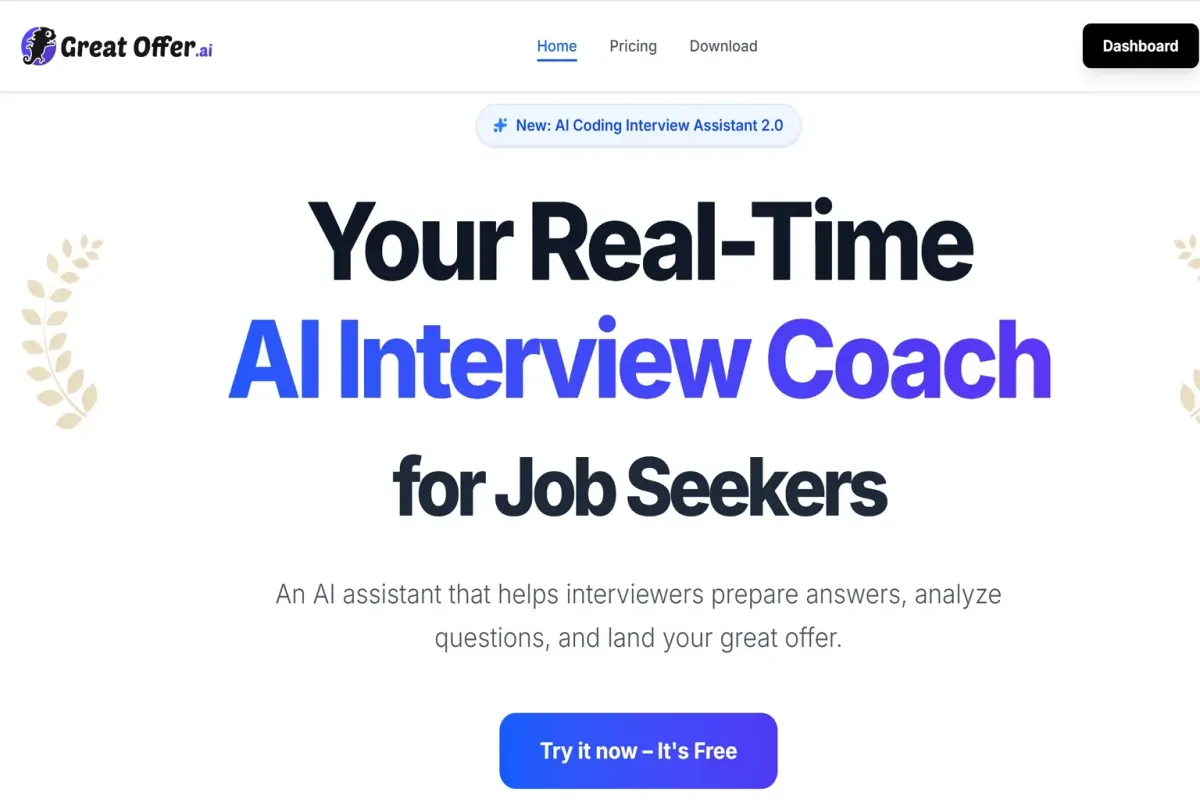
Use it as support for your own experience and reasoning—not as a substitute for preparation or as a way to misrepresent what you know.
A practical workflow is:
- Before the interview: add your resume, job description and return context; rehearse the five questions above.
- During a permitted interview: use concise prompts to stay structured while continuing to explain your own reasoning.
- After the interview: record difficult questions, evidence gaps and follow-up topics.
Ask questions that reveal role risk
Use the questions below as a starting point. GreatOffer.ai also maintains a longer internal guide to questions to ask in an interview.
- Why is the role open?
- What decisions does the India team own?
- What is the manager’s expectation for the first six months?
- How often must the team work across time zones?
- What is the current hybrid policy for this office and team?
- How are performance and promotion decisions made?
- What has changed about the team during the past year?
Evaluate the Offer Before Triggering the Move
Do not make an irreversible move based only on a verbal indication. Review the written offer, outstanding conditions and relocation dependencies.
Use an offer scorecard
| Factor | Suggested weight | What to verify |
|---|---|---|
| Role scope and level | 20 | Title, decision rights, IC/manager balance, success measures |
| Manager and team | 15 | Reporting line, team capability, hiring plan, working relationship |
| Compensation quality | 15 | Fixed pay, variable conditions, equity, benefits, clawbacks |
| Company and mandate | 10 | Business need, India investment, reason the role exists |
| Future market value | 10 | Skills, responsibility and credible progression |
| Work model | 10 | Office, hybrid expectations, commute and time-zone load |
| Relocation flexibility | 8 | Start date, temporary arrangements and reimbursement |
| Family fit | 7 | Schooling, caregiving, partner needs and support network |
| Legal, tax and benefits clarity | 5 | Items confirmed through employer documents and professional review |
The score does not decide for you. It prevents one attractive number from hiding a weak manager, unclear role or impractical move.

Verify in writing
- Formal title and internal level
- Reporting manager and team
- Work location and hybrid requirement
- Fixed and variable compensation breakdown
- Equity documents and vesting conditions
- Probation and notice terms
- Joining or relocation payments and clawbacks
- Background-verification conditions
- Start date and any agreed relocation flexibility
Watch for returnee-specific red flags
- The employer wants you to relocate before confirming the role.
- The scope becomes smaller during the process without a clear explanation.
- The team cannot explain what the India organization owns.
- The compensation breakdown remains vague.
- The employer pressures you to submit unnecessary sensitive information or pay a fee.
- The role requires unsustainable cross-time-zone work that was not disclosed early.
One commenter in the June 2026 Reddit thread advised returners not to chase only the highest package. That is not a universal rule, but it is a useful prompt: evaluate stability, manager quality, culture and future options alongside pay.
Common Mistakes to Avoid
- Waiting until arrival to start networking.
- Applying to unrelated individual-contributor and management roles with one resume.
- Comparing packages through exchange rates alone.
- Leaving the return date and destination vague.
- Relying on an overseas brand instead of explaining the actual scope.
- Copying fabricated metrics into resume examples.
- Memorizing polished interview answers that do not match real experience.
- Treating an internal transfer as automatically equivalent to the overseas role.
- Making family, housing or school commitments before the role is sufficiently clear.
- Continuing the same search activity after the funnel shows it is not working.
Conclusion: Make the Return a Managed Career Move
A successful return is not simply a relocation followed by a job search. It is a sequence of decisions: choose the right route, translate your experience, reduce recruiter uncertainty, prepare for the local interview process and evaluate the written role before triggering the move.
Start with one action today: write your target role, city, return date and strongest evidence in four lines. That statement will shape your resume, networking and interviews.
When your resume and target job description are ready, use GreatOffer.ai to rehearse your return positioning and prepare for permitted remote interview loops.