 Sasha
Sasha Mike Chen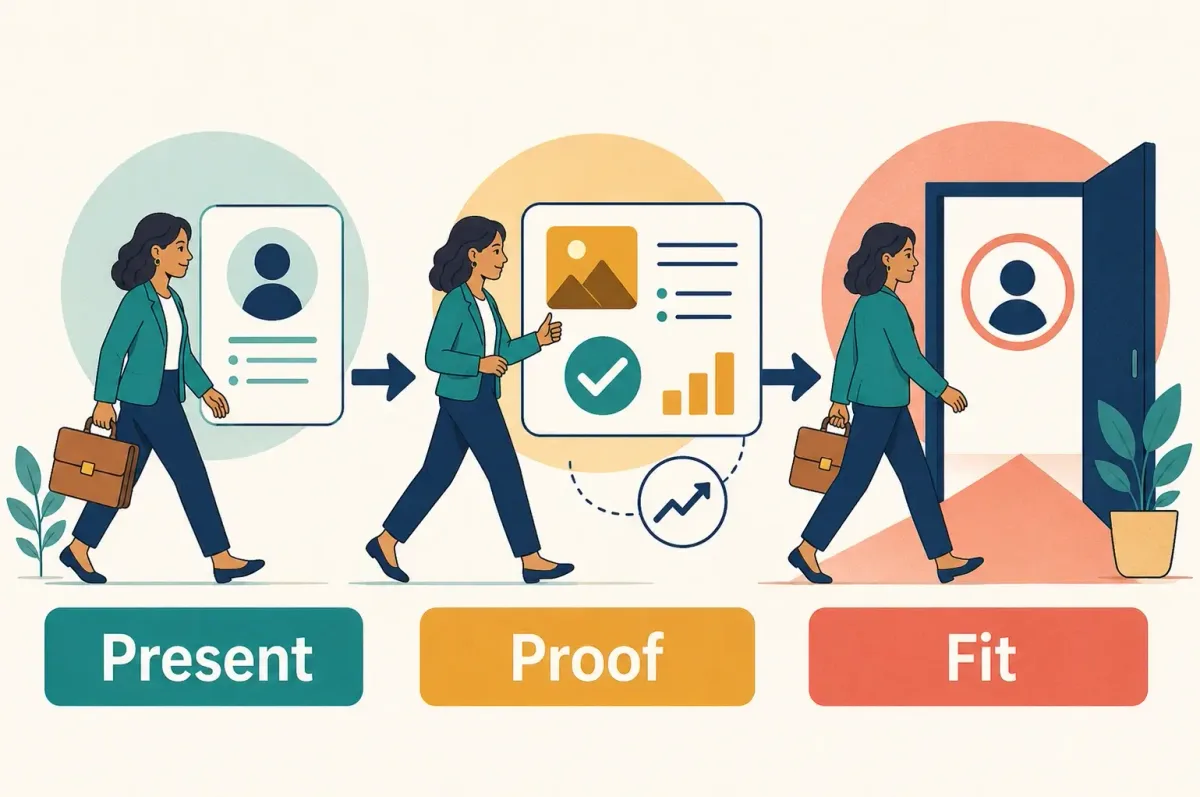
To answer “Tell me about yourself,” give a concise, job-relevant introduction. Start with who you are professionally, use one experience or result to show why you are relevant, and finish by connecting your background to the role. Aim for roughly 60–90 seconds, but follow the interviewer’s lead rather than forcing a memorized script.
Use this three-part structure:
- Present: Who you are professionally and what you focus on.
- Proof: One relevant experience, contribution, or result.
- Fit: Why this role is a logical next step.
Your answer is not a complete biography or a spoken version of your résumé. It is a short professional story that helps the interviewer understand what you do, what supports your fit, and why you are interested in this opportunity.
What Interviewers Are Really Asking
“Tell me about yourself” is broad on purpose. The interviewer is giving you room to decide which parts of your background matter most.
They are usually listening for three things:
- Direction: Can you explain who you are professionally?
- Relevance: Can you connect your experience to the role?
- Communication: Can you organize an open-ended answer clearly?

Career guidance from Harvard’s Mignone Center for Career Success and The Muse similarly emphasizes keeping the answer professional, selective, and tailored rather than recounting your entire history.
The details you emphasize should change slightly depending on who is listening:
| Interviewer | What they are likely trying to understand | What to emphasize |
|---|---|---|
| Recruiter | Overall fit, motivation, and career direction | A clear professional identity and a simple explanation of why you applied |
| Hiring manager | Whether you can handle the work | One relevant contribution, result, or problem you solved |
| Panel interviewer | Whether different teams can understand your value | Plain language, limited jargon, and cross-functional impact |
The structure stays the same. The level of detail changes.
“Tell me about yourself” is also slightly different from “Walk me through your résumé.” The résumé question usually invites a more chronological explanation. “Tell me about yourself” gives you more freedom to select only the experiences that best explain your fit.
Use the Present–Proof–Fit Framework
Many interview guides recommend a Present–Past–Future structure. Indeed describes this as one common way to organize the answer. Present–Proof–Fit uses the same basic progression, but makes the middle section more selective: do not list your past; use it as evidence.
1. Present: Establish Your Professional Identity
Open with the role, field, or professional direction you want the interviewer to evaluate.
Template
I’m a [role or professional identity] focused on [relevant specialty or type of work].
Examples of useful starting points include:
I’m a customer success manager focused on onboarding and retention.I’m a final-year finance student interested in commercial analysis.I’m an operations professional moving into project coordination.
Choose one identity. Do not begin with your birthplace, childhood, every qualification, or a list of unrelated job titles.
2. Proof: Show Why You Are Relevant
Next, choose one experience that supports a requirement of the job. It could be:
- A result you achieved;
- A project you owned;
- A problem you helped solve;
- A responsibility that grew over time;
- A relevant academic, volunteer, or independent project.
Template
In [role, project, or context], I [specific action or responsibility], which [verified result, useful outcome, or relevant scope].
Use numbers only when you can verify them. If you cannot quantify the result, explain the scope, the difficulty, the people affected, or what became better because of your work.
| Weak statement | Stronger direction |
|---|---|
I’m results-driven. |
Name the action you took and the result you can verify. |
I’m a strong communicator. |
Explain who you aligned, what you clarified, or which decision moved forward. |
I’m good under pressure. |
Describe a relevant situation in which you prioritized, diagnosed, or delivered under constraints. |
The goal is not to sound impressive in the abstract. It is to give the interviewer something concrete enough to explore in a follow-up question.
3. Fit: Explain Why This Role Makes Sense Now
Finish by connecting your background to the opportunity in front of you.
Template
I’m now looking to [next professional step], which is why this role’s focus on [specific responsibility, problem, or opportunity] stood out to me.
Avoid ending with only, I’m excited about this opportunity. Explain what you are excited to do.
A Complete Answer Template
I’m a [role or professional identity] focused on [relevant area]. In [recent role, project, or context], I [specific action], which [verified result or meaningful outcome]. That experience strengthened my ability to [capability required by the job]. I’m now looking to [next step], and this role stood out because [specific connection to the position].
Treat this as a set of prompts, not a script. Replace every bracket with information you can explain and defend in a follow-up.
How to Tailor Your Answer to the Job
A generic answer explains your background. A tailored answer helps the interviewer see why that background matters here. If you are preparing for the full conversation, use this job interview preparation checklist to plan your research, examples, and practice.
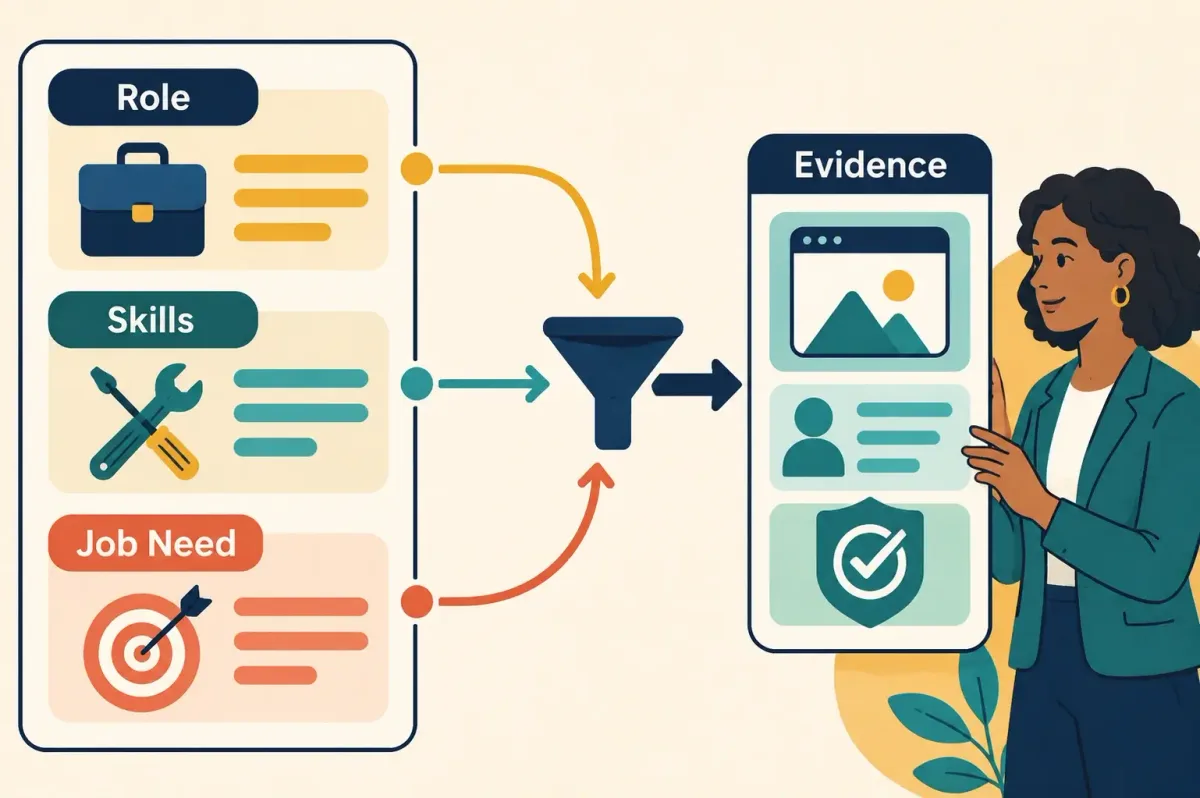
Find Three Signals in the Job Description
Before writing, identify:
- Core responsibilities: What will this person be expected to do regularly?
- Repeated skills: Which abilities, tools, or behaviors appear more than once?
- The likely hiring need: Is the company building, improving, scaling, stabilizing, selling, or replacing something?
Be careful with the third point. Use only what the job description or company materials make reasonably clear; do not pretend to know confidential business problems.
Match Each Signal to Real Evidence
Create a simple working table:
| Job signal | Your evidence | Where it belongs in the answer |
|---|---|---|
[Relevant responsibility] |
[Project, task, or result you can explain] |
Proof |
[Repeated skill] |
[Example of using that skill] |
Present or Proof |
[Stated team or company goal] |
[Reason this is a logical next step] |
Fit |
Choose the strongest evidence, not the largest number of examples. Your proof point should pass three checks:
- Is it relevant to this role?
- Can you explain what you personally contributed?
- Can you answer a follow-up about how you did it?
If the answer to any of these is no, choose a different example.
Adaptable “Tell Me About Yourself” Answer Examples
The examples below are templates, not real candidate stories. Replace the bracketed details with your own verified experience. Do not borrow a result, responsibility, or skill that you cannot support.
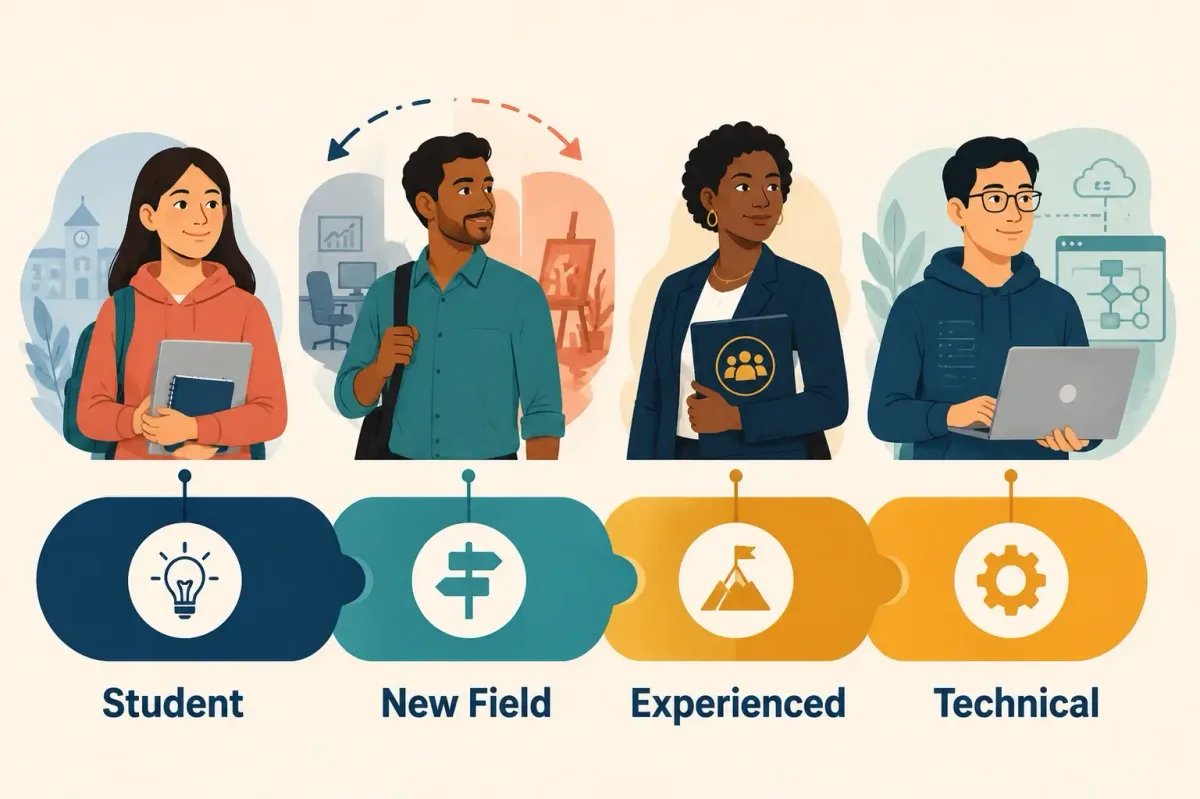
For a Student or Recent Graduate
I’m a final-year [subject] student focused on [relevant field or skill]. Through [coursework, internship, project, or student organization], I’ve developed experience in [relevant task]. In one recent project, I [specific contribution], which helped [verified outcome or completed objective]. I’m now looking for an entry-level [role] where I can apply that foundation while developing deeper experience in [responsibility named in the job description].
What makes it work: The answer does not apologize for limited employment history. It replaces job tenure with a relevant project, contribution, and direction.
Prepare for this follow-up: What did you personally own in that project?
With No Direct Industry Experience
I’m a [current professional identity] with experience in [transferable area]. In my current work, I’ve been responsible for [relevant responsibility], including [specific example]. That experience has strengthened my ability to [transferable capability required by the target role]. I’m now moving toward [target role or field], and I’ve prepared for that transition through [course, project, certification, volunteer work, or other real action]. This position stood out because it combines [existing strength] with [new responsibility].
What makes it work: The candidate leads with transferable value and evidence of preparation instead of focusing on what they lack.
Prepare for this follow-up: What have you done to test whether this new direction is right for you?
For a Career Change
I’ve spent the last [period] working in [current or previous field], where I developed strong experience in [transferable strengths]. The part of that work I found most valuable was [task connected to the new direction]. I recently took a more deliberate step toward [target field] by [real action], and it confirmed that I want to focus more deeply on [target responsibility]. I’m interested in this role because it would let me apply my background in [existing strength] while building further experience in [new area].
What makes it work: It explains the transition as a considered next step, not an escape from the previous career.
Prepare for this follow-up: Why make this change now?
For an Experienced Professional
I’m a [role] specializing in [relevant area], with experience across [relevant scope]. In my current or most recent position, I [specific responsibility or action], which [verified result or meaningful outcome]. That work strengthened my ability to [capability needed in the target role]. I’m now looking for broader responsibility in [next-step area], and this opportunity stood out because of its focus on [specific part of the role].
What makes it work: It selects one recent, relevant proof point rather than walking through the candidate’s full career.
Prepare for this follow-up: What did you personally own, and what would you do differently now?
For a Technical Role
I’m a [technical role] focused on [system, discipline, or problem area]. In my current work, I’m responsible for [relevant scope]. One example is [project or issue], where I [specific technical contribution] and [verified operational or user outcome]. I’m now looking for a role where I can go deeper in [technical responsibility], and I was particularly interested in this team’s work on [specific requirement or product area named publicly].
What makes it work: It shows technical relevance without turning the answer into a tool list or an unexplained architecture review.
Prepare for this follow-up: How did you know your solution worked?
What Not to Say
Avoid anything that makes the interviewer work to find the relevant point.
| Avoid | Do instead | Why |
|---|---|---|
| Recounting every job in order | Select one relevant turning point or result | Creates a clear narrative |
| Using adjectives without evidence | Support the claim with an action or outcome | Makes the answer credible |
| Sharing unrelated personal history | Include personal context only when it explains your motivation or working style | Protects focus and privacy |
| Criticizing a former employer | Explain what you want next in neutral language | Keeps the answer forward-looking |
| Ending with a generic compliment about the company | Name the responsibility or problem that interests you | Shows genuine relevance |
Personal information is not automatically inappropriate. A brief personal detail can help if it explains a career decision, a sustained interest, or how you approach your work. Leave it out if it does not help the interviewer understand your fit.
What to Do When the Interview Goes Off Script
A prepared opening is useful, but real interviews do not always let you deliver it uninterrupted. The goal is not to protect your script. The goal is to stay responsive while preserving your main point.
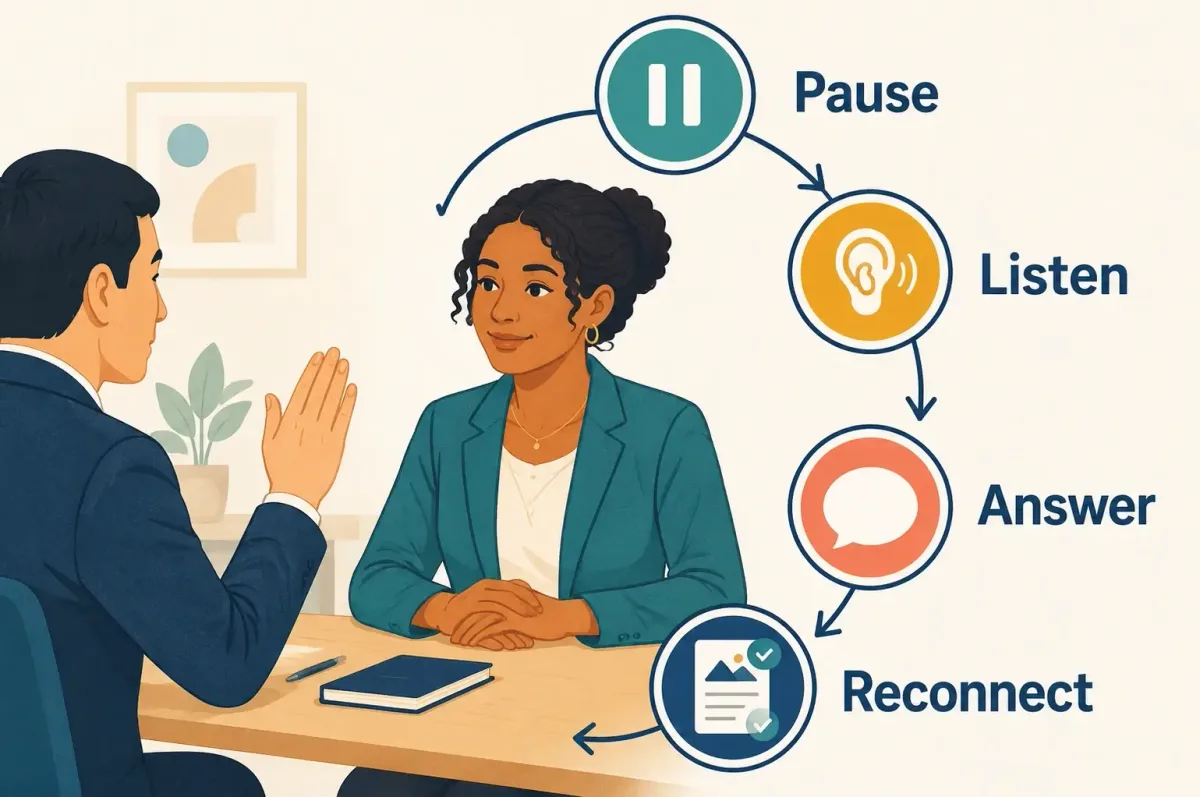
If the Interviewer Interrupts You
Stop and listen to the new question. Answer it directly rather than trying to finish the sentence you prepared.
You can say:
Absolutely—the short version is [brief answer]. The most relevant example is [proof point].
An interruption does not necessarily mean the answer was poor. The interviewer may need a shorter version, want clarification, or see a detail worth exploring.
If You Freeze or Lose Your Place
Pause. A short pause is better than filling the space with unrelated detail. Restart from either your professional identity or your strongest proof point.
You can say:
Let me pause and connect that back to the role. The most relevant part of my background is [proof point].
You do not need to apologize repeatedly. Reorient the answer and continue.
If They Say, “I’ve Read Your Résumé—Tell Me Something Else”
Do not repeat the same chronology in different words. Add a work-relevant detail that reveals how you think, what motivates you, or which type of problem you naturally take ownership of.
You can say:
Beyond the résumé, one thing that has shaped how I work is [relevant experience, interest, or working principle]. It matters in this role because [connection].
Keep the personal detail purposeful. You are adding context, not changing the interview into a private biography.
If They Keep Asking Follow-Up Questions
Answer the question in front of you. Do not restart your entire introduction.
Useful transitions include:
The part I personally owned was...The main constraint was...The result I can verify is...What I would do differently now is...
Follow-up questions may test ownership, judgment, accuracy, or depth. Prepare to explain your proof point beyond the polished summary.
If Your Answer Is Running Too Long
Do not add another example. Summarize your main point and return the conversation to the interviewer.
You can say:
To summarize, that experience is what led me to this opportunity. I’m happy to go deeper on whichever part is most useful.
Practice the Structure, Not Every Word
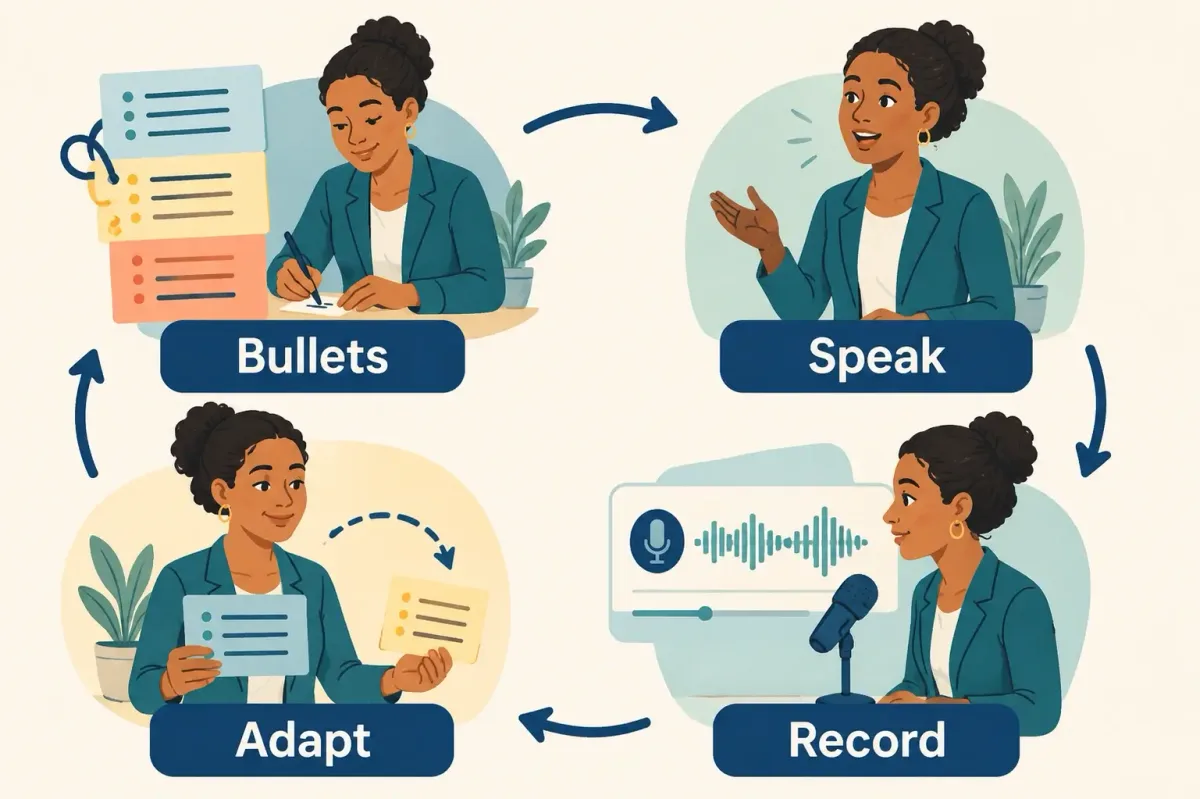
Memorizing every sentence can make recovery harder when the interviewer changes direction. Instead, remember three anchors: Present, Proof, and Fit.
Try this short practice routine:
- Write one bullet for each anchor.
- Say the answer aloud without reading full sentences.
- Record one attempt and check whether the main point is clear.
- Remove any detail that does not support the role.
- Practice a 30-second version.
- Ask someone—or a practice tool—to interrupt you with one follow-up.
- Repeat until you can preserve the structure using different wording.
Before you stop practicing, check:
- Can a listener identify your professional direction quickly?
- Does the answer contain real evidence rather than adjectives?
- Is the connection to this role specific?
- Can you explain the proof point in more detail?
- Can you shorten the answer if the interviewer redirects you?
- Does the wording sound like something you would naturally say?
How an Interview Assistant Can Support Your Preparation
An interview assistant is most useful when it helps you work with your own experience rather than supplying a generic “best answer.” Before the interview, it can help you turn a résumé and job description into a structured outline, identify vague claims, and generate follow-up questions for practice.
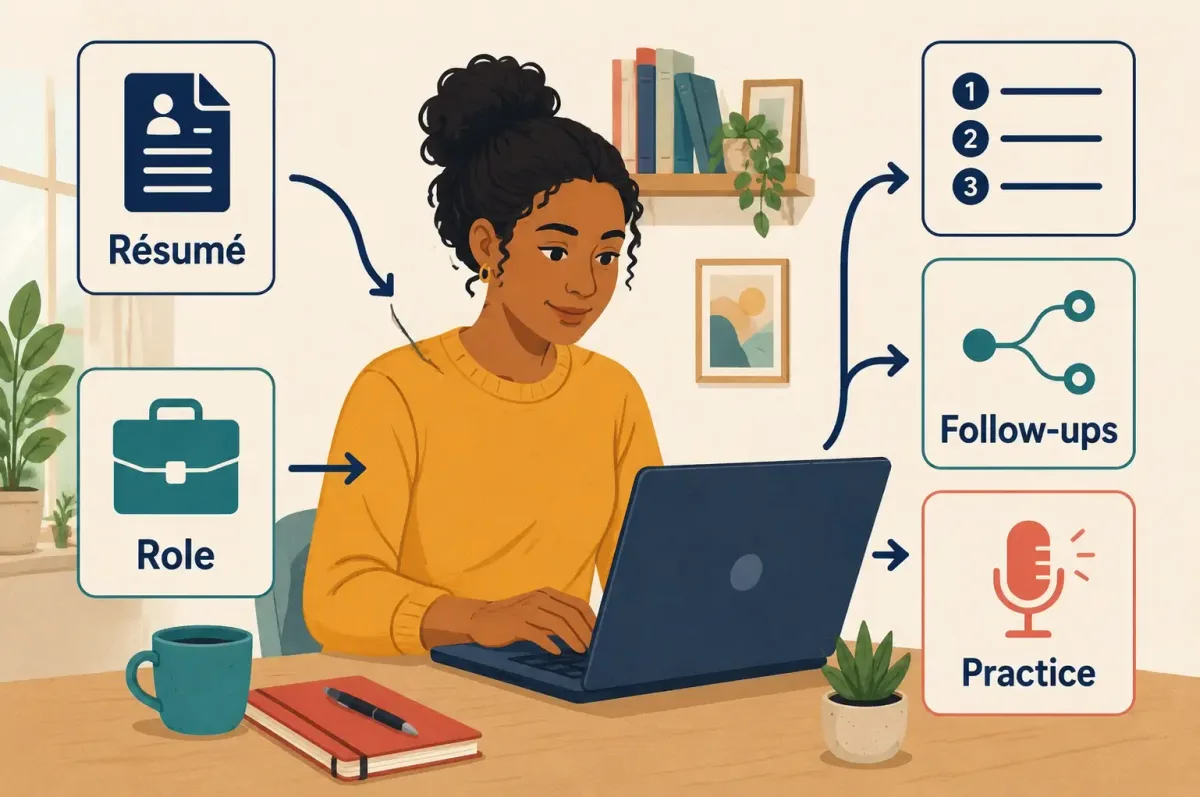
For example, you can use GreatOffer.ai to rehearse a Present–Proof–Fit answer and practice responding to follow-ups without memorizing a single script.
If you are considering real-time assistance during an interview, check the employer’s and interview platform’s rules first. Policies differ. Greenhouse’s published candidate guidelines, for example, distinguish between acceptable preparation and using generated responses during an interview. When a policy is unclear, treat the tool as preparation-only or ask the employer.
Whether you use a person, a recording, or an interview assistant to practice, keep the same boundaries:
- Use only experiences, responsibilities, and results that are true.
- Verify every generated suggestion before using it.
- Speak in your own words.
- Do not use a tool to fabricate an answer or bypass interview rules.
- Do not record an interview without the required permission.
The product should support your thinking, not replace it. For a broader comparison of preparation and real-time tools, see this AI interview copilot comparison guide.
Build the Answer, Then Practice the Conversation
A strong answer to “Tell me about yourself” does three things: it establishes who you are professionally, proves your relevance with one real example, and explains why the role makes sense now.
Write those three points as bullets. Practice a normal version and a shorter version. Then rehearse one interruption or follow-up so that your answer remains useful when the interview becomes a conversation rather than a script. Finally, prepare several questions to ask in the interview so you can close the conversation with the same level of focus.