
Disclaimer: This article provides general job-application guidance. Every example is illustrative; replace its names, numbers, and claims with details you can truthfully support, and follow each employer's rules for application materials and interview assistance.
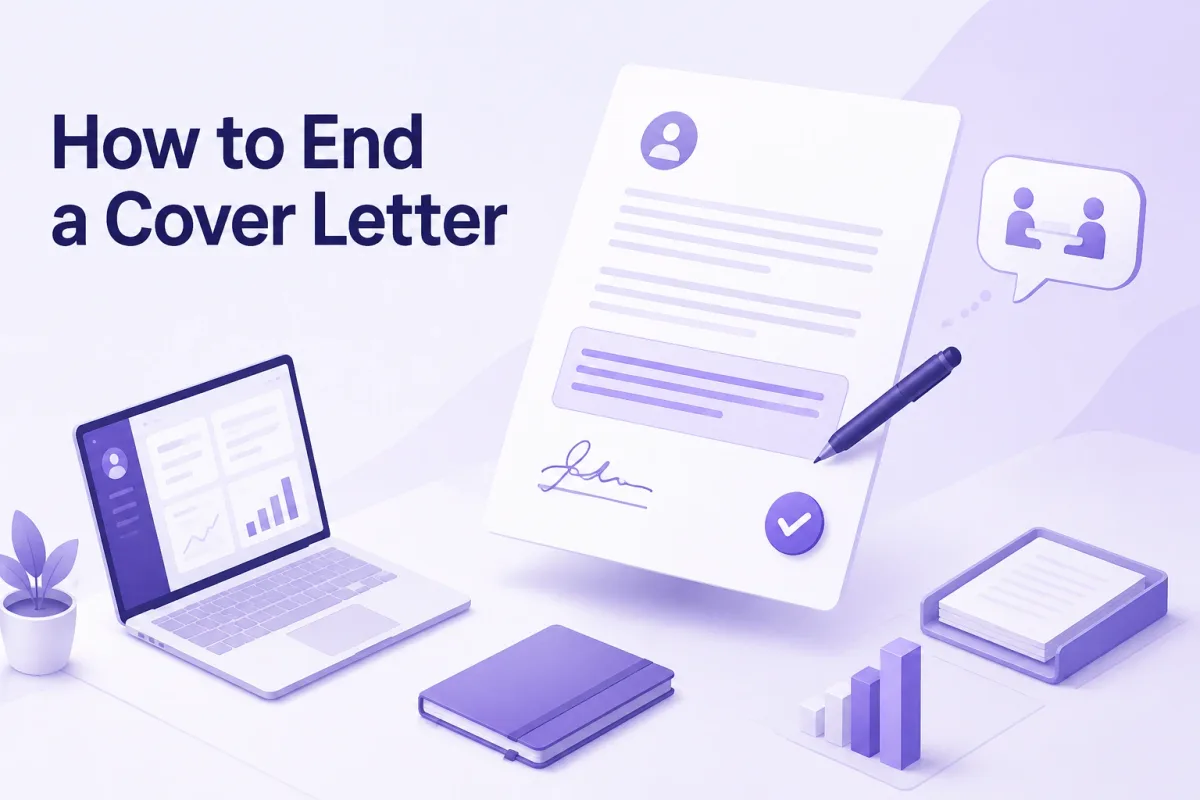
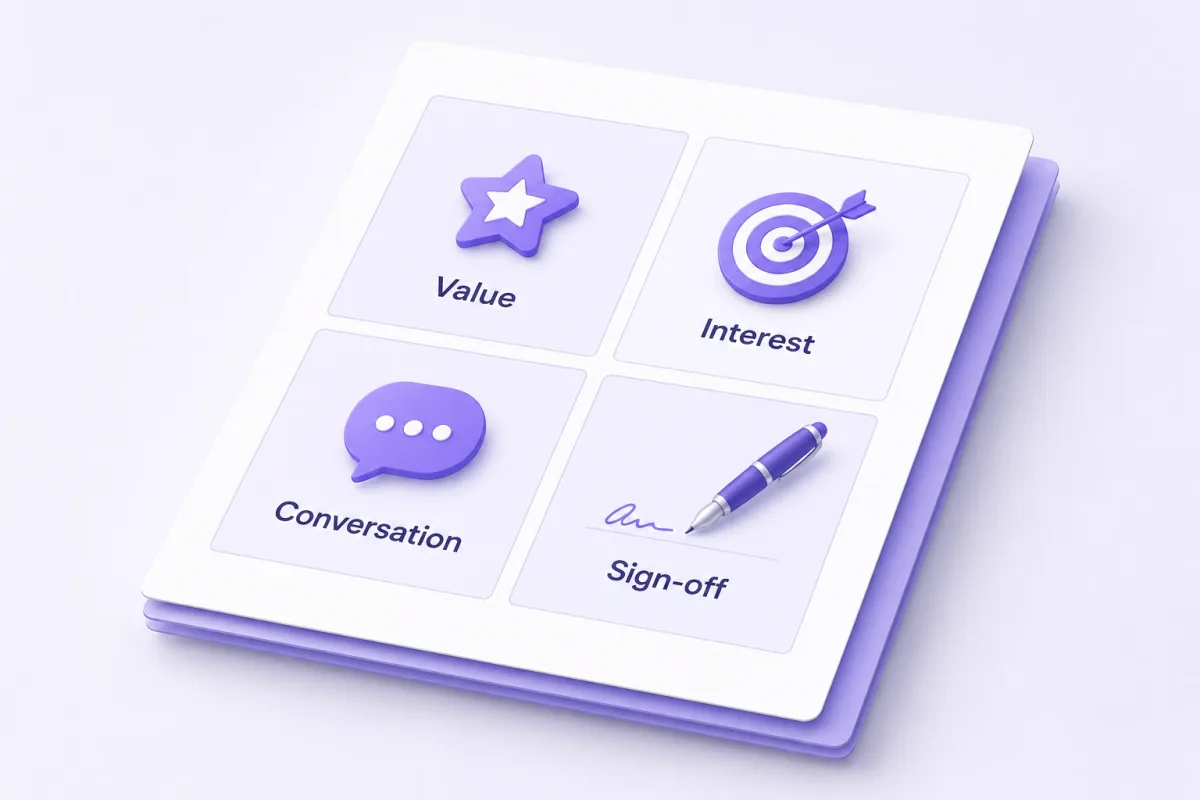
The ending has three distinct parts: the closing paragraph, the sign-off such as "Sincerely," and the signature block containing your name and relevant contact details. You do not need dramatic language. You need a concise reminder of your fit, a credible reason for your interest, and a polite next step.
How to End a Cover Letter in 4 Steps
A strong closing paragraph connects your most relevant qualification to the employer's needs, then makes the next step easy to understand. Purdue OWL's closing guidance recommends reminding the reader why you match the position, requesting an interview, thanking the reader, and ending with an appropriate sign-off.
1. Restate the Value You Can Bring
Use the first sentence to bring the reader back to the strongest connection between your background and this job. Replace labels such as "hard worker" with a skill, result, responsibility, or problem you can credibly discuss.
- Template: "Given my background in
[Core Skill/Domain], I am eager to help[Company Name]achieve[Key Metric or Goal]." - Why it works: It refocuses the hiring manager's attention on what they gain by bringing you onto the team.
2. Show Specific Interest in the Role
Show that the letter was written for this role rather than for employers in general.
- Do: Mention a specific project, product launch, or team initiative noted in the job description.
- Don't: Rely on generic praise such as "I have always admired your company."
- Template: "I am particularly drawn to
[Team/Project Name]'s work on[Specific Initiative]."
3. Invite a Conversation Without Sounding Entitled
Invite a conversation while respecting the employer's schedule and selection process.
-
Tone Comparison:
- Passive: "I hope to hear from you if you think I might fit."
- Confident: "I would welcome the opportunity to discuss how my background aligns with your upcoming goals."
- Pushy: "I will call your office next Monday at 9 AM to arrange our interview."
4. Thank the Reader and Add a Professional Sign-Off
Finish with a brief expression of thanks and a professional complimentary close.
- Micro-Example: "Thank you for your time and consideration. Sincerely, Jane Doe"
Here is how all four steps come together in a complete four-sentence closing paragraph:
"My six years of experience optimizing B2B email campaigns can directly support your team's expansion into enterprise accounts. I am genuinely excited about your upcoming product roadmap and would welcome the opportunity to discuss how my background aligns with your growth goals. Thank you for your time and consideration. Sincerely, Jane Doe"
Treat the four steps as functions, not a rigid sentence count. If two ideas fit naturally in one sentence, combine them. The goal is to make the ending easy to scan without removing information the employer needs.
Cover Letter Closing Examples for Different Situations
Choose the example closest to your career stage, industry, and application format, then replace every placeholder and unsupported claim. The University of Washington Career Center advises keeping a cover letter concise, tailoring it to the position, and connecting your experience to the employer's needs.
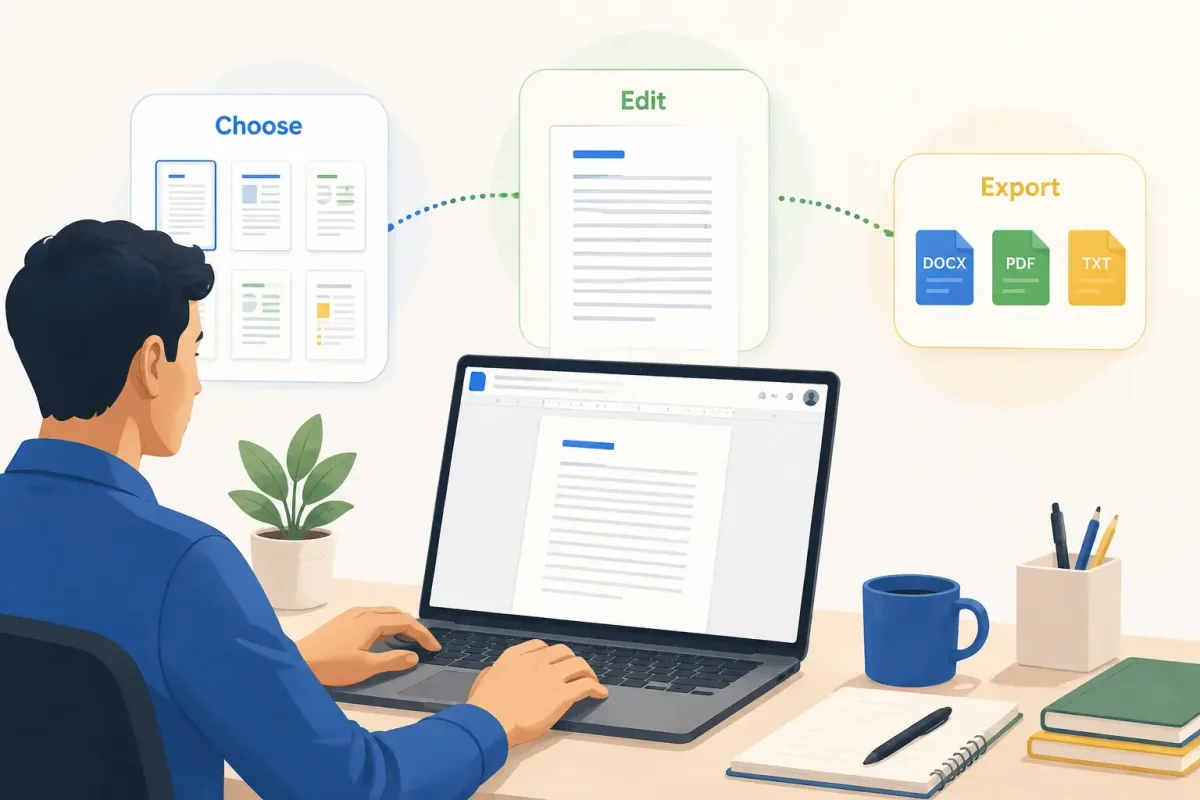
If you still need a clean document structure, start with these Google Docs cover letter templates before tailoring the ending.
For an Internship or First Job
When applying for your first role or an internship, focus on relevant coursework, campus leadership, academic projects, and transferable skills.
Example 1 (Academic Project Focus): "Through my senior capstone project in data visualization, I developed practical experience building interactive dashboards using Python and Tableau [Value]. I am excited about the analytics internship at [Company] because of your focus on open-source data tools [Fit]. I welcome the chance to discuss how my technical foundation can support your team's research projects this summer [CTA]. Thank you for your time and consideration [Thanks]."
Example 2 (Leadership & Transferable Skills Focus): "My experience managing event logistics for a 300-member student organization has prepared me to handle fast-paced scheduling and client communications [Value]. I have followed [Company]'s community initiatives for the past year and would love to contribute to your regional outreach events [Fit]. I would appreciate the opportunity to discuss how my organizational skills match your team's needs [CTA]. Thank you for considering my application [Thanks]."
For a Career Change or Limited Direct Experience
Highlight transferable competencies and your motivation for transitioning into a new industry without apologizing for a non-traditional background.
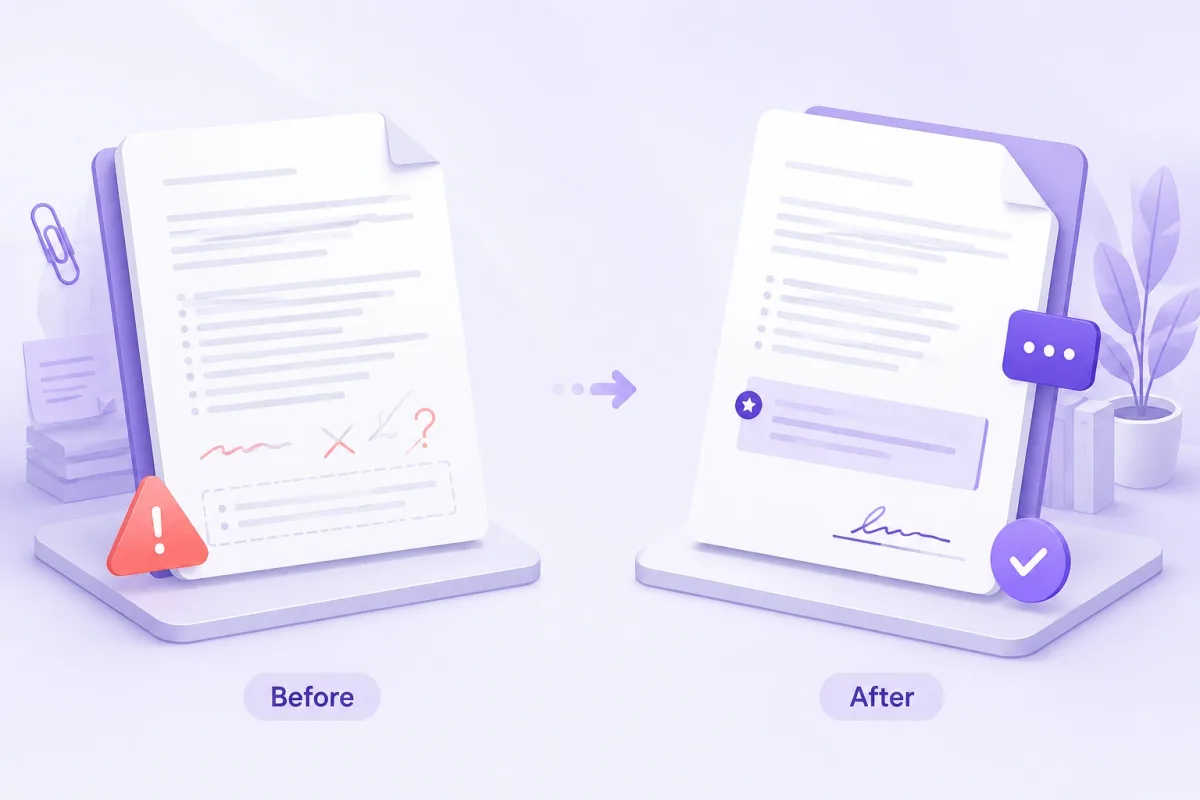
Before & After Comparison:
- Before (Apologetic): "Although I have never worked in HR before, I am a fast learner and hope you will give me a chance."
- After (Confident Value Transfer): "My decade of experience in client dispute resolution equips me to manage complex employee relations with discretion and care
[Value]."
Example 1 (Operations to Tech Project Management): "My background managing supply chain logistics has honed my ability to keep complex, multi-stakeholder projects on schedule [Value]. I am eager to bring this operational rigor to [Company]'s software development team [Fit]. I welcome the opportunity to discuss how my project oversight skills translate to your agile environment [CTA]. Thank you for your time and consideration [Thanks]."
Example 2 (Teaching to Corporate Training): "Designing curriculum for diverse learning styles has built my capacity to translate complex concepts into clear, engaging training modules [Value]. I am strongly aligned with [Company]'s emphasis on continuous employee development [Fit]. I would welcome a conversation about how my instructional experience can support your onboarding programs [CTA]. Thank you for reviewing my materials [Thanks]."
For an Experienced Professional or Manager
Experienced candidates can use the closing to emphasize the most relevant strategic impact, leadership responsibility, or business result they can support.
Example 1 (Quantified Growth Focus): "Having scaled engineering teams from 10 to 45 developers while reducing deployment cycle times by 35%, I am equipped to guide your platform infrastructure through its next growth phase [Value]. [Company]'s commitment to low-latency architecture aligns perfectly with my engineering leadership focus [Fit]. I look forward to discussing how my experience can accelerate your technical milestones [CTA]. Thank you for your consideration [Thanks]."
Example 2 (Strategic Transformation Focus): "My track record of leading cross-functional brand repositioning campaigns enables me to strengthen [Company]'s market share in the enterprise segment [Value]. I am inspired by your team's recent expansion into international markets and would love to support that strategy [Fit]. I welcome the opportunity to discuss how my campaign framework can drive your strategic goals [CTA]. Thank you for your time [Thanks]."
For Formal and Traditional Industries
For a more formal or regulated application, use understated, highly professional language unless the employer communicates in a clearly different style.
Example 1 (Legal / Compliance): "My extensive experience in regulatory compliance and contract drafting prepares me to support [Firm Name]'s risk management practice with precision [Value]. I hold deep respect for your firm's appellate litigation record and would be honored to contribute to your team [Fit]. I welcome the opportunity to discuss my qualifications in an interview [CTA]. Thank you for your time and consideration [Thanks]."
Example 2 (Corporate Finance): "My six years in financial modeling and capital allocation have consistently helped corporate clients optimize treasury strategy [Value]. I am particularly interested in [Bank Name]'s renewable energy investment desk [Fit]. I look forward to discussing how my analytical skills align with your portfolio objectives [CTA]. Respectfully yours [Thanks]."
For Startups or Creative Roles
When an employer communicates in a direct, conversational style, a concise closing can match that tone while remaining professional.
| Creative / Startup Style | Traditional Style |
|---|---|
| "I'd love to jump on a quick call to talk through how my design framework can speed up your product sprints." | "I welcome the opportunity to discuss my qualifications in a formal interview at your earliest convenience." |
Example (Product Design Focus): "I have spent the last four years redesigning mobile checkout flows to reduce cart abandonment [Value]. I love [Startup Name]'s frictionless approach to consumer fintech and would be thrilled to help refine your mobile user experience [Fit]. I'd welcome the chance to share a few design concepts and discuss how I can contribute to your upcoming feature release [CTA]. Thanks for your time [Thanks]."
For an Email Cover Letter
When sending your cover letter in the body of an email rather than as an attached document, keep the paragraph concise and place your contact block directly under your sign-off. Follow the employer's instructions if they specify a different format.
Email Closing Example: "My background in content strategy and SEO optimization positions me to expand [Company]'s organic search visibility [Value]. I am enthusiastic about your digital growth goals and would welcome the chance to discuss how my skill set matches your needs [CTA]. Thank you for your time and consideration [Thanks]."
Email Body vs. Attached Document Signature Block:
| Formatting Element | Email Cover Letter Body | Attached Document (PDF/Word) |
|---|---|---|
| Header Location | At the bottom below your typed sign-off | At the top of the page above salutation |
| Street Address | Optional / City, State only | Full mailing address (standard business letter) |
| Contact Links | Clickable LinkedIn URL and portfolio link | Plain text or hyperlinked text |
| Handwritten Signature | Not usually needed for an email body | Optional only when the application format calls for it |

Which Cover Letter Sign-Off Should You Use?
Your sign-off should match the tone already established in the letter. Robert Half's cover-letter guidance recommends conventional options such as "Sincerely," "Best regards," or a brief expression of thanks, while avoiding language that is overly familiar for an initial application.
The Safest Professional Sign-Offs
| Sign-Off | Formality Level | Best Used For | Risk Level |
|---|---|---|---|
| Sincerely, | Formal | Traditional, corporate, legal, finance, and general applications | Very low when the letter is formal |
| Best regards, | Professional / Warm | Most corporate, technical, marketing, and general business roles | Very low in a professional letter |
| Kind regards, | Professional / Polite | Education, healthcare, professional services, and relationship-led roles | Low when it matches the letter's tone |
| Thank you, | Direct / Modern | Email cover letters or applications that end with genuine thanks | Low when it does not replace the full closing paragraph |
Note on "Yours sincerely": The phrase is correct but is associated more strongly with British English. For a US application, "Sincerely," is the clearer conventional choice; "Best regards," is another professional option when the overall letter is slightly warmer. Grammarly's usage guide also distinguishes "Yours sincerely" as the British convention and "Sincerely yours" as the American form.
Sign-Offs That Depend on Company Tone
- Best, — Popular in fast-paced tech and startup environments. Safe for email cover letters when applying to informal teams, but may appear overly casual for executive or legal roles.
- Warm regards, — Adds personal warmth; best used when you have already built rapport with the recruiter or hiring manager through prior networking.
- Respectfully, — Highly formal; standard for military, government, judicial, or academic applications.
Sign-Offs to Use Carefully
- Cheers, — May fit a genuinely informal organization, but is risky in a cold application when you do not yet know the reader's style.
- Best wishes, — Polite, but less conventional than "Sincerely" or "Best regards" in a US cover letter.
- Thanks! or Thx — The abbreviation and exclamation point can make an initial application feel too casual.
- Warmly, or Love, — Usually too personal for a first professional contact.
- Emojis or icons (e.g.,
Sincerely, Jane 🙂) — Skip them unless the employer explicitly asks for a highly informal or creative application format.
How to Format Your Name and Signature
Format your sign-off with a capitalized first word, a trailing comma, one blank line, and the same professional name used elsewhere in the application.
Attachment / PDF Signature Format:
Sincerely,

Jane Doe
555-019-2831 | jane.doe@email.com | San Francisco, CA
linkedin.com/in/janedoe | janedoedesign.com
Email Body Signature Format:
Best regards,

Jane Doe
Senior UX Researcher
Phone: (555) 019-2831
Email: jane.doe@email.com
Portfolio: janedoedesign.com
LinkedIn: linkedin.com/in/janedoe
Cover Letter Endings to Avoid—and How to Fix Them
The following problems make a closing less specific or harder to trust. Each can be corrected without making the paragraph longer.
Generic Endings
Ending with a standalone "Thank you for your consideration" leaves the hiring manager with no final summary of why you fit the role.
- Weak: "Thank you for your time and consideration. I hope to hear from you soon."
- Fixed: "Thank you for your time and consideration. My experience managing multi-channel marketing budgets will allow me to deliver immediate value to your growth team, and I look forward to discussing this opportunity."
Passive or Uncertain Endings
Phrases like "I hope I might be considered" signal a lack of confidence in your qualifications.
[Passive Tone Scale]
Passive: "I know I don't have every qualification, but I hope you might consider my resume."
  ↓
Confident: "I am confident that my track record in client retention equips me to support your account management goals."
  ↓
Pushy: "I am obviously the most qualified candidate for this position and expect an interview."
Pushy or Entitled Endings
Demanding a specific interview date or implying that an interview is guaranteed creates friction with recruiters.
- Pushy: "I will follow up with your office next Tuesday at 2 PM to schedule our interview."
- Fixed: "I welcome the opportunity to discuss how my background aligns with your team's needs at your earliest convenience."
Overlong or Off-Topic Endings
The closing paragraph is not the place to introduce new qualifications, discuss salary expectations, or explain personal employment gaps.
-
Deletion Checklist:
- Remove all salary or compensation numbers (reserve for offer negotiation).
- Remove personal explanations regarding relocation or personal schedules unless specifically requested in the job posting.
- Keep the closing paragraph to the shortest length that covers value, interest, a reasonable next step, and thanks—often 2 to 4 focused sentences.
A Note on "I look forward to hearing from you"
Is "I look forward to hearing from you" bad? Not inherently. It is a polite, standard English phrase. However, relying on it alone as your entire closing sentence makes your ending feel abrupt. Pair it with a statement of value or interest to maintain momentum.
Use This 60-Second Cover Letter Closing Checklist
Use this simple decision tree and checklist before submitting your application. Review it alongside our guide to making a resume stand out so both documents present a consistent case for your fit.
Choose Your Tone in Three Questions
-
What is the industry and employer tone?
- More formal or regulated environment → Consider Sincerely, and a restrained CTA.
- Standard professional or less formal environment → Consider Best regards, and a direct but courteous CTA.
-
What evidence best supports your level?
- Entry/Internship → Highlight a relevant project, responsibility, or transferable skill.
- Experienced/Manager → Highlight a truthful result, leadership responsibility, or strategic contribution.
-
What is the application medium?
- Attached PDF/Word Document → Use formal letter header and full closing block.
- Email Body → Keep paragraphs extra brief; place contact links directly below typed sign-off.
The Six-Point Final Check
- Specific Value: Does your closing paragraph state at least one concrete skill, achievement, or capability?
- Tailored Fit: Did you reference the specific role, company, or team initiative?
- Polite CTA: Is your call to action clear and confident without demanding an interview?
- Gratitude Included: Did you thank the reader for their time and consideration?
- Safe Sign-Off: Did you select an appropriate complimentary close (Sincerely, or Best regards,)?
- Proofread Details: Have you verified the correct spelling of the hiring manager's name and the company name?
Conclusion: Finish Strong, Then Prepare for the Conversation
Learning how to end a cover letter comes down to four jobs: remind the reader what you can contribute, show why this particular role interests you, invite a conversation, and close professionally. Before submitting, read the paragraph aloud and confirm that every claim is accurate, specific to the role, and consistent with the rest of your application.
If the application leads to an interview, use this guide on how to prepare for a job interview to organize role-specific responses and key points. GreatOffer's real-time interview copilot can also support your preparation; follow the employer's policies and any applicable rules when using real-time assistance.
Editorial Sources
- Purdue OWL: Cover Letter Closings
- University of Washington Career Center: Cover Letters
- University of Pennsylvania Career Services: How to Write a Cover Letter
- Harvard Mignone Center for Career Success: Create a Resume/CV or Cover Letter
- Robert Half: How to Close a Cover Letter
- Grammarly: Sincerely Yours—Meaning, Usage, and Examples