
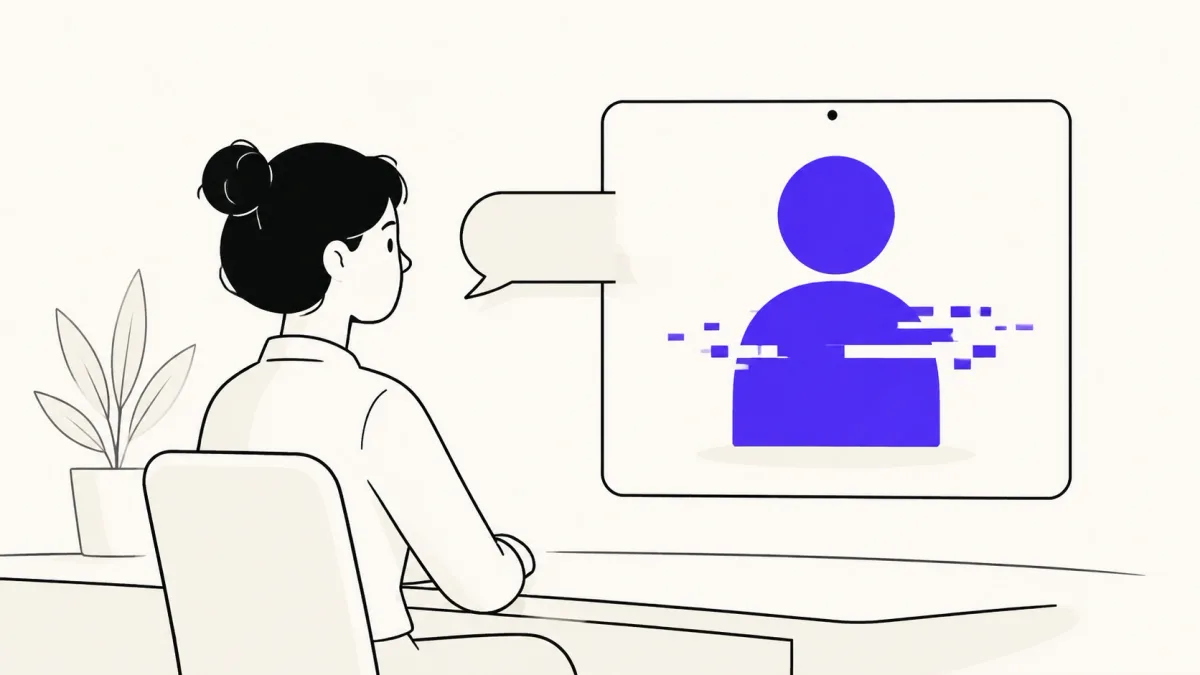
One candidate's July 2026 post described an automated screening that went wrong in six ways at once. The interviewer cut answers off mid-sentence, jumped topics without warning, sat in long silences, re-asked questions it had already asked, and ended the session early. What bothered them most was not the malfunction. It was not knowing whether the platform's glitches would land in their file as personal performance failures.
The Greenhouse 2026 Candidate AI Interview Report, published May 2026, surveyed 2,950 candidates across the United States, United Kingdom, Germany, Australia, and Ireland. Its headline figures report U.S. respondents (n=1,200): 38% have walked away from a hiring process because it included an AI job interview, and another 12% say they would.
Note what that definition does not say. It does not say AI has no place in hiring. A company can automate parts of screening without wrecking the candidate experience, and drop any one of four things and it starts discarding people it should be keeping. The four are reliability, transparency, a recovery path when something breaks, and a named human who can overrule the result. Most of what follows is about what to do when one of them is missing.
First, Identify What Type of AI Interview You Are Facing
Not every automated hiring tool works the same way, and preparing for the wrong one wastes your effort. Before you adjust anything about your delivery, work out which of these four you are actually facing.
| Interview Type | Candidate Experience | Possible AI Role | Best Question to Ask |
|---|---|---|---|
| One-way video interview | Records answers to preset questions on a screen with time limits | Transcription, summarization, scoring, or no AI analysis | Who reviews the recording, and can I re-record if an error occurs? |
| Interactive AI interviewer | AI asks and follows up in real time via voice or avatar | Dynamic questioning, real-time NLU, summarization, or scoring | What happens if the system interrupts or misunderstands me? |
| AI-assisted human interview | A person asks questions while AI works in the background | Meeting notes, live transcription, suggested prompts, or evaluation support | Will the interviewer review the original answers or only the summary? |
| Automated decision workflow | Candidate completes an assessment, often with invisible scoring | Ranking, threshold screening, recommendations, or rejection | Does a person review the result before a rejection is sent? |
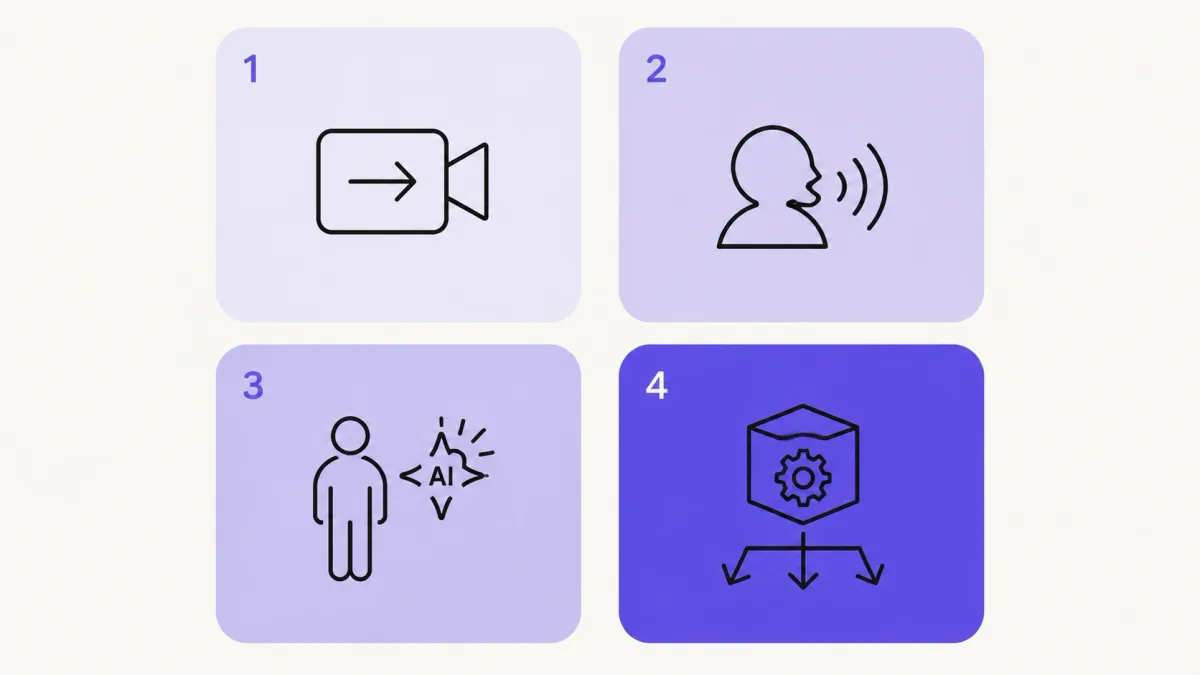
The phrase "AI interview" tells you nothing about who decides. It does not reveal what data gets analyzed, or whether any person can override the system. Knowing whether you face an asynchronous one-way video interview, an AI screening interview, or a backend workflow determines how you format answers and where you document faults.
Why Candidates Are Starting to Reject AI-Led Hiring Processes
Candidate resistance here is not generic technophobia. Strong candidates leave when a process optimizes for employer throughput and gives them nothing back.
Surprise Creates Distrust Before the First Question
Disclosure is where most processes fail first. In the Greenhouse survey of U.S. respondents, 70% were never clearly told upfront that AI would be evaluating them, and for 21%, the AI only became apparent once the interview started.
Think about what that feels like. Disclosure timing sets the trust level for everything after it, and you prepared for a conversation with a hiring manager and got an avatar instead. You had questions ready for a person. You dressed for a person. Now there is nobody to read the room with, and the first thing you learned about the company is that your time was not worth a heads-up.
An Interview Is Supposed to Work Both Ways
Hiring is a two-sided evaluation. You are assessing the manager, the team, the expectations, the salary, and how decisions get made. A fully automated early stage asks you to spend an hour without offering any of that back, and there is nobody to ask. For senior or specialized roles, where mutual alignment matters most, the trade gets worse the further up you go.
High Pay Does Not Automatically Repair a Low-Trust Process
Employers tend to assume compensation buys tolerance for friction. Sometimes it does. Financial pressure keeps plenty of candidates in processes they dislike, and pretending otherwise would be dishonest.
But money answers a different question than the one candidates are asking. It tells you nothing about whether the system works reliably, what it measures, where your recording goes, or whether a person will ever look at your answers. A high salary does not make an unaccountable process accountable.
Candidates Object Most Strongly When AI Has Decision Power
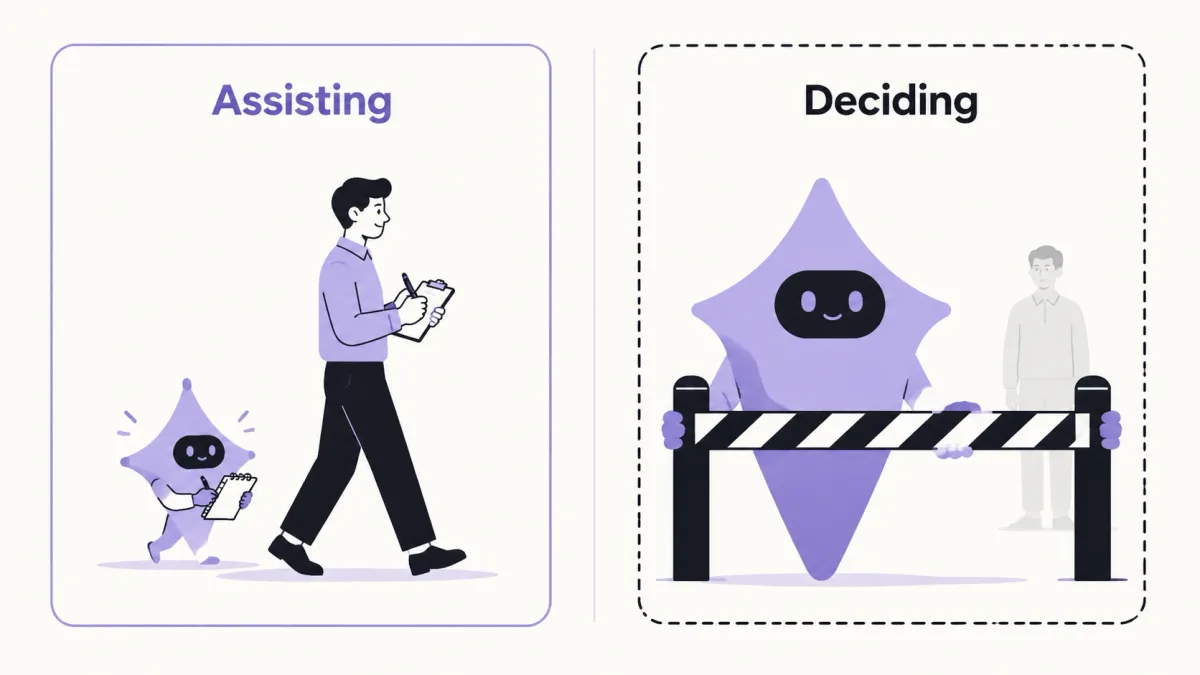
There is a sharp line in public attitudes between AI assisting and AI deciding. Pew Research Center's April 2023 survey on AI in hiring found 71% of U.S. adults opposed AI making final hiring decisions, and 66% said they would not apply to a job where AI made the call. That data is three years old and measured attitudes rather than behavior, but the shape of the objection has held. The resistance concentrates on opaque models acting as gatekeepers you cannot appeal to, not on background transcription or note-taking. Which is worth knowing before you walk out of a process: AI hiring transparency is the thing to ask about, and an AI tool taking notes for a human interviewer is a different proposition from one deciding your file.
The Three Ways an AI Interview Can Fail
"The AI interview was terrible" is not a diagnosis. Automated interviews fail in three distinct layers, and knowing which one you hit determines what you can do about it. The split below is mine, drawn up to make these sessions debuggable rather than taken from any standard taxonomy, but it holds up against the vendor data later in this piece.
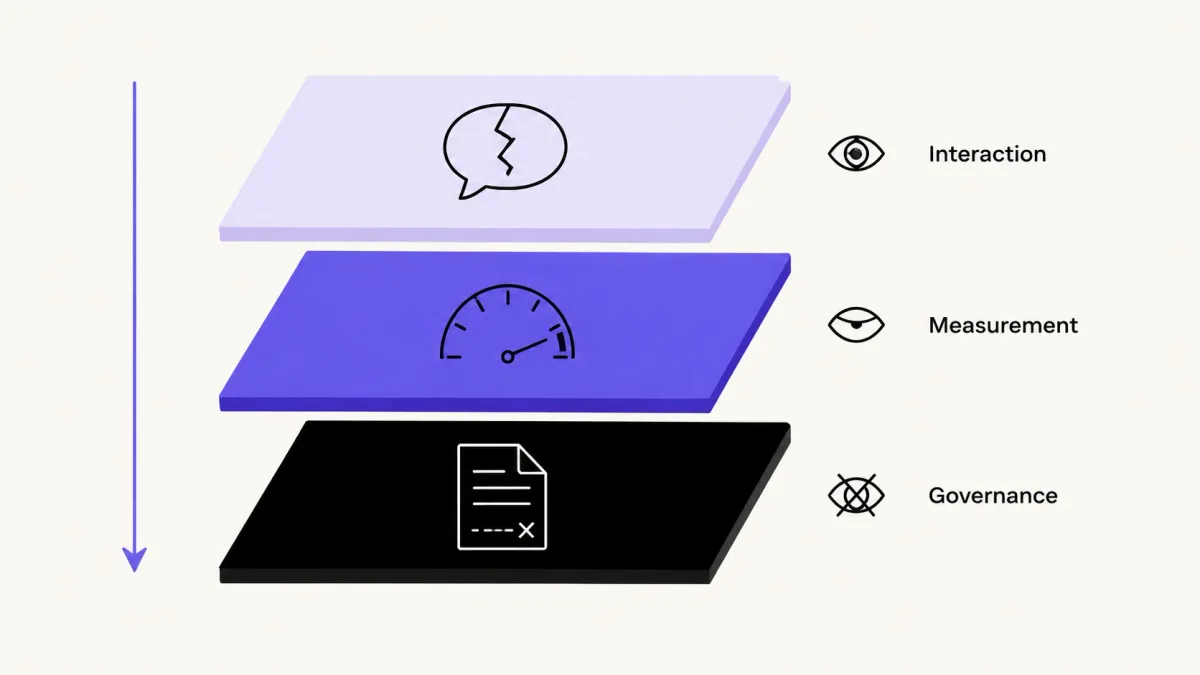
Layer 1: Interaction Failure
An interaction failure prevents normal communication between you and the interface:
- Interrupting before you reach the result. Voice-activity detection fires during a natural pause and cuts you off mid-answer.
- Long or unpredictable latency. Processing lag creates overlapping speech, or you assume the session froze and start over.
- Repeating a question without saying what is missing. The conversational state machine loops, asking the identical prompt three or four times.
- Irrelevant or context-free follow-ups. The model generates a question with no logical connection to your industry or your previous answer.
- Advancing while you are still speaking. The platform moves to the next prompt mid-sentence.
- Freezing, disconnecting, or ending early. The session crashes before the scheduled questions finish.
- Ignoring a request for clarification. You ask it to rephrase; it repeats the same script.
Here is the part that matters: you can see all of this, and the recruiter usually cannot. They receive a transcript or a score. The interruption that cost you your best example does not appear anywhere in what they read.
Candidates who come to me after one of these sessions almost always open by apologizing for their own performance. Halfway through, they mention in passing that the system froze twice. The freezing gets told as background detail, because by then they have already filed it under their own fault.
Layer 2: Measurement Failure
A measurement failure is a gap between what the system scores and what the job requires:
- Speech recognition altering names, numbers, years, technical terms, or negation. The classic version: "I did not lead the deployment" transcribed as "I led the deployment."
- Treating a rigid experience threshold as a complete measure of qualification. Hard filters cut candidates with equivalent transferable skills who lack the exact keyword phrasing.
- Scoring fluency, response speed, facial movement, or eye behavior without job-related validity. Inferring competence or honesty from features never shown to predict performance in that role.
- Penalizing a truncated answer as a choice. A Layer 1 interruption cuts your response; the scoring engine records missing evidence rather than a system fault.
- Optimizing for similarity to past interviewer ratings. Training on historical hiring decisions reproduces prior manager preferences, which is not the same thing as predicting job success.
Some automated interview research does find predictive value for narrow constructs under specific conditions. That does not validate every model, feature, role, or vendor, and vendors sometimes cite the general finding as if it certified their particular product.
Layer 3: Governance Failure
A governance failure is the absence of accountability when the first two layers break:
- No advance disclosure that AI will be involved.
- No explanation of whether the tool transcribes, scores, or screens.
- No data-retention or access information for video, voice, and transcripts.
- No technical-support contact to report a crash.
- No retake path, so a technical failure becomes a rejection.
- No meaningful human review before an automated recommendation becomes a decision.
- No accommodation process for candidates with disabilities or speech differences.
- Employer and vendor pointing at each other when something goes wrong.
Layer 3 is what converts a fixable glitch into a lost opportunity. A dropped call is a nuisance when a retake exists. Without one, it is a rejection.
A bad AI interview is not only a chatbot problem. It can be an interaction failure, a measurement failure, and a governance failure at the same time.
How to Prepare for an AI Interview Without Becoming Robotic
There is a real tension in preparing for these. Format your answers so speech recognition handles them cleanly, but not so rigidly that you sound like you are reading a script to a machine. Both failures cost you, and the four sections below are where the balance actually gets struck.
Ask Five Questions Before You Begin
Send these before you launch the software:
- Will I interact with a person, an AI system, or both?
- Does the AI only ask questions, or does it also score or recommend candidates?
- Will a recruiter review the original recording or transcript?
- Can I request technical support, a retake, or an accommodation?
- How will the recording, audio, transcript, and derived data be used and retained?
Confirm the basics too: salary range, work location, role level, and how many stages remain. An hour-long automated screen for an undisclosed salary band is a bad trade.
Build Answer-First Responses
Lead with the conclusion, every time. Not because the recognizer prefers it (it does not care about your rhetorical order) but because you may not get to finish. This structure holds up under how to prepare for an AI interview and how to answer AI interview questions:
- Direct answer in one sentence.
- One relevant example.
- Your action or decision.
- Measurable or observable result.
- Stop and let the next question come.
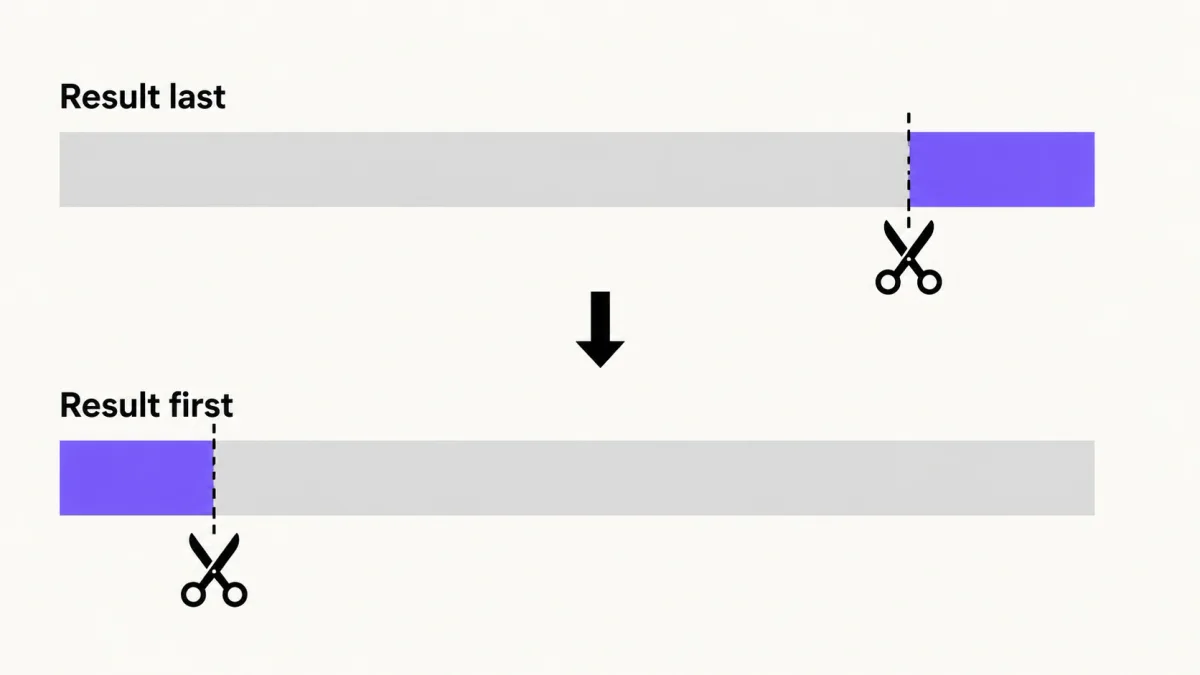
Prepare a 30-second and a 60-second version of the same example. If the system cuts you off at 15 seconds, your main achievement is already on the record.
Practice Interruption Recovery, Not Only Perfect Answers
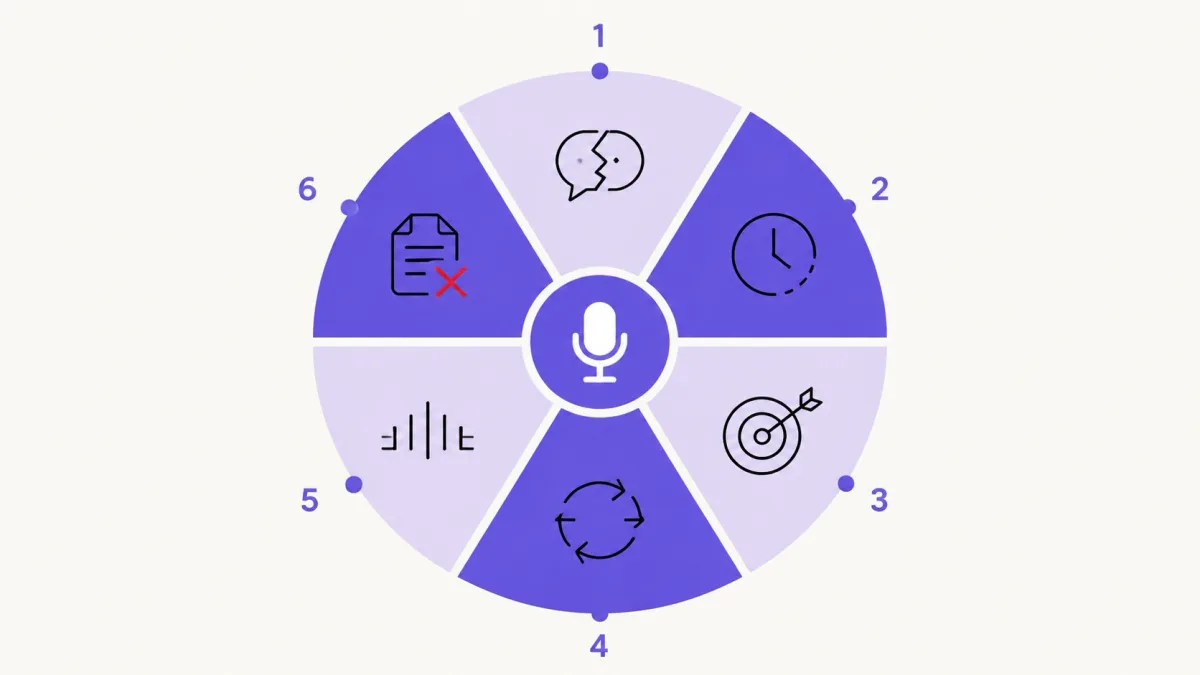
Almost nobody rehearses this, which is why almost everybody handles it badly. The default reflex when cut off is "Sorry, should I start again?" That costs fifteen seconds and drops you back at the top of the same story with less time left than before. The reflex worth building is the opposite one: a single sentence that puts the result on the record. Practice these six:
- Being cut off before your result.
- A five- to ten-second silence.
- An irrelevant follow-up.
- A repeated question.
- A request to compress your answer.
- A transcript that misstates a number or a qualification.
Complete a Technical and Accessibility Check
Layer 1 failures are the ones you can partly prevent:
- Microphone and background noise. A wired headset mic cuts room echo and transcription errors.
- Browser and network stability. Wired ethernet where possible. Disable ad-blockers and VPNs that interfere with WebRTC streams.
- Camera framing, only if video is required. Eye level, neutral lighting.
- Assistive technology. Confirm captions, additional time, text response, or alternative formats work inside the testing container before you start.
- Support contact. Save the email and phone number before you enter the session, not while you are panicking.
One thing to be clear about: do not hide a disability or skip an accommodation request to make the system's job easier. That is backwards. For general groundwork, our guide on how to prepare for a job interview covers the fundamentals.
What to Say When the AI Interviewer Interrupts, Loops, or Goes Off Topic
Here is what to say in each of the six situations you are most likely to hit.
If the AI Interrupts You
Stop briefly so you are not talking over it. Do not restart the whole story; you will run out of time. Add the missing result or your specific contribution in one sentence:
I believe my answer was cut off. I'll complete the final point in one sentence: our team reduced deployment downtime by 35% over six months.
To answer the original question directly, the result was a 22% increase in annual retention.
The part I want to make sure is captured is my specific contribution: I architected the primary database migration schema.
If the AI Pauses for Too Long
Wait five to ten seconds. Check whether the recording indicator is still active. Then ask, once:
Should I continue?
One thing candidates forget: on many platforms the recording keeps running through dead air. Whatever you mutter about the system while you wait may end up in the transcript. Note the approximate timestamp and stay quiet.
If the AI Asks an Irrelevant Follow-Up
Acknowledge it briefly, bridge to real experience, redirect to a core qualification. Do not argue with it and do not invent a connection that is not there:
Briefly, yes. The part most relevant to this role is my experience managing enterprise cloud infrastructure.
The closest professional example is leading our regional operational workflow restructuring last year.
I have not encountered that exact situation, but the comparable decision I made was auditing our third-party vendor compliance framework.
If the AI Repeats the Same Question
Give it two attempts, then move on:
- First repeat: Answer again, shorter, using different words. The recognizer may have missed a key term.
- Second repeat: Summarize and explicitly ask for the next question.
- Third loop: Document it. Finish the session if that is still possible.
To summarize, my answer is that I managed the annual security audit. If that addresses the question, please move to the next one.
If the AI Misstates a Qualification
Correct the record immediately and plainly:
To clarify the record, I have seven years in the exact function and three additional years in closely related work.
Prioritize corrections to names, dates, years of experience, certifications, work authorization, location, salary expectations, and availability. In systems that apply hard filters, a transcription error in one of those fields can end the process before anyone reads further.
If the Interview Ends Early
An early ending is not a rejection. Capture the final screen, any error message, the time, how many questions you completed, and the stated interview length. Then contact the recruiter while the details are still exact.
Document the Failure So a Recruiter Can Review It
Log these nine items while the session is still fresh:
- Interview invitation and stated format.
- Date, start time, and end time.
- Browser, device, and basic network status.
- Question where the issue occurred.
- Whether the answer was interrupted or omitted.
- Number of repeated questions or error messages.
- Screenshot or error code, when permitted.
- Whether the process ended before the expected duration.
- The exact correction or answer the recruiter should know.
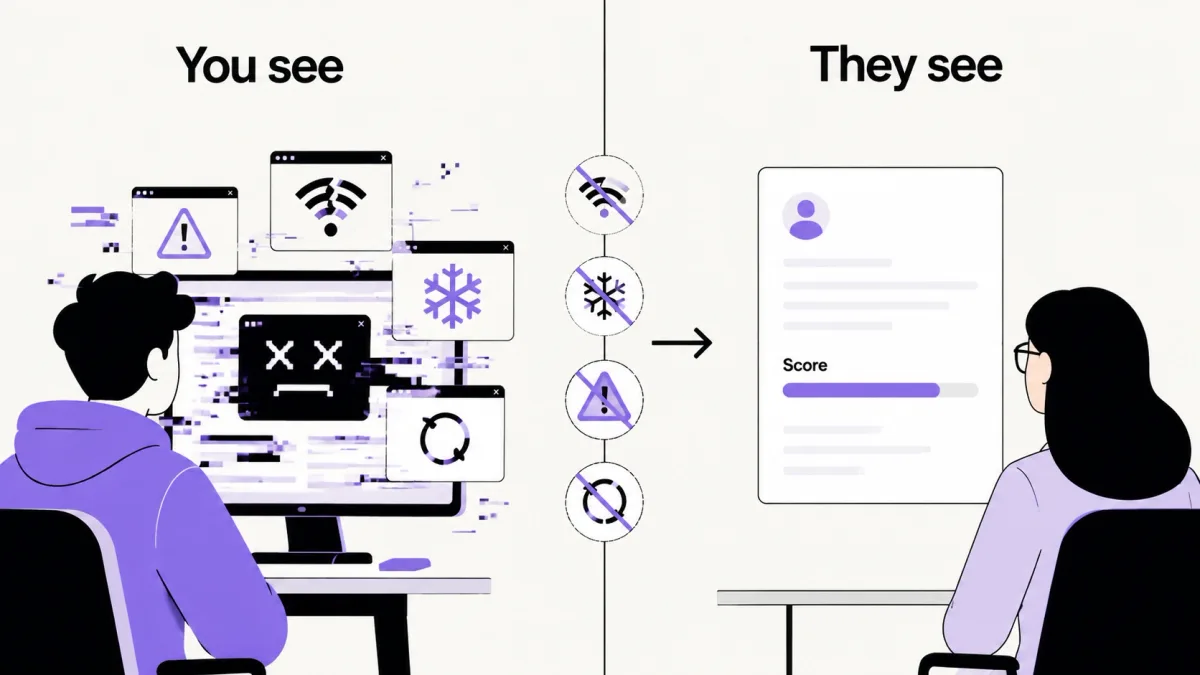
You are not building a case that the vendor's model is defective. A recruiter looking at a score cannot tell a system fault apart from a weak candidate, and this list is what lets them make that distinction. Send it while the details are exact.
When and How to Request Human Review
Most candidates never send this email, because asking for a retake sounds to them like making excuses. The ones who do send it usually get one of two replies: an offer to re-record, or a straight answer about whether a human reviews the recording at all. The second reply is worth having even when it is a no, because it tells you what a technical failure would actually have cost you.
Strong Reasons to Request Review or a Retake
Any one of these justifies asking:
- The interview ended before the stated completion point.
- The system repeatedly asked the same question and would not advance.
- A transcript or prompt misstated a material qualification.
- A key response was interrupted with no recovery opportunity.
- The page froze, disconnected, or displayed errors.
- A decision appeared to follow immediately from an ambiguous hard threshold.
- A disability, assistive technology, or accommodation issue affected completion.
- The employer said a person would review the result but the workflow is unclear.
Copy-Ready Human Review Email
Subject: Request for Review of AI Interview Technical Issue
During my interview on [date and time], the system interrupted or repeated several questions and ended before I could complete [specific response]. Could a recruiter review the full recording and system log, or provide an equivalent live screening or retake? I am happy to clarify any affected answer and can share the approximate timestamps of the issues.
Accommodation Request Language
I would like to request an alternative interview format or reasonable accommodation because the current automated format creates a barrier related to [brief functional limitation]. I can complete the same job-relevant assessment through [live video, phone, written response, captions, additional time, or another equivalent format].
Legal Information Disclaimer: This article provides general information regarding candidate rights and hiring practices. It does not constitute formal legal advice. There is no universal U.S. right for every candidate to demand a human interview, although disability accommodation and local automated-hiring rules may apply.
What Meaningful Human Review Should Include
Meaningful human oversight requires:
- Access to the original answer, recording, or transcript.
- Visibility into technical errors and low-confidence output.
- Authority to reverse or disregard the automated recommendation.
- A reviewer who is not merely confirming the system by default.
Should You Continue, Negotiate, Withdraw, or Report the Process?
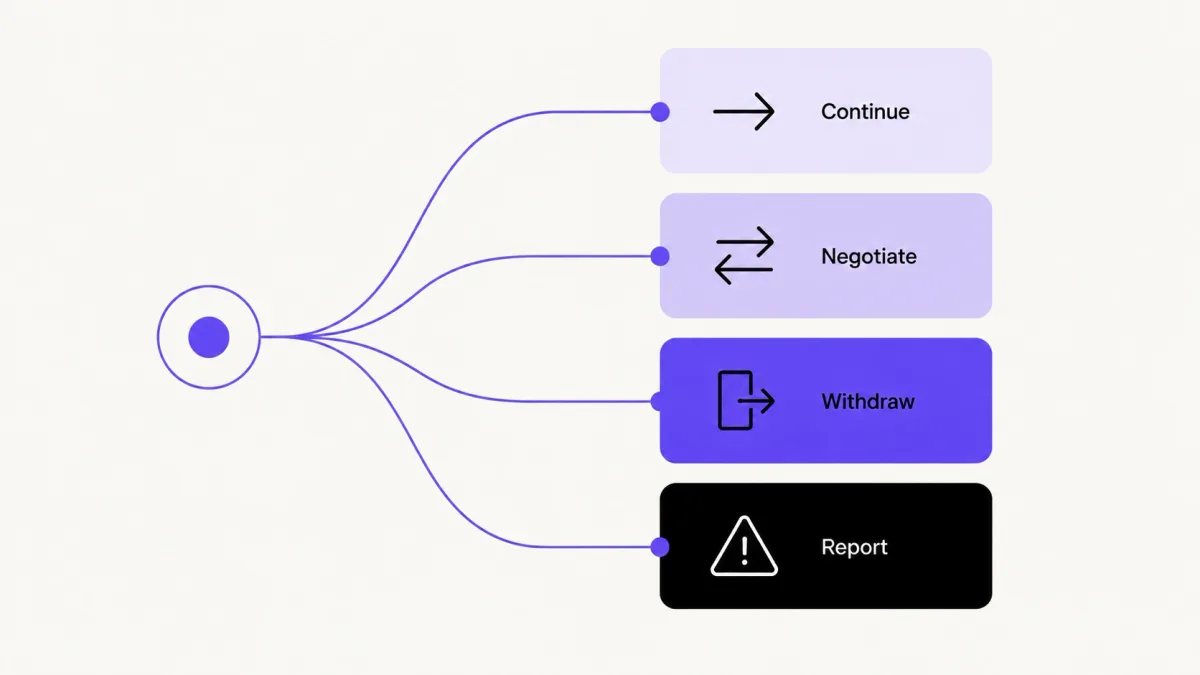
Four options, and the right one depends on what you are seeing and what leverage you have.
| Decision | Signals | Candidate Action |
|---|---|---|
| Continue | Verifiable role, clear salary and process, short screen, later human stage, support and retry available | Complete the screen and document any issues |
| Negotiate | Strong opportunity but unclear scoring, data use, accessibility, or human review | Ask for clarification, accommodation, retake, or live alternative |
| Withdraw | No human contact for a senior role, escalating unpaid steps, no salary clarity, serious faults with no remedy, opaque data handling | Decline briefly and protect your time and data |
| Report | Interview fee, equipment payment, fake check, cryptocurrency request, unverifiable recruiter, early demand for financial identity data | Stop communication, preserve evidence, verify independently, and report the scam |
A Polite Request for a Human Alternative
I remain interested in the role. Because interviews are also an opportunity to evaluate mutual fit, would the team be open to replacing the automated screen with a brief live conversation covering the same questions?
A Professional Withdrawal Message
Thank you for the invitation. I am withdrawing because I am not comfortable completing an automated interview without clearer information about human review, data use, and the opportunity to speak with the team. I appreciate your consideration.
One caveat on that last one. Withdrawing is not a moral obligation. Candidates reach these decisions carrying different financial pressure and different alternatives, and I have told people to go ahead and finish screens I thought were badly built, because that month the paycheck outranked the principle. Needing the job is a reason, not a failure of principle.
What Employers Should Provide Before Using an AI Interviewer
This section is for the other side of the table. If you run hiring and deploy one of these tools, here is the minimum standard.
Before the Interview: Informed Participation
Employers should disclose:
- That the candidate will interact with AI.
- Whether AI asks questions, transcribes, scores, recommends, ranks, or rejects.
- What data is collected and retained.
- Who can access the recording and derived data.
- How to request an accommodation, retake, or alternative process.
- When a candidate will interact with a person.
During the Interview: Fault Tolerance
Require:
- Pause, reconnect, and retake functions.
- A way to finish a cut-off answer.
- Technical issues excluded from communication or fluency scoring.
- Automatic logging of interruptions and recognition failures.
- A support contact that does not penalize the candidate for reporting problems.
During Evaluation: Job-Related Measurement
Employers and vendors should be able to answer:
- What construct is being measured?
- Why is it relevant to the role?
- What criterion validates the score?
- Does the model predict job performance or only reproduce historical ratings?
- Are results tested across accents, languages, disabilities, age groups, genders, and racial or ethnic groups?
- Are model updates revalidated?
- Do nonverbal features add meaningful information beyond answer content?
Before Rejection: Meaningful Human Oversight
- The reviewer can access original responses, not only a summary or score.
- The reviewer sees system errors, transcript uncertainty, and accommodation records.
- The reviewer has authority to override the model.
- Candidate disputes go to a person who can change the result.
After Deployment: Candidate Experience Metrics
Responsible HR organizations track nine core candidate safety metrics:
| Metric | What It Tracks | Target Signal |
|---|---|---|
| Invitation-to-start rate | Percentage launching the screen | Low rates signal initial candidate distrust |
| Completion rate | Percentage finishing all prompts | Measures interface clarity and duration fit |
| Mid-interview abandonment rate | Exits occurring mid-session | Spikes highlight interaction failures or crash errors |
| Retry and error rate | Technical reconnects or resets | High rates identify software instability |
| Human-escalation rate | Requests for recruiter support | Measures demand for retakes and accommodations |
| Review reversal rate | Human overrides of AI scores | Evaluates whether human review is genuine |
| Group error deltas | Disparities across demographics | Identifies potential accent or dialect transcription bias |
| Candidate Net Promoter Score | Post-interview satisfaction | Measures employer brand perception |
| Predictive performance validity | Score correlation with job success | Verifies whether high-scoring candidates perform well |
If the company cannot observe when its AI interviewer fails, it cannot know whether the system is creating efficiency or silently discarding qualified candidates.
Good AI Interviews Are Possible, but Efficiency Is Not the Only Outcome
The evidence here does not point one direction, and any article claiming otherwise is selling something. Three data points, each with a different limitation.
Greenhouse 2026 Candidate Survey
Published May 2026. Multi-market survey of 2,950 candidates across five countries, with headline figures reporting U.S. respondents (n=1,200). 38% have walked away from a hiring process that included an AI interview; another 12% say they would.
Classet Candidate Feedback (Vendor Data)
Classet, an AI phone-interview vendor, publishes ratings from its own product. Across 356 live interviews collected over 30 days, 62.4% rated the experience Excellent and 21.1% Good, roughly 83% positive. In the same dataset, 12.9% rated it Poor and 3.7% Fair, so close to one in six landed in the negative-to-mixed range.
Their breakdown of the negatives is the useful part. Among negative responses that included written comments, device and network failures accounted for 70%, while pacing and interruption issues, the complaints pointing at the AI itself, accounted for roughly 13%. That maps onto the three-layer model: much of what candidates experience as "the AI interview was terrible" originates in connection and audio problems rather than model judgment. The distinction stops mattering when no retake path exists, because a dropped call and a bad score produce the same outcome.
This is vendor data from its own customer base. Classet's separate structured survey of 150 candidates skewed toward maintenance and skilled trades (32%), warehouse and logistics (22%), and security (20%), which suggests the kind of hiring this product serves. It describes one vendor's results, not the market.
2026 Randomized Field Experiment (Preprint)
Voice AI in Firms, a July 2026 arXiv preprint by Brian Jabarian and Luca Henkel that has not yet been peer reviewed, randomly assigned 70,000 job applicants to interviews with human recruiters or AI voice agents. Applicants interviewed by AI were 12% more likely to receive job offers, and the paper reports those gains translating into higher job starts and worker retention with no decline in the productivity of hired workers. In both conditions, human recruiters evaluated the interviews and made the hiring decisions.
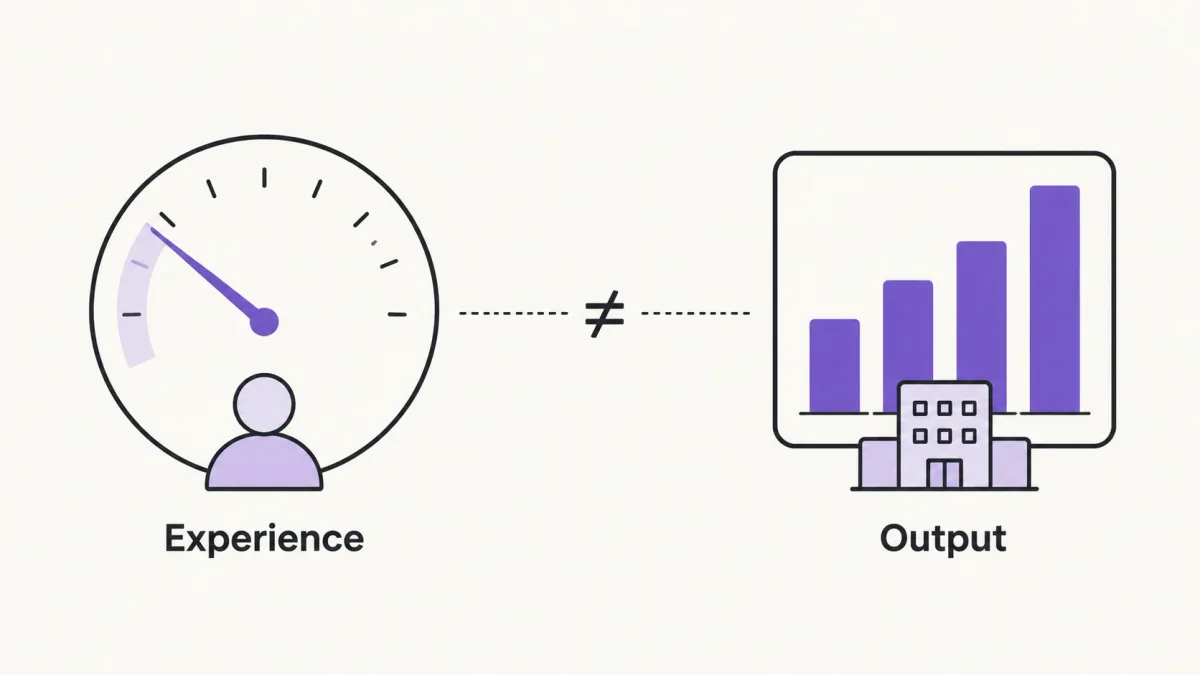
The study measured hiring outcomes, not how candidates felt about the process. That gap is the point of this whole section. Candidate experience and hiring output get measured with different instruments, so the Greenhouse abandonment figure and this offer-rate finding can both be true at once. An AI interviewer can improve throughput while eroding trust, and a design winning on only one of them is not winning.
How Great Offer AI Can Support Preparation and Clearer Responses
Everything above describes the same moment: the system cuts you off, jumps somewhere you did not expect, and you have to rebuild an answer in real time with no thinking room. That moment is exactly what we built Great Offer AI for.
The copilot listens to the question and puts a structured answer on your screen in under a second, in any of 52 languages. It sits in Focus Mode, visible on your display and absent from screen shares. For a technical question you can point it at a selected region of your screen and get the code read back with an approach, which matters when a timer is running and the interviewer has already moved on. Before the interview, the practice tools let you rehearse the compressed answers and the recovery lines from earlier in this piece until they stop requiring thought.
Two things it will not do. It will not write you experience you do not have, and it will not help you around an assessment rule, which is the whole argument in our guide to using AI in job applications. If an interviewer asks how you use AI in your work, how to talk about AI in job interviews covers answering that without sounding evasive or overreliant.
Live assistance depends on employer and platform rules, so check them first. No tool can correct an employer's scoring model or guarantee human review, a passing score, or an offer.
Conclusion: The Hiring Process Is Also an Interview of the Employer
You should not have to deliver perfect answers through a broken interface. Preparation reduces the ambiguity you can control. It cannot repair a governance failure, and no amount of rehearsal compensates for a company that offers no retake path and no human to appeal to.
A responsible employer tells you how AI is used, protects your opportunity to be heard, and puts a person with real authority between the model and the rejection email. Watch how a company handles a technical problem in its own process. That response is as informative as anything they will tell you about the role, and you are entitled to weigh it.
Three things to do before your next automated screen: write a concise answer set with 30- and 60-second versions, save the human-review email template where you can reach it fast, and decide in advance which failures would make you request a different format or walk away. Deciding that mid-glitch rarely goes well.