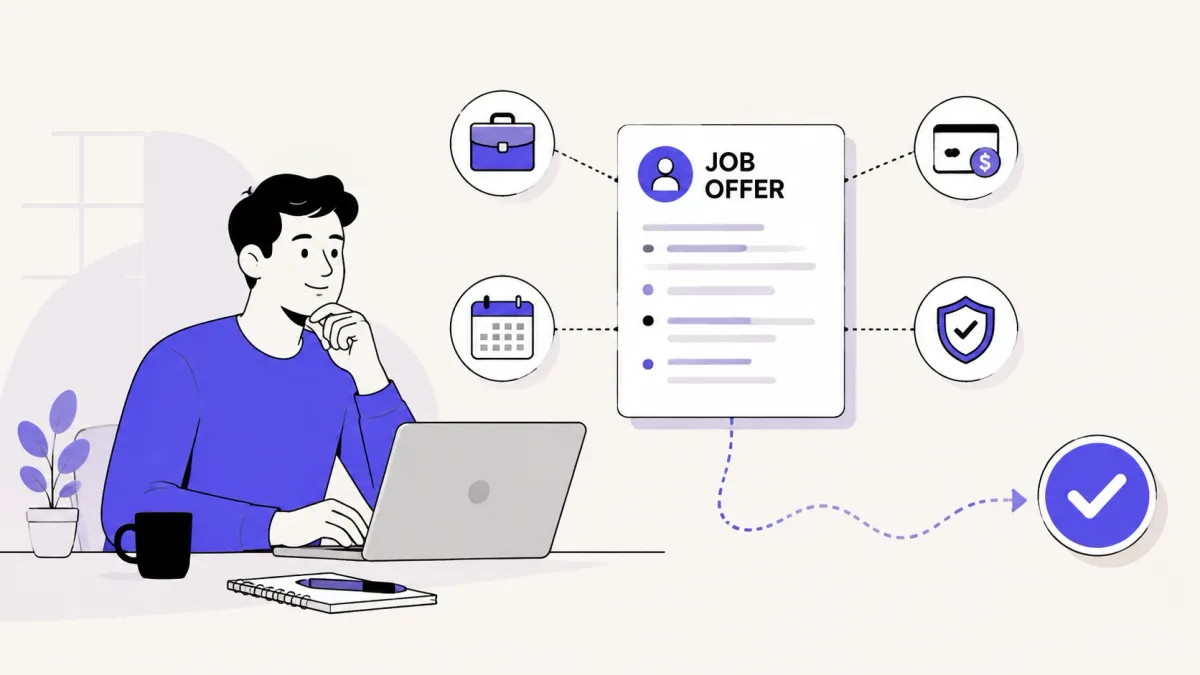

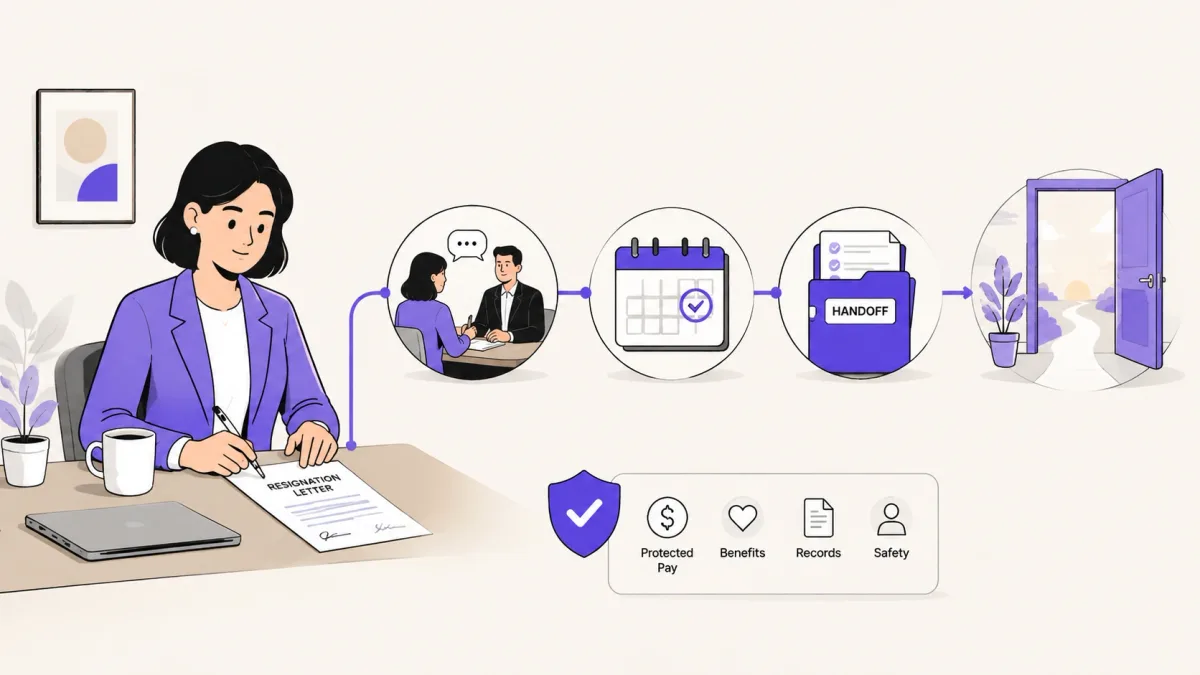
Dreading the resignation conversation is normal. Most exit problems come from improvising the timing, message, handoff, and benefits questions after emotions are already high. Treat the resignation as a short business project rather than a confession or debate.
Quitting a job professionally means communicating a firm decision clearly, creating a usable transition record, and closing employment details without giving up your safety or lawful boundaries.
Jump to: readiness | scripts | pay and benefits | safety
Scope: This article provides general U.S. career information, not legal, tax, financial, investment, or individualized employment advice. Rules and options depend on the facts, location, law, contract, and worker type.
Before You Quit, Run the Exit Readiness Gate
Before quitting a job, decide whether to leave now, finish your exit checks, search while employed, or test one realistic internal fix. I use the Exit Readiness Gate, Offer-Risk Ladder, Three-Date Exit Map, and Exit Balance Sheet as my practical coaching worksheets.
Quit Now, Search First, or Try One Internal Fix?
| Outcome | Use it when | Immediate next step |
|---|---|---|
| Leave or seek urgent help now | Immediate danger or an urgent rights concern | Get to safety and use the appropriate emergency, agency, union, or legal channel. |
| Finish the exit gate, then resign | Your decision is firm, but money, benefits, offer, or notice details remain open | Close the checklist before giving notice. |
| Search while employed | The job is unsustainable but not immediately dangerous | Search confidentially and build a financial buffer. |
| Try one time-boxed repair | One realistic change could solve the problem | Make one request and set a reassessment date. |
Run five checks before you choose:
- Safety: Is this conflict, a protected-rights concern, or immediate danger?
- Money: How long can you cover essential expenses and dependents?
- Next role: Is the offer written, accepted, and cleared of contingencies?
- Obligations: Check contracts, union terms, repayments, bonuses, equity, immigration, and licenses.
- Reversibility: Would one change in workload, schedule, leave, reporting line, accommodation, or scope solve the problem?
Make an internal fix measurable: "Reduce my priorities to these three projects by Friday, then reassess on September 1."
Is the New Job Secure Enough to Resign?
A promising interview is not an offer. A signed offer can still contain contingencies.
Use this Offer-Risk Ladder to see what remains outside your control:
| Stage | Resignation risk | What can still change | Written confirmation to request |
|---|---|---|---|
| 1. Recruiter interest | Extreme | Interviews, approval, headcount, and terms | Process and timeline |
| 2. Verbal offer | Very high | Written terms, approvals, conditions, and date | Full written offer |
| 3. Written offer received | High | Acceptance and listed conditions | Complete terms and contact |
| 4. Written offer accepted | Medium to high | Background, references, funding, or work authorization | Receipt of acceptance |
| 5. Contingencies pending | Medium | One or more stated conditions | Open items and owner |
| 6. Contingencies cleared | Lower | Start-date or business changes | Written clearance |
| 7. Start and onboarding confirmed | Lowest practical | Normal business risk | Date, location, and onboarding steps |
The FTC explains employment background-check rights, including when written permission is required. If a check or other condition is pending, ask whether it cleared. Silence is not confirmation.
Financial runway changes the decision. Someone with months of essential expenses saved can carry more offer risk than someone who would miss rent after one delayed paycheck. Choose the point you understand and can afford.
If you are still reviewing terms, use this guide to accepting a job offer before you resign.
Build a Three-Date Exit Map
Write three dates on one page. The expensive mistakes often sit in the gaps.
| Date | Record | Why it matters |
|---|---|---|
| Notice date | Manager conversation and written notice | Starts the exit process |
| Last working day | Final day and likely access cutoff | Controls handoff, pay, and equipment timing |
| Coverage and start dates | Current coverage end, new coverage start, and new-job start | Exposes insurance or income gaps |
Add bonus, commission, vesting, stock-exercise, repayment, visa, or licensing dates that can change your plan.
How to Quit a Job Professionally in Eight Steps
The cleanest resignation process is short, documented, and boring. Drama feels honest in the moment. A clear record protects you after the moment passes.
1. Confirm the Decision and Your Reason
Separate your private reason from the reason you need to communicate. Your private reason might be burnout, a poor manager, compensation, family needs, stalled growth, or a stronger offer. Your manager usually needs only the decision, your proposed last day, and enough context to plan the transition.
Truthful does not mean exhaustive. "I have decided to pursue another opportunity" can be true without naming the company, salary, or every frustration that pushed you out. If you are unsure, write two lines before the meeting:
- Private reason: The complete reason you are leaving.
- Workplace reason: The short version you are willing to place in an employment record.
Wait until your manager has received the resignation and communication timing is agreed before telling coworkers.
2. Review Your Contract and Company Policies
Check the documents that can affect timing or money before you choose a final day:
- Employment agreement and required notice terms
- Collective bargaining or union rules
- Bonus, commission, equity, and vesting terms
- Signing-bonus, relocation, tuition, or training repayment clauses
- Confidentiality, non-solicitation, and property-return rules
- PTO, expense, and final-pay policies
- Immigration, licensing, or regulated-role implications
Read the actual documents, not a coworker's memory of them. If a contract is unclear or the stakes are high, take it to a qualified professional. Do not ask a resignation template to interpret an agreement that can cost you money or affect your right to work.
3. Choose the Notice Period and Last Working Day
Two weeks' notice is a common U.S. professional convention. It is not a universal rule for every worker or every situation.
Choose a proposed last day after checking your contract, union agreement, project obligations, next start date, benefits, and safety. Then prepare for the employer to end your access or employment earlier than you proposed. Finish personal administrative tasks through approved channels before the meeting, but do not move company files or confidential information.
Use a real calendar date in the conversation and written notice. For example: "My proposed last working day is Friday, August 28."
4. Schedule a Private Conversation
For a standard resignation, use the most direct reliable channel available:
- In person
- Video call
- Phone call
- Email when a live conversation is impractical or inappropriate
- Text when it is the established work channel or no safer, reliable option exists
Send a simple meeting request. Do not put a dramatic preview in the subject line. If your manager is unavailable and timing matters, contact HR or the next appropriate leader and follow up in writing.
A written-only exit is reasonable when a live conversation creates a safety problem, when you need a clear record, or when synchronous contact is not realistically available. Professionalism is clarity, not performance.
5. State the Decision Clearly
Use four parts:
- The decision
- The proposed last day
- Brief appreciation or a neutral acknowledgment
- A bounded transition offer
In coaching sessions, I often hear a candidate spend the first minute building a case for why they are allowed to resign. Cut that minute. Your manager needs the decision before the explanation.
Say: "I have decided to resign. My proposed last day is Friday, August 28. I appreciate what I have learned here, and I will document my active work before I leave."
Do not ask, "Would it be okay if I left?" State the decision, discuss the proposed date if needed, then pause and let the manager respond.
6. Send a Written Resignation
Send a resignation email or letter after the conversation, preferably the same day. Include:
- A clear resignation statement
- Your role, if useful for the record
- The proposed last working day
- Brief appreciation or a neutral close
- A reasonable transition offer
- Personal contact details only if you want to share them
Leave complaints, legal arguments, medical details, and a full history of the workplace out of the standard job resignation letter. If you need to report misconduct, use the appropriate reporting or legal channel. Do not bury that issue inside a farewell note and hope someone treats it as a formal complaint.
7. Complete a Documented Handoff
Create a handoff document with each active responsibility, current status, next deadline, owner, approved file location, stakeholder, known risk, and pending decision. Transfer ownership through company systems.
The handoff should make the next week easier. It does not need to solve the next six months. Agree on priorities with your manager, complete what is reasonable during paid working time, and record what remains. Do not promise unlimited help after your final day.
8. Confirm the Administrative Exit
Before your last day, get written answers to the details that become harder to chase after access ends:
- Confirmed last day and account-access cutoff
- Final-pay process and pay-statement access
- Health coverage end date and benefits contact
- Equipment-return instructions and shipping responsibility
- Mailing address for tax documents
- Expense reimbursement status
- Reference contact, if the company provides one
- Any approved method for future questions
Save confirmation to a personal location only when company policy permits it and the message contains no confidential business information. Return property, collect receipts, and keep a record of what you returned.
What to Say When You Quit a Job
State the decision, give the date, keep the reason brief, and define your handoff. Change the detail by audience and channel.
Use a Situation, Channel, and Disclosure Grid
These messages should stay consistent without being identical.
| Audience | Best channel | Main purpose | Appropriate detail |
|---|---|---|---|
| Manager | In person, video, or phone, then email | Notify and agree on immediate transition steps | Decision, date, brief reason if desired |
| HR | Email or HR system | Create the administrative record | Date, contact details, pay, benefits, and equipment questions |
| Team or clients | Approved group message after manager alignment | Close working relationships and redirect work | Appreciation, last day, new owner, optional personal contact |
| Future interviewer | Spoken answer | Explain the move without attacking the former employer | What changed, what you want next, why this role fits |
Standard Manager Conversation
Meeting request
Hi [Manager's Name], could we meet privately for 15 minutes today? I have an employment update.20-30 second opening
I have decided to resign. My proposed last day is [Day, Date]. I appreciate the opportunities here and will document my active work before I leave.Written follow-up
Subject: Resignation | [Your Name]

Hi [Manager's Name],

This email confirms my resignation as [Job Title]. My proposed last working day is [Day, Date]. I appreciate the opportunities here and will document my active work before I leave.

Best,
[Your Name]
Leaving for Another Confirmed Job
You can keep the new employer and compensation private.
I have accepted another opportunity. My decision is final, and my proposed last day is [Day, Date]. I am keeping the new employer's details private for now.Use the offer to negotiate only if you would genuinely stay.
Leaving Without Another Job
Keep the message forward-looking. Do not apologize for lacking another offer.
I have decided to step away and focus on my next move. My proposed last day is [Day, Date]. I will document my current responsibilities before then.If a gap worries you, review getting a job with an employment gap.
Personal, Family, or Health Reasons
You do not need to disclose a diagnosis or family details.
I am resigning for personal reasons. My proposed last day is [Day, Date]. I am keeping the details private and will document my current work.Quitting a Job You Just Started
Acknowledge the timing once. Skip the long apology.
I recognize that I joined recently, but the role is not the right fit. I am resigning effective [Day, Date] and will organize the work assigned so far.Short-Notice or Immediate Resignation
State the date clearly and offer only what you can safely do.
Subject: Resignation Effective [Day, Date] | [Your Name]

Hi [Manager's Name],

I am resigning as [Job Title], effective [Day, Date]. I cannot provide a standard notice period due to [brief reason or circumstances I am keeping private].

Please send written property-return and offboarding instructions. I can provide [specific limited handoff help].

Regards,
[Your Name]
Manager Is Unavailable or in Another Time Zone
Try video or phone first. If the manager is unreachable, email the notice and copy HR or the next appropriate contact.
Subject: Time-Sensitive Employment Update | [Your Name]

Hi [Manager's Name],

I have not been able to reach you. This email confirms my resignation, with a proposed last day of [Day, Date]. Please confirm receipt and name the offboarding contact.

Best,
[Your Name]
When the Manager Pushes for Details or More Time
Repeat the boundary instead of inventing a new argument.
| Manager asks | Boundary response |
|---|---|
| "Why are you really leaving?" | "I have shared what I am comfortable sharing. The decision is final." |
| "Where are you going?" | "I am keeping that private for now." |
| "Can you stay another month?" | "I cannot stay beyond [Day, Date]. I can prioritize the handoff before then." |
| "What would make you stay?" | "I am not opening a negotiation." |
| "You are letting the team down." | "I understand the timing is difficult. I will complete the agreed transition work." |
Declining a Counteroffer
Thank you for the counteroffer. I have considered it, but I am continuing with my resignation. My final day remains [Day, Date].HR Benefits and Final-Pay Email
Subject: Offboarding Questions | [Your Name]

Hi [HR Contact],

Please confirm my last day and provide:

1. Final-pay timing and pay-statement access
2. Unused PTO treatment
3. Health coverage end date and continuation options
4. Retirement and equity contacts
5. Equipment-return instructions
6. My tax-document mailing address

Thank you,
[Your Name]
Team Farewell Note
Send this after the timing and work-transfer language are approved.
Hi team,

My last day at [Company] is [Day, Date]. Thank you for working with me. [Name or team] will take over [project or responsibility].

If you would like to stay in touch, you can reach me at [personal email or LinkedIn].

All the best,
[Your Name]
How Much Notice Should You Give?
Give enough notice to meet any binding obligation and support a reasonable transition, unless health, safety, serious misconduct, or another urgent circumstance makes that impractical. Two weeks is common. It is not magic.
| Situation | Notice choice | What to check |
|---|---|---|
| Standard U.S. professional role with no special obligation | Two weeks is often reasonable | Company policy, next start date, project calendar, and access risk |
| Senior, regulated, client-critical, or contract-bound role | A longer period may make sense | Contract, license, union terms, client duties, and whether the next employer agrees |
| Health, caregiving, serious harassment, retaliation, unsafe work, or nonpayment concern | Short notice or no notice may be appropriate | Immediate safety, documentation, benefits, contract terms, and qualified advice |
| Employer asks you to leave sooner | Follow the written direction | Pay status, final date, access, benefits, and equipment return |
USAGov explains at-will employment, but that general concept does not settle every contract, union, public-sector, protected-rights, or state-law issue. Check the rules that actually apply to you.
When Two Weeks Is Reasonable
Two weeks gives a manager predictable time to reassign work, gives you a bounded window for the handoff, and fits a familiar U.S. workplace convention. It does not guarantee a positive reference, severance, PTO payout, continued benefits, or two more weeks of system access.
When a Longer Notice May Make Sense
Consider more time when a contract requires it, a regulated responsibility needs a formal transfer, or a complex client transition benefits from a mutually agreed plan. Protect the start date of your next job. An extra month of goodwill at the old company is a bad trade if it damages the role you already accepted.
When Short or No Notice May Be Appropriate
How to quit a job without notice depends on the reason and any obligation that applies. Immediate danger, a health emergency, serious harassment or retaliation concerns, unpaid wages, or an employer-approved earlier date can change the answer. Put the resignation in writing and request return instructions. If a contract, visa, union rule, repayment clause, or threatened legal action is involved, get qualified guidance promptly.
What If the Employer Rejects the Resignation?
A manager may object to your proposed date, point to a notice clause, or end your work sooner. Do not turn the meeting into a courtroom. Restate the decision and proposed date in writing, ask HR to confirm the administrative record, and get advice when a real contractual or legal dispute exists.
The Exit Balance Sheet: Pay, Benefits, and Deadlines
Your resignation date can move money and coverage. Build the Exit Balance Sheet before the meeting, then replace every assumption with a document or written answer.
| Item | Amount or entitlement | Date or deadline | Confirmation source | Contact or owner | Status |
|---|---|---|---|---|---|
| Final paycheck | $_____ | _____ | Pay policy and state labor agency | Payroll | Open |
| Unused PTO or vacation | _____ hours / $_____ | _____ | Policy, plan, and state labor agency | HR or payroll | Open |
| Bonus, commission, or incentive | $_____ | _____ | Compensation plan | Manager, sales ops, or payroll | Open |
| Expense reimbursement | $_____ | _____ | Expense system and policy | Finance | Open |
| Health coverage end date | Plan: _____ | _____ | Benefits summary | Benefits administrator | Open |
| Marketplace or COBRA decision | Cost: $_____ | _____ | Coverage notice and official marketplace | Benefits administrator | Open |
| New coverage start date | Plan: _____ | _____ | New employer enrollment | New employer HR | Open |
| 401(k) or retirement plan | Balance: $_____ | _____ | Plan document | Plan administrator | Open |
| Equity vesting or exercise | Units: _____ | _____ | Equity plan | Stock administrator | Open |
| FSA or HSA action | Balance: $_____ | _____ | Plan rules | Benefits administrator | Open |
| Tuition, relocation, or signing-bonus repayment | $_____ | _____ | Agreement | HR or finance | Open |
| Equipment return | Items: _____ | _____ | Written return instructions | IT or facilities | Open |
| Tax-document mailing address | Address: _____ | _____ | HR profile | HR or payroll | Open |
Final Pay and Unused PTO
Do not guess the deadline or assume unused PTO will be paid. Federal law generally does not require an immediate final paycheck, although some states set earlier deadlines; review the DOL's last-paycheck guidance. Confirm the process with your employer's written policy and the applicable state labor agency.
Health Insurance After Quitting
Ask for the exact date job-based coverage ends. It may not match your last working day. HealthCare.gov explains the job-loss Special Enrollment Period, generally from 60 days before through 60 days after the loss. Ask the plan administrator about continuation options, including COBRA, and compare official dates and costs before choosing.
Your 401(k) After Leaving a Job
Get the plan administrator's contact information and read the distribution rules before moving money. The IRS explains the 401(k) rollover rules: a distribution paid to you generally has a 60-day rollover window and may be subject to mandatory 20% withholding, while a direct rollover can avoid that withholding. That is a process distinction, not an investment recommendation.
Unemployment Benefits After Quitting
Do not assume that resigning always qualifies or never qualifies. USAGov summarizes state unemployment benefits. Eligibility after quitting is fact-specific. If you worked remotely or across state lines, ask the relevant state agency where to file.
Take Your Records, Not Their Data
Prepare the personal records you are allowed to keep, and separately build the employer's transition record. Mixing those jobs is how a clean exit becomes a data problem.
| Personal administrative pack | Employer transition manifest |
|---|---|
| Employment agreement and relevant policies obtained through approved access | Project or responsibility |
| Pay statements and tax-document access instructions | Current status |
| Benefit summaries and plan contacts | Next deadline |
| Retirement and equity plan documents | New owner |
| Permitted performance reviews or work samples | Approved file location |
| Personal contacts you are authorized to keep | Stakeholders |
| Written confirmation of last day, coverage, pay process, and equipment return | Known risks and pending decisions |
| Personal return receipts and tracking numbers | Recurring meetings, forms, lists, and automations |
The dangerous shortcut is emailing yourself a folder called "My Work." That folder may contain client information, proprietary code, internal strategy, or trade secrets. Do not copy company databases, confidential documents, source files, inboxes, or customer lists to a personal account or cloud drive without explicit authorization.
Do not share personal passwords. Do not erase activity or try to evade IT controls. Transfer cloud files, calendars, forms, mailing lists, shared inboxes, and automations through the company's approved ownership process. If you need a work sample, ask for written permission and remove confidential information.
Your handoff document belongs in the employer's system. Your personal administrative record belongs in a permitted personal location. Keep that boundary clean.
Remote and Hybrid Resignation Protocol
To quit a remote job, create the same clear notification and written record you would create in an office, then pay closer attention to access, ownership, shipping, and time zones.
Use this remote offboarding checklist:
- Communication: Schedule the manager conversation in a reasonable overlap window.
- Use video or phone when practical, then send the resignation email.
- If the manager is unreachable, email the notice and copy HR or the next appropriate leader.
- Access: Confirm the exact date and time access will end.
- Transfer ownership of cloud files, calendars, forms, automations, shared inboxes, and mailing lists through approved tools.
- Update your home address for tax forms and final correspondence.
- Equipment: List every laptop, monitor, badge, security key, phone, and accessory in your possession.
- Get written shipping instructions, who pays, packaging requirements, and the process for damaged equipment.
- Photograph the packed equipment if policy allows, keep tracking, and save delivery confirmation.
- Keep the return receipt. Do not keep company data.
If you need to resign by email because time zones or access make a live meeting impractical, say that you tried to speak directly and request confirmation of receipt.
When the Workplace Is Toxic, Unsafe, Harassing, or Retaliatory
If work has become frightening or degrading, wanting out does not make you weak. Separate bad management from immediate danger and protected-rights issues, then use the right channel quickly.
Urgent safety: If there is immediate danger, leave the location and contact emergency services if needed. A resignation meeting can wait.
| Situation | Practical boundary |
|---|---|
| Rude, chaotic, or poorly managed workplace | Document objective facts, plan a controlled exit when practical, and do not diagnose a legal claim from ordinary unfairness alone. |
| Discrimination or harassment tied to a protected characteristic | Preserve evidence you may lawfully keep. Consider your internal process, the EEOC, a union, or qualified legal guidance. |
| Retaliation after protected activity | Record the protected activity, later actions, dates, communications, and decision-makers. Check external filing deadlines promptly. |
| Unsafe condition or whistleblower retaliation | Report through the applicable safety or whistleblower route and identify the specific deadline that governs the complaint. |
| Imminent physical danger | Leave the location, contact emergency help if needed, and prioritize safety. A private resignation meeting is not required. |
Title VII protects certain EEO activity from retaliation. Rudeness, favoritism, and poor management are not automatically the same thing.
Deadlines matter. EEOC charge-filing deadlines generally use 180 days and can extend to 300 days in specified circumstances. Separate federal-sector EEO deadlines generally require initial counselor contact within 45 days. Check the external deadline even if an internal process is open.
OSHA's right-to-refuse guidance describes narrow circumstances involving a real danger of death or serious injury and insufficient time to use regular enforcement channels. Do not turn that rule into a general instruction to stop working whenever a job feels unsafe.
Whistleblower deadlines vary by statute. The federal whistleblower deadline chart lists 30-day filing periods for some environmental statutes and 180 days for others. Identify the law and deadline that apply, even when an internal investigation is open.
Preserve lawful personal records and contemporaneous notes. Do not secretly take company files, client data, trade secrets, or documents you are not authorized to possess as "evidence." A lawyer or agency can advise on lawful preservation.
After You Resign, Build the Story for Your Next Job
Keep the facts consistent while changing the level of detail.
| Version | What it must do | Example |
|---|---|---|
| Manager | Communicate the decision | "I have decided to resign. My proposed final day is August 28." |
| Networking | Show what you want next | "I am targeting product analytics roles with closer engineering work." |
| Interview | Explain the move and fit | Use the 30-45 second answer below. |
I left because [brief factual change or mismatch]. It clarified that I do my best work when [specific condition or responsibility]. I am now targeting [type of role], and this position fits because [specific job requirement].Adjust the first sentence without turning it into an attack:
| Situation | Interview-safe framing |
|---|---|
| Left without another job | "I made a planned exit and focused on a targeted search." |
| Short tenure | "The role differed from the accepted scope, so I made an early decision." |
| Career gap | "I used the period for [truthful activity] and am ready to return in [target role]." |
| Burnout | "I stepped away from an unsustainable role and am now looking for [specific conditions]." |
| Difficult management | "The environment was not a fit. I want clearer ownership and decisions." |
| Accepted a new role | "I left for an opportunity that better matched my next step." |
| Declined a counteroffer | "The counteroffer did not change my reasons for leaving." |
When I rehearse these answers, the weak point is usually the middle sentence. Say what you are choosing, not only what you escaped.
Build your answer to why you are looking for a new job, then practice it with your resume and target role in Great Offer AI.
Common Mistakes When Quitting a Job
- Announcing before you are ready: Confirm the offer, money, benefits, and dates before coworkers hear the news.
- Resigning on a verbal or conditional offer: Identify every unresolved contingency and decide whether your runway can absorb the risk.
- Oversharing or attacking the employer: Put the decision and date in the resignation record. Use the proper channel for a complaint.
- Treating two weeks as universal law: Check the contract, policy, union terms, state rules, and safety facts that apply.
- Ignoring money dates: Add bonus, vesting, commission, coverage, and repayment dates to the Exit Balance Sheet.
- Copying company data: Keep permitted personal records and leave employer information in approved systems.
- Sharing passwords: Transfer ownership through IT or administrative controls instead.
- Promising unlimited availability: Define what you will finish before the final day and whether any later contact is acceptable.
- Taking a counteroffer without revisiting the problem: Ask whether the new terms repair the original reason for leaving.
- Forgetting the next-job explanation: Draft and rehearse the interview version while the facts are fresh.
Leave With a Clear Record and a Usable Next Step
Knowing how to quit a job professionally comes down to four things: a clear decision, a written record, a bounded handoff, and a protected next step. Courtesy matters, but it does not outrank safety or lawful boundaries.
Save the eight-step checklist. Complete the Exit Balance Sheet before you give notice. Draft the manager, networking, and interview versions of your reason for leaving before your final day. Then prepare for your next job interview and practice the answer in Great Offer AI until it sounds like your decision, not a speech you borrowed.