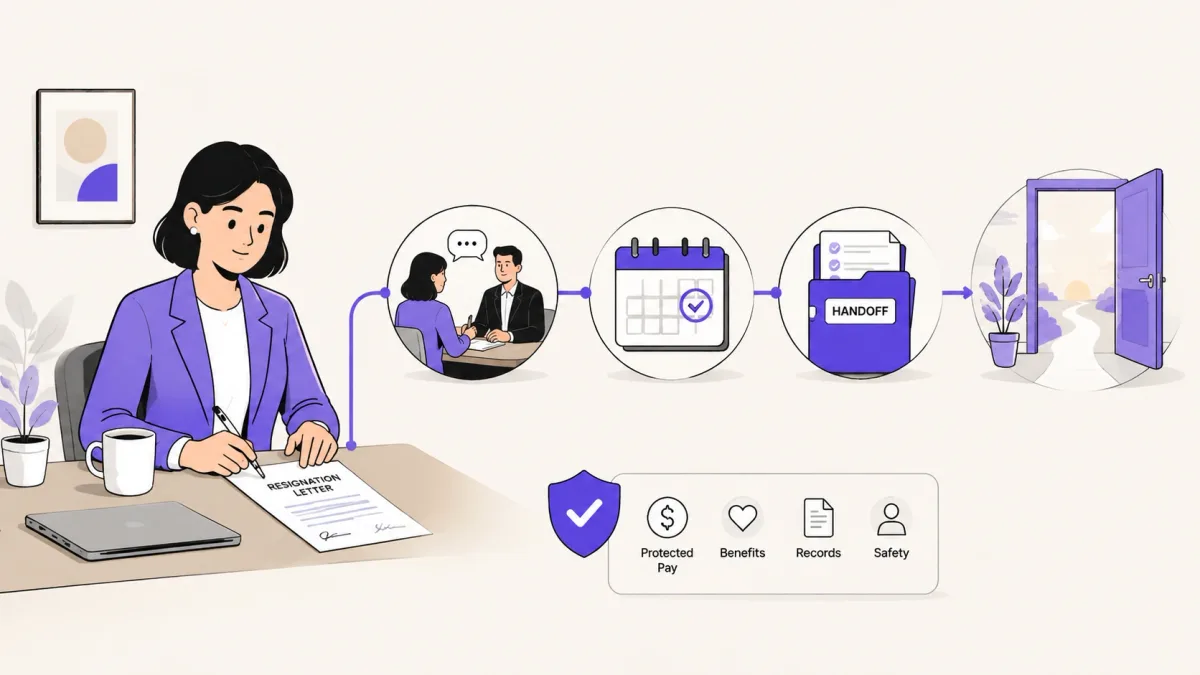


A candidate described this scenario on Reddit: they applied for Senior Developer, completed four interviews, and were then told the company could only hire them as Entry Level Developer. Some commenters called it a routine bait-and-switch; others explained that structured panels sometimes calibrate lower when the interview evidence does not match the advertised level.
This guide shows you how to diagnose what happened, lock down level and band before you invest four rounds, and negotiate from documented evidence when the offer arrives lower than the role you entered for.
What Does It Mean to Be Downleveled After an Interview?
Downleveling can happen when a structured interview panel believes the candidate meets a lower level than advertised. A survey of 2,900 workers by Greenhouse found more than half had experienced job responsibilities changing significantly between the interview and the hire. Business Insider reported a rise in tech-offer downleveling, citing former Meta engineering manager Alex Mai, as deeper hiring pipelines gave companies more room to make that risk determination instead of losing a candidate entirely.
Not every downlevel means the same thing. Four patterns show up most often:
Legitimate re-leveling. The interview evidence supports a lower level, the rationale is specific, and scope and pay move together. The company communicates early.
Role redesign or headcount change. The company changed the role for everyone. The original role may no longer exist for structural reasons, not candidate performance. You get a genuine new choice.
Budget-driven downgrade. The work stays close to the original role while title, internal level, or compensation drops. This reflects resource constraints more than a structured evaluation.
Likely bait-and-switch or severe process failure. The downgrade appears late. Explanations shift. The original role becomes unclear. The employer pressures you to accept based on time already invested.
Titles are not standardized. Ask about the public title, internal level, actual scope, and compensation band separately. A company may call someone "Senior" externally while placing them at mid-level internally, or use "Level 4" without a clear public title at all. That split is common at tech companies with formal leveling systems.
Legitimate Downleveling vs. Interview Bait-and-Switch
Interview bait-and-switch is a practical description for a process that attracts you with one role and later substitutes materially worse terms. It is not, by itself, a legal conclusion.
Use this comparison to assess what you are seeing.
| Signal | More Consistent With Legitimate Re-Leveling | More Consistent With Bait-and-Switch or Process Failure |
|---|---|---|
| Timing | Raised as soon as the panel sees a level mismatch | Revealed only at the verbal or written offer |
| Explanation | Specific competencies, examples, leveling criteria | Vague statements like "the team just sees you lower" |
| Consistency | Recruiter and hiring manager give the same explanation | Different people give different stories |
| Original role | Status is explained clearly | The company will not say whether the original role still exists |
| Scope | Responsibilities are genuinely narrower | Senior responsibilities remain while title or pay drops |
| Compensation | The new band is disclosed and matches the new scope | The company hides the band or anchors to a much lower number |
| Documentation | The company will confirm the new terms in writing | Key promises remain verbal |
| Choice and pressure | You have time to reassess the new role | The company uses deadlines or completed rounds to pressure you |
Exponent's downlevel-offer guidance argues that downlevel decisions are rarely an objective measure of your skills. They are usually the sum of subjective signals from the recruiter screen, early interviews, and the final round, which is exactly why two candidates with similar performance can land at different levels.
Use the Level-Scope-Pay Alignment Test
A company does not need to confess to bait-and-switch for the offer to be a bad decision. What matters is whether the new offer forms a coherent, trustworthy role.
| Pattern | Interpretation | Your Response |
|---|---|---|
| Level, scope, and pay all move down coherently | Possibly a real lower-level role | Evaluate it from zero as a new opportunity |
| Title and pay move down but scope stays senior | High risk of under-leveling and underpayment | Ask to restore level and pay or narrow the written scope |
| External title stays similar but internal level and band drop | Hidden downlevel | Ask about promotion, mobility, equity, reference title effects |
| Title drops, pay stays similar, scope narrows | Potentially acceptable with career trade-offs | Confirm review timing and future title path in writing |
| The company refuses written clarification | Trust and process risk | Pause the decision. Prepare to walk away. |
Confirm the Level and Salary Band on the Recruiter Call
Prevention starts before the full interview loop. Most downlevel surprises could be avoided if you locked down the approved role, internal level, and compensation band during the first recruiter conversation.
I use a Role Alignment Record with every candidate who enters a multi-round process. It catches misalignment before you invest four rounds on the wrong understanding.
Questions to Ask Before You Invest in the Process
Ask these before you schedule the full panel:
- Is this requisition approved at the advertised title and level?
- Does the company use a separate internal level or job code?
- What are the base salary and total-compensation ranges for the approved level?
- What scope, decision rights, or management responsibility distinguish this level from the one below it?
- Can the interview panel recommend a lower level?
- If downleveling is possible, when will the company communicate it?
- Who makes the final leveling decision?
- If the panel recommends a lower level, does the original senior requisition remain open?
Frame it as alignment, not suspicion:
Before we schedule the full process, I want to make sure we are aligned. Is the approved opening Senior [Title], what internal level does that map to, and what compensation band applies? If the panel evaluates candidates at a different level, when would that be communicated?
Create a Role Alignment Record
After the recruiter call, build a simple record. Update it at every stage.
Example:
| Field | Initial Value | Source | Last Confirmed |
|---|---|---|---|
| Public title | Senior Product Manager | Recruiter call | March 15, 2026 |
| Internal level or code | L5 | Recruiter call | March 15, 2026 |
| Base salary range | $145,000-$165,000 | Recruiter call | March 15, 2026 |
| Total compensation range | $180,000-$210,000 | Recruiter email | March 15, 2026 |
| Core scope and decision rights | Product roadmap, cross-functional leadership | Job description | March 15, 2026 |
| Team size and management responsibility | 2 direct reports | Recruiter call | March 15, 2026 |
Your record:
| Field | Initial Value | Source | Last Confirmed |
|---|---|---|---|
| Public title | Recruiter call | [Date] | |
| Internal level or code | Recruiter call | [Date] | |
| Base salary range | Recruiter call | [Date] | |
| Total compensation range | Recruiter call | [Date] | |
| Core scope and decision rights | Job description, recruiter call | [Date] | |
| Team size and management responsibility | Recruiter call | [Date] | |
| Reporting line | Recruiter call | [Date] | |
| Location and employment type | Job posting | [Date] | |
| Interview stages | Recruiter call | [Date] | |
| Downlevel policy | Recruiter call | [Date] | |
| Final decision owner | Recruiter call | [Date] |
Send a short recap email after the call to confirm what you heard:
Hi [Recruiter Name],

Thank you for the conversation today. To confirm my understanding, the approved role is Senior [Title] at internal level [Level], with a base salary range of [Range] and total compensation of [Range]. The interview process will include [Stages], and [Decision Owner] makes the final leveling decision.

If any of the above differs from your understanding, please let me know. Otherwise I will prepare accordingly.

Best,
[Your Name]
This email is not adversarial. It creates a shared record. It catches misalignment before you invest four rounds.
If you want to rehearse these questions using your real resume, past experience, and the target job description, Interview Practice Assistant can help you prepare the conversation before the stakes are high.
Reconfirm the Role at Every Interview Checkpoint
The recruiter call is not the last time to check alignment. Reconfirm at every meaningful stage.
| Checkpoint | What to Confirm | Suggested Language |
|---|---|---|
| After recruiter screen | Title, internal level, band, process | Send a short written recap |
| After hiring-manager interview | Senior-level scope, success metrics, decision rights | "How does success at this level differ from the level below?" |
| Before take-home or panel | Target level is unchanged | "Before I invest substantial prep time, can you confirm the role is still calibrated to Senior [Title]?" |
| After any role-change signal | Scope, team, location, manager, or level changes | "I heard [change]. Can you share what changed and why, in writing?" |
| Before final or offer call | Intended title, level, compensation band | "Before we move to the offer stage, can you confirm the target level and band?" |
Every question should sound like preparation, not interrogation. You are asking so you can prepare properly and make an informed decision.
In coaching sessions, the candidates who get blindsided at the offer stage are the ones who heard a signal midway through but did not follow up. An interviewer says "we would start you at an intermediate level and see how you do." That is not encouragement. That is a downlevel signal. Ask right then what it means for title, band, and scope. If you have been getting interviews but no job offers, these midstream signals matter even more.
For more interview questions that clarify expectations, see our guide on questions to ask in an interview.
What to Do When You're Offered a Lower Position Than You Applied For
If the offer arrives at a different level, title, or compensation band than the one you entered the process for, do not accept or reject on the call. Use the first 24 hours to gather facts.
Standard Decision Path (3-7 Days)
- Thank them. Ask for the complete written offer.
- Ask for the internal level, title, scope, compensation band, reporting line, location.
- Request the leveling rationale in writing.
- Ask whether the original role still exists and whether you were assessed for it.
- Compare the original job description, interview conversations, offer terms.
- Ask for a reasonable decision window.
- Build a side-by-side comparison before you respond.
Fast Decision Path (24-72 Hours)
If you are under time pressure and cannot complete a full negotiation, focus on the three questions that matter most:
- Is the compensation aligned with the new level and actual scope? If pay is far below the work, you will be underpaid from day one.
- Do I trust this employer after observing how they handled the downlevel? Late, inconsistent explanations predict how future decisions will be made.
- Would I apply for this exact role if I saw it today with no history? Completed rounds are sunk time, not a reason to accept worse terms.
If any answer is no, decline and move on. If all three are yes, accept with written guardrails or negotiate the one element that matters most to you.
Request a Written Leveling Rationale
Use this template to ask for the explanation in writing:
Thank you for the offer. Because I entered the process for [Original Title] and the offer is for [Offered Title], I would like to understand the calibration before I make a decision. Could you share the final internal level, the specific factors behind the change, the revised scope and compensation band, and whether the original role remains open?
Do not accuse the company of bait-and-switch in the first response. Gather the facts. Compare them to your record. Then decide whether the explanation is credible.
If the company will not put the rationale in writing, that is information too.
How to Negotiate a Downlevel Offer
If the explanation does not match what you observed in the interviews, or if the new terms do not form a coherent role, you can negotiate. The key is documented evidence, not feelings.
Build a Reverse-the-Downlevel Evidence Packet
Collect:
- The original job description or screenshot
- Recruiter emails confirming title, level, compensation range
- Interview notes showing senior-level scope or expectations
- Resume evidence tied to the target level
- A side-by-side Original Role vs. Offered Role table
- A primary request and one acceptable fallback
| Element | Original Role | Offered Role | Evidence |
|---|---|---|---|
| Public title | Senior [Title] | [Offered Title] | Job posting, recruiter email |
| Internal level | [Level or band] | [Offered level] | Recruiter confirmation |
| Base salary range | [Range] | [Range] | Recruiter call notes |
| Core scope | [Senior responsibilities] | [Offered responsibilities] | Job description, interview discussions |
| Decision authority | [Described authority] | [Offered authority] | Hiring manager conversation |
| Team or management responsibility | [Described] | [Offered] | Interview notes |
Outcome 1: Restore the Original Level, Title, and Band
Use this script when the interview evidence supports the original level:
Thank you for the offer and the leveling explanation. After reviewing my notes and the original job description, I believe the Senior [Title] level remains the best fit.

During the process, I was asked to [specific senior-level task or expectation from interviews]. My background in [specific experience that matches the original level] aligns with the scope described in the original job description. The recruiter confirmed on [Date] that the approved role was Senior [Title] at [Compensation Range].

I would like to ask whether the offer can be adjusted to the original title, internal level, and associated compensation band. I remain very interested in the role at that level.

Please let me know if you need any additional information.

Best,
[Your Name]
Reaffirm interest. Name the original alignment. Use two or three specific pieces of level evidence.
Outcome 2: Correct the Scope or Internal Level
Some companies separate external title from internal level. If the title cannot change, ask whether the internal level, compensation, or written scope can be adjusted.
Questions to ask:
- Can the internal level change even if the external title stays the same?
- Can compensation and equity reflect the actual scope?
- Can the written responsibilities be narrowed to match the lower level?
- What title will appear in references and employment verification?
Do not accept senior responsibilities at a junior level without a concrete trade-off. If the scope stays senior, the level and pay should too.
Negotiate Compensation When Scope and Pay Are Misaligned
If the responsibilities match the lower level but the compensation does not, or if senior responsibilities remain while pay drops, negotiate using market data and the documented scope mismatch:
I understand the leveling decision. Before I make a decision, I would like to discuss the compensation. The offered base of [Lower Amount] is below the market range for [Lower Title] with [X years] experience in [Location]. Based on [Glassdoor/Levels.fyi/Payscale], the typical range is [Market Range].

Additionally, the scope outlined in the offer letter includes [Specific senior responsibility], which is usually associated with the higher level. Can we adjust the base salary to [Target] to reflect both the market data and the actual scope?

Best,
[Your Name]
If the downlevel cuts compensation far below what the actual work justifies, address the gap directly:
I understand the title is [Lower Title], but the compensation of [Offered Amount] does not align with the responsibilities in the offer letter or the market range for this scope. [Specific senior duty] typically places a role in the [Market Range] band.

Before I can move forward, I need the base salary adjusted to at least [Target], which reflects the actual work described. If the company views this as a true [Lower Title] role, I would also expect the scope to be revised accordingly.

Best,
[Your Name]
Before you counter, use our guide to define your desired salary from market data, role scope, and your experience.
Outcome 3: Accept a Lower Level Only With Written Guardrails
If you decide to accept the lower level, require all of the following in writing:
- A specific review date
- Written promotion criteria
- A named decision owner
- Defined scope between now and review
- The compensation consequence of promotion
- Confirmation that the review is not merely an ordinary annual review
Use this template:
I appreciate the offer for [Offered Title]. Before I accept, I would like to confirm the path to [Original Title]. Can you provide in writing:

- The review date for promotion to [Original Title]
- The specific criteria and decision owner
- The scope and responsibilities during this period
- The compensation adjustment if promotion is approved

I want to make sure we are aligned on the timeline and expectations.

Best,
[Your Name]
A verbal promise that you can be promoted in six months is not a guarantee. Get it in writing or treat the offer as permanent at the lower level.
For more on how to evaluate and accept an offer with conditions, see our guide on how to accept a job offer.
Outcome 4: Decline the New Role
If the new role does not meet your standards, decline clearly. Leave the door open for the original-level opportunity:
I appreciate the time the team invested in the process. Because the offered role differs materially in level, scope, and compensation from the position I entered the process for, I am going to decline. I would be open to reconnecting if the original-level opportunity becomes available.

Best,
[Your Name]
For a full walkthrough of how to decline professionally, see our guide on how to decline a job offer.
Protect Yourself From the Four-Round Sunk-Cost Trap
If this exact lower-level role appeared in your inbox today, with no four-round history, would you apply for it?
Completed interviews are unrecoverable time. Past effort does not improve future title, scope, pay, manager quality, or promotion probability. The offer must be evaluated as a new opportunity, not as the least-bad outcome of a process you already invested in.
I often hear candidates say "I already did four rounds, I should take it." That sentence treats time already spent as a reason to commit more time to something that does not meet your standards. It is not.
Use this decision checklist:
- Would I choose this title and scope independently?
- Is the compensation acceptable for the actual work?
- Is the explanation specific and credible?
- Are promotion promises documented with a date, owner, criteria?
- Does the process increase or reduce trust in the manager and company?
- What are my real constraints: income, visa, health insurance, career change, location?
That last question matters. Accepting a lower level because you need income, health coverage, visa sponsorship, or a career-transition foothold is not weakness. It is a decision based on your actual constraints. If you accept for those reasons, do it with written guardrails. Continue protecting long-term career options. If you are changing industries or trying to get a job with no experience in a new field, accepting a slightly lower level may be a calculated trade-off.
Set walk-away criteria before the offer call. Decide in advance which combinations of title, scope, compensation, promotion timeline you will not accept, regardless of how many rounds you completed. When the offer arrives, compare it to your pre-set criteria rather than renegotiating with yourself under deadline pressure.
Why Companies Downlevel (And What It Tells You)
Understanding why companies downlevel candidates helps you assess whether the explanation you receive is credible.
Structured leveling systems. Some companies have formal frameworks that map skills, scope, decision-making authority to specific levels. An interview panel compares your demonstrated abilities against those criteria. If the gap is clear, they may recommend a lower level early in the process. This is the most defensible form of downleveling when it is communicated transparently.
Budget constraints without role redesign. The company wants the senior-level work but does not want to pay for it. Title drops, internal level drops, but the scope in the offer letter still describes senior responsibilities. Indeed's lower-offer guidance cites recruiter-turned-coach Alex Bryant on why offers drift from the posting: role requirements sometimes change after the req was opened, which lowers the offer without any bad intent.
Hiring-manager-panel disagreement. The hiring manager wanted you at Senior. The panel or the leveling committee disagreed. Rather than lose you entirely, they offer a compromise level. Whether this works for you depends on whose judgment matters more after you join.
Anchor negotiation. The company uses downleveling to establish a lower compensation baseline. They expect you to negotiate back up, but the anchoring effect of the lower offer changes the entire salary conversation. If you accept the lower level without adjusting compensation to reflect actual scope, they get senior work at mid-level pay.
Process failure or miscommunication. The recruiter misunderstood which role was approved. The hiring manager described senior scope in interviews but the approved headcount was always mid-level. The leveling decision was made weeks ago but nobody told you. These errors happen. They still cost you time.
The explanation matters less than the evidence. If the company will not document the leveling rationale, disclose whether the original role exists, or align scope with the new level, that process opacity tells you something about how decisions get made there.
The Hidden Costs of Accepting a Downlevel
Accepting a lower-level role is not automatically wrong. But know what you are trading.
Title compression on your resume. Future employers see the title, not the scope you actually performed. If your last role was Senior and you accept a mid-level title, your next search starts with recruiters filtering you as mid-level. You will spend interviews explaining why your title dropped. Some will assume you were downleveled for performance. Others will not ask. They will just move to the next candidate whose title matches the requisition. If you are worried about how this will look on your resume, see our guide on how to make a resume stand out despite title gaps.
Internal mobility constraints. Many companies tie promotion timing, compensation bands, equity grants to internal level. If you accept a lower level with a verbal promise of promotion in six months, check how often that company actually promotes people off-cycle. Some do. Most do not. You may wait 12 to 18 months for the next calibration window.
Compensation resets at every job change. Your next offer will be anchored to your current compensation. If you accept senior scope at mid-level pay now, that gap follows you. Recruiters ask what you currently make. You can decline to answer, but compensation history still shapes offers in practice.
Scope misalignment becomes your daily reality. If the offer keeps senior responsibilities at a junior title, you do not just carry that mismatch on paper. You explain it in team meetings. You work through it with cross-functional partners who assume your title reflects your decision authority. You manage it when your scope exceeds what your level is typically given.
Goodwill erosion. If you accept the downlevel grudgingly, planning to fix it later, that resentment does not stay hidden. It shows up in how you negotiate other terms, how you react to feedback, how you engage with the manager. That dynamic rarely improves after you start.
These costs are not reasons never to accept a lower level. They are reasons to go in with your eyes open, with written terms, with a clear understanding of what you gain and what you give up.
Red Flags vs. Yellow Flags in Downlevel Offers
Not every downlevel signal is equal. Some are immediate walk-away triggers. Others are warning signs that need follow-up.
Red flags: Walk away or demand written corrections before proceeding.
- The downgrade appears only at the written offer stage, after you have completed all interviews.
- Different people give different explanations for the level change.
- The company will not say whether the original role still exists or was filled by someone else.
- Senior responsibilities remain in the offer letter while title and pay drop to mid-level.
- The leveling rationale stays verbal. The company will not confirm it in writing.
- The recruiter pressures you to accept quickly because "the team wants to move fast" or "the offer may not stay open."
- Promotion promises remain vague. No specific review date, criteria, or decision owner.
Yellow flags: Get answers before you decide.
- The downlevel was disclosed late in the process but the explanation is specific and consistent.
- The original role was redesigned or eliminated after you started interviewing.
- Internal level and external title do not match, and the company will explain the gap but the implications for equity, promotion, and references are unclear.
- The company offers to revisit your level at six months, but the review criteria are loosely defined.
- Compensation stays in the expected range but the title drops.
- The hiring manager supports the original level but was overruled by a leveling committee or executive.
Yellow flags are not automatic rejections. They are questions that need clear, written answers before you commit. If the company treats reasonable questions as adversarial, that becomes a red flag.
What Downleveling Signals About Company Culture
How a company handles downleveling shows you decision-making patterns you will face after you join.
Transparent vs. Opaque Decision-Making
Companies with transparent leveling processes tell you the criteria up front. They explain which competencies map to which level. When a panel recommends a different level, they share specific examples from your interview. The recruiter and hiring manager give you the same explanation. InterviewDB's salary bait-and-switch guide draws the same line: if a company clearly explains that a role has been re-leveled and gives you the new band before the deeper rounds, that is usually process correction, not bait-and-switch. This does not guarantee the downlevel decision is correct, but it shows you how other decisions will be made there.
Opaque processes keep leveling criteria hidden. Different people give different stories. The rationale stays vague. "The team just felt you were better aligned to mid-level." That lack of clarity is not limited to hiring. It shows up in performance reviews, promotion decisions, project assignments. If they cannot explain their leveling logic, they probably cannot explain much else either.
How the Company Responds to Pushback
When you ask for written clarification, specific examples, or a comparison to the original role, does the company engage with your questions or treat them as adversarial?
A healthy response: "That is a fair question. Here is what the panel observed, here is how it maps to our leveling framework, and here is the revised scope. Take a few days to review and let us know if you have other questions."
A concerning response: "We have already spent significant time on this process. The offer is what it is. We need an answer by end of week."
The first pattern suggests a company that values informed decisions. The second suggests pressure-based management. You are seeing how conflict gets managed there.
Whether Process Failures Get Acknowledged
Sometimes the downlevel is a genuine process error. The recruiter misread the approved headcount. The hiring manager described senior scope but HR only opened a mid-level requisition. The leveling committee disagreed with the hiring manager and the recruiter did not communicate it until the offer stage.
When these failures happen, does the company acknowledge them? Do they offer to pause the process and recalibrate, or do they pretend the confusion was always your misunderstanding?
I see candidates accept downlevels from companies that refused to admit a process failure because they did not want to lose the opportunity. That refusal to acknowledge mistakes does not stay limited to hiring. It shows up when projects miss deadlines, when scope changes mid-sprint, when a manager overpromises to a client. A company that will not own its hiring errors will not own other errors either. If this pattern reminds you of past job-search struggles, you may also find our guide on how to prepare for a job interview helpful for future applications.
How Promotion Promises Get Documented
If the company offers a lower level now with a path to promotion later, how concrete is that path?
Strong signal: A named decision owner, a specific review date, written criteria, compensation adjustment details, examples of others who have been promoted off-cycle.
Weak signal: "We will review you in six months." No owner, no criteria, no documentation, no precedent.
The documentation standard you see in the offer negotiation is the documentation standard you will face when it is time to get promoted. If they will not put promotion terms in writing before you accept, they are unlikely to put them in writing after you start.
Use Great Offer AI to Prepare for Leveling and Offer Conversations
Downlevel offers are easier to handle when you have practiced the conversation before it happens. Great Offer AI gives you three ways to prepare:
Before the recruiter call. Use the Interview Practice Assistant to rehearse title, internal-level, scope, salary-band questions using your real resume and the job description. Practice asking without sounding suspicious or adversarial.
Before later rounds. Practice neutral follow-up questions when an interviewer describes work that does not match the advertised seniority. Learn how to confirm scope, decision rights, level expectations in real time.
Before the offer call. Role-play vague downlevel explanations, written-rationale requests, evidence-based counteroffers, conditional acceptance terms.
Practice Three High-Risk Scenarios
Use Great Offer AI to rehearse responses to:
Scenario 1. The recruiter or hiring manager says "the team sees you at a lower level" but will not provide specific examples or leveling criteria.
Scenario 2. The title and pay drop, but the responsibilities in the offer letter still sound senior.
Scenario 3. The recruiter promises a promotion in six months but will not document the review date, criteria, or decision owner.
Great Offer AI provides real-time interview coaching and personalized talking points based on your resume, past experience, job description. The Interview Practice Assistant helps you rehearse difficult conversations before the stakes are high. During live calls where AI assistance is permitted, Focus Mode guidance is designed to appear only on your screen and not in screen sharing.
Before your next recruiter or offer call, use Great Offer AI to rehearse the questions that confirm level, scope, compensation while the stakes are still low.
Conclusion: Treat the Downlevel Offer as a New Job
A late downlevel is information about both the role and the hiring process. You do not need proof of malicious intent to reject a misaligned offer.
Transparent evidence, aligned terms, written commitments matter more than the number of interviews completed. The decision is whether the new role is good enough on its own.
If the company cannot explain the change, will not document promotion promises, or uses your completed rounds to pressure you, that tells you how decisions will be made after you accept.
Practice the conversation before you have it. Great Offer AI can help you prepare evidence-based questions, respond to vague leveling explanations, negotiate without losing your composure.