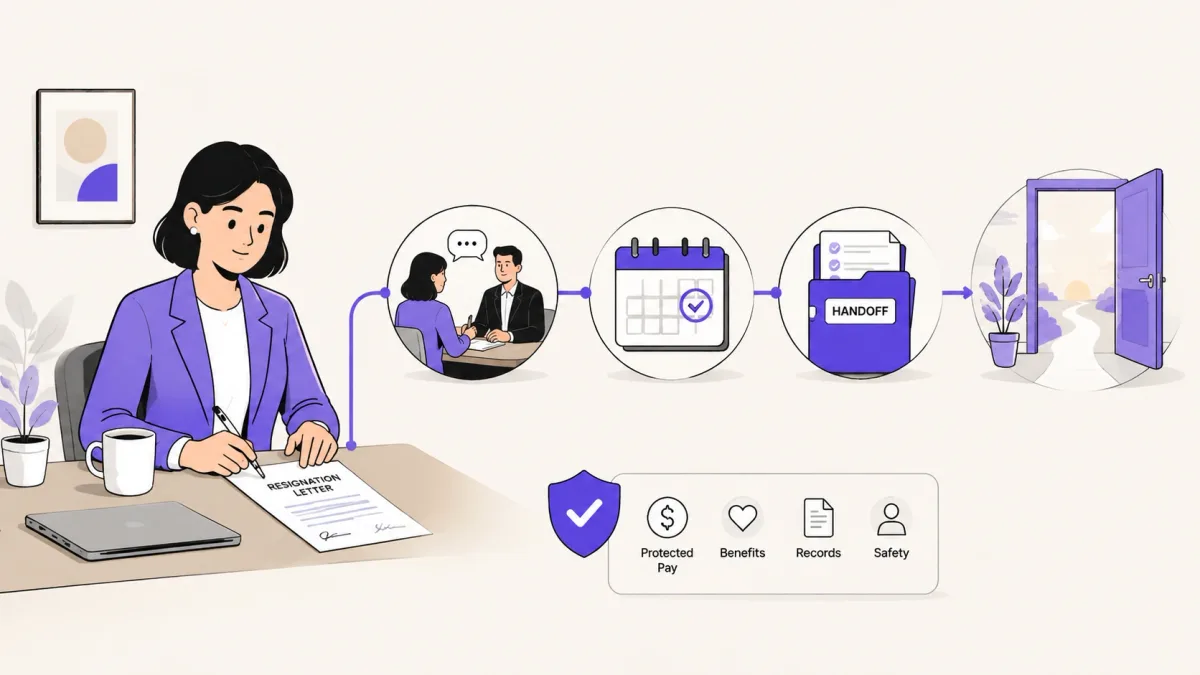


Sending more applications is not always the answer. A job search is a sequence: employers must find your application relevant, understand your evidence, move you through screening, and believe you are the right choice after the interview. Different failures require different fixes.
Start by identifying the last stage you reach consistently. That gives you a better next step than rewriting everything at once.
Start Here: Which Stage of Your Job Search Is Failing?
A job-search bottleneck is the first stage where your effort stops producing progress. Use the table below to find yours.
| What is happening? | Most likely area to investigate | First action |
|---|---|---|
| Most applications receive no response | Targeting, resume evidence, ATS readability, or low-quality postings | Audit a group of comparable applications |
| Recruiters contact you, but interviews rarely follow | Your introduction, motivation, salary, location, or availability | Review screening answers and practical requirements |
| You get interviews but no offers | Examples, communication, role knowledge, or interview preparation | Review the questions where your answers became vague |
| You reach final rounds but lose | Competition, fit, references, compensation, or an internal candidate | Request useful feedback and strengthen final-round evidence |
| Job posts disappear or remain open for months | A slow process, stale listing, or possible ghost job | Verify the role on the employer's careers page |
Complete a 15-Minute Application Audit
Review your last 10–20 applications, or all of them if you have fewer. For each one, record:
- Job title and experience level.
- Whether you met the essential requirements.
- Which resume version you used.
- Whether the role appeared on the employer's official website.
- Whether you contacted anyone connected to the company.
- The last stage you reached.
Do not compare unrelated applications as if they were one experiment. Ten applications for different roles, levels, and industries may tell you very little. Look for repeated signals among applications that targeted the same type of job.
Seven Reasons You Can't Find a Job—and What to Do Next
1. Hiring Conditions May Be Difficult in Your Target Market
The U.S. labor market is not one uniform market. Conditions differ by occupation, industry, location, experience level, and work arrangement. Employers in one field may be expanding while employers in another are hiring cautiously.
Check current occupation information through the BLS Occupational Outlook Handbook rather than relying only on general news or social-media discussions. If credible openings are limited, compare adjacent job titles, industries, locations, and hybrid options before concluding that your qualifications are the sole problem.
What you can control: the roles you target, the evidence you provide, the channels you use, and the way you prepare.
2. Your Target Role Is Too Broad or Does Not Match Your Evidence
A resume cannot position you clearly for four unrelated careers at the same time. If you apply for marketing, operations, customer success, and project management roles with the same document, employers may not understand where you fit best.
Choose one primary job family for your next application cycle. Identify three to five capabilities that appear repeatedly in credible descriptions, then match each capability to evidence from your actual work, education, projects, or volunteer experience.
Applying selectively does not mean waiting for a perfect job. It means choosing roles that can be supported by one coherent professional story.
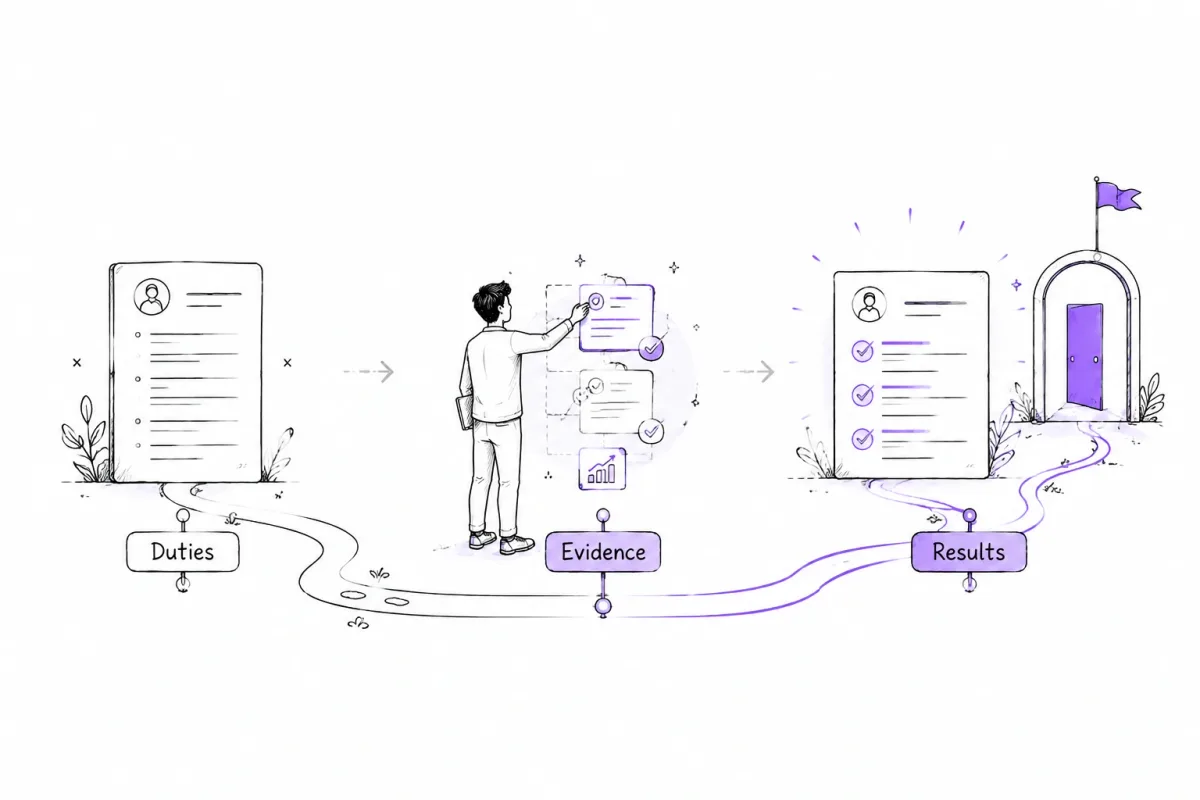
3. Your Resume Describes Duties but Does Not Prove Impact
Recruiters already understand the basic duties of common roles. They need to know your scope, decisions, and results.
Before:
Responsible for customer support and resolving complaints.
Illustrative improvement:
Resolved 45+ customer issues per day and introduced a response template that reduced repeat questions.
The number above is only an example. Use figures only when you can verify them. If you do not have a percentage or revenue result, describe the scale, frequency, complexity, stakeholders, or observable outcome.
The top section of the document should also make your target clear. A focused resume summary can connect your strongest evidence to the role without repeating the rest of the resume.
4. Your Resume Is Difficult for Software or People to Read
An ATS-friendly resume should also be easy for a recruiter to scan. Use conventional headings, consistent dates, and selectable text. Do not rely on graphics, icons, charts, text boxes, or complicated columns to communicate essential qualifications.
Tailoring does not mean copying the entire job description or forcing every keyword into the document. It means prioritizing accurate evidence that is relevant to that employer's requirements and using normal industry terminology where it truthfully describes your experience.
Before applying, ask:
- Does the top third of the resume make the target role clear?
- Are the most relevant accomplishments easy to find?
- Does the document use standard headings and a readable layout?
- Have I removed details that distract from the target role?
- Can every claim be supported in an interview?
5. You Rely Only on High-Volume Job Boards
Job boards are useful discovery tools, but a one-click application can place you in a large, undifferentiated pool. Whenever possible, verify the opening on the employer's website and look for a relevant human connection.
Former colleagues, managers, clients, classmates, alumni, and professional-group contacts are usually more useful than random outreach. Do not begin by asking a stranger for a referral. Ask a focused question that is easy to answer.
Hi [Name], I'm exploring [role] opportunities in [industry]. I noticed your experience at [company], and I'd appreciate any advice on the skills your team values most. Thank you for your time.
If the person responds, continue the conversation naturally. A referral is helpful only when the person can credibly connect your background to the role.
6. You Need Stronger Proof for an Entry-Level Role or Career Change
Enthusiasm alone does not remove an employer's uncertainty. When you lack direct experience, create evidence that makes your ability easier to evaluate.
Depending on the role, useful proof may include:
- A portfolio project based on a realistic problem.
- A work sample with a short explanation of your decisions.
- Volunteer, internship, or freelance experience.
- A case study showing how a transferable skill applies to the new field.
- A smaller or adjacent role that provides the missing experience.
Do not pretend that a project is paid employment. Label it accurately, explain what you did, and show how it relates to the target job.

7. You Are Spending Time on Stale, Misleading, or Unsafe Listings
No single sign proves that a posting is a ghost job. However, several warning signs should prompt additional checks:
- The same role has been reposted repeatedly for months.
- The employer's careers page does not show the position.
- The description is vague about responsibilities or reporting lines.
- The recruiter or company identity cannot be verified.
- The application requests payment or sensitive information unusually early.
- No one can explain the expected hiring timeline.
Treat these as risk indicators, not proof. If a listing asks for money, bank details, or identity documents before a legitimate hiring process, review the Federal Trade Commission's job-scam guidance before proceeding.
Reset Your Job Search in 14 Days
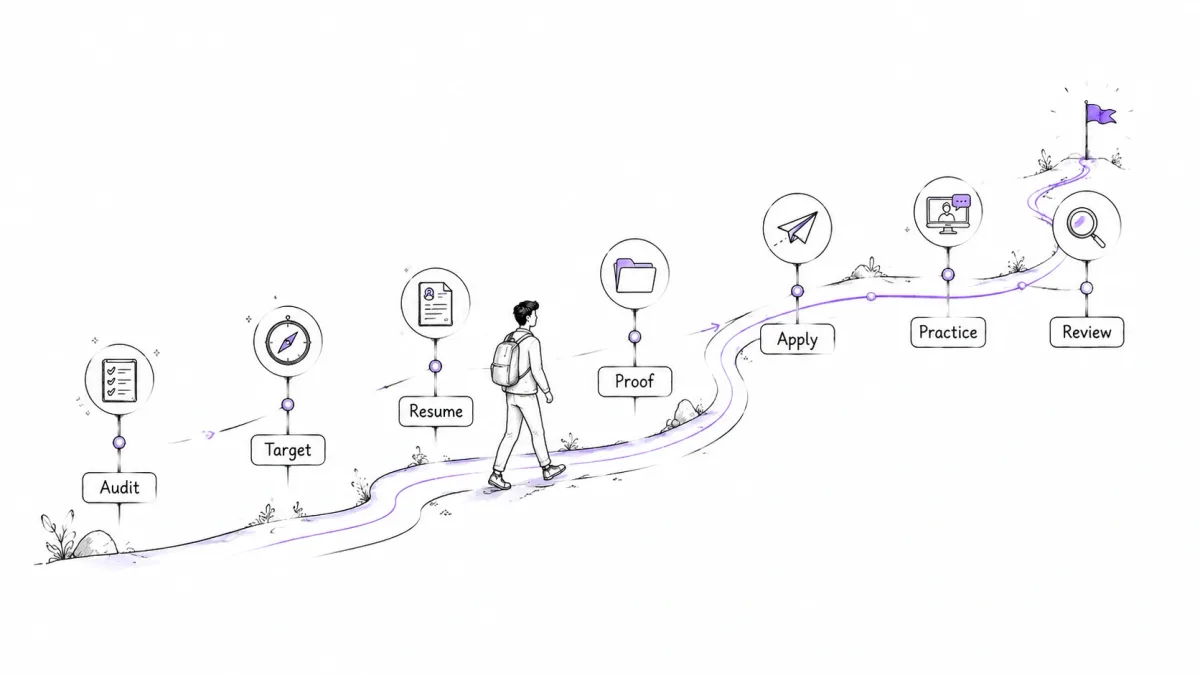
This plan is a diagnostic sprint, not a promise that you will receive an offer within two weeks. Its purpose is to replace repeated activity with a controlled process that produces useful signals.
| Time | Main task | Required output |
|---|---|---|
| Day 1 | Audit recent applications | A record of roles, resume versions, and the stage each application reached |
| Days 2–3 | Choose one target job family | A target-role statement and three to five required capabilities |
| Days 4–5 | Rebuild your core resume | A readable resume organized around relevant evidence |
| Days 6–7 | Create or improve proof | A project, work sample, portfolio item, or stronger accomplishment stories |
| Days 8–10 | Submit verified applications and contact relevant people | A small set of comparable applications and outreach records |
| Days 11–12 | Practice screening and interview questions | Three to five real stories and concise motivation answers |
| Days 13–14 | Review the new signals | A decision to continue, refine, or change the target |
At the end of the sprint, make one evidence-based decision:
- Still no responses: Recheck job fit, resume evidence, ATS readability, and posting quality.
- More screens but no interviews: Improve your introduction, motivation, and practical expectations.
- More interviews but no offers: Shift time toward role-specific stories and realistic practice.
- Few credible openings: Broaden the role, industry, location, or work arrangement deliberately—not randomly.
If You Are Not Getting Interviews
Focus on the application stage before changing your interview strategy.
Use this pre-application check:
- I meet the essential requirements, not necessarily every preferred qualification.
- My resume clearly targets this job family.
- My strongest bullets show relevant actions and outcomes.
- The job is verifiable on the employer's website or through a legitimate recruiter.
- I can explain in two sentences why I want this role.
- I have not used the same generic document for a meaningfully different job.
After applying, one concise follow-up may be appropriate when you have a legitimate contact. Mention the role, summarize one relevant qualification, and ask whether any additional information would be useful. Repeated generic messages or daily follow-ups are unlikely to strengthen your candidacy.
If a well-matched group of applications still receives no response, change one major variable at a time. For example, improve the evidence in the resume before simultaneously changing the target role, location, and application channel. Otherwise, you will not know which adjustment produced a better signal.
If You Get Interviews but No Offers
If employers repeatedly invite you to interview, your resume is probably doing at least part of its job. The bottleneck has moved.
| Interview problem | What to practice |
|---|---|
| Answers are too long | State the conclusion first, then add only the necessary context |
| Examples sound generic | Clarify your action, reasoning, and observable result |
| Technical answers stop at the solution | Explain assumptions, tradeoffs, testing, and verification |
| Motivation sounds weak | Connect the role to your skills, interests, and next career step |
| You freeze under pressure | Practice aloud with follow-up questions and time limits |

Build a small library of real stories: solving a difficult problem, handling disagreement, learning quickly, recovering from a mistake, and delivering under pressure. Adapt the emphasis for each question without inventing new experiences.
If you are changing roles, prepare a clear explanation of why you are looking for a new job. Focus on the direction you are moving toward rather than attacking a former employer.
For structured practice, GreatOffer AI's real-time AI interview copilot can help you rehearse answers, analyze questions, and organize your thinking before an interview. During a live interview, only use assistance when the employer, school, or platform permits it. Review the boundaries in Is Interview Copilot Cheating? before deciding how to use any interview tool.
If You Need Income Now—or the Search Is Affecting Your Wellbeing
When income is urgent, separate your search into two tracks.
| Immediate-income track | Longer-term career track |
|---|---|
| Temporary, contract, part-time, or adjacent work | Carefully targeted applications |
| Staffing agencies and local workforce services | Resume, portfolio, and interview improvement |
| Work that stabilizes income or schedule | Roles aligned with your preferred direction |
The U.S. Department of Labor's Job Seekers resources and CareerOneStop can help you locate training and employment services. Short-term work does not have to become your permanent career plan; it can create breathing room while you continue a focused search.
Job rejection can also damage confidence and routine. Set a daily stopping point, track actions you can control, and speak with someone you trust. If the process is seriously affecting your mental health or immediate safety, contact an appropriate local professional or crisis-support service.
Frequently Asked Questions
Should I Apply If I Do Not Meet Every Requirement?
You do not need to match every preferred qualification, but you should be able to perform the essential responsibilities or show credible evidence that you can learn the missing parts. Prioritize roles where you meet the core requirements and can explain the gaps honestly. Avoid applying far above your demonstrated level simply because the application is quick.
Should I Use One Resume or Several Versions?
Use one strong base resume for each closely related job family. Create another version when the target requires a meaningfully different professional story, such as moving from customer success to data analysis. Do not create a new document for every posting, but do adjust the summary, skill emphasis, and most relevant accomplishments when necessary.
Should I Contact the Hiring Manager After Applying?
Contacting a verified hiring manager or recruiter can be appropriate when you have a concise, relevant message. Mention the role and one reason your experience may be useful, then ask a simple question. Do not send repeated messages, demand a response, or contact several employees with the same copy-and-paste request.
When Should I Broaden My Role, Location, or Work Arrangement?
Broaden the search when verified, well-matched applications produce little signal and credible openings are limited. Change one dimension deliberately—for example, adding hybrid roles or an adjacent job title—then compare the results. Expanding every dimension at once creates another unfocused search and makes your results difficult to interpret.
Can a Career Gap Stop Me From Being Hired?
A gap can raise questions, but it does not automatically disqualify you. Prepare a brief, truthful explanation, then move the conversation toward your current skills, recent activity, and readiness for the role. Relevant projects, training, caregiving responsibilities, volunteer work, or contract assignments may provide useful context when described accurately.
Your Next Step
Do not treat every rejection as evidence that everything is wrong. Find the first stage where your search stops producing progress and work on that stage first.
- No responses: fix targeting, evidence, readability, and posting quality.
- Screens but no interviews: fix your introduction and practical fit.
- Interviews but no offers: fix your examples, role knowledge, and practice.
- Too few credible openings: broaden one part of the search deliberately.
If interviews are now your main bottleneck, use GreatOffer AI to support structured preparation while following the rules of every employer and interview platform.