
Note: Resume conventions vary by role, industry, and employer. Use this guide as a framework, and include only skills, experience, and results you can verify from your own background.
Resume Summary Basics: Purpose, Placement, and Length
A resume summary may also be called a professional summary, summary statement, or resume profile. Whatever heading you choose, its job is the same: select the most relevant parts of your background and present them before the reader reaches your employment history.
It should not summarize every role you have held. Think of it as a focused positioning statement for one application. If you are still organizing the rest of the document, start with this guide to what a resume is and what it should include.
| Question | Practical answer |
|---|---|
| Where does it go? | Below your contact information and before your work experience. |
| How long should it be? | Usually two to four concise sentences, depending on your layout and experience. |
| What should it do? | Explain your professional fit and point to evidence the reader can verify elsewhere in the resume. |
| Is it required? | No. Keep it only if it adds useful context or prioritizes important qualifications. |
Where Does a Resume Summary Go?
Place the summary directly below your name and contact details and above your work experience. If you use a professional headline, portfolio link, or certification after your name, keep the entire opening section compact so the first experience entry remains easy to find.
How Long Should a Resume Summary Be?
Most summaries work best as two to four sentences. The appropriate length depends on what the section needs to clarify.
A career changer may need slightly more context than someone whose recent job title already matches the target role. If the paragraph crowds out stronger experience bullets, shorten it or remove it.

Do You Need a Resume Summary?
Use a summary when it helps the reader understand your candidacy faster. Skip it when it merely repeats your headline, skills list, or most recent position.
Use a Resume Summary When...
- You have relevant experience that needs to be prioritized quickly.
- You are changing careers and need to connect transferable skills to a new role.
- Your background includes several functions, contract roles, or industries that need a unifying theme.
- You want to highlight a specialization, certification, project type, or level of responsibility that is not obvious from job titles alone.
- You are tailoring one resume to a specific role and need to foreground the most relevant evidence.
Consider an Objective When...
A resume objective may be useful when your direction needs more explanation than your existing experience can provide. This can apply to some students, recent graduates, or candidates making a substantial career change.
Even then, avoid writing only about what you want. A useful objective should pair your target direction with relevant education, projects, transferable skills, or other evidence of potential value.
Skip the Section When...
- Your recent experience already matches the target role clearly.
- Space on a one-page resume is limited and your experience bullets provide stronger evidence.
- The only summary you can write is a list of generic traits or keywords.
- The section repeats information that appears immediately below it.
Resume Summary vs. Resume Objective
| Feature | Resume Summary | Resume Objective |
|---|---|---|
| Main purpose | Presents relevant qualifications and evidence | Explains a target direction and transferable value |
| Best suited to | Candidates with relevant experience, specialization, or a complex background | Candidates whose target direction is not obvious from their experience |
| Evidence | Work results, project scope, technical skills, leadership, or domain knowledge | Education, projects, transferable skills, training, or related experience |
| Emphasis | What you have already demonstrated | Where you are going and what relevant value you can bring |
Neither format is automatically better. Choose the one that answers the reader's most important question about your fit.

What Should a Resume Summary Include?
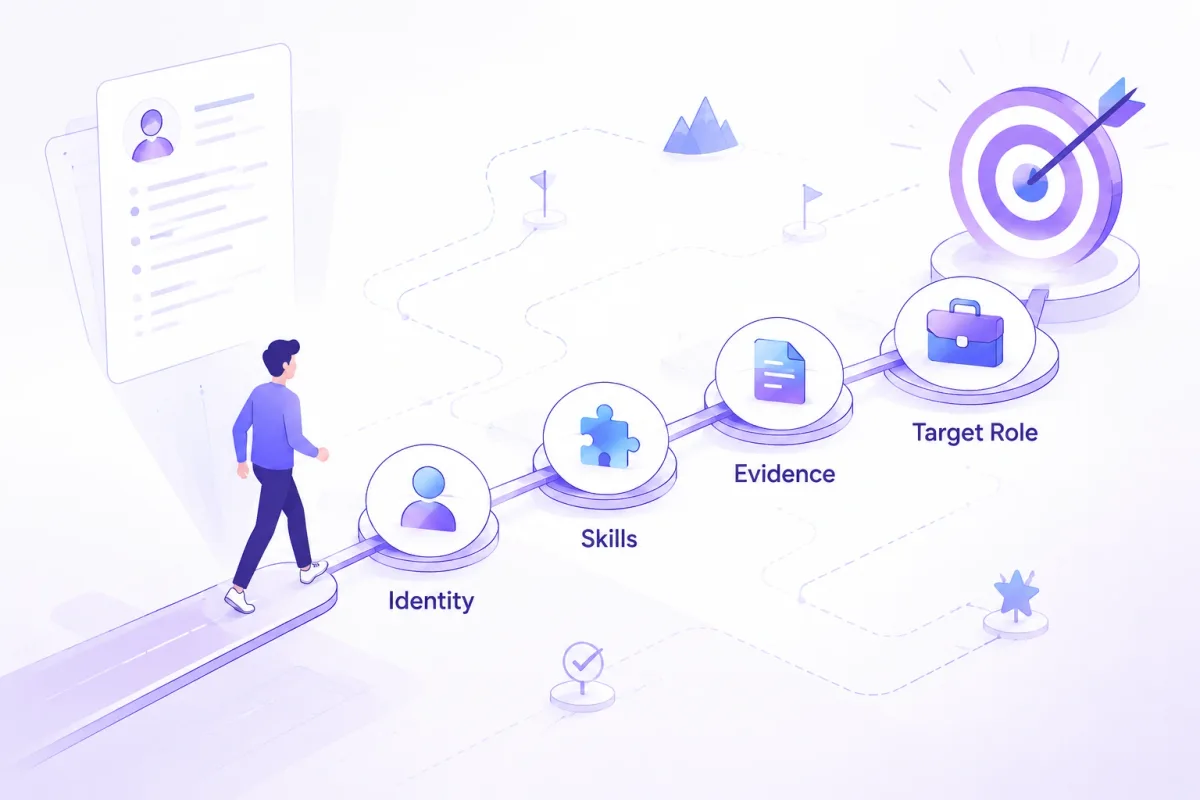
Every sentence should earn its place. A useful summary can be built from four parts:
The four-part resume summary formula
[Professional identity]with[relevant background], skilled in[two or three job-related capabilities].[Verified evidence of impact or responsibility]. Brings[specific strength]to[target role or business need].
1. Professional Identity
Begin with an accurate description of your field, specialty, or target role. Use a title you can support with your work history, education, projects, or professional responsibilities.
Avoid inflating your seniority to match the vacancy.
2. Relevant Qualifications
Choose two or three qualifications that matter to the specific job. These may include technical skills, industry knowledge, leadership, client work, operations, communication, or another capability supported by your experience.
Do not copy an entire skills list from the job description. Select only requirements you genuinely meet and can demonstrate elsewhere in the resume.
3. Evidence
Support your positioning with something concrete. Evidence may include:
- A verified result.
- The scale of a project.
- The type of customers or systems you supported.
- A process you improved.
- A relevant certification.
- A responsibility that demonstrates depth or ownership.
Metrics can be useful, but only when they are accurate and understandable. If you use a number, explain what changed and what you did. Never invent a percentage because a template appears to require one.
4. Target Relevance
Connect your background to the work the employer needs done. This does not require naming the company in every summary.
It does require selecting qualifications that make sense for the role instead of presenting a generic description that could appear on any application.

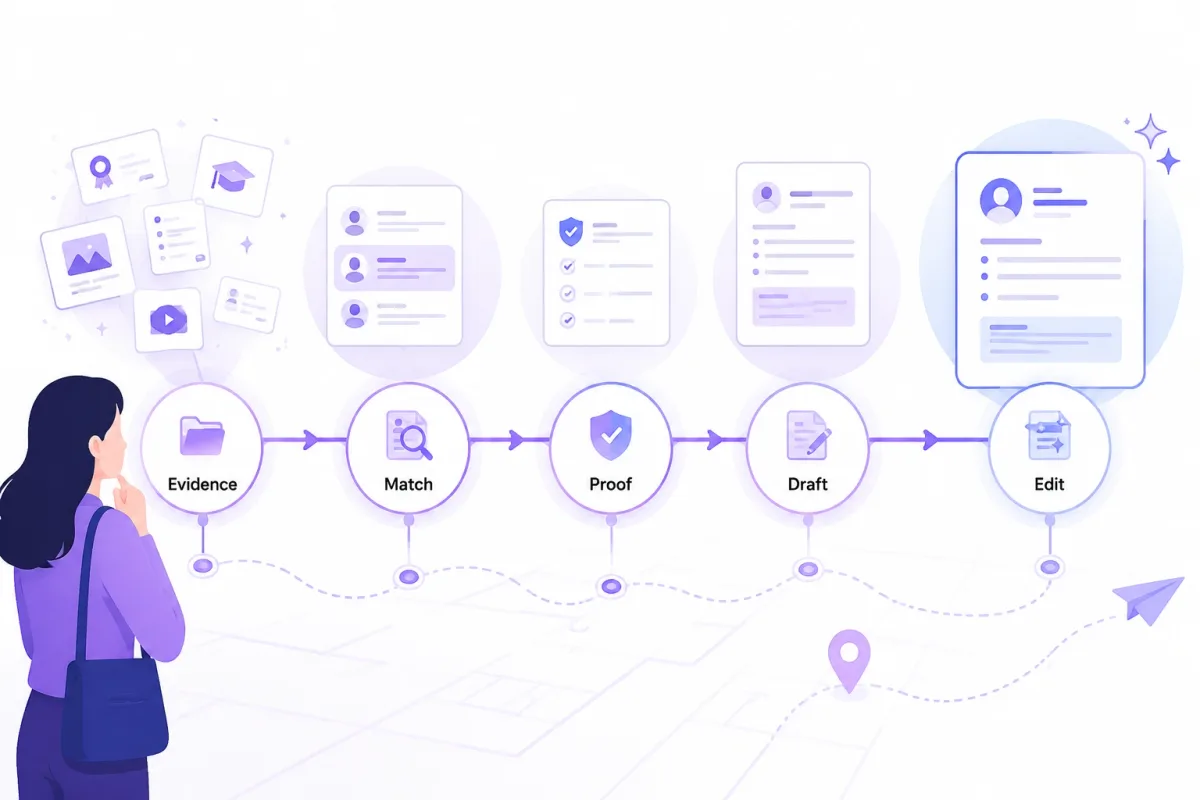
How to Write a Resume Summary in Five Steps
Write the summary after reviewing both your resume and the target job description. Starting with evidence makes it easier to avoid filler language.
Step 1: Build an Evidence List
Write down facts you can verify, including:
- Current and previous job titles.
- Relevant years or depth of experience, if useful.
- Tools, systems, methods, or subject areas you know.
- Types of projects, customers, teams, or environments you have supported.
- Responsibilities that show scope or ownership.
- Results you can document accurately.
- Relevant coursework, certifications, internships, volunteer work, or portfolio projects.
Do not try to write polished sentences yet. The goal is to create a factual source list for the summary.
Step 2: Identify the Job's Core Requirements
Read the job description and select three to five requirements that appear central to the role. Separate required qualifications from secondary preferences and repeated promotional language.
Use a simple matching table:
| Target requirement | Your verified evidence |
|---|---|
| 3+ years in B2B SaaS customer support | 4 years managing B2B SaaS client accounts |
| Ticketing workflow optimization (Zendesk) | Redesigned Zendesk workflows to reduce ticket backlogs |
| Team training and documentation | Created internal knowledge base articles for onboarding |
If you cannot provide evidence for a requirement, do not imply that you can.
Step 3: Choose the Strongest Proof
Select one or two facts that best demonstrate fit for the role. Prioritize evidence that is both relevant and easy to understand without additional explanation.
Strong proof does not always require revenue or percentage metrics. Project scope, complexity, customer type, turnaround time, compliance responsibility, team coordination, or a completed deliverable can also demonstrate value.
Step 4: Draft the Summary
Combine your identity, qualifications, evidence, and target relevance. Write for clarity first. You can tighten the language after the facts are correct.
Before and After Revision Example:
- Before: Hardworking and results-driven professional seeking a challenging role where I can use my skills and grow.
- After: Customer support specialist with 4 years of experience serving B2B SaaS accounts. Reduced average response time by 22% by redesigning Zendesk workflows and creating a team knowledge base.
Key Improvements Made in the Revision:
- Removed unprovable adjectives (hardworking, results-driven).
- Replaced the self-centered goal (seeking a role to grow) with a clear professional identity (Customer support specialist).
- Added specific business context (B2B SaaS accounts, Zendesk workflows).
- Included a contextualized outcome (reduced average response time by 22%).
- Kept facts consistent with details verifiable in the experience section.
Step 5: Edit for Clarity and Relevance
Review the draft with five questions:
- Does the opening identify a clear professional direction?
- Are the selected qualifications relevant to this job?
- Can every claim be supported by the resume or another application document?
- Have you removed generic adjectives and unnecessary repetition?
- Does the language sound natural rather than copied from the job description?
Relevant terminology can help readers and applicant tracking systems understand the topic of your experience, but there is no useful reason to repeat keywords unnaturally or target a hidden keyword score.
Resume Summary Templates by Career Situation
The following are fill-in templates, not real candidate profiles. Replace every bracket with accurate information from your own background, and delete any sentence you cannot support.
Resume Summary Template With Experience
[Current or target role]with[verified level of experience]in[industry, customer type, or work environment]. Skilled in[capability],[capability], and[capability], with experience[verified responsibility or result]. Brings[relevant strength]to[target business need].
Use this structure when your experience is relevant but the employer needs help seeing which parts matter most.
Resume Summary Template With No Full-Time Experience
[Student, recent graduate, trainee, or target-role identity]with experience in[relevant coursework, project, internship, volunteer work, or portfolio activity]. Developed skills in[supported tools or capabilities]through[verified project or responsibility]. Prepared to contribute[relevant value]in a[target role]position.
Do not claim a professional title or level of experience you have not earned. Projects and practical responsibilities are more useful than unsupported traits.
Resume Summary Template for a Career Change
[Current professional identity]transitioning into[target field or role], bringing experience in[transferable capability],[transferable capability], and[relevant responsibility]. Demonstrated[verified result, project, or scope]in[previous context]. Ready to apply this background to[specific need in the target role].
Make the transition explicit. The reader should not have to guess why your previous experience is relevant.
Resume Summary Template for Multiple Roles or a Nonlinear Career
[Unifying professional identity]with experience across[relevant functions, environments, or industries]. Combines[capability],[capability], and[capability]to support[shared type of outcome or business problem]. Offers verified experience in[most relevant responsibility or project].
Look for the common problem you solved across roles instead of listing every job category.
Resume Summary Mistakes to Avoid
| Avoid | Replace it with |
|---|---|
Results-driven team player |
A supported qualification, responsibility, or result. |
| Copying sentences from the job posting | Two or three requirements that match your real experience. |
| Listing many skills without evidence | A smaller set of relevant capabilities tied to a project or responsibility. |
| Focusing only on what you want | A statement showing what you can contribute to the target role. |
| Adding a percentage without context | An accurate explanation of what changed, how, and why it mattered. |
| Using a title you have not held or supported | An honest professional identity based on your actual background. |
| Repeating the same wording in every application | A revised version that prioritizes the current role's core requirements. |
The most common weakness is not imperfect wording. It is a lack of specific, verifiable information.
Turn Your Resume Summary Into an Interview-Ready Story
A resume summary is a written version of your professional introduction. Once it is accurate, use the same facts to prepare a spoken answer to “Tell me about yourself.”
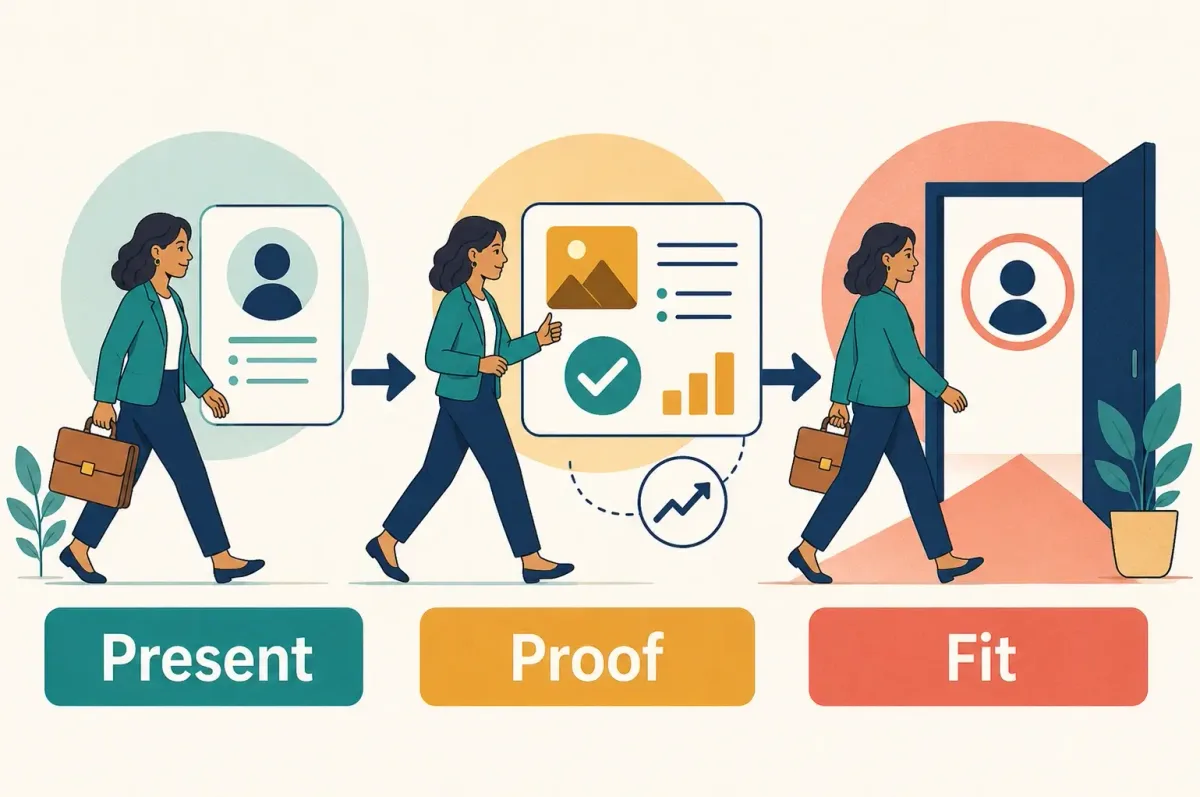
Do not memorize the paragraph word for word. Expand it into three parts:
- Present: Your current professional direction and strongest relevant capabilities.
- Evidence: A brief example that supports one of those capabilities.
- Target: Why that background is relevant to the role you are discussing.
For a more detailed structure, see how to answer “Tell me about yourself”.

When you are ready to move from resume writing to interview preparation, GreatOffer AI can help you practice and organize key talking points with real-time interview support. The goal is not to recite a polished summary; it is to explain the same verified evidence clearly and consistently.
Quick Resume Summary Checklist
Before submitting your resume, confirm each item below. Pair this checklist with the broader steps in how to make a resume stand out:
- Adds information that is not already obvious from your job title.
- States an accurate professional identity.
- Prioritizes qualifications relevant to the target role.
- Includes at least one verifiable responsibility, project, result, or scope signal.
- Uses metrics only when they are accurate and understandable.
- Avoids unsupported adjectives and copied job-description language.
- Fits comfortably above the work experience section.
- Matches the evidence in the rest of the resume.
- Can be explained naturally in an interview.
If several answers are no, revise the section or remove it.
Conclusion: Write a Summary That Earns Its Space
A strong resume summary is not a collection of impressive-sounding adjectives. It is a short, evidence-based explanation of why your background is relevant to a specific role.
First decide whether the section adds value. Then build it from verified facts, prioritize the requirements that matter most, and remove anything you cannot support.
If the final paragraph makes your fit clearer without repeating the rest of the page, it has earned its place on the resume.