
When an assistant can produce fifty lines of syntactically correct Python faster than a candidate can read the problem statement, typing speed stops telling you anything about engineering ability. Two candidates can leave your sandbox with code that looks equally polished and judgment that is nowhere close to equivalent. One of them knows the boundary conditions and which architectural constraint the solution just violated. The other pasted what the model said and hoped.
This guide covers both sides: seven competencies, a six-stage signal chain, a 75-minute blueprint, a 100-point scorecard, seniority calibration, and five candidate habits. Interviewing soon rather than designing the loop? Skip to what to practice, then come back for the rubric to see what the other side of the table is scoring. Last reviewed: August 7, 2026.
What Should an AI-Assisted Technical Interview Measure?
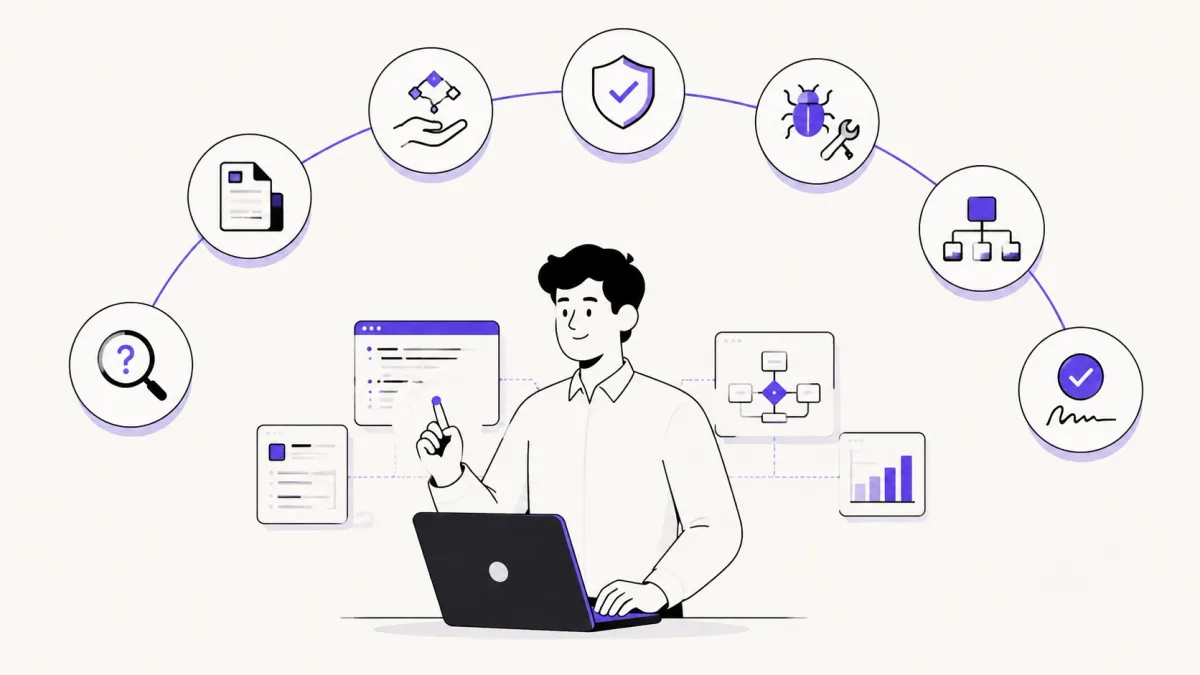
Once the tool handles syntax, the interview has to measure judgment and control of the system instead of generation speed. Seven competencies, each with the question that separates a strong candidate from a fluent one:
- Problem framing and requirements clarification. Can they take a vague request and find the hidden assumptions, edge cases, and acceptance criteria before any code exists? Weak candidates paste the ambiguous statement straight into the tool and inherit the model's defaults. Ask: "What assumptions did you make about inputs and system constraints before you generated this?"
- Context construction and task decomposition. A model knows only what you put in front of it. Watch whether they find the right interface signatures in an unfamiliar repository, and whether they cut the goal into units small enough to verify one at a time. Ask: "Why these interface files and not the rest of the module?"
- Judgment about when and how to use AI. Delegation is a decision, not a reflex. The sharpest version of this skill is knowing when to stop prompting a model that has hit an architectural wall. Ask: "What part of this did you decide not to delegate, and why?"
- Output review, testing, and verification. Code that compiles and clears a happy-path test can still be wrong, insecure, or slow. Score whether they read the diff, trace the data, and write tests built to break their own implementation rather than confirm it. Ask: "What test could we write right now that would prove this implementation wrong?"
- Debugging and recovery when AI fails. Can they isolate the cause: a bad requirement, missing context, a hallucinated API, or a bug already in the repository? Ask: "Three patches failed on the same memory allocation error. What now?"
- Architecture, security, performance, and maintenance tradeoffs. Working in a sandbox and shippable are different standards. Ask: "At ten million requests an hour with a P99 under 50ms, what breaks first?"
- Communication, transparency, and ownership. Someone has to own the pull request. Listen for whether they separate what the model wrote from what they wrote, and whether they reach for "that's just what the AI gave me" when a defect surfaces. Ask: "Which architectural decision here was entirely yours?"
Core Scoring Rule: AI-generated code should not receive a separate positive score. The candidate earns the score through the decisions, evidence, corrections, and explanations surrounding that code.
Why Traditional Technical Interview Signals Are Getting Weaker
The old loop ranked people on timed generation, syntax recall, and finishing speed. Once you authorize AI in the room, all three stop separating candidates: prompting a binary search tree into existence in five seconds proves only that the candidate has a tool open, syntax recall is moot when the assistant autocompletes the exact method signature, and finishing first with three hundred unverified lines is unreviewed technical debt with a bow on it.
Fundamentals still matter. They surface somewhere else now: in code reading, debugging, disconfirming test design, architectural explanation, and how the candidate adapts when a constraint moves.
Other teams reached this first. Cerebras runs candidates through real codebases with tools enabled. HackerRank splits the session into Plan, Build, and Review so planning and oversight get their own scores. Karat weights AI judgment, context management, and output validation over whether the final answer happened to be correct.
Adding judgment signals to a loop that still grades syntax recall just makes the scorecard longer. Something has to come out:
| Retire This Signal | Put This In Its Place |
|---|---|
| Memorized API syntax and parameters | Clarifying ambiguity and requirements |
| Raw lines of code written manually | Minimal effective context scoping |
| Time to first working solution | Disconfirming test design rigor |
| Whiteboard algorithm derivation | Debugging and failure recovery steps |
| Happy-path demos without tests | Complete candidate code ownership |
The last row is the one hiring committees argue about, so name the rule directly: a candidate whose fluent explanation does not match what the code actually does scores below one who stumbles through an accurate account. Polish is not comprehension.
AI Fluency Is Not Prompt Showmanship
Interviewers fall into one trap more than any other. A candidate writes a three-paragraph prompt stuffed with meta-instructions, and the room reads it as seniority. It usually is not. Elaborate prompting is what people do when they are not sure what they want.
| Weak Signal (Prompt Showmanship) | Stronger Signal (Engineering AI Fluency) |
|---|---|
| Crafts overly long, decorative prompts with vague instructions | Establishes a clear problem model, explicit constraints, and success criteria |
| Reads AI explanations verbatim when asked why code works | Explains the underlying data flow and trade-offs accurately in their own words |
| Struggles when the model enters a hallucination loop | Recognizes model failure quickly, isolates context, or writes the code manually |
Use the AI-Native Engineering Signal Chain
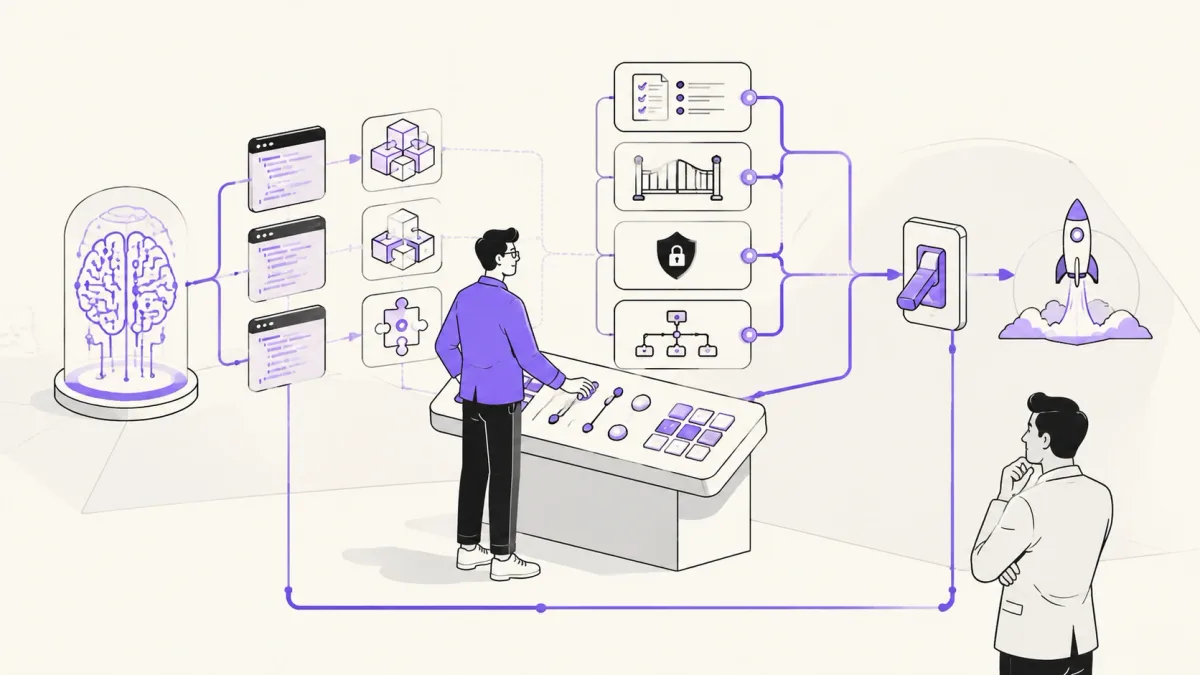
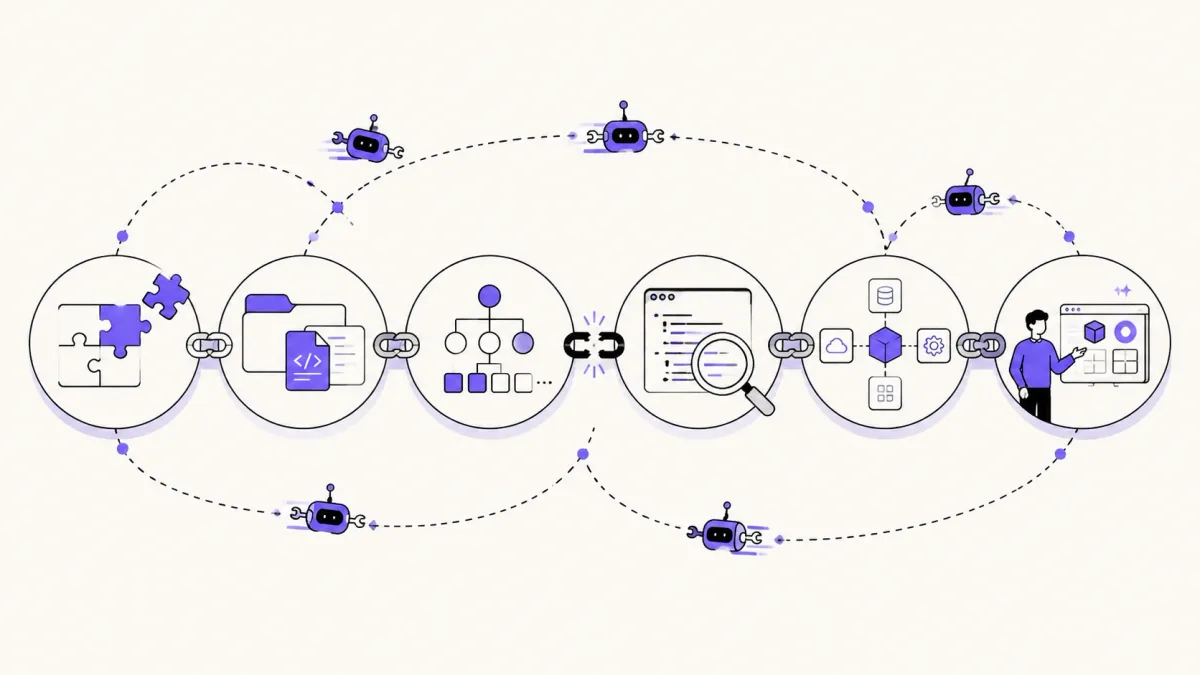
Seven skills are hard to watch for at once. I group them into six stages I call the AI-Native Engineering Signal Chain, which is my own label rather than established theory, drawn up so a failed interview becomes debuggable instead of just disappointing:
Frame → Contextualize → Delegate → Verify → Integrate → Defend
In order: skill 1 is Frame, skill 2 Contextualize, skill 3 Delegate, skill 4 Verify, and skill 6, the tradeoff call, is Integrate. Skill 7 is Defend. Skill 5, debugging and recovery, refuses to sit still: it fires at whichever stage just broke, which is why it gets its own scorecard weight and no stage of its own. Watch for it when a candidate is stuck, not at a fixed point.
Failures map to a missing link:
| Observed Interview Defect | Missing Stage | Root Cause |
|---|---|---|
| Builds a fast solution to the wrong business problem | Frame | Skipped requirement analysis and jumped into prompt execution. |
| Tool hallucinates non-existent methods or broken API patterns | Contextualize | Never supplied the relevant interface definitions or codebase examples. |
| Produces an oversized, unmaintainable 500-line blob | Delegate | Attacked a multi-step problem with one monolithic prompt. |
| Passes happy path but crashes on nulls or race conditions | Verify | Trusted output without reading diffs or running disconfirming tests. |
| Breaks existing service conventions or environment configs | Integrate | Wrote the snippet in isolation from system boundaries. |
| Cannot explain how data flows through the generated code | Defend | Treated the tool as an authoritative black box. |
| Loops on the same failing prompt, never switches to manual analysis | Debugging (any stage) | No systematic isolation of requirement, context, or prompt as the fault. |
A 75-Minute AI-Enabled Technical Interview Blueprint
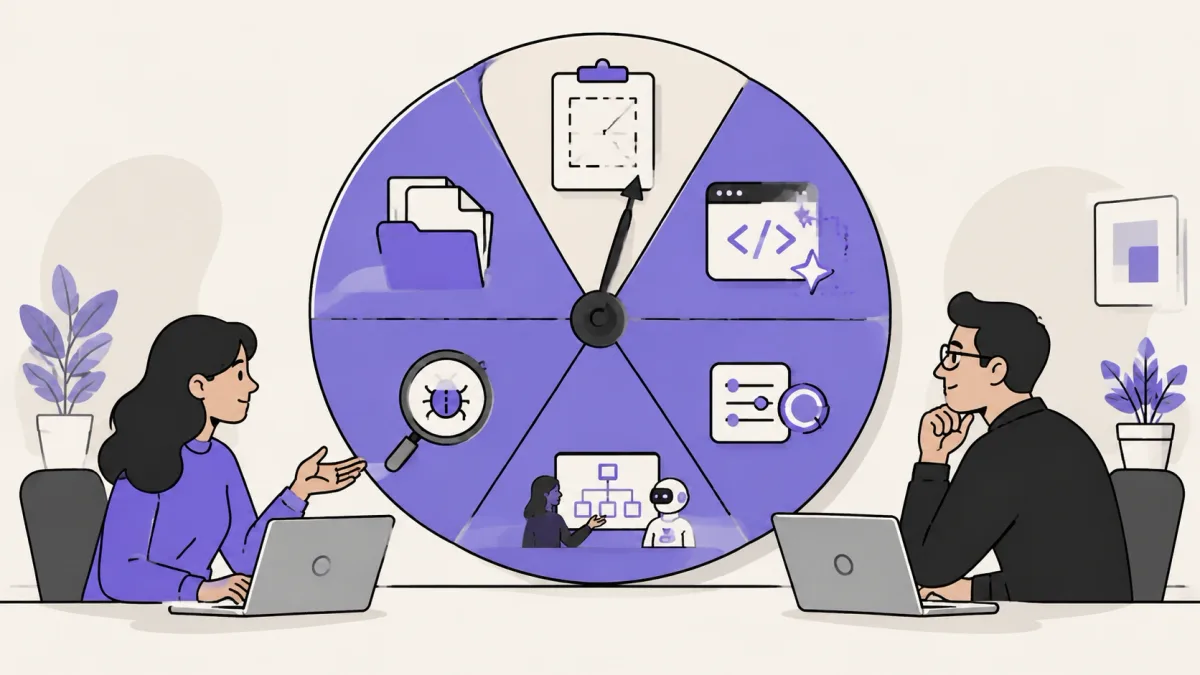
The quiet stages need protected slots or implementation eats them. Book 85 minutes: ten unscored for environment familiarization, then 75 on the clock. That warmup block is not optional, because skipping it converts your interview into a test of who already owns the tool. Only got a standard 75-minute slot? Run familiarization asynchronously the day before, same repository and version, sent to everyone competing for the same role.
| Minutes | Phase | What you hand over | Dimensions scored |
|---|---|---|---|
| -10 to 0 | Familiarization (unscored, unnumbered) | Tool and environment warmup | None |
| 0 to 10 | Phase 1, Problem Framing | A deliberately incomplete spec: "Build an in-memory event rate-limiter for our API gateway." No tools open yet. | Framing (15) |
| 10 to 20 | Phase 2, Codebase Orientation | A real repository with its own conventions and test helpers | Context (15) |
| 20 to 45 | Phase 3, AI-Assisted Implementation | The standardized environment, screen recording disclosed in advance | Collaboration (10), Verification (20), Debugging (15) |
| 45 to 55 | Phase 4, Constraint Change | "Infrastructure just mandated redis-backed storage with multi-region failover." | Tradeoffs (15), Framing revisited |
| 55 to 65 | Phase 5, Seeded-Flaw Review | A pre-generated patch with one realistic flaw planted | Verification, second pass |
| 65 to 75 | Phase 6, Defense and Retrospective | Tools closed. Data flow, rejected alternatives, debt left behind. | Ownership (10), Tradeoffs |
Weights are each dimension's full allocation from the scorecard below, not points added per phase. A dimension observed twice is still scored once, at the end, on everything you saw. The seven weights sum to 100.
Two phases decide whether this produces signal or noise.
Phase 5, the seeded flaw. Match the flaw class to the level. Logic errors visible in one function are the easy tier. State-dependent flaws are the middle tier, correct in isolation and wrong in context, like a cache that never invalidates. Contract violations are the hard tier, where the patch works and quietly breaks a caller's assumption about ordering or idempotency. Seed one flaw at the level's tier, plus one tier up when you want a stretch signal. A junior who finds the state-dependent flaw is a strong positive; a staff candidate who finds the seeded logic error and stops there is a flag. Score the review process separately from the catch, because a candidate who reads the diff systematically and misses your planted bug has shown more than one who spots it instantly after debugging the identical issue last month. A binary "found the flaw" checkbox measures luck.
The first thirty seconds tell you what the review will be. The candidates I would hire scroll the whole diff once before saying anything, then go back to a specific hunk and ask what calls it. The ones I would not start at line one and comment on naming as they go, and they are usually still doing that when the time ends. Same patch, and one of them never reached the part that would have failed in production.
Phase 6, the defense. Pausing AI for the last ten minutes is an ownership check, not a return to trivia. If a candidate cannot explain how their code handles error propagation without re-reading an AI transcript, they do not own the deliverable.
Debugging is the one dimension you cannot schedule, since it only appears when something breaks, and Phase 3 on a real repository usually supplies that. If a candidate genuinely never hits a failure, do not score the dimension zero and punish them for a smooth session: score the remaining 85 points, prorate to 100, and write down that you did.
A 100-Point Scorecard for AI-Assisted Technical Interviews
Impressions drift. A written rubric holds interviewers to observable evidence.
Score each dimension directly in its own points, so Verification runs 0 to 20 and Ownership runs 0 to 10. Before your first candidate you need four things: the repository and task, the seeded patch with its flaw chosen for the level, written score anchors for Verification and Ownership so two interviewers mean the same thing by a midpoint score, and one calibration round on recorded mock sessions. The validation section below separates what to log from your first cohort from what has to wait for outcome data, so read it before your first loop and let only the correlation work wait.
| Dimension | Weight | Hire-side evidence | No-hire evidence |
|---|---|---|---|
| Problem framing and requirements | 15 | Clarifying questions, named edge cases, explicit success metrics before prompting | Accepts incomplete specs, prompts immediately, assumes system limits |
| Context and decomposition | 15 | Finds files fast, feeds precise interfaces, works in testable steps | Dumps whole codebases, requests monolithic generation |
| AI collaboration judgment | 10 | Selective delegation, writes simple logic by hand, stops a repeating model | Prompts for trivia, retries failed prompts blindly, spectates |
| Verification and output review | 20 | Reads diffs line by line, catches hallucinated APIs, writes disconfirming tests | Accepts diffs unread, trusts compilation, checks only happy paths |
| Debugging and recovery | 15 | Logs, debuggers, stack traces, isolates root cause, fixes by hand | Pastes traces back repeatedly, applies patches blind |
| Engineering tradeoffs and quality | 15 | Weighs security, performance, maintainability against velocity | Ships fragile shortcuts, misses hardcoded credentials and O(N²) paths |
| Communication and ownership | 10 | Explains reasoning, separates own decisions from the model's, owns defects | Goes silent, cannot explain the data flow, blames the tool |
| Total | 100 | Hire bar starts at 70 total plus two dimension floors: 14/20 on Verification and 7/10 on Ownership. All three, not any one. |
Working code is a precondition, not a dimension. If the deliverable does not run there is no diff of their own to defend, so the session produces no total rather than a low one. Framing, Context, and the Phase 5 review stand on their own, so write those observations down before you close the file. Decide that before your first candidate, because the committee will ask.
Four operating rules:
- Reweight for your domain. Infrastructure roles carry more weight on security than a frontend loop does.
- No score without written evidence. Log the timestamp and behavior: "00:32, caught the missing null check before running tests." A bare number with no observation behind it gets thrown out.
- The two floors hold, and they move only between cohorts. The 70 bar and both floors are my starting position, not a validated cutoff, so expect to move them once you have outcome data. Move them in writing, for everyone in the next cohort at once. Moving them mid-cohort or for one candidate is the difference between calibrating a rubric and rationalizing a decision. Below 14/20 on Verification or 7/10 on Ownership is a No Hire even at a total of 80, because someone who ships unread generated code is a production incident with a start date.
- Anchor the middle before you score anyone. The table gives you the top and bottom. Write the midpoint yourself, in your own codebase, because that is where most candidates land and an undefined middle is where bias moves in. A 10 out of 20 on Verification looks roughly like this: read the diff, caught the obvious defect, wrote happy-path tests, ignored boundaries until prompted. Then split those 20 points as 14 for review process and 6 for the catch, so full marks on process with nothing caught clears the floor exactly and a lucky catch with no real review does not.
Adjust the Signal by Engineering Level
A junior scaffolding CRUD endpoints and a staff engineer sequencing a multi-service migration should not be graded off one column of expectations.
| Level | Primary expectations | What NOT to over-penalize |
|---|---|---|
| Junior | Language fundamentals, code reading, basic unit tests, saying something useful when stuck | Limited architectural depth, slower context gathering across a multi-file repo |
| Mid-level | Independent decomposition, clean integration, systematic debugging, edge-case tests | Not orchestrating multi-agent workflows or system-wide refactors |
| Senior | Ambiguity management, system boundary design, security and performance tradeoffs, review rigor | Writing fewer lines by hand, using AI heavily to prototype early |
| Staff+ | Cross-system impact, governance, rollback planning, long-term maintainability | Not using vendor shortcuts or typing code manually while exploring |
For senior and staff candidates, do not reach for a harder algorithm puzzle. Reach for more ambiguity: legacy dependencies, constraints that conflict with each other, a production failure mode with no clean answer. Difficulty is not the axis. Judgment is.
Standardize the AI Environment to Keep the Interview Fair
Give Candidate A a frontier reasoning model and Candidate B an older one on a bad connection, and your interview measures who had better tooling that morning. The unit you hold constant is the comparison group: everyone competing for the same role, scored against the same bar.
- Model and version: same model, version, temperature, and system prompt across the cohort. Pin the version explicitly rather than tracking whatever "latest" resolves to, and log what each candidate ran.
- Environment: same editor, extensions, terminal access, repository state, seed data, and environment variables.
- Limits and permissions: equal time and token budgets, and a clear upfront answer on whether docs and search are in play.
- Logging disclosure: tell candidates in advance that screen, terminal, and AI transcripts are recorded.
- Accessibility: verify keyboard navigation, screen reader support, and alternative input work before the session, not during it.
- Failure fallback: have a protocol for the API outage you will eventually get. Extra time or a local model.
What NOT to Score
Five inputs belong nowhere on the scorecard, because each smuggles in bias: prompt length, the candidate's personal subscription tier, vendor hotkey fluency, invocation count, and reading speed.
Invocation count is the one that trips teams up. Score the pattern, never the tally. Five rewordings of one failing prompt with no change in approach is a recovery failure; five bounded prompts down a decomposed task is good delegation. Same count, opposite signal. What scores badly is delegating a task direct inspection would have finished faster, which is a judgment error, not an arithmetic one.
Several organizations have published their approach. The GitLab AI-Native Hiring Working Group handbook documents standardized environments as an operational requirement, and HackerRank covers keeping the session controlled once assistance is enabled. Kogan went further and told candidates they would rather you used AI, on the grounds that watching transparent tool use beats policing an artificial restriction. Anthropic's write-up on AI-resistant evaluations works through designing around judgment rather than pattern matching. Hello Interview, CoderPad, Sherlock, and Built In land in the same place from the rubric side.
None of those is a predictive validity study. They are vendor frameworks, practitioner rubrics, and industry reporting, so they tell you where practice is moving, not which signals forecast performance. That correlation is unpublished, which is why you have to measure it in your own loop.

How to Validate the Interview Itself
Most teams redesign the interview, roll it out, and never check whether the new version works. A rubric that measures the right things on paper can still produce inconsistent scores, disparate impact, or no relationship to job performance. Test the test.
Measure inter-rater agreement with a number, not a vibe. Start with three anonymized recorded sessions scored independently, then argue about the gaps as a group. The disagreements are the point: when one interviewer reads "asked the model to explain its own diff" as strong verification and another reads it as passivity, that is a rubric that never defined the behavior. Three sessions surface rubric holes fast but will not give you a stable number, so do not compute one yet. Once fifteen or twenty have accumulated, run the intraclass correlation coefficient per dimension, or Cohen's kappa if you collapse to hire and no-hire buckets. Both are a one-line call in R's irr or Python's statsmodels. The measurement literature conventionally reads roughly 0.75 and up as good and 0.60 to 0.75 as acceptable. Below 0.60 the dimension is measuring your interviewers rather than your candidates, which is why that is the line I would not ship under. Set your own threshold before you collect, because one chosen after you see the data is not a threshold.
Start the adverse-impact audit with your first cohort. Break pass rates down by every group you are legally required to track. US employers usually screen with the four-fifths rule from the federal Uniform Guidelines: a group passing below 80 percent of the highest group's rate is the flag regulators look at. Log early so the trend exists when the sample means something, because the four-fifths rule on nine candidates is noise with a citation. Loop in employment counsel before you interpret a gap, since the remedy differs by jurisdiction and I am not the person to tell you what yours requires. Watch specifically for the access gap: candidates who already pay for the premium tool arrive fluent, and that is a proxy for spending money, not for engineering judgment.
Recalibrate when the model changes. Your seeded flaw was chosen because the assistant of the day would confidently walk past it. Two releases later it catches the same bug unprompted, and your hardest signal is now a freebie. Re-run the exercises quarterly and after any major release, and log which version each candidate used. Skip that and you are comparing two different tests while calling it one dataset.
Track the six-month correlation. Revisit interview scores against performance reviews half a year later and check whether the dimensions you weighted heaviest separated the engineers who performed. With a dozen hires you have an anecdote, not a validity study. Collect it anyway. Structured interviewing has a long research record, which is the reason to score against fixed dimensions at all, but I have not found published correlation data for AI-enabled formats specifically. In two years your own numbers may be the only evidence that any of this worked.
What Candidates Should Practice Before an AI-Enabled Interview
Grinding LeetCode by hand no longer prepares you for this format, and finding that out after two months of drilling problem sets is genuinely deflating. The hours were not wasted, they were aimed at the old test.
Do the cheap thing first: read the seven competencies above and the blueprint phases from your side of the table. That is the session you are walking into. Then ask your recruiter four things, each of which the hiring side should have decided already: which model and version, whether your screen and prompts are recorded, whether docs and search are allowed, and whether you get familiarization time before the clock starts. A team that cannot answer has not standardized its environment, which tells you something too.
Then five habits, each with a way to check yourself.
- Navigate an unfamiliar repository fast. Open a codebase you have never seen, trace data flow across three modules, find the relevant tests in ten minutes without asking a model to explain it. Passing looks like naming the entry point, the transformation, and the persistence layer out loud with the search box closed.
- Restate the problem before you prompt. Three bullets: input boundaries, null states, performance constraints. If you cannot write them, you do not understand the task well enough to delegate it.
- Scope context deliberately. Feed the specific interface files that matter instead of trusting global indexing, and ask for two implementations with tradeoffs rather than one answer. You are doing this right when you can say why the file you left out was irrelevant.
- Review the diff, then try to break it. Check variable scopes, error returns, and edge cases after each generation. Then write tests built to fail: empty arrays, concurrent calls, boundary values, expired tokens. The bar is one test that actually fails before you fix it. If everything passes on the first run, you are confirming, not verifying.
- Break your own solution, then defend it with the panel closed. Feed a misleading prompt on purpose, asking for a library version that does not exist, and see whether you catch what comes back. Debug it with a debugger rather than another prompt. Then change a constraint on yourself once it works, a memory ceiling or a latency budget, and adapt without starting over. That is Phase 4, and a constraint you impose on yourself is the closest you get to it without a panel in the room. Finish by explaining the data flow and security boundaries out loud, to a peer or a recording, saying which decisions were yours. The bar is getting through both, in order, without reopening the transcript. Playing that recording back is uncomfortable. It is also the fastest feedback available to you.
For guidance on discussing your AI usage with hiring managers without over-crediting or under-crediting the tool, read How to Talk About AI in Job Interviews.
Practice AI-Native Interview Skills With Great Offer AI
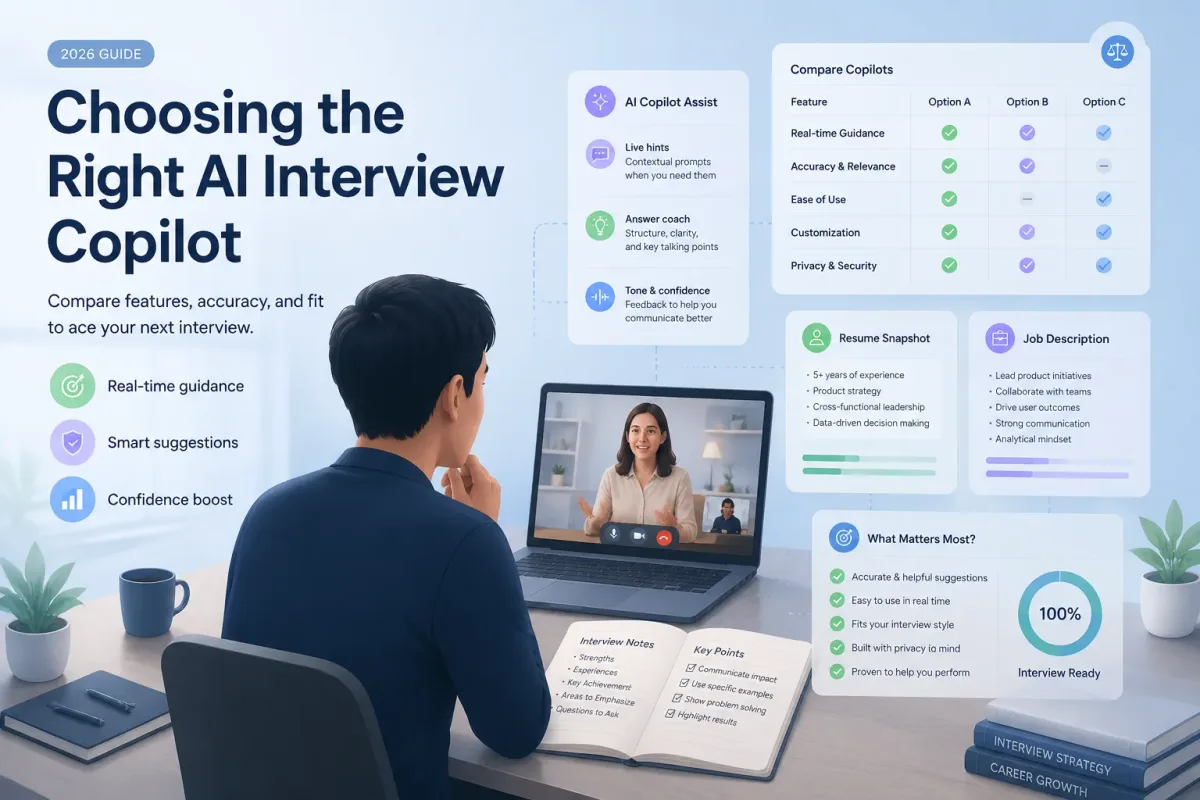
Reading about verification behavior and performing it under observation are different skills, and only one of them gets scored. That gap is what Great Offer AI's Interview Copilot is built to close. During practice, the Coding Copilot reads the code on your screen and explains it in real time, runs practice sessions with live guidance, and draws on your resume and the job description to surface talking points you can use. Its Focus Mode keeps that guidance on your own screen rather than in a shared view.
One boundary, and it follows from this article's argument: a display choice is not employer authorization, and keeping guidance off a shared view is not the same as being undetectable. Use real-time assistance in a live interview only where the employer and platform have granted permission.
Run the five habits above inside one practice session, in the order the interview meets them: restate the problem first, then orient in the repository and scope your context, then generate and try to break what comes back, then take the constraint change. Close the guidance panel for the defense, data flow and security boundaries included. Candidates skip that last step more than any other, and it is the one the panel is actually grading.
See also the AI Interview Copilot Comparison Guide and our framework on How to Prepare for a Job Interview.
What the Research Says About Verification Skill
Two recent papers carry more weight here than any hiring opinion, including mine. Neither studies interviews, so what they support is the premise underneath this article: supervision is now the work, and people are bad at reviewing AI output.
Annie Vella and Kelly Blincoe surveyed working engineers twice, six months apart, in The Impact of AI Coding Assistants on Software Engineering (arXiv:2605.23135, May 2026): 158 participants in the first wave, 101 in the second, 95 across both. They describe a shift toward supervisory work, directing tools and evaluating diffs rather than typing syntax. It is a preprint on self-reported survey data, so read it as a workflow trend, not a productivity measurement.
The second one should reshape your loop. In Programmers Are Poor and Overconfident Judges of LLM-Generated Assertions (arXiv:2607.08885, July 2026), Zhanna Kaufman and colleagues had 86 Python programmers judge whether LLM-generated assertions were correct and rate their confidence in each judgment.
| Assertion Type | Judgment Accuracy |
|---|---|
| Correct assertions | 74% |
| Incorrect assertions | 49% |
Accuracy was significantly higher on correct assertions than incorrect ones (OR = 2.94, p < 0.001). Read the second row again: 49% is a coin flip. The half of the work that matters most is the half people cannot do.
Confidence stayed at roughly 4 out of 5 in both conditions, with no significant difference. Engineers do not feel less sure when they are wrong. They feel exactly as sure. A candidate who waves through a flawed patch will sound as assured as one who caught the bug, so confidence tells you nothing and the behavior has to be tested directly. That is the case for seeded flaws, disconfirming tests, and an oral defense. The study put 86 people in a lab judging Python assertions, so treat it as a warning about review skill rather than a fixed error rate under interview pressure. The warning is enough.
Conclusion: Hire the Engineer Who Controls the System
When AI tools are allowed in technical interviews, the signal moves from code generation to engineering control. The engineer worth hiring is the one who framed the problem before prompting, read the diff, wrote the test that tried to break it, and can tell you which decisions were theirs.
If you run hiring, three things this quarter: standardize the environment for each comparison group, put verification and ownership floors in the rubric so a high total cannot hide unread code, and calibrate interviewers on recorded sessions before they score anyone real. Then start your own validation log, since the correlation data you would want to borrow does not exist yet.
If you are the candidate, start with the two habits that cost you the most points: restating the problem before you prompt, and defending the finished thing with the panel closed. Rehearse both with Great Offer AI.