

Note: Starbucks interview questions and hiring steps can vary by role, location, and manager. Candidate reports are anecdotal, and the sample answers below are illustrative. Use only truthful experiences and follow the current job posting and instructions from your recruiter or store contact.
15 Starbucks Interview Questions to Prepare For
Questions about excellent service, upset customers, staying calm under pressure, and motivation were reported in a Starbucks applicant’s Reddit discussion. A separate 2026 candidate thread reported questions about learning quickly, making a decision without a manager, and managing multiple tasks. The remaining items are closely related variations that prepare you for the same customer service, teamwork, judgment, and reliability themes.
-
Tell me about yourself.
Answer focus: Give a 30- to 60-second summary of your relevant background, one or two strengths, and why this role is your next step. For a structured opening, review how to answer "Tell me about yourself".
-
Tell us about your work history and why you are interested in Starbucks.
Answer focus: Connect your most relevant work, school, volunteer, or team experience to customer service and a fast-moving store environment.
-
Why do you want to work at Starbucks?
Answer focus: Mention a specific observation about the customer or team experience, explain why it suits you, and state what you hope to contribute.
-
Why should we hire you?
Answer focus: Choose two or three role-relevant strengths and support at least one with a short example instead of listing adjectives.
-
Tell me about a time you provided excellent customer service.
Answer focus: Show how you recognized a need, took useful action, and improved the customer’s experience.
-
Tell me about a time you exceeded a customer’s expectations.
Answer focus: Use a service story in which you did something thoughtful beyond the minimum without ignoring policy or other responsibilities.
-
Tell me about a time you dealt with an upset customer.
Answer focus: Demonstrate listening, respectful de-escalation, practical problem-solving, and knowing when to involve a manager.
-
Tell me about a time you stayed calm and professional in a stressful situation.
Answer focus: Explain how you prioritized, communicated, and protected accuracy or safety while under pressure.
-
Describe a time you had to learn a new skill quickly.
Answer focus: Describe your learning method, how you used feedback, and how you confirmed that you could perform accurately.
-
Describe a time you had to make a quick decision without a manager.
Answer focus: Show initiative within reasonable boundaries, address immediate risk or customer impact, and explain how you followed up.
-
Give an example of how you managed multiple tasks at once.
Answer focus: Describe how you ranked tasks by safety, customer impact, timing, and team dependencies.
-
Tell me about a time you worked effectively as part of a team.
Answer focus: Focus on communication, shared responsibility, and what you personally did to help the group succeed.
-
Tell me about a time you maintained quality during repetitive work.
Answer focus: Explain the routine, how you stayed accurate, and what checks or habits prevented mistakes.
-
What are your strengths and weaknesses?
Answer focus: Choose a strength relevant to service or teamwork and a genuine weakness that you are actively improving.
-
What is your availability?
Answer focus: Be precise and honest. State the days and times you can reliably work, plus any firm limits.
What the Interviewer Is Listening For
Starbucks’ official hiring guidance recommends researching the company and preparing specific examples for behavioral questions. The exact evaluation process is not public, but the questions candidates repeatedly report point to several practical themes:
| Question type | Evidence to include | What weakens the answer |
|---|---|---|
| Customer complaint | Listening, respectful language, a reasonable solution, and escalation when needed | Blaming or insulting the customer |
| Busy or stressful situation | Clear priorities, communication, accuracy, and calm action | Claiming you handled everything alone |
| Quick decision | Awareness of limits, immediate risk control, and follow-up | Ignoring safety or acting outside your authority |
| Teamwork | Your contribution, communication, and shared result | Saying “we” without explaining what you did |
| Why Starbucks | A specific reason, role fit, and contribution | Saying only that you like coffee, discounts, or the brand name |
For a barista interview, prepare strong examples involving customers, teamwork, pace, learning, and reliability. If you are applying for a shift supervisor role, add examples that show leadership, prioritization, coaching, and responsible escalation.
How to Answer the Most Important Starbucks Interview Questions
Use the frameworks below to organize your ideas, not to memorize a script. Most behavioral answers are easier to follow when you briefly explain the situation, your responsibility, the action you personally took, and the result.
Why Do You Want to Work at Starbucks?
Build your answer around three points:
- A specific observation: Mention something genuine you have noticed about the customer or team experience.
- Your connection: Explain why you enjoy customer-facing work, learning routines, or contributing to a fast-moving team.
- Your contribution: State what you would bring to the store.
Avoid giving an answer that could be used for any employer. Coffee, convenience, scheduling, or employee benefits can be part of your decision, but they should not be your entire answer.
Composite Sample Answer (Experienced Applicant) "Every time I visit my local Starbucks, I notice how smoothly the baristas communicate during morning rushes while still making eye contact and welcoming regulars by name. Having worked in high-volume food retail for two years, I thrive in that fast-paced environment. I want to work at Starbucks because your culture prioritizes genuine human connection alongside speed, and I am excited to bring my multitasking skills and positive energy to your morning shift."
Composite Sample Answer (First-Job Applicant) "Starbucks was the first place where I noticed how customer service can brightened someone's entire day. As a student leading school event setups, I discovered that I really enjoy working in energetic teams and solving problems under time pressure. I want my first job to be at Starbucks because you offer structured training and an environment where being welcoming, reliable, and detail-oriented directly impacts people in the community."
Do: Make the reason specific and connect it to evidence about you. Don’t: Lead with discounts, free drinks, or a generic claim that Starbucks is a great company.
Tell Me About a Time You Provided Excellent Customer Service
Choose a story in which you noticed what someone needed and took a specific action. The result does not need to be dramatic; a credible small detail is more useful than a vague claim that you always give excellent service.
Use a simple STAR structure:
- Situation: Where were you, and what did the customer need?
- Task: What were you responsible for?
- Action: What did you personally do?
- Result: What changed because of your action?
Composite Sample Answer "At my previous retail job, a customer came in looking for a specific gift item that was out of stock on our shelves. She looked noticeably stressed because she needed it for an event that afternoon. Instead of simply pointing her to our website, I checked our backroom inventory, found the final unopened box, and carried it out for her. I also called a nearby partner store to hold a matching accessory item. She was extremely relieved, thanked me for taking the extra step, and wrote a positive note to my manager."
Why it works: The answer names concrete actions and a clear outcome. Avoid: Taking credit for another person’s work or inventing customer feedback.
Tell Me About a Time You Stayed Calm in a Stressful Situation
A strong answer shows that calmness helped you take organized action. Explain how you assessed priorities, communicated with other people, and maintained accuracy rather than simply saying you did not panic.
Composite Sample Answer "During a weekend rush at my previous cafe job, our online ordering system suddenly went offline, causing mobile orders to print out out of order while a line formed at the register. Rather than panicking, I signaled my shift lead, stepped up to greet the waiting customers, and clearly explained that we were manually organizing orders. I focused on processing one order accurately at a time while keeping my team updated on incoming receipts. Because we communicated steadily, we cleared the queue in 20 minutes without making a single drink order error."
When building your own answer, use this sequence:
- Identify the immediate problem.
- Decide what requires attention first.
- Communicate with customers, teammates, or a supervisor.
- Work through the tasks in a controlled order.
Tell Me About a Time You Dealt With an Upset Customer
Show that you can listen without becoming defensive and work toward a reasonable solution. Use only actions that were within your authority, and explain when you would involve a manager.
A practical structure is:
- Listen without interrupting.
- Acknowledge the concern respectfully.
- Clarify what went wrong and what outcome is needed.
- Act or escalate within the rules of your role.
- Confirm that the next step is understood.
Composite Sample Answer "A customer was upset because his drink order was made incorrectly twice during a busy morning period. He approached the counter visibly frustrated. I immediately stepped forward, listened to his concern without interrupting, and apologized sincerely for the error and wait time. I remade his beverage personally, ensuring it matched his exact preferences, and offered a fresh pastry voucher for his trouble. He calmed down, thanked me for listening, and became a regular who greeted me by name."
Do: Describe the customer respectfully and focus on recovery. Don’t: Describe the customer as “crazy,” argue to prove them wrong, or claim authority you did not have.

Describe a Time You Learned a New Skill Quickly
The strongest answers show how you learn, not just that you are a fast learner. Name the skill, explain your method, mention any feedback you requested, and describe how you knew you could perform it accurately.
Composite Sample Answer "When I started volunteering at a community center, I had to learn a complex guest check-in software program in two days before an event. I created flashcard notes for core shortcuts, shadowed a senior volunteer for two hours, and asked them to observe my first three solo check-ins. By the end of the afternoon, I was checking guests in independently and even helped troubleshoot basic system errors for another volunteer."
Do: Emphasize practice, notes, repetition, and feedback. Don’t: Claim that you mastered a complex task instantly or pretend to know Starbucks-specific procedures you have not learned.
Describe a Time You Made a Quick Decision Without a Manager
This question tests whether you can take useful action without ignoring limits. A strong answer shows that you assessed the situation, addressed the immediate need, and informed the appropriate person afterward.
Use this decision sequence:
- Evaluate: Is this a routine issue, an urgent safety problem, or something outside my authority?
- Act: Take the safest reasonable action that is within your role.
- Escalate: Get help when policy, safety, money, harassment, or another serious concern is involved.
- Report: Explain what happened to the manager or supervisor.
Composite Sample Answer "While managing a community event, a guest spilled a drink near a high-traffic doorway, creating a slip hazard while my supervisor was in a meeting. Recognizing the immediate safety risk, I paused my current task, placed a caution sign over the spill, and cleaned the area immediately. Afterward, I informed my supervisor about the incident and logged it in our daily logbook. My supervisor praised me for taking quick, independent initiative to keep guests safe."
Give an Example of Managing Multiple Tasks at Once
Do not present multitasking as doing everything simultaneously. Explain how you decided what came first, communicated about anything that had to wait, and used the team when appropriate.
Composite Sample Answer "In my previous role, I frequently managed the front register while restocking supplies and monitoring incoming pickup orders. During sudden surges, I prioritized register customers first to keep wait times low, while signaling a coworker to assist with stocking. By keeping my workspace organized and maintaining clear verbal communication with my team, I completed all restocking duties on schedule while maintaining quick transaction times."
A useful priority order is safety first, then the customer currently waiting, then time-sensitive tasks, followed by work that can be delegated or completed later.

How to Answer With No Previous Job Experience
You do not need to invent retail experience. School projects, sports, volunteer work, clubs, caregiving, fundraising, and community events can all provide evidence of reliability, communication, service, and problem-solving.
| If you lack... | Consider an example from... | Show this evidence... |
|---|---|---|
| Customer service experience | Volunteering, school events, community fundraising, or helping visitors | Listening, helpfulness, and clear communication |
| Workplace pressure experience | Exams, sports, performances, or event deadlines | Composure, time management, and prioritization |
| Formal leadership experience | Group projects, clubs, or team responsibilities | Ownership, coordination, and follow-through |
| Retail or register experience | Ticket sales, bake sales, fundraising, or inventory tasks | Accuracy, accountability, and basic transaction handling |
Weak Answer vs. Strong Answer Comparison
❌ Weak Answer (First Job) "I've never worked in retail before, so I haven't dealt with upset customers. But I'm a really nice person and I get along with everyone, so I don't think it will be a problem for me."
✅ Strong Answer (First Job - Composite Example) "While I haven't worked in a retail store yet, I dealt with a difficult situation during a school group project when a teammate became frustrated over a missed deadline. I listened calmly without arguing, broke down our remaining tasks into small steps, and helped redistribute the work so we finished on time. That experience taught me how to stay patient and focus on solutions under pressure."
The stronger answer does not pretend that a classmate was a customer. It identifies transferable behavior and gives the interviewer something specific to evaluate.
What to Expect Before, During, and After the Interview
Starbucks’ hiring guidance says interviews may be virtual or in person and recommends researching the company, reviewing the role, and preparing specific behavioral examples. The details can vary, so use the instructions in your invitation and the current job posting as your primary source.
Before the Interview
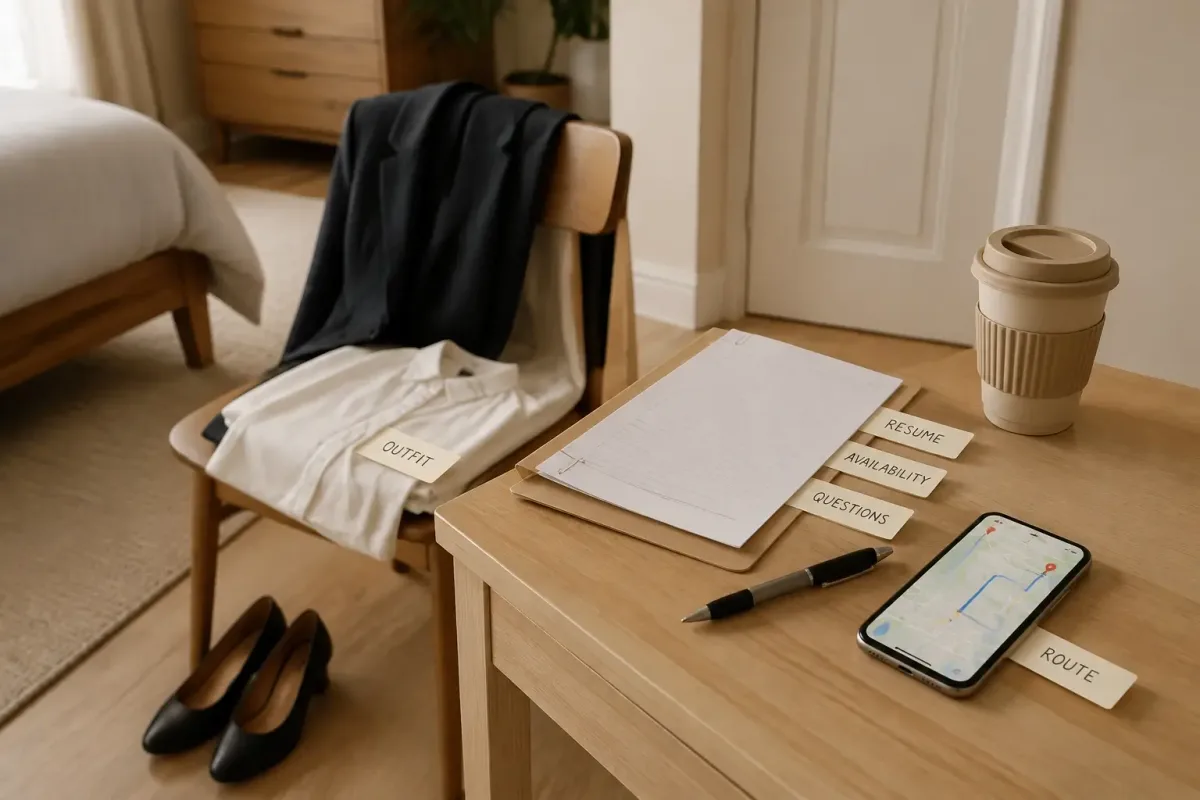
- Re-read the job description and identify the responsibilities you can support with examples.
- Confirm the interview time, location, contact name, or virtual meeting link.
- Prepare an accurate availability schedule, including any firm limits.
- Bring or have access to your resume if you submitted one.
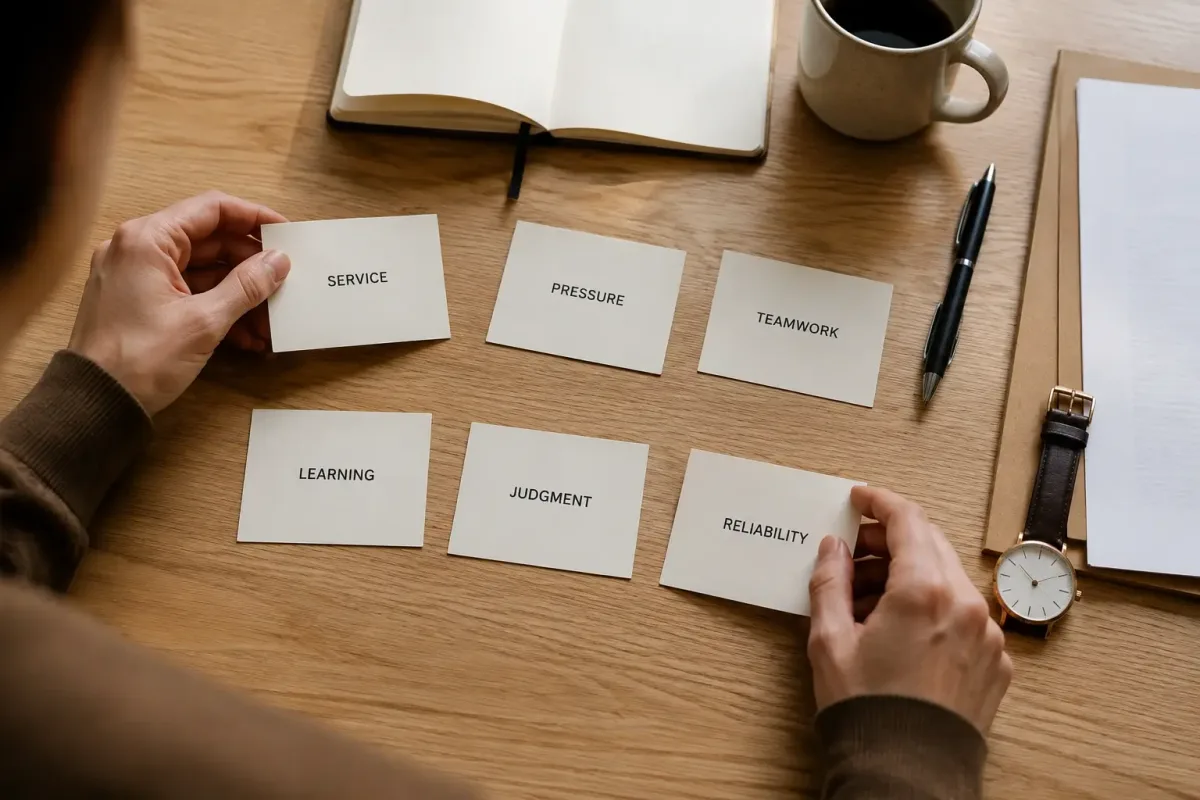
- Choose six stories covering service, pressure, teamwork, learning, judgment, and reliability.
Use the job interview preparation guide to organize the rest of your research, logistics, and practice.
What to Wear and Bring
Choose clean, neat, role-appropriate business-casual clothing that allows you to look professional in a customer-facing environment. You do not need to imitate a Starbucks uniform. If the recruiter or store contact gives specific instructions, follow those instead.
Bring:
- A resume copy, if relevant;
- Your written availability;
- A pen and small notepad;
- Two or three questions for the interviewer;
- Any documents specifically requested in your invitation.
Questions to Ask the Store Manager
Choose questions that help you understand the role and show that you are thinking about how to succeed. For more adaptable options, review these questions to ask in an interview:
- "What does success look like for a new partner in their first 30 days here?"
- "How does this store team communicate during peak morning rushes?"
- "What does the barista training process look like at this location?"
- "What are the next steps in your hiring timeline for this position?"
After the Interview
If you have an appropriate email address or contact method, send a short thank-you message that mentions the role and one useful point from the conversation. Follow any timeline the interviewer gives you. If no timeline was provided, one polite follow-up after several business days is more appropriate than repeated messages.
A 48-Hour Starbucks Interview Practice Plan
48 Hours Before: Build Your Six-Story Bank
Select six truthful stories and map each one to more than one question:
| Core story | Possible source | Main evidence | Questions it may support |
|---|---|---|---|
| Helping a customer or visitor | Work, volunteering, school event | Service and initiative | #5, #6, #7 |
| Handling a rush or deadline | Work, sports, performance, school | Composure and prioritization | #8, #11, #13 |
| Resolving a disagreement | Work, club, team, group project | Listening and conflict handling | #7, #12 |
| Contributing to a team | Shift, club, sport, group project | Communication and reliability | #2, #12, #15 |
| Learning a new tool or routine | Work, school, volunteering | Learning method and feedback | #9, #14 |
| Making a responsible decision | Event, work, caregiving, volunteering | Judgment and escalation | #10, #11 |
Write only keywords for the situation, action, and result. Full scripts are harder to adapt when the interviewer changes the wording or asks a follow-up question.
24 Hours Before: Practice Follow-Up Questions
Say each story aloud and check whether the listener can tell what you did. Then practice these follow-ups:
- "What specific action did you take?"
- "Why did you choose that approach?"
- "What was the exact outcome?"
- "What would you do differently next time?"
Aim for a focused answer that is usually around one minute, but do not cut out necessary context just to meet a timer.
If you want another practice round, GreatOffer’s real-time interview copilot can provide personalized suggestions while you rehearse or in interview settings where its use is permitted. Follow the employer’s rules, protect confidential information, and never use a tool to invent experience.
15 Minutes Before: Final Checklist
- Confirm the location or virtual meeting link.
- Keep your resume and availability ready.
- Silence your phone and close unnecessary applications.
- Review six story keywords, not full scripts.
- Prepare two or three questions.
- Take a slow breath and focus on listening to the exact question.
How This Guide Was Built
This guide combines Starbucks’ public hiring guidance with candidate-reported questions from two Reddit discussions. Candidate posts describe individual experiences and are not company policy. All sample answers are labeled as composite editorial examples and should be adapted only with truthful personal details.
Sources
- Starbucks Careers: Hiring Process
- Reddit r/starbucks: Job Interview
- Reddit r/starbucks: Updated Interview Questions 2026
Conclusion: Prepare Six Stories, Not 15 Scripts
Strong Starbucks interview preparation is less about finding perfect wording and more about offering clear, truthful evidence. Prepare six flexible stories, a specific reason for applying, an accurate availability schedule, and two or three thoughtful questions for the manager.
Start now by writing three keywords for a time you helped someone, stayed calm under pressure, or learned something quickly.