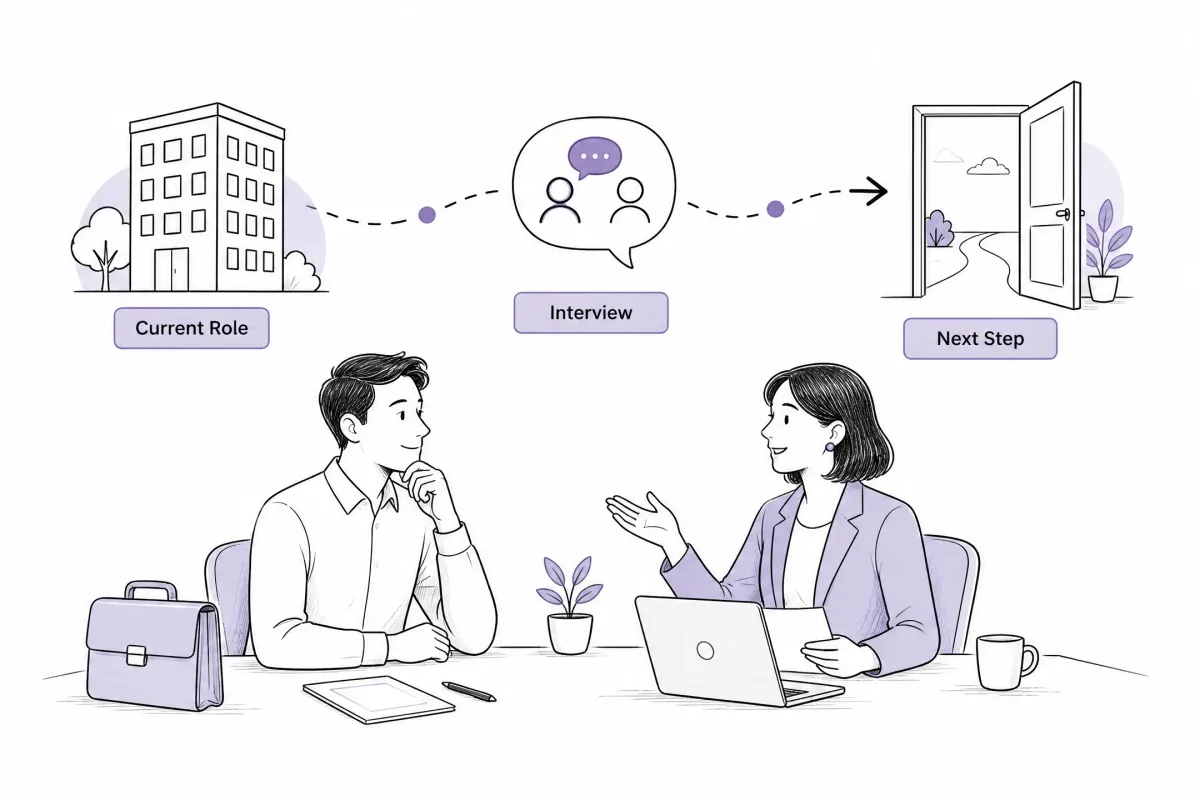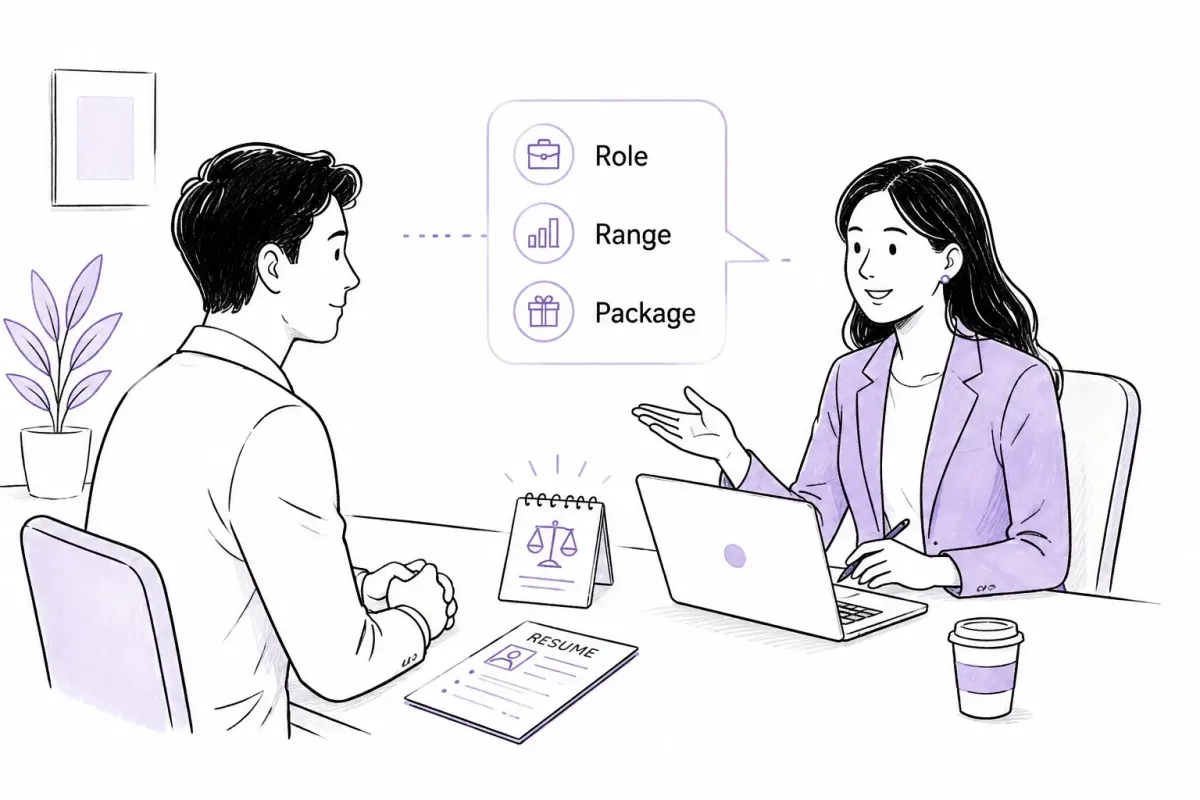

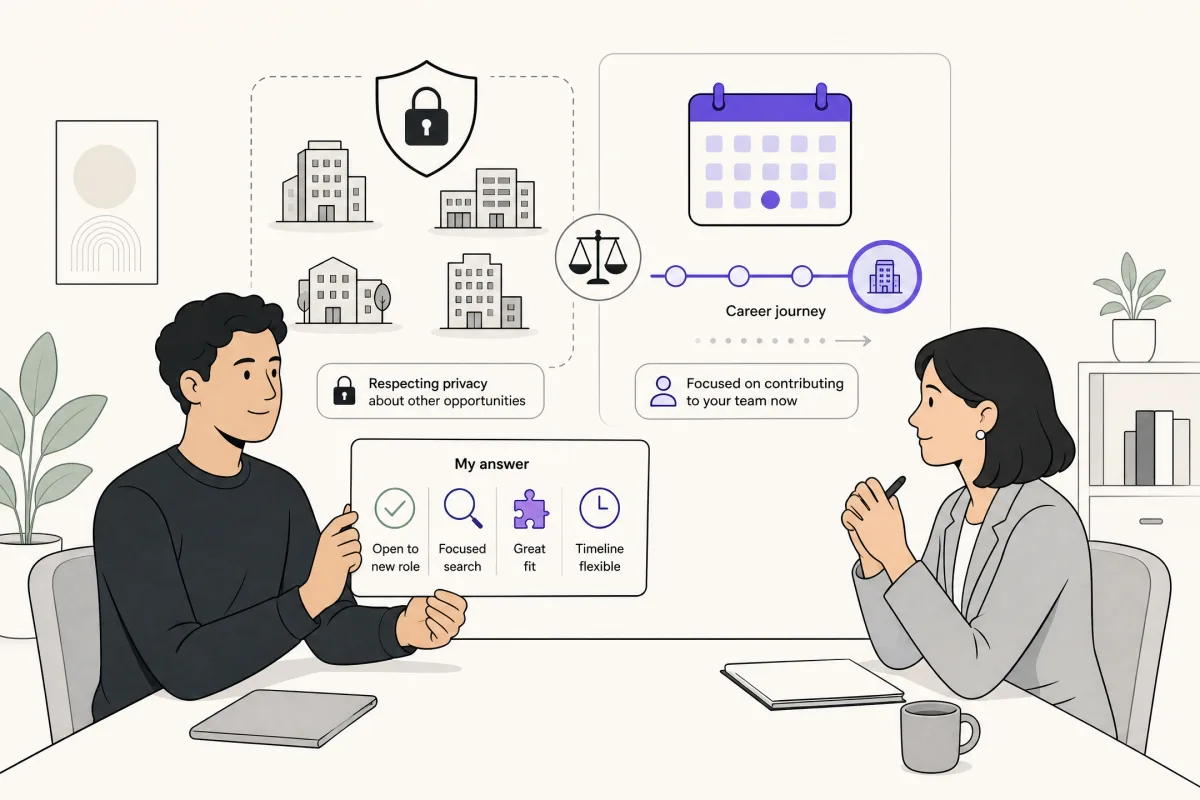
This question often arrives when a recruiter is trying to understand scheduling, acceptance risk, and how focused your search is. It can feel like a test of leverage, but the strongest response is usually a short, accurate status update—not a performance about how many employers want you.
If your search is just beginning, use this guidance alongside how to prepare for a job interview.
What Does “Are You Interviewing With Other Companies?” Mean?
The question asks for enough information to coordinate the hiring process, not a complete list of your applications, contacts, or compensation discussions.
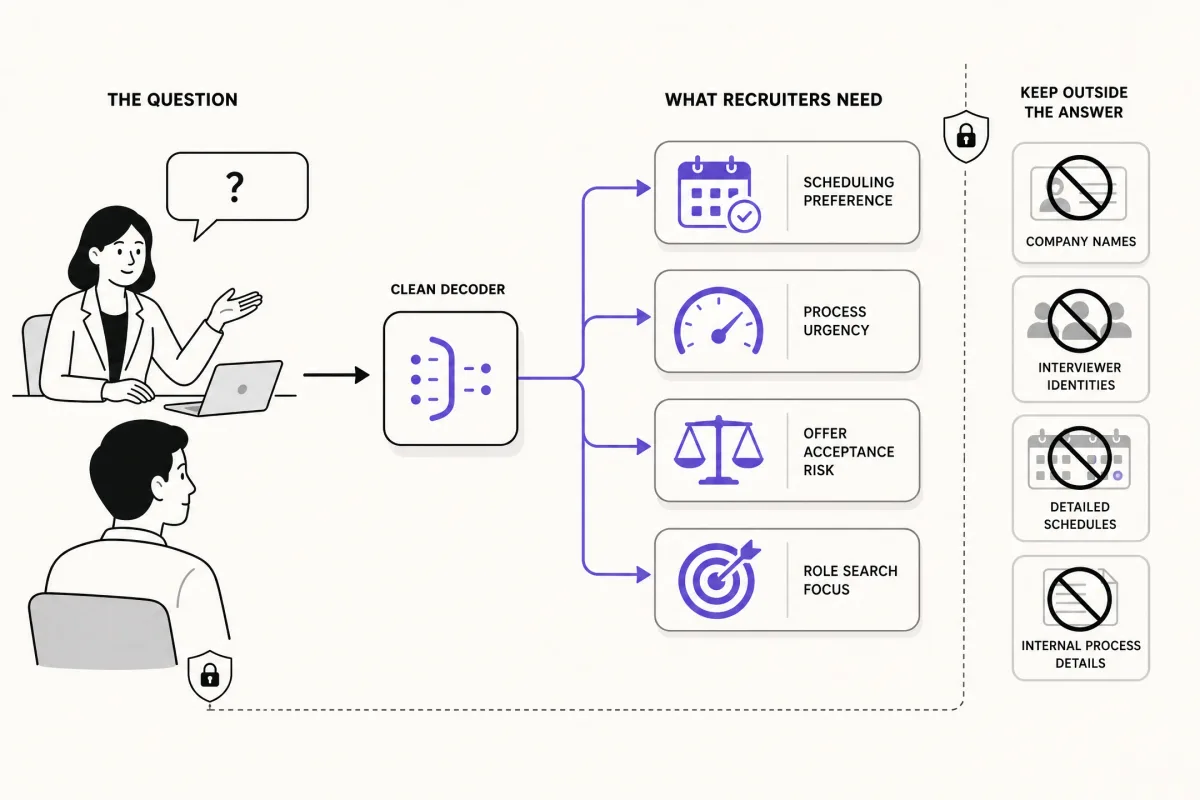
Most candidates hear this question as a trap. Often, it's a scheduling question with some risk assessment mixed in. The exact concern depends on who asks and how far you've progressed. A recruiter may be trying to:
- Understand whether you could receive another decision soon.
- Decide whether the interview schedule needs to move faster.
- Estimate the risk that an eventual offer will be declined.
- See whether your job search is focused on comparable roles.
- Understand the competitive set or, for an agency recruiter, avoid duplicate submissions.
- Check whether you have a realistic timeline for availability.
Hays' interview guidance points to three common concerns: your interest in the role, whether your search is focused, and how quickly the employer may need to move. None requires a list of company names.
Recruiter Question Decoder
The wording changes, but the information the recruiter needs is usually narrow:
| Recruiter Question | What It May Be Testing | Useful Answer Field | Usually Unnecessary |
|---|---|---|---|
| Are you interviewing elsewhere? | Whether you are active and may leave the process | Whether an active process exists and its broad stage | Full application history |
| How far along are you? | Whether a decision or offer may arrive soon | Early, mid-stage, final stage, or a real offer deadline | Interviewer names and exact schedules |
| Which companies? | Competition, conflicts, or duplicate agency submission | Industry or role category; duplicate-submission check if relevant | Company names by default |
| When do you need to decide? | Whether internal approvals can match a real deadline | Exact deadline and whether an extension is possible | Invented pressure or vague threats |
You can't know the interviewer's private motive. Don't waste energy trying to mind-read it. Answer the useful scheduling question and keep irrelevant details private.
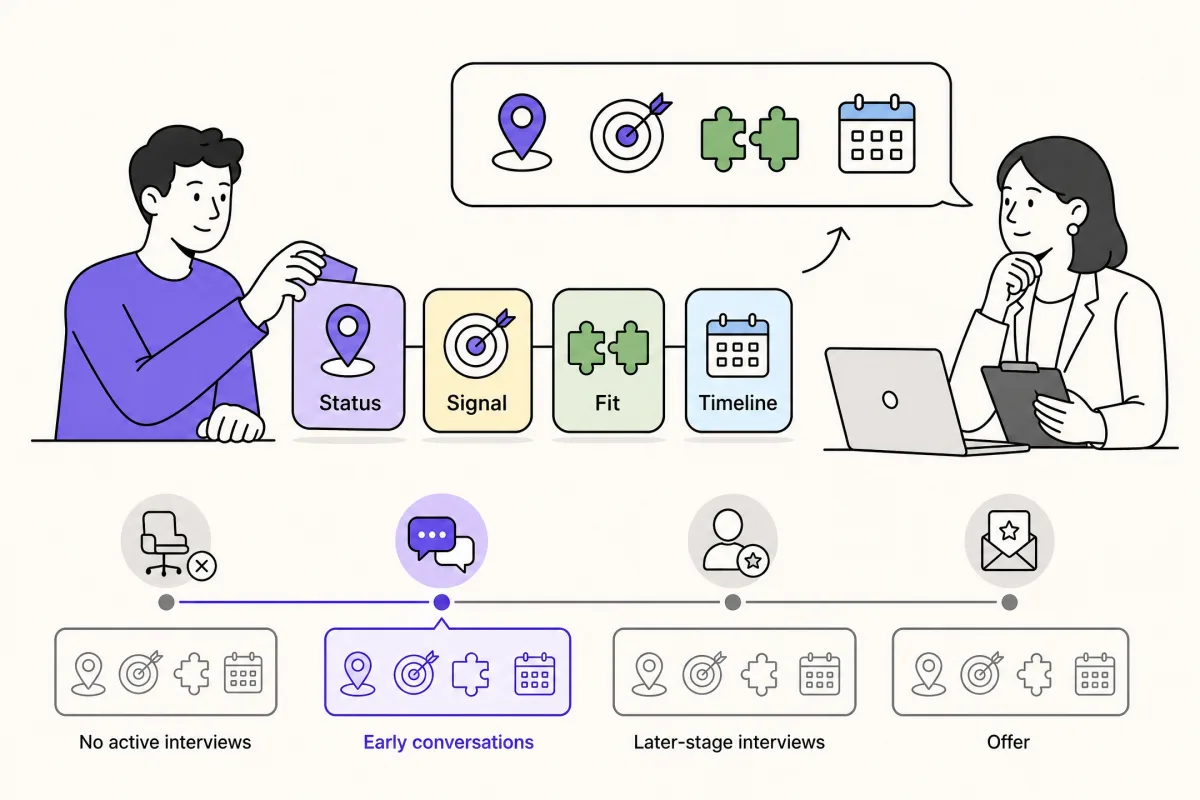
Use the Status-Signal-Fit-Timeline Answer Formula
Don't build a speech. Build four facts that fit into 15 to 30 seconds.
Status
Name the real stage without listing every application. Use language you could defend in a follow-up:
early in my searchspeaking with a few teamsin the later stages of another processreceived an offer with a response deadline of [date]
An application isn't an interview. Positive feedback isn't an offer. Keep the labels accurate now so your story still holds together later.
Signal
Show that your search has a direction. The common thread might be:
- A role type.
- A responsibility or skill.
- An industry or customer problem.
- A desired scope or career direction.
One sentence is enough. You want to sound deliberate, not as if you applied to every job with a keyboard.
Fit
Give one specific reason this role is a serious option. Skip number one choice and top priority unless you mean them. If you're still comparing, say one of the opportunities I'm most interested in, a particularly strong fit, or a role I would seriously consider.
Timeline
Share a date only if it exists. Otherwise ask:
"What are the remaining stages, and when does the team expect to make a decision?"
That question turns an awkward exchange into an ordinary scheduling conversation.
What to Say in Four Common Situations
Your answer should change when your situation changes. Pick the closest stage below and adapt the bracketed language. Don't borrow urgency from a later stage.
You Are Not Interviewing With Other Companies
Use this when: Your search just started, you're applying selectively, you're currently employed and this opportunity approached you, or your other applications haven't become interviews.
Say: You're not in another active interview process right now.
Don't imply: That you're unwanted, embarrassed, or committed to this company before you've learned enough to decide.
Example answer:
"I'm being selective and am still early in my search, so I am not in another active interview process right now. This role stood out because [specific responsibility, team, or problem]. Could you share the expected timeline for the next steps?"
Then ask: "What does the next stage look like, and when do you expect to move forward?"
Why it works: It answers the question without apologizing. If your search is genuinely early or selective, say that. Then spend your credibility on a concrete reason the role caught your attention.
You Are in Early or Mid-Stage Interviews
Use this when: You have real conversations or interviews underway, but nothing is close to a decision.
Say: You're speaking with a few teams at different stages.
Don't imply: That one recruiter message equals an interview process, or that offers are imminent.
Example answer:
"I'm speaking with a few teams about [role type] opportunities at different stages, but I do not have an offer deadline at the moment. I'm especially interested in this role because [specific fit]. What are the remaining steps and the expected decision date?"
Then ask: "What are the remaining steps, and when does the team expect to make a decision?"
Why it works: It gives the recruiter useful timing information without pretending you have leverage you don't have. Keep a few teams accurate. If it's one team, say one team.
You Are in Final-Round Interviews
Use this when: Another process is near a decision and you expect an update within a known window.
Say: The broad stage and the date you genuinely expect an update.
Don't imply: That an expected update is an offer deadline. Don't move the date forward to force a reaction.
Example answer:
"I'm in the later stages of another process and expect an update around [truthful date]. I remain very interested in this role because [specific fit]. Is there a realistic way to align the remaining steps with that timing?"
Then ask: "Is there a realistic way to align the remaining steps with that timing?"
Why it works: The employer can decide whether it can move. It may accelerate, keep its current schedule, or tell you it can't finish in time. You don't control that response. Your job is to give the team accurate information.
You Have Received an Offer
Use this when: Another employer has explicitly offered you the job. A final interview, a positive email, or "we should have good news soon" does not count.
Say: That you have an offer, plus the exact response date if the employer gave you one.
Don't imply: That verbal enthusiasm is a firm offer, that written terms exist when they don't, or that the deadline is earlier than it is.
Example answer:
"I have received an offer and need to respond by [date]. I have not made a decision, and this role remains a serious option because [specific reason]. Could you let me know whether the team can complete the remaining steps before then?"
If the offer is verbal and you don't have written terms or a fixed deadline:
"Another process has reached the offer stage, but I do not yet have written terms or a response deadline. I wanted to keep you updated because I remain very interested in this opportunity. What timing should I expect for your next decision?"
Then ask: "Can you share the target date for completing this process so I can plan responsibly?"
Why it works: Harvard's offer guidance recommends updating a preferred employer when a competing offer arrives and asking about your status. It also says not to bluff. A real date creates enough urgency; you don't need theatrical pressure. Save compensation details for the offer conversation. Our guides to answering the desired-salary question and accepting a job offer cover those separate decisions.
Use the Truthful Urgency Ladder
Urgency comes from a real decision point, not dramatic wording. Match the label to the facts:
| Real Status | Accurate Language | Language to Avoid |
|---|---|---|
| Applications only or a new search | early in my search, being selective | actively interviewing with several companies |
| Recruiter screens or mid-stage interviews | speaking with a few teams, at different stages | expecting offers soon without evidence |
| Final round | in the later stages, expecting an update around [date] | I have an offer |
| Positive verbal feedback | the process is progressing, I expect an update | verbal offer unless an offer was explicitly made |
| Formal offer | received an offer, need to respond by [date] | An earlier, higher, or invented deadline |
Check the Offer Terminology
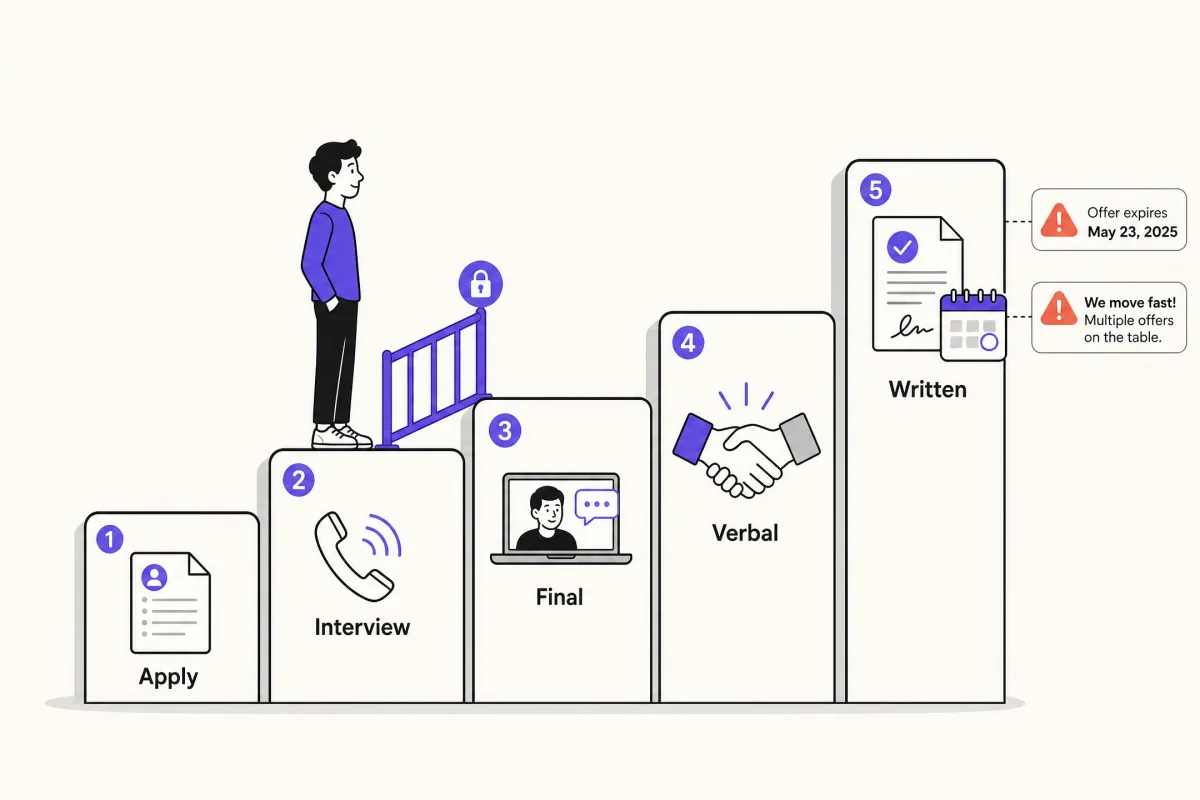
Don't promote yourself to the next stage before the employer does. Keep these distinctions straight:
- An application is not an interview.
- A recruiter conversation is not always an active interview process.
- A final round is not an offer.
- Positive feedback is not a verbal offer.
- A verbal offer is not the same as written terms.
- An offer without a stated deadline does not justify inventing one.
These aren't fussy technicalities. Each one changes what you can honestly tell another employer.
What You Should and Should Not Disclose
Privacy and deception are not the same thing. You may keep unnecessary details private. You may not replace them with invented facts.
| Information | Default Guidance | Reason |
|---|---|---|
| Whether an active process exists | Share truthfully | It answers the scheduling question |
| Broad interview stage | Share when relevant | It helps align timelines |
| Formal offer deadline | Share the exact date if it affects this process | It creates legitimate urgency |
| Industry or role category | Optional general context | It shows a focused search |
| Company names | Usually unnecessary | It protects privacy and reduces irrelevant probing |
| Exact interview dates and contacts | Usually unnecessary | They do not help the current employer assess fit |
| Another company's salary and benefits | Usually unnecessary at the interview stage | Compensation negotiation is a separate conversation |
| Unconfirmed verbal promises | Do not present as facts | They may never become an offer |
Hays also notes that you don't have to disclose specific details about other employers. A broad stage and a real deadline usually answer the scheduling question. The company name, interviewer's identity, and exact compensation usually don't.
Agency Recruiter Exception
A third-party recruiter may need to know whether you've already applied to a specific client so they can avoid a duplicate submission. Answer that narrow conflict question without handing over your complete search history:
"I keep the names of other employers confidential, but I can share the general stage and any real decision deadline. If you are planning to submit me to a client, I am happy to confirm whether I have already applied there."
That's cooperative without being an open-book request for every company in your pipeline.
More Leverage Is Not Always Better
Other interviews aren't magic leverage. A company may speed up, keep its schedule, or stop investing if it thinks you're unlikely to accept. Use this Interest × Timing matrix as a decision aid, not a prediction:
| Employer Interest | Candidate Timing | Possible Outcome | Candidate Response |
|---|---|---|---|
| High | Real final-stage process or offer deadline | The employer may accelerate | Give the real date and explain why this role is genuinely acceptable |
| High | No deadline | The process may continue normally | Ask for concrete next steps without manufacturing pressure |
| Moderate | Real late-stage process | The employer may accelerate or stop investing | Accept the uncertainty and do not exaggerate |
| Unknown or structurally slow | No deadline | Mentioning competition may not change the process | Ask for dates and remaining stages instead of repeating the leverage signal |
The harder you push the "other employers want me" message, the more clearly you need to show that this employer could actually hire you.
The University of Virginia's offer-negotiation rules give this principle a blunt name: "make it clear they can get you." If you mention your alternatives, also explain why you could choose this role. Otherwise, the recruiter may hear only that you're expensive to pursue and unlikely to accept.

How to Answer the Follow-Up Questions
Recruiters often ask a second question. Decide your boundaries before the call so you don't improvise a stronger story under pressure:
| Follow-up | What to say | Boundary |
|---|---|---|
| How far along are you? | Give a broad, truthful stage and a date only when supportable | Do not inflate progress |
| Which companies are you interviewing with? | Offer an industry, role category, or confidentiality boundary | Do not get defensive |
| Do you have any offers? | Answer yes or no precisely; distinguish a final interview, positive feedback, a verbal offer, and written terms | Do not blur the categories |
| When would you need to decide? | Give the exact deadline if one exists; if none exists, say so | Do not invent one |
| Is this role your first choice? | Do not force a false ranking; explain what makes it a strong fit and what information still matters | Do not overpromise loyalty |
| Would you accept our offer? | Avoid promising before reviewing the complete role and offer; confirm serious interest and name any unresolved decision factors | Do not accept blind |
For Which companies?, name the industry or role category, then return to this job. For Is this your first choice?, explain what makes the role strong without inventing a ranking. For Would you accept?, use a clean boundary: I'd need to review the full role and offer before committing, but I'm seriously interested.
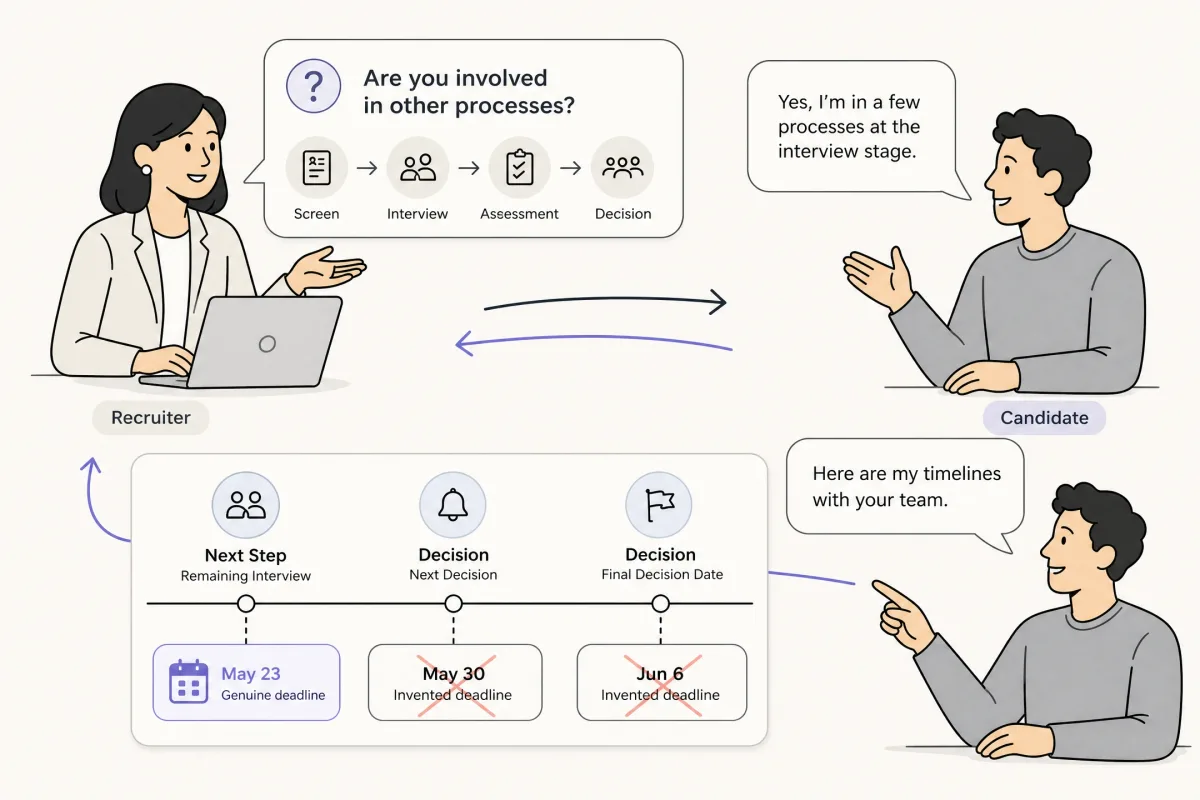
Ask for the Employer's Timeline in Return
They asked about your timeline. Ask about theirs. These questions work at almost any stage:
- What are the remaining interview stages?
- When does the team expect to make the next decision?
- What is the target date for completing the process?
- If another process reaches an offer stage, which update would be most useful to your team?
- Is there a realistic way to align the remaining steps with a decision deadline of [date]?
Skip Are you interviewing other candidates? It may feel satisfying for half a second, but it won't tell you when a decision is coming. Ask about stages and dates instead.
The National Association of Colleges and Employers, in its offer-deadline guidance, asks employers to explain their process and candidates to communicate pending deadlines. Treat the exchange as coordination, not a favor. Add one of these to the questions you prepare for the interview so you aren't guessing after the call.
When Your Status Changes After the Interview
Your answer can be true on Monday and outdated on Tuesday. That's normal. Update the recruiter when the change affects timing:
- Update the recruiter when a new final round or offer creates a real scheduling conflict.
- Give the exact date and keep the message short.
- Reaffirm specific interest in the current role.
- Ask whether the remaining steps can be completed by the deadline.
- Correct the record immediately if a deadline changes.
- If another offer is accepted, withdraw professionally from the remaining process.
Adapt this email to your situation:
Subject: Interview Process Timing Update

Hi [Name],

I wanted to share a timing update. I have received an offer and need to respond by [date]. I remain very interested in [Role] because [specific reason]. Could you let me know whether the team expects to complete the remaining steps before then?

I understand if the current process cannot be adjusted, and I appreciate the transparency.

Best,
[Your Name]
Keep salary out of this email. The relevant fact is the decision date. Robert Half's hiring-timeline advice also recommends asking about timing and following up professionally at each stage.
Answers That Damage Trust or Leverage
Bad answers usually fail in one of two ways: they invent leverage or promise too much. Use these spoken rewrites instead:
| Weak Answer | Why It Hurts | Say This Instead |
|---|---|---|
| "No, this is the only company I want." | Sounds absolute before you have enough information | "I'm early in a selective search, and this role stood out because [reason]." |
| "Yes, I'm about to get several offers." | Unsupported pressure damages trust | "I'm in a few active processes, but I don't have an offer deadline right now." |
| "I'm interviewing at [long list of famous companies]." | Sounds performative and invites irrelevant probing | "I'm focused on [role type] positions with [shared responsibility or scope]." |
| "Tell me how many other candidates you have." | Turns a useful scheduling question into a contest | "What are the remaining stages, and when do you expect to decide?" |
| "I have an offer," when you only received positive feedback | Creates a contradiction you may have to explain later | "The process is moving forward, and I expect an update around [date]." |
| "You're definitely my first choice." | Can sound rehearsed if key details are unresolved | "This is one of my strongest options because [specific fit]. I'd want to review the full role and offer before deciding." |
Forget trying to sound scarce. Give accurate information and keep a serious match possible. The employer's response to a real deadline also tells you something useful about its process.
Special Situations
Four situations deserve a small adjustment.
You Are Employed and Were Not Actively Looking
Say that no other active process exists, then explain what made this opportunity worth exploring. You weren't searching broadly. This role earned your attention.
Your Interviews Are in Different Industries
Name the responsibility, skill, customer problem, or career direction that connects the roles. Don't pretend the industries are similar. Explain the real thread.
The Employer Has a Slow Process
Ask for the realistic timeline. Don't invent a deadline to compensate for slow internal decisions. Once you know the pace, you can decide whether waiting makes sense.
A Third-Party Recruiter Asks for Company Names
Confirm only what is needed to prevent a duplicate submission. Keep unrelated processes private.
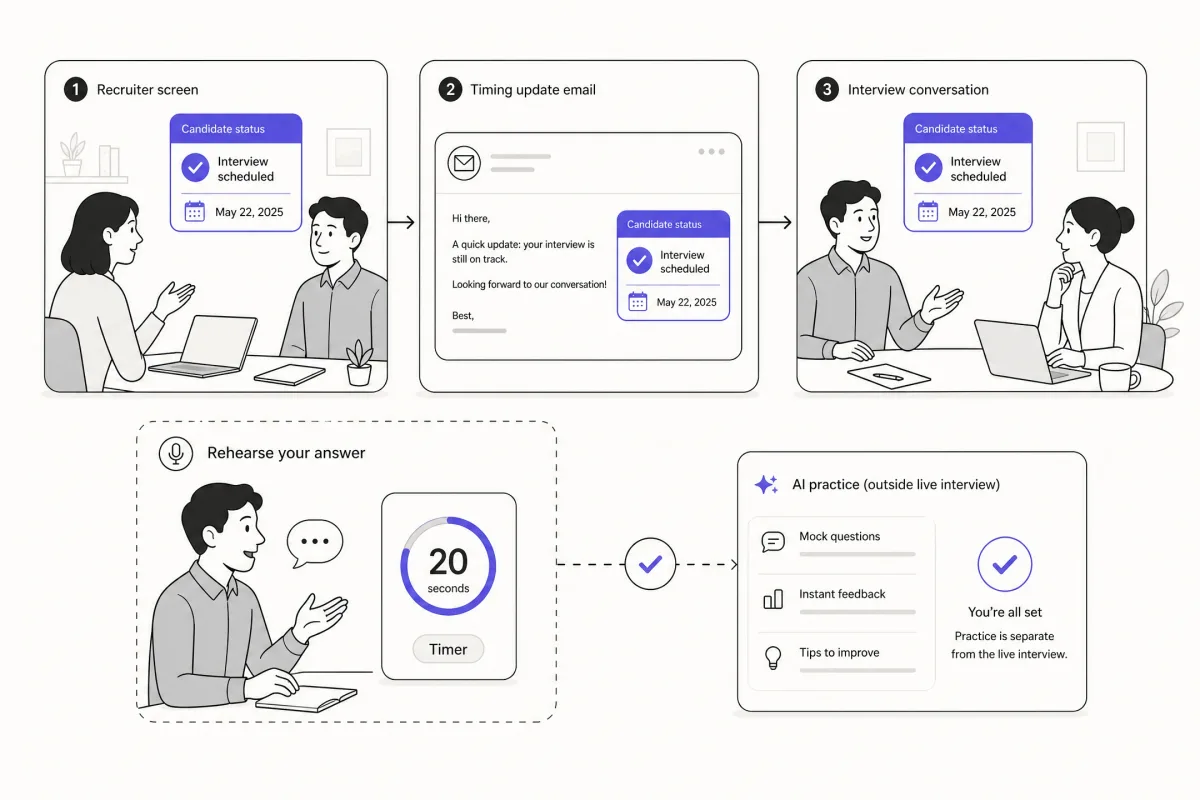
Practice a Consistent Answer With Great Offer AI
Knowing the right answer isn't the same as saying it cleanly under pressure. Use the Great Offer AI Interview Copilot to rehearse the version that matches your real situation, then practice the follow-ups: “How far along are you?”, “Which companies?”, “Do you have an offer?”, and “When do you need to decide?”
Don't use the tool to manufacture demand, company names, offers, salaries, or deadlines. Use it to shorten the answer, test your boundary language, and keep the same facts from the recruiter screen through any offer discussion.
Use real-time AI assistance only when the employer, institution, assessment provider, and interview platform allow it. Without clear permission, keep AI use to preparation and mock interviews before the call. Our guide to permission-first AI interview use explains the boundary.
Conclusion
When an interviewer asks whether you're interviewing with other companies, don't audition for the role of "high-demand candidate." Give the smallest truthful answer that helps both sides plan: your real stage, the kind of work you're targeting, why this role fits, and any actual deadline.
Before your next interview, write one 20-second answer and one timeline question. Say them aloud until they sound like you, not like a negotiation script. That's enough to protect your privacy, credibility, and room to decide. Use the Great Offer AI Interview Copilot for a mock round if you want to pressure-test the follow-ups before the call.