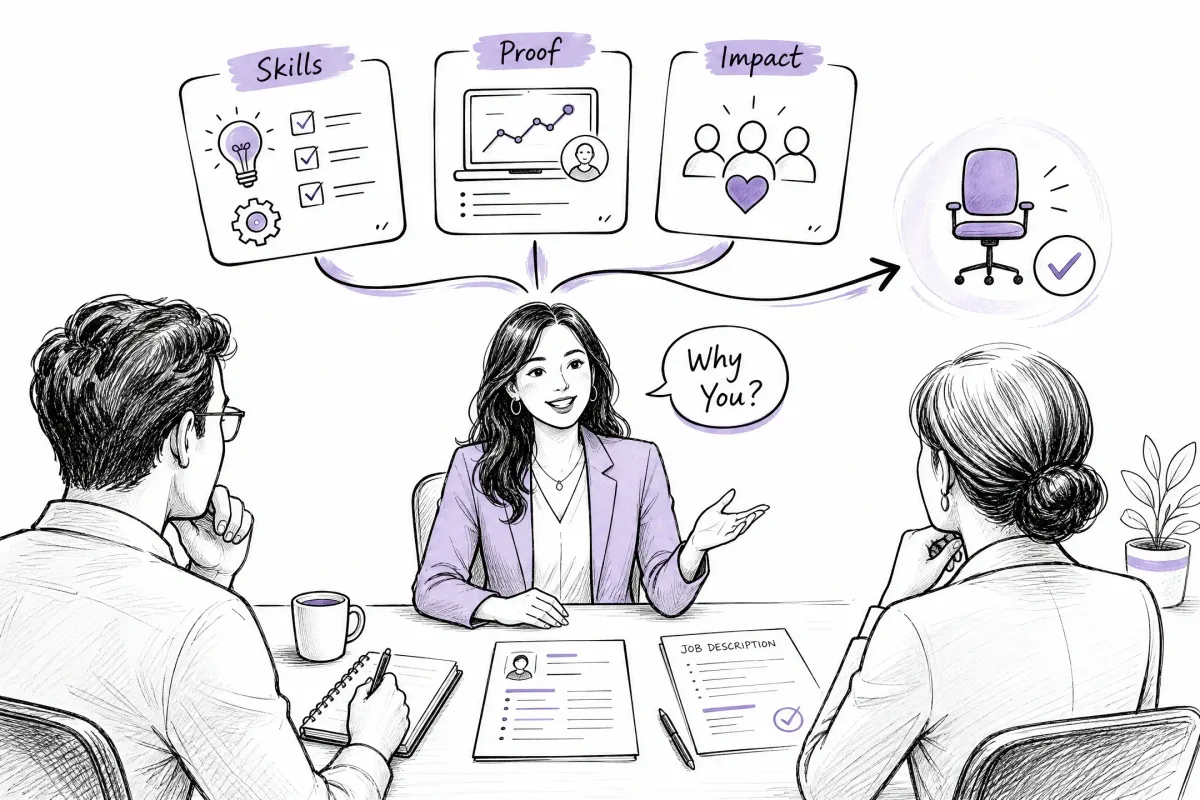

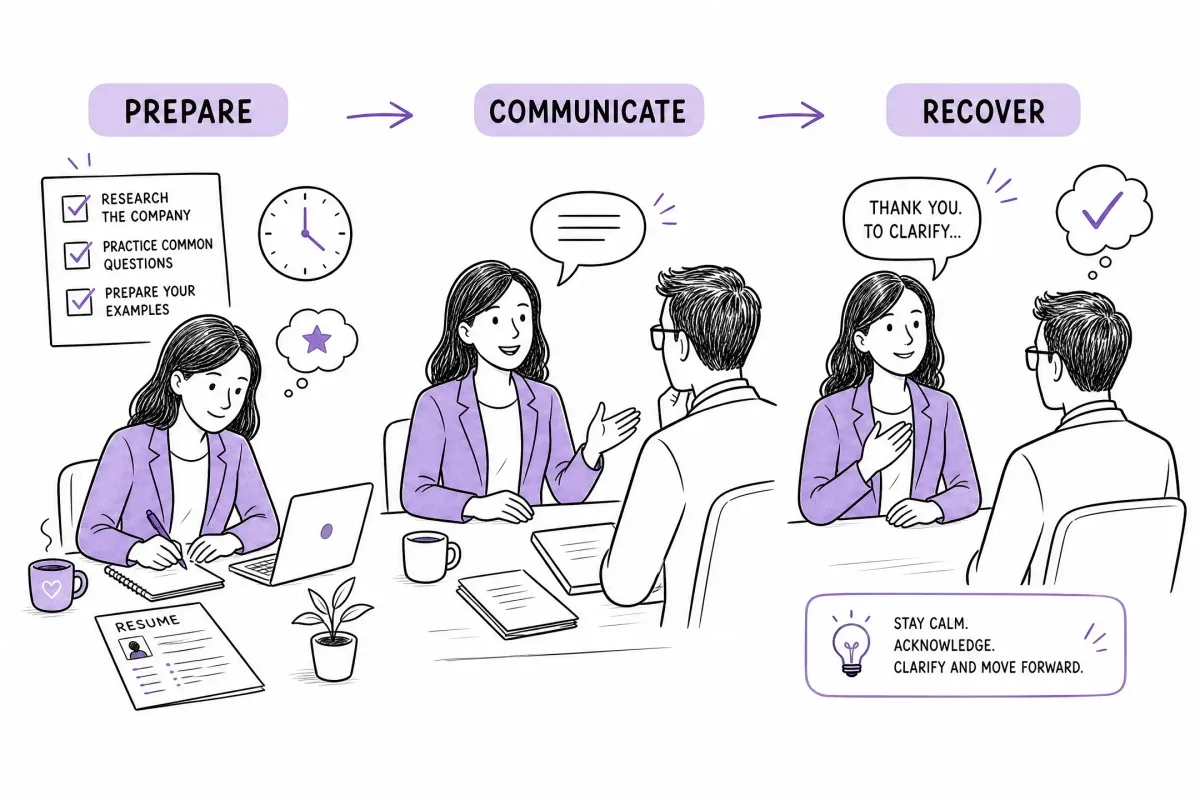
A job interview does not require perfect answers. It does require preparation, clear communication, relevant examples, sound judgment, and the ability to recover when something goes wrong.
The most common mistakes to avoid in a job interview include failing to research the company, arriving late, giving vague or overly long answers, criticizing former employers, not listening carefully, asking no meaningful questions, mishandling virtual interview technology, and following up poorly. Many of these mistakes are preventable, and some can be corrected calmly during the interview.
This guide explains what each mistake looks like, why it can weaken your interview, how to prevent it, and what to say if it happens.
The 15 Most Common Job Interview Mistakes at a Glance
- Failing to research the company and role
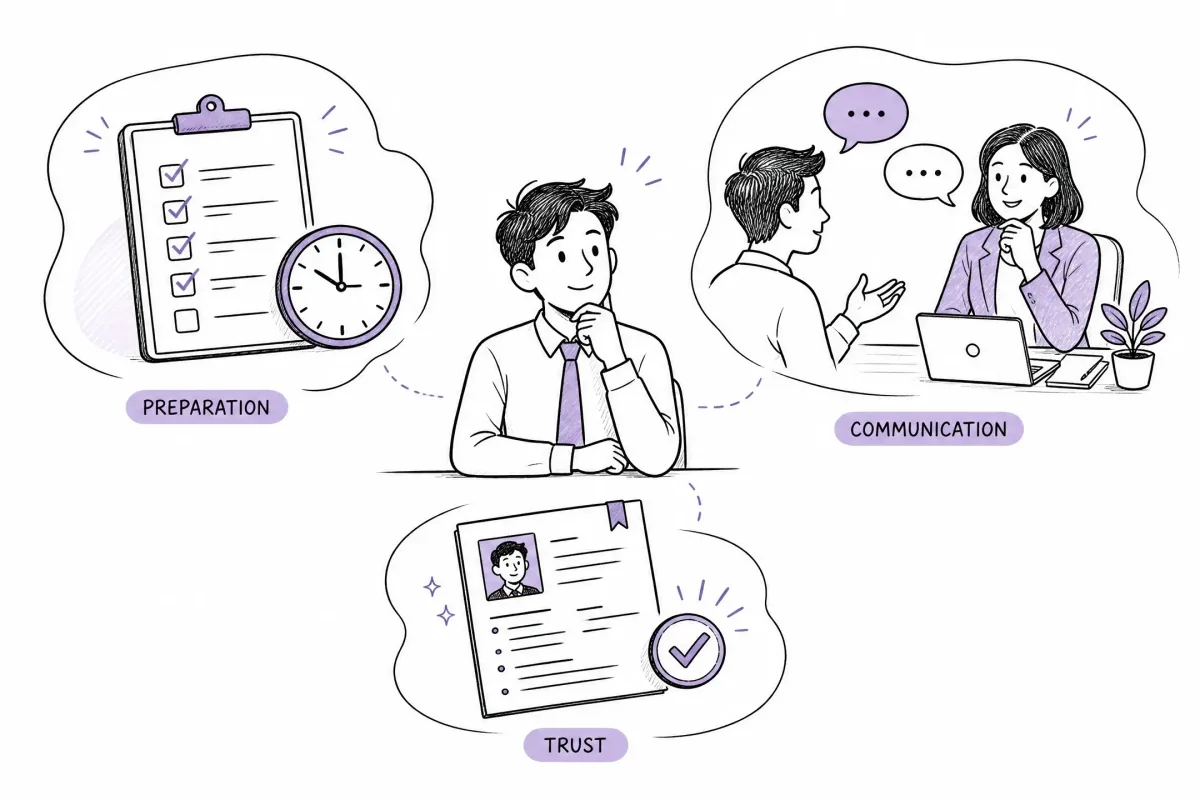
[Preparation Risk] - Arriving late or joining unprepared
[Preparation Risk] - Leaving technology and logistics untested
[Preparation Risk] - Dressing without considering the professional context
[Preparation Risk] - Giving long, unfocused, or rambling answers
[Communication Risk] - Making sweeping claims without specific evidence
[Trust Risk] - Not listening to the full question before answering
[Communication Risk] - Speaking negatively about previous employers or colleagues
[Trust Risk] - Exaggerating skills or experience on your resume
[Trust Risk] - Displaying distracting body language or disengagement
[Communication Risk] - Sounding heavily memorized rather than conversational
[Communication Risk] - Handling difficult or unexpected questions defensively
[Trust Risk] - Asking no meaningful questions at the end
[Preparation Risk] - Using interview assistance tools inappropriately
[Trust Risk] - Following up poorly—or failing to follow up at all
[Preparation Risk]
The seriousness of each mistake depends on what it communicates and how you respond. A brief pause or imperfect phrase is different from dishonesty, repeated disengagement, or ignoring explicit interview rules.
Mistakes You Make Before the Interview Starts
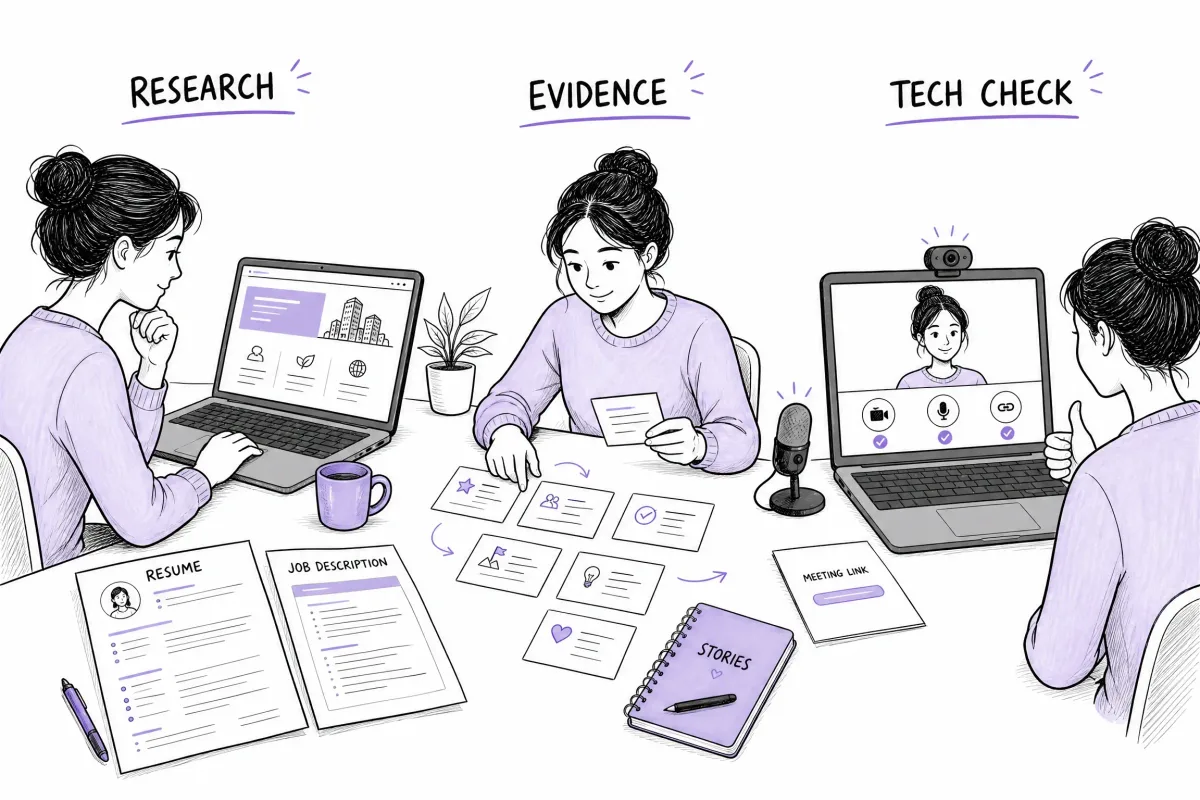
Preparation mistakes often affect the interview before the first question is asked. The goal is not to memorize everything about the company. It is to prepare enough context and evidence to make your answers specific and relevant.
Doing Too Little Research
Showing up with only a superficial glance at the company homepage can make your answers sound generic. Before the interview, identify:
- What the company does and who it serves;
- The product, service, or business area connected to the role;
- The main outcomes the position appears designed to deliver;
- The skills, tools, and responsibilities repeated in the job description;
- Two questions that show you understand the role.
Do not rely only on broad statements such as “I know your company is successful.” Connect your research to your own experience:
Research Translation Example: Instead of saying "I know you are a top software company," say "I saw your recent expansion into enterprise workflow automation, and my background scaling async messaging integrations aligns directly with where your engineering team is building."
The example works because it connects company research, a specific business direction, and relevant experience.
Practicing Answers Without Preparing Evidence
Practicing common questions without backing them up with concrete stories results in vague, unconvincing answers. Rather than trying to memorize dozens of scripts, build five versatile, reusable story blocks using the simplified STAR framework (Situation, Task, Action, Result).
| Story Category | Key Elements to Document | Reusable Scenario Focus |
|---|---|---|
| Achievement | Measurable outcome, timeline, team role | Projects delivered ahead of schedule or under budget |
| Conflict / Disagreement | Differing views, professional resolution, neutral tone | Navigating competing priorities with stakeholders |
| Failure / Mistake | Misstep, immediate accountability, lesson learned | System outage, missed metric, or process miscalculation |
| Leadership / Initiative | Unprompted action, cross-functional drive | Identifying a process bottleneck and creating a fix |
| Problem-Solving | Complex obstacle, analytical steps, final fix | Debugging a critical bug or resolving a client blocker |
Prepare the facts, sequence, and outcome of each story. Do not memorize every sentence. Interviewers may ask a follow-up question, and you need to explain the details naturally.
Leaving Logistics, Technology, and Appearance to Chance
Logistical friction creates unnecessary stress right before you sign on or step through the door.
- Do: Confirm the time zone, meeting link, software updates, camera angle, and microphone input 24 hours in advance.
- Don't: Assume your video conferencing app will update in seconds or that traffic will remain light.
- Do: Choose clean, comfortable attire aligned with the company culture (business casual for tech/startups; traditional formal for finance/legal).
- Don't: Overcomplicate your background or wear clothing that restricts comfort or causes technical video artifacting.
For an in-person interview, confirm the building, entrance, parking or transit route, and expected arrival process. For a virtual interview, test the exact device, connection, browser, camera, and microphone you plan to use.
Answer Mistakes That Weaken Strong Candidates
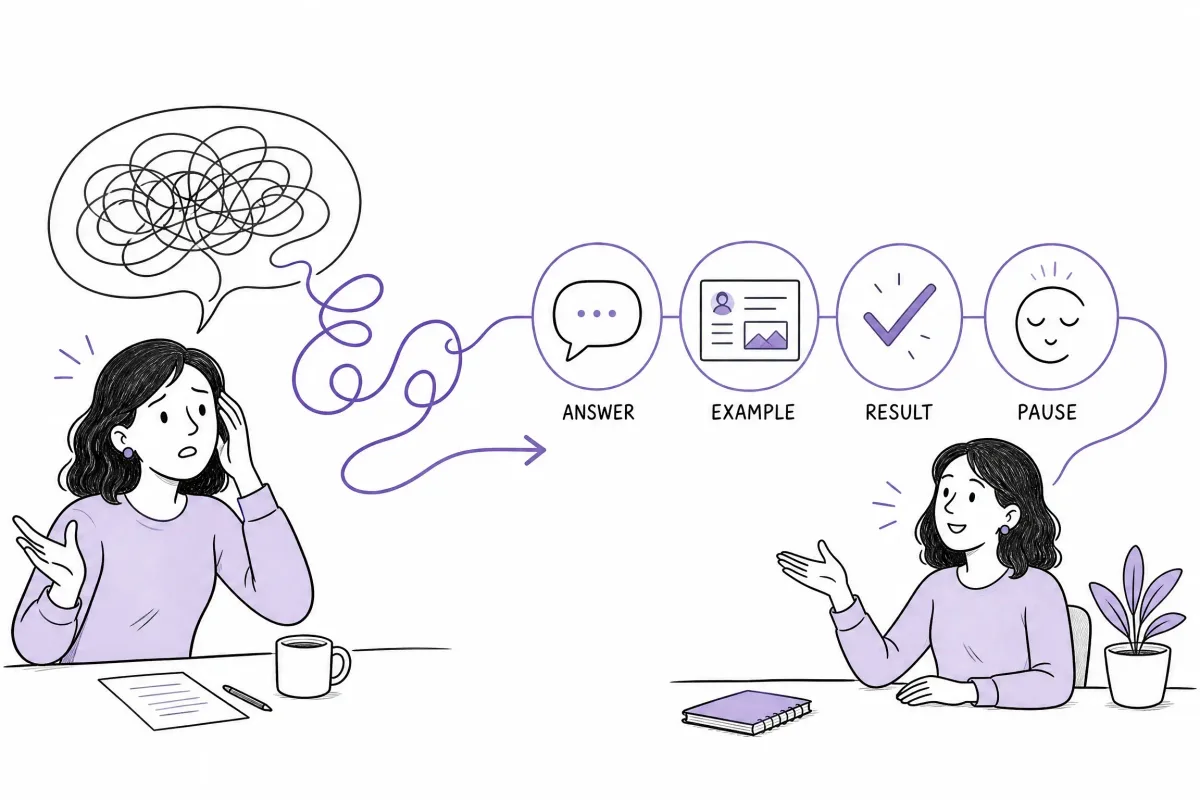
Strong experience can lose impact when an answer is too long, unsupported, defensive, or unrelated to the question. A useful structure is:
- Give the main answer first.
- Provide one relevant example.
- Explain the result or lesson.
- Stop and allow the interviewer to follow up.
Rambling Instead of Answering the Question
When candidates feel nervous, they often talk continuously while attempting to discover their point mid-sentence. Rambling dilutes your key message and makes it harder for the interviewer to evaluate your competence.
To stay concise, lead with your core conclusion first, support it with a 60-second example, and then pause. If you catch yourself rambling, use an immediate reset line:
"Let me pause and answer that more directly."
If you are unsure whether you have answered the question, ask:
"Would you like me to expand on the example or focus more on the result?"
Making Claims Without Specific Evidence
Self-congratulatory labels like "I'm a visionary problem solver" or "I'm an exceptionally hard worker" carry little weight without tangible proof.
- Weak Answer (Don't): "I am great at customer retention and always go the extra mile for clients."
- Strong Answer (Do): "In my previous role, I instituted a bi-weekly check-in cadence for at-risk accounts, which reduced quarterly churn by 14% across 22 enterprise clients."
Note: If exact percentage figures are confidential or unavailable, use verifiable ranges or relative metrics (e.g., "reduced resolution time from days to hours").
Before publishing, verify that any specific figures in sample answers are clearly labeled as illustrative or are supported by an approved source. Do not encourage candidates to invent metrics.
Speaking Negatively About a Previous Employer
Criticizing a former manager, toxic team, or prior company is one of the highest trust risks in an interview. Even if your frustration is entirely justified, badmouthing suggests potential difficulty with professional collaboration.
Use the four-part transition formula: Context → Neutral Fact → Professional Lesson → Future Fit.
Context & Neutral Fact
"Our team underwent three leadership restructures within six months, which shifted project priorities frequently."
Lesson & Future Fit
"While it taught me to remain adaptable under shifting targets, I realized I thrive best in an environment with clear, long-term strategic goals—which is why this role appealed to me."
Keep the explanation factual and brief. Do not use the interview to prove that a former manager was wrong.
Handling Weakness, Failure, and Salary Questions Defensively
High-pressure questions can reveal how you think about responsibility, learning, and trade-offs.
- Weakness Questions: Share a genuine, manageable professional growth area—not a disguised compliment like "I work too hard." Pair it with active mitigation. ("I historically struggled with delegating early-stage code reviews, so I set up explicit PR guidelines to empower junior devs while protecting my bandwidth.")
- Failure Questions: Take direct responsibility without blame-shifting, explain what you learned, and show how you applied that lesson later.
- Salary Expectations: If the topic comes up, give a range you can support with role scope, location, level, and your own requirements. Do not claim that one script works for every employer or market.
If you do not have enough information to discuss compensation, you can ask about the budgeted range, total compensation, or how the role is leveled before giving a final number.
Communication and Behavior Mistakes Interviewers Notice
Communication includes more than the words in your answer. It also includes whether you listen, respond to the actual question, and remain engaged with the conversation.
Interrupting, Missing the Question, or Talking Too Fast
Nerves can accelerate your speaking pace and make you answer before the interviewer has finished.
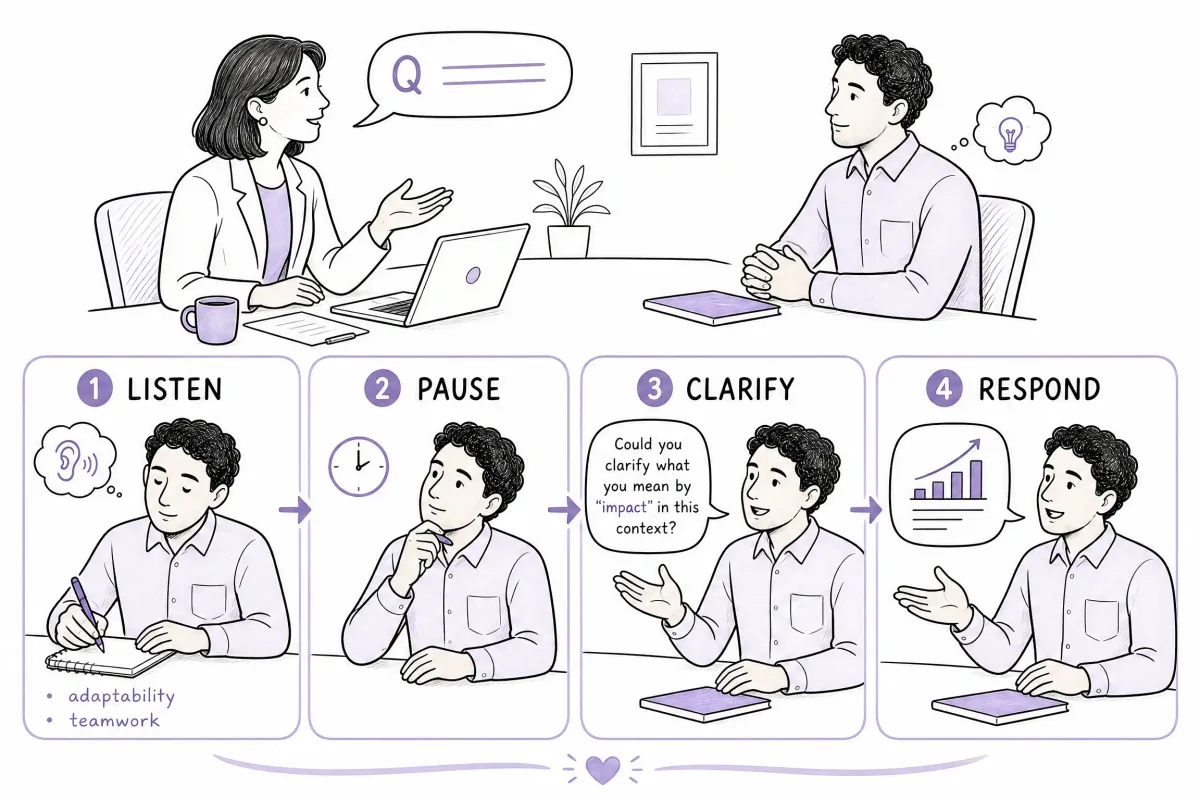
- Pause for 2 Seconds: Allow the interviewer to complete their full statement before speaking.
- Note Key Phrases: Write down 2–3 keywords while the interviewer speaks to keep your response anchored.
- Clarify Intent: If a question is ambiguous, confirm before answering: "Just to make sure I focus on what's most helpful, are you looking for an operational overview or the technical implementation details?"
A short pause is usually better than an immediate answer that addresses the wrong question.
Using Distracting Body Language
Body language advice should be practical and inclusive. Cultural backgrounds, accents, and neurodivergent communication styles vary widely; interviewers care far more about focus and engagement than rigid, forced gestures.
- Do: Maintain a comfortable, natural posture, position your camera at eye level, and keep your hands resting naturally.
- Don't: Repeatedly glance at a secondary phone screen, check notifications off-camera, or read word-for-word from hidden text windows.
The goal is not to perform a perfect set of gestures. Focus on listening, responding, and staying present. If eye contact is difficult for you, demonstrate engagement through clear answers, attentive listening, and relevant follow-up questions.
Sounding Memorized, Exaggerated, or AI-Generated
Reciting word-for-word scripts makes candidates sound robotic and unnatural. Interviewers may also ask follow-up questions that a memorized answer does not prepare you to handle.
Practice:
- The main point of each answer;
- One or two supporting details;
- The result or lesson;
- Possible follow-up questions.
Practice your stories with slightly different wording each time. This creates structure without forcing you to sound scripted.
Avoid These Mistakes in Virtual, Phone, Panel, and Technical Interviews
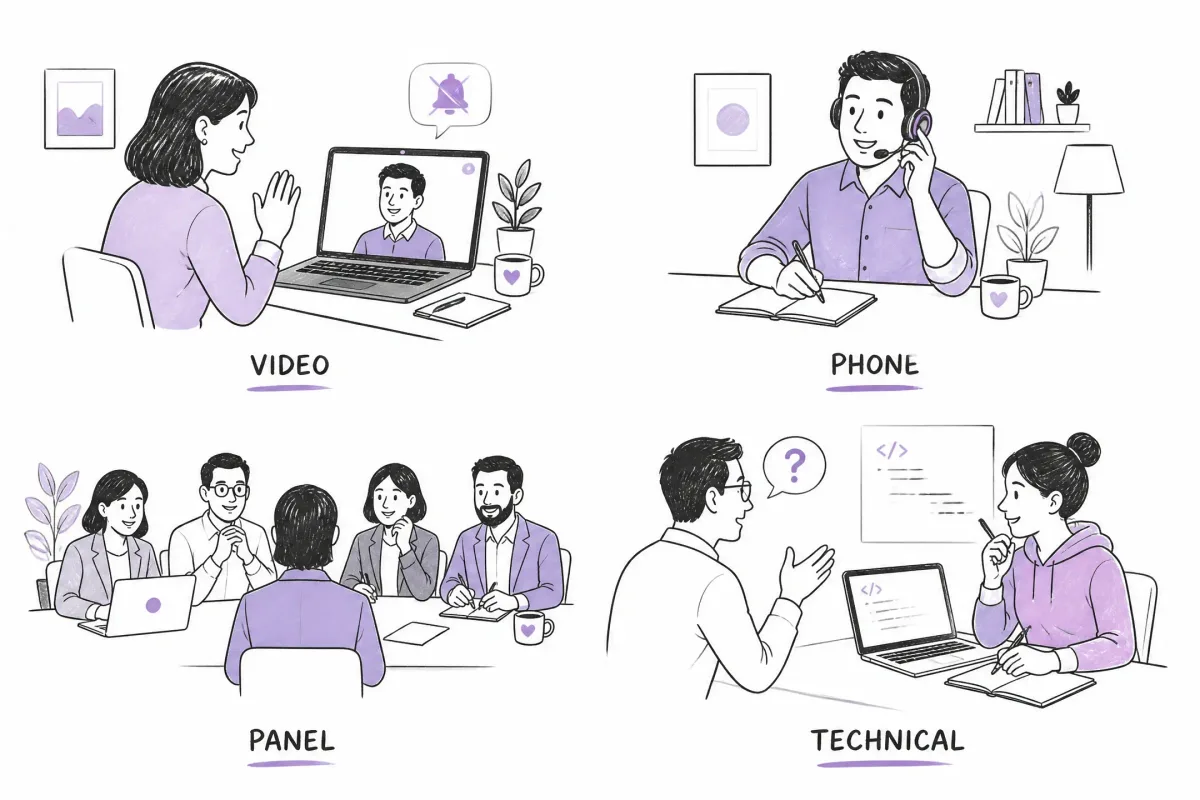
Different interview formats create different operational risks.
| Interview Format | High-Risk Mistake | Immediate Fix Action |
|---|---|---|
| Virtual (Video) | On-screen notifications popping up; reading scripts off-camera | Enable Do Not Disturb; place bullet notes near the lens |
| Phone Interview | Interrupting during audio delays; ambient background noise | Use a headset with noise cancellation; pause 2 seconds after speaker |
| Panel Interview | Addressing only the primary speaker; ignoring other panelists | Make eye contact with all panelists; reference specific panel questions |
| Technical / Coding | Jumping straight into code without clarifying requirements | State assumptions aloud; walk through edge cases before writing code |
Virtual Interview Mistakes
Before joining, check:
- The meeting link and time zone;
- Camera and microphone permissions;
- Internet connection and backup contact method;
- Lighting, camera height, and visible background;
- Notifications, private tabs, and unrelated windows;
- Whether your notes can be viewed naturally without reading a script.
If the connection fails, contact the recruiter or interviewer through the available backup channel. Keep the explanation short and focus on the next action.
Phone Interview Mistakes
Phone interviews remove visual cues, so pauses and interruptions can be more noticeable. Use a quiet location, stable reception, and a headset if appropriate. Let the interviewer finish speaking, and use a brief confirmation such as:
“That makes sense. I’d approach it in two steps.”
Panel and Technical Interview Mistakes
In a panel interview, answer the person who asked the question, then include the other panelists with natural eye contact or attention. Do not ignore a panelist who has not spoken.
In a technical interview, clarify the requirements before beginning. State assumptions, talk through trade-offs, explain edge cases, and describe how you would validate the result.
Using Interview Support Tools Responsibly
Preparation tools can help you organize experiences, practice answers, and identify gaps. They should not replace your own knowledge or be used to conceal a lack of capability.
If you use a tool such as the GreatOffer real-time AI interview copilot, treat it as a preparation or communication aid rather than a substitute for your own judgment. Before using any live assistance, confirm that it is allowed by the employer, assessment provider, or interview platform. Do not present AI-generated information or experience as your own if you cannot explain or defend it.
Three principles should guide your use of any interview support tool:
- Verify Employer & Platform Rules: Confirm that candidate support tools align with the guidelines set by your prospective employer or assessment platform.
- Never Mask Lack of Capability: Use AI guidance to organize your real thoughts and structured experience, not to claim expertise you do not possess.
- Maintain Authentic Dialogue: Ensure responses remain conversational and tailored to your actual background.
GreatOffer’s own terms and policies should be reviewed before publishing any product-specific claim or recommendation. The product should never be presented as a third-party authority, hiring guarantee, or substitute for preparation.
How to Recover From a Mistake During the Interview
A mistake is not automatically the end of an interview. The next step is to decide whether you should correct it immediately, clarify it later, or simply move on.
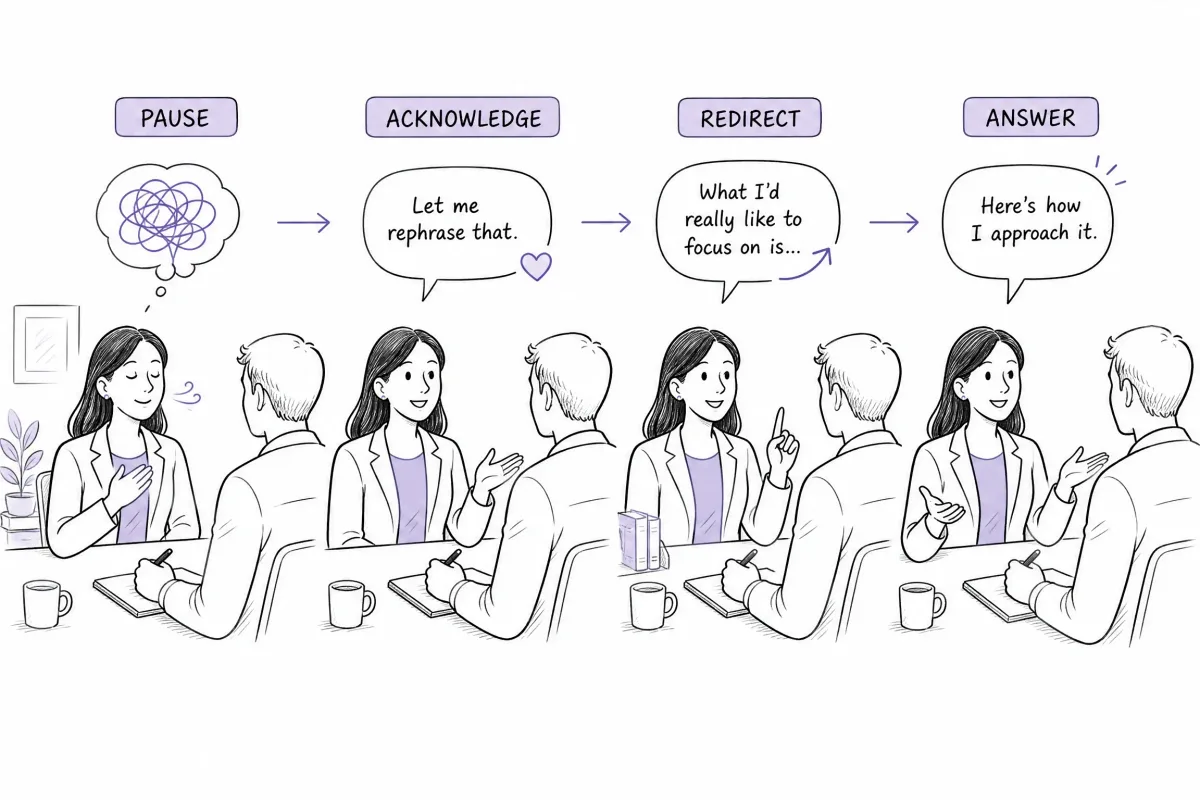
Use the Pause–Acknowledge–Redirect–Answer Method
When an answer stumbles, apply this simple four-step recovery sequence:
PAUSE
Take a slow, quiet breath to break the panic cycle.
ACKNOWLEDGE
Acknowledge the hiccup in 1 short, calm phrase.
REDIRECT
Signal a reset without over-apologizing.
ANSWER
Deliver your clean, structured response.
5 Direct Recovery Scripts to Use On the Spot
- When you lose your train of thought: "Let me pause for a moment to organize my thoughts so I can give you a clear answer."
- When you realize your answer was rambling: "Let me pause and answer that more directly."
- When you misheard or misunderstood the question: "On reflection, I realize I answered a slightly different question. May I revisit that to address [Topic] directly?"
- When you don't know an answer: "I don't have that exact metric at my fingertips right now, but here is how I would approach finding that solution..."
- When technology stutters or drops: "My apologies for the audio drop—I am back online now. Let me pick up right where I left off."
Recover From a Poor or Incomplete Answer
If you realize 10 minutes later that you left out a crucial project detail, you can circle back during a natural break or near the end of the interview:
"Before we move to your questions for me, I realized I left out a key piece of data when we discussed the system migration earlier. May I take 30 seconds to add that context?"
Use this approach only when the missing information is genuinely relevant. Do not interrupt the interview repeatedly to repair minor wording mistakes.
Recover From Lateness or Technical Problems
If an unexpected delay or connection failure occurs, handle it immediately:
- Before the Interview: Call or message your recruiter as soon as you anticipate a delay. Give a realistic ETA ("I am stuck due to a transit delay; I expect to arrive in 12 minutes. Please let me know if we should proceed or reschedule.").
- Upon Arrival / Connection: Offer a brief, sincere 1-sentence apology, assume responsibility without lengthy excuses, and pivot immediately to the interview.
After a technical problem, confirm that the interviewer can hear and see you before continuing. If the issue cannot be resolved quickly, ask whether they prefer to continue by phone or reschedule.
Decide Whether to Correct It in Your Follow-Up
Not every minor mistake requires a follow-up correction.
Worth Correcting in a Thank-You Email:
- A key factual metric you misstated;
- An important project detail you completely forgot;
- A major answer you left unfinished;
- A document or portfolio item the interviewer specifically requested.
Usually Leave Alone:
- A brief stutter;
- A moment of nervousness;
- A minor word slip that you corrected in the room;
- A short pause while thinking.
Repeatedly bringing up minor flaws in writing can draw more attention to them than the original mistake did.
Mistakes to Avoid After the Interview
The follow-up stage should reinforce your interest without becoming repetitive or demanding.
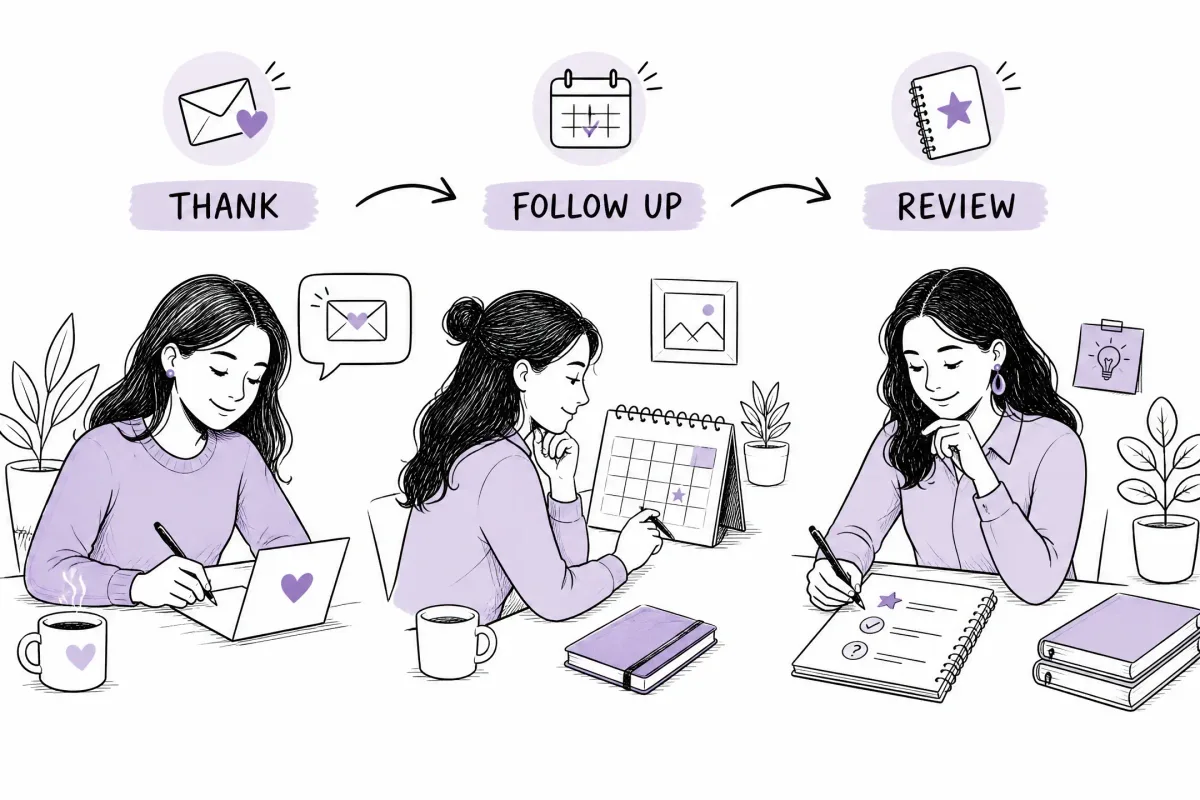
Sending No Thank-You—or a Generic One
A useful follow-up note can be short and specific.
4-Line Tailored Thank-You Structure:
- Express sincere appreciation for their time and the conversation.
- Highlight 1 specific topic or project discussed during the interview.
- Reiterate 1 core strength that aligns directly with that topic.
- Keep the closing concise and professional.
Avoid copying the same message to every interviewer without changing the details.
Following Up Too Often
Use the timeline provided by the interviewer. If they give a specific date, use that date as your reference point. If they do not provide a timeline, wait a reasonable amount of time before sending a short, polite check-in.
Do not send multiple messages in a short period simply because you are anxious. One clear follow-up is more useful than several messages that repeat the same request.
Failing to Review What Happened
Treat every interview as a learning opportunity. Conduct a five-minute review immediately after the interview.
| Question Prompts | My Debrief Notes |
|---|---|
| Which questions felt smooth and structured? | STAR story on conflict resolution worked very well. |
| Where did I struggle or feel unprepared? | Got caught off guard by the system architecture question. |
| Which technical or role facts need deeper review? | Need to review API rate-limiting formulas. |
| Action item for next interview | Prepare 2 concrete metrics for engineering scaling stories. |
Write down the actual question, the evidence you used, what you omitted, and what you will prepare next time. This makes the next practice session more focused.
A 10-Minute Pre-Interview Mistake-Proof Checklist
Use this checklist before the interview starts.
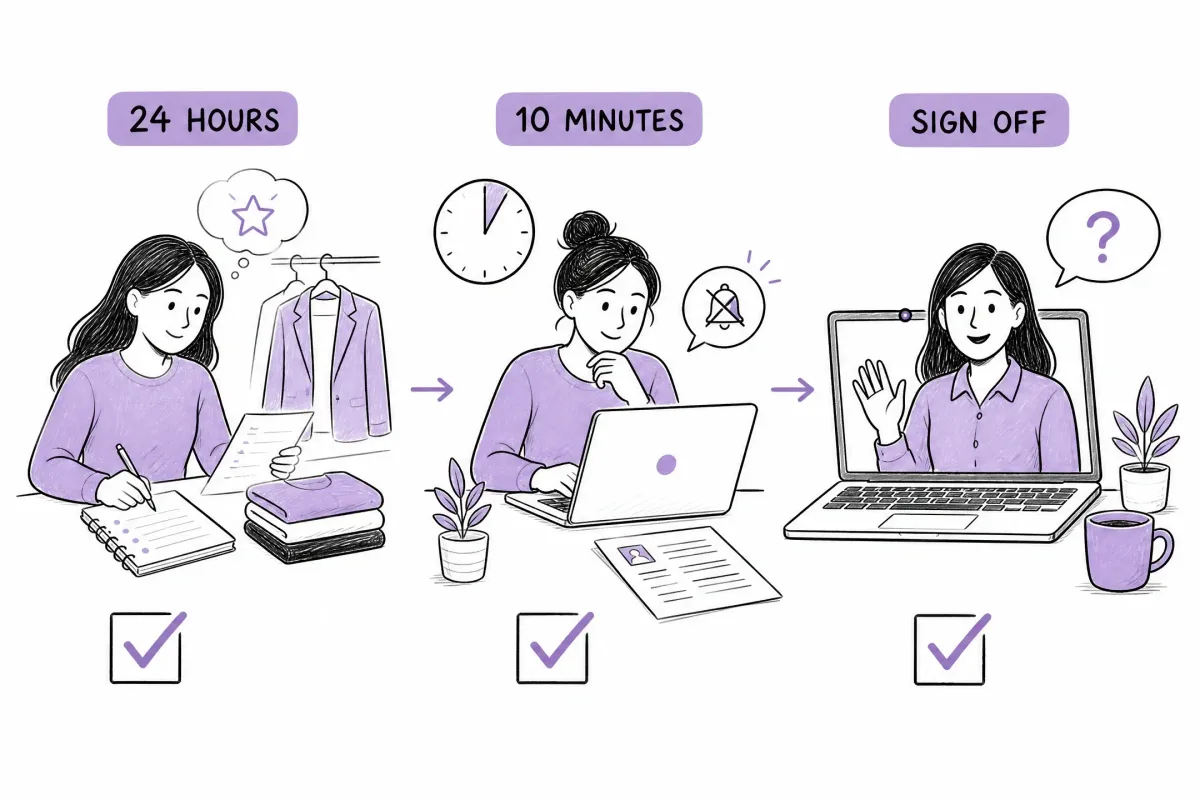
24 Hours Before
- Review the interviewer’s name, title, and role.
- Research the company’s product, service, customers, and current priorities.
- Confirm your five core evidence stories.
- Prepare two thoughtful questions.
- Test the meeting software, microphone, camera, and lighting.
- Confirm the route, building, meeting link, and time zone.
- Select appropriate attire.
10 Minutes Before
- Close unnecessary browser tabs, messaging apps, and email clients.
- Enable Do Not Disturb on phone and desktop devices.
- Position your resume and minimal bullet notes near eye level.
- Place a glass of water nearby and take three slow, deep breaths.
- Keep a backup phone number or recruiter contact available.
Before You Sign Off
- Ask meaningful questions about team challenges, role expectations, or next steps.
- Confirm the hiring timeline if the interviewer has not already explained it.
- Thank the interviewer sincerely for their time and insights.
Sources
Disclaimer
This article provides general interview preparation information, not legal advice. Employment and interview rules can vary by jurisdiction, employer, role, and assessment platform.
Conclusion: Avoid the Mistake—But Know How to Recover
Every candidate—from entry-level graduates to seasoned executives—will eventually experience an unexpected question or a minor interview stumble. What separates a strong response from a weak one is not absolute perfection, but the ability to stay composed, communicate clearly, and recover with confidence.
Before your next interview, choose two or three areas where you feel most vulnerable. Practice your core evidence stories, prepare one recovery sentence for each risk, and keep the 10-minute checklist handy.