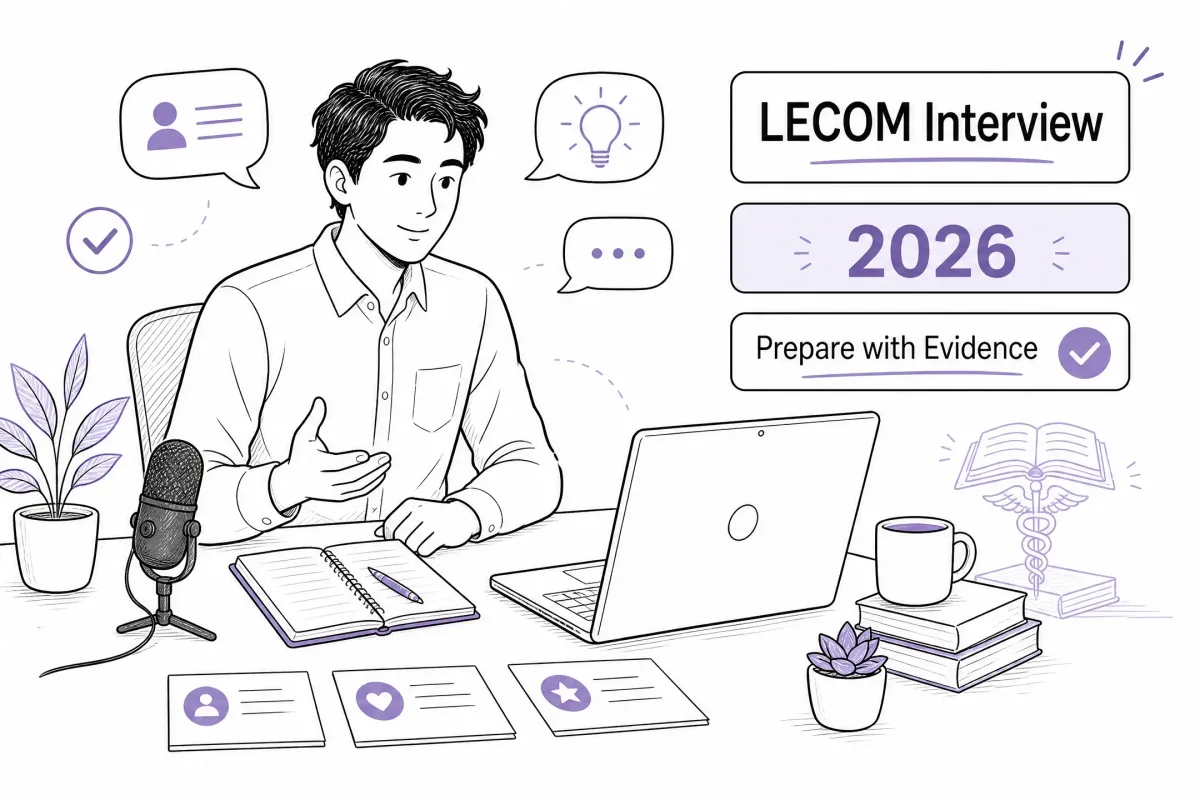
This guide is for applicants interviewing for LECOM's Doctor of Osteopathic Medicine (DO) program. It does not cover dental, pharmacy, EAP, or LECOM Health employment interviews.
What to Prepare First
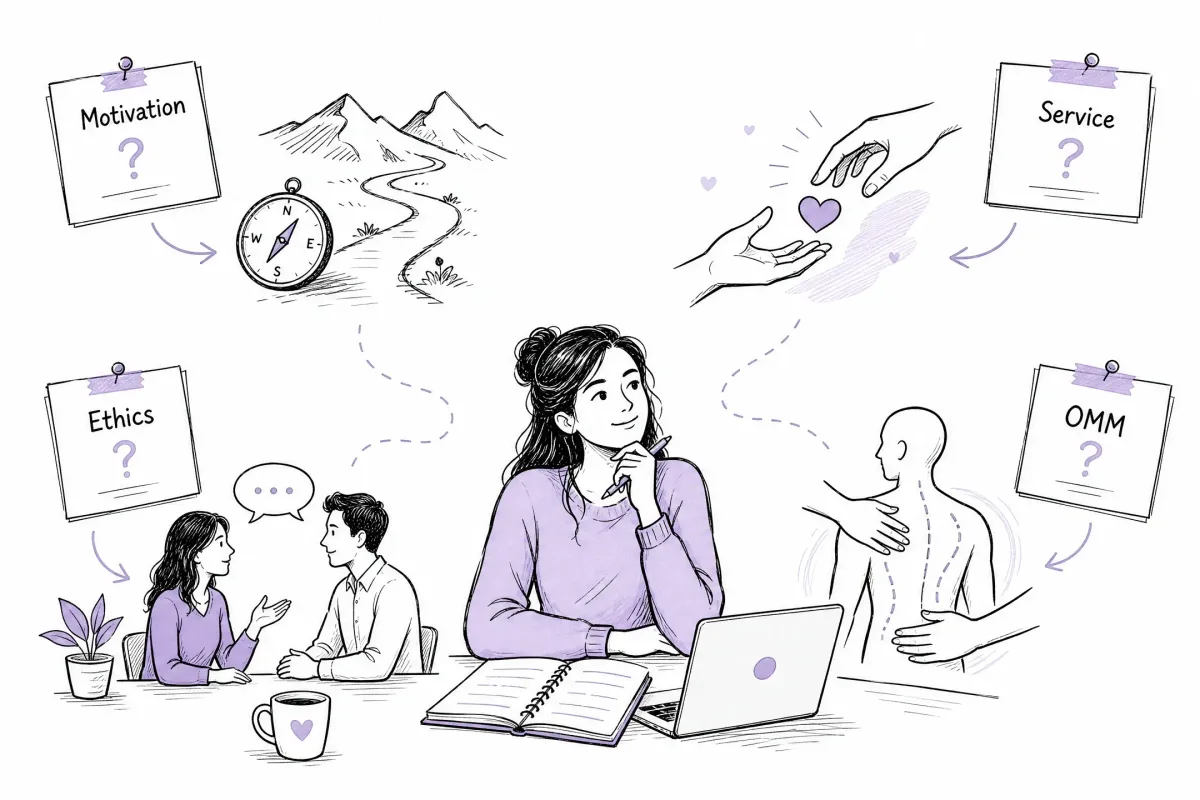
LECOM interview questions are best understood as recurring themes, not a permanent list of exact prompts. Prepare clear, evidence-based answers for:
- Why you want to become a physician
- Why osteopathic medicine
- Why LECOM
- Your learning-pathway fit
- Service, resilience, mistakes, and professionalism
- Patient distrust, treatment refusal, and public-health scenarios
- Osteopathic manipulative medicine (OMM)
- Any current LECOM material named in your invitation, such as a podcast or video
The most effective preparation is not memorizing online answers. Build a small set of true stories, connect them to the themes above, and practice responding to unfamiliar wording.
What Recent Applicant Reports Actually Tell Us
Important: This guide combines official LECOM information, dated applicant reports, and historical interview feedback. It is not an official LECOM question bank. Interview prompts, format, timing, assigned materials, and permitted resources can vary, so your invitation and applicant portal are the final authority.
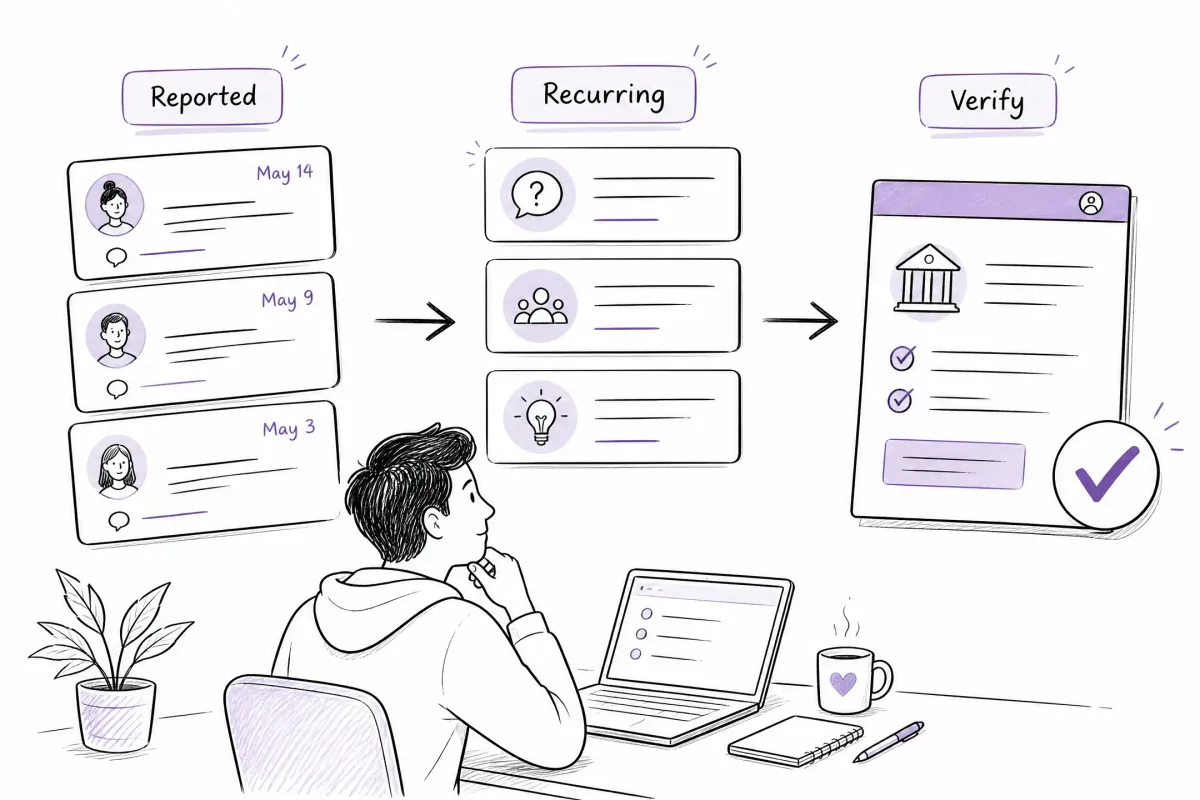
Online lists are useful only when you separate dated applicant reports from recurring historical themes.
A February 4, 2026 Reddit post covering the 2025–2026 cycle reported prompts about volunteering impact, the decision to pursue medicine, handling the academic and emotional demands of medical school, a patient who distrusts the medical system, improving U.S. public health, information the committee should still know, and LECOM social media.
Those topics remain useful practice material. However, later comments in the same discussion indicated that question sets can change. A newer August 2026 applicant discussion mentioned OMM, professionalism, what an applicant would contribute to LECOM, and a LECOM podcast. Treat community discussions as freshness signals—not proof that every applicant receives the same prompts.
Dated Question Tracker
| Evidence date | Cycle or context | Reported themes | How to use it |
|---|---|---|---|
| February 4, 2026 | 2025–2026 applicant report | Volunteering, motivation, resilience, patient trust, public health, additional information, LECOM social media | Use as a historical practice baseline |
| July–August 2026 | Comments during cycle transition | Applicants said the questions were changing | Do not memorize the earlier list word for word |
| August 2026 | 2026–2027 applicant discussion | Contribution to LECOM, professionalism, OMM, podcast-related reflection | Treat as emerging themes; verify your own instructions |
Use this tracker as a preparation map, not a prediction tool. The goal is to answer a new prompt with specific evidence, reflection, and a clear connection to medicine.
Confirm Your Program and Interview Format Before You Practice
Search results can mix regular DO admissions with Early Acceptance Program, dental, pharmacy, and LECOM Health employment interviews. Confirm that every resource you use applies to the process named in your invitation.
Before you begin mock interviews:
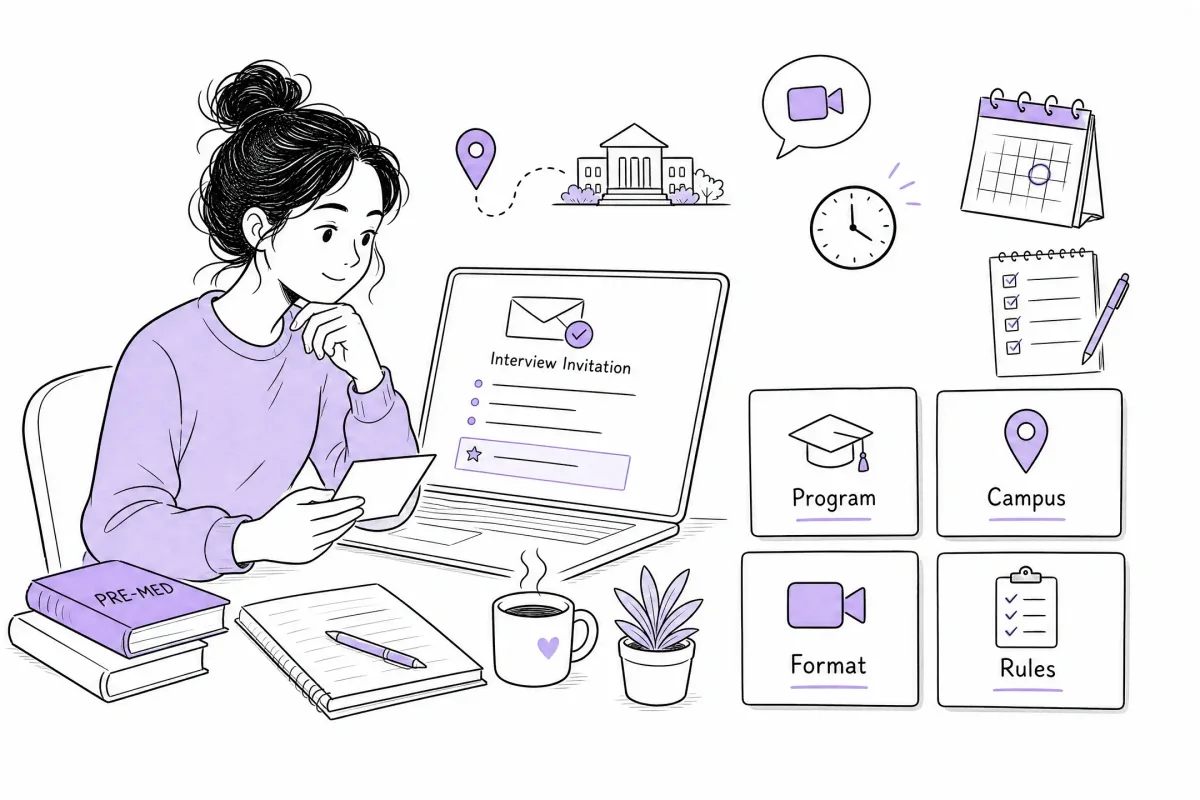
- Confirm the program and campus. Use your invitation and applicant portal, not a forum headline.
- Identify the format. Look for asynchronous video, live virtual interview, group interview, information session, or campus-visit instructions.
- Record the rules. Note the platform, deadline, time zone, attire, timing, retake policy, technical requirements, and whether notes are allowed.
- Check assigned materials. Look for a required webpage, podcast, video, policy, or other school-specific resource.
- Resolve conflicts with admissions. If an online report conflicts with your current instructions, follow the official instruction.
Applicant discussions suggest that experiences can differ by campus and cycle. Some Erie DO applicants have discussed asynchronous recordings, while other campus discussions mention live, group, or campus-day elements. These are applicant reports, not a universal LECOM policy. Do not assume a fixed question count, recording length, preparation time, or retake rule unless your current instructions state it.
LECOM Interview Questions by Theme
The questions below combine dated reports with recurring themes from the Student Doctor Network LECOM interview-feedback database. Because the database spans multiple years, it is best used to identify durable competencies, not to predict 2026 wording.
Motivation, Osteopathic Medicine, and School Fit
| Practice question | What a strong answer needs |
|---|---|
| Why do you want to become a physician? | One formative experience plus later evidence that confirmed your decision |
| Why osteopathic medicine? | A specific insight about patient-centered care, prevention, a DO experience, or OMM; do not frame DO as a backup |
| Why LECOM? | One or two verified LECOM features connected to your goals and experience |
| What would you contribute to the LECOM community? | A concrete strength supported by past behavior |
| Which LECOM learning pathway fits you best, and why? | Evidence of how you learn, collaborate, plan, and manage independent work |
Avoid reciting LECOM's mission statement. A stronger answer explains why a verified feature matters to you, shows evidence from your life, and states how you would contribute as a student.
Service, Resilience, and Self-Awareness
Prepare concise examples for questions such as:
- What impact has your volunteering had on other people?
- How will you manage the academic and emotional demands of medical school?
- Describe a challenge you faced and how you persevered.
- Tell us about a non-academic experience that shaped your decision to pursue medicine.
- What is one area you are actively working to improve?
- Tell us about a mistake or failure. What did you learn?
For each example, be clear about the situation, your responsibility, your action, the result, and your reflection. Focus on what you personally did. Protect patient or client privacy, and do not claim outcomes you could not observe or measure.
Patient Trust, Ethics, and Public Health
Scenario questions do not require a theatrical “perfect” answer. They are an opportunity to show that you can identify competing concerns, communicate respectfully, protect the patient, and recognize when to seek supervision.
- How would you respond to a patient who does not trust the medical system or your recommendation?
- What would you do if a patient declined treatment you believed was beneficial?
- What is a major challenge facing U.S. healthcare?
- How could an osteopathic physician contribute to better public health?
- What does professionalism mean in medicine?
Use this structure: Principle → Stakeholders → Action → Safeguard.
- Name the relevant principle, such as autonomy, safety, informed consent, or confidentiality.
- Identify who is affected and what you still need to understand.
- Explain your respectful next action.
- Add a safeguard, such as documentation, follow-up, consultation, or escalation.
For a public-health question, choose an issue you understand well enough to discuss with evidence and nuance. Avoid partisan slogans, unsupported statistics, and claims that one physician can solve a system-wide problem alone.
Emerging 2026 Themes: OMM and Current LECOM Content
Newer reports deserve attention because older preparation guides may not include them.
What Is Osteopathic Manipulative Medicine?
Prepare a plain-language answer. OMM is the hands-on component of osteopathic medical practice in which a DO uses osteopathic principles and specific techniques to evaluate and treat somatic dysfunction within a broader care plan. Do not describe it as a cure-all or reduce it to “cracking backs.” Review LECOM's current official materials before the interview.
A useful follow-up question is:
How would you explain OMM to a skeptical patient?
A strong answer should acknowledge the patient's concern, explain what OMM is and is not, discuss potential benefits and limitations honestly, invite questions, and ask permission before an examination or treatment.
What Did You Learn From a LECOM Podcast Episode?
Only prepare this as a required topic if your invitation, portal, or current applicant instructions mention it. If assigned, note the episode's main claim, one specific insight, how it relates to osteopathic medicine or medical education, and one respectful follow-up question or improvement.
Other emerging prompts may include:
- What would you bring to LECOM that is not already obvious in your application?
- How do professional expectations influence trust in medicine?
- Is there anything else the admissions committee should know about you?
Treat these as reported or practice themes, not guaranteed questions.
How to Build Strong Answers Without Memorizing Scripts
Prepare a small bank of true experiences and adapt them to different prompts.
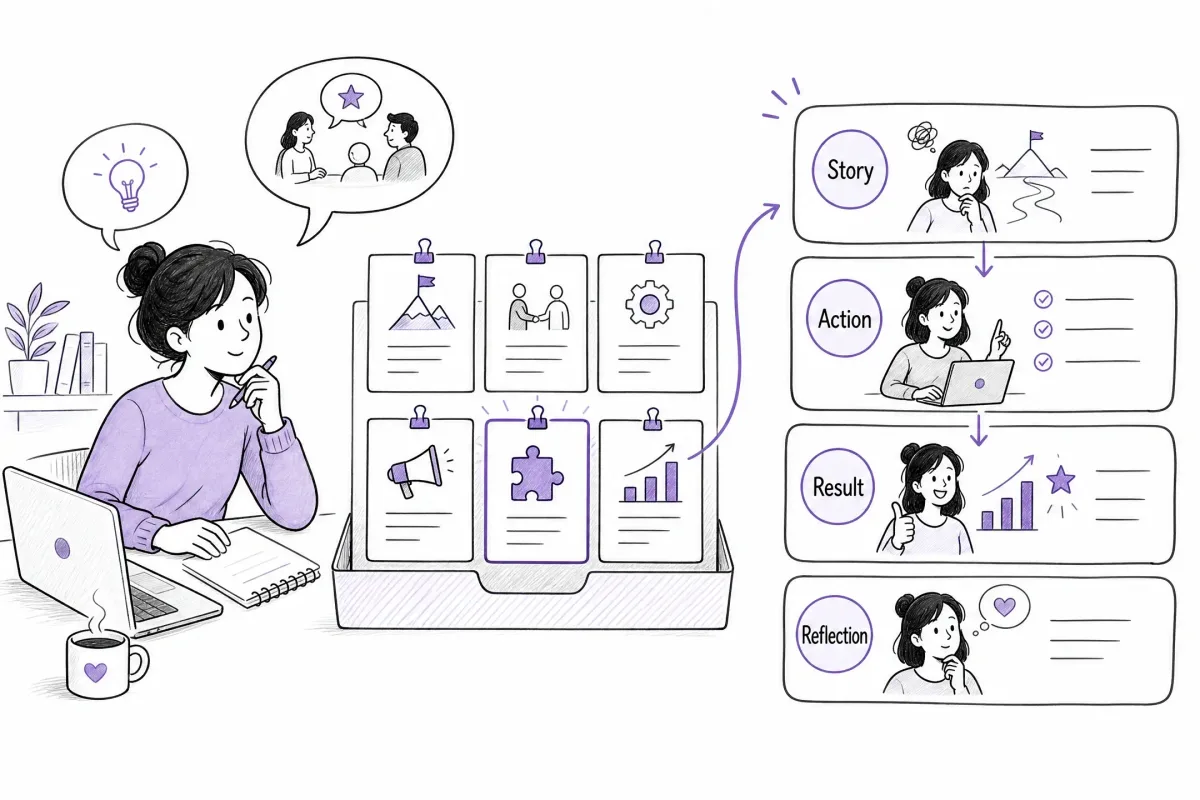
Build a Six-Story Evidence Bank
Prepare one example for each category:
- Service: A moment when your work affected another person or community
- Clinical exposure: An encounter that deepened your understanding of patient care
- Challenge: A demanding period that required resilience and support
- Teamwork or conflict: A disagreement, role problem, or communication breakdown
- Leadership or initiative: A time you improved a process or helped others act
- Mistake and growth: An error you owned and addressed
Keep each story to five bullets: context, responsibility, action, result, and reflection. Reflection turns an anecdote into evidence of growth.
Match the Framework to the Question
| Question type | Framework | Best use |
|---|---|---|
| Motivation and fit | Motivation → Experience → Insight → LECOM fit | Why medicine, Why DO, Why LECOM |
| Behavioral | Situation → Action → Result → Reflection | Service, conflict, failure, resilience |
| Ethical or scenario | Principle → Stakeholders → Action → Safeguard | Patient refusal, distrust, professionalism |
For a concise Why LECOM? answer, connect one verified school feature to personal evidence and a realistic future contribution. Do not copy another applicant's answer or force the same anecdote into every response.
Sound Prepared Without Sounding Memorized
Do:
- Practice from keywords rather than a full script
- Record multiple versions of the same answer
- Use a direct first sentence
- Change the example when the question changes
- End with reflection or relevance to medical training
Avoid:
- Reciting LECOM's mission statement word for word
- Giving a long biography before answering
- Claiming patient outcomes you could not measure
- Presenting another applicant's answer as your own
Research LECOM Before Answering “Why LECOM?”
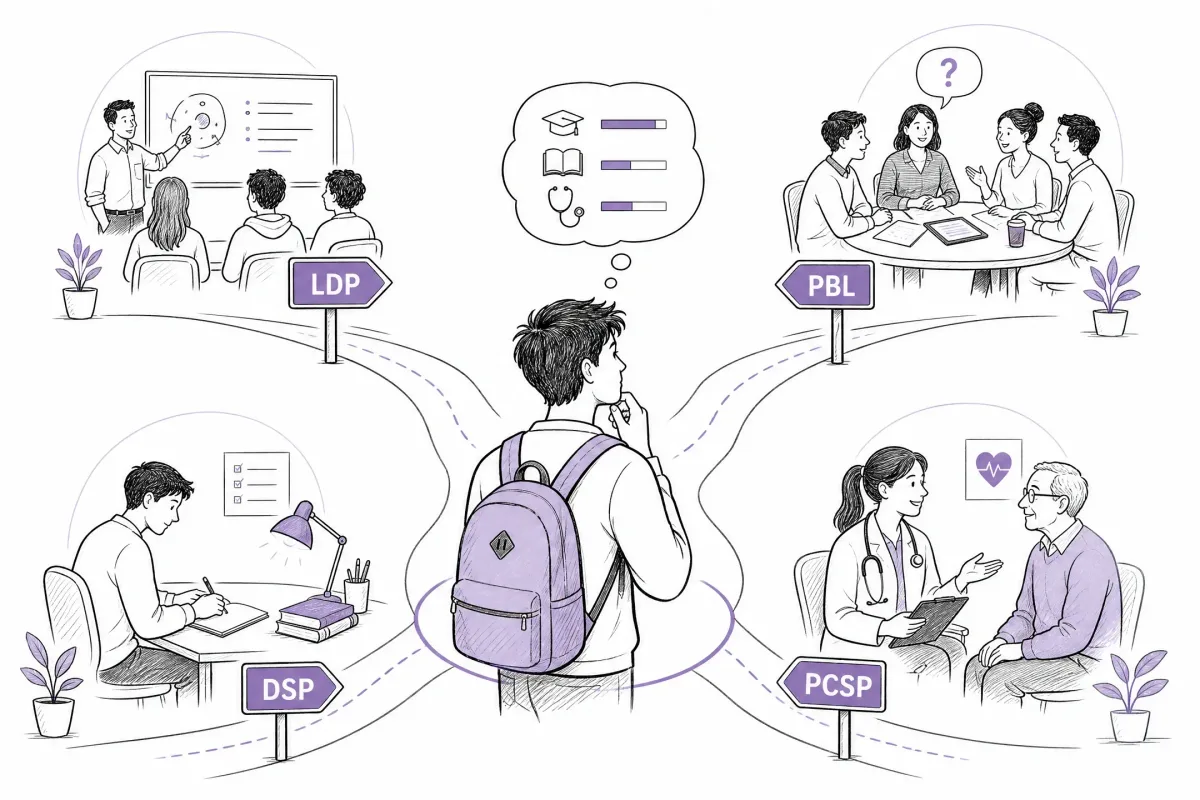
LECOM's College of Osteopathic Medicine lists multiple educational pathways, with availability varying by campus. Confirm the current option for your location on the official LECOM pathways page.
| Pathway | General structure | Evidence that can support fit |
|---|---|---|
| Lecture-Discussion Pathway (LDP) | Faculty-led lectures, laboratories, and structured coursework | You work well with a defined schedule and direct instruction |
| Problem-Based Learning Pathway (PBL) | Small-group cases with substantial self-directed study | You prepare independently, reason through uncertainty, and contribute to groups |
| Directed Study Pathway (DSP) | Organized independent study with defined requirements | You have demonstrated planning, accountability, and sustained self-learning |
| Primary Care Scholars Pathway (PCSP) | A pathway connected to primary-care preparation | You can explain a well-supported primary-care interest and understand the commitment |
Do not claim that a pathway “matches your learning style” without evidence. Describe a real setting in which you prepared independently, learned with peers, managed a structured schedule, or changed your study strategy after feedback.
A strong Why LECOM? answer contains:
- One verified LECOM feature that matters to you
- Evidence from your past showing the connection
- A realistic contribution you could make as a student
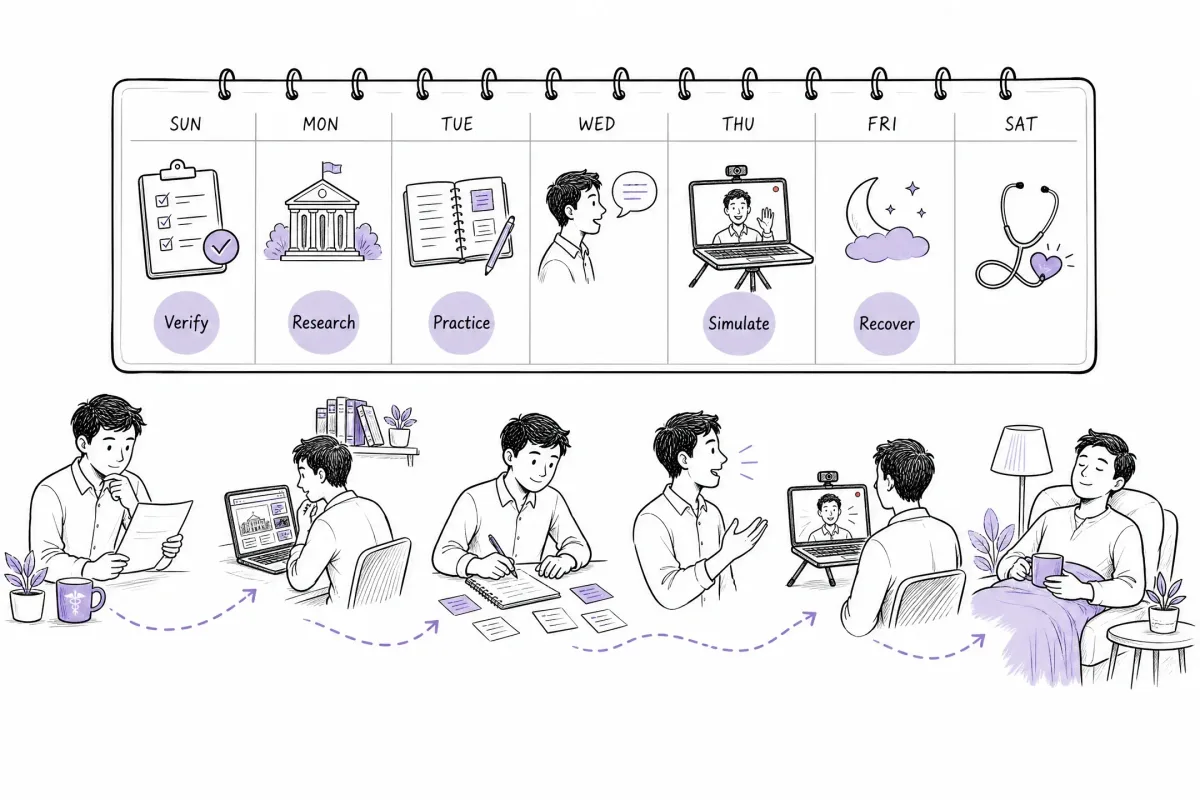
A Practical Seven-Day Preparation Plan
Day 1: Verify the Process
Confirm your program, campus, format, deadline, time zone, technology, attire, assigned materials, timing, and notes or retake rules.
Day 2: Research LECOM
Review official pathway and OMM information and your campus context. Complete any assigned podcast or video and record specific takeaways.
Day 3: Build Your Evidence Bank
Prepare six five-bullet stories and identify at least two questions each story can answer.
Day 4: Practice Motivation and Fit
Practice Why medicine?, Why osteopathic medicine?, Why LECOM?, pathway fit, and what you would contribute. Record 45-, 60-, and 90-second versions.
Day 5: Practice Scenarios
Work through patient distrust, treatment refusal, professionalism, resilience, and one healthcare issue. Explain your reasoning aloud.
Day 6: Complete a Full Simulation
Use unfamiliar questions, limited preparation, and one take. Review relevance, structure, evidence, reflection, pacing, eye line, and filler words.
Day 7: Consolidate and Recover
Review only your core bullets, official instructions, OMM explanation, pathway fit, and technical checklist. Test logistics and protect your sleep.
If You Have Only 24 Hours
Prioritize the format and deadline, three flexible stories, Why medicine?, Why DO?, Why LECOM?, a clear OMM explanation, any assigned material, and one realistic recorded mock interview.
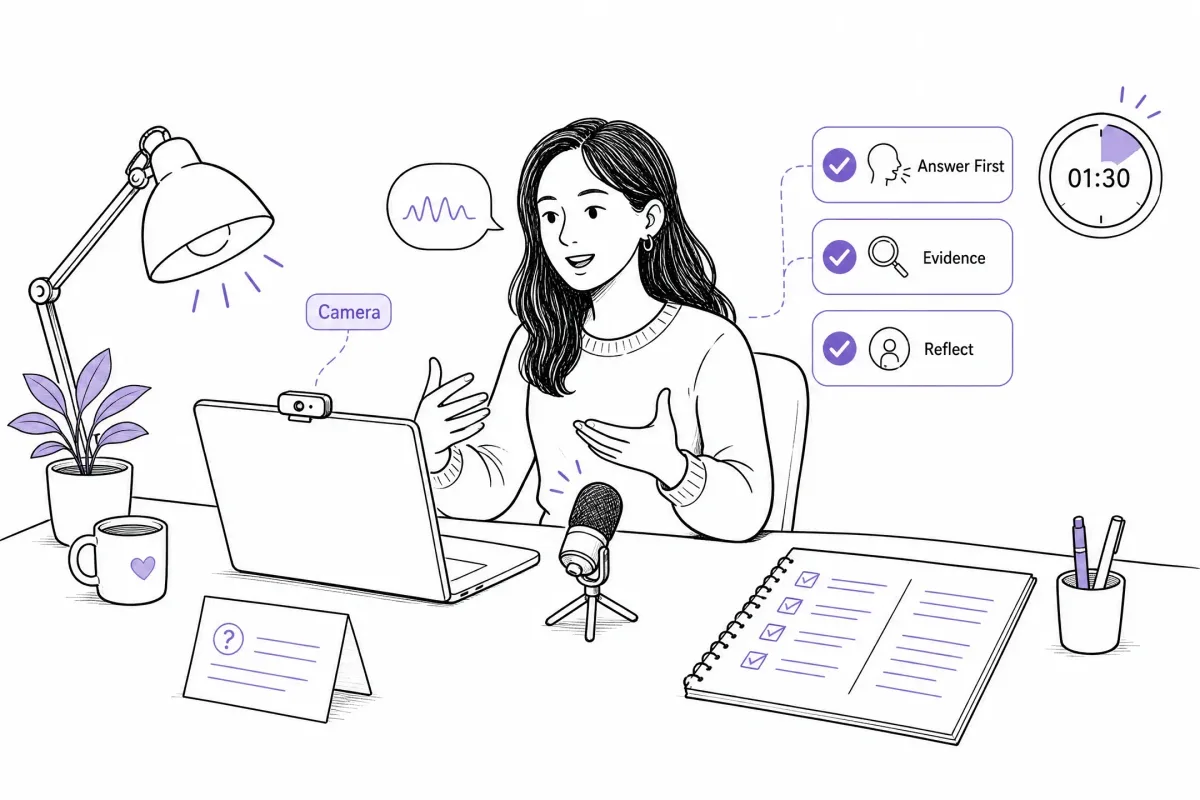
How to Practice for an Asynchronous LECOM Video Interview
Recorded interviews remove live feedback. Realistic repetition makes that environment less distracting.
Run a Timed Mock Interview
- Place the camera at eye level in a quiet, well-lit space.
- Close notifications and unnecessary programs.
- Draw one unfamiliar question at a time.
- Use the timing and retake rules from your own instructions.
- Record a single take unless retakes are explicitly allowed.
- Review the entire simulation after finishing.
Do not assume LECOM permits notes, captions, retakes, or external assistance. Follow your current interview rules.
Use a Simple Review Scorecard
Score each area from 1 to 5:
| Criterion | Review question |
|---|---|
| Relevance | Did the first sentence answer the actual question? |
| Structure | Could a listener follow the response? |
| Specificity | Did I provide concrete evidence? |
| Reflection | Did I explain what I learned or changed? |
| Timing | Did I finish without rushing or padding? |
| Delivery | Was my voice clear and conversational? |
| Visual focus | Did I look primarily toward the camera? |
If you stumble, pause and return to the point: “The main point I want to emphasize is…” Do not repeatedly apologize.
For interview practice, you can use GreatOffer AI's real-time AI interview copilot to rehearse unfamiliar prompts, practice pacing, and review answer structure. Use it before the official interview. Complete the LECOM interview independently and follow every instruction in your invitation.
Printable Pre-Interview Checklist
- I confirmed my program and campus.
- I read the invitation and portal instructions.
- I confirmed the deadline and time zone.
- I know whether the interview is recorded, live, group-based, or on campus.
- I checked for an assigned podcast, video, or webpage.
- I prepared six evidence stories.
- I practiced Why medicine?, Why DO?, and Why LECOM?.
- I can explain OMM accurately in plain language.
- I practiced a patient-trust scenario.
- I completed at least three timed recordings.
- I tested camera, microphone, lighting, power, and internet.
- I closed any resource or tool not permitted by the interview rules.
Prepare for Themes, Not a Leaked Question List
Use a 2026 question list to identify what to think about, not to produce a script. Confirm your instructions, prepare six true stories, practice motivation and fit, review OMM, check current-cycle materials, and complete a timed simulation. Wording changes; clear, reflective evidence remains useful.
Sources and Further Reading
- LECOM College of Osteopathic Medicine Learning Pathways
- LECOM DO Interview Questions 2025–2026 — Reddit
- LECOM Interview Questions — August 2026 Reddit Discussion
- LECOM Interview Feedback — Student Doctor Network
- LECOM Medical School Interview Tips — Cracking Med Admissions
- LECOM Interview Guide — NextGen Med Prep
- LECOM SDN Interview Questions — Leland