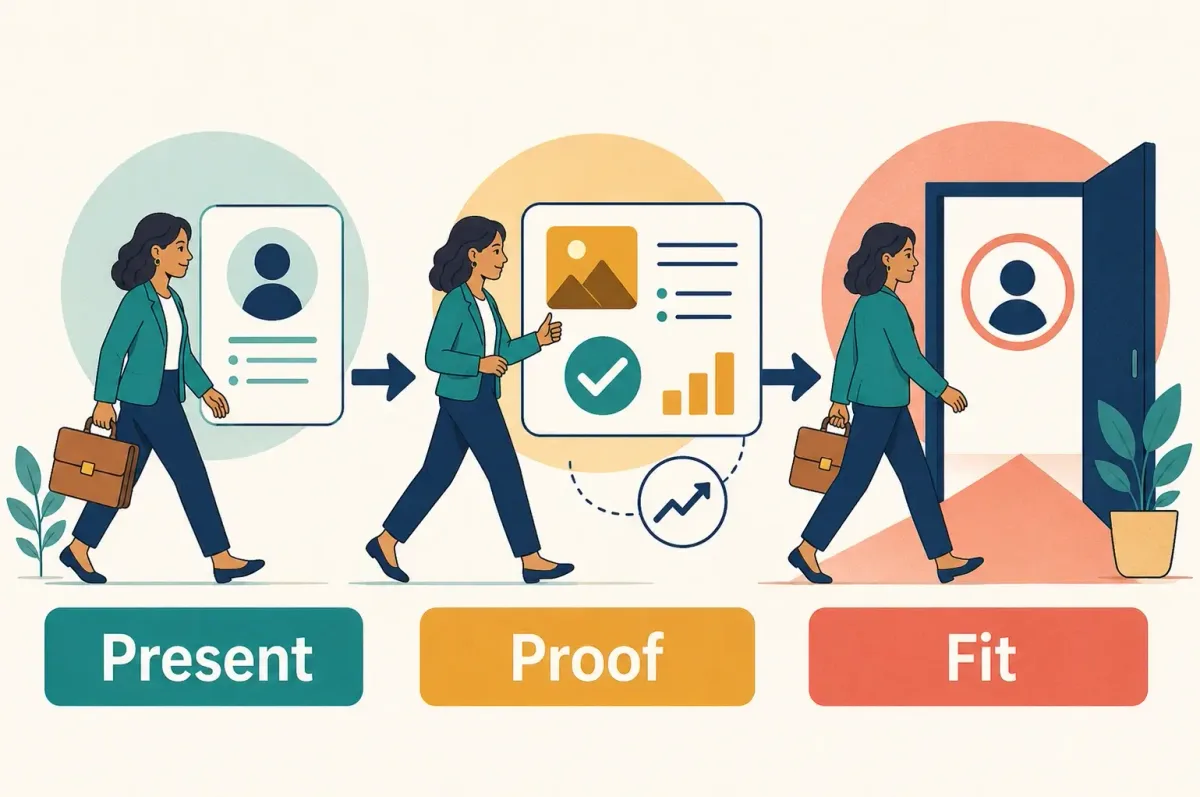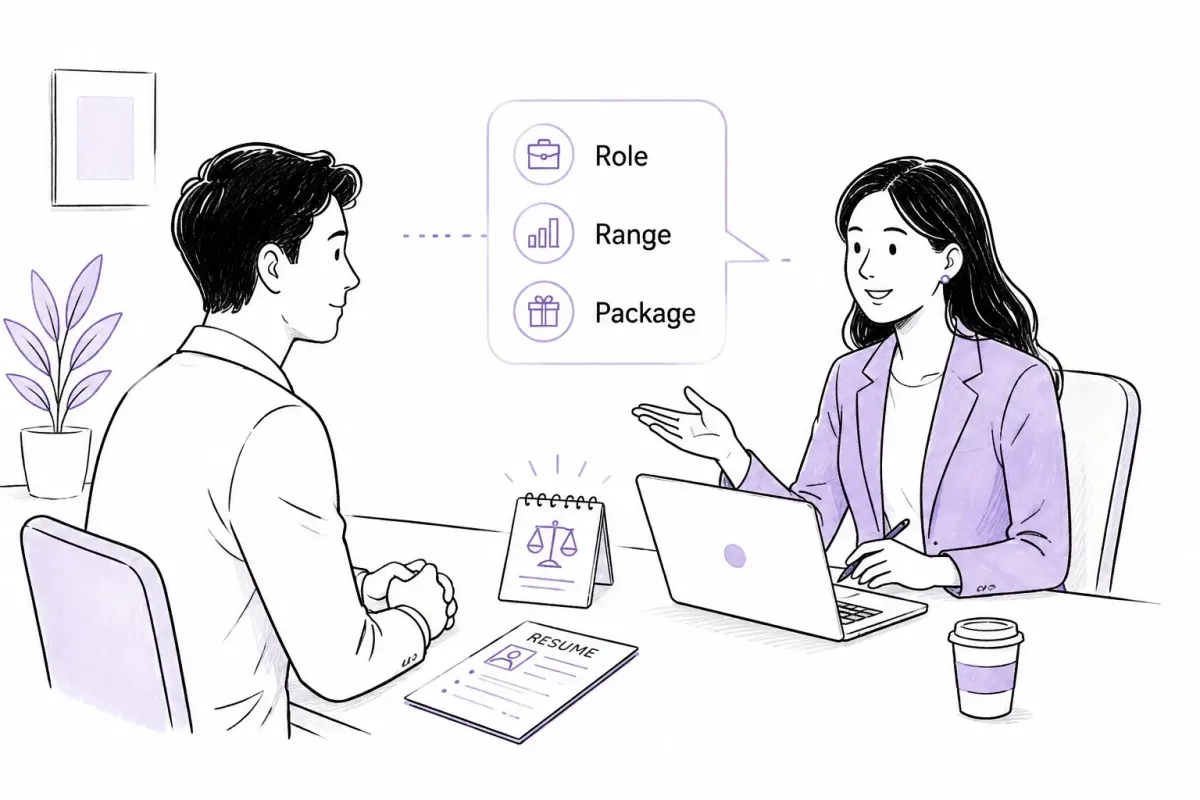


When interviewers ask “Why do you want to work here?”, they are not testing your ability to deliver praise or memorize a mission statement. They are evaluating three practical things: your underlying motivation, your alignment with the role, and your potential to contribute.
You do not need to call the organization your "dream company." A more credible answer follows four steps:
- Research one genuine company detail.
- Connect it to the responsibilities of the role.
- Prove your fit with a relevant experience or skill.
- Explain how you hope to contribute.
The sections below show how to research the company, build the answer, check whether it is specific enough, and deliver it without sounding scripted.
What Interviewers Are Really Asking
Interviewers ask “Why do you want to work here?” to evaluate your genuine interest, role alignment, and potential contribution. They want to verify that you have researched the organization, understand what the position requires, and chose this application deliberately rather than applying at random.
The Three Signals Behind the Question
- Specific Interest: Employers look for proof that you know what the company actually does. Example: Pointing out a recent product feature or customer segment shows you did real preparation.
- Role Fit: They want to see why this exact position matches your strengths. Example: Explaining how your analytical skills match their current data project proves logical alignment.
- Potential Contribution: They evaluate whether you are focused on helping the team succeed. Example: Mentioning how you plan to streamline customer onboarding connects your experience to their immediate goals.
Exaggerated emotion is unnecessary. Demonstrating quiet competence and real context carries far more weight than ungrounded excitement.
How This Question Differs From Similar Interview Questions
Job seekers often blend similar interview prompts together. Understanding the boundaries prevents you from repeating the same talking points across different questions:
| Question | Main Focus | Best Evidence to Provide | Common Mistake |
|---|---|---|---|
| Why do you want to work here? | Company alignment & overall context | One specific product, project, or operational fact | Giving a generic compliment like "You're an industry leader." |
| Why are you interested in this role? | Daily duties & direct skill fit | 1–2 specific responsibilities from the job description | Focusing only on company prestige rather than day-to-day work. |
| Why should we hire you? | Value proposition & competitive edge | Past achievements, metrics, and core technical skills | Reciting your entire resume instead of highlighting top results. |
| Why are you leaving your current job? | Career progression & forward focus | Growth targets, skill shift, or change in direction | Complaining about past management or company policies. |
For the value-focused version of this question, see how to answer “Why should we hire you?”.
The 4-Part Formula for a Strong Answer
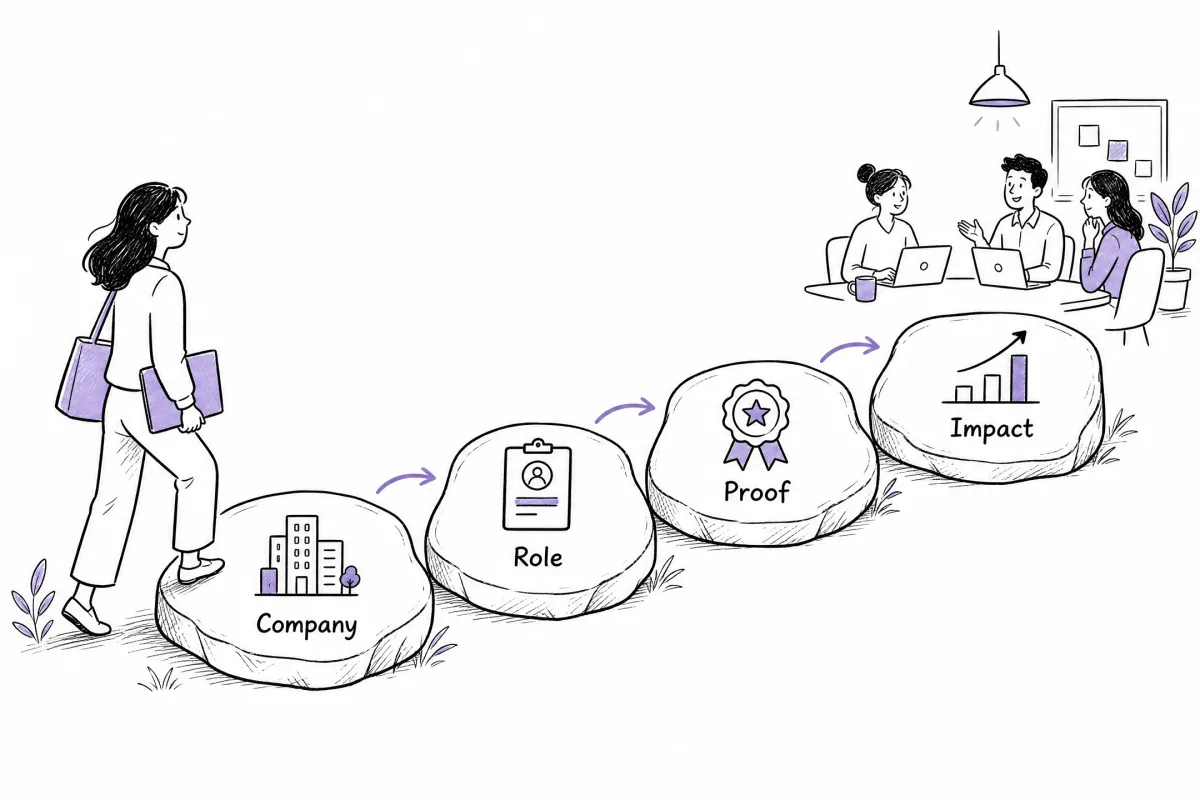
Structuring your response keeps you focused and prevents rambling. Use this four-step sequence to build a clear 30–60 second answer:
- Give a Specific Company Reason: Identify one verifiable detail about the business.
- Connect the Reason to the Role: Explain why that company detail makes this specific position compelling.
- Add Proof You Can Contribute: Share a brief metric, skill, or project result that proves capability.
- End With Future Contribution: State what you look forward to accomplishing in the position.
Recommended Answer Template
“I’m interested in [Company] because [specific evidence from research]. This [Role] fits my strengths in [relevant skill], as shown by [brief past result or project proof]. I’d be excited to use that experience to [future contribution to team goals].”
1. Give a Specific Company Reason
Focus on a tangible detail such as a core product, a customer problem they solve, an operational methodology, or a recent project. Avoid sweeping statements like "Your company has a great reputation."
- Weak Evidence: "I want to work here because your company culture is amazing and everyone seems friendly."
- Strong Evidence: "I noticed your recent expansion into enterprise security management, particularly how your platform handles multi-cloud compliance for mid-market clients."
2. Connect the Reason to the Role
Bridge the company context to your day-to-day duties. Reference 1–2 actual responsibilities from the job description rather than copying adjectives.
- Example: "That security expansion directly connects to this Senior Analyst role, which focuses on building automated compliance audit workflows."
3. Add Proof You Can Contribute
Give the interviewer a reason to trust your claim. Share a mini-STAR example (Situation, Task, Action, Result) summarizing a relevant outcome. Candidates with limited experience can reference course projects, certifications, or volunteer work.
- Example: "In my previous role, I automated our team's quarterly compliance checks, which reduced manual auditing time by 35% across four departments."
4. End With Future Contribution
Finish with a forward-looking goal focused on team impact.
- Example: "I would love to bring that same automation experience here to help streamline your enterprise onboarding timeline."
How to Research the Company in 10 Minutes
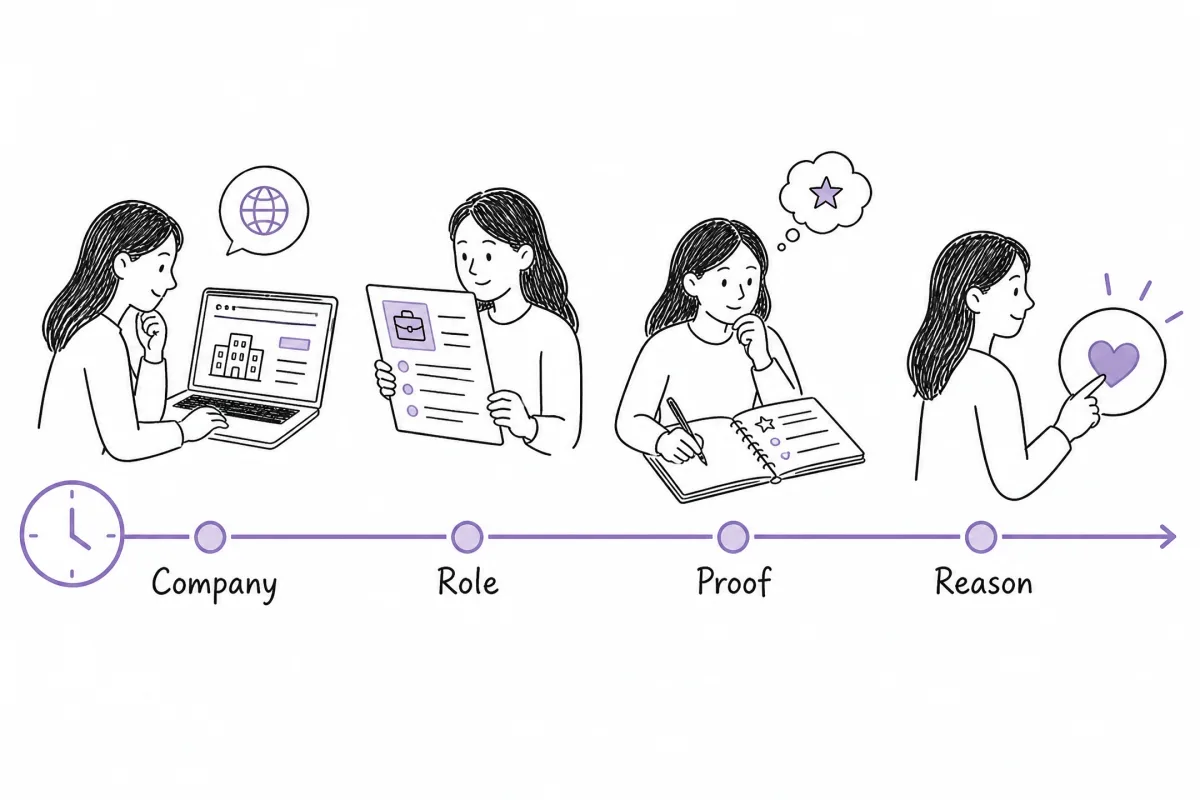
You do not need to memorize years of corporate history. Allocate 10 minutes before your interview to gather four specific data points:
| Time | Task | What You Need to Produce |
|---|---|---|
| Minutes 0–3 | Review the company website, product pages, About page, or recent official news | One company-specific fact |
| Minutes 3–6 | Review the job description | One or two important responsibilities |
| Minutes 6–8 | Review your own experience | One relevant project, skill, or result |
| Minutes 8–10 | Choose the strongest connection | One honest reason you can defend |
Minutes 0–3: Find One Company-Specific Fact
Visit the company website, official blog, or recent press releases. Look for a core product line, a major client case study, a recent technical release, or a clear public mission.
Minutes 3–6: Match the Fact to the Job
Open the job description. Highlight two primary responsibilities. Ask yourself: How does the company fact connect to what this role does every day?
Minutes 6–8: Select Your Best Evidence
Identify one personal accomplishment, skill, or academic project that directly aligns with those responsibilities. Make sure you can summarize it in two sentences.
Minutes 8–10: Choose One Honest Reason
Select the angle you feel most comfortable discussing. Ask yourself: "If the interviewer asks for more detail on this point, can I comfortably elaborate?"
Printable Checklist: 10-Minute Company Research
- One company fact: (Product feature, recent release, or specific client focus)
- One role responsibility: (Core duty from job description)
- One relevant proof point: (Past result, project, or skill evidence)
- One future contribution: (Immediate value you can deliver)
- One follow-up detail: (Supporting story if asked to elaborate)
How to Answer “Why Do You Want to Work Here?” Step by Step
Use this four-box Answer Builder to turn your research into an articulate, practice-ready draft.
| Section | Fillable Prompt / Notes |
|---|---|
| Company Reason | I noticed / admire... (e.g., your focus on open-source database scaling) |
| Role Connection | This matters to the role because... (e.g., this team leads infrastructure migration) |
| Relevant Proof | I have demonstrated this by... (e.g., reducing query latency by 20% in my last project) |
| Future Contribution | I would like to help the team... (e.g., maintain high uptime during peak client traffic) |
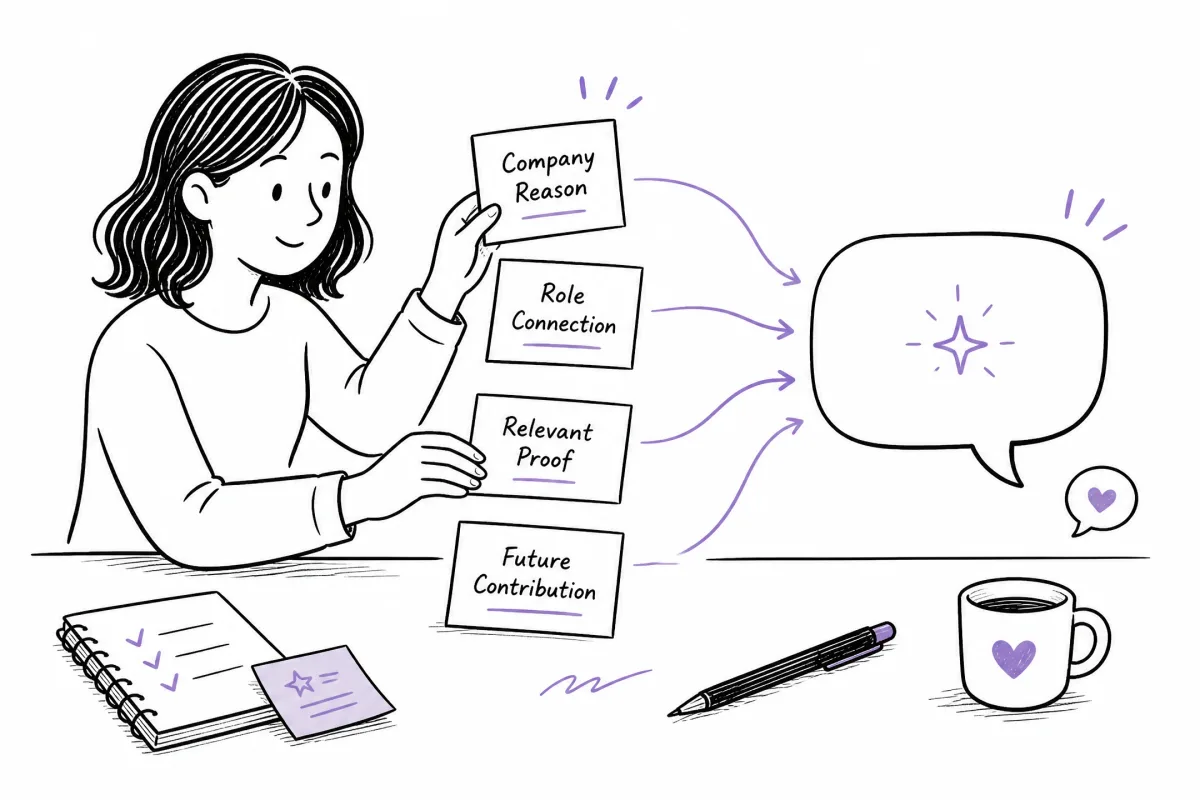
Step 1: Fill the Four Answer Boxes
Write bullet points for each section in the table above. Keep your raw notes brief and factual.
Step 2: Turn the Notes Into a 30–60 Second Answer
Combine your four bullet points into 3–5 spoken sentences. Lead with the company reason, transition into the role duties, state your evidence, and conclude with your planned impact.
Step 3: Run the Company-Name Test
Read your draft aloud and swap the company’s name with a direct competitor. If the answer still makes 100% sense without changing anything else, your response is too generic. Add more specific evidence until it fits only this employer.
Step 4: Score the Answer Before You Practice
Rate each component of your draft from 0 to 2 points:
- 0 Points: Missing or completely generic (e.g., "It's a great company.")
- 1 Point: Relevant, but lacks concrete evidence or specifics.
- 2 Points: Specific, authentic, and easily supported with follow-up details.
A total score of 6 to 8 points usually means your draft contains all four components. Treat this as an editing aid—not a validated hiring assessment or a prediction of interview performance.
“Why Do You Want to Work Here?” Sample Answers by Situation
About the examples: The sample answers and performance figures in this section are hypothetical teaching examples. Use them to study the structure, but replace every company fact, achievement, and metric with information you can verify from your own experience.
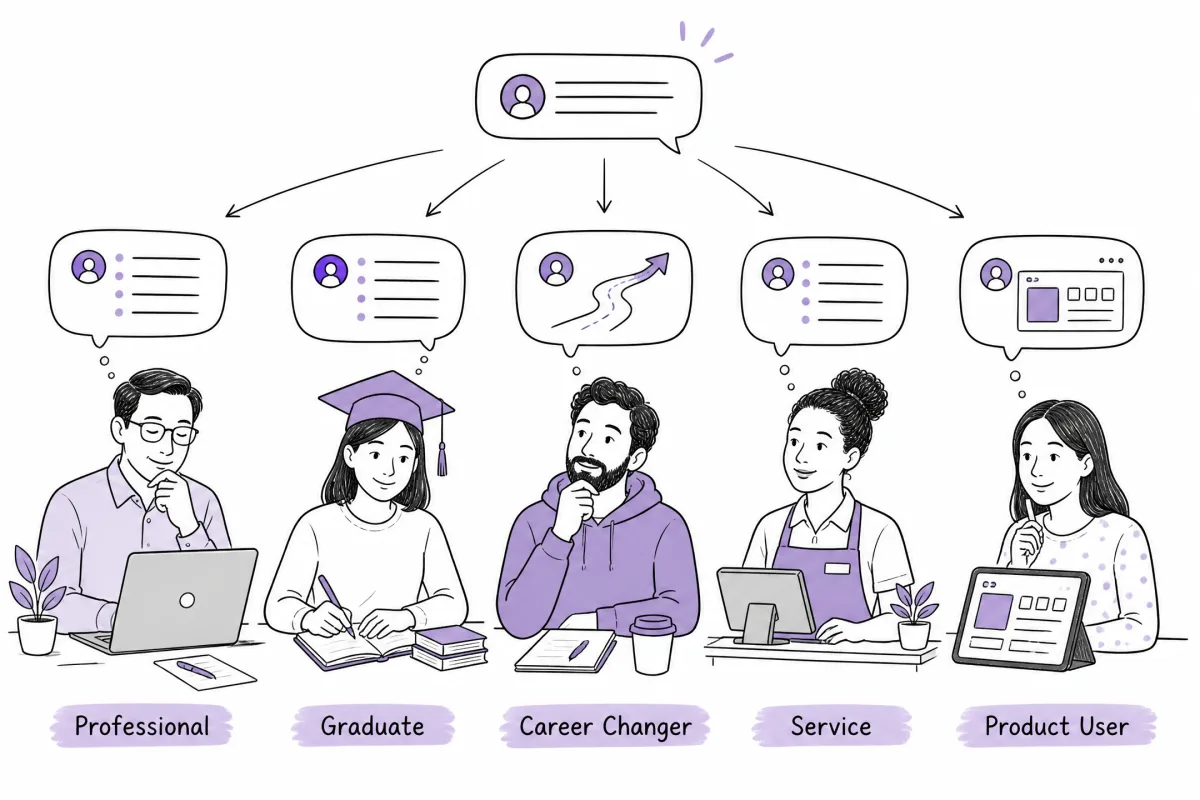
Review the matrix below to see how the four-part formula can adapt to different candidate backgrounds and career stages.
| Situation | Company Reason Focus | Available Proof | Future Contribution |
|---|---|---|---|
| Experienced Professional | Business growth direction & product scale | Track record & measurable result | Repeat or scale past capability |
| Recent Graduate / No Experience | Company mission & learning environment | Academic project or volunteer work | Quick adaptation & core delivery |
| Career Changer | Problem space & domain shift | Transferable skills & training | Cross-industry perspective |
| Retail or Customer Service | Customer care standards & team pace | Teamwork & service reliability | Dependable daily service quality |
| Product User | Direct user insight & product experience | Technical or customer domain skill | Drive user-centered improvement |
Example 1: Experienced Professional
“I’ve been following your team’s transition to automated data pipeline architecture over the past year. This Senior Data Engineer role is exciting because it sits directly at the intersection of pipeline optimization and real-time analytics. In my previous position, I redesigned our core ETL workflow, which reduced pipeline downtime by 40% and improved reporting speed. I’m eager to bring that data infrastructure experience here to help scale your real-time processing capabilities as client volume grows.”
- Why it works: Connects an industry trend directly to a past metric and a future infrastructure goal. (Annotated hypothetical example)
Example 2: Recent Graduate or Candidate With No Experience
“I chose to apply because of your team’s public commitment to building accessible, open-source educational software. As a recent graduate in Computer Science, I focused my senior capstone on web accessibility compliance for educational tools, building a web portal tested against WCAG standards. While I am early in my career, I am eager to apply those technical skills and assist your development team in maintaining high accessibility standards across new feature rollouts.”
- Why it works: Converts academic capstone experience into credible proof without inventing prior job history. Also naturally fits candidates and freshers entering the market. (Annotated hypothetical example)
Example 3: Career Changer
“After six years in B2B account management, I transitioned into project management because I thrive on solving operational bottlenecks. Your company’s recent launch of your unified client portal caught my attention, and this Implementation Specialist role aligns directly with my strength in cross-departmental coordination. In my previous role, I managed client integrations across 15 enterprise accounts with zero missed deadlines. I look forward to leveraging that client communication experience to ensure smooth onboarding for your software users.”
- Why it works: Frames cross-industry communication as an asset while connecting past achievements to new operational duties. (Annotated hypothetical example)
Example 4: Retail, Restaurant, or Customer Service Role
“I’ve lived in this neighborhood for two years and have always appreciated how efficient and welcoming your store team is during peak hours. This Customer Service Associate position fits my background in fast-paced food service, where I handled high order volumes while maintaining positive customer interactions. I’m a dependable team member who takes pride in creating a smooth store environment, and I’d be glad to bring that work ethic to your team.”
- Why it works: Grounded, realistic, and avoids forced corporate speeches for service-oriented environments. (Annotated hypothetical example)
Example 5: A Company Whose Product You Already Use
“I’ve been using your design collaboration tool for two years in my freelance projects, particularly your real-time prototyping feature. When I saw this Product Specialist role, I was eager to apply because I deeply understand the user experience and common friction points. In my last marketing role, I built user onboarding guides that improved feature adoption by 25%. I’d love to combine my product experience with my user research skills to help refine your customer support resources.”
- Why it works: Leverages real product familiarity into actionable ideas rather than superficial praise. (Annotated hypothetical example)
What If You’re Not Passionate About the Company?
Not every application is for a "dream job." It is completely normal to apply to positions primarily for stability, location, compensation, or general career continuity. However, stating "I just need a job" in an interview indicates low engagement.
Ask: Can you find one real detail about the duties, team, customers, stability, or use of your skills?
- Yes: Use the three-sentence Minimum Viable Honest Answer.
- Not yet: Prepare targeted questions for the interview.
- No, even after research: Re-evaluate whether the role fits your needs.
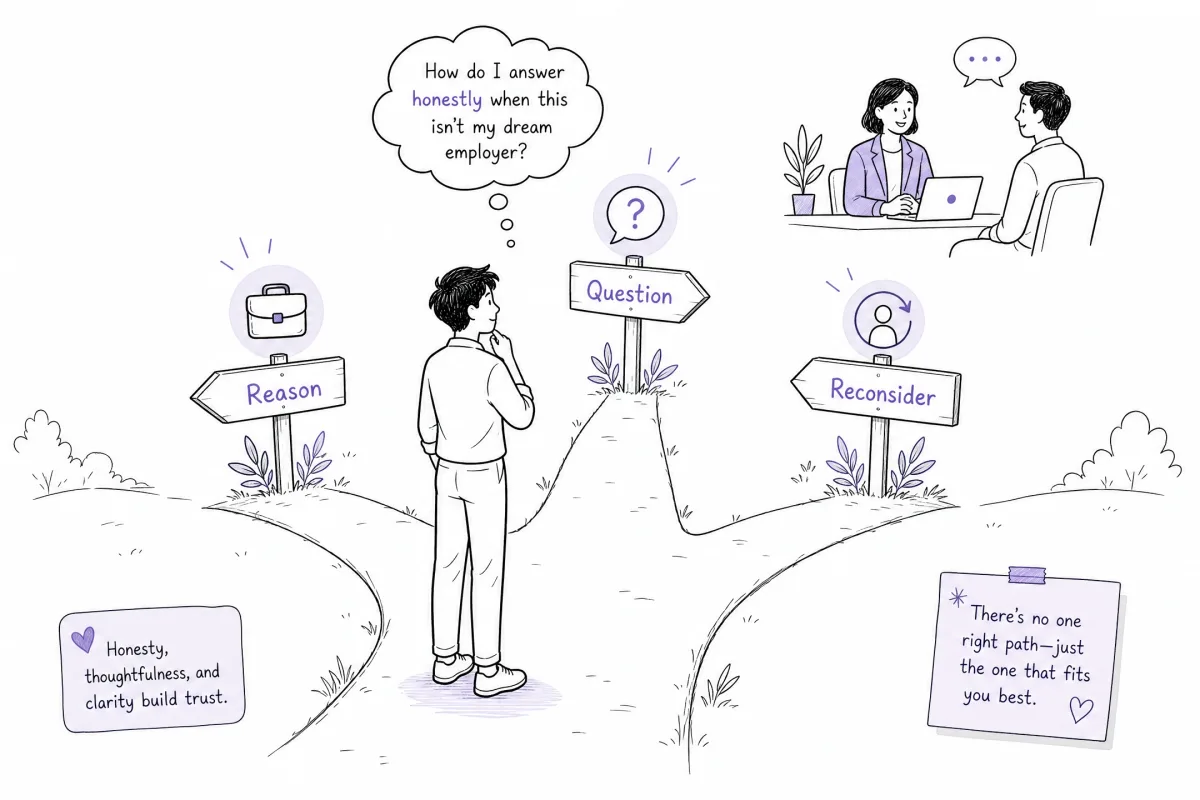
Use a Defensible Reason, Not Fake Enthusiasm
Instead of inventing false passion, identify a practical, defensible reason to respect the opportunity:
- Role Duties: The daily work matches skills you enjoy using.
- Customer Problems: The business solves a real, practical issue.
- Team Structure: The team size or workflow offers good operational focus.
- Stability or Growth: The company provides a reliable environment to develop core capabilities.
Build a Minimum Viable Honest Answer
Use this three-sentence structure when you need a clear, professional response without exaggerated emotion:
- Company/Role Fact: "I noticed this role focuses on streamlining regional logistics workflows."
- Personal Fit: "That matches my background in operations management and inventory tracking."
- Practical Contribution: "I'm looking for a stable team where I can apply my logistics skills and deliver reliable results every day."
When the Honest Answer Reveals a Poor Fit
If you spend 10 minutes researching a company and cannot find a single element you respect, consider your options:
- Option 1: Proceed with the interview and ask targeted questions to learn more about the team day-to-day.
- Option 2: Focus entirely on the specific technical or operational challenges of the job description.
- Option 3: Re-evaluate whether submitting the application or continuing the interview process is worth your time.
Bad Answers—and How to Fix Them
Avoid common pitfalls that make responses sound self-centered, generic, or scripted.
| Avoid Saying Only... | Why It Is Weak | Better Direction |
|---|---|---|
| "I need a job and the pay looks good." | Fails to explain why you chose this specific employer or role. | Acknowledge practical alignment, but highlight role fit and core contribution. |
| "Your company is amazing and an industry leader." | Vague and applicable to any employer; sounds like empty flattery. | Name one verifiable project, product feature, or operational fact. |
| "This will be a great stepping stone for my career." | Focuses entirely on what you gain after leaving the position. | Focus on the immediate value of the work itself and current team goals. |
| "I love your company culture." | Unsubstantiated and sounds memorized without specific evidence. | Point to an observable working style, open-source project, or public practice. |
| An overly polished, generic AI answer | Lacks personal detail and crumbles under follow-up questions. | Rewrite using your own phrasing, metrics, and conversational cadence. |
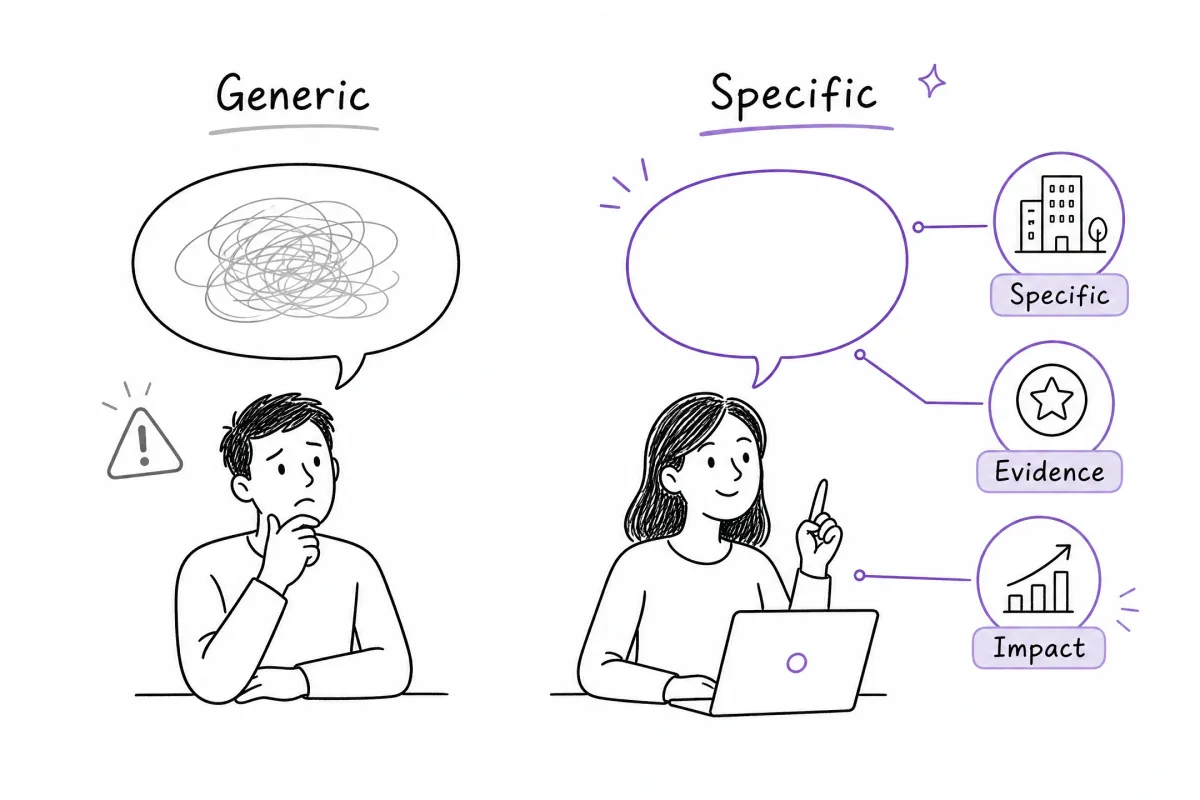
Before & After Transformation
- Before (Weak & Generic):
“I want to work here because your company is an industry leader with a great culture. I’ve always dreamed of working for a company like yours, and I know this role would be the perfect stepping stone for my career.” - After (Specific & Defensible):
“I’m interested in your company because of your recent focus on modular API architecture for financial tools. This Backend Developer role fits my experience in node service optimization, where I previously cut API response times by 15%. I’m excited about the opportunity to apply that experience to your current microservices migration.”
How to Practice Without Sounding Scripted
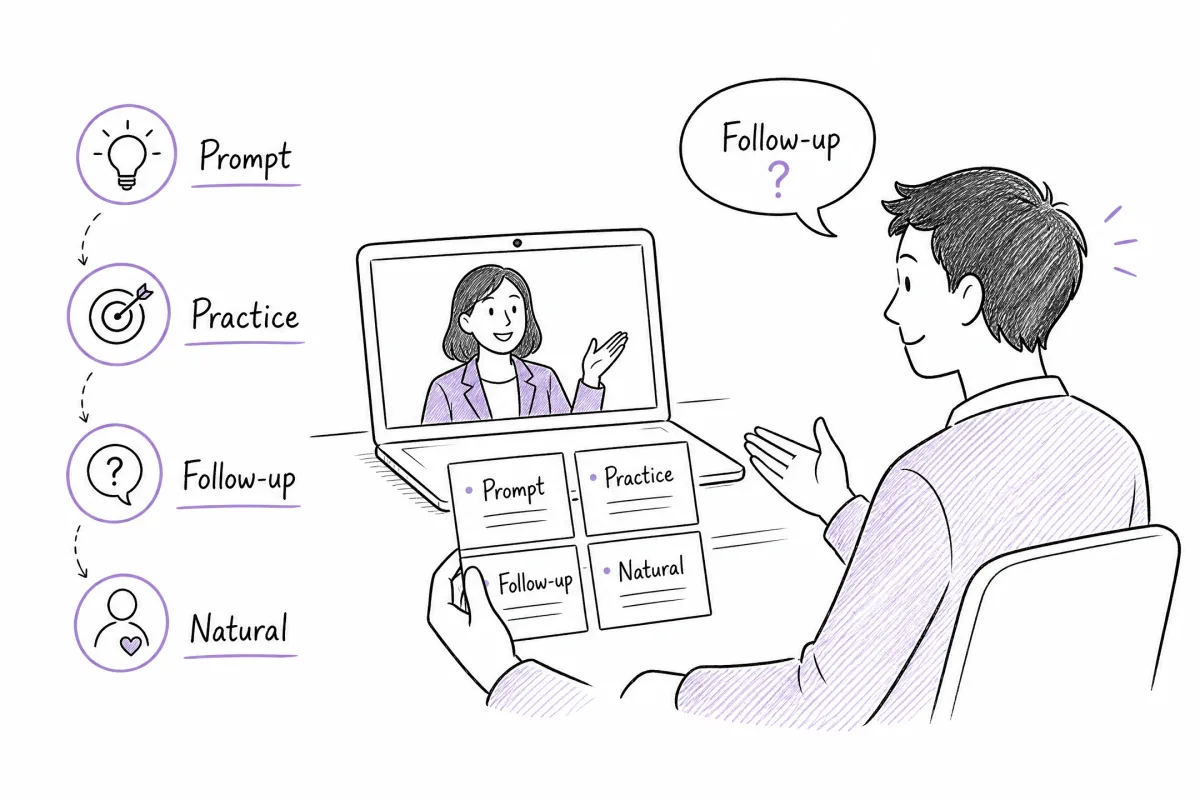
Writing a draft is only the first step. To deliver your answer naturally in a live conversation, practice delivering the core ideas rather than reciting memorized text.
Use Bullet Prompts, Not a Memorized Paragraph
Do not attempt to memorize your answer word-for-word. Memorization creates rigid delivery and increases anxiety if you forget a phrase. Instead, remember four anchor keywords:
- Company Fact: (e.g., Modular API)
- Role Duty: (e.g., Microservices migration)
- Past Proof: (e.g., 15% latency reduction)
- Future Goal: (e.g., Smooth service migration)
Practice 30- and 60-Second Versions
Adapt your answer length based on the interview format:
- Screening Call (30 Seconds): Concise and direct. Mention the company reason, role fit, and a brief proof point.
- Hiring Manager Interview (60 Seconds): Expand slightly on your past project evidence and connect it to team goals.
Prepare for Follow-Up Questions
Interviewers frequently ask follow-up questions to test whether your initial answer was genuine:
- “What specifically stood out to you about our recent project?”
- “Why is this specific role the right step for you right now?”
- “How would you measure your contribution in the first 90 days?”
Use AI as a Coach, Not a Source of Fake Experience
AI tools can help you refine your spoken delivery, test response timing, and simulate follow-up prompts.
Practice tip: After you have written a truthful draft, you can rehearse it with GreatOffer AI, a real-time AI interview copilot, to practice follow-up questions and keep your answer structure clear under pressure.
Use note: GreatOffer AI is an interview preparation and assistance tool. You are responsible for verifying every response and following the policies of the employer, educational institution, recruiter, and interview platform involved.
Build an Answer You Can Defend
A compelling interview response is not about delivering dramatic speeches or overstating your passion. When answering why you want to work for a company, success comes down to clear preparation, honest self-assessment, and grounded proof.
- Find one specific company fact using a focused 10-minute research session.
- Fill out the four-box Answer Builder to link your research directly to the job duties.
- Rehearse out loud using keyword bullet prompts and prepare for one follow-up question.
Take 10 minutes today to draft your four-part response—and enter your next interview with complete confidence.