
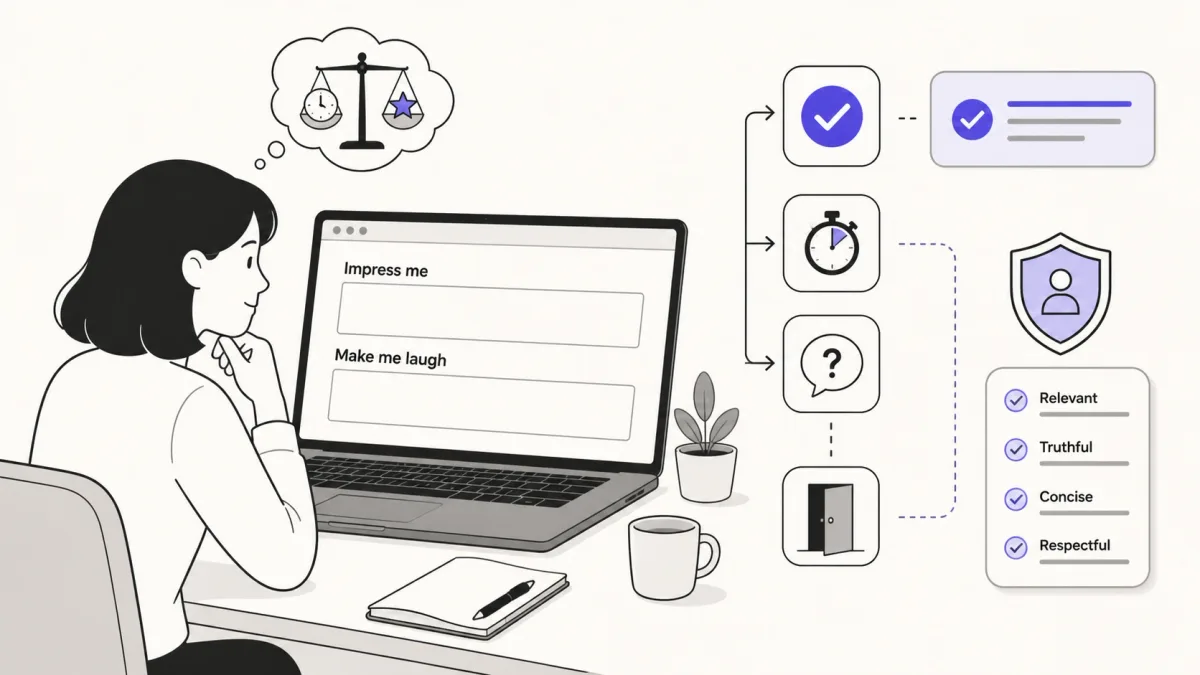
You're moving through an ordinary job application when a required text box asks you to impress the reviewer or make them laugh. The role may be serious, the character limit may be huge, and the evaluation criteria are invisible. That combination makes a small prompt feel more consequential than it probably is.
The real challenge is not producing the cleverest sentence. It is identifying what the employer may be testing, deciding how much effort the prompt deserves, and writing an answer you can defend in a later interview.
Both answers should be intentionally short. A large character limit is not a request to fill the box when the instruction says one or two sentences.
What Do Impress Me and Make Me Laugh Mean on a Job Application?
Impress me and make me laugh are open-ended application prompts that ask candidates to demonstrate value, judgment, tone, or personality in a short response.
Some use them to observe brevity and written communication. Others want to see how you handle ambiguity, whether you can match a casual brand voice, or how you respond when there's no template answer. In roles where creativity, entertainment, or brand tone is a genuine job requirement, an open prompt can function as a work sample. In other cases, the connection to the work is weak, and the employer is adding an informal culture signal or trying to deter generic applications.
The same words mean different things in different roles. "Make me laugh" could be close to a work sample for a comedy writer, social media creator, or entertainment role. For an IT Help Desk Support role, it's more likely a communication-style or subjective-performance prompt unless the employer explains a job-related purpose.
You cannot see the hidden scoring standard. The practical response is to infer the most defensible job-related purpose, answer proportionately, and assess the rest of the application. Do not assume an unusual prompt predicts a bad workplace or better hiring outcomes. Judge it alongside role clarity, compensation transparency, and total application burden.
Classify the Question Before You Answer It
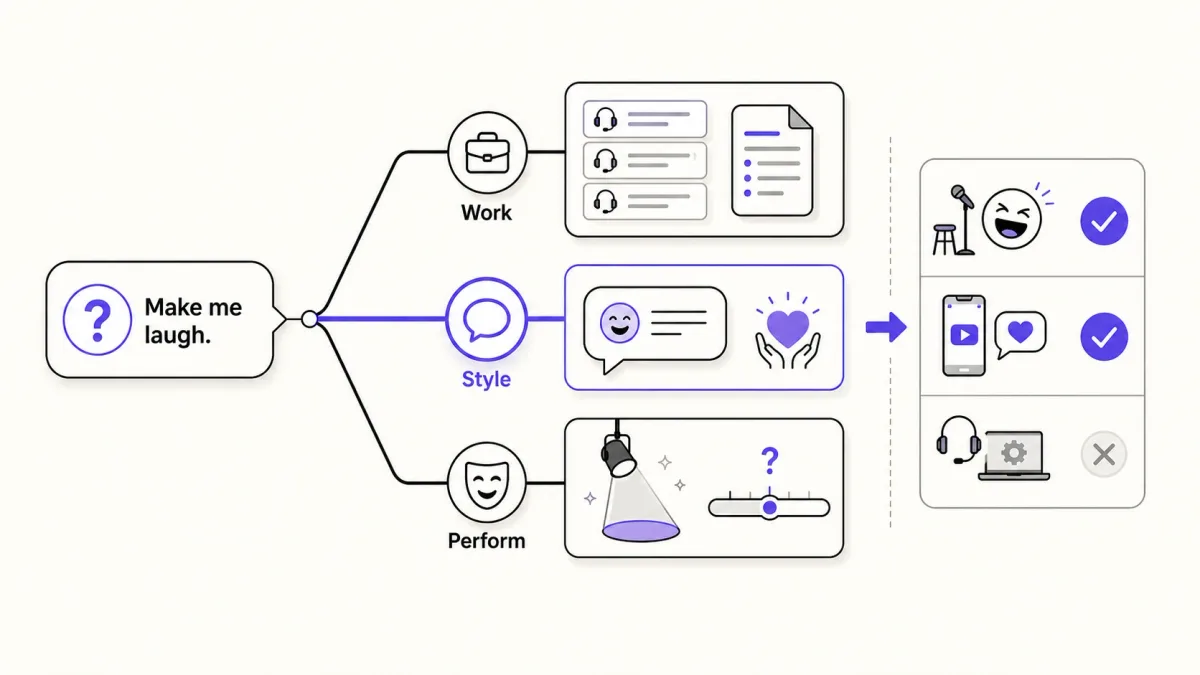
Classification depends on the job, not just the wording. Use these three categories.
Real Work Sample
A real work sample mirrors an important part of the actual job, as described in the OPM work sample guidelines. Examples include prioritizing three support tickets, drafting a response to a frustrated user, or explaining a troubleshooting step in plain language.
A work sample can deserve a more thoughtful answer when the scope is reasonable and the evaluation purpose is clear. The output should resemble something you'd produce in the first month on the job.
Communication-Style Prompt
A communication-style prompt has some defensible link to tone, brevity, empathy, or audience awareness. Example: writing one sentence that reassures a user whose system has failed.
You can usually answer briefly while watching for ambiguity and unnecessary subjectivity. The prompt may be testing whether you can write a short, professional response under a vague constraint.
Subjective Performance Prompt
A subjective performance prompt asks you to entertain, charm, or impress a reviewer without a clear connection to an important job behavior or a visible evaluation standard. "Make me laugh" for an IT support role is the main example.
Time-box this category and evaluate it alongside the role's value and the application burden. One awkward question in an otherwise credible process is different from a pattern of unrelated performance requests.
| Prompt Type | What It May Measure | Example | Candidate Response |
|---|---|---|---|
| Real work sample | A job task or job-relevant competency | Prioritize support tickets and explain the order | Answer carefully if the scope is proportionate |
| Communication-style prompt | Tone, clarity, empathy, or brevity | Reassure a frustrated user in one sentence | Answer briefly and professionally |
| Subjective performance prompt | Charm, humor, or cultural familiarity with an unclear rubric | "Make me laugh" for an unrelated role | Time-box and assess the wider process |
Run the REAL Prompt Check
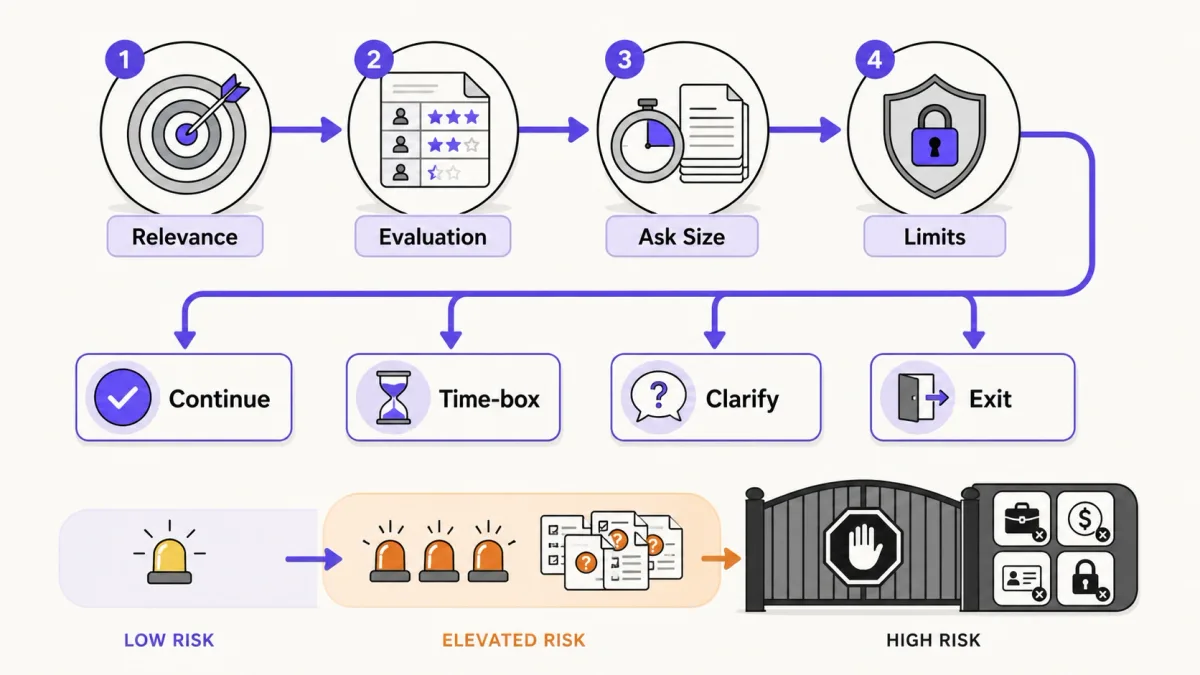
REAL is an editorial framework for this article, not a validated hiring assessment or legal test. Use it to decide whether a prompt deserves your time.
Relevance
Does the response map to a real, important behavior you'd perform after being hired? Relevance changes by role. Explaining a fix to a non-technical user is relevant for help desk support. Making a recruiter laugh is rarely job-relevant unless entertainment or brand voice is part of the work.
Evaluation
Could two reviewers use the same stated criteria and reach a reasonably similar judgment? A vague prompt with no visible rubric increases subjectivity. That doesn't mean the employer has no internal criteria, but you're answering blind.
Ask Size
Check the expected time, number of prompts, answer length, research burden, and whether the output could be used by the company. A sentence is different from a strategy deck, production design, codebase feature, or analysis of real company data.
Limits
Does the prompt pressure you to reveal medical, family, age, religious, national-origin, or other private information? Does it create a language, cultural-reference, or disability barrier unrelated to the job?
Here's the difference between a weak prompt and a more job-related one:
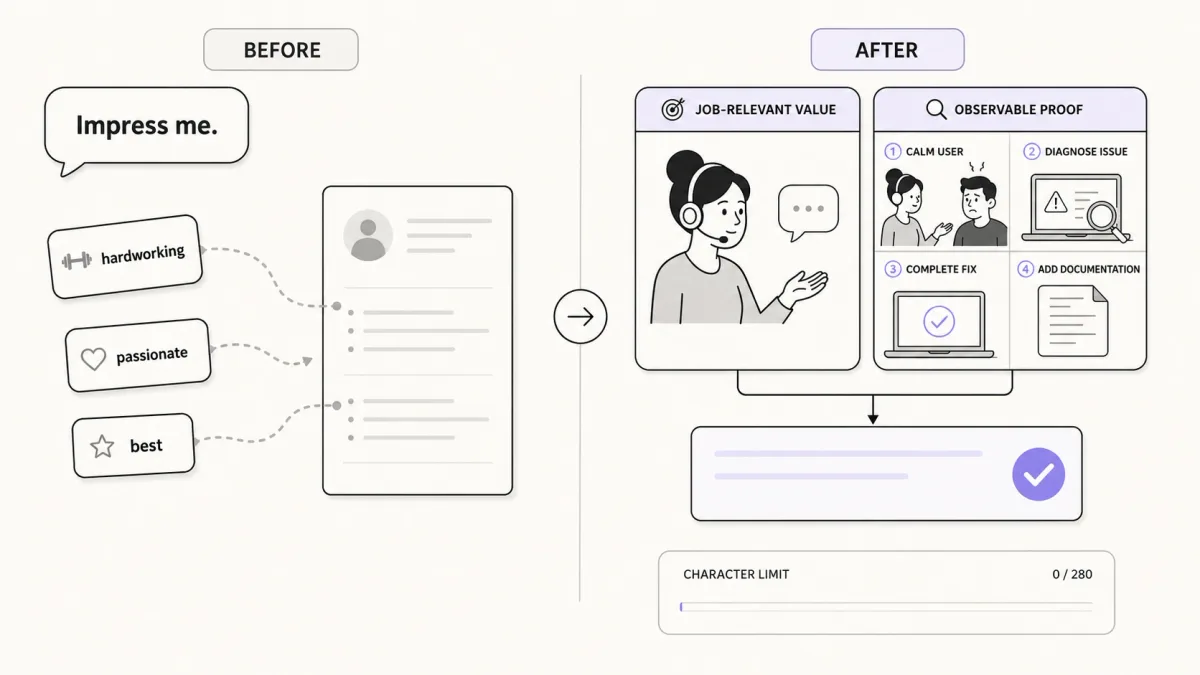
Weak: "Impress me."
More job-related: "In two sentences, describe how you would handle a frustrated user whose ticket only says, 'Nothing works.'"
The second prompt gives you a job behavior, constraint, and clearer basis for evaluation. The point is not that all open questions are bad. It's that relevance, evaluability, proportionality, and access make them more defensible.
Decide Whether to Continue, Time-Box, Clarify, or Exit
Don't judge the prompt in isolation. Scan these factors quickly:
- Role value and fit
- Compensation, responsibilities, location, and process transparency
- Employer legitimacy and verifiable contact information
- Prompt relevance
- Number and length of questions
- Total application time already spent
- Whether the requested output could be reused by the employer
- Privacy, security, and accommodation concerns
Use this decision matrix:
| Decision | When It Fits | What to Do |
|---|---|---|
| Continue | The employer is credible, the role is clear, and the prompt is brief with some defensible communication value | Give a professional one- or two-sentence answer |
| Time-box | The role may be worthwhile, but the prompt is subjective, awkward, or weakly related | Limit the full set of lightweight subjective prompts to 5-10 minutes |
| Clarify | The instruction, scope, evaluation purpose, expected time, or permitted format is unclear; the output may be reusable | Ask what skill is being assessed, what length is expected, and whether an equivalent format is available; review the accommodation options later in this guide |
| Exit | The employer cannot be verified, basic job terms are opaque, unrelated prompts multiply, substantial usable work is requested, or the process crosses privacy or security boundaries | Stop investing time without writing a long defense of the decision |
5-10 minutes is an editorial heuristic for opportunity-cost control, not research data. Apply it to the full set of lightweight subjective prompts, not to a real work sample or accommodation need.
Risk Gradient
One short awkward question in an otherwise credible and transparent process is a yellow light. You can answer briefly and continue.
An orange-light pattern includes several unrelated performance questions, punitive wording ("N/A will be rejected"), thin role information, or an already lengthy application. Time-box your response and raise your evaluation threshold for the rest of the process.
A red-light pattern includes a request for substantial reusable work, confidential information, payment, credentials, unsafe downloads, or sensitive personal disclosure; an unverifiable company; or repeated boundary violations. Stop investing time.
One yellow light is not proof of a toxic workplace. A red-light pattern is a reason to build a focused job-search plan around better opportunities.
What to Write When a Job Application Says "Impress Me"
Use this formula:
Job-relevant value + observable behavior or supportable proof.
You're not being asked to prove you're the most impressive person in the applicant pool. The safest strategy is to show how you create value in the target role.
Strong Answers by Situation
IT Help Desk Support
"I can turn a frustrated 'nothing works' ticket into a calm diagnosis, a clear fix, and documentation the next technician can use."
This answer names three job-relevant behaviors: de-escalation, troubleshooting, and knowledge transfer. All three matter in a support role, and all three can be observed or verified later.
Entry-Level Candidate
"I learn unfamiliar systems quickly, document what I discover, and ask precise questions before a small issue becomes a repeat ticket."
This works when you don't have extensive experience. It shows learning speed, documentation discipline, and judgment about when to escalate. Those are all observable.
Evidence-Based Template
"In [role or project], I [specific action], which led to [supportable result]. I would bring the same [skill] here."
Fill the brackets with real information. "In my last role, I reduced ticket reopen rate from 18% to 11% by writing step-by-step user guides. I would bring the same documentation discipline here." The result needs to be something you can defend in an interview.
General Transferable-Skill Template
"I am good at [job-relevant strength], and I show it by [observable behavior]. That is the same approach I would bring to [important part of this role]."
Example: "I am good at turning technical problems into plain-language explanations, and I show it by writing documentation non-technical users actually follow. That is the same approach I would bring to your customer support team."
Rewrite Weak Answers
Weak: "I am the best problem solver you will ever hire."
Better: "I solve technical problems by isolating variables, testing one change at a time, and documenting what worked. That approach would let me handle your help desk volume without creating repeat tickets."
The first answer makes an unsupported claim. The second shows the method and connects it to a job outcome.
Weak: "When I was seven, my family's computer broke, and I fixed it by reading the manual for three hours. That's when I knew I wanted to work in IT."
Better: "I troubleshoot by reading documentation, isolating the failure point, and testing fixes methodically. I would use that same process to resolve your users' tickets efficiently."
The first answer burns half your character limit on irrelevant childhood backstory. The second gives the current method and a job-relevant result.
Weak: "I'm hardworking, passionate, and a people person."
Better: "I respond to frustrated users with calm, clear steps. That tone helps me resolve issues faster because users follow instructions instead of escalating."
Generic adjectives don't show value. Observable behavior does.
Boundaries
Do not:
- Invent metrics, awards, clients, credentials, or outcomes
- Use trauma, diagnosis, family history, religion, age, or another private detail as proof of worth
- Fill a large text box when the written instruction asks for one or two sentences
- Write an answer you could not expand on truthfully in an interview
A large character limit is not a target. If the instruction says one or two sentences, write one or two sentences.
What to Write When a Job Application Says "Make Me Laugh"
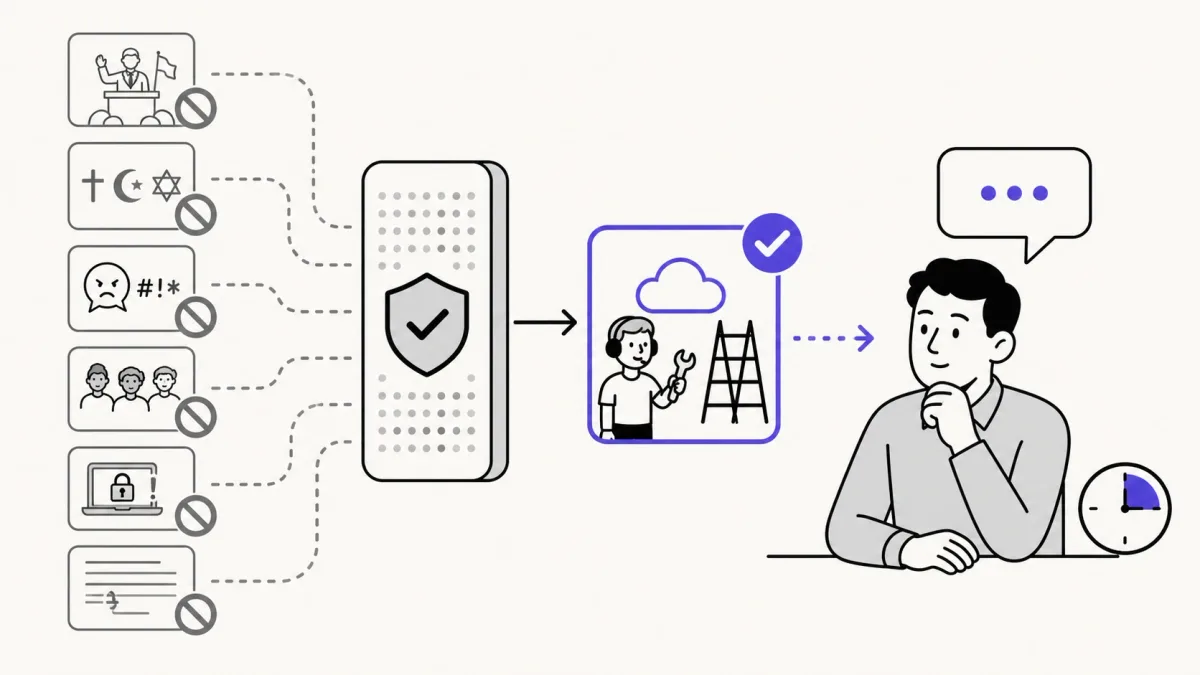
Use this formula:
One clean, low-context line + stop.
The goal is not to win a comedy contest. The answer should be understandable on first read, harmless without shared cultural knowledge, and natural enough for you to own later.
Low-Risk Examples
Role-Adjacent Joke
"Why did the help desk technician bring a ladder? The ticket said the problem was in the cloud."
This signals awareness of the job and uses a common IT reference. It's brief, clean, and doesn't require explanation.
Light Self-Awareness
"My sense of humor is mostly dry, but I promise my troubleshooting notes are not."
This works for reserved candidates. It's low-performance and pivots quickly to job relevance.
Everyday Technical Observation
"I tried to organize my browser tabs. They opened a support ticket."
This is brief and broadly understandable. It doesn't lean on shared cultural references or insider knowledge.
The tradeoffs: the role-adjacent option signals job awareness. The self-aware option is natural for a candidate who doesn't perform comedy. The observation is brief and universally accessible.
Humor Boundaries
Avoid:
- Politics, religion, sexual content, alcohol, or drugs
- Protected identities, accents, disability, age, family status, or national origin
- Insults aimed at users, coworkers, former employers, recruiters, or the company
- Data breaches, security incidents, layoffs, violence, or other high-stakes events
- Sarcasm that could read as contempt
- A long setup that needs explanation
- An AI-generated joke you do not understand or would never say
Forced humor fails in an application field the same way it fails in a conversation. If you wouldn't say it naturally, don't submit it.
A Professional Non-Joke Option
If forced humor would be unnatural, use a restrained response:
"I am better at calming frustrated users than writing punchlines, but I bring the same sense of timing to both."
This still answers with personality. It acknowledges the request without performing comedy you don't own. Do not criticize the question inside the application field.
When an Awkward Question Becomes an Application Red Flag
Separate three levels of work.
Lightweight Personality Prompt
One or two sentences, a few minutes, and almost no independent commercial value. The documented "Impress me" and "Make me laugh" fields fit this category based on the visible instructions. Do not call them free labor.
Small Work Sample
A contained task that resembles the job, has a defined scope, and is used for assessment. It may be reasonable when the time demand is proportionate and the employer explains the purpose. Examples include drafting a response to a realistic support ticket, prioritizing a short task list, or explaining a process step.
Potentially Reusable Unpaid Work
A custom strategy, complete design, production-ready code, campaign, data analysis, article, or solution to a live company problem that could create value outside candidate evaluation.
Ask these five questions:
- How long will this take?
- Is it based on a real company problem or fictional data?
- Could the company use the result without hiring me?
- Has the employer explained how the work will be evaluated and handled?
- Can I provide a smaller sample, portfolio piece, walkthrough, or redacted version instead?
Clarify scope and use before starting a substantial assignment. If the employer cannot explain what skill the work measures or how it will be scored, that's a reason to reconsider the application.
Bias, Language, Disability, and Accommodation
Vague or culturally specific prompts may amplify differences in communication style, disability, language background, or cultural reference points that are not central to the job.
That observation does not prove discrimination or illegality in an individual case. Poor selection design is not the same as a legal violation. Open-ended prompts can sometimes give candidates more choice in how they express themselves. Clearer, job-related, structured prompts can reduce unnecessary decoding demands. English fluency, accent, humor, or cultural familiarity should not be treated as universally job-relevant. The connection depends on what effective performance actually requires.
If you need accommodation during the application process, review the EEOC applicant guidance:
- Ask for clarification about what competency the prompt is intended to assess
- Request a clearer, accessible, or equivalent format when needed
- Ask about expected length or additional processing time where appropriate
- Avoid volunteering a diagnosis or detailed medical history unless you choose to provide information necessary for an accommodation process
You don't need to use personal or medical information to "impress" an employer. A job-relevant strength and observable behavior are stronger answers than private disclosure.
This is general information about U.S. federal employment principles, not legal advice about an individual application. State and local rules may add protections. If you believe you've experienced discrimination, consult an employment attorney or review the EEOC hiring guidance.
Use AI Without Inventing a Personality
AI can help you draft, compress, and test an answer. It should not create a persona you cannot maintain.
AI can:
- Generate direct, warm, dry, or lightly playful tone options
- Compress a long answer into one or two sentences
- Flag possible offense, oversharing, unsupported claims, or jargon
- Turn a real experience into a job-relevant value statement
AI should not:
- Invent experience, metrics, credentials, clients, or outcomes
- Create a comic persona you cannot maintain
- Supply a joke you do not understand
- Replace your ordinary voice with polished but empty language
Before you submit an AI-drafted answer, run the AI Sustainability Test:
Could I say this naturally, explain why I chose it, and give a truthful follow-up example in an interview?
If any part of the answer is no, rewrite. You will need to prepare for the follow-up interview using the personality and examples you submitted. An AI-generated persona that doesn't match your actual voice creates a consistency problem you cannot fix later.
If you want to practice explaining your answer live, Great Offer AI Copilot lets you rehearse interview responses in realistic scenarios. It's designed for interview preparation, not personality generation or application automation.
Conclusion
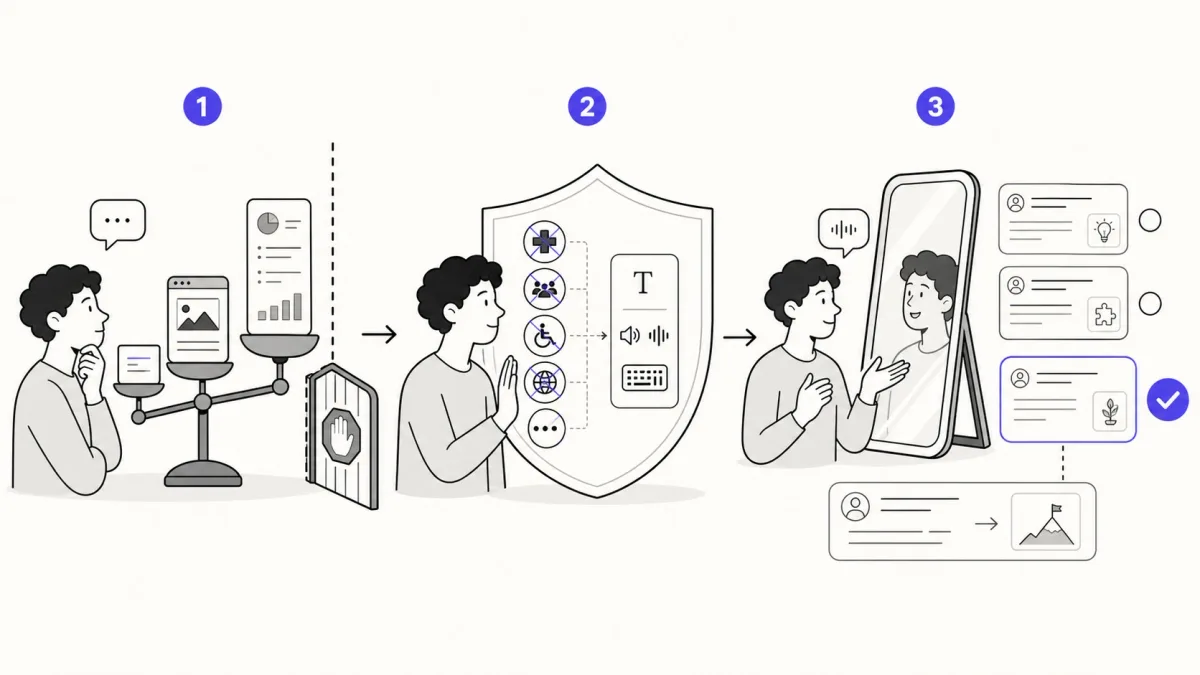
Classify the prompt. Run the REAL Prompt Check. Continue, time-box, clarify, or exit. If you answer, keep it short, truthful, low-risk, and sustainable in a later interview.
You don't need to perform unlimited personality to earn the right to apply. One awkward prompt can be handled in a few minutes. A broader pattern of opacity, excessive work, or boundary problems deserves a different decision.
When you're ready to move forward, know which questions to ask in an interview to evaluate the company's process and culture. After you submit, follow up on your application professionally without over-investing in a single unclear opportunity.