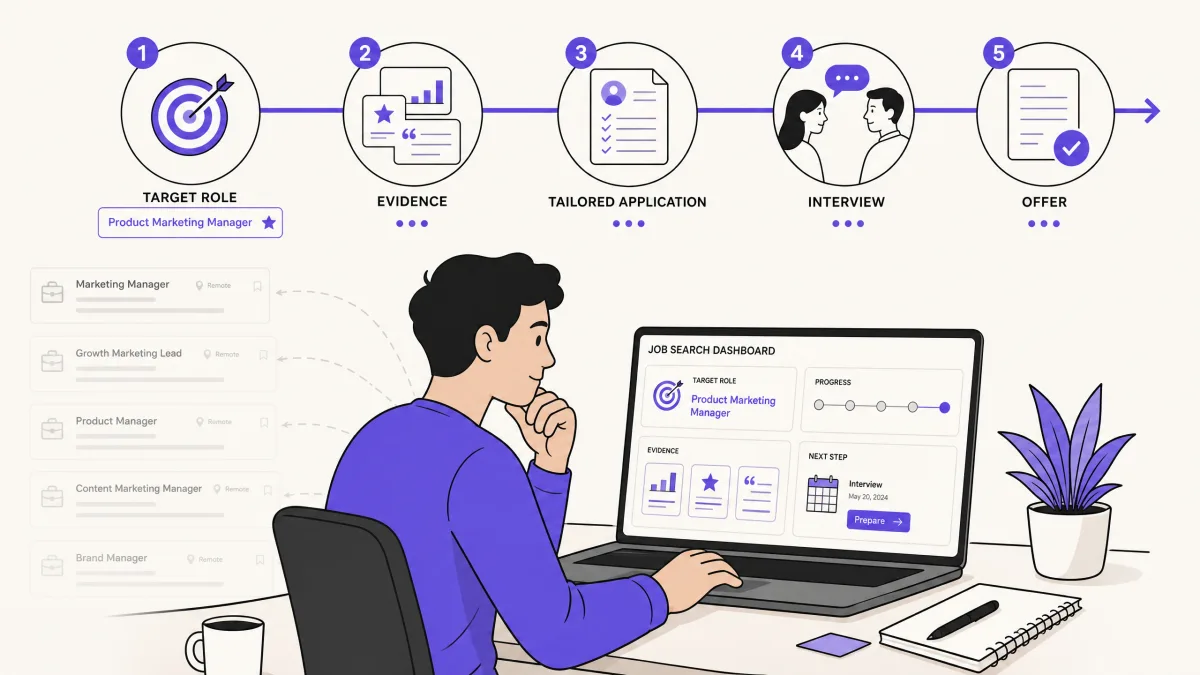


When your job search stalls, the most common temptation is to increase your output: sending twice as many resumes, applying to unrelated positions, or constantly changing your materials. I've coached hundreds of candidates through this exact pattern. More activity is not automatically better activity. Without a clear diagnostic approach, repeating the same steps simply accelerates burnout. To get better results, you need practical job search tips that help you identify your primary bottleneck and repair the specific stage that is stopping your progress.
An effective job search is a feedback process: choose a target, create a credible match, reach the right opportunities, convert conversations, and change the first stage that stops producing useful signals.
The Job Search Tips That Matter Most
Applying for jobs without a prioritized plan often leads to wasted effort. Before adjusting every file on your desktop, focus on the fundamental habits that generate qualified hiring conversations.
- Target one clear role family to keep your application messaging consistent and believable.
- Study current job descriptions before editing your materials so you align with real employer priorities.
- Tailor the highest-impact parts of the resume, focusing on your headline, summary, and recent relevant achievements.
- Apply where the fit is explainable and credible, prioritizing quality fit over high-volume submissions.
- Use several opportunity channels for different purposes, combining direct employer sites, recruiters, and public resources.
- Make specific networking requests that ask for defined insights rather than generic help.
- Practice screening and interview answers aloud to build fluent, confident storytelling under pressure.
- Debrief each meaningful conversation immediately to capture unhandled questions and improve your next response.
- Change one variable at a time so you can measure what actually improves your response rate.
- Stop repeating tactics that produce no useful signal, protecting your time and mental energy for tests that work.
If you try to implement every piece of job search advice simultaneously, you'll struggle to pinpoint what caused a sudden breakthrough or a continued delay. Use these core principles as your baseline, then diagnose your search pipeline to decide which step requires your attention today.
Diagnose What to Fix Before You Change Everything
When candidate applications go unanswered or interviews end without offers, most job seekers assume their entire strategy has failed. In reality, job searches usually break at one specific bottleneck. Upstream improvements often create more leverage than downstream polish. Rehearsing advanced behavioral interview answers won't help if your resume fails to communicate basic role eligibility.
Use the First-Fix Triage Table
Use this diagnostic triage framework to identify where your pipeline is currently dropping signal and focus your effort on the earliest failing stage:
| Current signal | Likely first bottleneck | Fix first | Do not change yet | Deeper guide |
|---|---|---|---|---|
| You cannot find many credible, relevant openings | Target or source quality | Narrow the role family and change the opportunity source | Do not rewrite the entire resume first | How to Get a Job |
| Strong-fit applications receive almost no relevant replies | Fit, resume positioning, or application quality | Review a small recent batch and strengthen the most relevant evidence | Do not increase volume and change direction at the same time | How to Make a Resume Stand Out |
| Screening calls rarely advance | Positioning, motivation, or concise storytelling | Rebuild the 60-second role-fit answer and practice it aloud | Do not replace every search channel | How to Prepare for a Job Interview |
| Interviews happen, but offers do not | Evidence, clarity, role understanding, or delivery | Review repeated questions and the weakest answer | Do not solve the problem by memorizing more generic answers | Getting Interviews but No Job Offers |
| Offers are consistently wrong for your needs | Targeting, filters, or expectations | Move important constraints earlier in the search | Do not assume negotiation can repair every mismatch | How to Accept a Job Offer |
| The search repeatedly collapses from overload | Workload and process design | Reduce active tasks and schedule one weekly review | Do not use guilt to increase activity | Continue to the weekly experiment section below |
Repair the Earliest Failing Stage
Later-stage optimizations cannot compensate for an earlier signal failure. If an employer discards your application because your core qualifications are unclear, polishing your closing interview questions won't generate interviews. Identifying your bottleneck prevents wasted hours on lower-impact edits.
This triage table is a diagnostic starting point rather than an absolute rule or a judgment of your capabilities. If you feel completely blocked and need to analyze deeper root causes behind candidate rejections, read Why Can't I Find a Job? to audit your overall strategy.

Target Better Roles Before You Apply
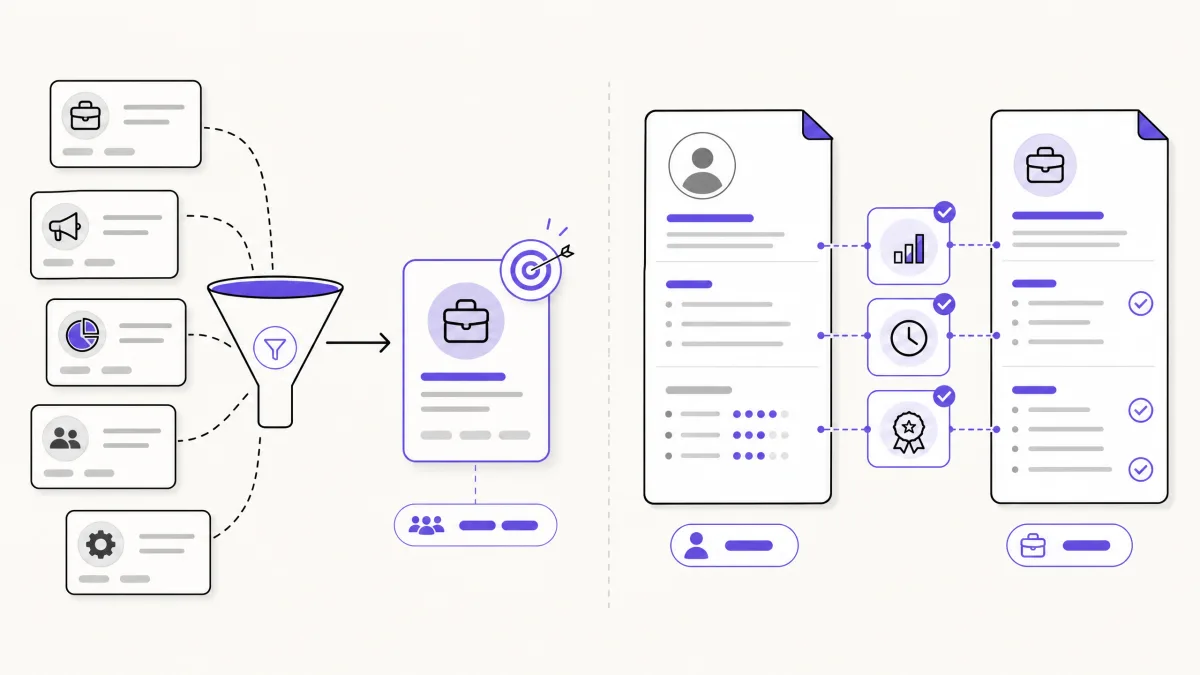
Effective job search strategies begin with disciplined target selection. Scattering applications across wildly different job titles dilutes your positioning and forces you to rebuild your professional narrative for every submission.
Tip 1: Choose One Clear Role Family
A role family consists of job titles that share core responsibilities, toolsets, and evaluation criteria—Data Analyst, Business Intelligence Analyst, and Operations Analyst, for example. Define one primary role family and a tight secondary set of adjacent titles.
Alongside title alignment, establish explicit search boundaries:
- Location and work mode: Remote, hybrid, or on-site within specific commuting limits.
- Seniority and level: Individual contributor, lead, or manager level corresponding to your verifiable scope.
- Compensation and constraints: Minimum acceptable base salary, scheduling realities, and true gatekeeping requirements such as active certifications or security clearances.
Don't ignore necessary authorization, licensing, or schedule constraints in hopes that an employer will overlook them later. Clarity up front saves weeks of dead-end recruitment conversations.
Tip 2: Study Several Current Job Descriptions
Before drafting or updating application materials, analyze ten active job descriptions within your chosen role family. Look for recurring patterns across employers:
- Core responsibilities: What daily tasks appear in the top three bullet points?
- Essential tools: Which software platforms, languages, or frameworks appear repeatedly?
- Key outcomes: What business problems are these teams hired to solve?
Distinguish true must-have requirements from trainable skills and secondary preferences. Use these postings as market research to understand how employers describe their problems, not as text to paste directly into your resume.
Tip 3: Decide Whether the Role Is Explainably Close
When evaluating an opening, ask a straightforward question: Can I point to truthful, verifiable evidence for the core work required?
You don't need an identical previous job title to establish a credible match. Relevant proof can come from paid employment, structured projects, freelance engagements, internships, formal volunteering, specialized coursework, or military service, provided every claim is represented honestly. If you're changing industries, focus on transferable outcomes and tools rather than job titles alone. A project manager transitioning into product management can emphasize stakeholder alignment, roadmap prioritization, and cross-functional collaboration as relevant proof points.
If you're returning to the workforce or navigating a career gap, review Can You Get a Job With an Employment Gap? to frame your recent experience with confidence and transparency.
Improve Your Resume and Applications Without Rewriting Everything
Many job search tips advise candidates to rewrite their entire resume for every single job posting. This approach is inefficient and unsustainable. A more effective job search relies on targeted, high-impact alignment.
Tip 4: Tailor the Highest-Impact Parts of the Resume
Instead of re-crafting every bullet point, focus your customization on the top third of your resume—the areas recruiters evaluate during an initial review:
- Professional headline: Align your title line with the target role family, such as Customer Success Manager | Enterprise Onboarding and Retention.
- Summary statement: Highlight two or three core capabilities that directly mirror the employer's top requirements.
- Top bullet points: Rearrange the evidence under your most recent roles so the most relevant achievements appear first.
Mirror specific industry terminology only when it accurately reflects work you've actually performed. For deeper resume optimization strategies, read How to Make a Resume Stand Out.
Tip 5: Replace Duties With Evidence
Generic task descriptions fail to differentiate candidates. Transform routine job responsibilities into clear proof points by incorporating context, actions, and verifiable scope or outcomes.
Before—duty focused:
Responsible for managing customer support tickets and resolving software issues.
After—evidence focused:
Resolved 45+ technical support tickets weekly across B2B accounts, maintaining a 98% CSAT score and reducing escalation resolution time by 20%.
Effective proof doesn't require invented revenue figures. Demonstrating quality, volume, speed, ownership, or process improvements provides compelling evidence of performance.
Tip 6: Use a Quality Bar Before Applying
Before submitting an application, run a quick three-point verification check:
- Verification: Is the posting legitimate, recently updated, and posted directly on an official hiring channel?
- Credibility: Can you articulate a clear, two-sentence explanation of why your past experience qualifies you for this specific work?
- Customization: Have you adjusted your top summary and key bullet points to reflect the posting's primary requirements?
Ten carefully vetted, tailored applications can produce more useful feedback than a much larger batch of generic submissions.
Tip 7: Follow Up With Context, Not Pressure
If you've submitted a tailored application for a high-fit role, a brief, professional follow-up can demonstrate genuine interest. Wait 7 to 10 business days after applying unless the employer provides a different timeline. Keep your message short, polite, and value-additive by mentioning a newly relevant project or reaffirming a specific point of fit. For timing guidelines and outreach copy, read How to Follow Up on a Job Application.
Find Better Opportunities and Build Useful Relationships
Relying solely on major public job boards places you in a high-volume application pool. Diversifying your discovery channels expands your reach and can reveal opportunities you might otherwise miss.
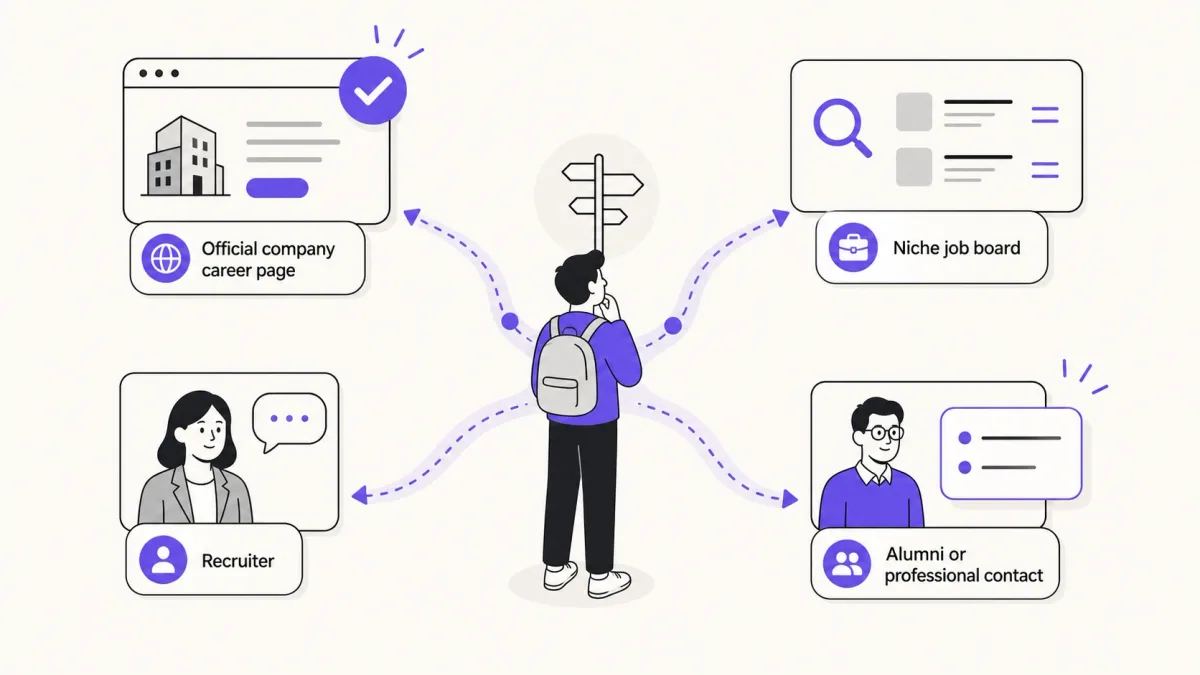
Tip 8: Use Several Channels for Different Purposes
Spread your job hunting tactics across multiple opportunity sources, assigning a clear strategic purpose to each:
- Company career pages: Direct submission and verification of active roles.
- Niche and industry job boards: Targeted listings with lower noise and higher role specificity.
- Recruiters and agencies: Context on employer hiring timelines and active search mandates.
- Alumni and professional associations: Warm networking connections and insider industry context. For platform-specific strategies, see How to Find a Job on LinkedIn.
- Public workforce resources: Free local training, career counseling, and public-sector openings supported by USAGov's job help page, including CareerOneStop, American Job Centers, and USAJOBS.
Tip 9: Prioritize Fresh, Verifiable Opportunities
Whenever you locate an interesting role on an aggregator or social feed, navigate directly to the employer's official career page to verify that the opening is active. Confirm that the job details, location requirements, and application instructions match. Prioritizing newer postings can help you focus on roles that are more likely to be actively reviewed, but verification matters more than an arbitrary age cutoff.
Tip 10: Make a Specific Networking Request
Job hunting networking fails when candidates send vague messages asking contacts to “let me know if you hear of any open roles.” Busy professionals cannot manage your job search for you. Instead, ask for concise, low-friction information.
Low-pressure outreach example:
Hi Sarah. I saw your recent post about scaling the operations team at Apex Logistics. I'm currently exploring senior logistics coordinator roles in Chicago and would love to ask two brief questions about how your team structures regional routing. Would you be open to a 10-minute chat or answering via email this week?
Tip 11: Earn the Referral Request
Requesting a job referral from a professional contact is an earned step, not an opening move. Build rapport first by conducting an informational interview or seeking context about the team's working environment. Only request a referral when the contact clearly understands your qualifications and can comfortably advocate for your fit. Always provide an easy, polite option for them to decline without awkwardness.
Turn More Interviews Into Useful Progress
Landing screening calls suggests that your resume and application targeting are generating interest. Once you enter the interview pipeline, your primary focus shifts to converting conversations into progress.
Tip 12: Prepare Evidence Stories From the Job Description
Review the target job description and select four to six core requirements. For each requirement, prepare a concise evidence story using a structured framework:
- Situation and task: Set the context and specific objective in two sentences.
- Action and decision: Detail the choices, analysis, and execution you personally owned.
- Result and reflection: Share the measurable outcome, team impact, or key operational lesson.
Tip 13: Practice Aloud, Not Only in Your Head
Silently reviewing interview answers creates a false sense of readiness. Vocalizing your responses exposes awkward transitions, rambling explanations, and pacing issues. Rehearse your 60-second professional introduction, core evidence stories, and answer to “Why this company?” aloud. Record a practice run on your phone or computer to evaluate your clarity, tone, and pacing.
Tip 14: Debrief Immediately After Each Interview
Within 30 minutes of concluding an interview, open a notebook or document and record your immediate observations:
- Which questions felt natural, precise, and well received?
- Where did you hesitate, struggle for evidence, or talk too long?
- What unexpected technical or behavioral topics arose?
Use these notes to refine your evidence stories before your next round. Tracking these details helps you separate correctable performance gaps from underlying company-culture mismatches.
Tip 15: Use Interview Assistance Only With Permission
During high-stakes technical or behavioral rounds, structure and clarity matter. The GreatOffer AI Interview Copilot can provide real-time assistance personalized to your resume, experience, and job description.
Focus Mode does not appear in screen shares, but screen-share invisibility is a display behavior, not permission. Obtain explicit employer, interviewer, and platform permission before using live assistance. Read our permission-first AI interview guide before deciding whether real-time support is appropriate.
For complete preparation strategies, including mock-practice frameworks and research checklists, explore How to Prepare for a Job Interview.

Run One Job Search Experiment Each Week
When job search results stall, changing your target, resume template, networking outreach, and interview style all at once makes it impossible to know what worked. Instead, operate like a practitioner running controlled weekly tests.
Use the One-Variable Weekly Experiment Card
Track your adjustments using this structured experiment framework:
| Field | Reader writes |
|---|---|
| Current bottleneck | Applications submitted for three weeks with zero responses |
| Hypothesis | The resume summary is too broad and fails to highlight industry-specific tools |
| Single change | Rewrite the top summary and headline for the next 10 applications to match target keywords |
| Primary signal | Receive at least one recruiter screening request within 10 business days |
| Review date | Friday of next week—keep, adjust, or revert based on the response signal |
See Three Weekly Experiments
- Problem: Few relevant replies. Narrow your target role family and strengthen the top third of your resume for a batch of 10 applications. Keep your cover letter format and outreach message identical so you isolate the resume-summary variable.
- Problem: Screening calls stall. Rebuild your 60-second “Tell me about yourself” introduction to focus on recent relevant outcomes. Practice it aloud five times before your next call while keeping your background preparation stable.
- Problem: Technical interviews stall. Refine your explanation structure for a recurring system-design question, ensuring you outline constraints before jumping into solutions.
Track Signals, Not Only Application Count
Measuring job search progress strictly by total application volume is misleading. Focus on qualitative progress metrics: recruiter response rates, screening-call conversions, interview-stage advancements, and clearer feedback from hiring managers. These learning signals indicate whether your adjustments are moving you closer to an offer.
Know When to Stop Repeating a Job Search Tactic
Knowing what to stop doing is just as important as knowing what to start. Continuing ineffective habits drains your energy and delays necessary adjustments.
- Stop sending generic applications when a meaningful batch produces zero relevant recruiter responses.
- Stop changing multiple variables at once, such as altering your resume format, target industry, and outreach messaging in the same week.
- Stop conducting complete resume rewrites for every job posting. Adjust only the highest-impact summary and bullet points.
- Stop applying for unverified roles that lack clear employer details, realistic job expectations, or verifiable career channels.
- Stop asking cold contacts for immediate job referrals without establishing professional context or mutual value first.
- Stop evaluating your personal worth using raw application counts. Measure success by feedback quality and stage progression.
Stopping an unproductive tactic isn't giving up on your job search. It's a strategic decision that frees up time and mental clarity to test a better approach.

Protect Your Money, Identity, and Time
Job search pressure can make candidates vulnerable to fraudulent offers and identity theft. Incorporate basic safety precautions into your job search plan to protect your personal and financial security.
Job Search Safety Checklist
- Never pay for a job offer: Honest employers do not ask you to pay upfront for a job, buy equipment with a check they sent, or return part of that money. Review the FTC job-scam guidance.
- Protect sensitive personal information: Do not include your Social Security number, bank details, driver's license number, or date of birth on a resume or in an early-stage application.
- Verify background-check requests: Employers using a third-party background-reporting company generally need your written permission before obtaining the report. See the FTC background-check guidance.
- Verify employer identity: Check recruiter addresses against the company's official domain and independently locate a company contact before sharing sensitive information.
Use This 30-Minute Job Search Reset Today
If your current job search feels overwhelming, pause active applications and run this 30-minute diagnostic reset:
30-Minute Job Search Reset Card
- 5 minutes: Identify your clearest signal failure. Are you missing leads, replies, screenings, or offers?
- 10 minutes: Audit a small recent batch. Inspect your last five applications, outreach emails, or interview debrief notes to spot recurring patterns or missing evidence.
- 10 minutes: Make one high-impact adjustment. Adjust your top summary, refine your 60-second introduction, or switch to a fresh opportunity channel.
- 5 minutes: Set your experiment review date. Define the precise signal you're watching for and choose a date to evaluate the outcome.
Completing one controlled, high-quality improvement today does more for your job search momentum than leaving twenty browser tabs open.

Summary: Fix Your Search One Stage at a Time
A successful job search doesn't require changing everything at once. By applying targeted job search tips, diagnosing your current bottleneck, running controlled weekly experiments, and holding your strategy to high evidence standards, you can transform a stalled job hunt into a more manageable hiring pipeline. Choose one signal to monitor, make one precise adjustment today, and schedule your first review date.
For step-by-step guidance across every phase of your career transition, read How to Get a Job.