

This guide explains what ultrasound techs make nationally, how salary changes by state and setting, how sonography compares with nursing and radiologic technology, and how to evaluate a real job offer.
Ultrasound Tech Salary at a Glance
The table below adds percentile context to the national benchmark. The median is usually the most useful midpoint for job seekers, while the lower and upper percentiles show how entry-level, experienced, specialized, and premium-market roles may compare.
| Pay Measure | Annual Pay | Hourly Pay | What It Means |
|---|---|---|---|
| 10th percentile | $67,820 | $32.61/hr | Often reflects newer workers, lower-paying regions, or lower-paying settings |
| 25th percentile | $80,430 | $38.67/hr | Common early-career benchmark in many markets |
| Median | $96,590 | $46.44/hr | Best national midpoint for salary expectations |
| Mean | $97,240 | $46.75/hr | Average pay, pulled upward by high-paying markets |
| 75th percentile | $106,930 | $51.41/hr | Common for experienced or specialized staff roles |
| 90th percentile | $129,370 | $62.20/hr | Top-end staff, specialty, high-cost metro, or premium-role range |
The BLS Occupational Outlook Handbook may show a different median figure because it still references May 2024 wage data in some places. For a 2026 salary article, use the May 2025 OEWS wage table as the primary national pay benchmark.
Mean vs. Median: Why Salary Sites Disagree
Salary websites can show different ultrasound tech salary numbers because they may use different wage years, data sources, or calculation methods.
The median is usually the safest benchmark for job seekers because it shows the midpoint of the market. The mean, or average, can be pulled higher by high-paying states, specialty roles, senior workers, and premium contract positions. Job boards may also publish figures based on self-reported salaries or active job postings, which can move faster than official government wage surveys but may be less consistent.
When comparing salary data, check three things before drawing a conclusion:
- Source: Government wage survey, job board, employer posting, or self-reported data
- Year: May 2024, May 2025, or another reporting period
- Measure: Median, mean, percentile, hourly rate, annual salary, or posted pay range
For offer decisions, use the BLS median and local wage data as a baseline, then compare that number with current job postings in your metro area.
Entry-Level, Mid-Career, and Top-Earner Ranges
Percentiles are not the same as exact career stages, but they are useful for estimating where a job offer may sit in the market.
| Career Situation | Useful Benchmark | How to Interpret It |
|---|---|---|
| New graduate or lower-paying setting | 10th to 25th percentile | A lower offer may be normal in some regions, but it should still match local demand and credential expectations |
| Established staff sonographer | Median | A reasonable midpoint for many full-time staff roles, especially when benefits are included |
| Experienced or specialized sonographer | 75th percentile | Often a better comparison point for workers with strong credentials, specialty coverage, or hospital experience |
| Premium market or top-end role | 90th percentile | More likely in high-cost metros, hard-to-fill specialties, lead roles, or premium schedules |
Use these ranges as conversation starters, not guarantees. A new graduate in a high-paying metro may earn more than an experienced worker in a lower-paying rural market, while a hospital role with call and weekend coverage may produce more total compensation than a clinic role with the same base rate.
Ultrasound Tech, Sonographer, or Diagnostic Medical Sonographer?
These terms usually refer to the same career.
- Diagnostic medical sonographer is the formal title used by the BLS.
- Sonographer is the common professional title used in hospitals and imaging departments.
- Ultrasound tech or ultrasound technician is the search-friendly term many students, job seekers, and recruiters use.
In clinical settings, employers often prefer “sonographer” or “technologist” because the role requires real-time image acquisition, anatomy knowledge, patient communication, and judgment about image quality.
Hourly vs. Annual Pay
Most ultrasound techs are paid hourly, especially in hospitals, imaging centers, and outpatient clinics.
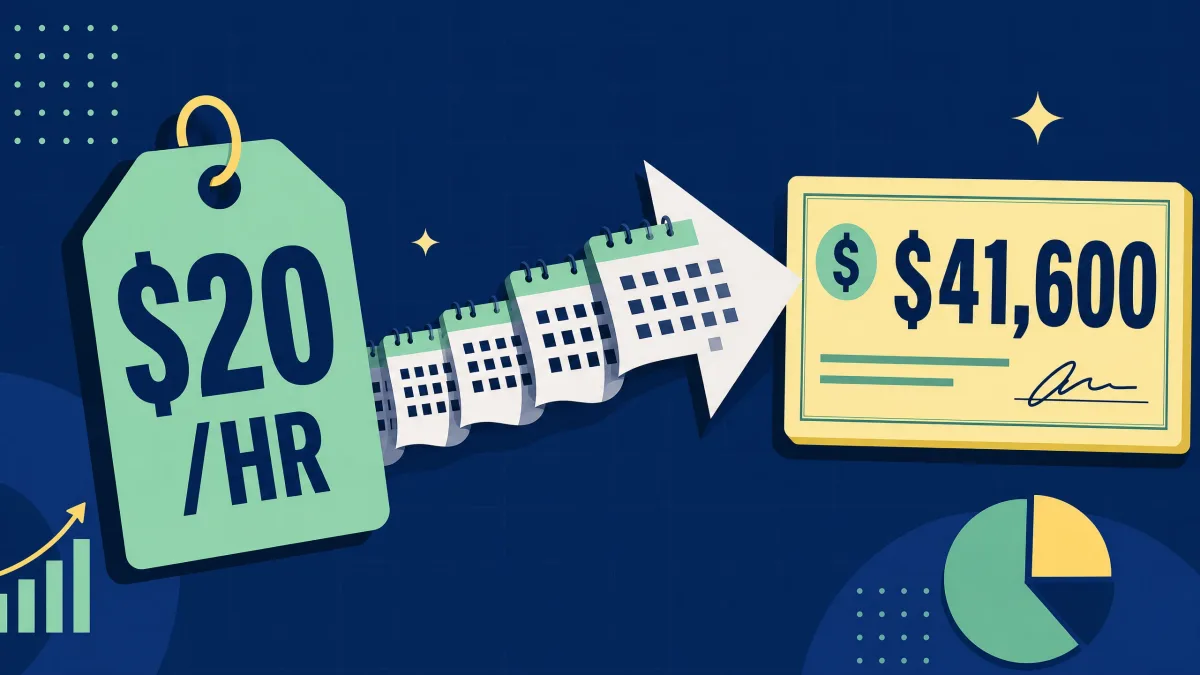
To estimate annual pay from an hourly rate, multiply the hourly wage by 2,080 hours:
Hourly rate × 2,080 = estimated gross annual pay
For example:
| Hourly Rate | Estimated Annual Gross Pay |
|---|---|
| $35/hr | $72,800 |
| $45/hr | $93,600 |
| $55/hr | $114,400 |
| $62/hr | $128,960 |
This estimate does not include overtime, evening or weekend differentials, call pay, bonuses, tax treatment, or unpaid gaps between contracts. For a detailed conversion example, see how $35 an hour translates to annual pay.
Ultrasound Tech Salary by State

Location is one of the biggest drivers of ultrasound tech salary. High-paying states often have higher housing costs, stronger hospital competition, higher labor costs, or a shortage of experienced sonographers. Lower-paying states may still offer better take-home comfort if rent, taxes, and commuting costs are lower.
The examples below show how wide the state gap can be.
| State | Median Annual Pay | Median Hourly Pay | How to Read It |
|---|---|---|---|
| California | $128,530 | $61.79/hr | Very high gross pay, but major metro living costs can be high |
| Hawaii | $124,430 | $59.82/hr | High pay influenced by island labor markets and housing costs |
| Washington | $121,340 | $58.34/hr | Strong pay in competitive healthcare markets |
| Texas | $83,500 | $40.14/hr | Below the national median, but local cost and tax factors matter |
| Alabama | $68,180 | $32.78/hr | Lower gross wage, often paired with lower regional living costs |
| North Carolina | $86,010 | $41.35/hr | Midrange example where metro and employer type can matter a lot |
Do not compare states by gross salary alone. A $120,000 salary in a high-cost coastal city may not feel better than an $85,000 salary in a lower-cost market once rent, commuting, insurance, taxes, and family expenses are included.
How to Use State Salary Data Before Applying
Before accepting a job offer, compare four things:
- State wage data: Use it to understand the broad regional market.
- Metro wages: Large cities can pay much more than rural areas in the same state.
- Employer type: Hospitals, outpatient centers, physician offices, and specialty labs may pay differently.
- Total compensation: Base rate is only one part of the offer. Benefits, shift differentials, call pay, PTO, retirement match, tuition support, and credential reimbursement can change the real value.
If you are relocating, build a simple comparison using expected rent, commute, state taxes, health insurance costs, and expected schedule. That will tell you more than salary alone.
What Drives Ultrasound Tech Pay?

Two sonographers in the same city can earn different pay because they bring different credentials, experience, specialties, schedules, and employer settings.
| Pay Driver | Why It Matters | What to Check |
|---|---|---|
| Experience | Experienced sonographers usually scan faster, handle difficult exams, and need less supervision | Years required in job postings |
| Credentials | Registries can qualify you for more roles and specialty departments | RDMS, RVT, RDCS, RCS, or other accepted credentials |
| Specialty | Cardiac, vascular, pediatric, and high-acuity roles may pay more in some markets | Specialty-specific job postings |
| Work setting | Hospitals may include call, weekends, holidays, and urgent exams | Base rate plus differential policy |
| Schedule | Nights, weekends, and call can increase total pay | Written differential and call-back terms |
| Region | Wage floors vary widely by state and metro | BLS state and local wage data |
Education and Credentials
Most employers look for graduates from accredited diagnostic medical sonography programs, often at the associate degree level. A bachelor’s degree can help with management, education, or leadership pathways, but it does not automatically guarantee higher entry-level pay in every market.
Credentials matter because they can expand the jobs you qualify for. Common sonography-related credentials include:
- RDMS: Registered Diagnostic Medical Sonographer
- RVT: Registered Vascular Technologist
- RDCS: Registered Diagnostic Cardiac Sonographer
- RCS: Registered Cardiac Sonographer
The practical value of a credential depends on the employer and department. Instead of assuming a fixed pay bump, check local postings and ask whether the employer pays more for dual registries or specialty coverage.
Specialty and Modality
General sonography, OB/GYN, vascular, and cardiac roles can all provide strong pay, but the highest-paying path varies by region.
Cardiac and vascular sonography often appear in higher-paying job discussions because these roles require specialized knowledge and are heavily used in hospital, cardiology, vascular surgery, and high-acuity settings. Pediatric, fetal, and advanced echo roles may also command premium pay, but the opportunities are more specialized and may require additional training or experience.
The best specialty is not always the one with the highest headline salary. Consider:
- How many jobs exist in your region
- Whether employers require prior experience
- Whether the schedule includes call or weekends
- Whether the specialty fits your interests and physical stamina
- Whether the credential helps you qualify for more stable roles
Work Setting, Shift Pay, and On-Call
A daytime outpatient clinic and a hospital trauma department can offer very different work lives.
| Setting | Typical Advantages | Potential Trade-Offs |
|---|---|---|
| Hospital | More shift options, emergency exams, call, overtime, specialty departments | Nights, weekends, holidays, higher pace, more unpredictable cases |
| Outpatient imaging center | More predictable schedule, lower acute-care pressure | Fewer differentials and less call pay |
| Physician office | Regular hours, smaller team environment | May offer lower total compensation in some markets |
| Travel or contract role | Potentially higher gross pay and flexibility | Benefits, taxes, housing, contract gaps, and relocation stress vary widely |
Ask for the pay policy in writing. A strong offer should clearly state base hourly rate, overtime rules, evening/night/weekend differential, standby call pay, call-back pay, holiday pay, benefits, and credential reimbursement.
Ultrasound Tech Salary vs. Other Healthcare Careers
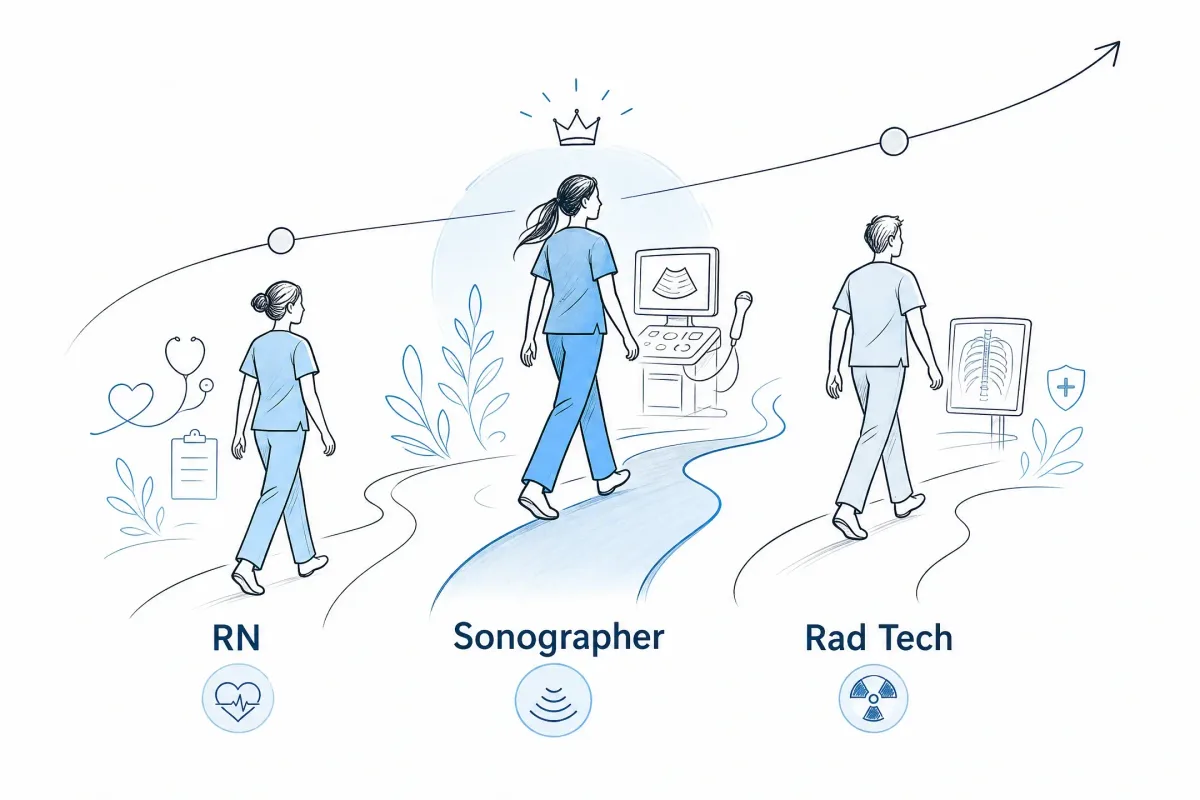
Many people compare sonography with nursing and radiologic technology because all three can be entered through associate-degree pathways in many states. The best choice depends on pay, training requirements, daily work, physical demands, and long-term career options.
| Career | BLS May 2025 Median Annual Pay | Typical Work Focus |
|---|---|---|
| Registered Nurse | $97,550 | Bedside care, medication administration, patient coordination, broad specialty options |
| Diagnostic Medical Sonographer | $96,590 | Real-time diagnostic imaging, anatomy evaluation, patient exams |
| Radiologic Technologist / Technician | $80,110 | X-ray imaging and related radiologic procedures |
RN vs. Ultrasound Tech
Registered nurses and ultrasound techs have very similar national median pay in the latest BLS wage data. RN pay is slightly higher nationally, but the difference is small enough that lifestyle and work style matter more than the headline number.
RN roles can offer broader career mobility across ICU, ER, surgery, administration, case management, education, and advanced practice routes. Sonography is more focused and diagnostic, with less responsibility for medication administration or continuous bedside nursing care.
Sonography may be a better fit if you want a high-skill imaging role with one-on-one exams and technical problem-solving. Nursing may be a better fit if you want a wider range of departments and long-term clinical leadership paths.
Radiology Tech vs. Ultrasound Tech
Diagnostic medical sonographers earn more nationally than radiologic technologists and technicians in the latest BLS median wage data. That pay difference reflects the real-time, operator-dependent nature of sonography: image quality depends heavily on the sonographer’s positioning, anatomy knowledge, scanning technique, and judgment.
Radiologic technology can still be a strong path, especially for people interested in X-ray, CT, MRI, interventional radiology, or radiation-related imaging careers. If your main goal is the highest median pay among these options, sonography currently has the stronger national wage benchmark.
Is Ultrasound Tech Salary Worth the Training?

For many students, ultrasound technology can offer a strong return on training time because the national median pay is close to six figures and the occupation has a strong employment outlook. The BLS projects employment of diagnostic medical sonographers to grow 13% from 2024 to 2034, much faster than the average for all occupations.
That does not mean the career is easy. Sonography can be physically demanding, competitive to enter, and stressful in high-acuity settings.
How Long Does It Take to Become an Ultrasound Tech?
A common pathway takes about two to three years, depending on prerequisites and program format.
Typical steps include:
- Complete prerequisites: Anatomy, physiology, physics, algebra, and other required coursework.
- Attend an accredited sonography program: Many students pursue an associate degree through a CAAHEP-accredited program.
- Complete clinical training: Programs usually include supervised scanning experience.
- Earn credentials: Many employers prefer or require registry credentials such as RDMS, RVT, or RDCS.
- Apply for entry-level roles: Compare offers by hourly rate, setting, schedule, and benefits.
Before enrolling, confirm accreditation, clinical placement support, registry exam eligibility, total tuition, graduation rate, credential pass rate, and job placement support.
Stress, Physical Demands, and Work-Life Fit
The salary can be attractive, but the work is not passive. Sonographers may spend long periods scanning, applying transducer pressure, helping position patients, working in awkward postures, and staying focused during technically difficult exams.
Potential challenges include:
- Shoulder, wrist, neck, and back strain
- Fast-paced emergency or inpatient exams
- Emotionally sensitive patient interactions
- Pressure to capture diagnostic-quality images
- Call, weekends, holidays, or night rotations in some settings
Good ergonomics, adjustable equipment, supportive staffing, training, and realistic scheduling can make a major difference in long-term career sustainability.
How to Increase Your Ultrasound Tech Salary

The most reliable way to increase ultrasound tech salary is to become more valuable in your local job market. That usually means stronger credentials, more specialty coverage, better interview performance, and smarter offer evaluation.
Choose Credentials That Match Local Demand
Do not pursue every credential just because it exists. Look at job postings in your target city and identify what employers repeatedly request.
For example:
- If hospitals often request vascular coverage, RVT may be valuable.
- If cardiology groups are hiring, RDCS or a cardiac pathway may help.
- If OB/GYN centers dominate your area, relevant OB/GYN experience may matter more.
- If you want leadership, training or management experience can become important later.
The right credential is the one that expands your realistic job options in the market where you want to work.
Compare Offers With Local Data
A good offer is not just a high hourly rate. Review the full compensation package, and prepare a researched response to “What is your desired salary?” before recruiter screens.
Use this checklist before accepting:
- Is the base rate competitive for your state and metro area?
- Are evening, night, weekend, holiday, and call differentials listed in writing?
- How often will you actually be on call?
- Is call-back paid at a premium rate?
- Are CME, credential renewal, or registry exam costs reimbursed?
- What are the health insurance premiums and deductibles?
- Is there a retirement match?
- Does the schedule protect you from burnout?
- Are there growth paths into lead, specialist, educator, or application roles?
If the base rate is slightly lower but the benefits, schedule, and learning environment are much stronger, the offer may still be reasonable.
Prepare for Salary and Interview Questions
Salary negotiation is easier when you can explain your value clearly. Combine this preparation with the broader steps in how to prepare for a job interview, then prepare answers to questions such as:
- “What are your salary expectations for this role?”
- “Which registries or specialties do you bring?”
- “How do you handle technically difficult scans?”
- “How do you manage emergency add-on exams when the schedule is full?”
- “Are you comfortable with call, weekends, or rotating shifts?”
If you want structured practice, GreatOffer.ai’s real-time AI interview copilot can help you rehearse interview answers and organize talking points for healthcare job interviews and salary conversations. Use it as preparation support, not as a salary data source.

Conclusion
Ultrasound tech salary is strong compared with many associate-degree healthcare paths. The latest BLS wage data shows a national median of $96,590 per year, but your real earning power depends on state, metro area, credentials, specialty, work setting, schedule, and benefits.
Use national data as your starting point, then compare local wages and real job offers. The best compensation decision is not simply the highest hourly rate—it is the role that gives you fair pay, sustainable workload, strong training, and room to grow.
Sources
- U.S. Bureau of Labor Statistics — Occupational Employment and Wages: Diagnostic Medical Sonographers
- U.S. Bureau of Labor Statistics — Occupational Outlook Handbook: Diagnostic Medical Sonographers
- U.S. Bureau of Labor Statistics — Occupational Employment and Wages News Release
- U.S. Bureau of Labor Statistics — Registered Nurses
- U.S. Bureau of Labor Statistics — Radiologic and MRI Technologists
- O*NET OnLine — Diagnostic Medical Sonographers Local Wages
- CAAHEP — Find an Accredited Program
- ARDMS — Certification Information