

Kansas Wage, Household Income, and Living-Wage Benchmarks
| Metric | Latest figure used in this guide | What it measures | Best use |
|---|---|---|---|
| Average individual wage | $60,640/year or $29.15/hour, May 2025 | Mean wage across all Kansas occupations | Broad statewide comparison |
| Typical worker benchmark | About $48,000/year, 2025 | Median annual wage across occupations | First check for a typical pay level |
| Median household income | $74,275, 2020–2024 | Income received by an entire household | Household-level comparison |
| Living wage | $21.63/hour for one adult with no children, February 2026 | MIT estimate for basic needs | Budget and relocation baseline |
Sources: BLS May 2025 OEWS tables, U.S. Census Bureau QuickFacts for Kansas, and the MIT Living Wage Calculator for Kansas.
Why the numbers are different
The figures above measure different things:
- Mean wage is total pay divided by the number of workers. A relatively small number of high earners can pull it upward.
- Median wage is the midpoint: half of workers earn more and half earn less. It is often the cleaner starting point for evaluating a typical salary.
- Household income may combine wages from two earners, self-employment income, and other income. It is not one person’s salary.
- Living wage estimates the income needed for expenses included in a specific methodology. It is not a market wage or a guarantee of a comfortable lifestyle.
Before using any salary figure, check its source, data period, geography, population, and whether it represents mean pay, median pay, base salary, or total compensation.
Average Salary in Kansas by Occupation
A statewide average is useful for orientation, but job seekers should normally compare an offer with the median for the relevant occupation. The table below uses 2025 BLS-based wage estimates published through the U.S. Department of Labor’s CareerOneStop. Kansas employment counts come from the Kansas Department of Labor’s 2025 Economic Report and reflect May 2024 employment.
| Occupation | Kansas employment | 2025 median hourly pay | 2025 median annual pay | Typical preparation | Common interview focus |
|---|---|---|---|---|---|
| Registered Nurses | 32,640 | $38.14 | $79,320 | Nursing education and state licensure | Clinical judgment, prioritization, patient scenarios |
| Customer Service Representatives | 32,250 | $19.39 | $40,330 | High school diploma and on-the-job training | De-escalation, judgment, problem solving |
| Heavy and Tractor-Trailer Truck Drivers | 23,250 | $28.33 | $58,930 | Professional training, CDL, safe driving record | Safety, compliance, routing decisions |
| Software Developers | 15,850 | $54.53 | $113,420 | Degree or equivalent technical experience and portfolio | Coding, system design, technical tradeoffs |
| Accountants and Auditors | 14,030 | $37.98 | $79,000 | Bachelor’s degree; some roles prefer a CPA | Accuracy, controls, deadlines, stakeholder communication |
| General and Operations Managers | 25,500 | $44.63 | $92,840 | Substantial related experience; a degree is common | Leadership, execution, process improvement |
Sources: CareerOneStop Salary Finder for 2025 wage medians and the Kansas Department of Labor 2025 Economic Report for May 2024 employment counts.
These roles are examples, not a complete ranking of Kansas occupations. They were selected because they combine meaningful Kansas employment with clear wage data and distinct interview requirements.
How to evaluate your own occupation
Use the closest standard occupation rather than relying only on the title in a job posting. Titles such as “manager,” “analyst,” or “developer” can describe very different responsibilities.
Then ask:
- Is the job benchmark statewide or specific to a metro area?
- Does the role appear entry-level, experienced, senior, or managerial?
- Are licenses, shifts, travel, on-call work, or specialized tools part of the job?
- Does the posted range represent base salary or total compensation?
- Are the responsibilities broader than the title suggests?
If an offer is above or below the median, that alone does not make it good or bad. The difference should be explainable through experience, specialization, geography, schedule, responsibilities, or benefits.

Average Salary in Kansas by Metro Area
For a consistent geographic comparison, the following table uses BLS May 2024 regional releases for mean hourly wages across all occupations.
| Metro area | Mean hourly wage | What the figure represents |
|---|---|---|
| Wichita, KS MSA | $27.34 | Mean wage across all occupations in the metro |
| Topeka, KS MSA | $28.10 | Mean wage across all occupations in the metro |
| Kansas City, MO-KS MSA | $30.78 | Mean wage across all occupations in the two-state metro |
Sources: BLS regional releases for Wichita, Topeka, and Kansas City.
A metro-wide mean does not tell you what a specific occupation should pay. A software developer, nurse, accountant, or truck driver may have a local market that differs substantially from the all-occupation figure.
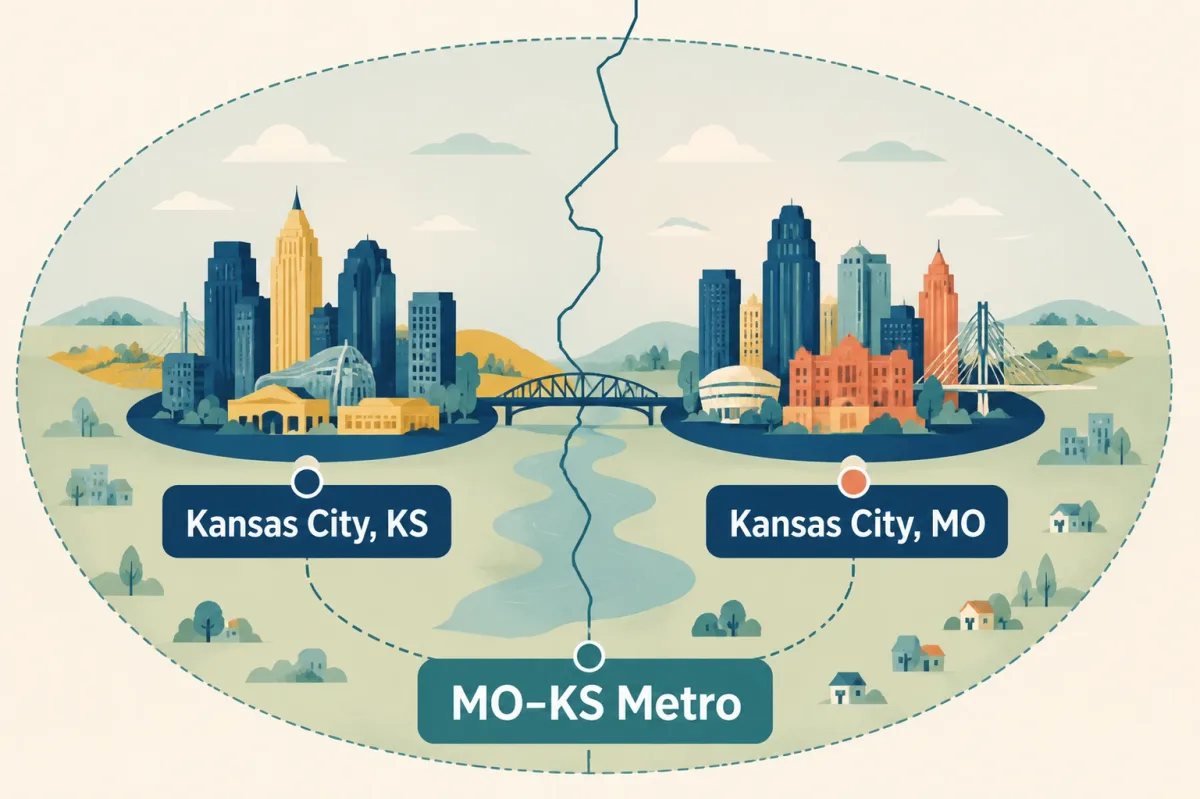
Kansas City, Kansas is not the same data market as Kansas City, Missouri
“Average salary in Kansas City” can refer to three different geographies:
- Kansas City, Kansas, the city in Kansas;
- Kansas City, Missouri, the city in Missouri; or
- Kansas City, MO-KS Metropolitan Statistical Area, a cross-state labor market that includes counties in both states.
Always read the geography label before comparing an offer. A figure for the MO-KS metro should not be presented as if it describes only Kansas City, Kansas.
How to compare pay and local costs
Use three layers:
- Start with the median wage for the occupation.
- Check whether the job is tied to a city, metro, remote pay zone, or statewide market.
- Compare guaranteed compensation with housing, transportation, childcare, healthcare, and other essential costs for your household.
This approach is more useful than ranking cities by one all-occupation average.
What Is a Good Salary in Kansas?
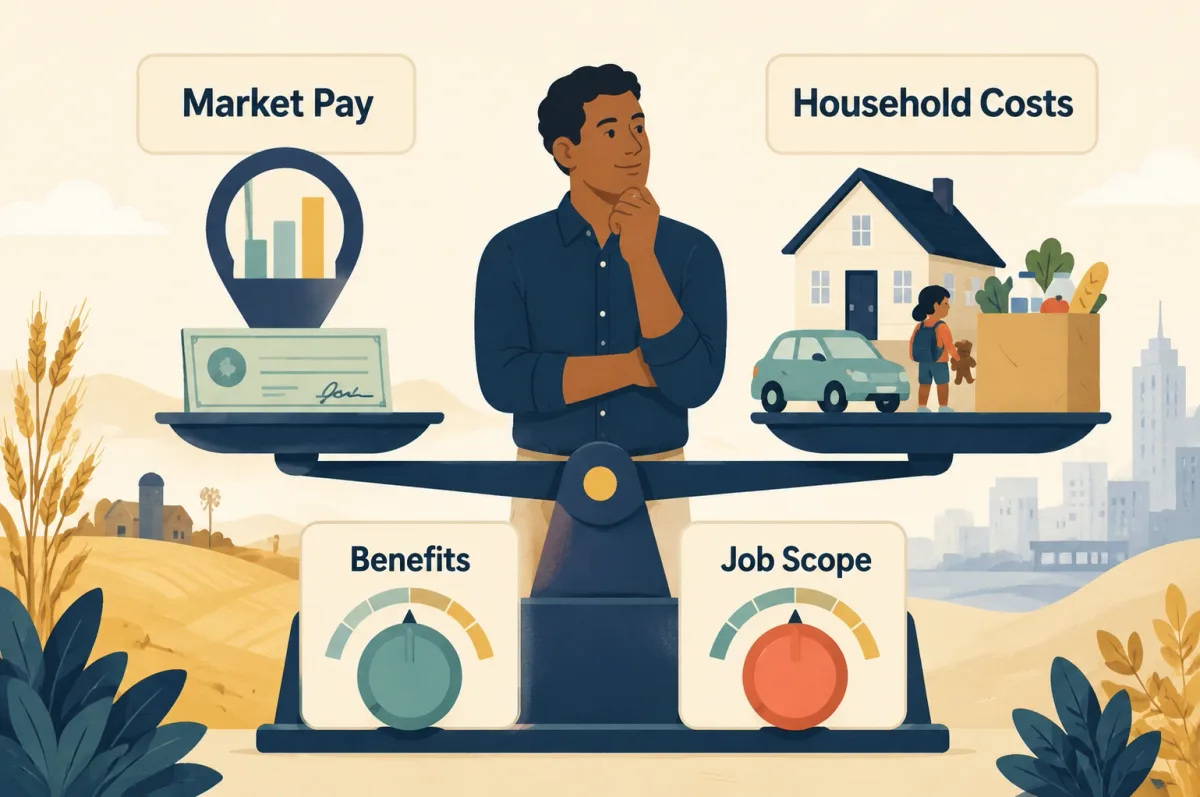
A good salary in Kansas is one that is competitive for the occupation, covers the household’s essential costs, supports savings, and provides acceptable compensation for the job’s responsibilities and schedule. There is no single number that meets those conditions for every worker.
A useful evaluation combines two questions:
- Market value: What does this occupation normally pay in the relevant location?
- Household fit: Does the compensation work for this household’s costs and priorities?
Kansas living wage by household type
MIT’s living-wage estimates provide a basic-needs baseline. They are not a measure of market salary or discretionary comfort.
| Household type | Living wage per working adult |
|---|---|
| 1 adult, 0 children | $21.63/hour |
| 1 adult, 1 child | $36.07/hour |
| 2 adults, both working, 0 children | $14.88/hour for each working adult |
| 2 adults, 1 working, 2 children | $39.03/hour for the sole working adult |
For two-working-adult households, the MIT figure is the required hourly wage for each working adult, not a combined household hourly wage. See the MIT Kansas calculation for the full household table and methodology.
A salary above the living-wage threshold may still feel tight if housing, debt, insurance premiums, commuting, or childcare costs are high. A salary below a broad statewide mean may still be competitive for a specific occupation. That is why market value and household fit should be evaluated separately.
Kansas Salary Reality Check
Use this worksheet when comparing a current salary or offer:
| Question | What to record |
|---|---|
| What is the standard occupation? | Match the role to the closest BLS occupation rather than relying only on the employer’s title |
| What is the correct geography? | Kansas statewide, a specific city, a metro area, or a remote pay zone |
| What pay is guaranteed? | Base salary or hourly pay, excluding uncertain bonus or commission |
| What changes total value? | Bonus, shift differential, health premiums, retirement match, PTO, schedule and commute |
| Where do you fit in the range? | Entry, experienced, senior, specialized or managerial |
| Does the pay work for your household? | Essential costs, dependents, savings goals and risk buffer |
Classify the result as:
- Below the supported range: Research comparable roles and prepare a data-based question or counteroffer.
- Within the supported range: Compare benefits, scope, schedule, growth and household fit.
- Above the supported range: Confirm whether the role includes broader responsibilities, variable pay or unusually demanding conditions.
Which Kansas Jobs Offer Higher Pay?
The highest-paying occupation is not automatically the best career target. Some specialized medical and executive jobs pay very well but require years of training or have relatively small employment bases. Other occupations employ thousands of Kansas workers but have more moderate wages.
Among the larger-employment roles shown in this guide, software developers, general and operations managers, registered nurses, and accountants have median annual wages above the statewide median estimate. Truck driving offers a shorter formal training path than many degree-based occupations, while customer service has a large employment footprint but a lower median wage.
Use four factors when comparing career paths:
- Pay: Is the occupation’s median above the minimum you need?
- Access: Can you realistically meet the education, license, experience or portfolio requirements?
- Labor-market evidence: What do official projections and annual openings show?
- Fit: Do the daily work and interview requirements match your strengths?
Current employment is not the same as future demand. Do not label an occupation “fast-growing” or “in demand” without Kansas-specific projections, annual openings, or transparent current job-posting data.

How to Use Kansas Salary Data in Your Job Search
Salary research should change what you do, not simply give you another number to remember.
Set a floor, target and stretch range
- Floor: The lowest compensation that works after considering essential costs and noncash value.
- Target: A defensible figure based on the occupation, geography, responsibilities and your evidence.
- Stretch: A higher figure for roles where your experience or specialization strongly exceeds the baseline requirements.
Do not add an arbitrary percentage to your current salary. Build the range from the market and the role.

Compare job listings consistently
Record the same information for every serious opportunity:
- base pay;
- bonus or commission;
- health insurance cost;
- retirement contribution;
- PTO and holidays;
- schedule, shift or on-call expectations;
- commute, travel or remote policy;
- title, level and promotion process.
A higher base salary can be offset by expensive benefits, long travel, unpredictable hours or weak advancement. A lower base can sometimes be offset by stronger guaranteed benefits or a materially better schedule.
Build a focused shortlist
Group roles into:
- Strong match: You meet the core requirements and the range supports your target.
- Competitive match: You meet the essential requirements and can demonstrate relevant outcomes.
- Stretch role: You are missing one or two noncritical requirements, but the scope and upside justify applying.
Before applying, review several current descriptions for the same occupation. Repeated tools, responsibilities and outcomes reveal what employers are likely to test in interviews.
Prepare for the Interview and Salary Question
Knowing the market range is only useful if you can explain why your experience fits the job’s level.
Build evidence for the role
Prepare five to seven examples that can answer multiple questions. Each should show:
- the situation and constraint;
- the decision you personally made;
- the action you took;
- the measurable or observable result; and
- what you learned or would improve.
Different roles require different proof:
| Role | Evidence worth preparing |
|---|---|
| Software Developer | A project explained end to end, including technical tradeoffs and results |
| Registered Nurse | Patient scenarios showing safe prioritization and communication |
| Operations Manager | A process improvement, resource tradeoff or leadership decision |
| Accountant | A control issue, deadline risk, close improvement or error prevented |
GreatOffer.ai’s job interview preparation checklist provides a structured preparation process. If your opening answer is unclear or too long, review how to answer “Tell me about yourself”.

Answer salary expectations without guessing
A concise answer can establish a researched range while preserving room to discuss the full offer:
Based on the responsibilities and Kansas market data for this occupation, I’m targeting a base range of $X to $Y. I’m open to discussing the final level, bonus structure, benefits and the full scope of the role.
Use the occupation and geography to support the range. Personal expenses can determine your private floor, but they are usually not the strongest argument to present to an employer.
Use interview assistance responsibly
An AI interview copilot can help organize multi-part questions, surface prepared evidence and keep answers structured under pressure. It should support genuine experience and judgment, not create accomplishments a candidate cannot defend.
Use real-time assistance only when permitted by the employer and interview platform. Mock interviews, STAR-story preparation and post-interview review are lower-risk ways to prepare. If assistance is permitted, explore GreatOffer.ai and test the workflow before the interview.
How to Negotiate a Kansas Job Offer
A supported counteroffer is based on market evidence, role scope and relevant experience—not simply a desire for a higher number.
Review the full package
| Category | Questions to ask |
|---|---|
| Base pay | Is it annual or hourly? Is the schedule guaranteed? |
| Variable pay | How is bonus or commission calculated, and how often is it actually paid? |
| Benefits | What are the employee premiums, deductibles, retirement match and eligibility dates? |
| Time | How much PTO is available? Are holidays, travel, shifts or on-call time involved? |
| Flexibility | Is remote or hybrid work written into the offer? |
| Growth | What level is the role, and when is compensation reviewed? |
Compare the offer with the occupation benchmark and correct geography. Then check whether the responsibilities are broader than the title, whether variable pay is realistic, and whether benefits materially change the value.
Make a concise counteroffer
Use four steps:
- Confirm enthusiasm for the role.
- State the market- and scope-supported target.
- Connect the request to relevant experience and results.
- Ask whether there is flexibility, then pause.
Thanks again—I’m excited about the role. Based on Kansas market benchmarks for this occupation and the scope we discussed, I was targeting $X in base compensation. Given my experience in A/B/C and the results I can deliver in D, is there flexibility to move the base closer to $X?
If base pay is fixed, consider whether a sign-on bonus, earlier review date, additional PTO, schedule flexibility, professional-development budget or corrected job level would change the decision.
Never invent competing offers, current compensation or qualifications. If the package remains below your floor and noncash value does not close the gap, walking away may be the rational decision.
Methodology and Sources
This guide separates wage, income and living-cost measures rather than presenting them as interchangeable salary figures.
- Statewide mean and median wage: May 2025 BLS Occupational Employment and Wage Statistics state data. The median is rounded in this guide for readability.
- Occupation wage medians: 2025 BLS-based estimates in the U.S. Department of Labor’s CareerOneStop Salary Finder.
- Kansas occupation employment: May 2024 counts in the Kansas Department of Labor 2025 Economic Report.
- Household income: U.S. Census Bureau QuickFacts for Kansas, covering 2020–2024.
- Living wage: MIT Living Wage Calculator for Kansas, updated February 15, 2026.
- Metro wages: BLS regional occupational employment and wage releases for Wichita, Topeka and Kansas City, using May 2024 estimates.
Data products are released on different schedules. We retain the period beside each figure instead of making all numbers appear to come from 2026.
Turn the Benchmark Into a Better Job Decision
The statewide average is a useful starting point, not a personal answer. Match the salary figure to the question: use occupation data to judge an offer, geography to refine the comparison, household costs to test affordability, and evidence from your experience to prepare for interviews and negotiation.
Once you know your target range, write down the three strongest examples that show you can perform at that level. Then practice explaining them clearly. GreatOffer.ai can help structure interview preparation and, where permitted, provide real-time support during the conversation.