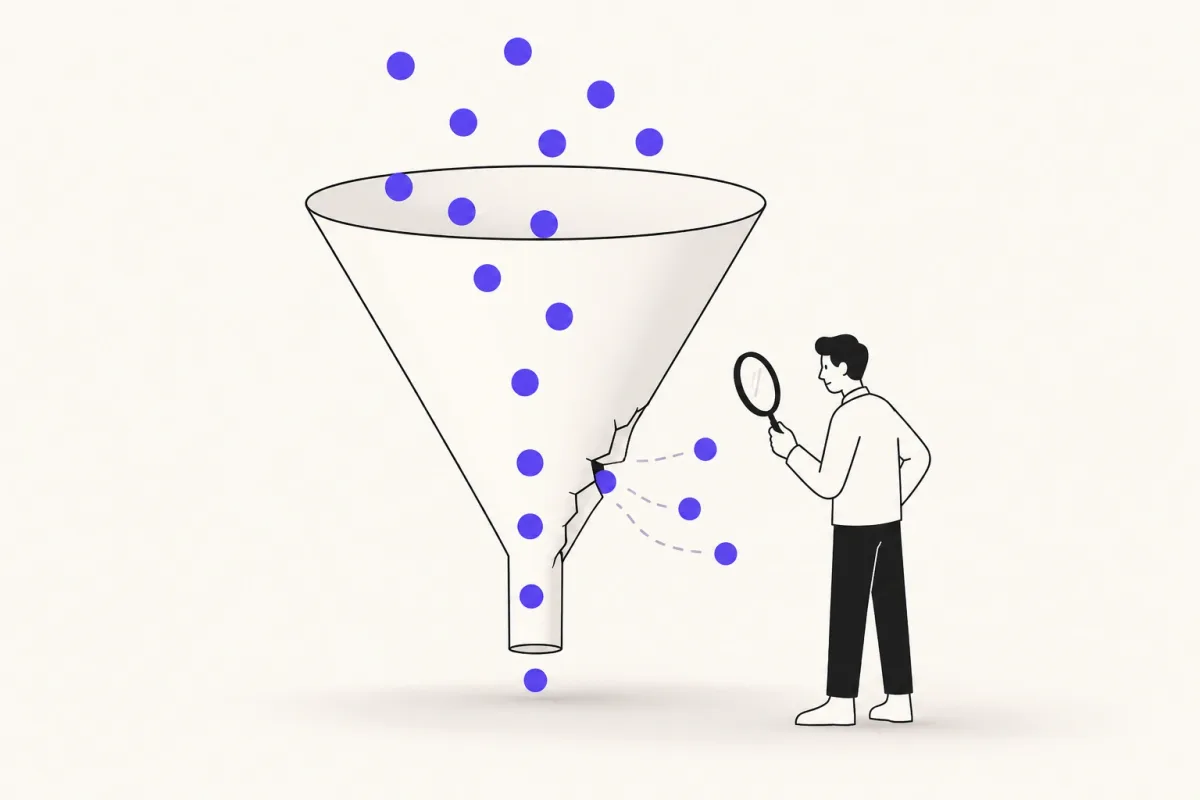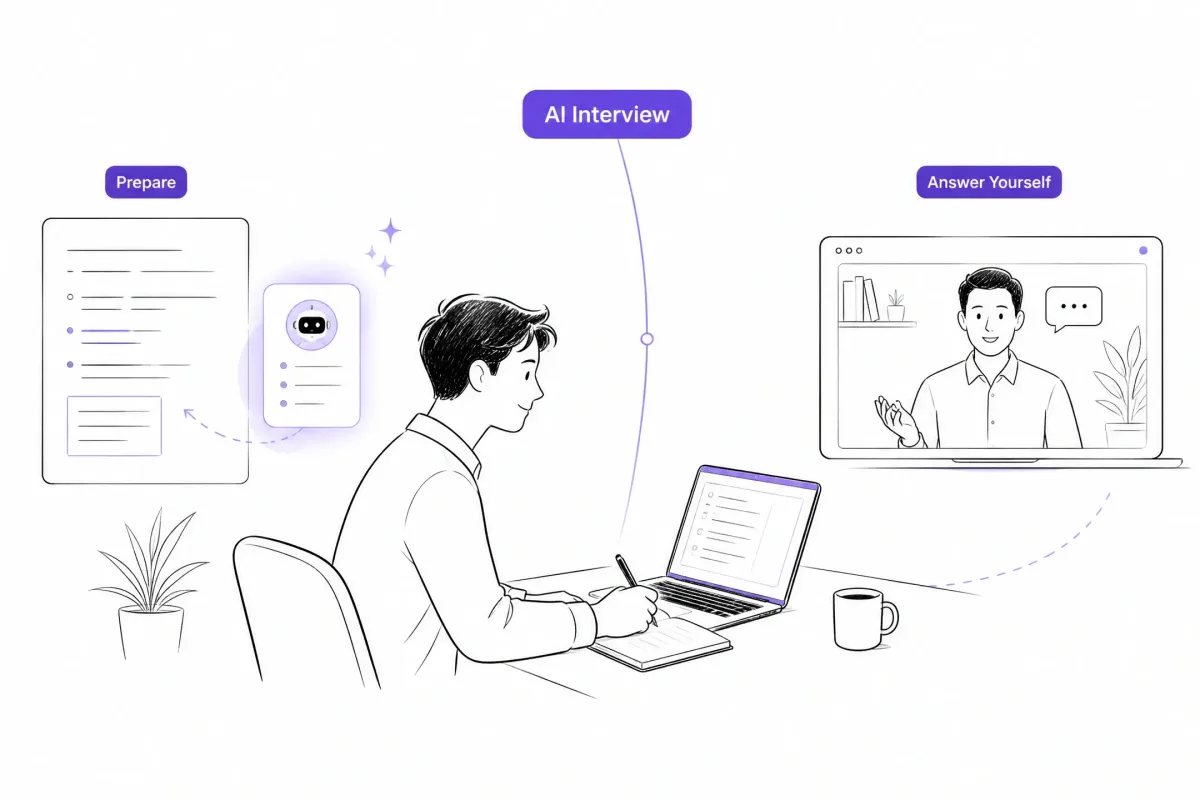

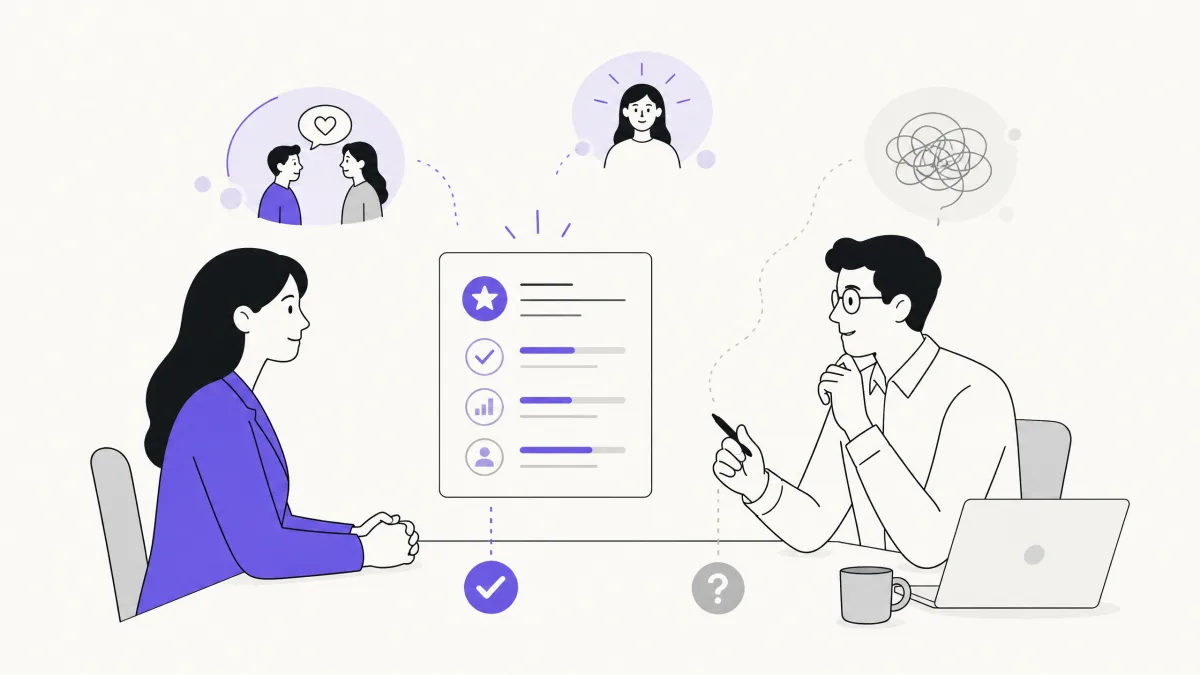
Why do job interviews feel like vibes? Usually because job-relevant evidence, the way you came across in the moment, and internal hiring decisions you cannot see are blended into one unexplained judgment. That is why job interview bias can feel personal even when you cannot identify a single mistake. A single interviewer-side Reddit post from August 2026 discusses 30-minute interviews, hiring-committee disagreement, school and previous-company signals, communication style, "executive presence," and "fit." Its August 31 snapshot showed about 5,835 score and 396 comments. It is one anecdote, not an industry statistic.
What that leaves you with is a practical assignment rather than a conspiracy. This guide will help you make your evidence easier to see, ask for the job-related criteria behind vague words like "fit" and "executive presence," and diagnose what was and wasn't under your control after a disappointing interview. You cannot fully repair a biased process from the candidate side. You can make your evidence clearer, more comparable, and easier to defend.
What People Mean When They Say an Interview Was "Vibes-Based"
"Vibes" isn't a formal hiring method. It's a candidate's shorthand for a judgment that felt unclear or weakly documented. When someone says an interview was decided by vibes, they usually mean the decision rested more on interpersonal compatibility than on a comparison of demonstrated skills.
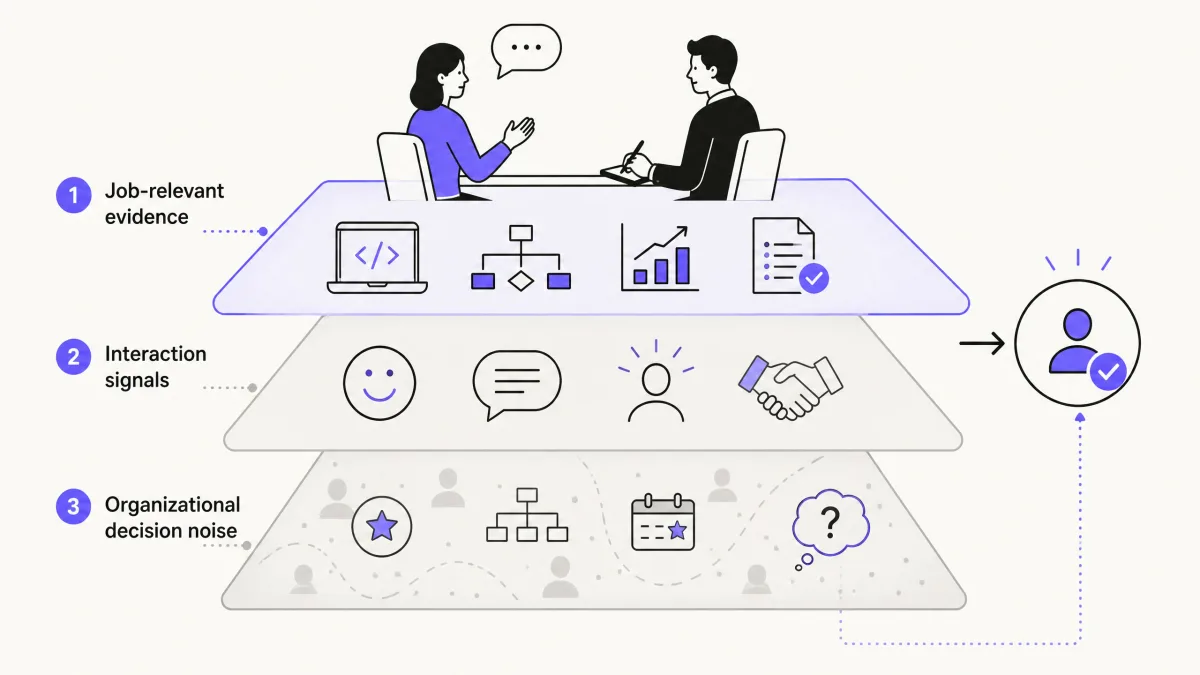
That shorthand collapses three different layers into one. Here's the distinction that matters:
| Layer | Examples | Candidate control |
|---|---|---|
| Job-relevant evidence | Decisions, technical work, customer outcomes, judgment, collaboration | High: prepare concrete examples |
| Interaction signals | Clarity, pacing, listening, stress, rapport, nonverbal behavior | Partial: practice and regulate |
| Organizational decision noise | Internal candidates, budget, disagreement, role change, influential objection | Low: observe, ask, and decide whether to continue |
Words like "fit," "chemistry," and "executive presence" sit somewhere between the first and third layer. They may refer to genuinely job-relevant working behaviors, or they may become vague proxies for similarity. You often cannot tell which one you're being evaluated against unless you ask, and asking well is a skill this article will build.
The honest framing: a candidate experiences one conversation, but the outcome may contain all three layers at once. You can improve the first two and ask questions about the process. The third is only partly observable and never fully controllable. That boundary is where post-interview anxiety often starts, so let's name it clearly now: preparing well for a job interview is about the first two layers, and knowing that is its own relief.
Why Short or Unstructured Interviews Amplify First Impressions
There's a reason a single awkward moment can feel like it defined the whole conversation. When interviewers have little time and no fixed comparison points, early impressions can carry more weight.
A University of Florida report on workplace first impressions synthesizes a meta-analysis of 204 independent samples drawn from 145 studies. It notes that impressions can form in under a minute, and that visible cues like communication style and physical appearance can be stronger signals than the substantive content someone delivers. Importantly, the analysis found associations with later evaluations and work outcomes but could not establish causation, and the results varied by context. In other words: first impressions may color a conversation, but that evidence doesn't say they always override competence or cause rejection.
A 2016 study by Swider and colleagues, based on 163 mock employment interviews, found that initial impressions were related to interviewer evaluations of applicant responses, with the relationship stronger earlier in the structured interview. The abstract does not disclose the field period, and mock interviews are not the same as a live hiring process. Treat it as one data point about how early impressions can carry forward, not as proof that the first five minutes decide everything.
Mechanically, a few things make early judgments sticky:
- Short interviews can leave too little time to collect comparable evidence.
- When questions aren't standardized, each interviewer may follow a different thread, so your answers may not be comparable side by side.
- A positive or negative first call can change which later details get attention. Once a halo or horn effect sets in, your strong points may be re-read through that filter.
- Stress and pacing can bury otherwise solid content, so delivery can affect whether the substance is easy to follow.
None of this means content is irrelevant or that you should accept a loud first impression as destiny. It means you should get the evidence out early and make sure it's visible before the conversation's initial read gets cemented.
What Structured Interviews Change: What They Do Not
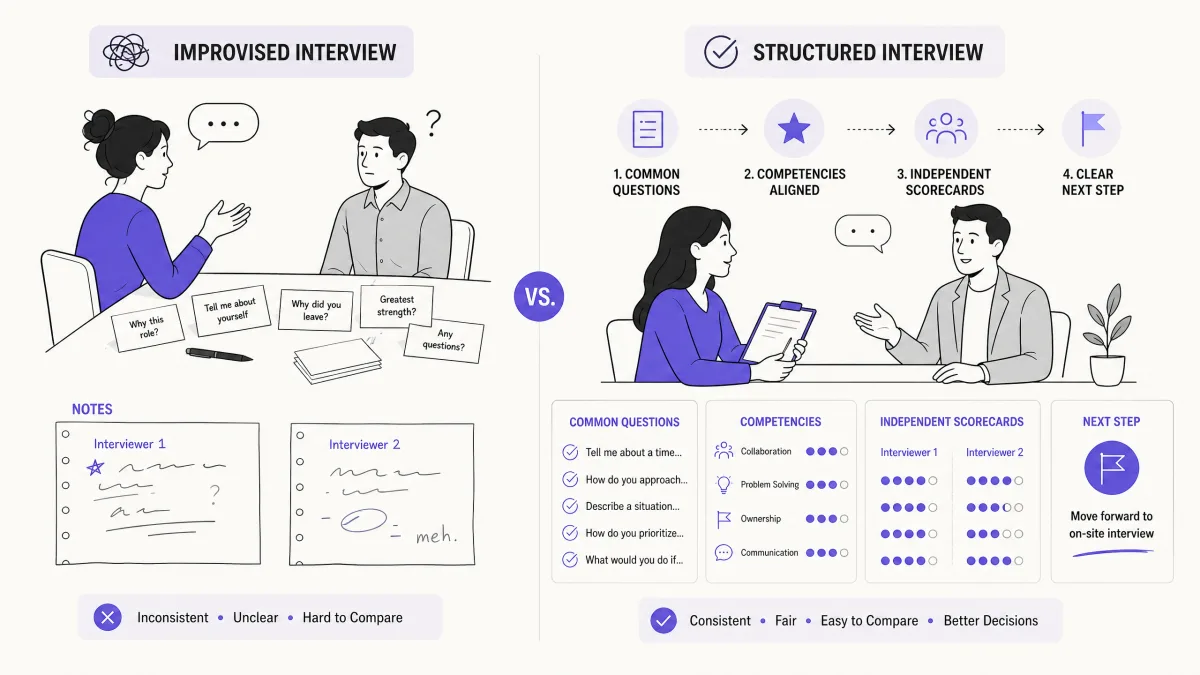
The counterweight to first impressions and interviewer discretion is structure. The U.S. Office of Personnel Management's structured-interview guidance describes interviews that use job-related competencies, the same predetermined questions and probes for every candidate, common rating scales or proficiency benchmarks, and panel scoring. Structure can limit discretion; higher structure is associated with better consistency, reliability, and validity. That makes it process guidance rather than a statistic, which is exactly how it should be read.
For you as a candidate, a structured process has one big advantage: it creates more comparable opportunities to provide evidence. You're being asked the same core questions as everyone else, against the same defined competencies, often with a panel taking notes independently.
But structure doesn't guarantee a fair result. If the competency itself is wrong for the role, the rubric is so vague it can't be scored, or organizational factors like internal politics or budget dominate, a structured interview can still produce an unsatisfying outcome. Structure reduces one kind of noise; it doesn't eliminate every kind.
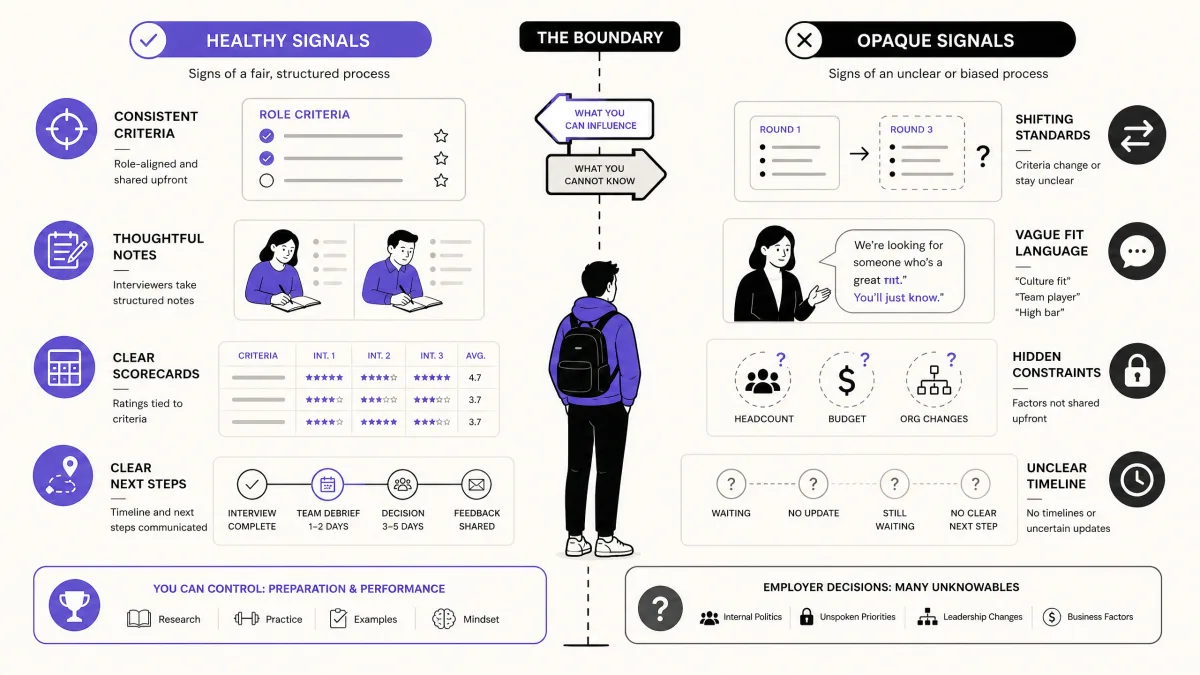
You can tell a lot about a process from how it's run. Watch for these signals during the interview itself:
| Signal | What it suggests |
|---|---|
| Same core questions asked consistently | The employer wants comparable evidence |
| Clear competency language | The evaluation has a job-related target |
| Notes or a visible scorecard | The panel may separate evidence from memory |
| Independent evaluation before discussion | One person's reaction may carry less weight |
| A specific next step | The process has an accountable owner |
If you see these, they are clues that the employer may be trying to create comparable evidence. If they're absent, that is useful information too: it may indicate a less consistent process, although you still cannot infer the full reason for an outcome from one interview.
How Culture Fit and Executive Presence Become Vague Filters
"Culture fit" and "executive presence" are phrases that can make a fair interview feel like a personality test. Part of the problem is genuine: these labels can describe real, job-relevant behaviors. The other part is that, left unqualified, they become an easy place for bias to hide.
Cornell's interviewer-bias guidance catalogues the common errors you're up against. They include stereotyping, inconsistent questions across candidates, first-impression error, negative emphasis on one bad detail, halo and horn effects where one trait colors everything, cultural noise, nonverbal bias, contrast effects against the previous candidate, and the similar-to-me error where an interviewer unconsciously prefers someone who reminds them of themselves. Any of these can distort how a candidate's evidence is interpreted. Cornell's page is a taxonomy of risks, not a prevalence study.
Research helps show why these patterns can be subtle. Lauren Rivera's 2012 study of elite professional-service firms found that employers evaluated "cultural matching" through leisure activities, background, experiences, and self-presentation alongside demonstrated work skill. That qualitative study involved 120 interviews with employers and hiring decision-makers plus participant observation, with fieldwork from 2006 to 2008. It's evidence that this dynamic exists in a specific, high-status context, not a claim that every employer weighs extracurriculars or lifestyle similarity. Keep those boundaries in mind before you generalize it to your own situation.
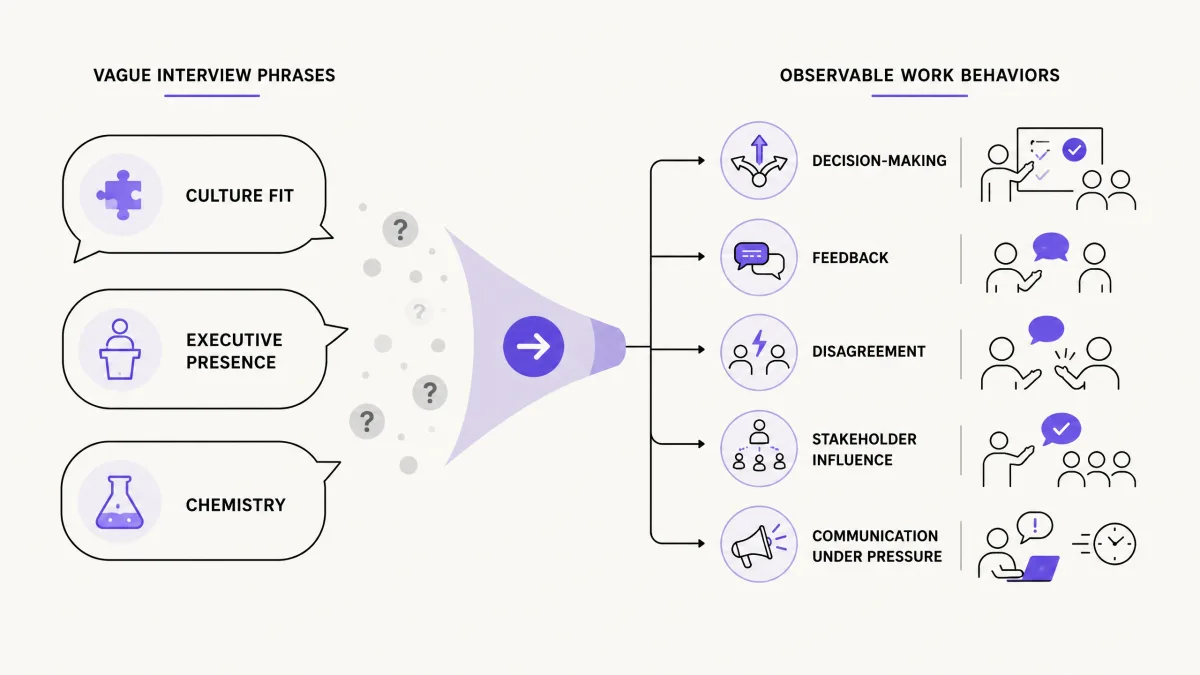
So when you hear "culture fit," "executive presence," or "chemistry," your next move is to translate the vague phrase into an observable behavior:
| Vague phrase | Ask what observable behavior it means |
|---|---|
| Culture fit | How does the team make decisions, give feedback, and handle disagreement? |
| Executive presence | Is the concern about presenting trade-offs, influencing senior stakeholders, or handling uncertainty? |
| Chemistry | What communication behavior is necessary for this role? |
Notice what this approach refuses to do: it doesn't tell you to change your accent, identity, appearance, or personality to resemble the interviewer. You shouldn't contort yourself to satisfy an undefined standard. Instead, you ask for the specific behavior, and then you demonstrate that you can produce it.
The Evidence Visibility Framework
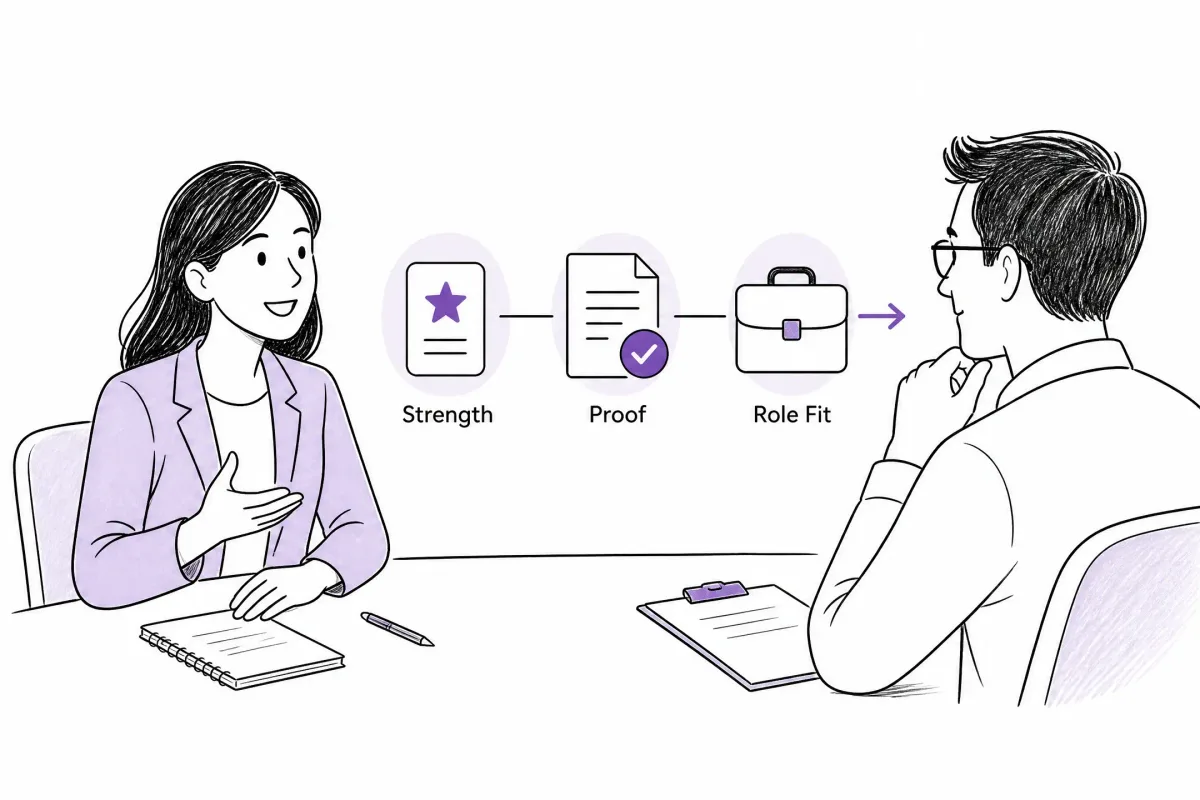
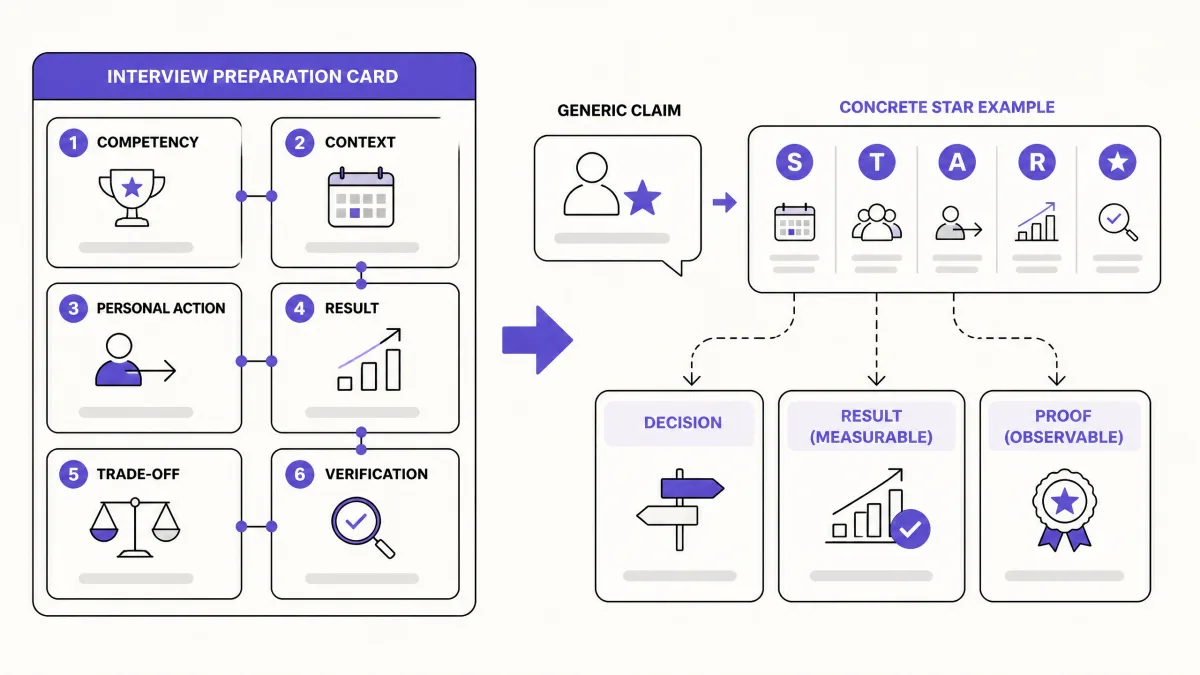
A useful first step before an interview is to build an Evidence Visibility Card for each core competency the role demands. It's a printable, screenshot-friendly table that forces you to say something concrete and defensible instead of offering generic self-praise.
For every important competency, fill in six fields:
| Field | Prompt |
|---|---|
| Competency | What job-related ability is being tested? |
| Context | Which project, customer, team, or incident makes the example concrete? |
| Personal action | What did you personally decide, build, change, or communicate? |
| Result | What changed, and how do you know? |
| Constraint or trade-off | What limitation, risk, or alternative did you manage? |
| Verification cue | What test, metric, review, monitoring, or feedback supports the claim? |
Each field earns its place. Competency keeps the story relevant to what's actually being tested. Context stops you from making generic claims. Personal action separates your ownership from team activity. Result shows change rather than effort. Constraints reveal judgment under pressure. And verification makes the claim survivable under a follow-up, because interviewers may probe claims without a backing test, metric, or review.
The difference between a weak and an evidence-visible answer is stark. Here's a fictional, illustrative example:
Weak:
I am a strong communicator who works well with cross-functional teams.
Evidence-visible:
When product and engineering disagreed about a launch risk, I wrote a one-page decision brief, separated the reversible from the irreversible choices, and led a review that moved the launch date by one week. We used the brief to track the risk through release, and the issue did not recur in the next deployment.
The second version gives the interviewer a decision, a constraint you managed, and a verification cue. It doesn't need fake percentages to be persuasive. Latency, reliability, defect rate, incident recovery, review quality, delivery time, risk reduction, customer outcomes, or a clearly described decision all count as valid evidence.
The same card works outside technical roles. For example, a fictional customer-operations answer could be: "When a key customer disputed a renewal invoice, I mapped the account history, coordinated finance and account management, and proposed a credit tied to a corrected process. The customer renewed, and finance adopted the checklist." The competency is dispute resolution, the action is visible, the result is specific, and the process change is a verification cue.
A separate observational study shows why this mapping matters. Liu and colleagues analyzed 7,650 people hired by one Chinese IT company, using interview-note data collected from July 1, 2016, to July 1, 2018. Their text-matching score between interview notes and job-capability dimensions was associated with later performance ratings, promotions, and turnover outcomes. The authors' marginal-effect estimate linked a one-standard-deviation increase in the matching score with about 2% higher performance. This is an association in one company's data, not proof that a particular answer causes better performance, and it may not generalize to other countries or employers.
If you want to practice answers to strengths questions the same way you'll deliver them, out loud, with a practice partner or coach pushing back on vague claims, that rehearsal is where the card turns from a worksheet into a real skill.
A 30-Minute Interview Playbook
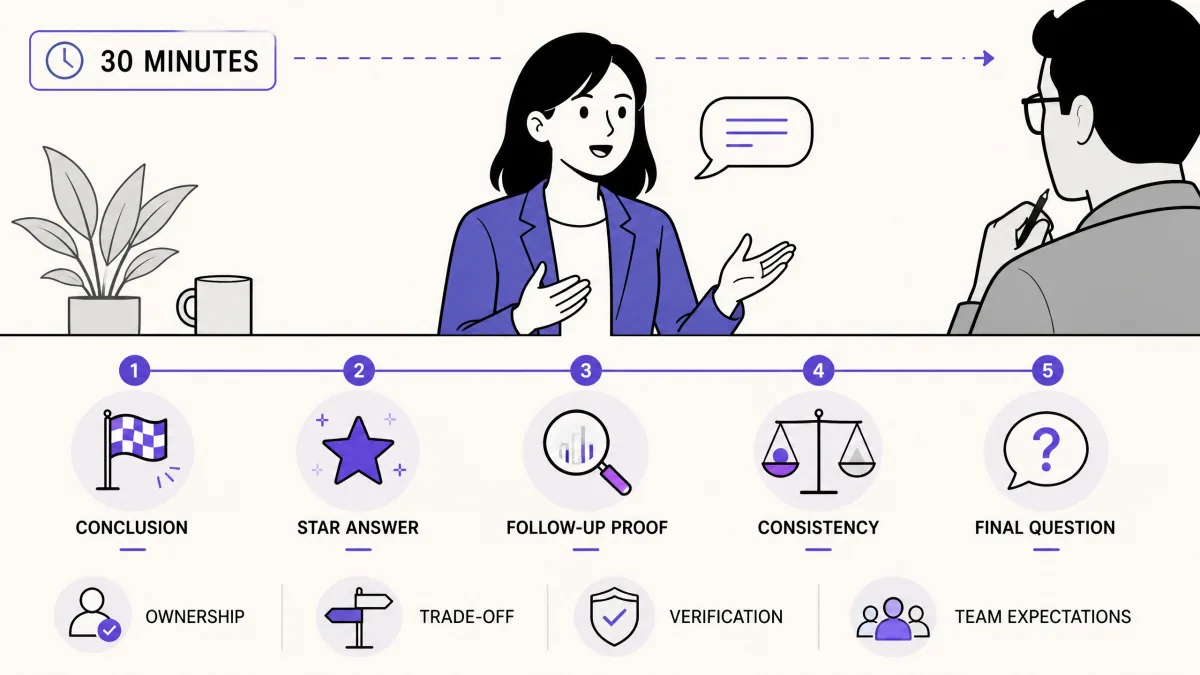
When you don't know how long you'll actually get, a tight sequence protects your best evidence. Here's how to spend a short interview.
The first 60 seconds
Answer the question, or introduce yourself, with a conclusion first. Name the relevant role, the problem, or the result up front. Do not open with a long chronological autobiography. That burns the exact window where first impressions are forming.
The next 60-90 seconds
This is your STAR moment: Situation, Task, Action, Result. The UK National Careers Service's STAR guidance frames it this way and notes that good examples are concise and conversational rather than scripted, with follow-ups expected, so leave room for them.
Make personal ownership explicit with "I" where it's accurate, and state one constraint or trade-off you managed. That line helps separate a story from evidence.
The next follow-up
When the interviewer asks for more depth, add one verification detail: a test, a metric, a review, monitoring, customer feedback, or a postmortem. If they want even more, choose a technical, stakeholder, or outcome detail rather than re-explaining your setup. That signals you have more depth without repeating yourself.
During the rest of the interview
Keep dates, roles, scope, numbers, and decisions consistent across every answer. Contradictions can quickly undermine credibility. If a question seems to be aiming at a hidden rubric, ask for clarification instead of guessing. And if you get interrupted, finish your conclusion in one sentence and offer to expand, rather than abandoning the point.
The final two minutes
Ask one question that reveals what the team actually evaluates. Something like, "What does a strong first year in this role look like to you?" surfaces the criteria you should have been demonstrating, and the answer may reveal whether the evaluation is anchored to job behaviors. For more options, see these questions to ask in an interview.
What to Say When the Question or Feedback Is Vague
A useful interview skill is turning vague language into a specific, job-related request. Ask politely, once, without being difficult. These scripts convert "not a fit" and "we didn't feel it" into something you can actually respond to:
- "Which part of this role would you like me to make more concrete?"
- "When you say culture fit, which working behaviors matter most for this team?"
- "Is the executive-presence concern about presenting trade-offs, influencing senior stakeholders, or communicating under pressure?"
- "Which competency would you like me to support with another example?"
- "If you can share one job-related area I should strengthen, I would appreciate the specificity."
Use them in four moves: ask once, calmly; listen for a behavior rather than a personality label; give one targeted example; and stop if the interviewer won't or can't clarify, or if time has run out. You are not obligated to keep re-litigating an undefined standard.
The same logic applies after a rejection. Forage's guidance on asking for interviewer feedback is a useful model: ask politely for actionable, specific feedback, and self-assess your STAR structure, impact, and confidence. Go in expecting that many employers simply won't provide feedback. Silence is not proof of failure, and it is not proof of bias. It may reflect policy, workload, or the absence of a feedback process. Don't invent a story about your worth from a company's refusal to explain itself.
The Post-Interview Diagnostic Matrix
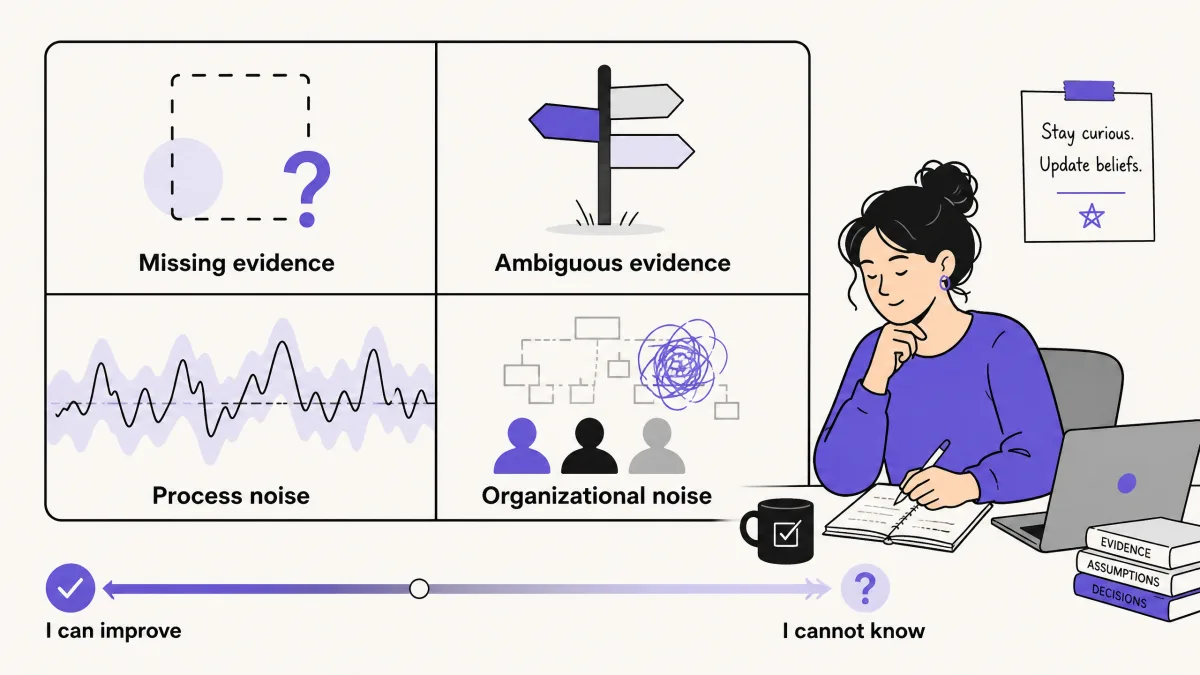
Give yourself ten minutes after an interview to review it as data, not to run an emotional autopsy on your entire identity. The Post-Interview Diagnostic Matrix separates four different causes of a weak outcome:
| Signal | What may have happened | What to change | Control / confidence | What remains unknowable |
|---|---|---|---|---|
| Missing evidence | The answer never showed personal ownership or result | Prepare a tighter example | High / high | Whether the panel already preferred another candidate |
| Ambiguous evidence | Role, timeline, metric, or decision was unclear | Add one sentence of context and one verification detail | High / medium | Whether the interviewer interpreted ambiguity fairly |
| Process noise | Questions, time, or scoring were inconsistent | Ask for criteria and record the pattern | Low / medium | Internal headcount, candidate slate, or private feedback |
| Organizational noise | Internal politics, budget, or a strong objection dominated | Decide whether the process is worth repeating | Low / low | The exact weight of an unseen decision |
Fill in where each of your signals actually landed:
| Question or signal | What I said | Evidence visible? | Next adjustment | Control level |
|---|---|---|---|---|
Then apply a clear decision rule. If the same missing evidence shows up in multiple interviews, improve the story. If only one interviewer reacts negatively while your other evidence was strong, record the uncertainty rather than rewriting your identity. If the process repeatedly uses vague fit language without asking for job-related examples, evaluate the employer as well. It may be a poor evaluation environment. And if you genuinely cannot know the reason, resist inventing a story about your worth. A few honest "I'll never know" rows are healthier than a false narrative.
If you're stuck in a pattern where strong interviews still aren't turning into offers, this matrix is the right tool to diagnose why interviews are not turning into offers, separating what's under your control from what isn't.
How to Tell Whether the Employer's Process Is Vibe-Heavy
Some of this is out of your control, but recognizing a weak evaluation process is a legitimate part of deciding where to spend your energy. Here's what a healthy process tends to look like:
- Competencies are explained in advance.
- Core questions are consistent across candidates.
- Interviewers take notes or use a scorecard.
- The candidate is invited to ask for clarification.
- Multiple evaluators contribute independently.
- The recruiter can explain the next step and timing.
And here's what a vibe-heavy process looks like:
- Every interviewer improvises a different standard.
- Feedback is only "we didn't feel it" or "you lacked executive presence."
- Similarity to the interviewer's school, hobbies, accent, or social style seems to carry more weight than job evidence.
- The role or success criteria change during the process.
- The company won't describe the competencies it's testing.
- You're pressured to perform a personality rather than demonstrate work.
Keep a boundary in mind: one disorganized or unprepared meeting may simply be an accident. Repeated opacity across interviewers, rounds, or the whole process may be a signal about the employer's process. You're allowed to decide that an evaluation environment is not good enough to justify your time.
What You Cannot Control: How Not to Blame Yourself
A weak interview can contain both a communication problem you can fix and a process problem you can't. Naming the second category matters, because without it, responsibility collapses unfairly onto the candidate.
Here are factors you may never see or control:
- Internal candidates or referrals already in the pipeline.
- Budget, headcount, or a frozen or collapsing requisition.
- One influential person's strong objection.
- Panel disagreement that resolved against you for reasons beyond your performance.
- A role that changed scope after your interview was scheduled.
- An interviewer who prefers a different communication style than yours.
- A process that was never designed to compare candidates consistently in the first place.
Communication quality genuinely affects how visible your evidence is. That part is on you to work on. But not every rejection is a communication lesson, and treating it as one can become its own kind of self-harm. Hold this grounding line:
I can improve the evidence I present without pretending I can control another person's judgment.
One more caution, and it's important. One interaction rarely supports a reliable legal conclusion. If you think a pattern may involve a protected ground, document the job-related facts and seek qualified local legal advice; rules vary by jurisdiction. This is general information, not legal advice. Neither jumping to a conclusion nor swallowing every doubt is the right move. A qualified professional can help you assess the situation.
Use Great Offer AI to Practice Evidence, Not a Persona
By now the framework is in place, so a practice tool can help you rehearse rather than paper over a gap. Great Offer AI Interview Copilot can help you practice in a way that's tied to real experience and clear about its limits.
With a framework like the Evidence Visibility Card, the tool is useful for:
- Rehearsing a 60-90 second answer built from a real experience.
- Getting feedback on missing context, unclear ownership, weak results, or unsupported claims.
- Practicing likely follow-ups and keeping your facts and numbers consistent across answers.
- Trying a second, more concise version of the same story, without inventing a new personality or fabricating results.
The tool cannot remove interviewer bias, predict a hiring committee, or guarantee you an offer. It won't create truthful experience where none exists, and it can't replace your own judgment about whether a process is fair. Use any live assistance only when the employer and interview platform allow it. Otherwise, keep AI to preparation and mock interviews. Used honestly, it is preparation and feedback, not a shortcut that bypasses the human and organizational subjectivity this article describes. Rehearse your real evidence, get structured feedback, and go into the interview able to make that evidence visible.