


Starting a job and then hearing from another employer creates a uniquely awkward decision: you have a real commitment in front of you, but an earlier hiring process may now produce a role that fits better. The pressure comes from timing, not just ambition. You need to compare a lived current job with a partly untested future one while keeping every timeline and employment record accurate.
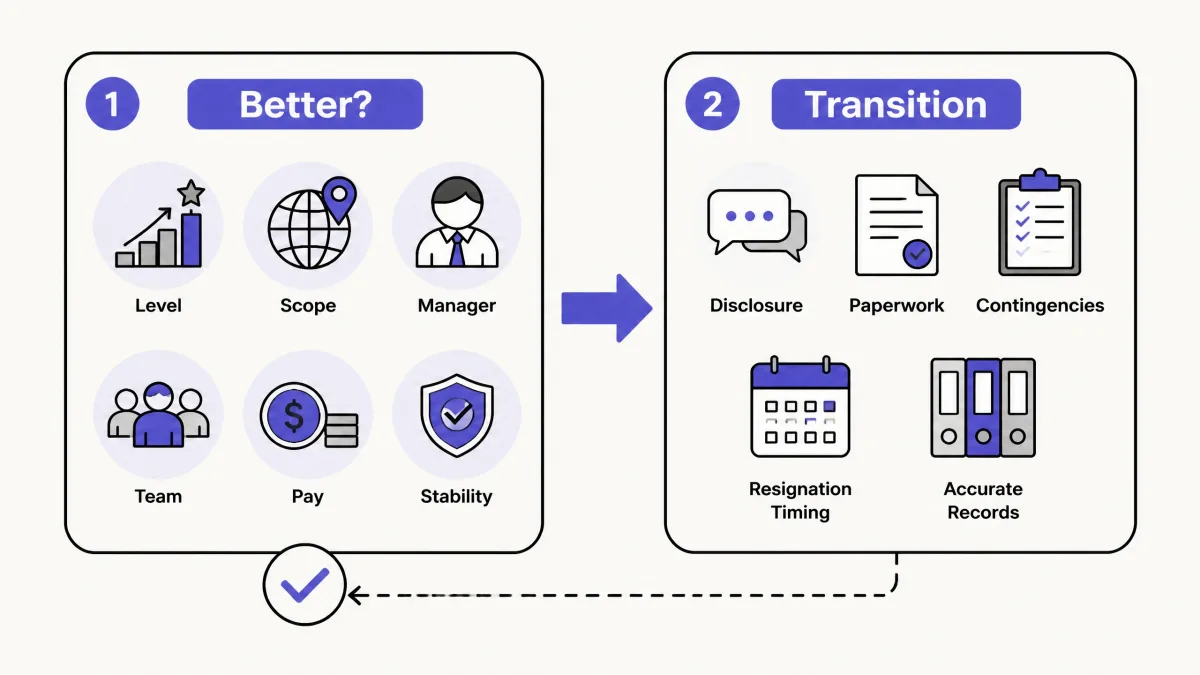
That makes this a two-part decision. First, determine whether the second opportunity is genuinely better after verification. Then decide whether and how to transition without resigning too early, hiding a material change, or damaging your professional record.
The Better Job Offer After Starting a New Job: Verdict First
You can leave, but only if the second role is verifiably better and not just a shinier title. The answer isn't yes or no on its own. It depends on how real the improvement is and whether you can transition safely. Almost everyone in this spot asks the same questions: is leaving after one month a career mistake, should I tell the recruiter I already started somewhere, and how do I explain this without sounding reckless. This guide answers them in order.
The current team might be great. Onboarding might be going fine. Leaving now feels disloyal. At the same time, the second role might offer a higher reporting level, larger scope, or a technical fit you've wanted for years. Staying feels like forfeiting a rare shot. That tension is normal, but it's not what you should be deciding yet.
Your answer depends on four things:
- How much better the verified future actually is, compared with the role you're already in.
- How costly and reversible the transition would be: money, benefits, relationships, paperwork.
- Whether the second offer is genuinely final and decision-ready, not just likely or verbal.
- Whether you can explain the timeline truthfully to the new recruiter, your current manager, and any future interviewer.
One short tenure isn't automatically harmless. Don't pretend it is. But a single explainable event is different from a repeated pattern, and context always matters. Notice the contradiction: guilt about leaving argues for staying regardless of quality, while excitement about the new title argues for leaving regardless of evidence. Set both feelings aside while you work through the decision.
Separate the Two Decisions
Start by splitting one overwhelming question into two that must be answered in order.
Decision A: Is the second opportunity truly better?
Judge this on level, actual scope, authority, manager, team, stability, technical fit, promotion runway, compensation, location, work model, and downside risk. This is a comparison of verified future value, done as if neither guilt nor excitement existed.
Decision B: If it's better, how do I transition honestly and safely?
Handle disclosure, paperwork, contingencies, resignation timing, repayment terms, short-tenure records, and communication with all three parties: the new employer, the current manager, and your future self on the record.
Most people merge these and end up lost. Guilt about leaving leaks into Decision A, so a genuinely better role gets talked down. Excitement about the offer leaks into Decision B, so a candidate resigns before the paperwork is real. Keep them apart. First establish whether the second role is genuinely better. Only then decide how to move.
Don't Resign While the Second Job Is Only Likely
This section comes before anything else for one reason: the originating scenario usually involves a process that looks like it will produce an offer but hasn't produced one yet.
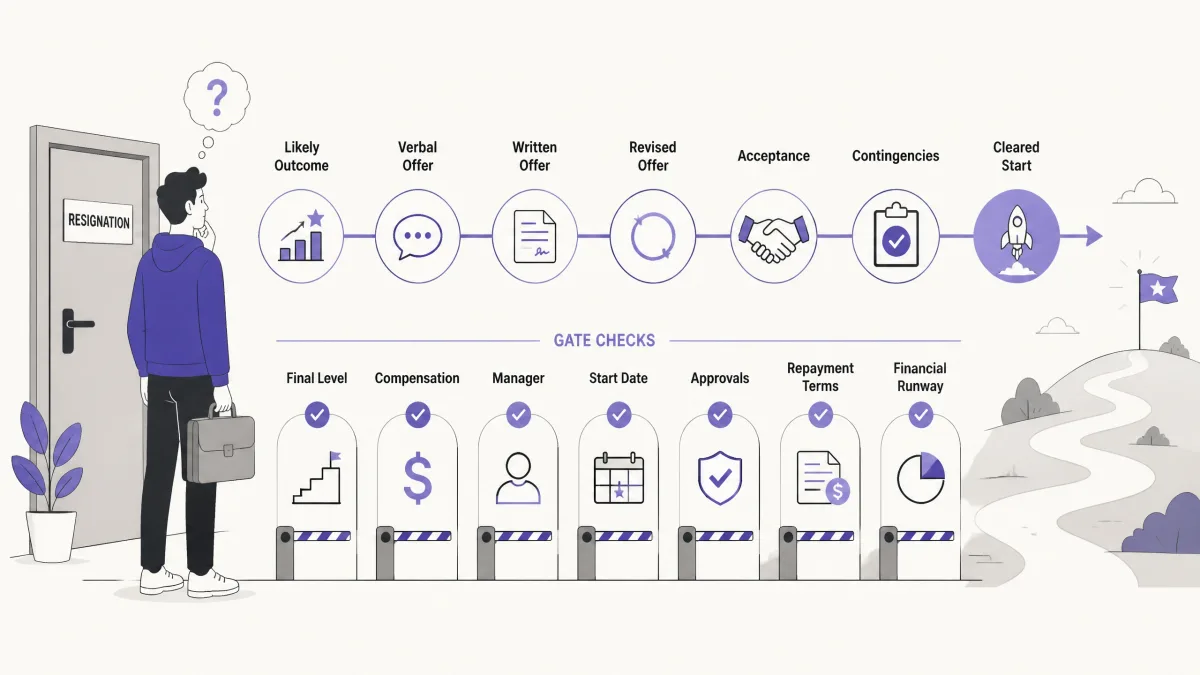
A positive recruiter signal isn't an offer. A verbal offer isn't the final written document. Even a written offer can still carry contingencies: a background check, an approval, a start-date assumption, or an immigration clearance that hasn't cleared. And nothing about the conversation so far means the employer can't change its mind.
Don't create an irreversible exit based on probability. Keep performing the current job, and don't announce a move, until you hold something you can act on.
The No-Resignation Gate
Don't resign until each item on this list is confirmed, or until you've consciously accepted the documented risk of proceeding without it:
- Final written offer received.
- Legal employer entity and job location confirmed.
- Internal level, title, and compensation confirmed.
- First-year scope and reporting manager confirmed.
- Start date confirmed.
- Material background-check and other contingencies cleared where possible; if a condition remains, you've explicitly accepted that risk.
- Required employer approvals completed or documented.
- Sign-on, relocation, equity, and repayment terms reviewed.
- Immigration, licensing, or conflict issues checked when relevant.
- Current employer obligations reviewed.
- Financial runway exists if timing moves or the offer is withdrawn.
- Acceptance state and response deadline documented.
Between where you sit and that final paperwork there is a sequence of distinct states, and each one behaves differently:
Likely outcome → verbal offer → written offer → questions or negotiation → revised written offer → acceptance → contingencies pending → cleared start
The gate is risk management, not a legal rule and not a guarantee against rescission. It won't stop an employer from withdrawing an offer, and no one can promise you that. What it does is stop you from resigning on the basis of a guess. Before you create an irreversible exit, review the written offer before you resign and make sure the role and the terms are real.
Verify Whether the Higher Level Is Real
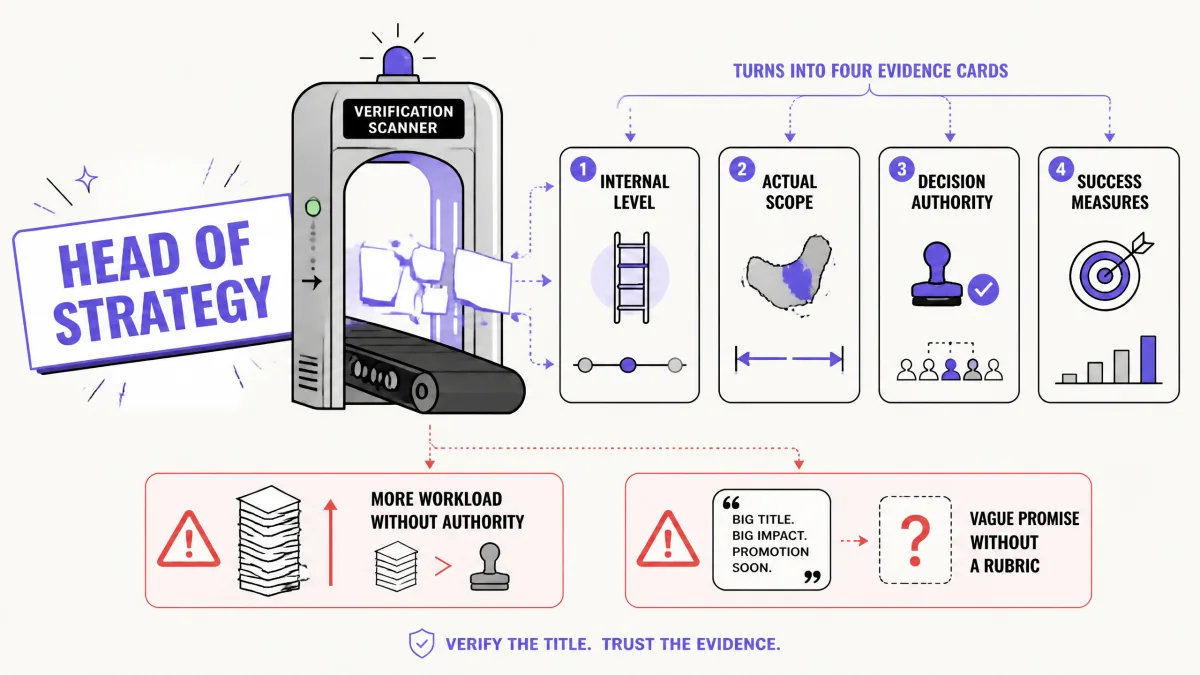
A senior-sounding title on a job posting and a real step up in a compensation band aren't the same thing. The second offer might genuinely sit at a higher internal level, or the recruiter might have handed you a title that echoes above the actual grade. This is why the next section exists: you test the claim before you trust it.
Start by asking the right questions:
- What is the official internal level code?
- What decisions will I own in the first six and twelve months?
- What systems, teams, budgets, or customer outcomes are in scope?
- How will success be measured?
- Which responsibilities are expected immediately, versus after onboarding?
- Who is the manager, and how does that manager evaluate this level?
- What does promotion from this level require?
- Why is the role open?
- What portion of the work is new development, maintenance, operations, documentation, or on-call?
The Higher-Level Reality Check
| Recruiter claim | What to verify | Evidence to request | Red flag |
|---|---|---|---|
| Higher internal level | Official level code and compensation band | Written offer or recruiter confirmation | The external title sounds senior, but the internal level is unchanged |
| Larger scope | Systems, decisions, ownership, ambiguity, and cross-team impact | Role charter and examples from the hiring manager | More scope only means more workload |
| More authority | Decisions owned versus influenced | Specific manager examples and success measures | Accountability without decision rights |
| Better promotion path | Next-level criteria and calibration process | Performance rubric, review cycle, and promotion examples | A vague promise of rapid promotion |
| Better technical fit | First-year roadmap, maintenance load, and on-call expectations | Team roadmap and project mix | The interview project differs from daily work |
| Greater stability | Why the role is open, funding, and reorganization exposure | A current hiring-manager explanation | Stability is asserted without current evidence |
A title is a claim. Scope, authority, success measures, and the internal level are the evidence.
Watch for the common false positives. A senior title with mid-level authority inflates the label. A larger workload without larger decision rights is more work, not more seniority. A promotion promise without a rubric or a calibration process is a hope, not a plan. And a role described through the interview project rather than the daily roadmap tells you nothing about what you'll actually be doing.
If this is the first time you're checking whether the level and the pay align with the actual offer, it's worth the exercise before you decide anything. You should check whether level, scope, and pay align on the second offer the same way you'd evaluate any role. Don't let the excitement of a bigger title skip the step where you confirm what it actually means.
Compare the Current Job and the New Offer With Evidence
The new role only deserves to win if it wins on evidence, and the current role only deserves to keep you if its real advantages are part of the comparison. Judging the new offer on recruiter language while judging the current job on its worst day isn't a comparison. It's a confirmation of a prior conclusion.
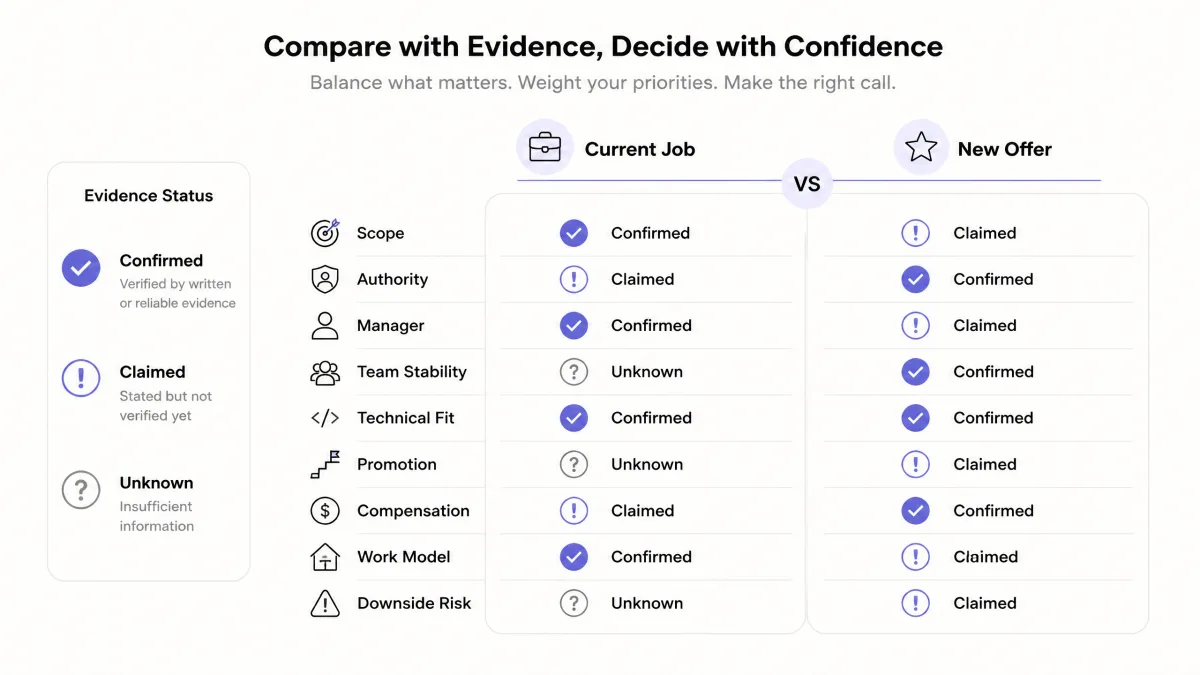
Compare the current job on what you've actually experienced, not only the employer's reputation or the onboarding deck. Compare the new job on evidence, not only the recruiter's enthusiasm. Then fill in the scorecard, row by row. Don't invent your own weights or market averages to make one side win.
The After-Start Offer Scorecard
The scorecard doesn't end in one total number, because a single score hides too much. Instead, record the evidence quality next to every criterion. Use must-have, high, medium, or low for importance.
| Criterion | Importance | Current job evidence | New offer evidence | Confidence | Downside if wrong | Next question |
|---|---|---|---|---|---|---|
| Real level and scope | Confirmed / Claimed / Unknown | |||||
| Decision authority | ||||||
| Manager quality | ||||||
| Team stability | ||||||
| Technical and work fit | ||||||
| Promotion runway | ||||||
| Guaranteed and total compensation | ||||||
| Work model and location | ||||||
| First-year learning and impact | ||||||
| Reversibility and downside risk |
Use these three labels honestly:
- Confirmed means the term is in writing or is supported by a specific accountable person, not a general sense that it's probably fine.
- Claimed means it was stated but lacks enough detail or documentation to act on.
- Unknown means you have no reliable answer, and you shouldn't award optimistic points for a blank space.
A new role shouldn't win simply because all of its unknowns were treated as best-case outcomes. If a criterion is unknown on the new side and confirmed on the current side, that gap is itself a finding about the risk you'd be taking, not a reason to assume the gap resolves in your favor.
Compare the Next 90 Days With the Next Two Years
One score, or one gut reaction, hides the real shape of this decision because the two relevant time horizons beat to different rhythms.
The Two-Horizon Decision Grid
| Horizon | Questions |
|---|---|
| Next 90 days | What must be repaid? Could benefits lapse? Is relocation required? How certain is the start date? Which contingencies remain? What disruption or relationship cost is likely? |
| Next 2 years | Which role builds stronger scope, skills, sponsorship, promotion evidence, compensation trajectory, technical depth, and location fit? |
Here's the judgment that holds both horizons together:
A difficult 90-day transition can be rational when the two-year advantage is material and verified. A compelling two-year story isn't enough when the first 90 days contain unresolved offer, repayment, immigration, or start-date risk.
Consider an illustrative example, not the story of any one employer. Say your current role has a strong manager and low immediate risk but thinner scope than you want. The new offer carries verified senior scope and a better technical fit, but it requires a relocation, and its start date is contingent on an approval that hasn't come through yet. On a two-year view the new role looks clearly better. On a 90-day view, the start date and the relocation terms are unresolved, which means resigning today would put the entire upside on a condition you don't control. The rational move in that example is to resolve the start date and the relocation terms before you compare the long-term upside. Resolve the short-term risk first. Only then is the long-term comparison a real one.
Reset the One-Month Sunk Cost
By now you've probably spent a month of someone else's onboarding time, absorbed part of the team's calendar, and started building a working relationship. That investment is real, but it isn't a reason to decide your next several years.
The One-Month Sunk-Cost Reset
If you hadn't spent the last month onboarding, which role would you choose based only on verified future value and real exit costs?
Then be precise about what counts:
- Onboarding time already spent is a sunk cost. It's gone either way, so it has no place in a forward-looking decision.
- Signed obligations, repayment terms, relationships, and factual-record consistency aren't sunk costs. Those are live consequences you must count.
- Guilt isn't a cost category. Count real consequences without letting an awkward-but-manageable conversation decide the next several years.
Address the guilt directly and without flinching. The employer invested time in you, and you joined in good faith. That's true, and it matters, but a late-arriving process can still create a rational new decision. Integrity is shown in truthful disclosure and professional execution, not in staying solely to avoid an awkward conversation. That doesn't mean you owe the employer nothing, and it doesn't mean loyalty is irrelevant. It means the debt is discharged honestly: through truthful answers, a clean handoff, and a professional departure, not through staying in a role that no longer fits.

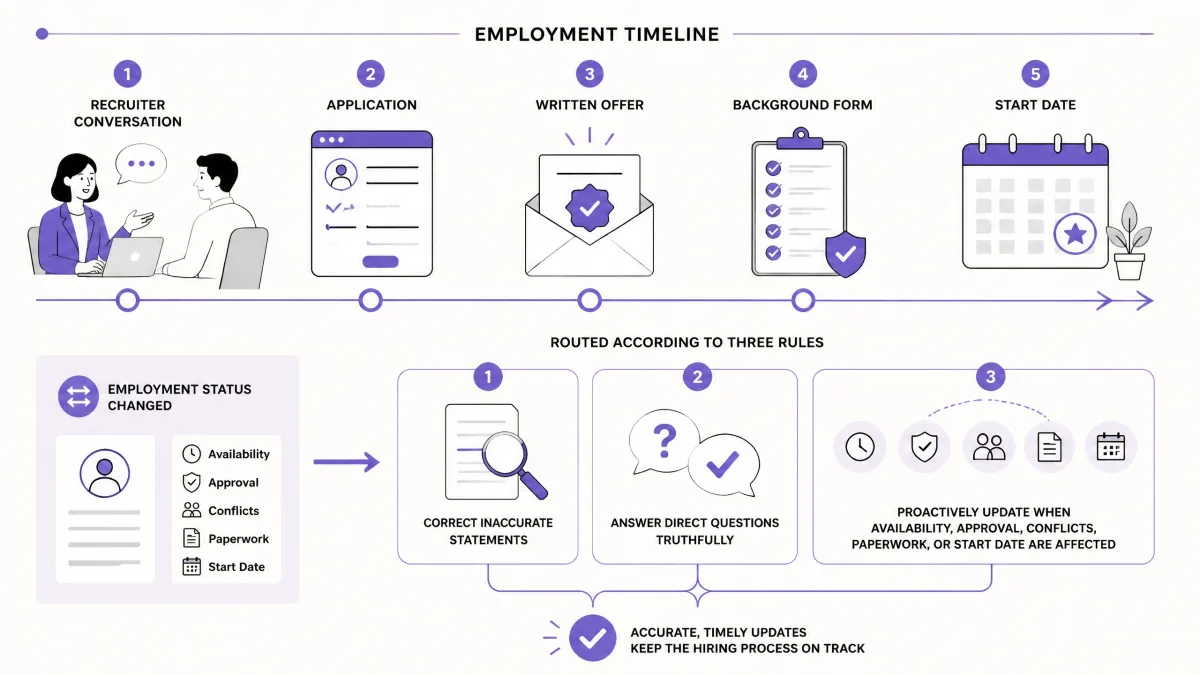
Decide Whether and How to Update the New Recruiter
This is where many candidates get stuck, and the rule is simpler than the worry suggests:
Correct any earlier inaccurate statement and answer direct questions or forms truthfully. If nobody asked and the earlier record remains accurate, consider a proactive update when the changed employment status materially affects availability, approval, start date, conflicts, or final paperwork. Don't base the decision on a guess about what a background check will reveal.
Here's how to think about it. If, earlier in the process, you gave a direct answer about your current employment, your availability, or your employer, and that answer is now inaccurate, you should correct it promptly. Answer recruiter questions, applications, and background forms truthfully, according to what they actually ask. If nobody asked, and everything you said earlier is still accurate, then a proactive update is a judgment call. It isn't a universal legal duty, and this article won't claim it is one.
A proactive update becomes usually prudent before the relevant decision when the new job materially affects availability, start date, approvals, conflicts, or final paperwork. You don't owe a long apology for failing to volunteer the update during an earlier technical discussion. If the earlier conversations genuinely focused on your experience rather than your current status, and that's factually true, you can say so. If you previously answered inaccurately, correct the answer directly rather than rationalize it.
If the second process began before your current start date, you can say so when that's true. Frame your continued interest in terms of scope, technical fit, location, or long-term goals. Don't fabricate dissatisfaction with the current employer. And remember you can't control whether the company changes its decision. If you decide a status update is appropriate and its facts are accurate, use this script:
Since this process began, my employment status changed and I started a new role on [date]. I remain interested because this position is unusually aligned with [scope, technology, or long-term goal]. Before we move into final approvals or background forms, I want to make sure my current timeline is accurate. Does this change any approval, start-date assumption, or information you need from me?
A proactive update isn't an admission of wrongdoing, and it isn't something you send as a confession. You're giving the employer accurate, decision-relevant information at the moment it becomes relevant. If you need a broader sense of how to frame a truthful hiring-timeline update without damaging your candidacy, that follow-up belongs with give a truthful hiring-timeline update.
The Disclosure and Consistency Map
The same situation plays out differently depending on who is on the other side of the conversation. Use this map to keep every message accurate and consistent:
| Audience or record | What to communicate | What not to do |
|---|---|---|
| New recruiter or hiring manager | Correct any earlier inaccurate statement; answer direct questions truthfully; when the change materially affects timing, availability, approval, or paperwork, consider a proactive update with the start date and continued interest | Don't hide the change when directly asked; don't imply a universal duty to volunteer every status change; don't present the update as a confession |
| Application or background form | Answer the exact question truthfully and use accurate dates | Don't assume the job will appear or remain invisible |
| Resume | Use a truthful, selective career summary appropriate to the role | Don't alter dates to erase an overlap |
| Current manager | State the decision, acknowledge the timing, give the proposed last day, and offer a practical handoff | Don't list every complaint or reveal confidential details |
| Future interviewer | Explain one careful transition from an earlier process to a materially closer fit; show subsequent stability and judgment | Don't attack either employer or invent a layoff |
Two judgment notes belong here. First, truthful answers and corrections are mandatory. A proactive update is context-dependent, and this article doesn't invent a universal disclosure duty. Second, a short-role disclosure isn't a prediction about employment verification. Whether a particular background check surfaces the role depends on the report's scope, sources, timing, authorization, and the employer's own process, none of which you control. Make your decision on accurate, honest answers, not on a guess about invisibility.
Ask for the Missing Offer Details
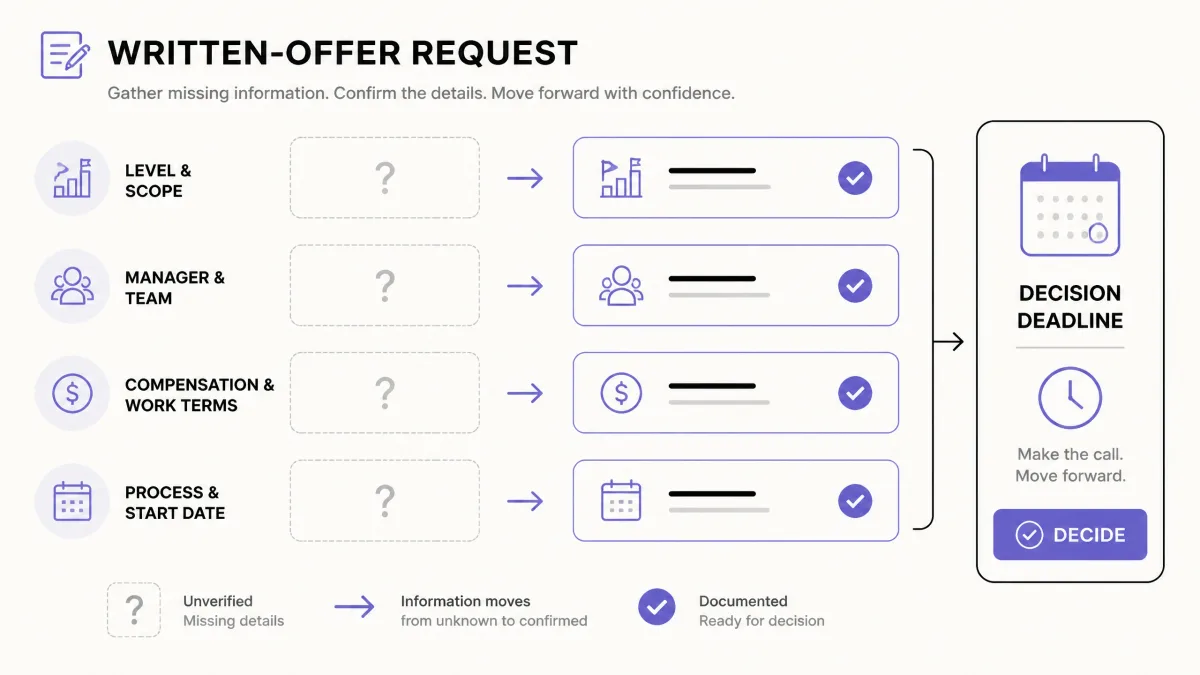
If key facts are still claimed or unknown, ask for them in writing before you decide. Don't treat the title as a substitute for the terms.
Use this script:
I'm very interested, and I want to evaluate the final role rather than the title alone. Could you confirm the internal level, first-year scope, reporting manager, compensation components, start date, and remaining contingencies in writing? I can give you a firm answer by [date] after I review those items.
Then organize your follow-up questions by category, so nothing important gets buried.
Level and Scope
- What's the internal level code?
- Which decisions does this role own?
- What does success at six and twelve months look like?
- What portion of the role is delivery, operations, documentation, mentoring, and cross-team influence?
Manager and Team
- Who will be the direct manager?
- Why is the role open?
- How stable are the team's priorities and funding?
- How is performance calibrated?
Compensation and Work Terms
- Which compensation is guaranteed, target, one-time, or equity?
- What are the vesting, bonus, and repayment terms?
- What are the work location, office, travel, on-call, and relocation expectations?
Process and Start Date
- Which approvals remain?
- Which contingencies must clear?
- What's the expected written-offer and start-date sequence?
- Can the response deadline be extended until the missing items are confirmed?
When you do negotiate or review terms, remember that the written offer is what locks an agreement. Career-services guidance consistently stresses getting the final offer in writing before accepting. For example, UC Berkeley's job-offer negotiation guide frames the written letter, not a verbal expectation, as the document that reflects any agreed-upon changes to level, compensation, or start date.
Check the Cost of Leaving the Current Job
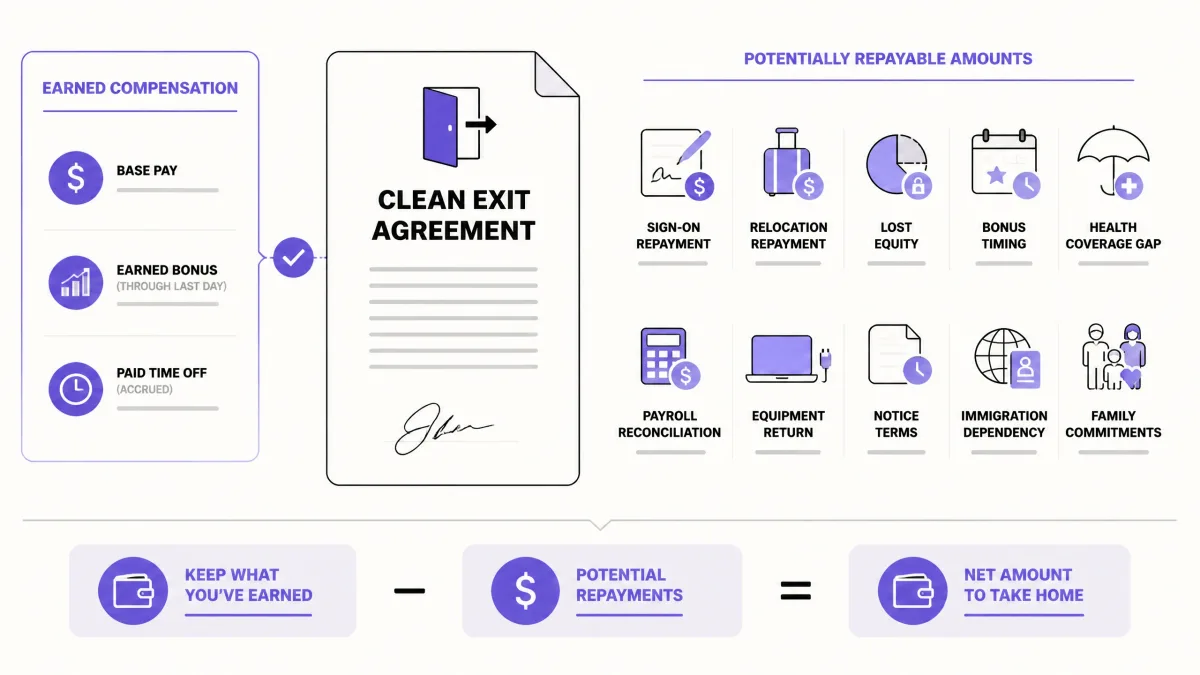
Leaving has a price beyond the emotional one, and you need the full accounting before you compare the two roles. Review your signed documents and the formal benefit and payroll policies, and separate money you've already earned from money that might be repayable if you leave early.
The Exit-Cost Checklist
- Sign-on bonus repayment.
- Relocation repayment.
- Training, education, or tuition agreements.
- Equity grant or vesting loss.
- Bonus eligibility and payment dates.
- Health insurance end date and new coverage start.
- PTO, expenses, and payroll reconciliation.
- Equipment, access, and confidential information.
- Notice expectations and signed employment documents.
- Non-solicit, confidentiality, and conflict terms.
- Immigration or work-authorization dependency.
- Housing, move, planned leave, or family commitments.
Work through the checklist against your actual documents and policies. When a consequence is material (a large clawback, an equity that wouldn't vest, a benefit gap, or an immigration dependency), seek qualified local advice on the contract, tax, insurance, or immigration implications. This article doesn't provide legal, tax, insurance, or immigration conclusions.
One line in the guidance matters enough to repeat: don't take confidential files, source code, customer information, or internal documents you aren't entitled to keep as you leave. Clean professional departure doesn't include walking out with anything you don't own.
Choose One of Four Paths
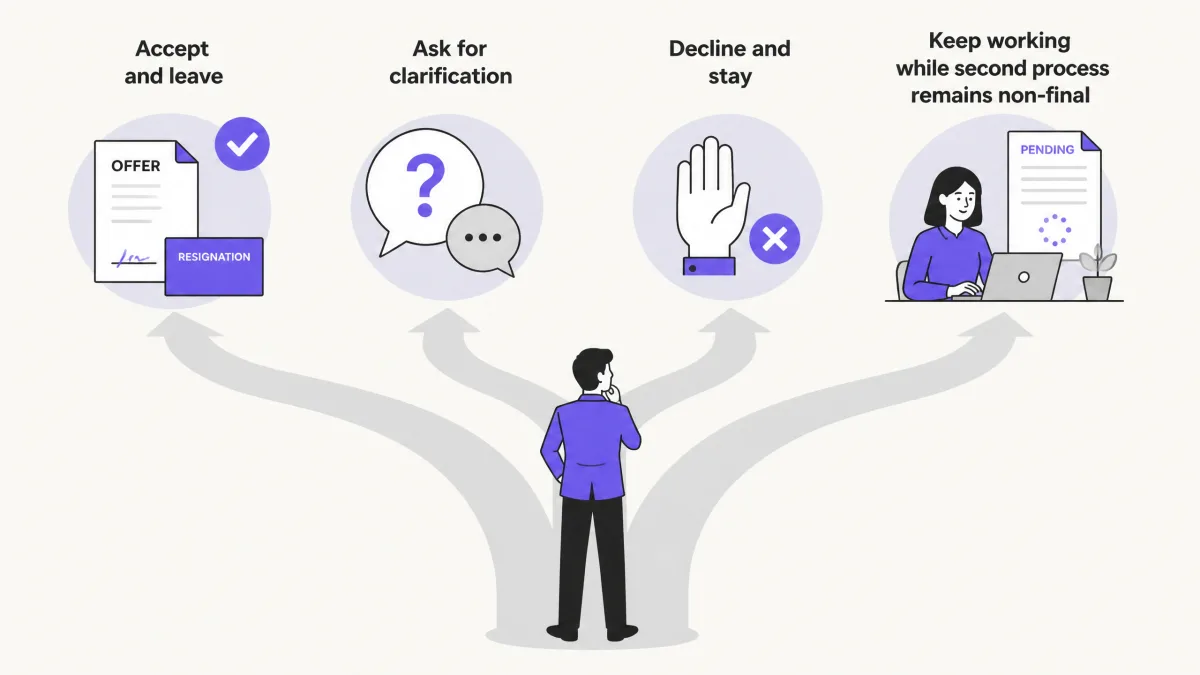
Once you've verified the offer, compared the two horizons, reset the sunk cost, handled the recruiter update, and priced the exit, you're finally in a position to choose. There are exactly four paths, and each has a condition and a minimum next action.
The Four Decision Paths
| Path | Use when | Minimum next action |
|---|---|---|
| Accept and leave | The new role is materially better, evidence is strong, and the No-Resignation Gate passes | Accept in writing, confirm the sequence, then resign professionally |
| Ask for clarification or time | Level, scope, manager, team, contingencies, or exit costs remain unknown | Send focused questions and request a specific response date |
| Decline and stay | The improvement is mostly title, assumptions are weak, or the current role wins on priorities | Decline promptly and recommit to the current role |
| Keep the current job while the second process remains non-final | The second job is likely or verbal but isn't decision-ready | Continue working; don't announce a move or resign |
Path 1: Accept and Leave
Use this path when the higher level is real, the scope and the manager are verified, the two-year advantage is material, the exit costs are understood, and the No-Resignation Gate passes. Then execute in order:
- Receive and review the final written offer.
- Resolve negotiation and contingencies.
- Accept in writing.
- Confirm the start date and transition sequence.
- Resign from the current job.
Acceptance strengthens your position, but it doesn't make an offer impossible to withdraw. Don't treat a signed acceptance as a guarantee, and keep a small buffer against a changed plan.
Path 2: Ask for Clarification or Time
Use this path when the new role might be better but key facts remain claimed or unknown. You need a focused list of decision-changing questions, a specific date for the employer's response, and a specific date for your own decision. Vague delay tactics help no one. A defined request for the evidence you need is legitimate leverage for a careful decision.
Path 3: Decline the New Offer and Stay
Use this path when the advantage is mostly title, the manager or the team is weaker, the work or the location doesn't fit, the risk isn't compensated, or the current role simply serves your priorities better. Decline promptly and recommit to the job you're already in.
Use this script:
Thank you for the offer and for the time the team invested. After comparing the confirmed scope, timing, and my current commitments, I've decided to remain in my current role. I appreciate the opportunity and wanted to close the loop promptly.
If you decide to stay, make it a real decision and decline the new offer clearly and promptly rather than leaving it hanging.
Path 4: Keep Working While the Second Process Remains Non-Final
Use this path when you expect an offer but don't yet hold a decision-ready document. Continue performing the current job professionally. Don't announce a resignation, don't count projected compensation or a projected title as confirmed, and update the employment timeline only when the second process becomes serious. Then reassess when the facts change. This isn't stalling. It's refusing to make an irreversible move on an assumption.
How to Resign From a Job You Started One Month Ago
If the decision is final, make the departure clean and brief. You don't need to justify the decision at length, and you shouldn't relitigate it in the resignation conversation.
Use this script:
I accepted another role that's a closer long-term fit for the scope I want to build. I realize the timing is difficult, and I'm sorry for the disruption. My proposed last day is [date], subject to our notice process. I'll document my work, return equipment, and make the transition as clean as I can.
The communication rules keep the conversation professional:
- Speak with your manager promptly after the decision is final.
- Acknowledge the timing without asking permission to make the decision.
- Give the proposed last day.
- Keep the explanation short.
- Don't attack the current company.
- Don't cite rumors or unverified performance concerns.
- Don't disclose the new employer's confidential details.
- Complete an orderly handoff to the extent permitted.
If you want to preserve the relationship and avoid burning a bridge, follow the fuller steps for how to quit a job you just started professionally without turning the departure into a list of grievances.
Resume, Application, and Background-Check Consistency
A resume, an application, and a background form aren't the same document, and the rules differ slightly for each. Understand the difference and you'll avoid the biggest consistency traps.
A resume is a selective professional summary. You can choose what to include, but every fact and date you do include must be accurate. If the one-month role is irrelevant to the job you're pursuing, you can leave it off a resume, provided you don't alter dates to erase an overlap you're claiming.
An application or a background form may ask for a complete employment history. If a form asks for it, answer the question that's actually asked, with accurate names and dates. Don't assume the one-month role will appear in a background report, and don't assume it will stay invisible.
Background-check scope varies. In the United States, the Federal Trade Commission says employers may ask about or check employment history, and separate rules apply when an employer uses a background reporting company, including notice, written permission, and certain steps before an adverse decision based on the report. The contents of a particular report still depend on the report, the authorization, and the underlying facts. The FTC page Employer Background Checks and Your Rights explains your rights when a third-party reporting company is involved. That's educational guidance, and it doesn't predict what any one report will contain.
Finally, keep a private chronology for yourself: employer names, titles, and exact start and end dates for every role. When a future form or interviewer asks, you'll be able to answer accurately without reconstructing dates from memory.
How to Explain Leaving After One Month in a Future Interview
If you leave, a future interviewer will eventually ask why you were in a role for only a month. The explanation works when it follows a single, honest arc, and it collapses when you improvise or attack an employer.
Use a three-part framework:
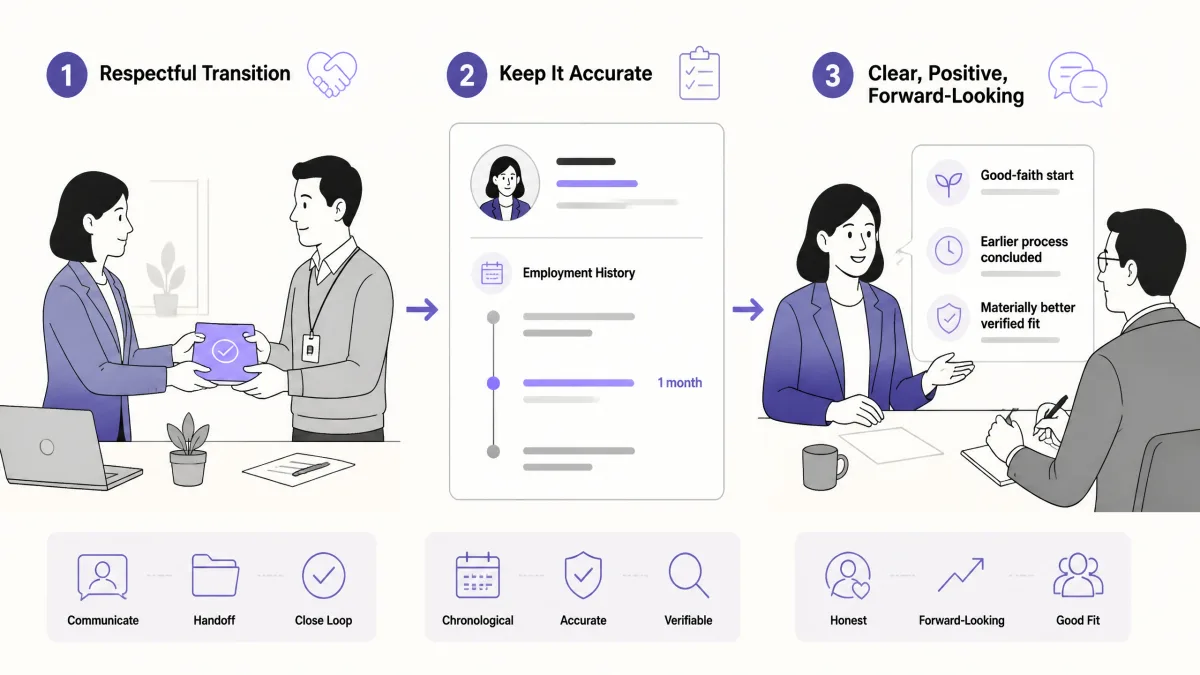
- Good-faith start. You joined the first company intending to do the work.
- Timing. A hiring process that began earlier concluded after you started.
- Material fit. The final role offered verified scope, technical alignment, location, or long-term value that was unusually strong.
Then add evidence of judgment, if you have it: you didn't leave for a vague possibility, you verified the offer, and you handled the departure directly.
Sample answer:
I joined the first company in good faith. A hiring process that had started earlier concluded after I began, and the final role was materially closer to the scope and technical direction I wanted to build long term. I verified the role, made one difficult transition, and handled the departure directly. Since then, I've been deliberate about choosing roles I can commit to.
Adjust the final sentence to your real record. If you don't yet have subsequent stability to point to, don't invent it. Say what's true and let consistency carry the rest. For the mechanics of doing this without disparaging either employer, see how to explain a short tenure without attacking the employer.
Should You Ask the Current Employer for a Counteroffer?
It's possible that, when you resign, the current employer will offer more money or a different assignment to keep you. Decide now how you feel about that, so you aren't making it up in the moment.
Don't use the new offer as a threat. A counteroffer only addresses the decision if it fixes the real gap that made you consider leaving. More cash doesn't automatically fix weak scope, a poor technical fit, an unfavorable work model, or a nonexistent promotion runway. If the new role is attractive mainly because of its long-term scope, a rushed counteroffer may solve none of your actual reasons for leaving. And don't bluff: only raise the possibility of staying if a genuine path exists.
Practice the Conversation With Great Offer AI
The hardest parts of this decision are often not the analysis. They're the conversations. Rehearsing them before you're sitting across from a recruiter or your manager makes the real thing calmer and more consistent.
Great Offer AI is a real-time AI interview copilot that can help you practice. Use it to rehearse the employment-timeline update to the new recruiter, practice the answer to "Why leave after one month?", prepare for recruiter and manager follow-up questions, check that your dates, reasons, level, and scope stay consistent across every conversation, and try concise versions in different tones while preserving your real facts.
Be clear about what a practice tool can't do for you. It can't decide which job is better. It can't verify level, scope, stability, or an employer's intent. It can't predict a rescission, a promotion, or a background-check outcome. If it makes a claim about any of these, treat that as coaching input and confirm it against the facts. It doesn't provide legal, tax, insurance, or immigration advice, and it can't guarantee an offer or protect a professional relationship. Use it for what it is: a rehearsal room for a conversation you need to get right.
Practice the timeline update and "why leave so soon?" conversation before you speak with the recruiter or your manager. Try Great Offer AI's interview copilot.
Sources and Methodology
This article is an editorial decision framework designed to stay within clear evidence boundaries.
- Research was reviewed on September 2, 2026.
- The originating scenario is based on an anonymous post in the r/cscareerquestions subreddit, treated as a single self-report rather than prevalence data. Its engagement is not evidence of how common this situation is and is not used to support claims in the article.
- No industry statistics were used or approved for this article.
- U.S. background-check guidance from the FTC is provided for educational context and does not predict what a particular background check will contain.
- The UC Berkeley career-center source is used only for guidance on written offers and negotiable terms. Its student-career-center context is not presented as a universal rule for all working professionals.
- This article does not provide legal, tax, insurance, contract, or immigration advice. Where a consequence is material, rely on your signed documents and applicable formal policies, and seek qualified local advice.