


Late-stage offer changes are hard to judge because they arrive after you have invested time in interviews, researched the company, and started imagining the move. An employer may describe the difference as a clarification, while the written offer leaves you looking at a job that no longer matches the one you evaluated.
The reason may be an honest correction, a genuine business change, or a persistent misleading pattern. You do not need to settle the employer's intent before responding. The immediate question is whether the final role still works for your finances, daily life, and career.
What Is a Job Offer Bait-and-Switch?
A job offer bait-and-switch is a practical description for a hiring process that attracts a candidate with one set of material terms and later substitutes meaningfully worse or different terms.
This is a candidate risk label, not an automatic legal conclusion. A material term is one that could change your decision, compensation, daily life, or career path. TestGorilla's overview uses role, pay, title, and work arrangements as examples of terms that can make the job materially different from the one advertised.
Material terms include:
- Guaranteed base salary or hourly rate, and how often it's paid.
- Target bonus, maximum bonus, commission, premium, or OTE, including which part is actually guaranteed.
- Equity, vesting, sign-on, relocation, or clawback conditions.
- Health coverage, employee premiums, retirement contributions, PTO, paid holidays, and benefit eligibility dates.
- Title, internal level, responsibilities, decision authority, and reporting line.
- Work location, remote or hybrid ratio, office days, travel, relocation, and commute.
- Working hours, shifts, weekends, on-call, overtime expectations, and classification.
- Start date, probation, contingencies, and decision deadline.
When one of these shifts enough to affect your decision, you are no longer evaluating the same job. Reset the decision.
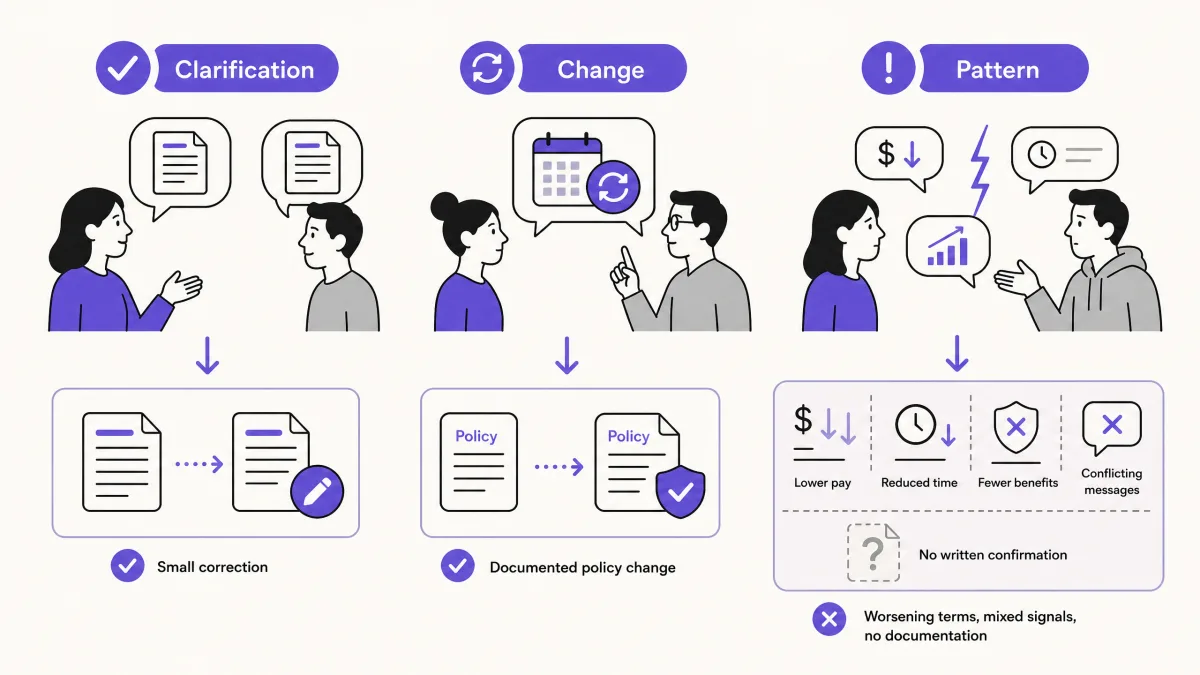
Clarification, Later Change, or Persistent Misleading Pattern?
Not every difference is the same thing, and you don't need to resolve the employer's motive to respond well. What matters more is the pattern you can observe and document.
| Pattern | Observable signs | Candidate interpretation |
|---|---|---|
| Clarification | Same underlying value; ambiguous wording is corrected; recruiter and offer agree after you clarify | Ask for written confirmation; reassess only if the clarification really changes your decision |
| Later business change | Employer identifies a specific changed budget, policy, location, scope, or start date and gives a consistent explanation | The explanation may be real, but the revised role must be evaluated as a new offer |
| Persistent misleading pattern | A significant selling point is stated repeatedly, then changes late; explanations conflict; several terms worsen; or the employer refuses to document them | Higher process and trust risk; use the Severity Matrix and consider withdrawal |
Do not waste the conversation trying to prove which label is "true." Ask four questions instead: When did the term change? Does the explanation stay consistent? Is the new term specific? Will the employer put it in writing?
JobMirror's offer-red-flag guidance recommends asking why the role changed and requesting the current title, scope, pay, reporting line, or other expectations in writing. The employer's answer tells you more than arguing over the label. The interview rounds you already completed do not make the revised terms worth accepting.
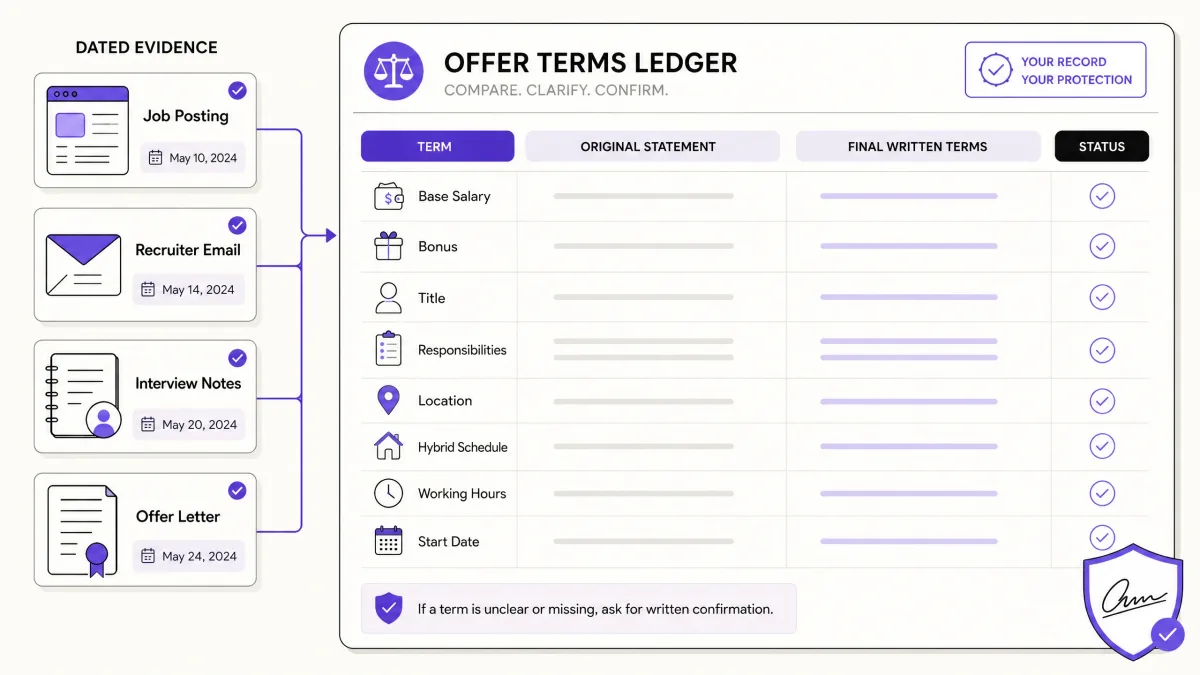
Build the Offer Terms Ledger Before You Call the Recruiter
Before you call the recruiter, put every decision-changing term in one table.
| Term | What was originally said | Source and date | Certainty | Final written term | Difference | Decision impact | Next action |
|---|---|---|---|---|---|---|---|
| Base salary | Confirmed / Estimated / Unclear | ||||||
| Bonus or commission | Guaranteed / Target / Maximum / Unclear | ||||||
| Benefits, PTO, and eligibility | |||||||
| Title and internal level | |||||||
| Responsibilities and scope | |||||||
| Manager and reporting line | |||||||
| Work location | |||||||
| Remote or hybrid ratio | |||||||
| Schedule, weekend, shift, or on-call | |||||||
| Employment classification | |||||||
| Start date and contingencies | |||||||
| Decision deadline |
Record the exact source for each statement, not just your memory of it:
- Saved job posting and the version date you captured.
- Recruiter email or message, with the date.
- Interview notes naming the speaker and date.
- Your verbal-offer recap email.
- Bonus, commission, equity, or remote-work policy document.
- The final offer letter and any revised versions.
Stick to your own records. Do not collect confidential customer data, another employee's private compensation, or restricted company documents.
In one anonymous Reddit self-report (n=1), a candidate said the number presented early as base pay was later described as the theoretical maximum, including bonus and premium. The actual base would have been 25% to 30% below the candidate's current pay, and reaching the headline number depended on demanding KPIs.
That anecdote does not show how common this is or what the employer intended. It shows why "What part is guaranteed?" belongs in the first recruiter call. In the Ledger, the difference is simple: part of the stated fixed pay became conditional. The next action is to request the written plan, KPI definitions, eligibility rules, payment timing, and a revised base if you are still interested.
Once your table is built, use it to review the written job offer before accepting. Compare each term with a dated source, not a half-remembered phone call.
Run the Compensation Reality Check
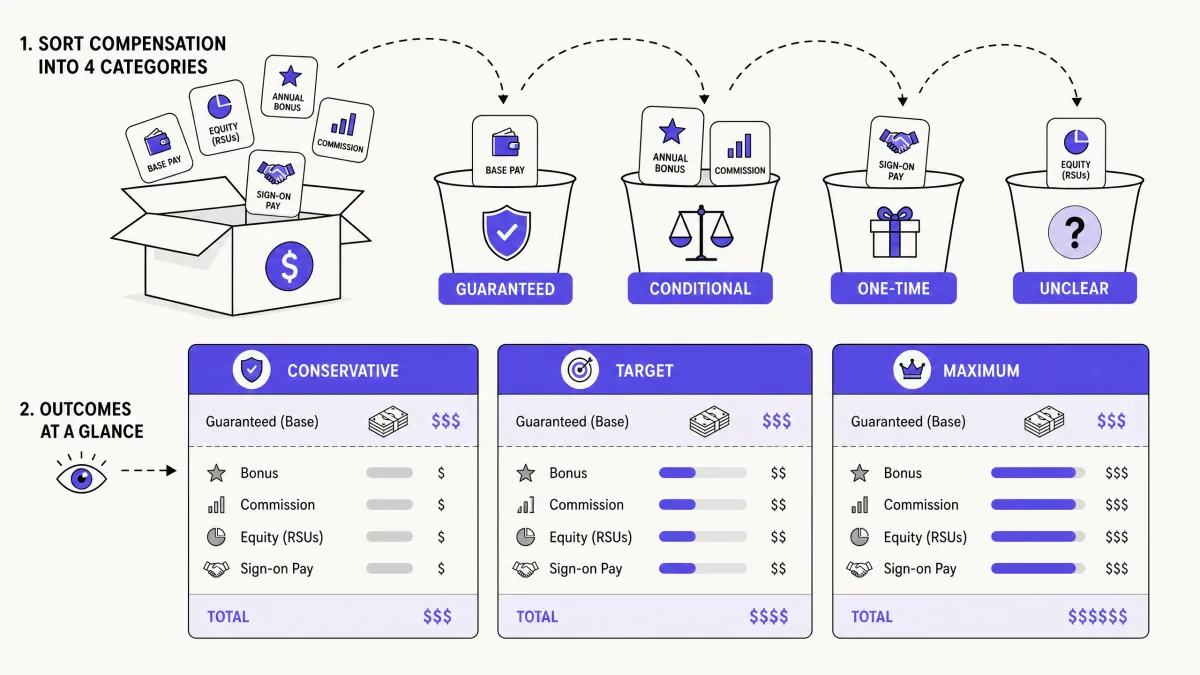
A headline compensation number can mean four very different things. Before you compare anything, classify every item.
| Type | Definition | Examples | How to use it |
|---|---|---|---|
| Guaranteed | Pay that does not depend on a future performance threshold | Base salary, fixed hourly rate | Use as the foundation of the comparison |
| Conditional | Pay that depends on a target, formula, quota, KPI, vesting event, or eligibility rule | Target bonus, commission, premium, equity vesting | Use the written plan and show uncertainty |
| One-time | Pay that applies once and may have repayment conditions | Sign-on bonus, relocation payment | Keep separate from recurring annual pay |
| Unclear | Pay with no usable formula, threshold, timing, history, or plan document | "Up to" pay, informal revenue share | Do not count as guaranteed value |
4dayweek.io's offer-evaluation guide makes the same separation: base salary is guaranteed, performance bonuses depend on targets, sign-on bonuses are one-time, and equity vests over time. OTE ("on-target earnings") is base plus target variable pay. It is not guaranteed cash.
Now pressure-test the details:
- Base salary: State whether it is annual or hourly, and whether the schedule changes the effective rate.
- Target bonus: A target is not a guarantee. Require eligibility, formula, measurement period, payment date, and proration rules.
- Maximum bonus or OTE: An "up to" number is not your salary. Identify every assumption needed to reach it.
- Commission or premium: Require the written plan, quota, rate, eligible revenue, reversals, timing, and change rights.
- Equity: Keep grant value, vesting, liquidity, and tax questions separate from guaranteed cash.
- Sign-on or relocation: Record repayment or clawback conditions, and keep one-time value separate from recurring pay.
Then run three scenarios rather than inventing a single "real total compensation" number:
- Conservative: Guaranteed compensation plus only highly certain one-time items.
- Target: Formal target compensation, clearly labeled as conditional.
- Maximum: Theoretical ceiling, used only to understand upside and never compared as if it were guaranteed base.
Fill in your own worksheet.
| Component | Conservative | Target | Maximum | Source or formula | Risk note |
|---|---|---|---|---|---|
| Guaranteed base | |||||
| Bonus or commission | |||||
| Equity | |||||
| One-time payments | |||||
| Recurring work-term costs |
There is no universal discount factor for a target bonus. The company, plan, and your risk tolerance all matter. Keep the guaranteed number separate so you never compare a guaranteed base with a theoretical maximum. To build the compensation floor you will negotiate from, use these same steps to set a defensible salary range.
Calculate the Real Cost of Changed Work Terms
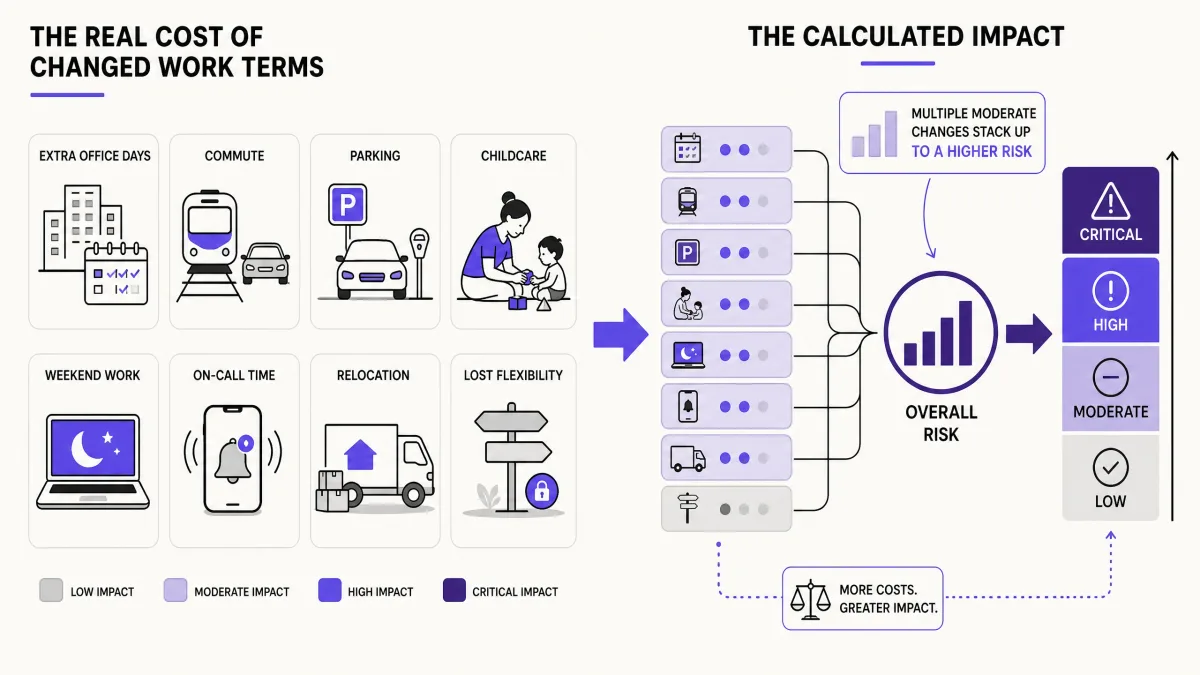
Salary math misses the changes that reshape your week: extra office days, a longer commute, weekend or shift work, on-call time, relocation, and lost flexibility. These are real costs, and they don't show up in the headline number.
USC's career center and the University of Missouri career center both include location, commuting, moving, schedule, or remote-work factors in offer evaluation. Price the difference when one of those terms changes:
- Additional commuting days and a longer or new commute.
- Parking, tolls, transit, fuel, meals, or childcare.
- Weekend or shift disruption.
- On-call expectations.
- Travel or relocation.
- Unpaid or uncompensated time.
- Loss of schedule flexibility.
- Additional working time that lowers the effective hourly value.
- A materially different responsibility set, title, or career trajectory.
There is no universal dollar value for these tradeoffs. Use your own numbers in the worksheet.
| Changed term | Frequency | Direct cost | Time cost | Career or lifestyle impact | Annualized effect |
|---|---|---|---|---|---|
In another anonymous Reddit self-report (n=1), the role was described through four interviews as three office days and two remote days. At the offer stage, it became four office days, one remote day, and possible weekend work. The employer added $2,000 a year.
Do not ask whether $2,000 sounds generous. Price the extra commute, parking, childcare, weekend disruption, and time. Tax treatment and personal priorities matter too. Run the revised arrangement through your own worksheet, then decide whether the job still clears your floor.
Use the Change Severity Matrix
Once you've classified compensation and priced the work-terms change, rate the overall severity. This is a candidate decision tool, not a legal standard.
| Severity | Observable pattern | Recommended response |
|---|---|---|
| Low | Wording clarification; economic and lifestyle impact is close to zero; explanation is consistent and documented | Request written confirmation and continue evaluating |
| Moderate | Quantifiable change to start date, bonus target, title, or a limited schedule detail | Pause acceptance, calculate the impact, and negotiate a specific adjustment |
| High | Lower guaranteed base, guaranteed pay converted to conditional pay, significant loss of remote days, added weekend or shift work, or a material scope/level change | Request the original terms or reprice the revised role; do not accept while unresolved |
| Critical | Multiple core terms changed, explanations conflict, documentation is refused, or a short deadline adds pressure while key terms remain unresolved | Treat the offer as a new and higher-risk decision; consider withdrawing and seeking qualified advice where needed |
Classify a change with four questions:
- Would it change your decision or minimum requirement?
- Is the economic, schedule, or career impact measurable?
- Is the change reversible or negotiable?
- Is the employer's explanation consistent and documented?
Then apply a stacking rule: several moderate changes can create a high or critical overall risk even when no single change looks decisive.
Three anchors are enough: a documented start-date adjustment may be Low or Moderate; fixed compensation becoming conditional is High; and several worsening core terms plus a refusal to revise the document is Critical.
The matrix tells you what to do next. It does not tell you whether the employer acted illegally.
Reconfirm the Offer at Five Hiring Checkpoints
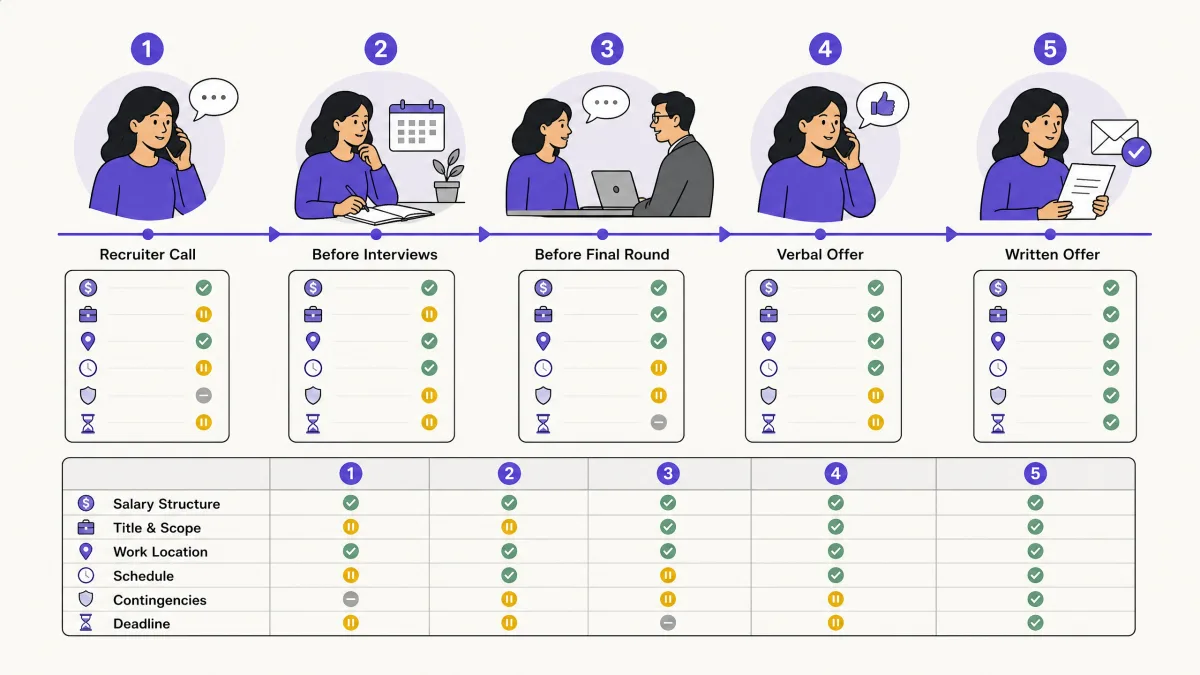
Reconfirm the expensive terms whenever the person, policy, or document changes. A useful answer is specific enough to record. A vague answer is a reason to pause.
| Checkpoint | Ask | A useful answer includes | Record in the Ledger | Pause if |
|---|---|---|---|---|
| Recruiter call | Is the number base, target total cash, OTE, or a maximum? Which parts are guaranteed? What is the expected office, remote, weekend, travel, shift, or on-call schedule? | A clear pay structure and a concrete schedule | Exact numbers, labels, schedule, speaker, and date | Base cannot be separated from OTE, or the work arrangement cannot be stated |
| Before core interviews | Has the title, level, scope, location, or work arrangement changed since the posting? Which duties take most of the role's time? | A stable role definition and realistic duty mix | Current title, level, scope, location, and source | Interviewers describe materially different jobs |
| Before the final round | Are there undisclosed weekend, shift, travel, relocation, probation, classification, or availability requirements? Is the compensation structure unchanged? | Confirmation or a specific update before more time is invested | Every newly disclosed requirement and who confirmed it | A decision-changing term remains "to be determined" |
| Verbal offer | Can we restate the base, bonus formula, benefits, title, manager, location, schedule, start date, contingencies, and deadline? | A complete recap with no unexplained gaps | The full verbal offer and the promised date for the written version | You are pressed to accept before reviewing the written offer |
| Written offer | Does every decision-changing term match the Ledger? Who will issue a revised version after any clarification or negotiation? | A final document that matches the agreed terms | Version date, differences, open items, and owner | A material term is missing, contradictory, or left only in an informal conversation |
These questions sit inside a broader interview strategy. For more on what to cover as you move through the process, see questions to ask before the next interview.
What to Ask When a Term Changes
The previous section helps you catch a change early. These are the questions to use after you have found a discrepancy.
Base, Bonus, Commission, or OTE
- Is the figure guaranteed base salary, target total cash, OTE, or a maximum?
- What written plan defines eligibility, formula, KPI, measurement period, and payment date?
- Which part of the earlier figure became conditional?
- Can the base be revised to reflect the amount discussed earlier?
Remote, Hybrid, Location, or Schedule
- Is the office schedule a contractual offer term, a current policy, or a manager expectation?
- How often can the policy change, and who approves exceptions?
- Does the role include weekends, shifts, on-call, travel, or relocation?
- Can the agreed schedule be written into the offer or a signed addendum?
ResumeMate's remote-work negotiation guide recommends raising the request after receiving the written offer and before accepting, then documenting the agreement. For a decision-changing arrangement, ask for a revised offer, signed addendum, or formal written confirmation from an authorized representative. A casual email may document the discussion without overriding a broader policy or contract.
Title, Level, Duties, or Reporting Line
- Which responsibilities or interview evidence led to the change?
- Does the compensation band, promotion path, and performance rubric match the new level?
- Is the original role still open?
If the core issue is a title or level step-down, use the separate guide to evaluate a downleveled offer. It covers the full level, scope, and pay diagnosis.
Start Date, Probation, Contingencies, or Deadline
- Which conditions must clear before the role is final?
- What happens if the start date moves?
- Can the response deadline be extended while the revised terms are reviewed?
- Who will send the revised written offer, and by what date?
After a call, send a same-day recap listing the original term, the revised term, your requested correction, and the date you need the revised document. This gives the employer a clean chance to correct any misunderstanding and gives you a dated record.
Choose One of Three Response Paths
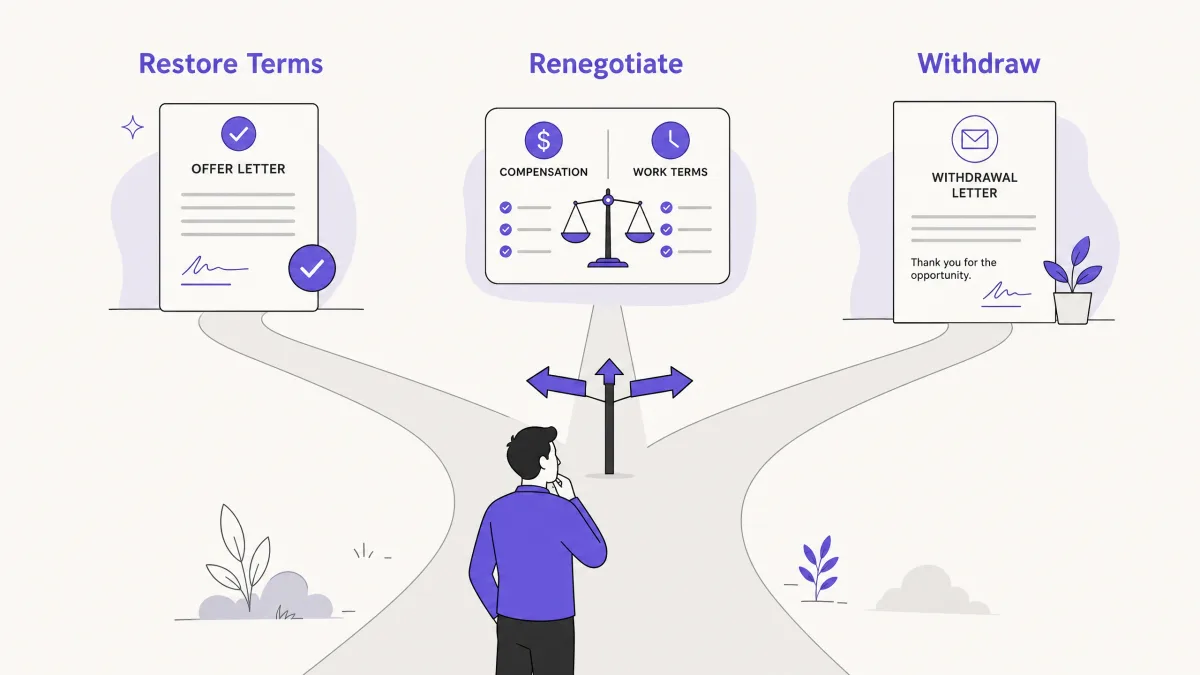
Once you have priced the change and rated its severity, pick one path. Do not send a message that asks for the old terms, proposes a new deal, and threatens to leave all at once.
| Path | Use when | Required evidence | Minimum written outcome |
|---|---|---|---|
| Request original terms | Earlier term was specific and well documented | Dated posting, email, or recap | Revised offer restoring the term |
| Renegotiate revised role | You may accept if the impact is offset | Quantified change and specific ask | Revised offer with compensation, schedule, scope, and date |
| Withdraw | Revised role fails a minimum requirement or trust threshold | No proof of intent required | Concise written withdrawal and saved record |
Path A: Request the Original Terms
Use when the earlier term was specific, consistently repeated, and supported by a dated source.
Earlier in the process, we discussed [original term]. The written offer lists [different term]. I am still interested if the offer can be revised to reflect [original term]. Can you send an updated version by [date]?Path B: Renegotiate the Revised Role
Use when the employer confirms the new condition is real, and you'd still consider the role at a different price or structure.
With [changed condition], I would need [specific compensation, schedule, or scope adjustment] to move forward. Can you include that in a revised written offer by [date]?Path C: Withdraw
Use when the revised role no longer meets your minimum requirements, or the process no longer feels trustworthy enough to continue.
Thank you for the offer and the time the team invested. Because the final terms differ materially from the conditions I evaluated, I have decided not to move forward.A few response rules regardless of path:
- Start with the factual difference, not the label "bait-and-switch."
- Make one primary request and one fallback, not a vague list of complaints.
- Set a reasonable written reply date tied to the employer's decision deadline.
- Ask for a revised document, not only a call summary from memory.
- Don't bluff another offer or deadline.
- Don't threaten to expose the employer.
Robert Half's salary-negotiation guide recommends researching the market, considering total compensation and flexibility, and negotiating from the written offer. Keep your counter concise and evidence-based, then ask for the agreed outcome in a revised offer. If you withdraw, use the full guide on how to decline a job offer to close the process cleanly.
Use Great Offer AI to Rehearse the Conversation
The hard part is often saying this cleanly under pressure. Use Great Offer AI in a mock interview setup to rehearse one factual discrepancy, one primary request, one fallback, and the recruiter's likely follow-up questions. Keep your Ledger beside you so you keep the dates and numbers consistent.
The tool can help you practice how you say it. It cannot prove a promise, judge legality, predict whether an offer will be withdrawn, or decide whether you should sign. Use it as a rehearsal room, not a referee.
Reset the Sunk Cost Before You Decide
If this revised offer were the first version you saw today, without the interviews behind it, would you still apply or accept?
Four interviews do not make a worse offer better. Read the revised offer as if it came from a company you had never spoken to. The employer's time investment does not obligate you to accept. Compare the job in front of you with your alternatives and the risk you would take from here.
A quick decision test:
- Would I apply to this revised role today?
- Does it meet my guaranteed compensation floor?
- Does the work arrangement fit my life?
- Is the role scope still useful for my career?
- Did the employer respond to the discrepancy clearly and in writing?
- What is my fallback if another term changes after I join?
A scarce job market can legitimately affect your choice. That is your call to make with your financial runway and minimum requirements in view. It does not make the changed terms better.
Do Not Resign Until the Final Terms Pass the Gate
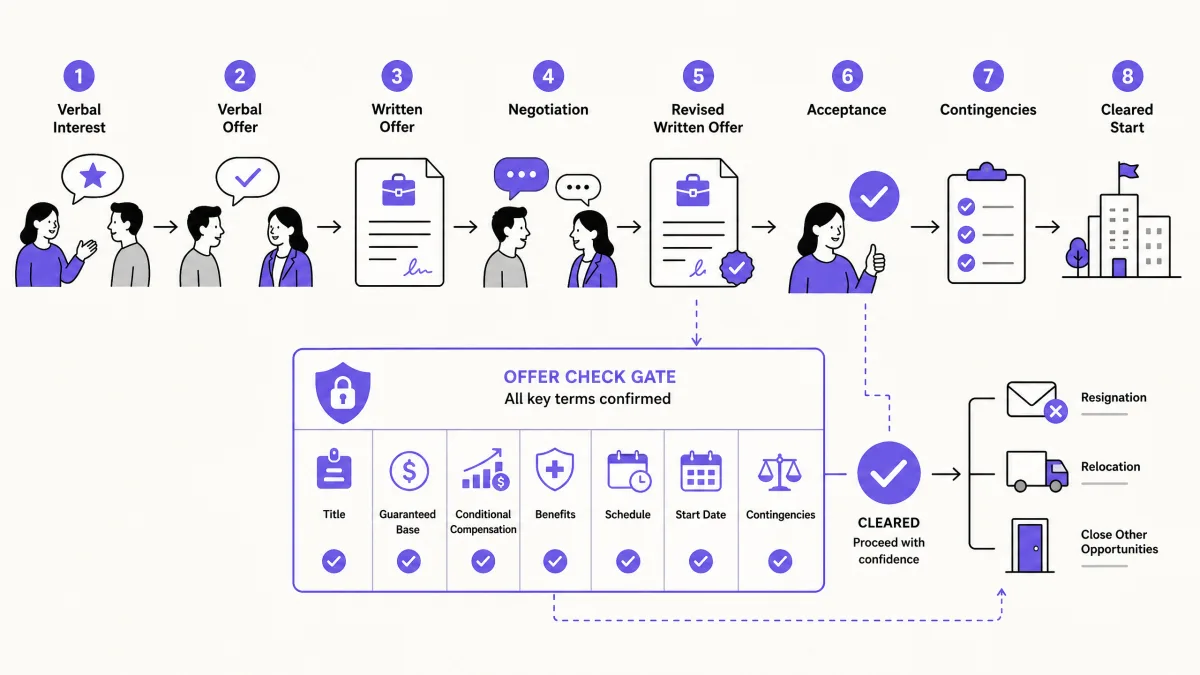
My default advice is simple: do not resign on a verbal offer. Before you accept, resign, relocate, or close other processes, require confirmation that all of the following are settled:
- Final title, scope, and reporting line are written.
- Guaranteed base and conditional compensation are separated.
- Bonus, commission, premium, equity, and sign-on terms are supported by written terms or formulas you can evaluate.
- Benefits, PTO, employee costs, and eligibility dates are clear.
- Remote or hybrid ratio, office days, location, schedule, weekend, shift, and on-call expectations are written.
- Start date, decision deadline, and all contingencies are listed.
- The final negotiated version has been received.
- You understand which conditions remain pending and who confirms clearance.
Think of the offer as a sequence of distinct states, not one moment:
Verbal interest -> Verbal offer -> Written offer -> Questions or negotiation -> Revised written offer -> Acceptance -> Contingencies pending -> Cleared start
Each is a separate stage where you can pause. There is no universal legal rule for when a specific person must resign, so treat this as risk control, not a legal directive. Do not make an irreversible move while a decision-changing term remains unsettled.
Is a Changed Job Offer Illegal?
A changed offer is not automatically illegal. Contract, wage-disclosure, discrimination, misrepresentation, and reliance questions depend on the documents, jurisdiction, timing, and facts.
What you can do now:
- Preserve the posting, correspondence, offer versions, expense records, and dated notes.
- Don't assume every recruiter statement is a binding promise.
- Don't assume an employer can ignore every written or signed term.
- State-specific pay-transparency rules may govern what must appear in job advertisements. New York is one example: New York State's pay-transparency guidance says covered employers with four or more employees must disclose compensation or a compensation range in covered advertisements and include the job description if one exists. That is a New York rule, not a national one.
- Seek qualified local advice when the change overlaps with a signed agreement, costs incurred after relocating or resigning, protected-status discrimination, retaliation, wage disclosure, or another significant legal concern.
This article cannot tell you whether a specific employer acted illegally. It can help you preserve the facts and make a cleaner decision. Get qualified local advice when the stakes or potential rights justify it.
Sources
Guidance sources used in the article: TestGorilla, JobMirror, 4dayweek.io, USC Career Center, University of Missouri Career Center, ResumeMate, Robert Half, and New York State Department of Labor.