
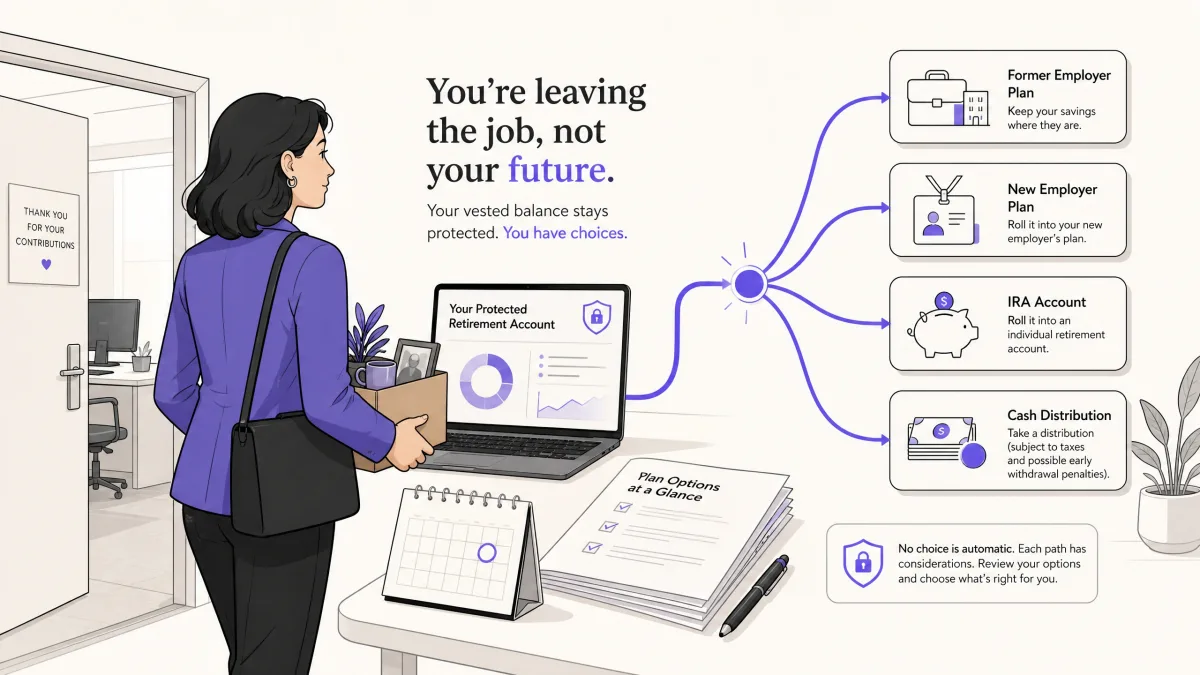
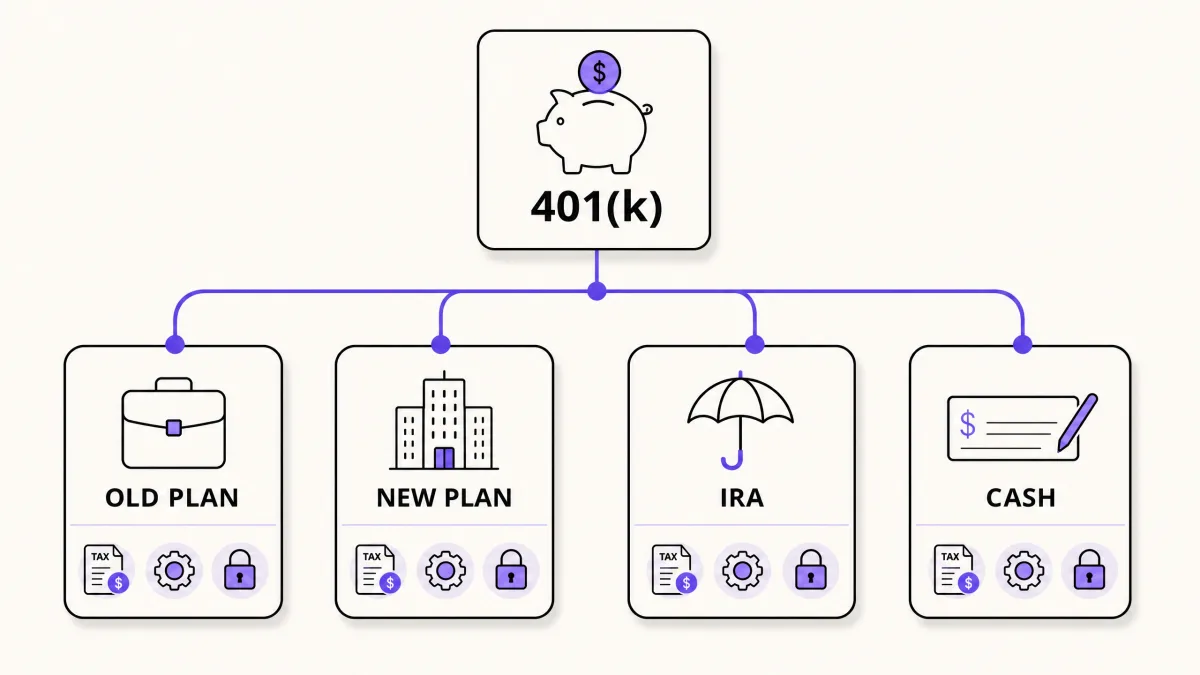
Leaving a job (whether you resigned, were laid off, or retired) doesn't erase your 401(k) balance, but it does create decisions. Your vested balance remains yours. Payroll contributions normally stop after employment ends. You generally have four common paths: leave the money in the former employer's plan if the plan permits, move it to a new employer plan if that plan accepts the rollover, roll it to an IRA, or take a cash distribution. Unvested employer contributions, plan loans, small balances, taxes, and special account features can all change the result.
This article is educational information only. It is not investment, tax, or legal advice. Check your Summary Plan Description, distribution notice, and plan administrator because plan terms differ.
Below you'll find a four-option comparison table, a tax-path map, an exit snapshot worksheet, a "do not move yet" gate for complex situations, an action calendar, a document checklist, and answers to common questions. Each tool is a practical editorial framework, not a validated financial model.
What Changes to Your 401(k) When Employment Ends?
Your vested balance remains yours
Under IRS vesting rules, employee contributions are always fully vested. They're your money from day one. Unvested employer matching or other employer contributions may be forfeited if you leave before meeting the plan's schedule requirements.
Account ownership is separate from investment performance. The balance can still rise or fall with the investments, but the vested portion belongs to you regardless of your employment status.
Payroll contributions and employer funding usually stop
You generally cannot keep contributing through payroll after leaving. Final matching contributions, true-ups, profit sharing, or delayed deposits depend on plan-specific rules and the timing of your separation. Compare your final statement with your final payroll records to confirm that all contributions and matches you expected actually posted.
The account may stay invested, but access and rules can change
If the plan permits the balance to remain, the money typically stays invested in your chosen funds. However, recordkeeper access, fee structures, withdrawal options, loan treatment, and beneficiary procedures can all shift after you're no longer an active employee. Some plans charge higher fees for terminated participants or restrict certain transactions. You may also receive a small-balance notice if your vested account is below the plan's involuntary cash-out threshold.
Your vested 401(k) remains yours under the same vesting rules, but you do need to stay on top of contact information, beneficiary designations, and any plan-specific deadlines to avoid unwanted automatic distributions or lost-account problems.
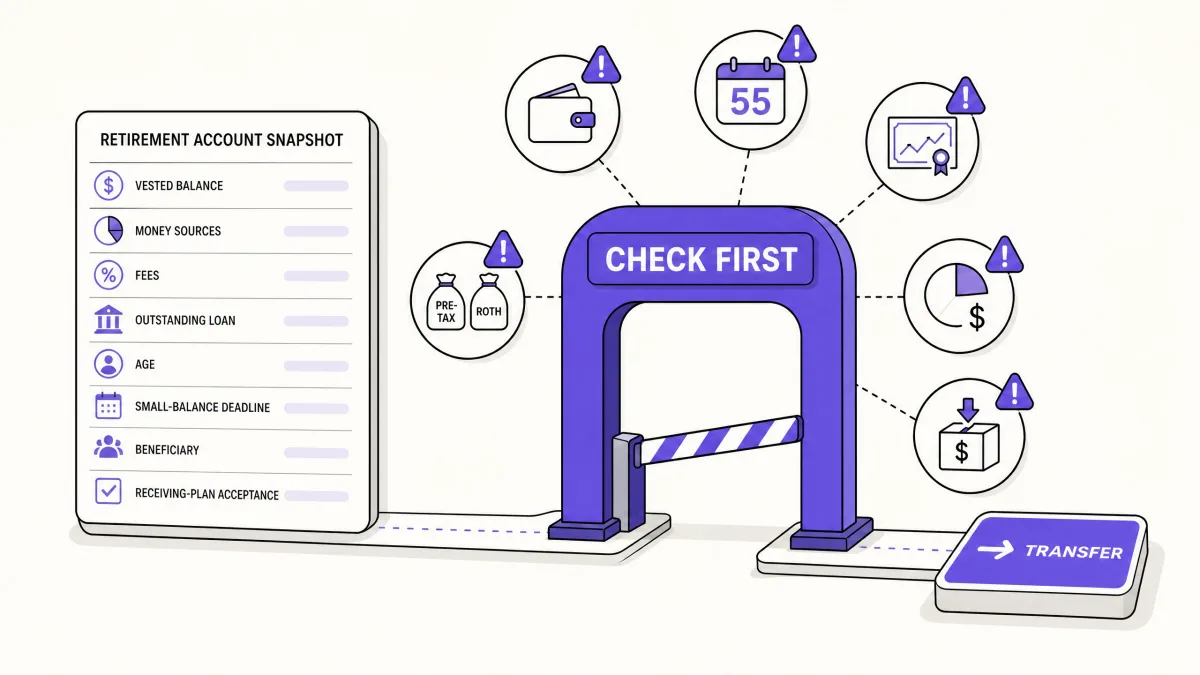
Complete a 401(k) Exit Snapshot Before Moving Money
Before you authorize any transfer, gather the account facts. This worksheet is a practical decision tool, not a financial score.
| Field | What you record | Why it matters |
|---|---|---|
| Last working day | Exact date | Starts your transition record and may affect plan events |
| Age in the calendar year of separation | Age and birth date | Flags possible Rule of 55 analysis |
| Total and vested balance | Both amounts | Separates owned money from unvested employer amounts |
| Money sources | Pre-tax, Roth, after-tax, rollover, employer stock | Determines compatible destinations and tax treatment |
| Outstanding loan | Balance, payment status, plan deadline | Flags possible repayment or loan offset |
| Current plan costs | Administrative and investment expenses | Enables a real comparison |
| New plan acceptance | Yes, no, unknown; accepted source types | Prevents an unsupported transfer assumption |
| RMD status | Not applicable, approaching, or currently required | Prevents an ineligible rollover |
| Small-balance notice | Amount, deadline, stated action | Prevents an unwanted cash-out or automatic rollover |
| Contact and beneficiary details | Address, email, phone, beneficiary | Reduces lost-account risk |
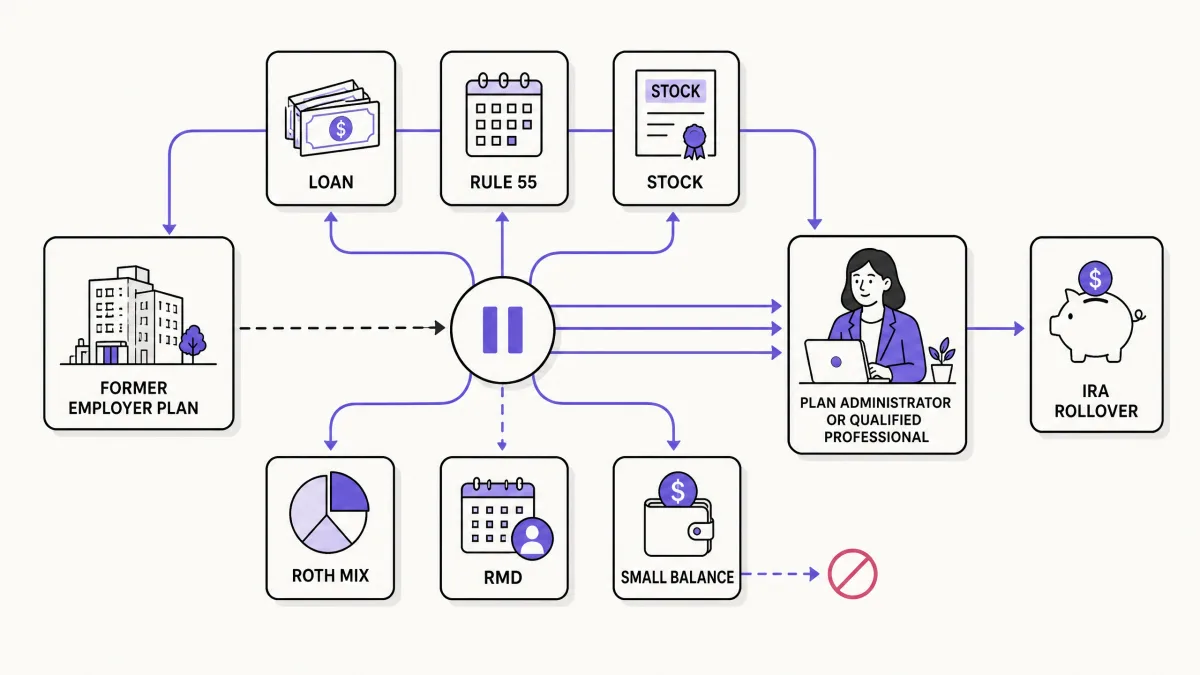
Run the Do-Not-Move-Yet Gate
Pause before authorizing a transfer if any of these apply:
- You may need the Rule of 55 (separated in or after the year you reached age 55 from the employer maintaining this plan)
- The account has an outstanding loan or pending offset
- It holds employer stock with possible net unrealized appreciation treatment
- It includes after-tax contributions or mixed Roth and pre-tax sources
- You are taking or approaching a required minimum distribution
- You received a forced-distribution notice
- A divorce, QDRO, beneficiary, inheritance, bankruptcy, or creditor-protection issue exists
If any of these describe your situation, contact the plan administrator and an appropriately qualified professional before you move the money. These circumstances can create irreversible tax consequences or eliminate valuable options.
Your Four Common 401(k) Options After Leaving a Job
Not every option is available to every participant. Plan terms, balance size, and the receiving account's rules all determine what you can actually do. Here's the summary:
| Option | Immediate tax in a properly handled transaction | Main reasons to consider it | Main issues to verify |
|---|---|---|---|
| Leave it in the former employer plan | Usually none | Strong plan, low fees, useful plan-specific features | Eligibility, fees, service, withdrawals, small-balance rules |
| Roll it to a new employer plan | Usually none with a direct rollover | Consolidation, plan features, possible loan access | Whether the plan accepts the rollover and each money source |
| Roll it to an IRA | Usually none for a compatible direct rollover | Broader control or investment access | Fees, services, protections, Rule of 55, source mapping |
| Take a cash distribution | Often taxable | Immediate liquidity | Withholding, income tax, possible additional tax, lost tax deferral |
Option 1: Leave the money in the former employer's plan
If the plan permits the balance to remain, you can do nothing for now. Possible advantages: no immediate transaction, familiar investments and institutional pricing, plan-specific protections or withdrawal rules, and potential relevance of the Rule of 55 if you separated in or after the year you reached 55.
Questions and drawbacks: the plan may not permit the balance to remain, especially if it's below the involuntary cash-out threshold. Administrative and investment fees can be higher for terminated employees in some plans. The investment menu is limited to what the plan offers. You cannot add new payroll contributions. Keeping multiple accounts with old employers increases record-keeping complexity and the risk that you lose track of contact information. Plans can force out a vested, nonforfeitable benefit under their terms if it meets certain IRS cash-out thresholds. Check the Summary Plan Description and any distribution notice before assuming the balance will stay put indefinitely.
Option 2: Roll it into a new employer's plan
If your new employer offers a 401(k) or similar plan and that plan accepts rollover contributions, consolidation can simplify your retirement picture. Possible advantages: one workplace account to monitor, the new plan's features, services, or loan access, and possible current-employer required minimum distribution treatment where allowed by the plan.
Questions and drawbacks: under IRS rollover guidance, a plan is not required to accept rollovers. The plan may restrict which money sources it will accept. For example, some plans accept pre-tax rollovers but not Roth or after-tax contributions. Fees, investment options, waiting periods, and withdrawal rules differ from plan to plan. Confirm direct-rollover instructions, accepted sources, and any waiting periods before you initiate the transfer.
Option 3: Use a direct rollover to an IRA
Rolling the account to an IRA can give you broader control over investment choices, provider selection, and account services. Possible advantages: a wider investment menu, the ability to consolidate multiple old employer accounts into one IRA, and your choice of custodian and advisory services.
Questions and drawbacks: compare all fees, cash-sweep terms, advice fees, and account services. Legal and creditor protections can differ by account type and jurisdiction. An IRA does not provide the employer-plan Rule of 55 exception. Employer stock, after-tax contributions, or loans can require special handling. Keep pre-tax, Roth, and after-tax destinations accurate. Under Roth conversion tax rules, moving pre-tax money to a Roth IRA is generally taxable.
Option 4: Take a cash distribution
If you need immediate liquidity, you can request a cash distribution. Under IRS distribution withholding rules, the plan generally withholds 20% of the taxable amount of an eligible rollover distribution paid to you. The taxable portion is generally included in your income. Under early-distribution tax rules, a possible 10% additional tax can apply if you're under age 59½ unless an exception applies. Withholding may be lower or higher than your final tax liability, depending on your total income, deductions, state taxes, and whether any exceptions reduce or eliminate the additional tax.
You also lose future tax-deferred or tax-free growth on money you withdraw. That doesn't mean you should never cash out. Sometimes liquidity is the priority. Understand the tradeoffs clearly before you decide.
Compare the Four Options With One Decision Matrix
Use this matrix to weigh what matters for your specific situation. The best destination depends on your full account facts and priorities; no single column wins for everyone.
| Factor | Former employer plan | New employer plan | IRA | Cash distribution |
|---|---|---|---|---|
| Immediate tax in a properly handled transaction | Usually none | Usually none with a direct rollover | Usually none for a compatible direct rollover | Often taxable |
| Administrative and investment costs | Plan-specific; may be institutional or retail pricing | Plan-specific; employer often negotiates | Varies widely by provider; compare carefully | N/A after distribution |
| Investment menu | Limited to plan offerings | Limited to plan offerings | Broad; nearly unlimited | N/A |
| Consolidation | Keeps this account separate | Can combine old and new workplace accounts | Can consolidate multiple old accounts | Eliminates the account |
| Loan availability | Generally not available after separation | May be available if plan permits and you meet service requirements | Not available | N/A |
| Withdrawal rules | Plan-specific; may have restrictions | Plan-specific; may have restrictions | Flexible but subject to tax rules | Immediate access |
| Rule of 55 relevance | May apply if you separated from this employer in or after the year you reached 55 | May apply if you separate from the new employer under the same age rule | Does not apply | N/A |
| RMD handling | Former-plan RMDs generally begin at applicable age even if working elsewhere | May allow still-working delay only while employed by this plan sponsor | RMDs required at applicable age unless still working (not applicable for IRAs) | Distribution satisfies RMD if applicable |
| Legal and creditor protection | ERISA protection | ERISA protection | State law; can vary | N/A after distribution |
| Paperwork and support | Former employer relationship; access may be limited | Active employer relationship; often better access | Your choice of provider and service level | One-time distribution paperwork |
| May fit when | Plan is strong, fees are low, balance is above forced-out threshold, no immediate need | New plan accepts rollovers, you want consolidation, new plan has good features and pricing | You want control, broader investments, or need to consolidate multiple accounts | You need cash now and understand the tax cost |
| Verify before acting | Eligibility, fees, services, small-balance rules, loan status | Acceptance of your specific sources, waiting periods, plan quality | Fees, services, protections, impact on Rule of 55 and future rollovers | Full tax impact, withholding, whether any portion is not taxable, lost compounding |
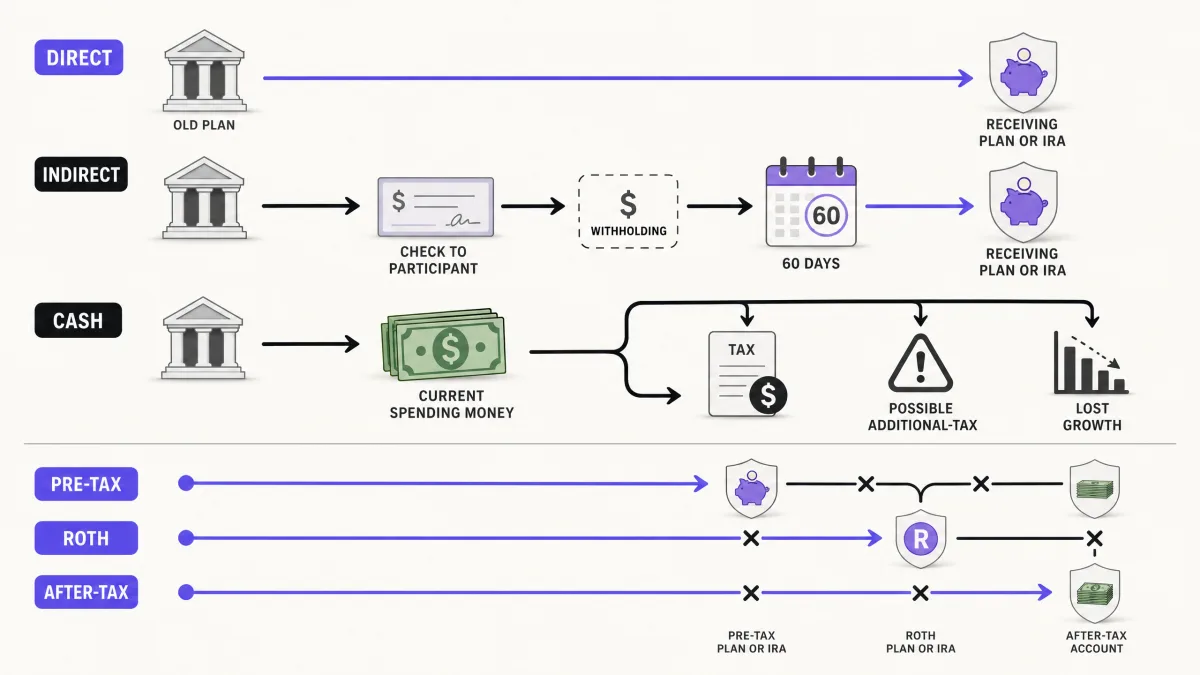
How Direct Rollovers, Indirect Rollovers, and Cash Distributions Work
Use a three-path tax map
| Path | Where the money goes first | Mandatory 20% withholding on the taxable amount | 60-day issue | Common risk |
|---|---|---|---|---|
| Direct rollover | Directly to the receiving plan or IRA | Generally no | Not your operational deadline | Incorrect payee or incompatible destination |
| Indirect rollover | Paid to you first | Generally 20% of the taxable amount of an eligible rollover distribution | Generally yes | Failing to replace withheld money or missing the deadline |
| Cash distribution | Paid to you and not rolled over | Generally 20% of the taxable amount when the distribution is rollover-eligible | No rollover completed | Current income tax and possible additional tax |
Explain the 60-day rule without overgeneralizing
Under the IRS 60-day rollover rule, the general period begins when you receive an eligible rollover distribution. A direct rollover does not require you to complete an indirect rollover within 60 days because the money never touches your hands. If you do receive a check made out to you, rolling over the full gross distribution may require replacing the amount withheld from the taxable portion with other funds. Not every distribution is rollover-eligible. Confirm the distribution type before assuming you can complete a rollover.
Separate withholding, income tax, and the possible additional tax
Cash received now is not the same as final after-tax cost. The categories that affect the result include:
- Federal withholding
- Final federal income tax
- State income tax where applicable
- Possible 10% additional tax
- Any amount successfully rolled over
- Lost future tax-advantaged growth
This is not a personal tax calculation. Consult a tax professional to estimate your specific liability.
Keep pre-tax, Roth, and after-tax money mapped correctly
Compatible destinations differ by money source. Under Roth conversion tax rules, moving pre-tax money to a Roth IRA is generally taxable. The IRS Roth 401(k) rules explain why not every distribution is qualified and tax-free: it must meet both the five-year rule and an additional qualifying event.
Under IRS mixed-source rollover rules, a partial distribution from an account holding both pre-tax and after-tax money generally contains a proportionate share of each. When the entire distribution is sent at the same time to multiple destinations, current IRS rules may allow the pre-tax and after-tax portions to be directed separately. You cannot freely withdraw only the after-tax principal from a mixed account. Get written source-level instructions before you transfer.
Special Situations to Resolve Before You Move the Account
You have an outstanding 401(k) loan
Under IRS plan-loan rules, the plan may permit continued payments, require repayment, or offset the balance; plan terms control. Not every loan becomes due on your last day of employment. A plan loan offset is a reduction of your account balance to repay the loan.
Under IRS loan-offset rules, a qualified plan loan offset can have a rollover deadline tied to the federal tax-return due date, including extensions. The offset is only qualified if the loan satisfied the applicable tax-law loan requirements immediately before the triggering event and the offset occurred solely because of plan termination or, for severance, within the 12-month period beginning on the severance date. You need outside funds to complete that rollover. Ask when the offset will occur and whether the plan treats it as qualified.
You separated in or after the year you reached age 55
Under the IRS Rule of 55, the exception applies to distributions from the qualified plan maintained by the employer from which you separated. It can remove the 10% additional tax from qualifying plan distributions; it does not remove ordinary income tax. It does not apply to IRAs or automatically carry over to an unrelated earlier employer's plan. Rolling the money to an IRA first can remove access to this plan-level exception. Certain public-safety employees can have different rules; consult an expert if that applies to you.
The account holds employer stock
IRS NUA guidance explains why net unrealized appreciation may create a special tax-planning issue. Pause before rolling employer stock into an IRA and obtain specialist review. This article does not provide an NUA recommendation or calculation.
The account contains Roth or after-tax contributions
Keep Roth, pre-tax, after-tax, and rollover sources separate. The receiving account must be compatible with the source. Under IRS Roth distribution rules, a qualified distribution must satisfy both the five-year rule and an additional qualifying event; nonqualified distributions may include taxable earnings. Request a source breakdown and receiving-account instructions in writing.
You are at or near your applicable RMD age
Under IRS RMD rollover rules, a required minimum distribution is not eligible for rollover. A current-employer plan may allow a still-working delay only while you remain employed by that plan sponsor. Working for another company generally does not delay RMDs from a former employer's plan. Use your applicable RMD age based on your birth year and account context; there is no universal age for every reader. Mention the 5% owner exception and plan-specific rules to your advisor.
The plan can force out a small balance
Under IRS involuntary cash-out rules, plans may use a limit of up to $7,000 for the vested, nonforfeitable benefit. A plan may use a lower threshold. A mandatory distribution may be paid to you or automatically rolled over to an IRA depending on the amount, your election, and the plan terms. Read the Summary Plan Description and distribution notice. Do not assume every plan uses the full $7,000 limit or that the limit applies to the total account balance rather than the vested portion.
Follow a Time-Sensitive 401(k) Action Calendar
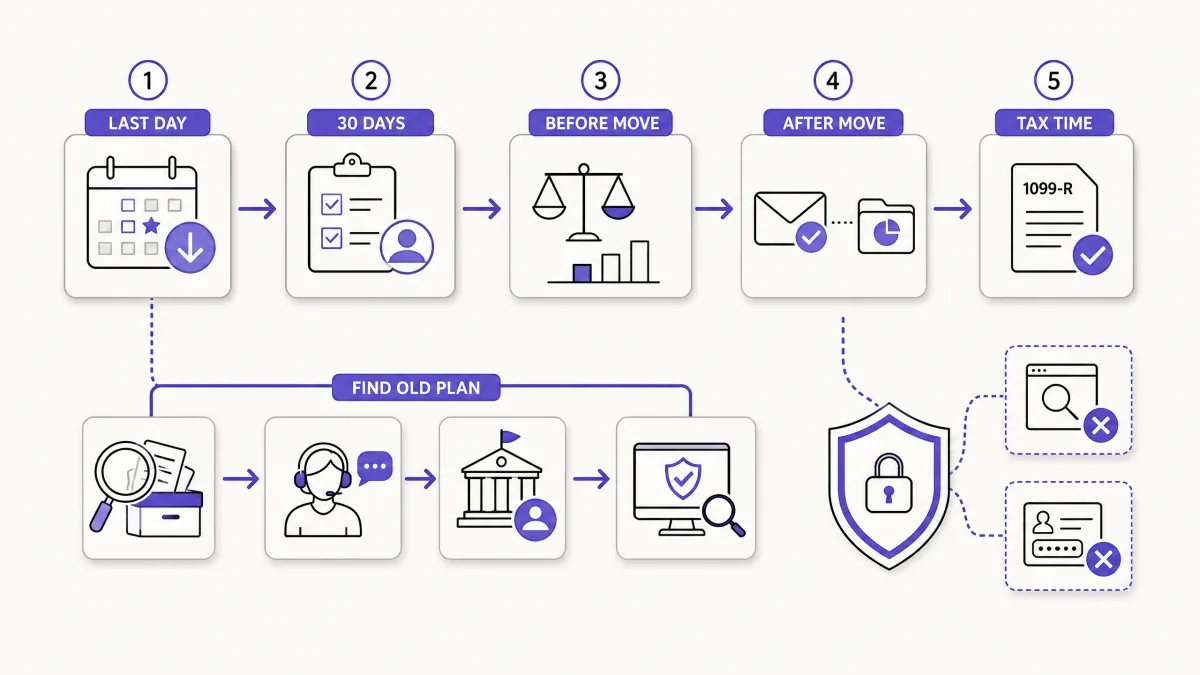
| Timing | Action | Record to keep |
|---|---|---|
| Before the last day | Download the statement, SPD, loan documents, beneficiary record, and recordkeeper contact | Saved PDFs and contact details |
| First 30 days after leaving | Confirm the final contribution, vested balance, address, loan status, and any small-balance deadline | Final payroll record and plan confirmation |
| Before authorizing a transfer | Complete the Exit Snapshot and Do-Not-Move-Yet Gate | Written comparison and professional questions |
| Immediately if a check is paid to you | Identify whether it is rollover-eligible, note the receipt date, and obtain tax guidance | Check copy, distribution notice, and receipt date |
| After the transfer | Confirm receipt, source mapping, and investment status | Receiving-account confirmation |
| Tax filing season | Reconcile Form 1099-R and rollover documentation | Tax forms and transfer records |
| Each year | Update contact and beneficiary information and review account costs | Current account profile |
This timeline is an organizational tool, not a legal safe harbor. You do not have to wait 30 days to act if you're ready sooner, and some situations require faster action.
How to Find a 401(k) From an Old Job
If you've lost track of an old account, follow these steps in order:
- Search old account statements, email, payroll records, and tax documents for the plan or recordkeeper name.
- Contact the former employer's HR or benefits team.
- Ask for the plan administrator, recordkeeper, and current contact instructions.
- If the employer is closed or unreachable, use reliable public plan records and retirement-account search resources. Schwab's lost 401(k) search guide includes searching for the plan name and checking Form 5500 filings.
- Provide prior names, addresses, employment dates, and employee identifiers only through trusted channels.
- Confirm the account and beneficiary information after access is restored.
Privacy warning: Do not pay an unknown company merely to reveal a plan contact. Do not enter a Social Security number into an unverified search site.
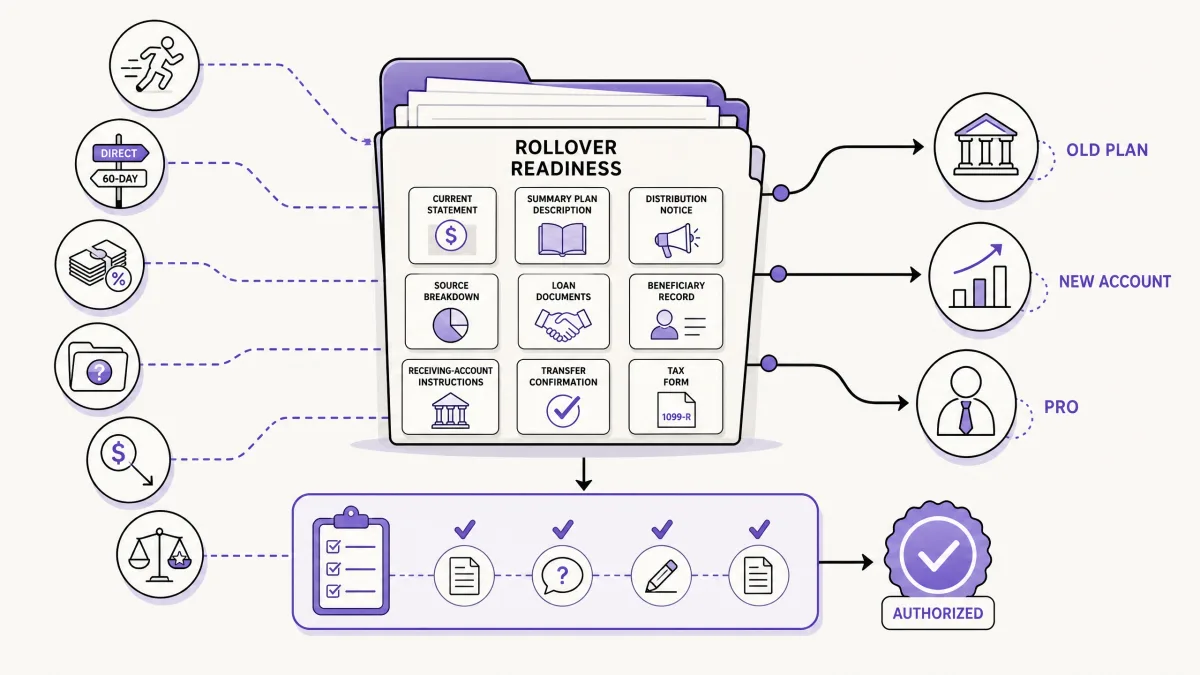
Build a Rollover Readiness Packet and Ask the Right Questions
Assemble the document packet
Gather these records before you authorize a rollover:
- Latest statement
- Summary Plan Description
- Distribution and rollover notice
- Source breakdown (pre-tax, Roth, after-tax, rollover, employer contributions)
- Loan documents if applicable
- Beneficiary confirmation
- Receiving-account instructions
- Check-payee and mailing instructions
- Transfer confirmation after the rollover
- Form 1099-R and supporting tax records
Questions for the former plan
- What is my vested balance?
- Which money sources are in the account?
- Can the balance remain in the plan?
- What fees and withdrawal restrictions apply to terminated participants?
- Is there a small-balance deadline or forced-distribution rule?
- What happens to the outstanding loan?
- Does the account hold employer stock?
- What are the exact direct-rollover instructions and check payee?
Questions for the new plan or IRA provider
- Does the account accept this rollover and each source type (pre-tax, Roth, after-tax, rollover)?
- What fees, investment options, services, and withdrawal rules apply?
- How should the check be titled and delivered?
- How will pre-tax, Roth, and after-tax amounts be recorded in the receiving account?
- When will the money be invested after receipt?
Questions for a qualified professional
- Could the Rule of 55 apply to my situation?
- Is employer-stock net unrealized appreciation relevant?
- Is a Roth conversion occurring?
- Is an RMD or plan loan offset involved?
- Do legal, creditor, divorce, or beneficiary issues require specialist review?
Common Mistakes After Leaving a Job
Here are the most frequent errors and how to avoid them:
- Assuming vested money disappears when employment ends. It doesn't. Your vested balance remains yours.
- Moving the account before checking Rule of 55, employer stock, a loan, after-tax money, or an RMD. These factors can eliminate options or create tax consequences.
- Treating every rollover as a 60-day rollover. Direct rollovers do not have a 60-day participant deadline.
- Treating 20% withholding as the final tax bill. Withholding is an estimate; your final liability depends on your total income, deductions, and applicable exceptions.
- Cashing a check without confirming whether the distribution is rollover-eligible. Not every distribution can be rolled over.
- Assuming every plan uses the $7,000 small-balance limit. Plans may use a lower threshold, and the limit applies to the vested, nonforfeitable benefit, not necessarily the total account balance.
- Comparing only investment performance instead of fees, services, access, protections, and plan rules. A complete comparison includes all of these factors.
- Failing to update contact and beneficiary information. Lost accounts are a common problem.
- Losing Form 1099-R, transfer confirmation, or source-level records. You may need these for tax filing or future rollovers.
- Accepting a provider's recommendation without checking conflicts and alternatives. Financial institutions have business reasons to prefer one account type; verify the recommendation fits your situation.
Conclusion
Your vested 401(k) balance remains yours after you leave a job, but you generally need to choose among four paths: leave it in the former plan if permitted, roll it to a new employer plan if that plan accepts the rollover, roll it to an IRA, or take a cash distribution. Unvested employer contributions, plan loans, employer stock, Roth or after-tax sources, required minimum distributions, and small-balance rules can all change the decision.
The safest first action is often to download the plan documents, complete the Exit Snapshot, run the Do-Not-Move-Yet Gate, and call the plan administrator before authorizing a transfer. Understanding fees, protections, and tax treatment helps you make an informed choice rather than accepting a default or provider recommendation.
This article is educational information only. It is not investment, tax, or legal advice. Consult the plan administrator, your Summary Plan Description, and qualified professionals for guidance specific to your situation.
Prepare for Your Next Job Interview
Leaving one job often means preparing for the next. Great Offer AI provides real-time interview assistance personalized to your resume, experience, and job description. Focus Mode does not appear in screen shares, but screen-share invisibility is a display behavior, not permission. Obtain explicit employer, interviewer, and platform permission before using live assistance. Learn more at greatoffer.ai/copilot and read about permission-first AI interview use.