
Ghost jobs became front-page news in July 2026 when the Texas Attorney General announced an investigation into LinkedIn over allegations that the platform advertised and profited from fake or misleading job opportunities. That announcement opened an investigation and issued a Civil Investigative Demand for documents related to verification practices, marketing, Premium subscriptions, and job-listing representations. It did not establish liability, prove wrongdoing, or announce a lawsuit.
For candidates, the problem is concrete. You spend hours tailoring your application, complete a four-hour take-home assignment, sit through three rounds of interviews, and then hear nothing. Or the recruiter finally admits the role is paused. Or you find out the team already picked an internal candidate before your first screen. That time does not come back.
I have watched candidates invest weeks in processes for roles that were never going to hire. The employer was collecting market data. The platform listing stayed live because no one explicitly turned it off. The recruiter could not confirm headcount because the client never told them. Everyone had a reason. The candidate had the loss.
I'm Mike Chen, a career coach working on interview strategy and job-search decisions. What follows is the filter I give candidates before they spend real hours on a listing.
This article explains what counts as a ghost job, why suspicious listings remain online, what platforms can realistically verify, what accountability should look like, and how you can check a job before you invest more time.
What Is a Ghost Job?
A ghost job is a listing presented as a current hiring opportunity even though the position does not exist or the employer has no reasonable present intent to fill it. The term should not automatically include every old, paused, filled, duplicated, or unanswered posting, because those states can result from delay, poor maintenance, or syndication rather than deception.
Use a Posting Status Taxonomy, Not a Real-or-Fake Label
Different posting states create different risks. Not every suspicious listing is deceptive, and not every deceptive listing is a scam. The labels matter because your response should change with the risk.
| Posting status | What it means | How to treat it |
|---|---|---|
| Active vacancy | Approved role with an active hiring process | Proceed after normal due diligence |
| Evergreen pipeline | Future talent collection without a guaranteed immediate opening | Proceed only if the pipeline status is disclosed |
| Paused or frozen | A real requisition stopped by budget or headcount changes | Ask for a restart date before you invest more time |
| Filled but still live | The team hired someone but did not close the listing | Treat as stale and report as incorrect if appropriate |
| Duplicate or syndicated | The same role appears through an ATS, agency, or aggregator | Find the employer-owned source and requisition ID |
| Deceptive or nonexistent | The listing appears active without a real role or reasonable hiring intent | Treat as a likely ghost job and preserve evidence |
| Recruitment scam | A false identity, payment request, phishing attempt, or data theft scheme | Stop contact and use the platform's fraud-reporting path |
Ghost jobs and recruitment scams overlap, but they are not identical. A ghost job may come from a real employer with no current vacancy. A recruitment scam uses a false identity to steal money or data.
The worst damage comes from treating everything the same. An old posting you can verify with the employer before applying is not the same risk as a listing where the recruiter cannot name a hiring manager. One deserves a five-minute check. The other deserves a hard stop.
5-Minute Red Flags: Stop Signs Before You Apply
Before you spend two hours tailoring your resume or completing a take-home assignment, run this quick filter. These are stop signs, not proof a job is fake. They tell you to verify before you invest more.
-
The recruiter cannot name the hiring manager after you ask twice. If they do not have access or a real client, you are applying into a void.
-
The listing has refreshed three or more times with no visible status change. A cosmetic bump is not the same as an active hiring push.
-
The job does not appear on the company's careers page with the same title and location. An absent listing is not proof. But confirm it before you invest time.
-
The recruiter asks for a lengthy assignment but gives you no decision date or hiring owner. Real hiring has deadlines and accountability.
-
The recruiter says "we are always hiring" but cannot identify a current approved opening. That is pipeline language, not active-vacancy language.
-
The posting is identical to one you saw six months ago, or the same role appears from multiple unconnected sources. Either it is duplicated or it never closed.
If you see two or more of these, pause. Ask one direct question before you invest more time. If the answer is still vague, treat it as a moderate-risk signal and adjust how much effort you put in.
How to Check a Job Before You Invest More Time
Use the Verify Before You Invest workflow to reduce wasted application and interview time. The goal is not to avoid every risk. It is to know the risk before you commit hours to a process.
Step 1: Run a Five-Minute Listing Check
Before you tailor an application or complete an assignment, check the basics:
- Employer-owned careers page: If it is there, do the title, location, and requisition ID match the platform listing?
- Requisition ID: Does the listing include a trackable job number?
- Company email domain: Does the recruiter use the employer's domain or a verified agency?
- Original posting date and visible refresh date: When was the role first published and last updated?
- Exact title, location, level, compensation, and responsibilities across versions: Do the platform listing, careers page, and recruiter email match?
- Application system link: Does the platform listing link to the employer's ATS?
A mismatch between the two versions is a stronger signal than an absent listing. Companies do post externally before their own site updates.
Step 2: Use a Ghost Job Evidence Ladder
Risk exists on a spectrum. Treat weak signals differently than strong ones.
| Evidence level | Examples | What to do |
|---|---|---|
| Weak signal | Old listing, vague description, no response after one application | Limit tailoring time and look for confirmation before you invest more |
| Moderate signal | Repeated refreshes with no visible change, missing employer listing, inconsistent details, recruiter cannot explain the timeline or name a decision owner | Ask direct questions before you commit to a take-home assignment |
| Strong signal | Employer confirms no vacancy, role is filled but still represented as active, poster identity is false, platform confirms the information is wrong | Save your records, stop or limit contact, and report through the platform's correct path |
Weak signals deserve a low-effort application. Moderate signals deserve specific questions. Strong signals deserve a full stop.
Step 3: Create a Job Posting Verification Record
Track each opportunity you pursue. The template below becomes essential if you need to escalate later.
Company: [Company Name]
Role title: [Title]
Platform URL: [URL]
Employer careers-page URL: [URL]
Requisition ID: [ID]
First seen date: [Date]
Platform posting date: [Date]
Last refresh date: [Date]
Recruiter name: [Name]
Recruiter domain: [Domain]
Vacancy confirmed by: [Name/Title]
Confirmation date: [Date]
Hiring timeline: [Timeline]
Inconsistencies: [List any]
Next verification date: [Date]
Decision: [Proceed / Limit effort / Pause / Report]
Step 4: Reconfirm Before High-Cost Steps
Before a take-home assignment or multi-round interview, confirm:
- Is the requisition still active?
- Does the team have approved headcount?
- Has the role been paused or materially changed since it was posted?
- Who owns the hiring decision?
- What are the remaining interview stages?
- What's the expected decision date?
Step 5: Apply a Time-Investment Stop-Loss
Use a risk-based rule instead of an unsupported age cutoff:
- Low-verification cold application: Keep customization low
- Deeply tailored application: Verify first
- Take-home assignment: Require a current role-status answer before you start
- Multi-round process: Reconfirm at major checkpoints
- Repeated inconsistency or silence: Follow up once, then reduce effort or exit
I have seen candidates complete 10-hour assignments for roles that were paused two weeks before the assignment was sent. A single confirmation question before starting would have saved them the time.
For the complete follow-up sequence after applying, see our guide on how to follow up on a job application.
Questions to Ask a Recruiter About an Active Vacancy
These questions force specificity. A recruiter who cannot answer them after two asks is giving you a signal. In my experience, the single best predictor of a real vacancy is whether the recruiter can name the hiring manager and explain why the position is open now.
Ask before you invest heavily:
Is this an approved, active vacancy, or an evergreen pipeline role?Why is the position open now?When was the requisition approved or most recently reconfirmed?Is the team hiring for one opening or building a future candidate pool?Who owns the hiring decision?What is the expected interview and decision timeline?Has the role, level, location, or compensation changed since the job was posted?Before I complete the assignment, can you confirm that the requisition is still active?
The wording matters. "Is this active?" is easier to dodge than "When was the requisition approved?" A specific question forces a specific answer or a revealing evasion. In mock interviews, the question that gets the most useful signal is "Why is this position open now?" A recruiter with a real vacancy can answer it in one sentence.
| Recruiter response | Interpretation | Next action |
|---|---|---|
| Specific team, owner, timeline, and opening reason | Stronger confirmation, not a guarantee | Proceed and record the answer |
| Clearly disclosed pipeline or future role | Not necessarily deceptive if transparent | Decide whether the uncertain timing is worth your effort |
| Vague answer with no owner or timeline | Moderate risk signal | Ask one specific follow-up before you invest more time |
| Conflicting answers across interviewers | Stronger process-risk signal | Request written clarification before you proceed |
| Confirmation that the role is paused or filled | The public listing may be stale or incorrect | Stop major investment and report if the platform category fits |
A recruiter who says "the team is figuring out headcount" is telling you the role is not approved. A recruiter who cannot name a hiring manager after you ask twice either does not have access or does not have a real client. Both are stop signals.
For more questions to ask during the interview process, see our guide on questions to ask in an interview.
Use Great Offer AI to Rehearse Vacancy-Verification Conversations
Great Offer AI cannot verify whether a vacancy is real or access an employer's internal headcount. What it can do is help you prepare sharper questions and rehearse the conversation before you commit more time.
- Provide context: Upload the job description and your resume so the practice session is role-specific.
- Rehearse the questions: Practice asking about vacancy status, opening reason, decision owner, and hiring timeline.
- Prepare for vague responses: Practice follow-ups for answers like
the team is still figuring out headcount. - Update your record: After the real conversation, update your Job Posting Verification Record.
Three scenarios worth practicing:
- The recruiter says the company is always hiring but cannot identify a current opening.
- The posting remains live while the recruiter tells you the role is paused.
- The recruiter asks you for a lengthy assignment but gives no decision date or hiring owner.
If live AI assistance is permitted, Great Offer AI can surface role-specific talking points during the call. Follow the employer's interview rules.
To learn more about interview preparation, see our guide on how to prepare for a job interview.
Why Do Ghost Jobs Stay Online?
Ghost jobs stay online because job platforms can verify accounts, posting history, duplicates, and reported violations more easily than they can verify an employer's current budget or intent to hire. At the same time, a larger job marketplace can create user and commercial value while deeper verification creates cost and false-removal risk. The solution is not guessing intent from posting age. It is requiring current vacancy statements, visible status history, expiration, and accountable reporting.
Map the Four Actors and Their Incentives
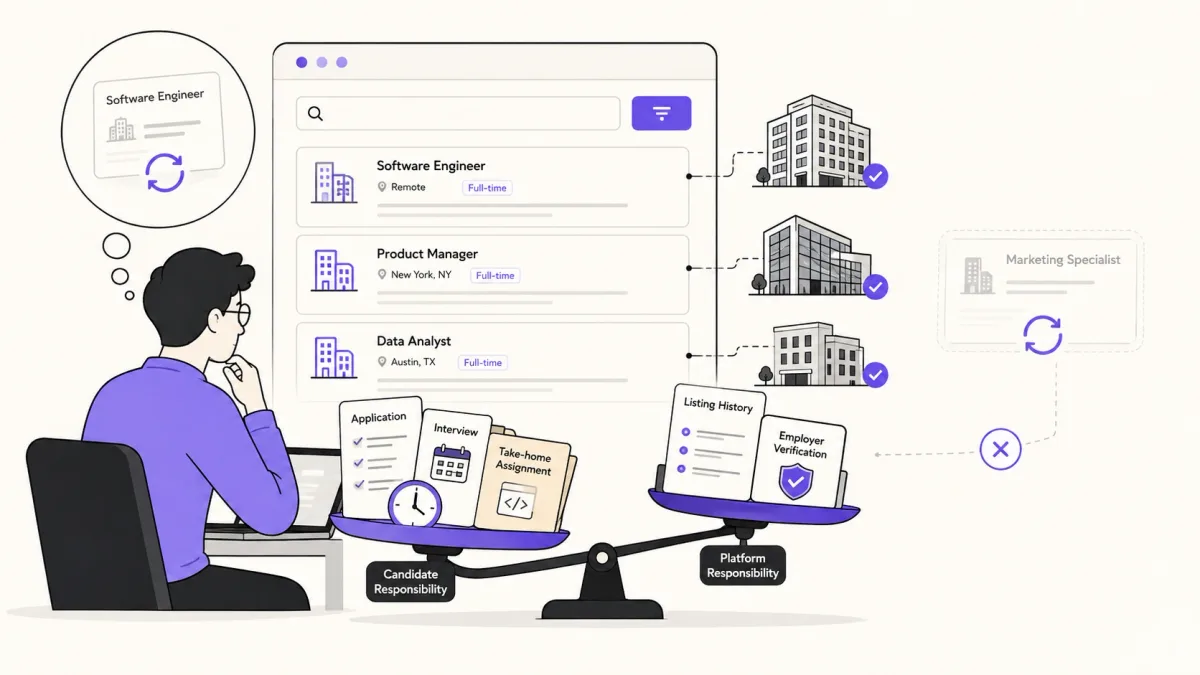
The ghost job problem is not a conspiracy. It is a coordination failure. Four groups touch each listing, and they do not see the same information or pay the same costs.
| Actor | Possible benefit | Direct cost | Hidden information |
|---|---|---|---|
| Employer | Talent pipeline, market testing, future optionality, required external posting | Recruiter time and reputation risk | Budget, approved headcount, urgency, internal candidate status |
| Recruiter, agency, or ATS | Pipeline depth, client coverage, workflow efficiency | Maintenance and communication cost | Requisition status, client priority, synchronization rules |
| Job platform | Marketplace inventory, search activity, recruiter products, candidate products | Moderation, verification, customer support, and false-removal risk | Account behavior, duplicate patterns, report history, posting lifecycle data |
| Candidate | A possible job opportunity | Research, tailoring, applications, assignments, interviews, privacy, and opportunity cost | Only public listing data and the employer's answers |
Candidates bear the highest wasted-time cost while having the least access to internal vacancy information. You research the company. You rewrite your resume. You complete the assignment. The employer knows whether headcount is approved. The recruiter may know whether the client is serious. The platform knows whether the listing refreshes weekly with no status change. You know none of that until you ask, and by then you already invested the time.
Explain the Platform Incentive Problem Carefully
A deeper catalog can make a marketplace look more useful and give users more reasons to search, return, or buy related services. That is the commercial pull toward keeping listings up.
Verification pulls the other way, because it costs money. Someone has to contact the employer, confirm the headcount approval and the hiring timeline, and repeat that on a schedule. The cost scales with every listing. It also creates the risk of removing legitimate but slow-moving roles. A senior search can sit open for months because the bar is high, and closing it for age would punish an employer who is genuinely hiring.
The platform also does not control the employer's budget. No job board knows whether a company's CFO froze headcount yesterday. Writing a policy against fake jobs is easy. Confirming that each requisition is still live is not. Where status and expiration systems are weak, paused, filled, duplicated, and misleading listings all look equally current.
That is an inference from marketplace structure, not evidence about any platform's internal motives. It also explains why companies post ghost jobs and get away with it: the cost of an unmaintained listing falls almost entirely on candidates. Job board accountability means moving some of that cost back, without over-removing real vacancies.
What Can a Job Platform Actually Verify?
Platform accountability should focus on observable behavior, required disclosure, and enforcement rather than pretending software can read intent.
| A platform can observe or verify | The employer should be required to state | A platform cannot reliably infer from the listing alone |
|---|---|---|
| Poster identity and account history | Whether a current vacancy exists | The employer's private budget decisions |
| Company domain and authorization | Whether headcount is currently approved | Whether leadership will later freeze the role |
| First-published and last-refreshed dates | Whether the listing is active, paused, pipeline-only, or filled | Whether an internal candidate is favored |
| Duplicate text and syndication patterns | The hiring timeline and decision owner | Whether the company will ultimately hire anyone |
| Material edits and reposting behavior | Whether the role has materially changed | The employer's unrecorded subjective intent |
| User reports and prior violations | When the employer reconfirmed the vacancy | Whether a slow process is deceptive or merely disorganized |
Employer statements do not prove a role is real. They create an accountable representation that can be audited. If an employer states that headcount is approved and the listing is active, that statement can be matched against later behavior. If the same employer repeatedly states that vacancies are active but never hires, the platform has a pattern. Without the statement, the platform is guessing.
A platform can verify who posted the listing and when it was last touched. An employer knows whether the budget exists today. Neither can predict whether the CFO will freeze hiring next week. Accountability starts with disclosure, not knowing everything.
The Texas LinkedIn Investigation: What It Does and Does Not Establish
On July 14, 2026, the Texas Office of the Attorney General announced an investigation into allegations involving fake or misleading job opportunities on LinkedIn. The office issued a Civil Investigative Demand requesting information about advertising, marketing, verification practices, Premium subscription representations, and job-listing representations.
| The announcement establishes | The announcement does not establish |
|---|---|
| An investigation was opened | LinkedIn violated the law |
| A Civil Investigative Demand was issued | Texas filed a lawsuit |
| The office is examining verification and marketing representations | LinkedIn knowingly created ghost jobs |
| Premium-related representations are part of the inquiry | The investigation has reached a conclusion |
Scrutiny is expanding from employer behavior to platform verification and paid-marketplace representations. That shift matters: platform accountability is becoming a regulatory question, not just a user-experience complaint.
What Platform Accountability Should Look Like
Good platform accountability reduces candidate harm without over-removing real vacancies. The features below are observable, implementable, and directly address the information gaps that allow ghost jobs to persist.
Build a Job Posting Lifecycle, Not a Timeless Listing
Most platforms treat every listing as equally current. A role posted yesterday looks the same as one posted six months ago with no employer contact since week two. The posting date becomes meaningless because it measures publication, not currency.
Platforms should show candidates all of these:
- First published
- Last employer-confirmed active
- Last material edit
- Reposted or refreshed
- Paused
- Filled
- Closed by employer
- Removed by platform
The phrase posted 30+ days ago is a weak proxy. A recent employer confirmation is more useful than a cosmetic refresh. If the employer reconfirmed the role last week, a 90-day listing is more reliable than a 10-day posting with no requisition ID or careers-page match.
A lifecycle model also exposes patterns. If a listing refreshes every 30 days for six months with no visible status change, you can see that. If the same employer repeatedly posts roles that sit for months with no visible hiring, the pattern becomes legible.
Use a Platform Accountability Scorecard
Good platform accountability includes ten observable features. Each one closes a specific gap that costs candidates time.
-
Employer identity verification: Confirm the poster controls the company domain and is authorized to hire. This stops impersonation and fake-company scams.
-
Vacancy-status statement: Require employers to affirm that a current vacancy exists and headcount is approved. This creates an accountable record that can be audited against later behavior.
-
Visible posting and refresh history: Show when the role was first published, last materially edited, and last reconfirmed. That lets a candidate judge currency instead of trusting a posting date.
-
Automatic stale-post expiration: Close listings that have not been employer-confirmed within a defined window. A 90-day expiration with employer reconfirmation is reasonable.
-
Duplicate and syndicated-post detection: Flag when the same role appears from multiple sources and link to the employer-owned listing. Otherwise candidates apply twice to one job through different aggregators.
-
Separate report categories: Provide distinct paths for fraud, filled, stale, misleading, duplicate, and incorrect listings. Lumping everything into one report type makes the data useless for enforcement.
-
A defined review and appeal workflow: Explain how reports are handled and give employers a clear correction path.
-
Enforcement against repeat offenders: Apply measurable consequences for accounts with repeated violations. A single stale listing is a mistake. Ten stale listings across six months is a pattern.
-
Aggregate transparency reporting: Publish anonymized data on report volume, resolution rates, and enforcement actions. Without it, nobody outside the platform can tell whether enforcement happens.
-
Candidate-visible resolution status: Tell the person who reported a listing whether it was reviewed, corrected, or removed. Without that, reporting feels like shouting into a void, and people stop doing it.
Do Not Make Candidates Prove Employer Intent
Evidence standards should rest on facts a candidate can actually observe:
- A listing conflicts with the employer's careers site
- The employer confirms the role is filled or paused
- The listing repeatedly refreshes without a visible status change
- Different versions show materially inconsistent location, level, or compensation
- The platform or employer confirms that the information is incorrect
The platform holds the employer's statement and the lifecycle data. It should investigate those rather than ask a candidate to prove someone else's state of mind.
What Laws and Platform Rules Are Changing?
Regulatory scrutiny of ghost jobs and platform accountability is expanding. The changes below show a shift from employer-only responsibility to platform verification and disclosure requirements.
LinkedIn's Published Jobs Policies
LinkedIn's Jobs Policies require bona fide job opportunities and a reasonable, legitimate intent to hire for the specific listed position. The policy also requires truthful, accurate, and complete job information and prohibits fraud or deception.
A published prohibition is different from independent confirmation of every employer's current headcount. The policy creates a standard. Enforcement depends on detection, reporting, and verification capacity. A policy that says "no ghost jobs" does not prevent ghost jobs from appearing. It creates a basis for removal once a ghost job is identified.
The question is not whether the policy exists. It is how violations get detected, how reports get handled, and what happens to repeat offenders.
Ontario's Vacancy and Platform Requirements
As of January 1, 2026, Ontario's official Employment Standards Act guidance describes new requirements for covered public job postings. Covered employers must disclose whether a vacancy exists. Job-posting platform operators must provide a conspicuous mechanism for reporting fraudulent publicly advertised job postings and publish a written policy explaining how they address those postings.
The guidance describes employer-size thresholds and other exceptions. The requirement does not apply to all Canadian employers or all jurisdictions. Read the full guidance to understand coverage, definitions, and compliance obligations.
This is the first jurisdiction to require platforms to provide a fraud-reporting mechanism and publish an enforcement policy. The requirement is procedural. It does not mandate a specific removal standard or timeline, but it does force platforms to say publicly how reports are handled.
Investigation Is Not Adjudication
The Texas inquiry described above is an investigation into allegations. An investigation announcement does not prove wrongdoing, establish liability, or predict the outcome. Treat it as a signal that regulatory attention is increasing, not as a legal conclusion.
When Should You Report, Pause, or Walk Away?
Different situations call for different responses. The table below maps common scenarios to the best action.
| Situation | Best response |
|---|---|
| False identity, payment request, phishing, or malware | Stop contact immediately and report as fraud or scam through the platform's dedicated fraud path |
| Role is filled, broken, or materially incorrect | Report through the platform's incorrect-listing path with specific evidence |
| Role is transparently described as a future pipeline | Decide whether uncertain timing fits your search timeline and risk tolerance |
| Recruiter cannot confirm status before a high-cost assignment | Pause and request written confirmation of active vacancy status before you start work |
| Repeated contradictions with no clear owner or timeline | Limit further investment or walk away after one direct follow-up |
| No response after a normal application | Follow up once with a specific question; do not label it a ghost job without more evidence |
The boundary between a stale listing and a ghost job matters. A listing that has not been updated is an operations failure. A listing presented as active when the employer knows no vacancy exists is deception. Report the facts you can observe. Let the platform investigate intent.
LinkedIn provides reporting paths for spam or scam, discriminatory or offensive jobs, and broken or incorrect listings. Other platforms have similar reporting mechanisms. Use the category that best matches the problem. Do not report a listing as fraudulent when the accurate category is stale or filled.
Reporting a listing does not guarantee removal. Platforms evaluate reports against their policies and the evidence provided. The more specific your report, the more likely it is to result in action.
Conclusion: Vacancy Transparency Should Be a Shared Responsibility
Employers should disclose current vacancy status. Platforms should make posting history, expiration, reporting, and enforcement visible. You should verify before you make high-cost commitments, but you shouldn't carry the entire burden of proving hidden employer intent.
If you need help preparing for interviews at roles you've verified, Great Offer AI provides real-time coaching and practice tailored to your resume and the job description.
We monitor regulatory developments and update this article when new platform requirements or investigations emerge.
Looking for verified opportunities? Learn how to find a job on LinkedIn with better filtering and search strategies.