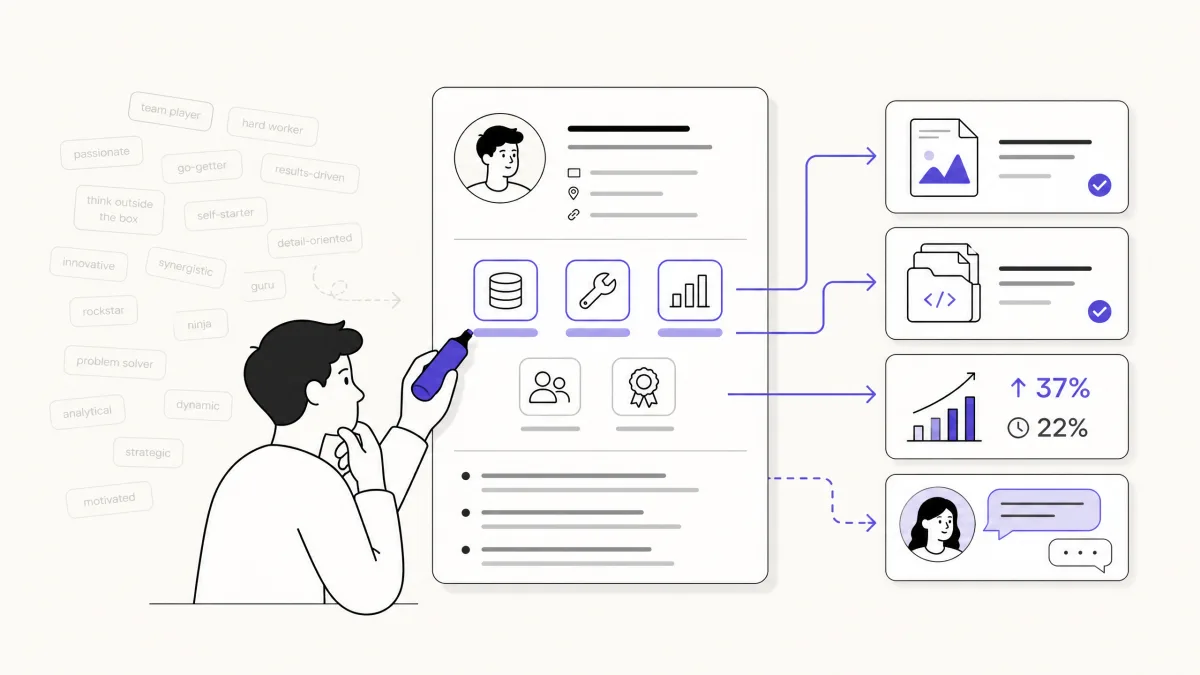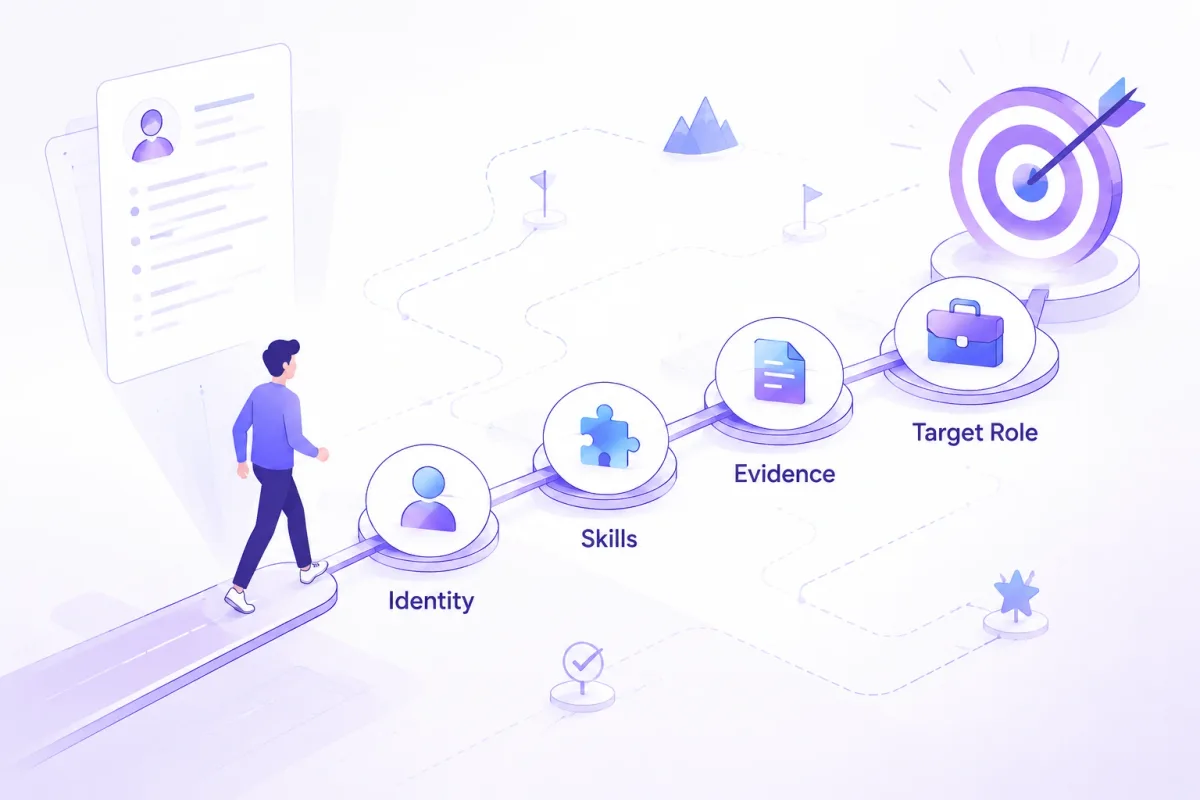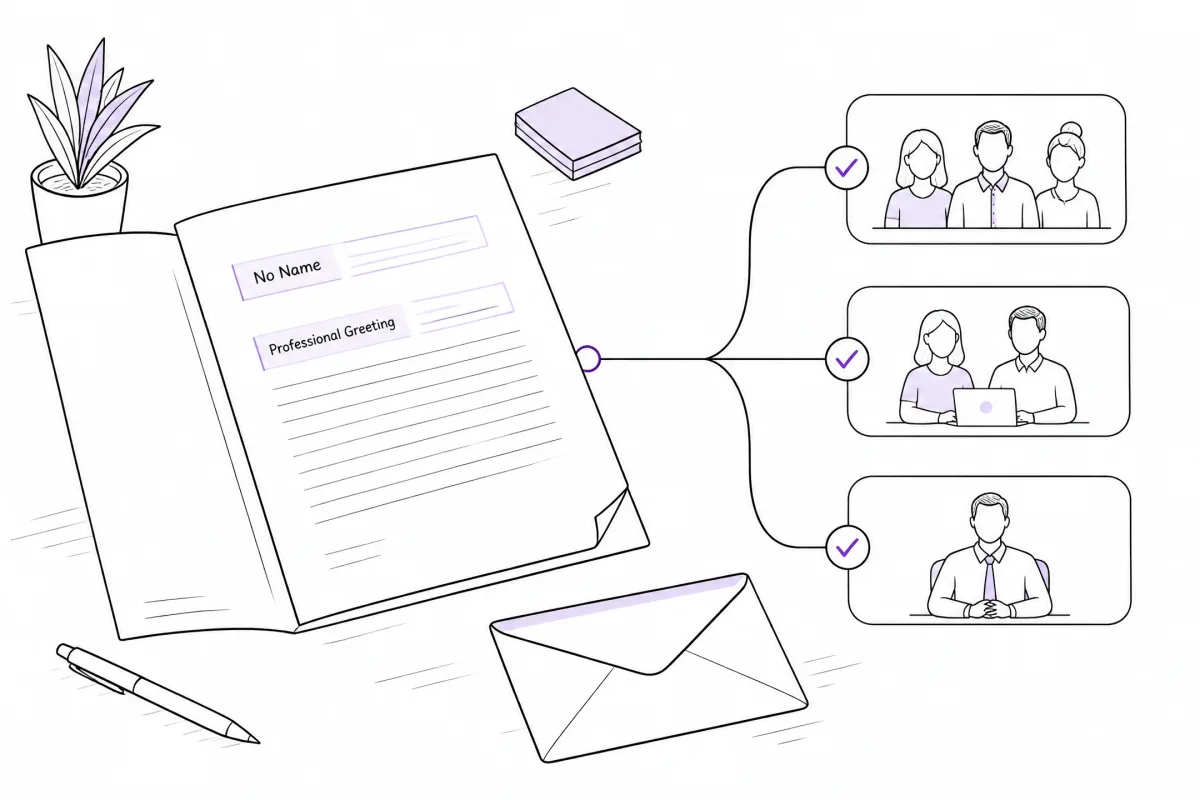


Software engineer resumes are often treated as technology inventories, but hiring decisions are built from evidence: what you owned, how you built it, what constraints you handled, and what changed. The same stack can describe a student project, a mid-level service, or senior architecture work, so the target role and level have to shape the document from the first line.
This guide starts with a complete, text-based example for a fictional mid-level backend engineer. It then gives you a JD-to-Evidence Matrix, a Role by Seniority Matrix, an Impact Ladder, a Project Selection Rubric, and a three-pass QA checklist. Use them to decide what belongs on the page and what you should be ready to defend in a technical interview.
Worried about ATS compatibility? Skip to Make the Resume ATS-Friendly Without Writing for a Robot for implementation-specific guidance that debunks common myths.
Software Engineer Resume Example
Here's a complete, text-based example for a fictional mid-level backend engineer. The candidate and employers are fictional. Numbers are illustrative. Replace them with your real, verifiable figures before you submit.
Alex Ramirez Seattle, WA · (555) 014-2918 · alex.ramirez@email.com · linkedin.com/in/alex-ramirez · github.com/alexramirez
Backend Engineer | Go, Python, Distributed Systems
Backend engineer with 5 years building and operating services that handle 2 million requests a day. I own reliability and delivery: I design APIs, ship migrations that don't break users, and reduce latency when it matters. Most recently cut p95 checkout latency from 850 ms to 320 ms while keeping error rate under 0.5%.
Technical Skills
- Languages: Go, Python, TypeScript
- Frameworks & Libraries: Gin, FastAPI, React (basic), gRPC, Celery
- Data & Storage: PostgreSQL, Redis, Kafka, S3
- Cloud & Infrastructure: AWS (ECS, Lambda, RDS), Terraform, Kubernetes (basic)
- Testing & Quality: pytest, Go test, GitHub Actions, Prometheus, Grafana
Work Experience
Senior Backend Engineer | TechStart Inc. | Mar 2023 to Present
- Cut p95 payment-checkout latency from 850 ms to 320 ms by profiling the request path, adding connection pooling, and caching fraud-check responses in Redis; verified with Prometheus dashboards and load tests across 3 regions.
- Owned the migration of 5 payment services from a monolith to gRPC APIs, defining service boundaries and a rollback path so we shipped with zero customer-facing downtime.
- Reduced CI build time from 18 to 7 minutes by caching Go modules and parallelizing test shards, cutting the team's average review-to-deploy time and unblocking 15 weekly releases.
- Led on-call rotation for 8 services; wrote runbooks that cut mean time to recovery for DB connection failures from 45 to 12 minutes.
Backend Engineer | DataFlow Systems | Jun 2021 to Mar 2023
- Designed and built a user-profile API in Python (FastAPI) serving 12 services, implementing auth, validation, and automated tests across 20 endpoints; reduced duplicate queries that caused 40% excess load.
- Added structured logging and error tracking across 15 services, giving on-call engineers a searchable path to diagnose timeout incidents faster.
- Improved checkout-flow completion by partnering with product to define acceptance criteria and writing integration tests that cut regressions by 60%.
Selected Project
Real-time Order Dashboard (personal/portfolio) Built a dashboard that ingests 500 order events per second from Kafka, aggregates them in Go, and serves results to a React frontend. Handles 50 concurrent users with sub-second refresh. Self-documented with a clear README, setup instructions, and a runnable demo.
Education
B.S. Computer Science, University of Washington, 2021. Coursework: Distributed Systems, Database Systems, Operating Systems, Algorithms.
What Makes This Example Work
- The target role and level are obvious. Backend is in the title, the summary names the stack and seniority, and the evidence backs it up.
- Every skill appears in the work. Go, Redis, Prometheus, and gRPC show up in experience bullets, not just the skills list.
- Team results connect to personal contribution. "We shipped with zero downtime" pairs with "I defined service boundaries and a rollback path."
- Technical depth includes constraints. Caching decisions, migration risk, and measurement approach all surface.
- Impact is specific and honest. Latency, build time, recovery time. Real engineering outcomes, not invented revenue claims.
- The structure scans cleanly. Standard headings, reverse chronological roles, selectable text. Readable by humans and parsing tools.
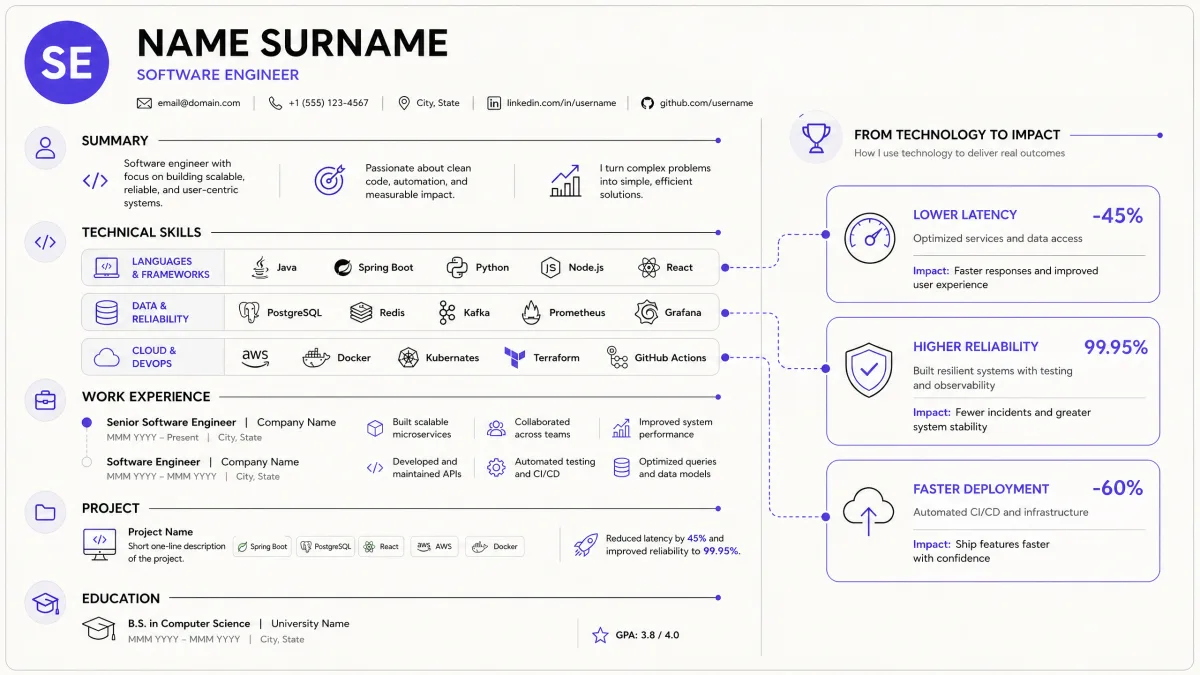
For a short, matched template, see the variants in make your resume stand out to recruiters and ATS.
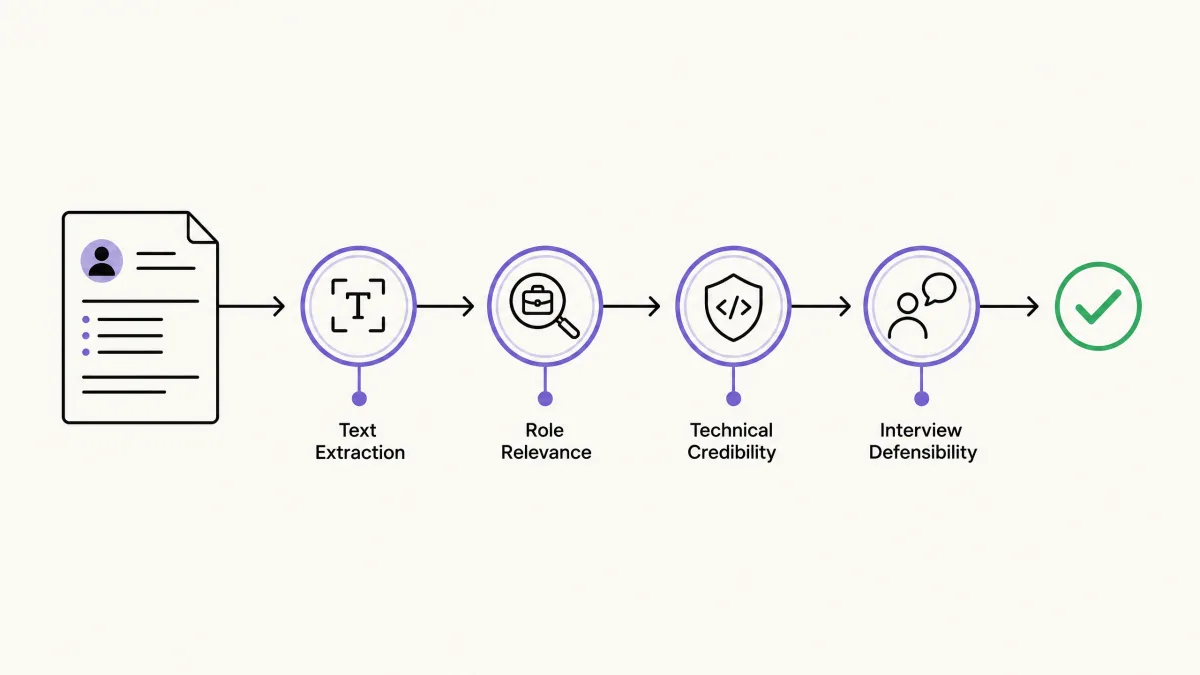
The Four Checks Your Resume Must Pass
Before you write a word, know the bar. Every software engineer resume should pass four checks. This is my quality-control model, not a claim that every employer uses the same four-step process.
| Check | Question | Common Failure | Fast Fix |
|---|---|---|---|
| Text extraction | Does the exported file preserve headings, dates, skills, and reading order? | Broken order, missing text, decorative elements leaking into the text stream | Run the plain-text extraction test before submitting |
| Role relevance | Can a reader identify the target role, level, and strongest evidence quickly? | Generic summary and undifferentiated skills | Reorder evidence around the target job |
| Technical credibility | Does the document show ownership, complexity, constraints, and results? | Tool lists and vague responsibilities | Add contribution, mechanism, scope, and outcome |
| Interview defensibility | Can you explain every important claim? | Inflated ownership, unexplained metrics, copied keywords | Remove or rewrite anything you can't defend |
You'll return to these four checks in the final QA section. A bullet isn't finished until it's both readable and defensible.
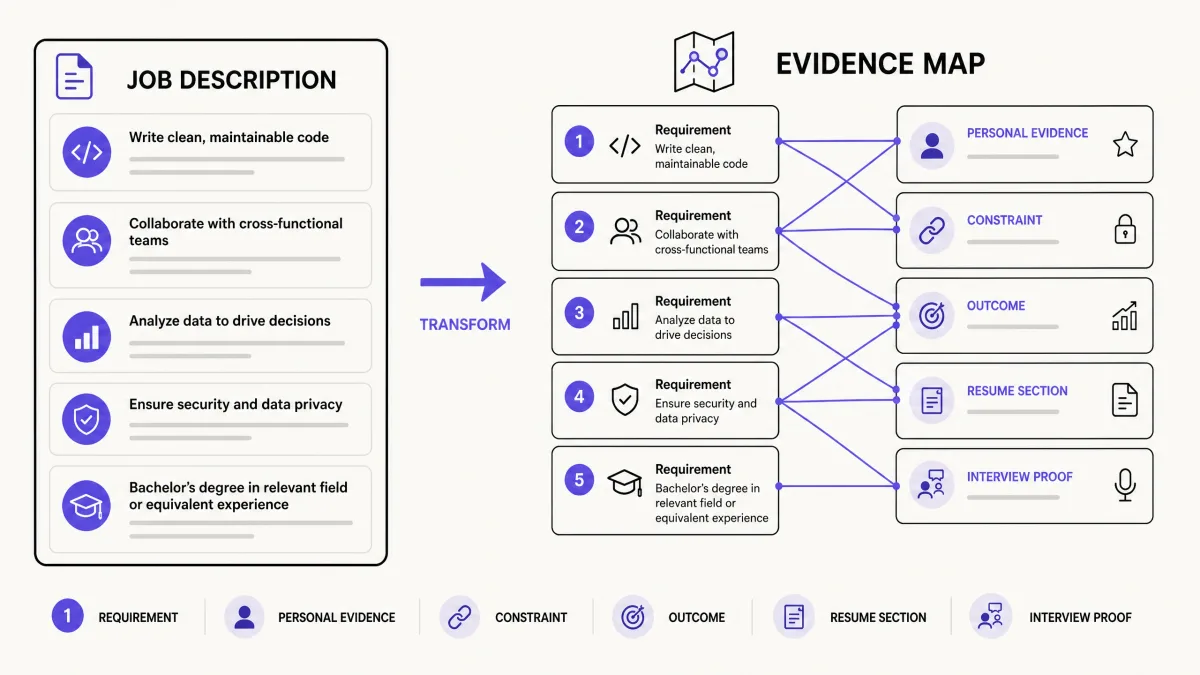
Build a JD-to-Evidence Map Before You Write
Tailoring a software engineer resume doesn't mean copying keywords and hoping they stick. It means connecting every real requirement to proof you can produce.
Compensation is a separate question, but the evidence overlaps. Use the software engineer salary guide to compare role family, scope, location, level, and pay type before you attach a salary target to your resume or interview story.
Save the full job description. Separate it into six buckets:
- Role outcomes (what the company says you'll deliver)
- Must-have skills (the technologies and practices that look non-negotiable)
- Preferred skills (the nice-to-have list that separates candidates)
- Domain or product context (what they build and who they serve)
- Seniority signals (titles, scope language like "own" or "lead", expected autonomy)
- Collaboration or leadership expectations (cross-team, mentoring, stakeholder, design-review language)
Then fill in this six-column JD-to-Evidence Matrix for each important requirement:
| Job Requirement | Your Evidence | Scope or Constraint | Outcome | Resume Section | Interview Proof |
|---|---|---|---|---|---|
| The real requirement | A job, project, open-source contribution, internship, or strong coursework example | Traffic, data volume, services, users, teams, deadlines, platform limits, reliability targets, ambiguity | Business, user, system, delivery, quality, risk, or team result | Experience, Project, Skills, Education, or omit | The story, artifact, metric source, technical decision, or lesson you can explain |
Each column plays a role. Job Requirement captures what the job actually wants, not every repeated keyword. Your Evidence names a real artifact you can point to. Scope or Constraint proves you handled something non-trivial under pressure. Outcome is what changed, not just what you did. Resume Section tells you where the evidence belongs. Interview Proof prepares you to answer the follow-up.
A completed backend example:
| Job Requirement | Your Evidence | Scope or Constraint | Outcome | Resume Section | Interview Proof |
|---|---|---|---|---|---|
| Experience designing high-throughput APIs | Built a payment-checkout API in Go | Handles 2,000 req/s during peak event | p95 latency 850→320 ms under load | Experience | Load-test script, Prometheus dashboard, decision log on pooling/caching |
Running this exercise surfaces gaps before you draft. Keep a master evidence bank that holds more detail than any single resume will show. For every project or work item, record:
- The project or problem
- Your personal contribution (what you alone did)
- The technologies used
- The architecture or implementation choice and why
- The constraint or trade-off you weighed
- The outcome
- How the outcome was measured or observed
- The failure, correction, or lesson
- The related interview story
Then apply four decisions: Keep (strong, relevant evidence), Strengthen (relevant but vague, rewrite it), Remove (unsupported or irrelevant), and Build (a missing skill or project you can't honestly claim yet).
The O*NET descriptor for Software Developers (15-1252.00) reminds you of the breadth engineers actually own: analyzing needs, developing testing or validation procedures, and modifying software to correct errors or improve performance. Map your evidence across those buckets (implementation, quality, performance, communication) rather than only listing what you built.
Choose the Right Format, Length, and Section Order
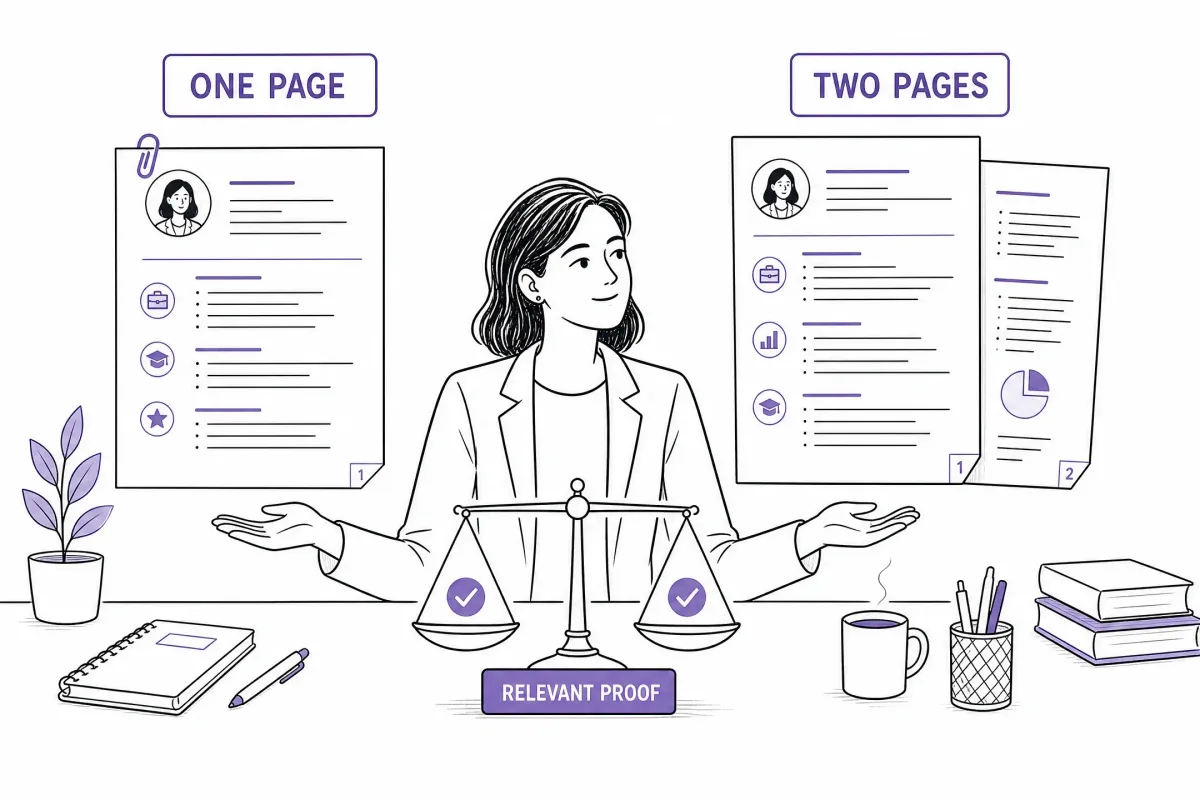
Reverse chronological order is the safest default. It lets a reviewer follow your recent work and progression in one glance. There's no universal rule that every resume must be one page. Treat length as a judgment call guided by how much genuinely relevant evidence you hold.
| Candidate Situation | Likely Starting Point | Editing Rule |
|---|---|---|
| Student, new graduate, or early-career candidate | One page | Keep only relevant education, projects, internships, and skills |
| Mid-level engineer with several relevant roles | One page if clear; two if evidence is genuinely dense | Remove repetition before shrinking text |
| Senior, staff, manager, researcher, or patent/publication-heavy candidate | One or two pages | Keep only evidence that establishes scope, direction, or differentiated expertise |
Don't mistake "one page" for an ATS requirement. It's a readability guideline. To settle the question for your profile, decide whether your resume should be one or two pages, then adjust your content, not your parseability. What matters more than the page count is that nothing on the page is redundant.
Stick to a single-column layout and standard section headings as a low-risk baseline. Two-column designs aren't automatically doomed. The risk is that any layout shift can change how a particular parser reads the text, which is why testing matters more than any single formatting dogma.
Recommended section orders:
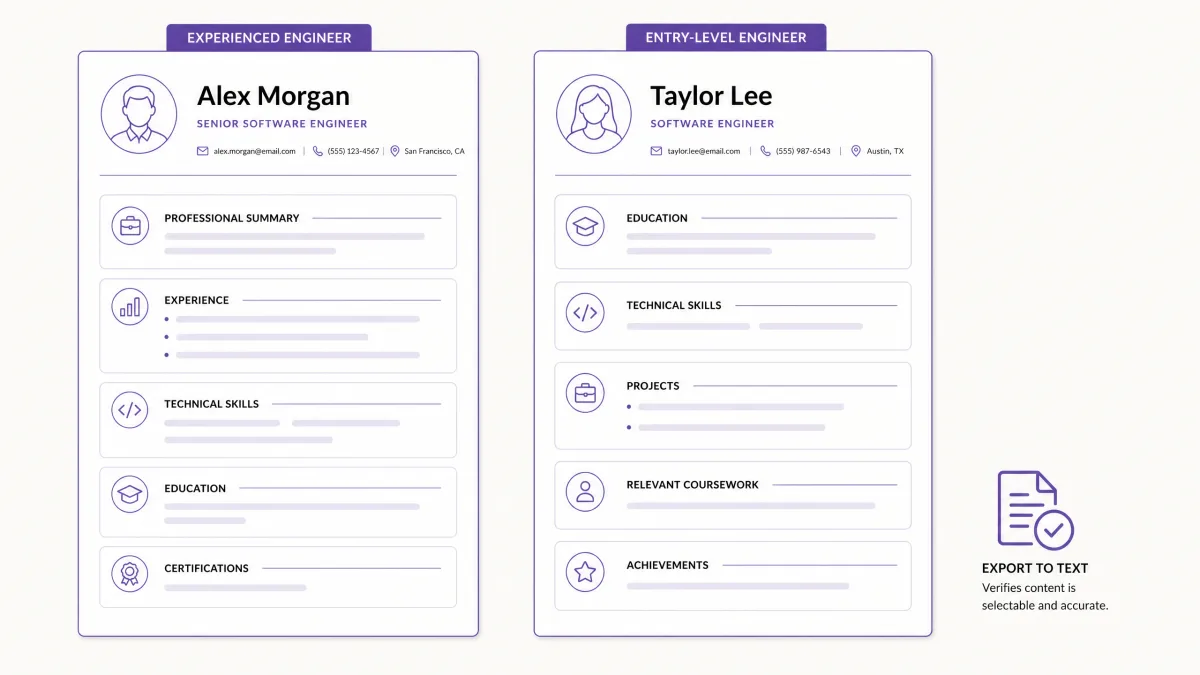
Experienced candidate
Header → Summary (if useful) → Experience → Skills → Selected Projects (if useful) → Education
Entry-level candidate
Header → Summary or objective (if useful) → Education or Skills → Projects → Experience → Additional Evidence
For the file format:
- Follow the application system's accepted formats
- Use selectable text, not flattened images
- Export the final version and inspect the extracted text order
- Don't assume PDF, DOCX, ODT, or image parsing behave identically across systems
Two formatting details deserve extra care. First, keep company names, job titles, and dates visually and textually next to each other. Second, place your skills near the experience that proves them or in a compact grouped block a reviewer can scan in seconds. Keep the baseline clean (standard headings, one column, consistent spacing) and let the strength of your evidence do the differentiating. Where a role genuinely rewards design (frontend or creative-adjacent engineering), a subtle, well-tested layout can help, but only after you confirm the file still extracts cleanly.
Write Every Software Engineer Resume Section
Each section has a different job. Keep them focused and evidence-based rather than formulaic.
Header and Links
Include your name, a target title when it adds clarity, city and state, phone, and a professional email. Add LinkedIn, plus GitHub or a portfolio link only after the profile has passed the quality gate later in this guide. Avoid long raw URLs and decorative labels that bury your contact info.
Summary or Objective
A summary is optional. Keep it only when it quickly establishes your target role, experience level, relevant domain, strongest technical evidence, and one differentiating outcome or scope signal. An entry-level objective should state your technical foundation, strongest project or internship proof, and the role you want.
Three brief examples:
- Entry-level objective: "CS graduate with strong fundamentals in Go, PostgreSQL, and system design, ready to grow as a backend engineer. Built and deployed a 50-user REST API with auth, tests, and CI; seeking a role where I can own production features."
- Mid-level summary: "Backend engineer with 5 years building and operating high-throughput services in Go and Python. Specialize in API design and reliability; recently cut p95 latency by 62% across 8 services with zero downtime."
- Senior summary: "Senior backend engineer who owns architecture and operational excellence across 3 teams. Design service boundaries, set reliability targets, and mentor engineers; led a payment-platform migration that reduced deployment risk by 80% without customer impact."
Skip empty adjectives like passionate, results-driven, innovative, or rockstar unless the sentence contains actual proof. For the fuller formula, see how to write a targeted resume summary.
Work Experience and Impact Bullets
Use a primary bullet pattern that bundles contribution with proof:
Delivered [outcome] for [user, product, or system] by [technical action], under [scope or constraint], verified by [metric or evidence].
Each strong bullet should answer most of these: What changed? What did you personally own? How was it built, fixed, migrated, tested, or operated? What constraint, scale, or trade-off mattered? How was the result measured or observed?
Keep four concepts distinct, otherwise bullets blur into vague responsibilities: Responsibility (what the role generally required), Project (what the team built), Contribution (what you personally did), and Outcome (what improved, shipped, changed, or became possible).
Engineering evidence is broader than shipping features. Draw bullets from architecture and design, implementation, testing and validation, deployment and migration, reliability and incident response, performance and cost, security and risk reduction, documentation and tooling, and mentoring or cross-team enablement. Identify the source of every number: monitoring, analytics, incident records, tickets, benchmarks, release history, or a clearly labeled estimate.
A useful habit when drafting every bullet is to ask: If a hiring manager asked me to show them this claim in one minute, what would I point to? If the answer is a dashboard, a PR, a benchmark, an incident report, or a release, you're on solid ground.
A short generic rewrite:
Weak: "Worked on improving the checkout flow."
Strong: "Cut checkout drop-off by 35% by profiling the request path, caching fraud-check responses in Redis, and A/B-testing the change across 20% of users, verified in analytics."
Follow the guidance in the MIT career services resume checklist: describe the project, the activity, and the results; start bullets with action verbs; quantify size, scale, budget, or staff when you have the numbers; and use job-relevant keywords. Four role-specific rewrites appear later.
Software Engineering Skills
Group relevant skills under clear labels so a reviewer can scan them fast: Languages, Frameworks and Libraries, Data and Storage, Cloud and Infrastructure, Testing and Quality, and Observability and Developer Tools. Sort skills by relevance to the target job and by strength of evidence. A skill should normally appear in experience or projects too. To learn how to choose and prove the right resume skills, treat the list as proof-first rather than keyword-max.
Don't use progress bars or star ratings, claim expert-level proficiency across a huge stack, list tools you barely touched just to raise the keyword count, or replace evidence of collaboration with a soft-skills list. Soft skills are more credible when they show up through technical work: an incident you resolved, a design review you led, mentoring you did. Keep the list tight. Relevant and supported beats comprehensive every time.
Projects
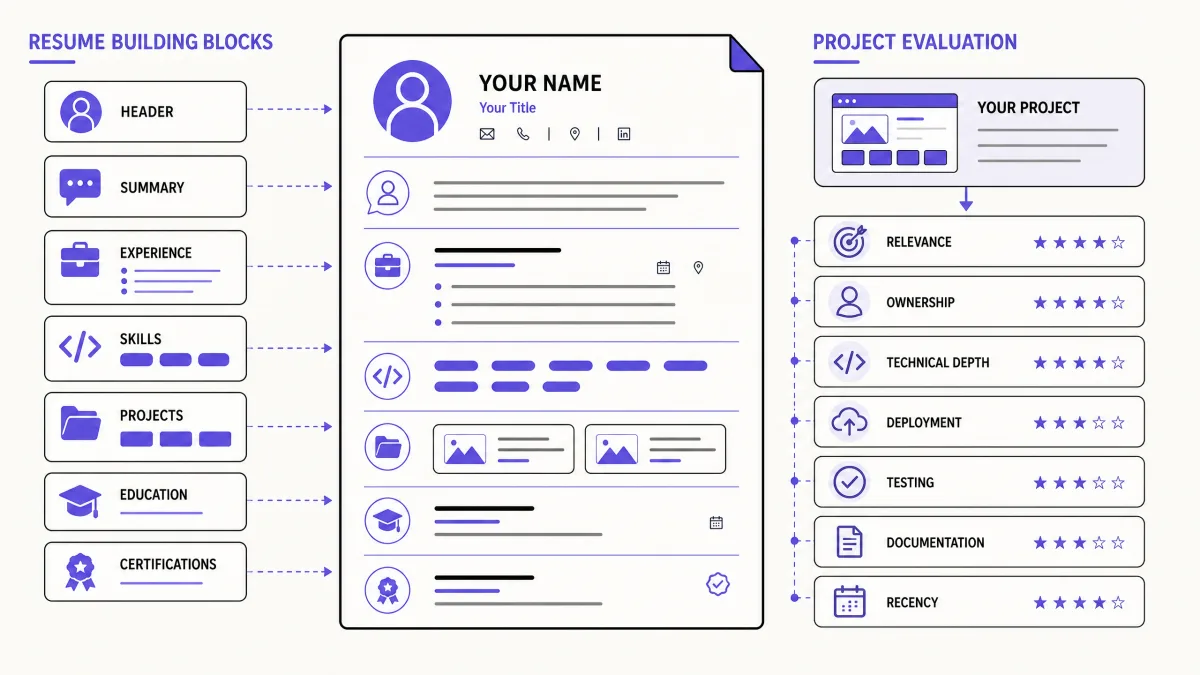
Use the Project Selection Rubric to score each candidate project from weak to strong across seven dimensions:
| Rubric Dimension | Weak (1) | Strong (3) |
|---|---|---|
| Relevance to target role | Unrelated tech or domain | Directly matches the job's stack and domain |
| Personal ownership | Followed a tutorial end-to-end | Designed and built it yourself |
| Technical depth | Surface-level CRUD | Real constraints, architecture, or trade-offs |
| Real users, deployment, or practical use | Runs only on your laptop | Deployed, used by others, or demonstrable |
| Testing and quality | No tests | Automated tests, CI, measurable quality |
| Documentation and reproducibility | No README | Clear setup, run, and architecture docs |
| Recency | Years old, no updates | Recent or actively maintained |
Entry-level candidates may use two or three strong projects when paid experience is thin. Experienced candidates should keep projects only when they add evidence not already shown in work history. A project that's deployed and has at least one real or simulated user is far more persuasive than a repository that's never run anywhere but a local machine. Don't present a tutorial clone as an independently designed product. If you have no experience to build from yet, work through how to build credible proof when you have no experience.
Education and Certifications
Entry-level candidates can place education higher. Experienced candidates should compress it unless a degree, research program, publication, or certification materially supports the target role. Include the degree and institution, a graduation date when useful, relevant coursework for early-career candidates, honors, and certifications tied to the target job. Don't let certifications replace evidence of building, operating, testing, or improving real systems.
Tailor the Evidence by Role and Seniority
The same evidence reads differently for different roles. Choose what to lead with based on the job you are after, not just your total years of experience.
Role Matrix
| Target Role | Strongest Evidence | Useful Outcome or Scope Signals | Weak Signal to Avoid |
|---|---|---|---|
| Frontend | Performance, accessibility, design systems, state management, experimentation, browser behavior | Load time, interaction latency, accessibility findings, reuse, release impact | A long framework list with no shipped interface |
| Backend | APIs, data integrity, distributed systems, storage, concurrency, service ownership | Latency, throughput, reliability, data volume, migration risk | Saying microservices without ownership or constraints |
| Full-stack | End-to-end delivery, integration, product judgment, data flow, deployment | Feature adoption, release speed, reliability, workflow completion | A shallow list covering every layer |
| Mobile | Platform constraints, app architecture, offline behavior, release ops, performance | Crash behavior, startup time, release cadence, device coverage | Listing iOS or Android tools without shipped work |
| Platform, DevOps, or SRE | Reliability, deployment, observability, incident response, infrastructure, cost | Availability, recovery, lead time, deployment frequency, cost, toil | Claiming DevOps from basic CI configuration |
| Data or ML | Pipelines, data quality, model evaluation, serving, monitoring, governance | Data volume, freshness, accuracy, model quality, inference performance | Listing models without evaluation or production context |
| Security | Threat modeling, secure design, detection, response, remediation, compliance | Vulnerability reduction, detection coverage, remediation time, risk | A tool list with no security decision or result |
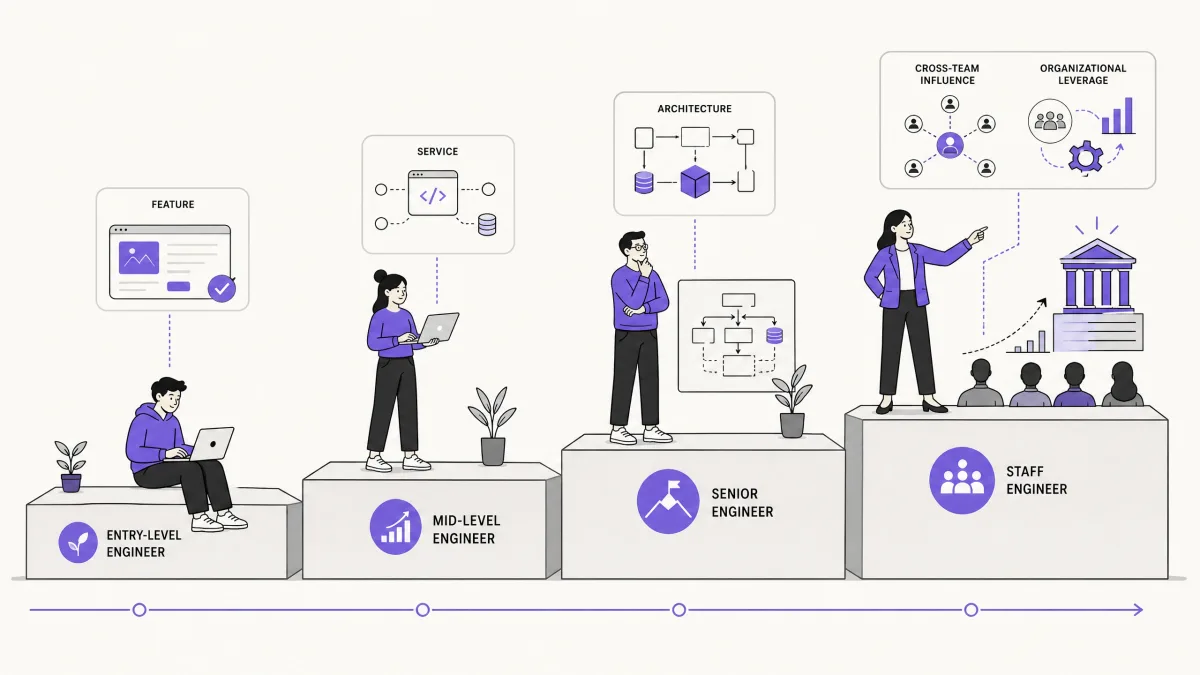
Seniority Matrix
| Level | Evidence Priority | Scope Signal | Leadership Signal |
|---|---|---|---|
| Entry or new graduate | Fundamentals, learning speed, project ownership, quality | A complete feature, service, application, or meaningful component | Clear collaboration and feedback response |
| Mid-level | Independent delivery, trade-offs, reliability, cross-functional execution | A service, system area, launch, migration, or recurring operational responsibility | Coordination and ownership without inflated team leadership |
| Senior | Architecture, ambiguity, operational ownership, risk, mentoring, cross-team influence | Multiple systems, teams, business areas, or long-lived decisions | Technical direction, decision quality, and developing others |
| Staff or principal | Organization-level leverage, standards, strategy, long-term risk, influence without authority | A platform, portfolio, multi-team program, or company-wide technical direction | Alignment, durable mechanisms, and technical leadership beyond a single team |
Years of experience add context but do not prove a level on their own. Reviewers look for architecture, operational ownership, and cross-team influence, not just how long you have been employed.
Senior ≠ Years of Experience
A senior title doesn't prove senior scope. Reviewers look for:
- Architecture decisions you owned (not just participated in)
- Operational responsibility (on-call, incident response, production impact)
- Cross-team influence (design reviews, standards, mentoring)
- Ambiguity resolution (defined the problem before solving it)
Five years at one company doing similar tasks may read as strong mid-level. Three years owning architecture across teams reads as senior.
For engineering managers, emphasize team outcomes, hiring and development, delivery systems, stakeholder alignment, and technical judgment without claiming individual implementation you did not perform. If you are targeting a senior role, lead with architecture decisions, resolved ambiguity, operational responsibility, and the people you developed.
Show Impact Without Inventing Metrics
Here's the rule that keeps your resume both strong and defensible:
Quantify what you can verify. Describe scope, change, or risk honestly when a precise number doesn't exist.
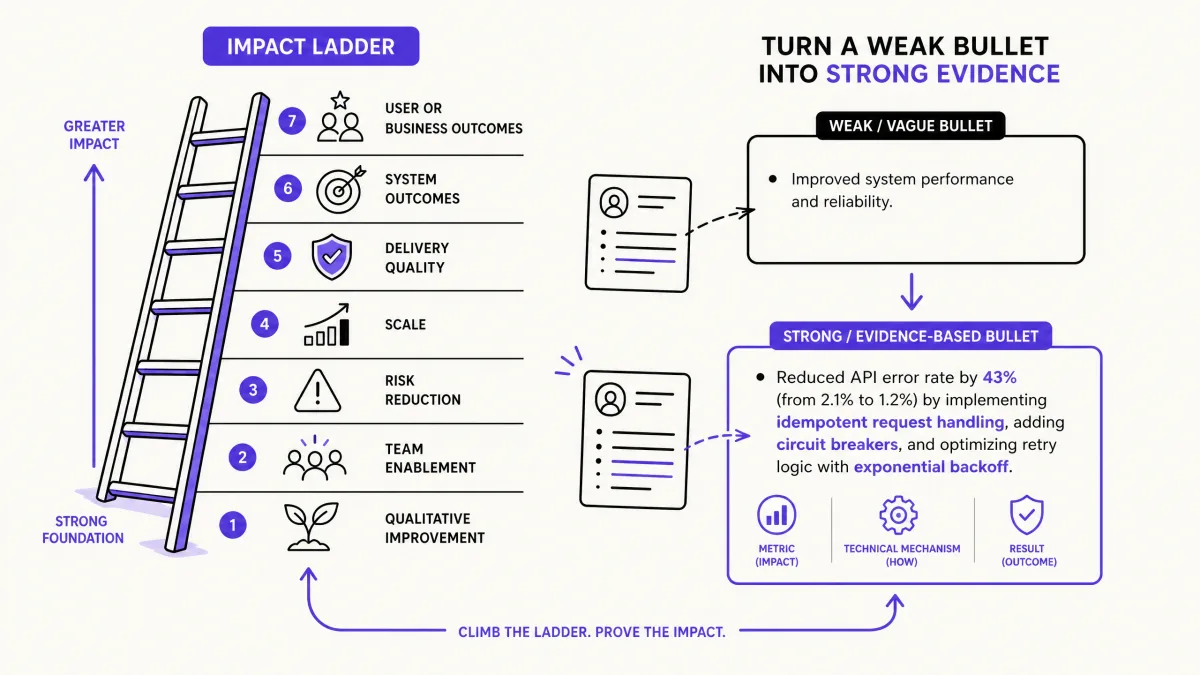
You don't need revenue figures to demonstrate impact. Engineers rarely own the top-line business number. Instead, climb the Impact Ladder and use whatever honest evidence you actually hold:
- Business or user outcome: revenue, conversion, adoption, retention, support burden, workflow completion
- System outcome: latency, throughput, reliability, error rate, capacity, cost, resource use
- Delivery or quality outcome: lead time, deployment frequency, defect escape, test coverage, rollback rate, review time
- Scale or complexity: services, data volume, requests, regions, integrations, platforms, teams, migration size
- Risk or ownership: incident reduction, security remediation, compliance readiness, recovery, rollback safety
- Team or process enablement: reusable tooling, standards, documentation, onboarding, mentoring, unblocked launches
- Qualitative outcome: replaced a manual process, enabled a launch, standardized a pattern, resolved a recurring failure, or made an ambiguous system understandable
Acceptable evidence includes a direct instrumented metric, a documented operational record, a ticket/release/benchmark/incident record, a defensible range, a clearly labeled estimate, or a concrete before-and-after state. Never invent a percentage just so a bullet looks quantified. An honest scope statement beats a fabricated number every time, because the fabrication collapses the moment an interviewer asks how you measured it.
Most engineers have strong evidence in the middle rungs (system outcomes, delivery quality, scale) that they incorrectly believe is too "technical" to be impressive. It's not. A reviewer hiring an engineer wants to know you can make a system faster, more reliable, cheaper, or safer to run.
Entry-Level Backend Rewrite
Weak: "Built an API for a class project using Python."
Strong: "Designed and documented a Python API for course registration, implementing authentication, validation, and automated tests across 12 endpoints; deployed a working demo and documented setup and trade-offs."
The strong version adds ownership, quality, scope, deployment, and defensibility.
Frontend Rewrite
Weak: "Improved website performance."
Strong: "Reduced product-page latency from 3.2s to 1.1s by profiling the rendering path, removing unused CSS bundles, and validating the change across Chrome, Safari, and Firefox."
The strong version adds a baseline, a result, the mechanism, and the coverage, so the claim is testable.
Platform or SRE Rewrite
Weak: "Worked on CI/CD and monitoring."
Strong: "Standardized deployment checks and service dashboards for 20 microservices, cutting mean time to recovery from 30 to 8 minutes while giving on-call engineers a documented rollback path."
The strong version adds mechanism, scope, operational outcome, and team value.
Senior or Lead Rewrite
Weak: "Led the migration to microservices."
Strong: "Set the migration strategy for the payment platform, defined service boundaries and rollback criteria, and coordinated 3 teams through phased delivery that reduced deployment risk by 75% and cut release cycle time from 2 weeks to 3 days."
The strong version adds direction, trade-offs, cross-team scope, delivery mechanism, and outcome, the hallmarks of senior evidence. Use placeholders only where the value is genuinely unknown to you; do not pad with jargon.
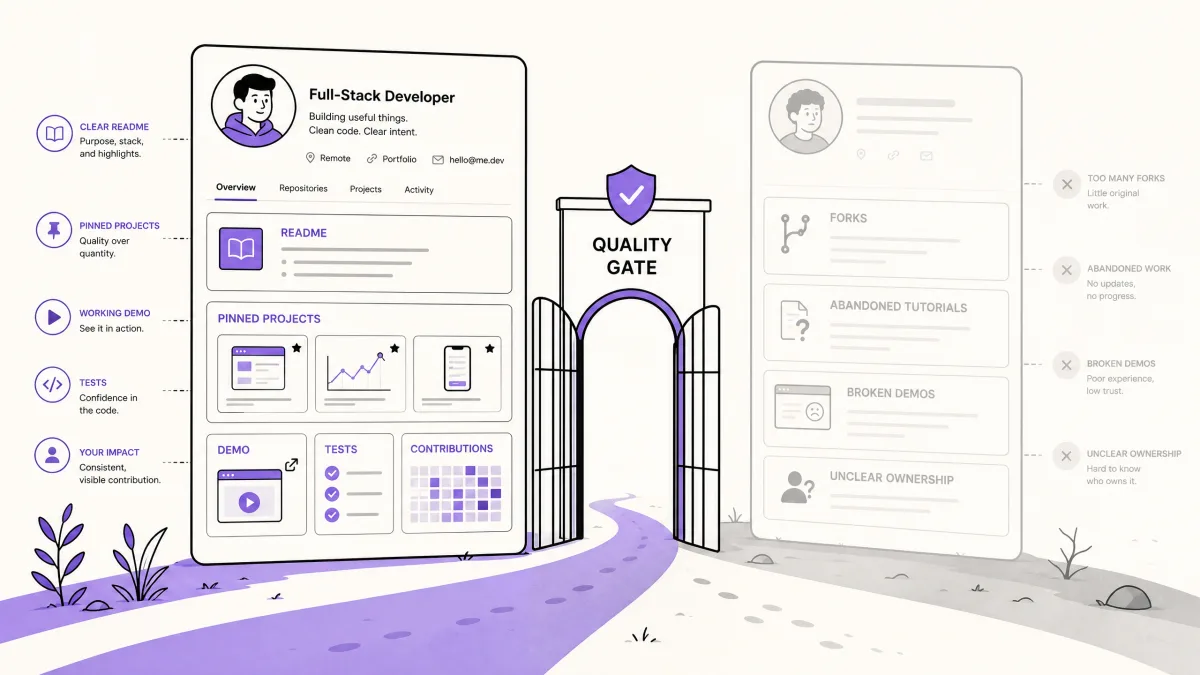
Decide Whether GitHub and Portfolio Links Help
A GitHub link isn't automatically a positive signal. The question is whether your profile helps a reviewer verify and trust your work. According to GitHub's own guidance on using your profile to enhance your resume, a well-maintained profile can show skills and experience. The advice is about curation, not about requiring GitHub for every engineer.
Include
- The profile supports the target role
- The bio and profile README are current
- Three to five relevant projects are pinned (platform guidance, not survey data)
- The strongest repositories have clear READMEs
- A reader can identify your contribution
Fix First
- Strong code exists, but the README, setup, screenshots, demo, tests, or project status are unclear
- The profile contains too many unrelated repositories
- The best work is hard to find
Leave Off
- The profile is mostly forks, abandoned tutorials, broken demos, or unexplained private-looking artifacts
- The public work conflicts with the resume
- You wouldn't want the repository discussed in an interview
For any strong project README, include the problem and core features, installation or run instructions, a demo or usage example, testing instructions, architecture or important trade-offs, and the current status plus your contribution.
GitHub Profile Checklist
Before linking your GitHub on a resume, verify:
Profile Level:
- Professional bio (2-3 sentences about your focus area)
- Profile README with current status and tech stack
- 3-5 relevant projects pinned (not forks or abandoned tutorials)
- Contributions graph shows consistent activity
- Profile picture is professional (or thoughtful avatar)
Repository Level (for each pinned project):
- Clear README with problem statement
- Installation/setup instructions that work
- Demo, screenshot, or usage example
- Test instructions or CI badge
- License file present
- Your specific contribution is clear (not a fork with no commits)
- Code is documented (comments for non-obvious logic)
- No sensitive data, API keys, or passwords in commit history
When to Skip GitHub:
- Profile is mostly forks with no personal commits
- Pinned projects are tutorial follow-alongs presented as original work
- Best work is in private repos and can't be shown
- Public code conflicts with claims on resume
- You wouldn't want any pinned repo discussed in an interview
Make the Resume ATS-Friendly Without Writing for a Robot
Treat ATS compatibility the way you'd treat any integration: verify it, don't assume it. The core principle is:
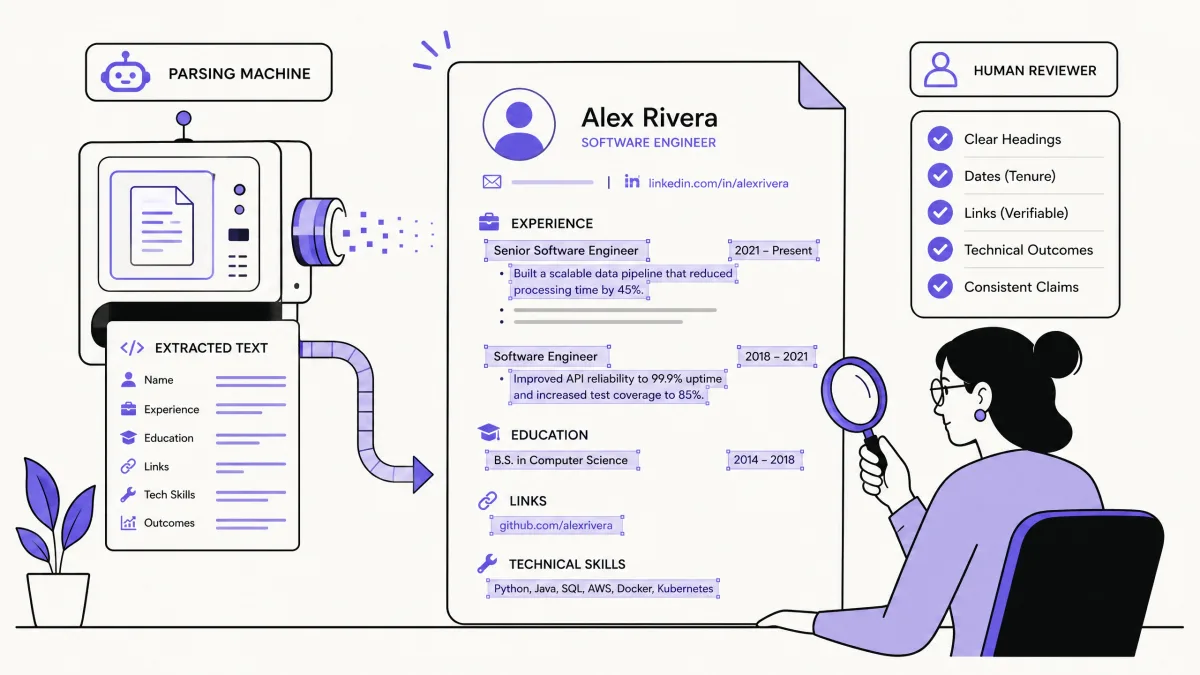
ATS parsing is implementation-specific. Follow the employer's accepted formats, use selectable text and recognizable section labels, and verify that the document's text can be extracted in a logical order.
Different applicant tracking systems genuinely differ in what they scan and how. Workable's resume-upload documentation describes parsing capabilities that include image-based and multilingual CVs, with extraction of candidate fields. Recruitee's CV-parsing documentation describes support for PDF, Word, and ODT, and notes recruiters can review or correct parsed information. These official product pages show that supported formats and extraction behavior vary. No single formatting rule is universal.
Practical steps that lower your risk: follow the exact upload instructions; use standard headings such as Experience, Skills, Projects, and Education; keep dates and names textually associated; use selectable text; include both an acronym and its full form once when the job description uses both; export and inspect the plain-text reading order; and check links after export.
Avoid hidden text, white text, keyword stuffing, unsupported skills, and claims that a template guarantees ATS success or that every image, table, column, PDF, or DOCX behaves the same in every system. Treat the plain-text extraction test as practical risk reduction, not proof that every ATS uses the same parser.
Common Software Engineer Resume Mistakes
Nuance matters more than a checklist, but a few patterns show up repeatedly:
- Treating the skills section as a technology shopping list. Prove each skill in experience or projects instead.
- Starting every bullet with worked on, helped, or responsible for. Open with the outcome or action.
- Reporting a team result without personal contribution. Pair the team's outcome with what you owned.
- Inventing percentages to make a bullet look quantified. Use honest scope or scale.
- Filling the summary with buzzwords. Replace adjectives with verifiable facts.
- Letting old or weak projects crowd out recent work. Prune for the target role.
- Linking an uncurated GitHub profile. Apply the include/fix/omit gate.
- Copying job-description language you can't prove. Tailor with honest evidence.
- Claiming senior scope through title or years alone. Show architecture, ownership, and influence.
- Using a visually complex layout without testing extraction. Verify the plain-text order.
- Showing inconsistent dates, titles, skills, or project status across the resume, application, LinkedIn, and GitHub. Keep one coherent story.
- Including claims you can't explain under technical questioning. Remove anything that won't survive a follow-up.
Run a 10-Minute Resume QA
Before you submit, spend ten minutes running a final review that mirrors the Four Checks.
Machine Pass
- The file opens correctly and text is selectable
- Extracted text follows a logical order
- Standard section headings remain intact
- Dates, names, and skills aren't separated or lost
- Links work
Human Pass
- The target role and level are obvious
- Recent and relevant evidence appears before low-value detail
- The strongest technical outcomes are easy to find
- Skills are supported by experience or projects
- The document is readable without dense walls of bullets
Technical and Interview Pass
For every major bullet, confirm you can explain: what you personally owned, the key constraint, the technical choice, the trade-off, how the result was measured or observed, what failed or changed, and what you'd do differently.
Consistency Pass
- Dates and titles agree with the application and LinkedIn
- GitHub and portfolio projects match the resume description
- Technologies aren't added only because an AI tool suggested them
- You can maintain the same professional story in an interview
AI can help you organize, compare, and rewrite, but you must remove any invented details and preserve your real voice. The principle behind all four passes: a bullet isn't finished until it's both readable and defensible. If you hit gaps, revisit the JD-to-Evidence Matrix and the Impact Ladder rather than papering over weak claims.
Next Steps
Target the role. Map the evidence. Write honest impact. Calibrate for role and level. Test the file. Defend the claims.
Once your software engineer resume earns an interview, shift from writing to preparation. Be ready to walk through ownership, technical decisions, trade-offs, failures, and results for every claim on the page. Your resume and your interview story are the same document. Make sure they tell it consistently.