
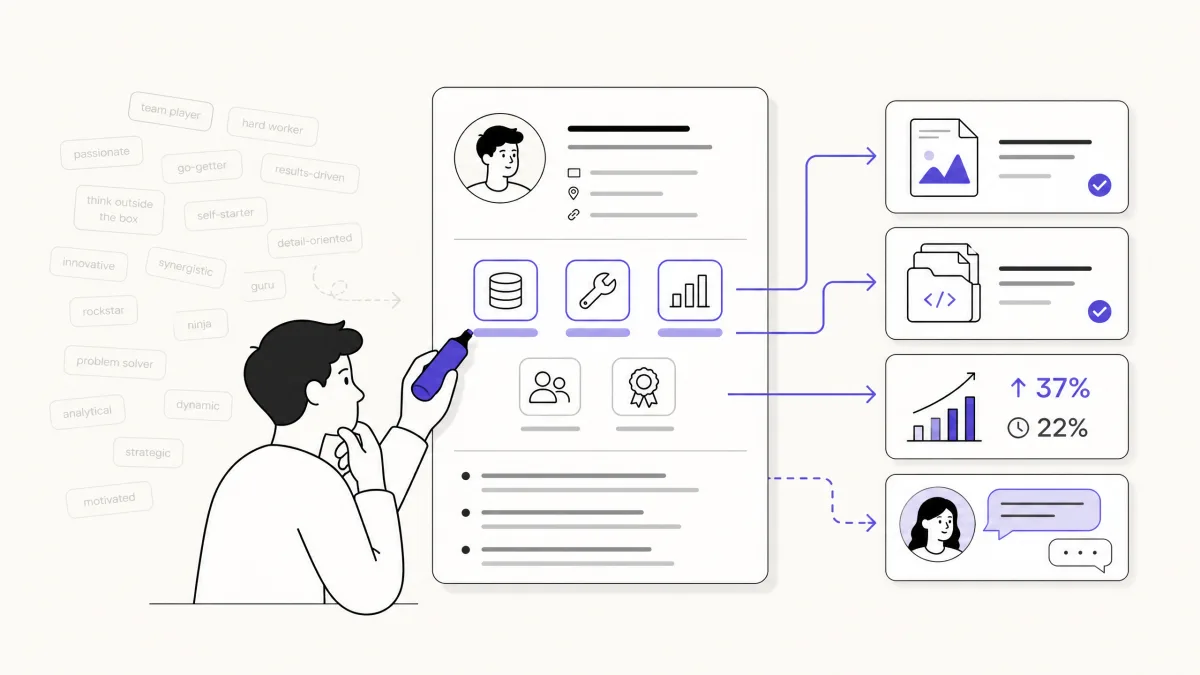
When job seekers struggle to get callbacks, the instinct is to pad their skills list with buzzwords. Bad move. A long list of unverified keywords doesn't strengthen your application; it buries your real qualifications. The best skills to put on a resume are the ones the target job requires and you can prove. Prioritize specific technical, role-related, and transferable skills, then back the important ones with examples in your experience or projects. Leave off anything you can't explain in an interview.
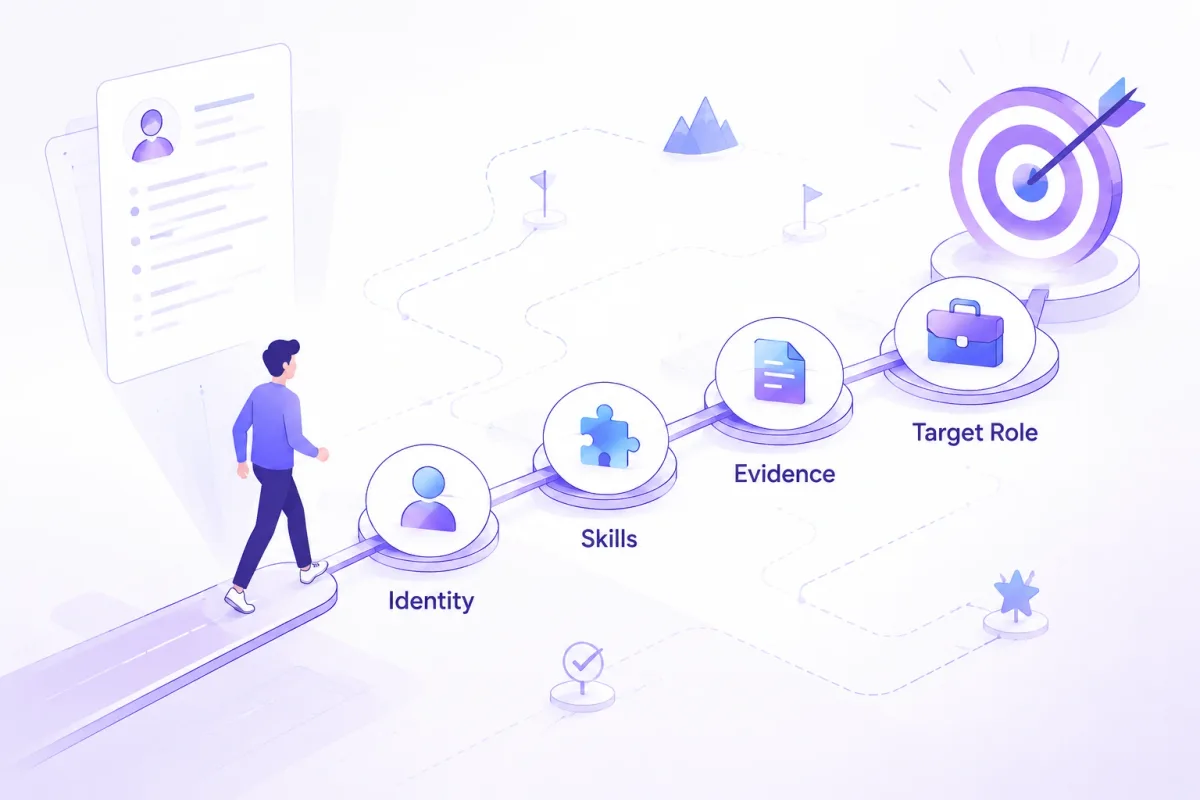
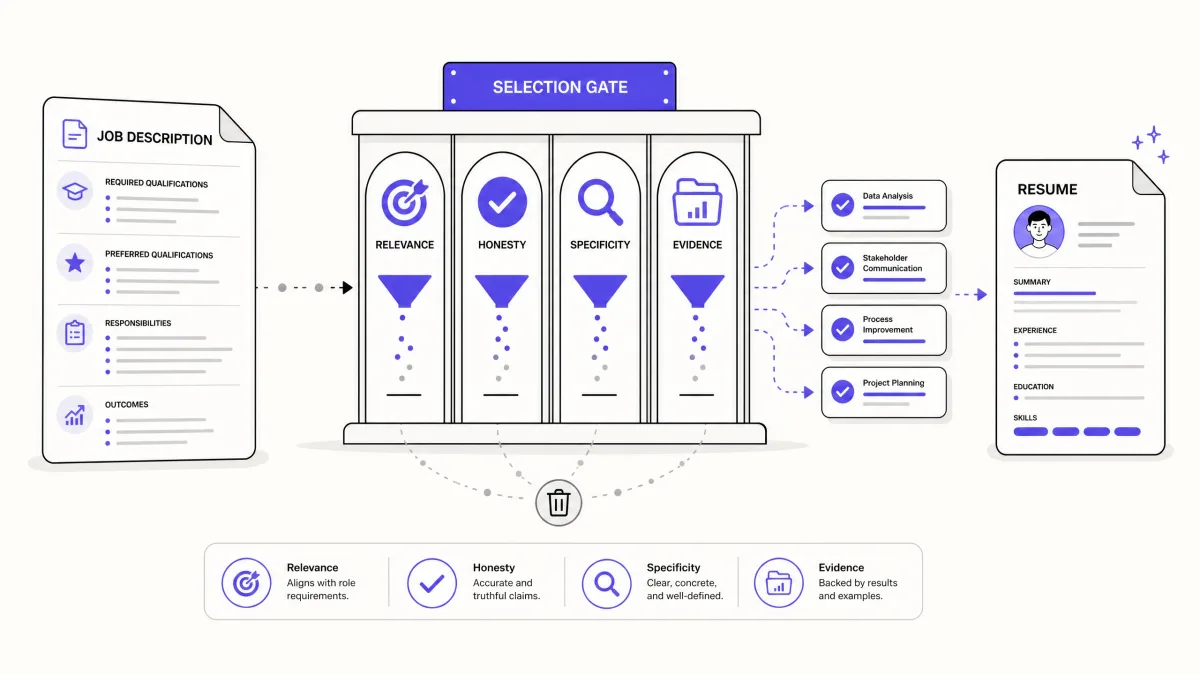
Resume skills are job-relevant abilities, tools, methods, and behaviors that you can back with credible experience, projects, education, credentials, or results. Every claim needs to pass a strict four-part gate. A skill belongs on your resume only when it is:
- Relevant to the target role's core responsibilities.
- Truthful about your current operational ability.
- Specific enough to communicate concrete tools or tasks.
- Supported by evidence you can explain in an interview.
This guide gives you a proof-first decision framework. You'll see 50+ grouped skill examples, extract posting requirements, map evidence to a 5-level ladder, place skills correctly, optimize for ATS screening, and defend every claim in interviews.
What Are the Best Skills to Put on a Resume?
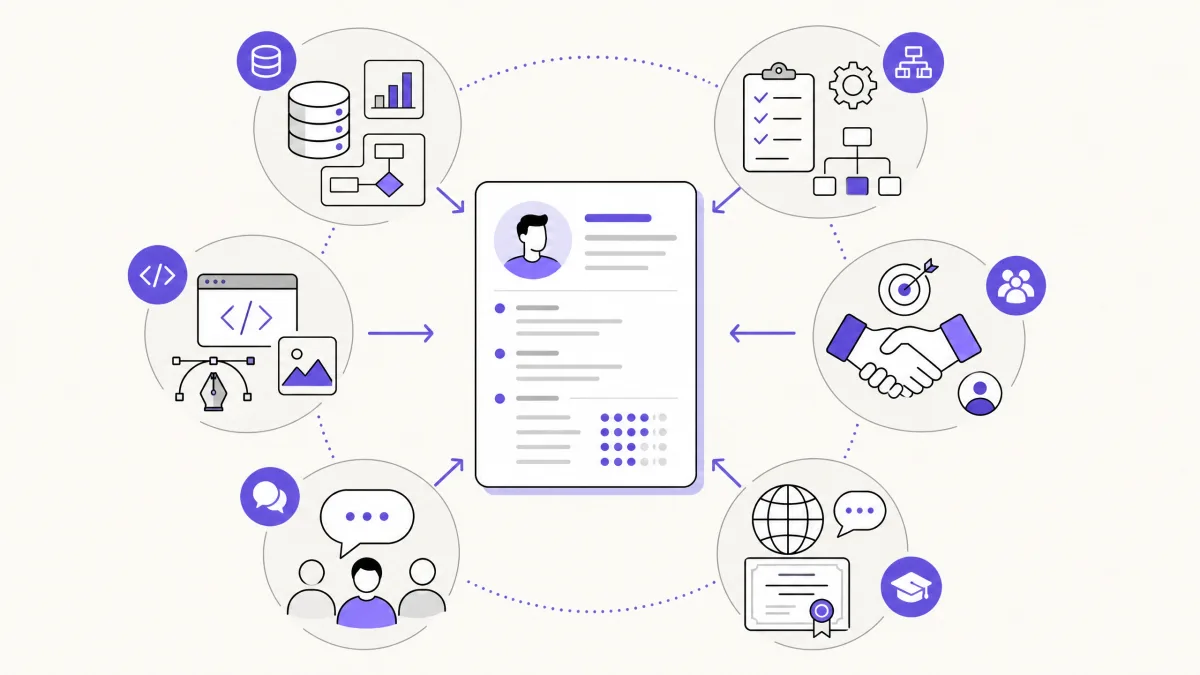
Skills to put on a resume are job-relevant abilities, tools, methods, and behaviors that you can support with credible evidence. The following 50+ examples cover six core domains. Pick only the specific skills your target job description requires that you can back with evidence.
Data and technical skills
Technical and data capabilities show you can analyze, interpret, and leverage information to support business operations.
- Tools & platforms: Microsoft Excel (pivot tables, XLOOKUP, macros), SQL (joins, subqueries), Python (Pandas, NumPy), R (statistical modeling), Tableau, Power BI.
- Analytical methodologies: Data analysis, data visualization, statistical analysis (A/B testing, variance analysis), data cleaning and ETL auditing.
Business and operations skills
Operations skills prove you organize workflows, manage resources, and execute projects efficiently.
- Management & planning: Project management (scoping, milestone tracking), process improvement (workflow mapping, SOPs), budgeting, forecasting, inventory management.
- Analysis & governance: Financial analysis (P&L reviews, ROI modeling), vendor management (SLAs, contractors), risk management, quality assurance, regulatory compliance.
Sales, marketing, and customer skills
Customer-facing skills show you can build relationships, drive revenue, and enhance customer experiences.
- Sales & account management: Customer relationship management (CRM operations in Salesforce or HubSpot), account management, lead generation, pipeline tracking, contract negotiation.
- Marketing & research: Market research (customer segmentation, competitive analysis), search engine optimization (on-page, technical audits), content strategy, email marketing campaigns, A/B testing, social media management.
- Service delivery: Customer service (conflict de-escalation, knowledge base maintenance), customer success (onboarding, renewals, NPS tracking), technical support (troubleshooting, escalation management).
Software, design, and digital skills
Software and digital capabilities prove you build, design, maintain, and secure technology systems.
- Programming & development: JavaScript (React, Node.js), Python (Django, Flask), Java, C#, Ruby on Rails, Git (branching, pull requests), API integration (REST, GraphQL), database management (MySQL, PostgreSQL, MongoDB).
- Cloud & infrastructure: Amazon Web Services (EC2, S3, Lambda), Microsoft Azure, Google Cloud Platform, cloud computing architecture, cybersecurity (firewalls, encryption protocols, vulnerability assessment), DevOps (CI/CD pipelines, Docker, Kubernetes).
- Design & user experience: Figma (prototyping, component libraries), Adobe Creative Suite (Photoshop, Illustrator, InDesign), user experience research (usability testing, personas, journey maps), wireframing, responsive design.
People and communication skills
Behavioral skills show how you collaborate, lead, present, and influence across teams and stakeholders.
- Communication & presentation: Written communication (reports, documentation, memos), verbal communication (client calls, presentations), presentation design (PowerPoint, Google Slides), technical writing, storytelling with data.
- Collaboration & influence: Negotiation (vendor contracts, salary discussions), conflict resolution (mediation, de-escalation), stakeholder management, cross-functional collaboration, meeting facilitation.
- Leadership & development: Team leadership (delegation, performance reviews), coaching (one-on-one feedback, skill development), training (onboarding, workshops, lunch-and-learns), mentoring.
Transferable, language, and credential-based skills
Transferable skills span industries and roles. Languages and credentials validate specialized qualifications.
- Universal capabilities: Problem-solving, critical thinking, time management, organization, adaptability, attention to detail, research, decision-making under ambiguity, prioritization.
- Languages: Bilingual or multilingual proficiency for client communication, translation, or localization work (e.g., Spanish (native), Mandarin (professional working proficiency), French (conversational)).
- Certifications & licenses: Include only current and role-relevant credentials (e.g., PMP, CPA, CFA, Google Analytics Certification, AWS Certified Solutions Architect, Series 7, RN license, Six Sigma Green Belt).
Pro Tip: Name certifications precisely. Write
Google Analytics Individual Qualification (GAIQ)rather thanGoogle certification. Spell out acronyms once, especially for industry-specific credentials recruiters may not recognize immediately.
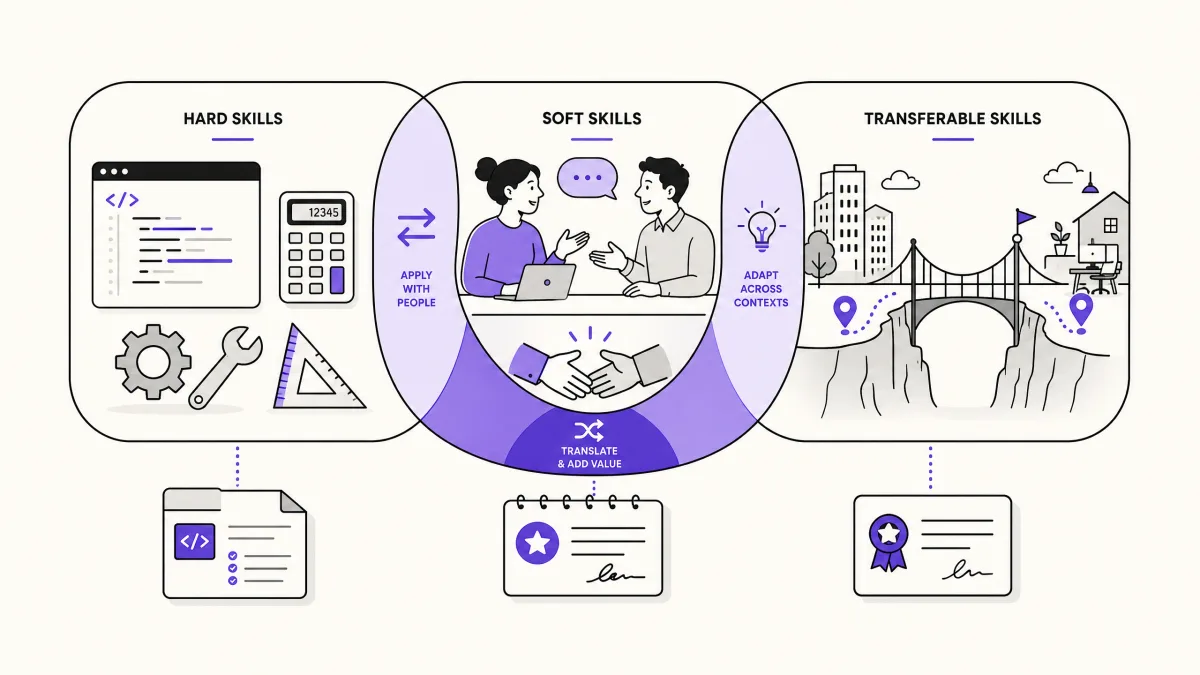
Hard Skills, Soft Skills, and Transferable Skills
Understanding skill categories helps you structure your resume. The NACE career competencies describe technical proficiencies and broad behavioral habits employers value across roles.
| Skill type | Plain-English definition | Examples | Strongest proof | Common mistake |
|---|---|---|---|---|
| Hard skills | Learnable technical tools, processes, and methods required to perform tasks. | SQL, Financial Modeling, Python, SEO | Projects, deliverables, certifications, or metrics. | Listing general categories (e.g., "Software") instead of tools. |
| Soft skills | Behavioral traits and cognitive habits that dictate collaboration. | Stakeholder Management, Conflict Resolution | Accomplishment bullets showing behavioral choices during challenges. | Listing self-awarded adjectives without supporting evidence. |
| Transferable skills | Core capabilities developed in one setting that carry over. | Problem-solving, Time Management, Written Communication | Translating achievements into the language of your target role. | Using former industry jargon that confuses hiring managers. |
Hard skills
Hard skills are technical capabilities you can teach, measure, and test: software, languages, and analytical methods. Specificity matters. Writing "Python, SQL, Tableau" gives hiring managers a clear picture. Writing "Computer Skills" tells them nothing.
Soft skills
Soft skills describe how you perform work, handle stress, and collaborate. Hard skills show what you can build; soft skills show how you function within a team. Because soft skills are subjective, claiming "Communication" carries little weight. Demonstrate them inside experience bullets with real scenarios.
Transferable skills
Transferable skills span industries. For career changers, returnees, or entry-level candidates, they bridge past experience and target roles. Keep your context truthful while using terminology the target field recognizes.
Extract the Right Skills From the Job Description
To maximize relevance, analyze job postings systematically. Rather than skim titles, use this 5-step process to identify the exact tools, methodologies, and behaviors employers value most, helping you build your resume around a target role.
Step 1: Separate requirements, preferences, responsibilities, and outcomes
Break job posting text into four buckets:
- Required qualifications: Non-negotiable gatekeepers (e.g., "5+ years of SQL experience").
- Preferred qualifications: Bonus capabilities that differentiate top applicants (e.g., "Experience with Snowflake preferred").
- Core responsibilities: Daily tasks you'll own (e.g., "Build weekly sales dashboards").
- Expected outcomes: Business goals the role supports (e.g., "Reduce churn by improving onboarding velocity").
Step 2: Mark tools, methods, behaviors, and deliverables
Highlight specific keywords using four codes:
- Tools & platforms: Software, hardware, or systems (Salesforce, AWS, Excel, Figma).
- Methods & processes: Frameworks and operating techniques (Agile/Scrum, Financial Modeling, A/B Testing).
- Behaviors & soft skills: Interpersonal traits (Cross-functional collaboration, Stakeholder management).
- Deliverables & outputs: Tangible work products (Quarterly financial reports, User research briefs).
Step 3: Normalize synonyms and abbreviations
Identify variations in industry terminology. If a posting requests "Customer Relationship Management software," write Customer Relationship Management (CRM). Using both the full term and its abbreviation ensures clarity for human reviewers and automated screening systems.
Step 4: Apply the Skill Selection Gate
Run every potential skill through the four-part gate before adding it:
- Relevance: Does this skill directly support a required task or outcome in the posting?
- Truthfulness: Can I perform this skill independently at the level expected today?
- Specificity: Is the skill written with enough precision to mean something?
- Evidence: Do I have a real project, work bullet, or credential to prove this claim?
Step 5: Classify the decision
Put each extracted skill into one of four action buckets:
| Job-description phrase | Type | Priority | Current evidence | Decision | Resume wording |
|---|---|---|---|---|---|
| "3+ years querying large datasets with SQL" | Hard Skill / Tool | High (Required) | Built multi-table SQL queries in prior analyst role | Match now | SQL (Relational database querying, multi-table joins) |
| "Experience managing complex project timelines" | Transferable | Medium (Responsibility) | Coordinated cross-departmental marketing launches | Transferable with context | Project Coordination (Timeline management, stakeholder tracking) |
| "Familiarity with Tableau dashboards" | Hard Skill / Tool | Low (Preferred) | Completed online tutorial but never used at work | Learn honestly; do not imply mastery | Omit from resume; practice before claiming |
| "Expert-level Python for machine learning" | Hard Skill / Tool | High (Required) | No experience with ML libraries | Do not claim | Do not add; would fail technical interview |
Decision categories:
- Match now: List the skill prominently in your Skills section and reference it in Experience or Projects bullets.
- Transferable with context: Rephrase your past work using target-role terminology while keeping the original truthful setting.
- Learn honestly; don't imply mastery: Either omit entirely or disclose your learning stage truthfully if the posting welcomes growth candidates.
- Don't claim: Remove from consideration. Claiming skills you can't defend creates immediate trust issues during interviews.
Prove Every Important Skill With Evidence
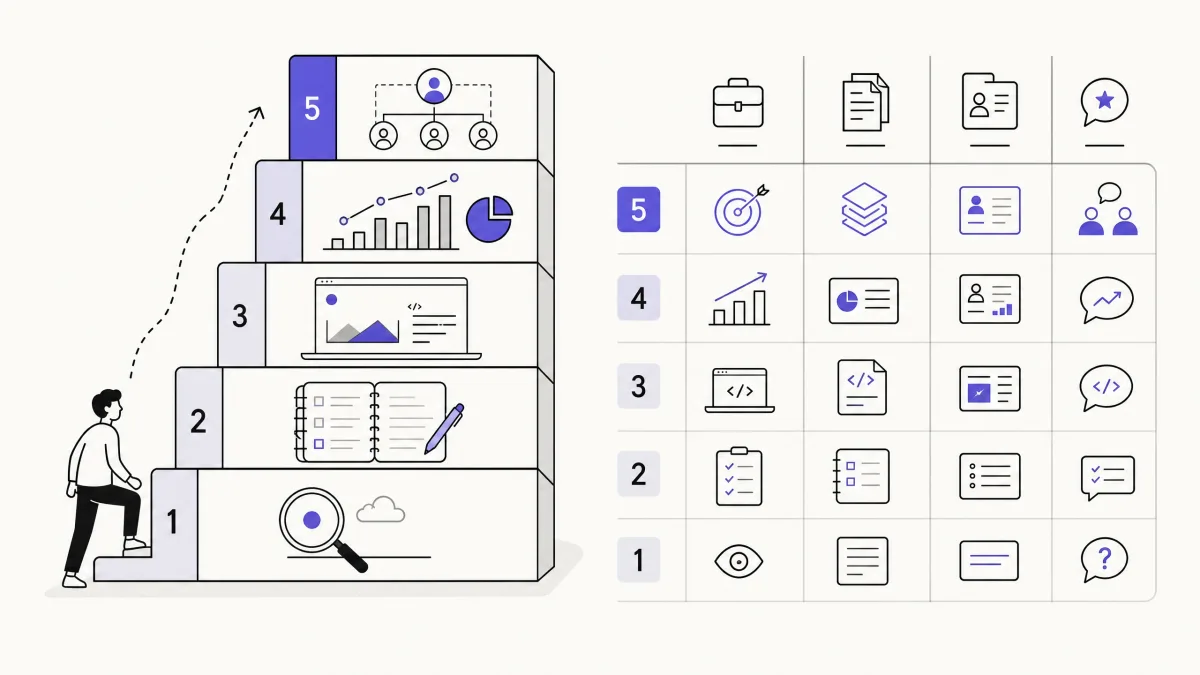
A skill listed on a resume is an unverified claim until backed by evidence. Hiring managers discount standalone skills lists that lack context. Map your skills to a 5-level evidence ladder and build a formal evidence matrix before writing your experience section.
Use an evidence-strength ladder
Gauging evidence strength helps you pick accurate verbs:
- Level 1 (Exposure): You understand the concept or observed others using it, but haven't applied it independently. Action: Keep off primary skills section; place in education or omit.
- Level 2 (Practiced): You used the tool in guided coursework, exercises, or tutorials. Action: Frame as project-based or educational experience.
- Level 3 (Used independently): You applied the skill to complete real work tasks without step-by-step supervision. Action: Valid skill claim for entry to mid-level roles.
- Level 4 (Repeated with results): You used the skill repeatedly to produce verified, measurable business outcomes. Action: High-priority skill to highlight in accomplishment bullets.
- Level 5 (Led, designed, or taught): You architected systems, designed operational workflows, or trained others. Action: Core differentiator for senior roles.
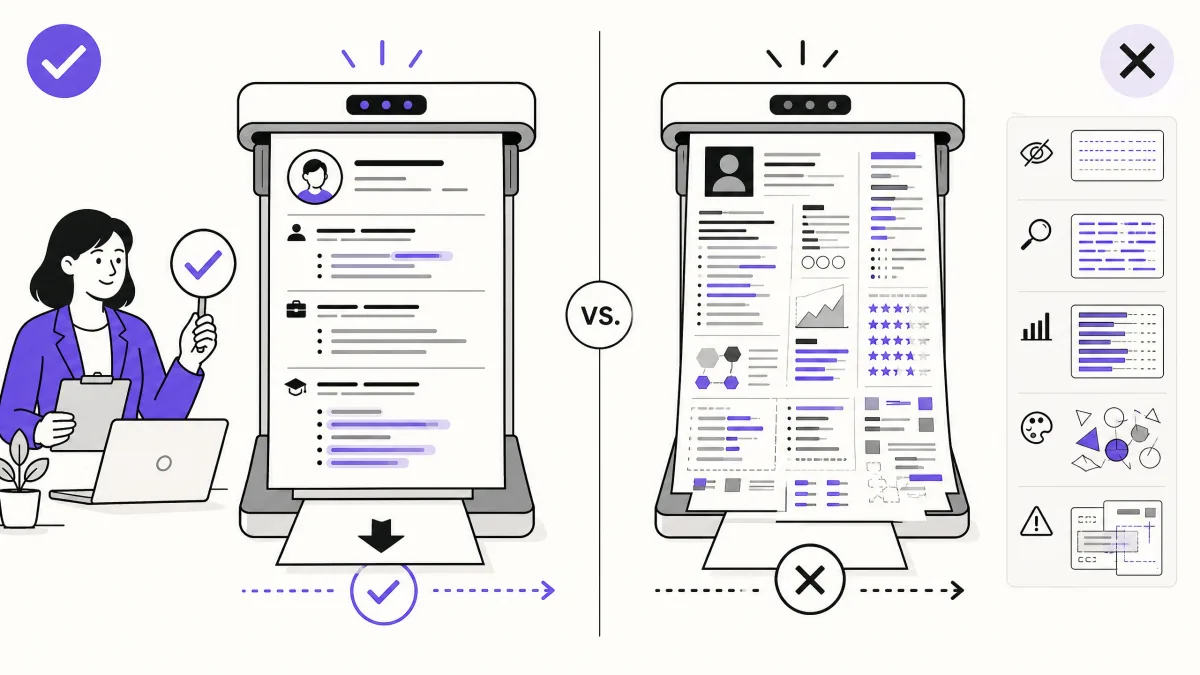
Never use artificial progress bars, self-awarded star ratings, or percentage scores (e.g., "Python: 85%"). These visual gimmicks offer no real information and invite skeptical questioning.
Build the Skill Evidence Matrix
Map your priority skills using this matrix to connect claims directly to evidence and placement strategies:
| Skill | Job-description wording | Evidence source | Evidence strength | Resume placement | Interview proof |
|---|---|---|---|---|---|
| SQL | "Must query sales data to extract pipeline trends" | Prior Business Analyst job at Retail Corp | Level 4 (Repeated with results) | Skills Section + Experience Bullet | Query structure, dataset size, reporting time saved |
| Cross-functional collaboration | "Partner with engineering and sales to launch products" | Lead role on 2025 product redesign team | Level 4 (Repeated with results) | Summary + Experience Bullet | Alignment cadence, conflict resolved during launch |
| Financial modeling | "Build monthly breakeven and revenue forecasts" | Capstone Finance Project in University | Level 2 (Practiced) | Projects Section + Education | Assumptions used, sensitivity analysis completed |
Show three before-and-after examples
Transforming weak labels into evidence-backed claims improves impact. Notice how these examples replace generic claims with clear action, context, and verifiable results:
Technical skill
- Weak claim:
SQL - Evidence-backed template:
Used SQL to query multi-table customer databases, creating automated data models that combined [N] internal sources and reduced monthly reporting prep time by [X%].
Soft skill
- Weak claim:
Communication - Evidence-backed template:
Presented weekly operational risk updates to [N] cross-functional department heads, facilitating alignment that resolved [specific operational bottleneck] prior to product release.
Transferable skill
- Weak claim:
Problem-solving - Evidence-backed template:
Identified the primary driver of [recurring operational error], redesigned the intake validation process, and reduced error rates by [X%] across [N] client accounts.
Note: Bracketed figures like
[N]and[X%]are placeholders. Replace them with your own true, verifiable facts before submitting.
To make a resume stand out with stronger evidence, follow this principle: the Skills section makes the quick claim, the Experience or Projects section proves it with context, and your interview answers defend it with detail.
Where to Put Skills on a Resume
Placing skills strategically ensures recruiters find key qualifications immediately during a scan. Different resume sections serve different communication functions, as outlined in our guide on what a resume should include.
Skills section
The dedicated skills section functions as a rapid visual index of your technical and functional toolkit. Group related items under clear subheadings so recruiters can scan your document in seconds.
- Data & Analytics: SQL (joins, aggregation), Excel (pivot tables, XLOOKUP), Tableau, Power BI
- Operations & Methods: Project Management, Process Mapping, Agile/Scrum, Vendor Management
- Languages: English (Native), Spanish (Full Professional Proficiency)
Experience section
Your professional experience section is the most critical area for proving skill mastery. Weave tools into accomplishment-driven bullet points that explain task context and verified outcomes.
Projects section
For entry-level applicants, career changers, freelancers, or returnees, a dedicated Projects section provides a powerful venue for demonstrating skill application. Describe project scope, tools used, and your personal contribution clearly.
Summary section
Your summary should feature only two or three core skills that define your professional positioning. To frame these top capabilities effectively, read our guide on how to write a resume summary that supports your target role.
Education, coursework, certifications, and licenses
Place skills from education or bootcamps in Education or Projects. Always list professional licenses and certifications with precise titles (e.g., Project Management Professional (PMP)®, License #12345, PMI).
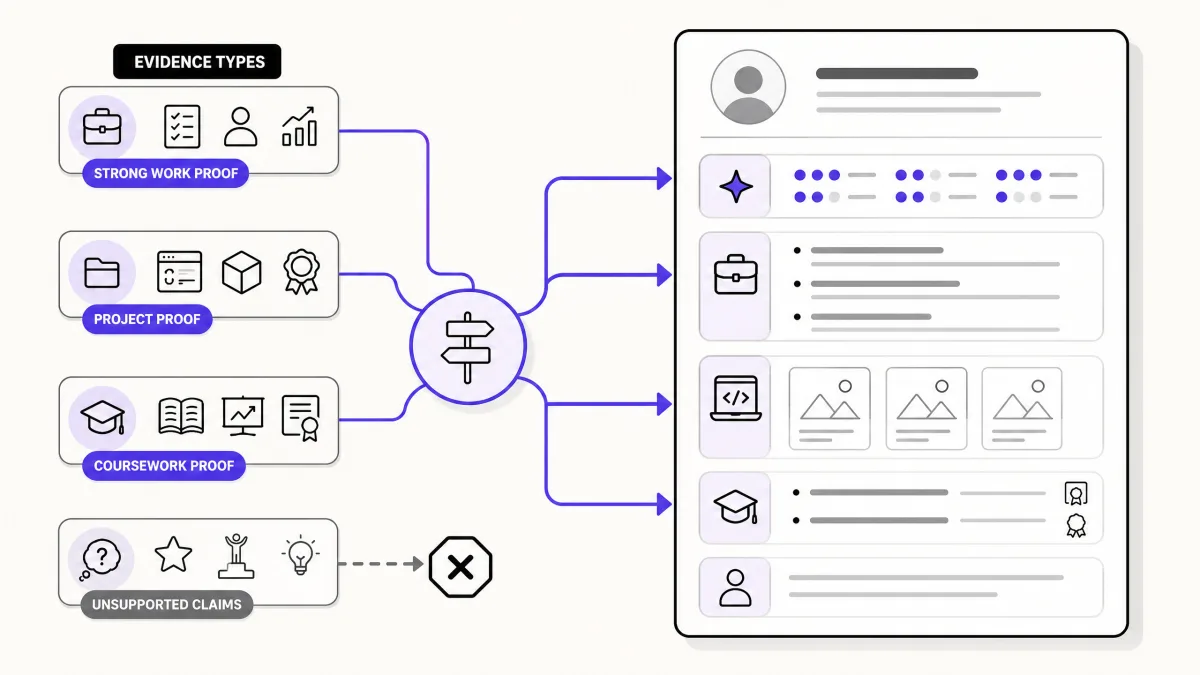
Resume placement decision tree
- Strong work proof: Place in Experience bullets plus a compact Skills index.
- Strong project proof: Place in Projects section plus a categorized Skills list.
- Coursework or practice only: Place in Education or Projects with an honest level statement.
- Unsupported or irrelevant: Omit from resume entirely.
Resume Skills Examples by Career Stage
Your career stage dictates where your skill evidence comes from and how you present it to hiring managers:
| Career stage | Primary evidence source | Recommended skill strategy | Key placement focus | Common trap to avoid |
|---|---|---|---|---|
| Entry-Level Candidate | Academic capstones, internships, student leadership, part-time jobs. | Emphasize practical application, tools used in coursework, and teamwork habits. | Projects Section, Education, and a structured Skills Index. | Overstating academic exposure as senior enterprise mastery. |
| Career Changer | Past professional experience in a different field or industry. | Translate past achievements into the operational language and keywords of the target role. | Summary Section, Transferable Skills, and Target Experience Bullets. | Relying on former industry jargon that confuses hiring managers. |
| Experienced Professional | Years of full-time professional industry achievements. | Focus on leadership, system ownership, scale, complexity, budget oversight, and results. | Executive Summary, Impact Experience Bullets, and Category Skills. | Listing basic, assumed baseline software (e.g., MS Word, Email). |
| Employment Gap Returnee | Freelance projects, consulting, continuing education, volunteering, caregiving. | Highlight proactive skill maintenance, recent certifications, and contract deliverables. | Functional/Hybrid Bullets, Recent Projects, and Certifications. | Trying to hide dates using vague, unanchored skills lists. |
Entry-level candidate
Focus on skills demonstrated through internships, capstone projects, labs, and student leadership. Resume.io's 2026 skills report analyzed 58,433 submitted resumes and 1,533 detected hires and associated technical-skill signals paired with evidence with stronger placement outcomes. That finding is directional, not a guarantee, so be honest about your experience level while showcasing hands-on practice. For additional strategies, explore how to get a job with no experience.
Career changer
Translate past achievements into the terminology of your target industry. For instance, a former teacher transitioning into Corporate Training can translate "Lesson Planning and Classroom Management" into "Instructional Design, Curriculum Development, and Facilitation." Keep the original context truthful while using vocabulary aligned with your target field.
Experienced professional
Omit baseline software that is universally assumed (such as basic email or web browsing) and focus on high-value competencies: system architecture, team leadership, cross-functional strategy, budget control, and scale.
Candidate with an employment gap
Highlight contract work, freelance assignments, volunteer roles, or certifications completed during that period. Present transferable skills clearly without attempting to disguise employment dates. For guidance on addressing gaps transparently, see can you get a job with an employment gap.

Use ATS Keywords Without Keyword Stuffing
An Applicant Tracking System (ATS) is software used by employers to collect, organize, scan, and search applications. While optimizing your resume for ATS screening is important, attempting to trick software with gimmicks backfires when human recruiters review your file.
| What helps | What does not help |
|---|---|
| Standard section headings (e.g., "Skills," "Work Experience"). | Hidden white text or microscopic font keyword stuffing. |
| Clean, single-column formatting without text boxes or tables. | Unnatural, repetitive listing of the same keyword phrase. |
| Natural inclusion of exact phrases from the job description. | Copying the entire job posting text into your resume footer. |
| Both full technical terms and acronyms (e.g., "Search Engine Optimization (SEO)"). | Claiming tools or software you have never used in practice. |
| Priority skills placed inside Experience bullet points. | Treating an ATS scan match as a guarantee of an interview. |
What helps
- Use standard section headings: Stick to conventional titles like "Skills," "Professional Experience," and "Education."
- Use clean formatting: Avoid complex multi-column layouts, embedded graphics, or text boxes that confuse parsing software.
- Include technical variations: Write out both full terms and common acronyms (e.g., Search Engine Optimization (SEO) or Project Management Professional (PMP)).
- Integrate keywords into experience bullets: Place core skills within contextual accomplishment sentences rather than relying solely on a standalone list.
What does not help
- Hidden text gimmicks: Pasting white keywords into margins is easily flagged by modern software and results in rejection.
- Keyword stuffing: Repeating keyword phrases unnaturally hurts readability and alienates human recruiters.
- Unearned claims: Listing tools you cannot explain in an interview creates immediate trust issues during hiring calls.
Applicant tracking systems and employer workflows vary across organizations. Write primarily for the human recruiter and hiring manager who will make the ultimate interview decision.
Skills to Leave Off Your Resume
Removing irrelevant, outdated, or vague claims is just as important as selecting the right skills. Pruning weak entries increases the visual impact of your strongest qualifications. I often find "Microsoft Office" listed alongside specialized technical skills, or vague buzzwords like "Hard worker" that add no differentiation.
Removal checklist
- Irrelevant skills that have no connection to the target role.
- Vague buzzwords that lack concrete operational meaning.
- Obsolete technology platforms no longer used in industry.
- Baseline skills that are universally expected for modern office roles.
- Unverifiable claims you could not explain or defend in an interview.
- Confidential or proprietary information from former employers.
Two replacement examples
Notice how replacing vague claims with specific tools or behaviors immediately strengthens your application:
-
Replace vague baseline software with specific tools:
- Remove:
Computer skills, Web browsing, Microsoft Word - Replace with:
Advanced Excel (XLOOKUP, Pivot Tables), SQL database querying, Tableau dashboard design
- Remove:
-
Replace generic soft skill buzzwords with action-driven behaviors:
- Remove:
Hard worker, Results-driven, Team player, Creative thinker - Replace with:
Cross-functional team leadership, Stakeholder negotiation, Agile sprint facilitation
- Remove:
Turn Resume Skills Into Interview Proof
Every skill listed on your resume represents an implicit promise that you can demonstrate that capability in an interview. The most common failure is claiming skills without a real example to defend them. Hiring managers look for candidates who explain claimed skills with clarity and confidence. To prepare effectively, follow our guide to turn resume skills into interview examples.
Prepare four items for every priority skill
For each core skill highlighted on your resume, prepare a four-part defense story:
- A clear claim: State your proficiency level and operational context clearly.
- One concrete example: Identify the specific project, task, or situation where you applied the skill.
- One verified result: Quantify the outcome or provide a concrete detail that validates your impact.
- A structured interview story: Organize your narrative using the STAR framework (Situation, Task, Action, Result).
Anticipate follow-up questions
Interviewers frequently probe skill claims with targeted follow-up questions to verify real-world experience:
- "Where and when did you first apply this skill in a professional setting?"
- "What specific part of this project did you personally own versus what was handled by teammates?"
- "What was the most challenging technical roadblock you encountered while using this tool, and how did you resolve it?"
- "If you had to execute this process again today, what would you do differently?"
If you cannot answer basic follow-up questions about a skill comfortably and honestly, remove it from your resume or downgrade the claim to reflect your true level of exposure.
Practice with GreatOffer.ai
Transitioning resume claims into verbal responses requires practice. Candidates can use the GreatOffer AI Interview Copilot to prepare for technical and behavioral interviews. By analyzing your resume, experience, and target job posting, the platform helps you structure clear talking points and practice follow-up questions. During live online interviews, Focus Mode does not appear in screen shares, but screen-share invisibility is a display behavior, not permission. Obtain explicit employer, interviewer, and platform permission before using live assistance.
Next Step: You can practice turning those examples into interview answers using tailored AI interview practice sessions before your next hiring call.
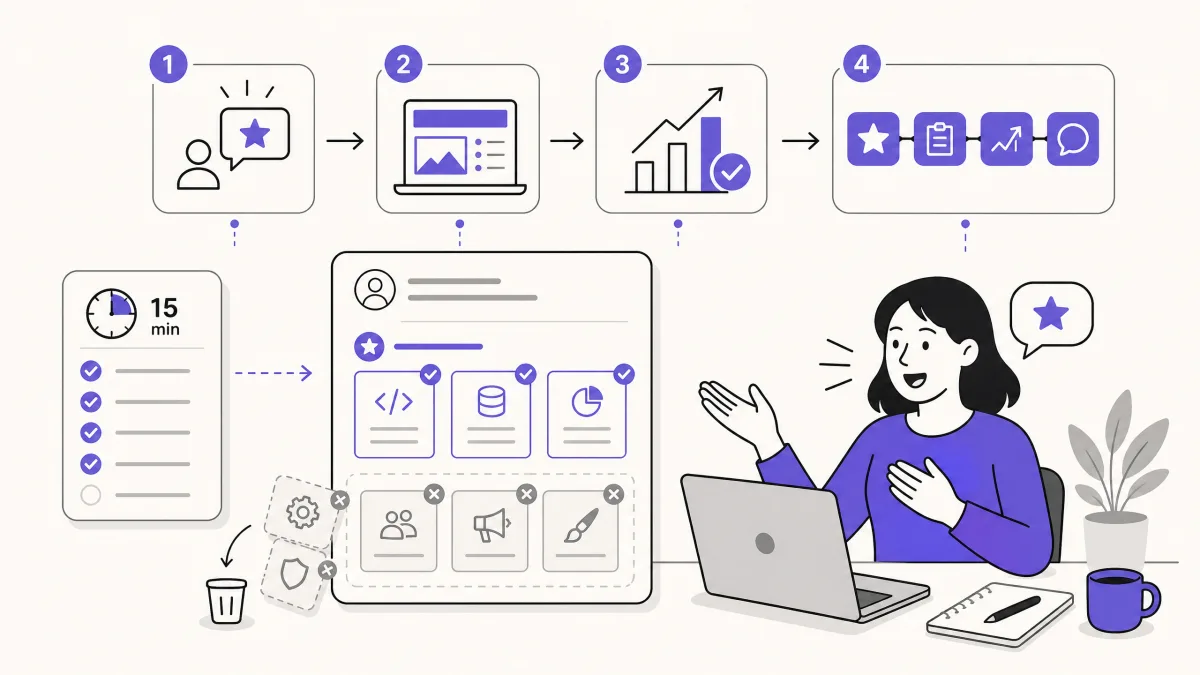
Run a 15-Minute Resume Skills Audit
Before submitting your job application, run your draft through this quick 8-step audit to catch errors, remove weak claims, and verify evidence alignment:
- Align with target job description: Confirm that every skill listed directly addresses a requirement or responsibility in the job posting.
- Prune filler and buzzwords: Delete generic claims like "Hard worker" or "Motivated" that provide no concrete proof.
- Specify tools and methods: Ensure software tools, programming languages, and industry frameworks are named precisely.
- Verify experience evidence: Confirm that your top five priority skills are demonstrated within your experience or projects bullet points.
- Check spelling and terminology: Verify that technical terms, software names, and professional certification acronyms are spelled correctly.
- Remove visual rating bars: Delete arbitrary skill percentage bars or star graphics.
- Ensure LinkedIn consistency: Verify that skills, dates, and job titles on your resume match your public LinkedIn profile without contradictions. For detailed guidance on LinkedIn optimization, see how to find a job on LinkedIn.
- Test your verbal defense: Speak your top skill stories aloud once to ensure you can explain them clearly without hesitation.
Submit your application only after your skills section and experience bullets tell the same coherent, verifiable story.
Conclusion
Building a powerful resume skills section is not about collecting industry buzzwords. Superior applications succeed by making fewer, highly relevant, truthful claims supported by concrete evidence and aligned with the target job description.
Apply the four-part selection gate, structure evidence across a 5-level ladder, place skills strategically across your resume, and prepare to defend every claim during interviews. This transforms your application from a simple list of buzzwords into a compelling professional portfolio. Run the 15-minute audit on your current draft today, select your target job description, and ensure that every skill claim on your document earns its place.