

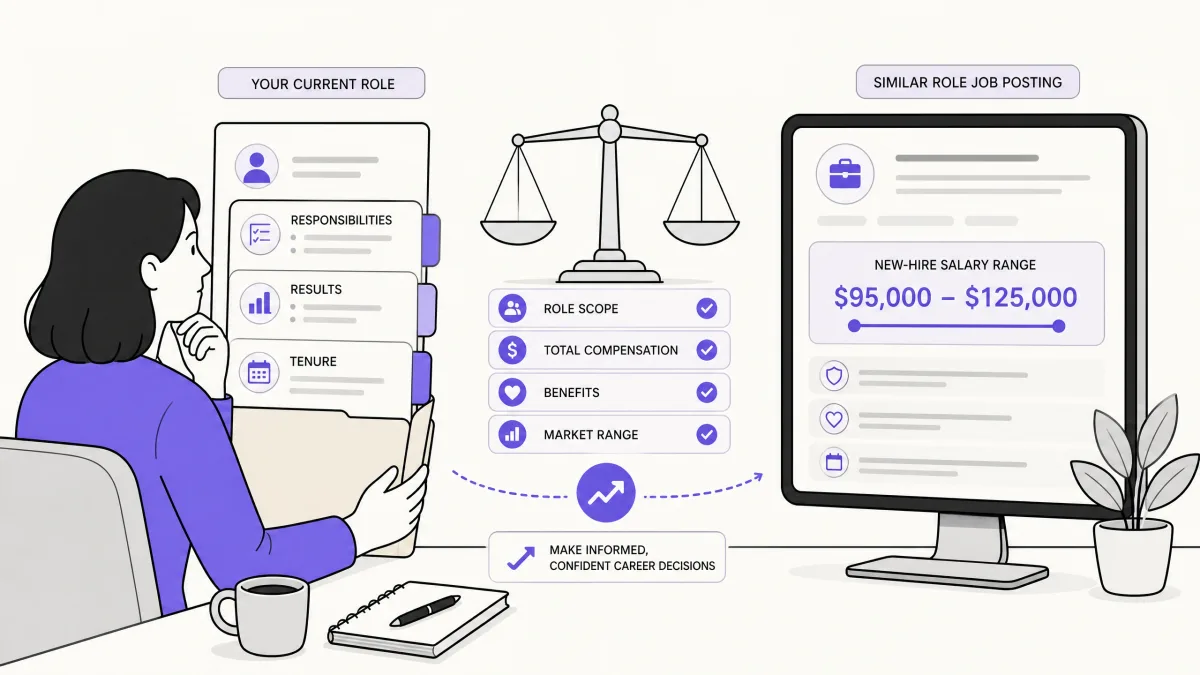
If you are thinking, "a new hire makes more than me" for what looks like the same job, the first instinct is to feel cheated. The useful response is to act like a negotiator. Save the full posting, compare it with your role, build a one-page evidence packet, then ask for a specific salary correction with a named decision-maker, written response date, and effective date.
One boundary first: an advertised range is not proof of an accepted salary or identical roles. It is evidence that your employer budgeted that range for an opening, which is enough to start a careful conversation.
Do these five things before you say anything.
- Save the full job posting: URL, date, location, duties, qualifications, and compensation language.
- Compare the opening with your current role before calling it the same job.
- Build a one-page evidence packet from your scope and results, not from another employee's records.
- Ask for a specific base-salary correction, the decision-maker, a written response date, and an effective date.
- Decide in advance which written outcomes justify staying.
A concrete example helps. An anonymous Reddit poster reported earning about $27,000 while their employer advertised a similar opening at $38,000 to $50,000. The $11,000 figure is the gap between that reported salary and the advertised floor, not a confirmed new-hire salary. Use the story as context, not proof that pay compression is widespread. Your employer's posting and your own role are the facts that matter to your case.
Is This Pay Compression or a Legitimate Job Difference?
Pay compression occurs when the pay difference between newer or less-tenured employees and experienced employees becomes unusually small or reverses, often because external hiring rates move faster than internal salary adjustments. Compensation platforms such as Lattice describe wage compression as newly hired, less-experienced employees earning close to what current staff earn, sometimes crossing into wage inversion where the newcomer earns more. Keep that definition practical, not legal: compression describes a pattern in pay, not wrongdoing.
Before you assume you are compressed, separate three situations:
- Base-pay compression: comparable base salaries are too close or inverted. This is the pattern that usually sparks the conversation.
- A total-compensation difference: base pay looks different, but commission, bonus, equity, shift pay, or benefits change the real comparison. A $10,000 base gap can shrink or vanish once variable pay is included.
- A legitimate role difference: level, scope, credentials, location, schedule, or decision authority materially differs. A titled difference is not automatically a pay problem.
The table below tells you what to compare and what will stay unknown until the employer answers.
| Pattern | What to Compare | What Remains Unknown |
|---|---|---|
| Base-pay compression | Base salary, internal level, location, schedule | Why each person was placed where they were |
| Total-compensation difference | Commission, bonus, equity, differentials, benefits on top of base | Actual amounts another employee earned |
| Legitimate role difference | Level, duties, authority, credentials, location, hours | Whether the employer applies the bands consistently |
Do not assume every new-hire premium is unfair or unlawful. The point of this first step is to figure out which of the three patterns you are actually in. That decision determines everything that follows, including whether you should ask at all.

What a New Job Posting Proves: And What It Does Not
The public posting is useful, clean evidence because you can save it without exposing anyone's private compensation record. But treat it precisely. Here is what a job posting salary range proves and what it does not.
| The posting can prove | The posting does not prove |
|---|---|
| The employer publicly assigned a salary range to that opening at that time | A person was hired, or what that person accepted |
| The public title, location, schedule, qualifications, and described duties | The opening sits at the same internal level or scope as your role |
| A current hiring signal worth asking the company to explain | Every number in the range is base salary |
| You automatically qualify for the floor, midpoint, or ceiling | |
| The range applies to every location, schedule, or candidate profile |
Save the full page, not just the salary. That means the URL, capture date, location, job ID, duties, qualifications, and the compensation language in full. A cropped screenshot of a number is weak evidence; a full, dated record survives scrutiny. Keep it somewhere you can retrieve later, such as a personal file, an email to yourself, or a saved PDF.
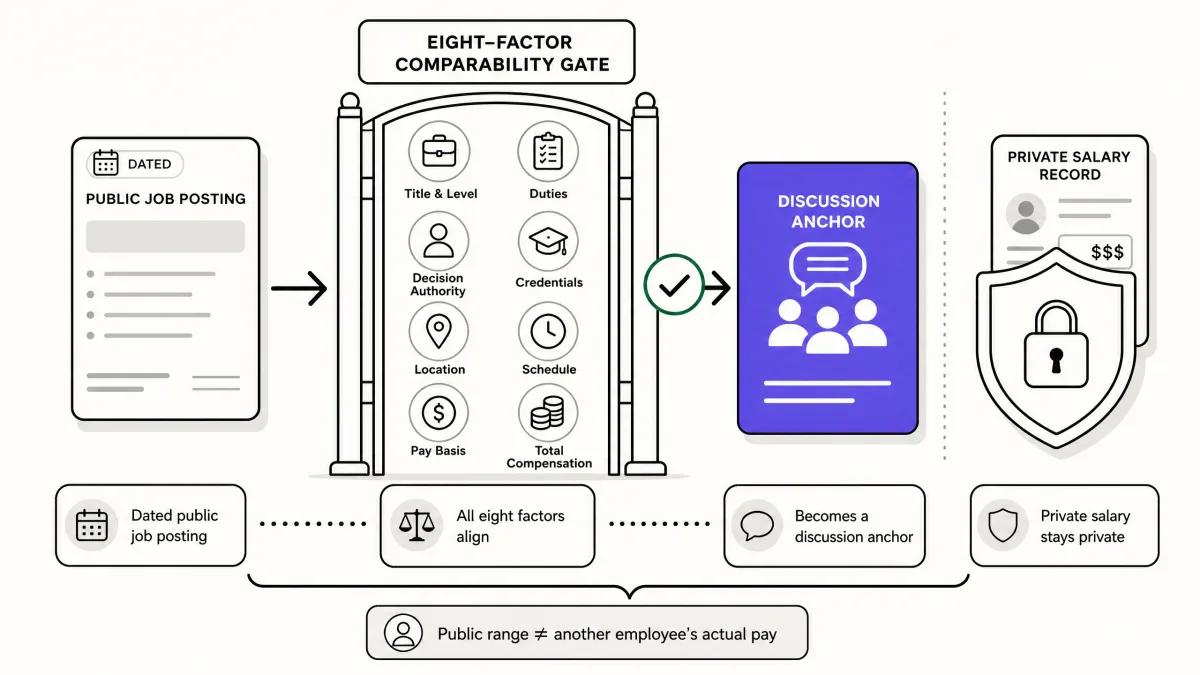
How to use it correctly: the advertised salary range is a defensible discussion anchor only after you have a strong comparability match. Before that match, the range tells you what the employer has budgeted for an opening and little else. Once your roles genuinely overlap, the floor of that range becomes a reasonable, conservative starting point to ask the company to explain and to correct.
Run the Comparability Gate Before You Negotiate
Do not walk into the conversation claiming "same job, different pay." Compare the work actually performed, and compare it on paper. Use the eight-factor gate below and fill it in for your own situation.
| Factor | Current Role | Posted Role | Match, Partial Match, or Unknown |
|---|---|---|---|
| 1. Title and internal level | |||
| 2. Core duties and approximate share of time | |||
| 3. Decision authority, account ownership, and business risk | |||
| 4. Required experience, credentials, and specialized knowledge | |||
| 5. Location and labor market | |||
| 6. Schedule, shift, travel, and on-call expectations | |||
| 7. Hourly or salaried basis, pay period, and classification | |||
| 8. Base salary, bonus, commission, equity, shift pay, and benefits |
Reading the results:
- Mostly Match. You have a credible internal pay equity and market-correction case. Move to the evidence packet.
- Several Partial Matches. Isolate which differences justify which part of the range. Do not ask for the top because you match on one factor.
- Multiple Unknowns. Your next action is role-level clarification, not an accusation. Ask what level, location, or schedule the posting targets.
A title match does not prove a scope match, and a title difference does not prove the work differs. Compare duties, authority, and decision risk, not just names. Job content is what matters here, and getting this right protects you from asking for something you cannot defend.
Do not turn this into a legal equal-pay conclusion. This section is about building an internal and market argument, not finding discrimination. If a legal question becomes relevant, review the applicable law or get individual advice instead of guessing from the pay gap.
Build a Same-Job Evidence Packet
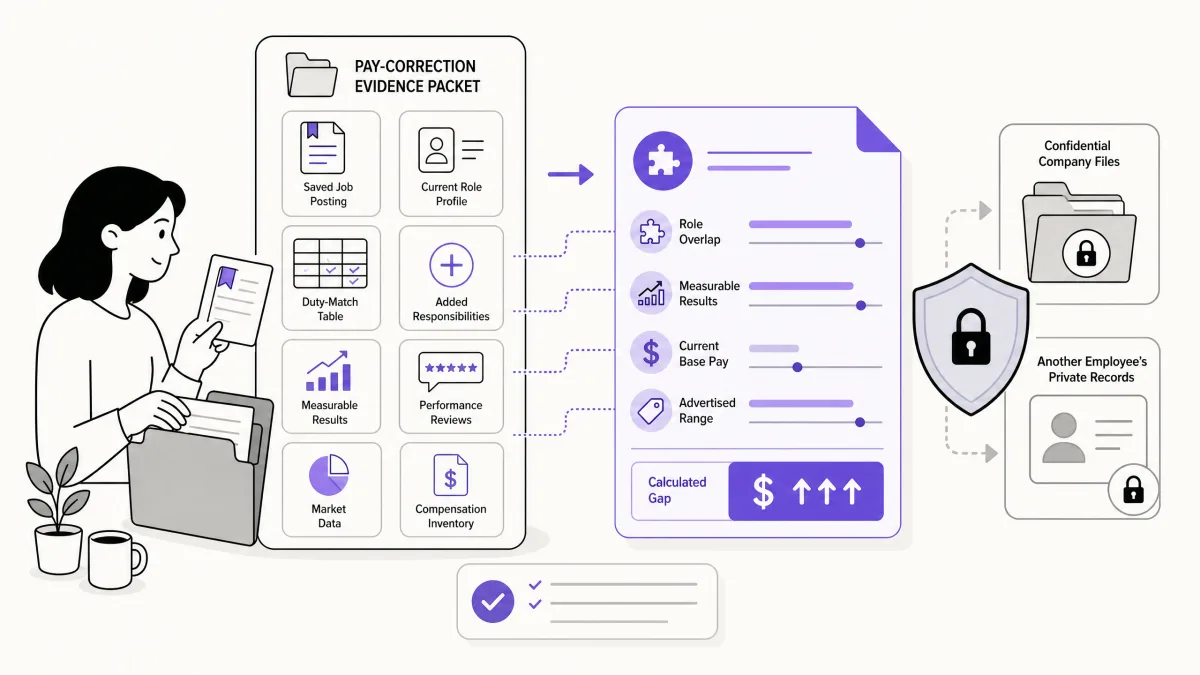
Once the gate suggests a real overlap, assemble the evidence that a fair reviewer would want to see. Rank it in this order, from strongest to weakest:
| Evidence | What It Supports | Limitation |
|---|---|---|
| Saved public job posting (date, URL, job ID, full compensation language) | The employer budgeted a range for that opening | Does not prove any person's actual pay |
| Current offer letter, job description, latest role profile | Your official scope and level | May understate what you actually do now |
| Duty-match table (your work vs. posted duties) | The comparability argument | Your framing, so stay factual |
| Added responsibilities since hire (on-call, account ownership, training, specialized work) | Why you justify the higher band now, not at hire | Requires documented support |
| Measurable outcomes tied to revenue, cost, time, service, risk, quality, or retention | Your contribution and results | Pull from your own performance records |
| Formal performance reviews, documented praise, credentials, skill growth | Track record the employer already logged | Only as current as the reviews |
| Written statements about a raise, commission plan, revenue share, or relevel | Prior agreements or intentions | A verbal promise is weaker than paper |
| External wage sources matched by occupation, location, level, and date | Market position beyond the posting | Match the criteria or it skews the ask. The U.S. Bureau of Labor Statistics wage-data overview is a starting directory, not a quote for your exact value |
| Current compensation inventory (base, bonus, commission, equity, differentials, benefits) | The exact starting number for the calculation | Keep base separate from variable pay |
Compress the packet onto one page: current and posted title/level, match score, added responsibilities, three strongest results, current base, advertised range, and dollar/percentage gap. Keep the backup ready if the manager asks. A clean one-pager signals a business case, not an emotional complaint.
Privacy and confidentiality guardrails. Copy only what you are properly able to use. Do not copy customer data, trade secrets, restricted internal reports, or another employee's private record. Do not download files you are not authorized to retain. Lean on public postings, personal performance records, and documents you legitimately have. A strong case never depends on leaking someone else's information, and breaking a confidentiality rule can destroy the credibility of an otherwise fair request.
Research the Market Without Cherry-Picking
The posting is an internal hiring signal. It is not a complete market study. Add one or two external reference points so you can separate an employer-specific correction from a broad claim that your occupation pays more everywhere.
Start with the Bureau of Labor Statistics wage-data overview and identify the closest occupation and area available for your work. Then check whether the source describes hourly pay, annual pay, a percentile, or a different compensation measure. Do not compare a national occupation estimate with a local posting and call the difference proof of underpayment.
Use this filter for every market source:
- Occupation. Does the source describe the work you actually perform, rather than a title that merely sounds similar?
- Location. Does it cover your labor market or clearly explain the geography behind the estimate?
- Level and scope. Does it distinguish entry, experienced, supervisory, technical, or specialized work when those differences matter?
- Reference date and pay basis. Is the data current enough for the conversation, and are you comparing base pay with base pay?
Keep a source note in your packet: source name, URL, access date, occupation, location, measure, and limitation. This prevents cherry-picking a high number that does not match your geography or scope.
The best market evidence is the number you can explain without stretching the source. If the posting, your scope, and matched references point in the same direction, your request sounds grounded. If they conflict, ask what explains the difference before choosing an anchor.
Market data supports the conversation; it does not set your employer's pay policy. Your manager may still weigh budget, internal bands, performance, and hiring needs. Make the gap legible and ask for a defined decision.
Calculate the Gap and Choose a Defensible Ask
Before you compute anything, align what you are comparing:
- Annual base to annual base.
- Hourly rate to hourly rate, with your schedule assumptions stated.
- Bonus to bonus and commission to commission.
- Same location, level, and schedule where you can.
Then run the math transparently:
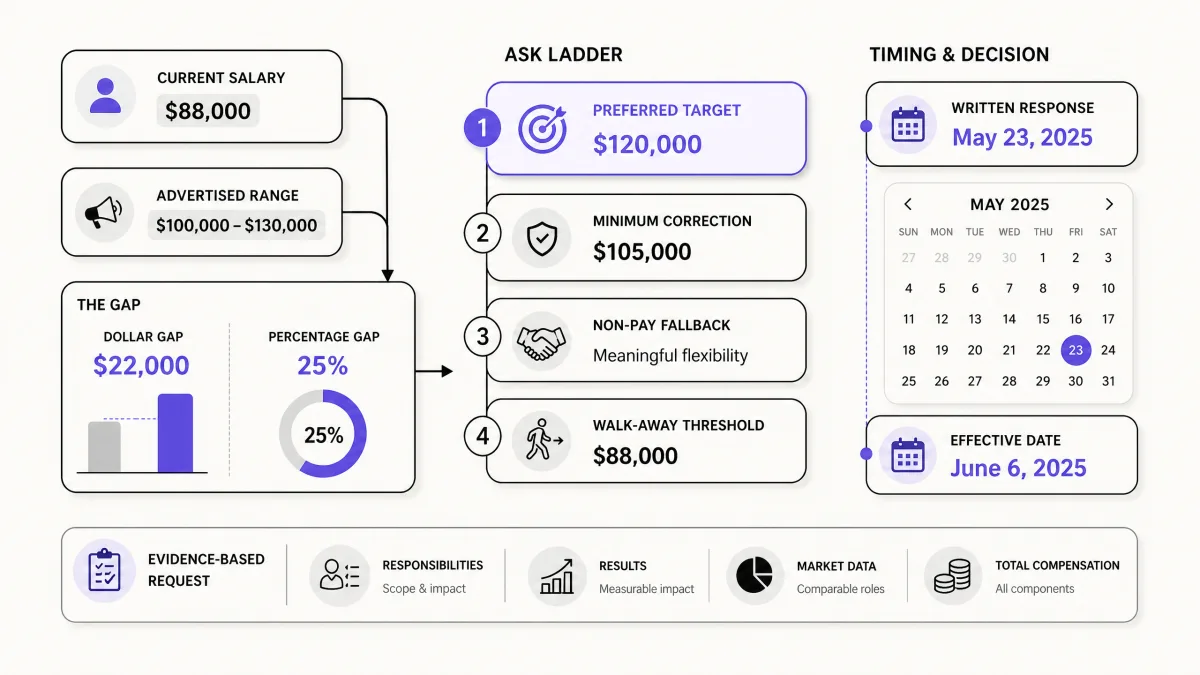
Dollar gap = comparable advertised salary minus current comparable salary
Gap percentage = dollar gap / current comparable salary
These formulas describe the gap in your evidence. They do not prove legal entitlement or establish your exact market value. They show the distance between your current base and the advertised range for a comparable opening. Say that framing out loud when you use the numbers.
Then build your Ask Ladder so you know exactly where you stand before the meeting:
- Preferred target. The salary supported by level, scope, results, internal range, and external market evidence. This is what you ask for first.
- Minimum acceptable correction. The lowest defined outcome that materially fixes the gap. If you fall below this, the offer does not solve the problem.
- Non-pay fallback. A relevel, a written phase-in, commission terms, a schedule change, or an internal transfer, but only if it has real value to you rather than serving as a hollow yes.
- Walk-away threshold. The response or delay that triggers an external search. Decide it now, while you are clear-headed.
If the roles are highly comparable, the advertised floor is a conservative starting anchor. A request above the floor requires evidence of stronger level, tenure, responsibilities, results, or market position. Without that evidence, you sound entitled rather than prepared.
Two rules keep the ask defensible. Never say the new employee does not deserve the pay; that turns a compensation question into an attack on a specific person. And never ask for the top of a broad range without explaining exactly why you belong there on level, scope, and results.
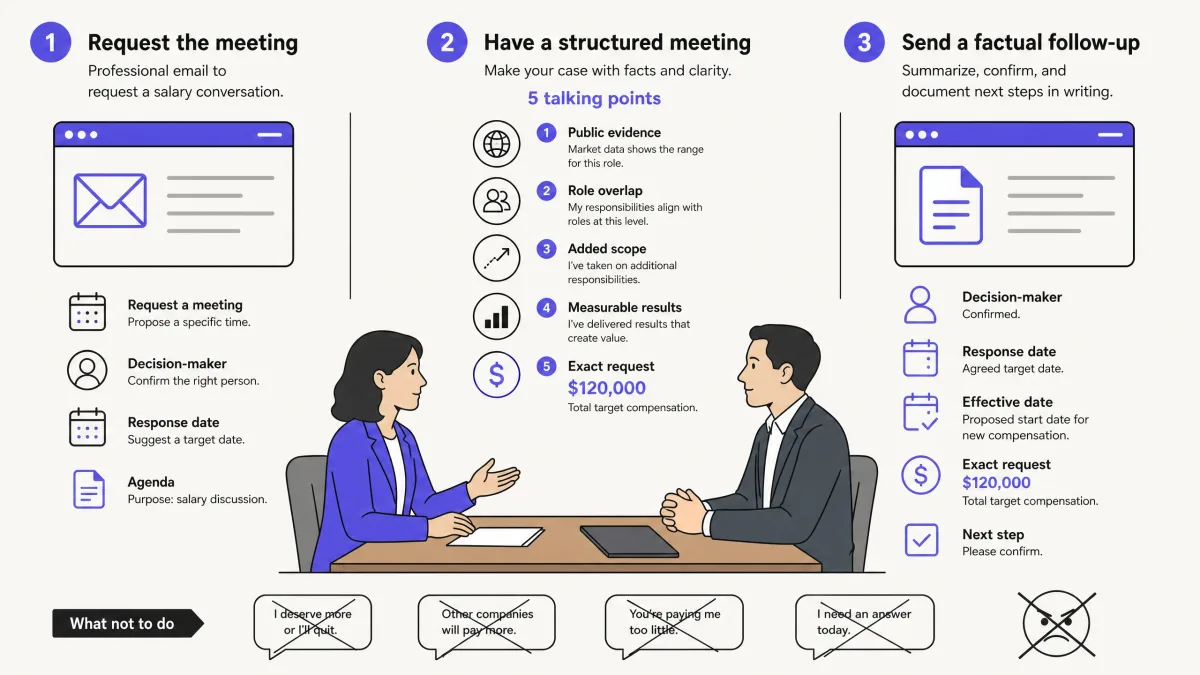
Ask for a Pay Correction, Not a Favor
You are requesting a documented market and internal-equity adjustment to your base salary. Here are three copy-ready assets.
1. Meeting Request Email
Subject: Scheduling time to discuss a base-salary adjustment
Hi [Manager],
I would like to schedule time to discuss a market and internal-equity adjustment to my base salary. I reviewed the company's current posting for [role], compared its responsibilities and requirements with my current scope, and prepared a concise summary of the overlap, my added responsibilities, and results.
Could we set aside 20 minutes this week? I can send the one-page summary ahead of time if that is useful.
Thank you, [Your name]
Keep the full argument out of the scheduling email. Its job is to secure the meeting and signal preparation.
2. Meeting Opening Script
Use this sequence:
- State the public evidence. "I noticed the current posting for [role] lists a range of [X] to [Y], and I want to understand how my current level and pay compare."
- Explain the role match and important differences. "After reviewing the duties and requirements, my scope overlaps on [factors]. It differs on [differences], which I want to be fair about."
- Summarize added scope and measurable results. "Since my level was set, I have taken on [responsibilities] and delivered [results]."
- State the exact base-salary request or narrow target range. "Given the overlap and my results, I am requesting a base adjustment to [amount or narrow range]."
- Ask who decides, when you get a written response, and when a change would take effect. "Who owns the decision, when can I expect a written response, and if approved, what effective date would apply?"
The last question turns a friendly chat into a real decision.
3. Follow-Up Email (Sent After the Meeting)
The recap should record:
- the requested salary;
- the evidence discussed;
- the person responsible for the decision;
- the promised response date;
- any proposed effective date or next step.
Subject: Recap: base-salary discussion, [date]
Hi [Manager],
Thanks for the time today. To capture our conversation: I requested a base-salary adjustment to [amount], based on [evidence discussed]. You indicated [decision-maker] would review it, with a response expected by [date]. We agreed to follow up on [effective date / next step].
Please let me know if I captured anything incorrectly.
Thank you, [Your name]
Avoid: "It is unfair that the new person makes more," "Pay me or I quit," "I know what everyone earns," or any threat to publish private information. They weaken your case.
Decode the Manager's Response
You will likely hear one of these replies. Each has a precise follow-up and an acceptable written next step. The goal is not to argue about whether the manager is being honest. It is to surface the missing decision, owner, amount, or date.
| Manager Response | Precise Follow-Up | Acceptable Written Next Step |
|---|---|---|
| 1. "The roles are different." | Ask for the internal level and the specific duties, authority, location, or qualifications that place the opening in a different band. | The level difference and the band for both roles, in writing. |
| 2. "The range is for external hires." | Ask how the company reviews internal equity and where your current role sits in its salary band. | Your current band placement and the internal-equity review process. |
| 3. "There is no budget." | Ask who can approve an exception, what can be adjusted now, when the next budget decision occurs, and what amount would take effect then. | The exception path and the amount tied to the next decision date. |
| 4. "Wait until review season." | Ask for the review date, target amount, decision criteria, decision owner, and effective date in writing. | A dated plan with amount, criteria, owner, and effective date. |
| 5. "Commission or revenue share will make it up." | Ask for the formula, eligible revenue, trigger, owner, payment date, examples, and what happens if the plan changes. | The exact commission terms, not a hand-wave. |
| 6. "The range is broad, and nobody starts at the top." | Agree the ceiling is not automatic, then ask what places someone at the floor, midpoint, or upper band, and where you are currently placed. | Your placement in the band and the criteria for moving up it. |
| 7. "We cannot discuss another employee's pay." | State that your request is based on the public posting, your current scope, and your own compensation, not anyone else's record. | Confirmation that the request was understood on those terms. |
| 8. "We value you, but I cannot promise anything." | Ask what the manager can submit, who makes the decision, and what written update will arrive by a specific date. | A named submitter, decision owner, and dated update. |
Every follow-up pushes toward a concrete decision, owner, amount, or date. A detailed "no" is more useful than a warm "we value you" with nothing attached.
Put Every Promise Through the Six-Part Promise Test
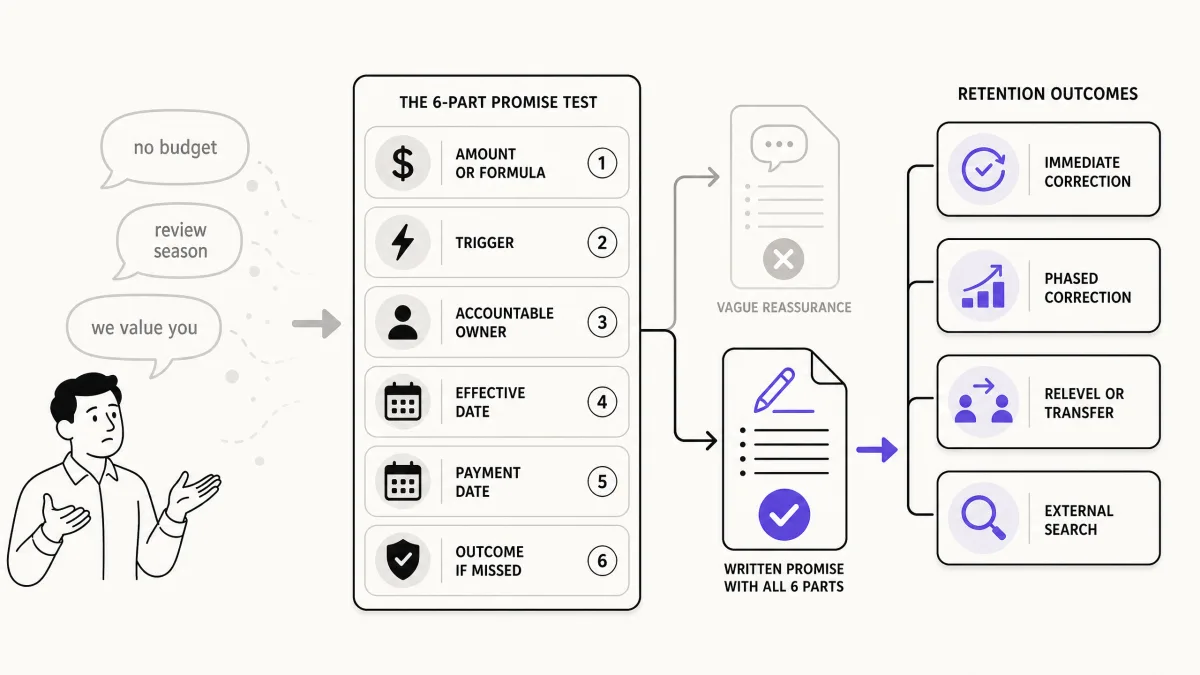
Warm intentions are not pay outcomes. Test every future raise, commission, bonus, or revenue-share promise against these six parts:
- Amount or formula. What, exactly, will change, and how is it calculated?
- Trigger or measurable condition. What must happen for it to take effect?
- Accountable owner. Who is responsible for making it happen?
- Effective date. When does it actually start?
- Payment date. When does money land in your account?
- Outcome if missed. What happens if the milestone slips or the business changes?
Some promises simply fail the test:
- Fails: "We will revisit this next cycle." No amount, trigger, date, or owner.
- Fails: "Commission should make up the difference." No formula, trigger, or payment mechanics.
- Stronger: A written amount or formula, a named approver, a dated decision, an effective date, and stated payment mechanics.
A written phased correction can be a legitimate outcome. The problem is a vague intention dressed up as a commitment.
Send this short follow-up after any verbal promise:
To make sure I understand the proposal, please confirm the amount or formula, approval owner, decision date, effective date, and first payment date.
If they can put those six answers on paper, you have something to rely on. If they cannot, you have learned what you need to know about the promise.
Choose Among Four Retention Outcomes
The internal conversation should end in one of four written outcomes. Anything that does not fit one of these is not a resolution yet.
| Outcome | Minimum Written Proof | Walk-Away Signal |
|---|---|---|
| Immediate correction | New salary, effective date, first-paycheck date, title/level if changed, next review | Approval that never appears on the next pay statement |
| Written phased correction | Specific salary steps, dates, approval, and payment timing | A plan with no amount or no date |
| Relevel or internal transfer | Title, level, duties, salary, reporting line, effective date | A title change with no pay change; no date |
| External search and exit | A genuine, vetted external offer you are willing to accept | Repeated delay, refusal to explain the range, vague promises, below your minimum |
Immediate Correction
Use this when the employer confirms the comparison and issues a material base adjustment. Verify the new salary, effective date, first-paycheck date, title or level if changed, and the next review window. Confirm the approval in writing so there is no ambiguity when payroll updates.
Written Phased Correction
Use this when the company cannot close the gap at once but does give you specific salary steps, dates, approval, and payment timing. This is workable only when the plan has real numbers and real dates. Do not accept a plan with no amount and no date, because that is not a plan at all.
Relevel or Internal Transfer
Use this when your current role is misleveled, or another internal role formally recognizes your scope. Verify the title, level, duties, salary, reporting line, and effective date in writing. Remember that a title alone is not a pay correction. A new title that leaves your base unchanged still leaves the gap in place.
External Search and Exit
Use this when the company keeps delaying, refuses to explain the public range, replaces one vague promise with another, or offers less than your minimum acceptable outcome. Start searching while employed when that is practical. Do not bluff an external offer, and do not resign before you understand the next-step financial and benefits consequences of leaving.
The two questions meet here: Is the gap supported by comparable work, and is this still a place worth staying if the company will not correct it? The written outcome gives you the answer.
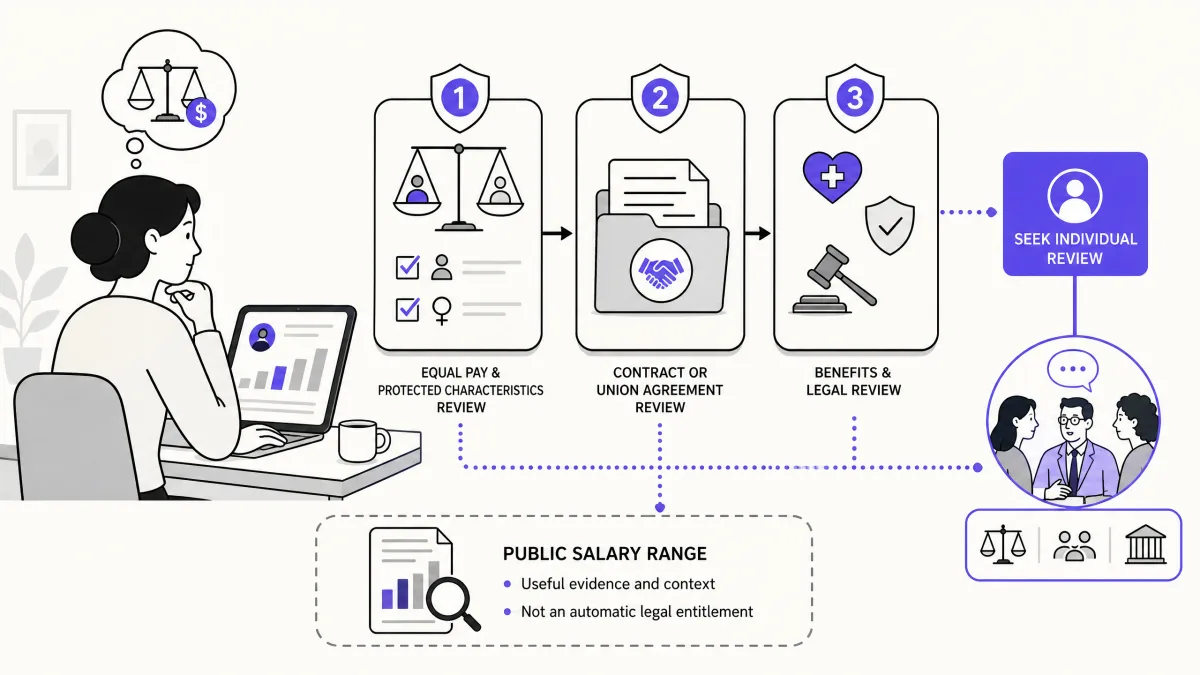
When a Pay Gap May Raise a Legal or Rights Question
Pay compression by itself is not proof that an employer broke the law. If the gap is market-driven and applied without discrimination, it can be entirely lawful even when it feels unfair.
The U.S. Equal Employment Opportunity Commission describes the Equal Pay Act as covering sex-based pay differences for substantially equal work in the same establishment. Under that framework, job content, not your title, determines whether the work is substantially equal. Differences can be lawful when they rest on seniority, merit, production, or a factor other than sex. Other federal anti-discrimination laws extend protections across additional protected characteristics.
| Ordinary Compression Question | Seek Individual Review When |
|---|---|
| Market-driven gap, no protected characteristic involved | The pattern tracks sex or another protected characteristic |
| Differences traceable to seniority, merit, or production | You reported retaliation after a discrimination complaint or other protected activity |
| A routine negotiation about a raise | A contract, collective bargaining agreement, public-sector rule, or another protected right may control |
| The employer's explanation conflicts with documented facts |
If one of the right-hand situations applies, that is a reason to get individual review from an employment attorney or, where relevant, your union or public-sector representative. Do not rely on a blog post for that decision. And for emphasis: a public salary range does not, by itself, create a legal entitlement.
This is general U.S. career information, not legal or contract advice.
Start a Job Search Without Turning the Interview Into a Complaint
The external market is a practical test of your options. You do not have to wait for the internal conversation to fail before preparing. Protecting your position is prudence.
Before you go far, get the mechanics right:
- Update your resume with current scope and results.
- Search while maintaining current performance.
- Protect confidential information.
- Use a genuine external offer only when you are willing to accept it.
- Avoid telling interviewers about a coworker's private compensation.
When an interviewer asks why you are leaving, keep it clean and use this structure: What changed -> What I am seeking -> Why this role. It keeps you positive and forward-looking without eroding trust.
A 20- to 30-second example:
My role expanded significantly, but the compensation and level remained out of alignment with the scope. I raised the issue internally and did not receive a defined correction, so I am looking for a role where the responsibilities, level, and compensation are clear from the start.
Do not call your former employer cheap, dishonest, toxic, or illegal, and do not turn the answer into a salary negotiation. Use the desired-salary guide, leaving explanation, and job-search tips to prepare. Some candidates use an AI interview coach such as GreatOffer.ai to organize answers under pressure. That is preparation support only; the interviewer sets the rules. When an offer arrives, review it carefully with how to accept a job offer. If you leave, follow a professional resignation checklist.

One-Page Pay-Compression Worksheet
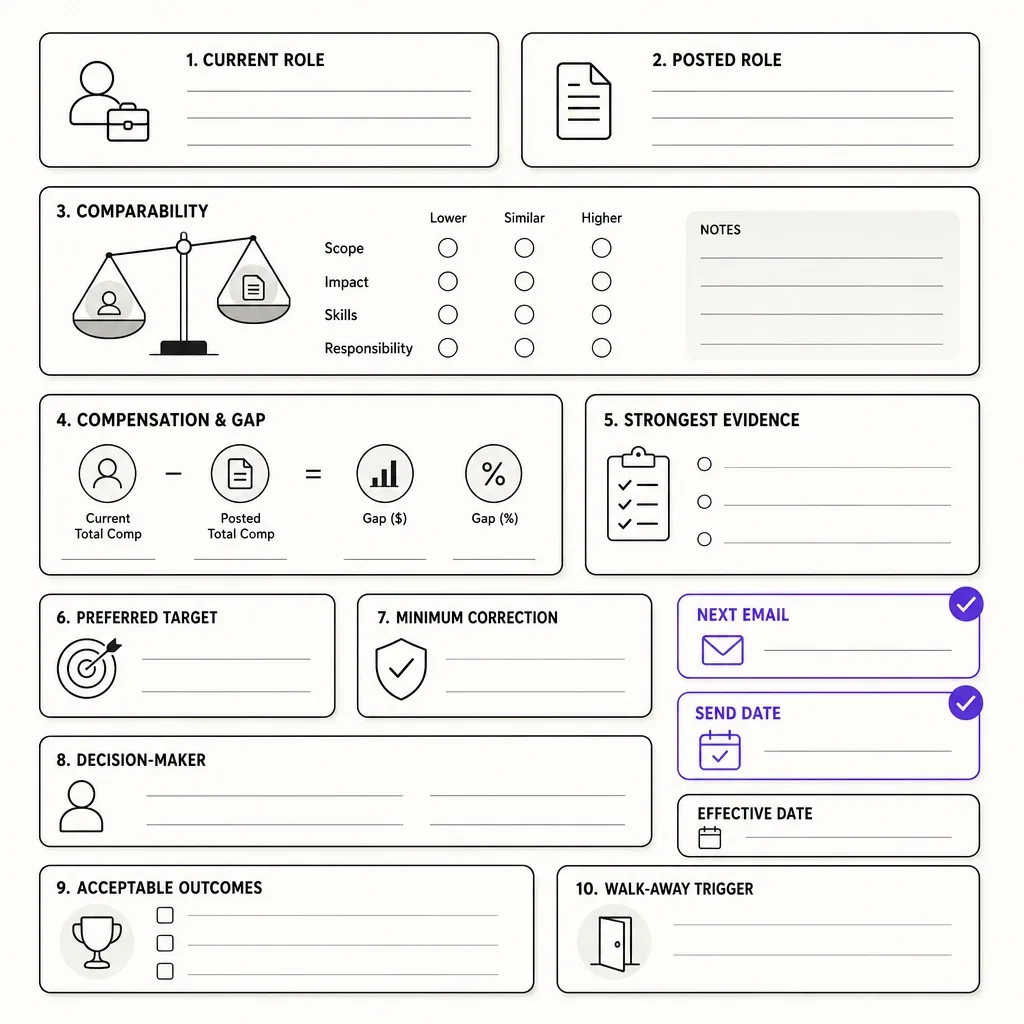
Copy this onto a single page before you schedule the meeting.
- Current title and internal level: ____________________
- Posted title and level: ____________________
- Comparability: Match ____ Partial Match ____ Unknown ____
- Current base salary: ____________________ Total-compensation components: ____________________
- Advertised base / compensation language: ____________________
- Dollar gap: ____________________ Gap percentage: ____________________
- Three strongest evidence items: 1) ____________________ 2) ____________________ 3) ____________________
- Preferred target: ____________________ Minimum acceptable correction: ____________________
- Decision-maker: ____________________
- Written response date: ____________________
- Effective date: ____________________
- Acceptable outcomes: ____________________
- Walk-away trigger: ____________________
- Next email and send date: ____________________
You now have a comparability check, an evidence packet, a specific ask, a deadline, and a short list of acceptable outcomes. The only step left is to send the first email.